





Suicide is a leading cause of death among young adults in the UK, 1 and the fourth leading cause of death among those aged 15–29 years worldwide. 2 In England and Wales, 1108 deaths by suicide were recorded among those in higher education between 2016 and 2023, with approximately 160 deaths per year. 3 Although age-adjusted rates among students remain lower than the general UK population, 3 there was an increase in student suicide rates from 2009 to 2017, Reference Gunnell, Caul, Appleby, John and Hawton4 with rates stabilising from 2018. 5 However, these figures do not include suicide attempts, which may affect a greater proportion of the student population. Reference Zhao, Xin, Bai, Zhang, Liu and Xu6
Meta-analytic review indicates approximately 27% lifetime prevalence of suicidal ideation in university students, with 14% reporting ideation within the past year and 3% reporting a lifetime suicide attempt, Reference Crispim, dos Santos, Frazão, Frazão, de Albuquerque and Perrelli7 whereas cross-national data from the World Mental Health initiative indicate 32.7% lifetime ideation and 4.3% lifetime attempts among first-year students, with approximately three-quarters experiencing onset before 16 years of age. Reference Mortier, Auerbach, Alonso, Bantjes, Benjet and Cuijpers8 Experiences of prior mental health conditions, stress, minoritised sexual orientation, male gender, adverse childhood experiences and financial anxiety are associated with increased risk. Reference Kabir, Syed, Vinnakota, Okello, Isigi and Abdul Kareem9,Reference Akram, Ypsilanti, Gardani, Irvine, Allen and Akram10 Moreover, factors such as alcohol use and lack of social support are associated with suicide attempts, Reference Zhao, Xin, Bai, Zhang, Liu and Xu6 both of which are prevalent among UK university students. Reference Akram, Drabble, Irvine, Allen, Akram and Stevenson11
The integrated motivational–volitional model of suicidal behaviour describes domains for suicide risk: diathesis (e.g. personal, biological, early risk factors), motivation (e.g. experiences of coping, belonging, rumination, social support) and a volitional phase (e.g. active planning, impulsivity, means). Reference O’Connor and Kirtley12 Some diathesis and psychosocial factors can be measured through self-report. Reference Goodday, Rivera, Foran, King, Milanovic and Keown-Stoneman13 In addition to personal risk factors, young people entering university are also exposed to new stressors, including financial pressures and academic workload, Reference Duffy, Keown-Stoneman, Goodday, Horrocks, Lowe and King14 but more research is needed to identify factors associated with suicidal ideation and behaviour in large, representative UK samples.
Current evidence draws largely from cross-sectional analyses, with limited studies examining the trajectory of suicide risk. Mental health symptoms typically decline over the academic year, Reference Duffy, Keown-Stoneman, Goodday, Horrocks, Lowe and King14 yet little is known about factors associated with new-onset ideation, attempts in students with no prior symptoms or recovery and persistence among those with existing risk. Understanding both support needs and factors associated with change may inform targeted prevention and intervention. Additionally, although suicidal ideation is considered an important precursor to attempts, Reference Franklin, Ribeiro, Fox, Bentley, Kleiman and Huang16 research examining the relationship between suicidal ideation and suicide attempts in university populations has been limited. Reference Zhao, Xin, Bai, Zhang, Liu and Xu6,Reference Macalli, Navarro, Orri, Tournier, Thiébaut and Côté17,Reference Klonsky, Dixon-Luinenburg and May18
Aims
The study’s aims were to examine suicidal ideation and attempts among university students in the UK over an academic year, specifically to (a) identify demographic and psychosocial factors associated with lifetime suicide risk, (b) examine factors associated with no presentation and new onset of suicide risk and (c) evaluate the relationship between suicidal ideation and attempts.
Method
Study design
Participants were students who took part in the Nurture-U longitudinal survey, described in the study protocol. Reference Marshall, Duffy, Chamberlain, Dooley, Dorey and Forty19 The survey was adapted from the U-Flourish survey, Reference Goodday, Rivera, Foran, King, Milanovic and Keown-Stoneman13 and administered at five UK universities (Cardiff, Exeter, Newcastle, Oxford, Southampton) in autumn and spring terms 2021–2024, with data collection in 2021 limited to the University of Oxford. The survey included measures of mental health and well-being, psychosocial outcomes and lifestyle factors. All participants completed surveys in the same academic year (for students who completed the surveys in more than 1 year, only data from the first year were analysed). Ethics approval was obtained from each university (Cardiff: Wales Research Ethics Committee, IRAS reference 155838, REC reference 16/WA/0323; Exeter: FHLS Psychology Research Ethics Committee, 519175; Newcastle: Faculty of Medical Sciences Research Ethics Committee, 24735/2022; Oxford Medical Sciences Interdivisional Research Ethics Committee, Ref. R60998; Southampton: Faculty of Medicine Ethics Board, ERGO 73178). Reference Marshall, Duffy, Chamberlain, Dooley, Dorey and Forty19
Measures
Demographics and personal history
Participants self-reported demographic information, prior mental health diagnoses and treatment, family mental health history, and experiences of childhood adversity.
Psychosocial and mental health measures
Participants completed psychosocial and mental health questionnaires for depressive symptoms (Patient Health Questionnaire-9 (PHQ-9)), Reference Kroenke, Spitzer and Williams20 anxiety symptoms (Generalised Anxiety Disorder-7 (GAD-7)), Reference Spitzer, Kroenke, Williams and Löwe21 well-being (Short Warwick–Edinburgh Mental Wellbeing Scale (SWEMWBS-7)), Reference Stewart-Brown, Tennant, Tennant, Platt, Parkinson and Weich22 alcohol use (Alcohol Use Disorders Identification Test for Consumption), Reference Bush, Kivlahan, McDonell, Fihn and Bradley23 rumination (Ruminative Responses Scale – Brooding subscale), 24 resilience (Brief Resilience Scale), Reference Smith, Dalen, Wiggins, Tooley, Christopher and Bernard25 emotion regulation (Difficulties in Emotion Regulation Scale), Reference Gratz and Roemer26 self-compassion (Self-Compassion Scale – Short Form), 27 sleep quality (Sleep Condition Indicator-8) Reference Espie, Kyle, Hames, Gardani, Fleming and Cape28 and loneliness (adapted UCLA Loneliness Scale-8). Reference Roberts, Lewinsohn and Seeley29
Suicidal ideation and suicide attempts
Suicidal ideation and attempts were assessed with items from the Columbia Suicide Severity Rating Scale. Reference Posner, Brown, Stanley, Brent, Yershova and Oquendo30 At baseline, participants were asked, ‘In your past, have you had thoughts about ending your life?’ and ‘In your past, have you ever made any suicide attempts?’. At follow-up, participants were asked the same questions with respect to the current academic year.
Additional variables
University site and academic year were included as potential confounding variables.
Statistical analysis
Statistical analyses were conducted in R version 4.5.2 (R Foundation for Statistical Computing, Vienna, Austria; https://www.R-project.org/) using RStudio version 2025.09.2 (Build 418; Posit Software, PBC, Boston, Massachusetts, USA; https://posit.co/download/rstudio-desktop/) on Windows 11 version 25H2 (Microsoft Corporation, Redmond, Washington, USA; https://www.microsoft.com/windows/windows-11). Logistic regression models were fitted to evaluate changes in risk trajectories. Missing data were handled with multiple imputation by chained equations with 20 imputations. Reference Buuren and Groothuis-Oudshoorn31 For outcomes at baseline and follow-up, inverse probability weights were computed with Firth-penalised logistic regression to account for separation owing to missingness, Reference Heinze, Ploner, Jiricka and Steiner32 followed by exclusion of missing outcomes while maximising coverage for covariates, Reference Sullivan, Salter, Ryan and Lee33 with results pooled using Rubin’s rules.
As sample size was determined by recruitment to the Nurture-U survey,
Reference Marshall, Duffy, Chamberlain, Dooley, Dorey and Forty19
an a priori power calculation was not performed. Secondary analyses examining suicidal ideation and attempts included Bayesian probability calculations alongside inferential analysis to mitigate small sample sizes (n = 43–52). Two conditional probabilities were estimated: the probability of an attempt at follow-up given prior ideation and an attempt at follow-up given a past attempt,
 $P\left(A|B\right)={P\left(B|A\right)P\left(A\right) \over P\left(B\right)}$
. Case–control models for these subanalyses were matched on propensity scores,
Reference Li, Raghunathan and Rubin34
including demographic characteristics and baseline mental health outcomes (GAD-7, PHQ-9, SWEMWBS-7). The threshold α < 0.05 was used for statistical significance.
Results
Participants
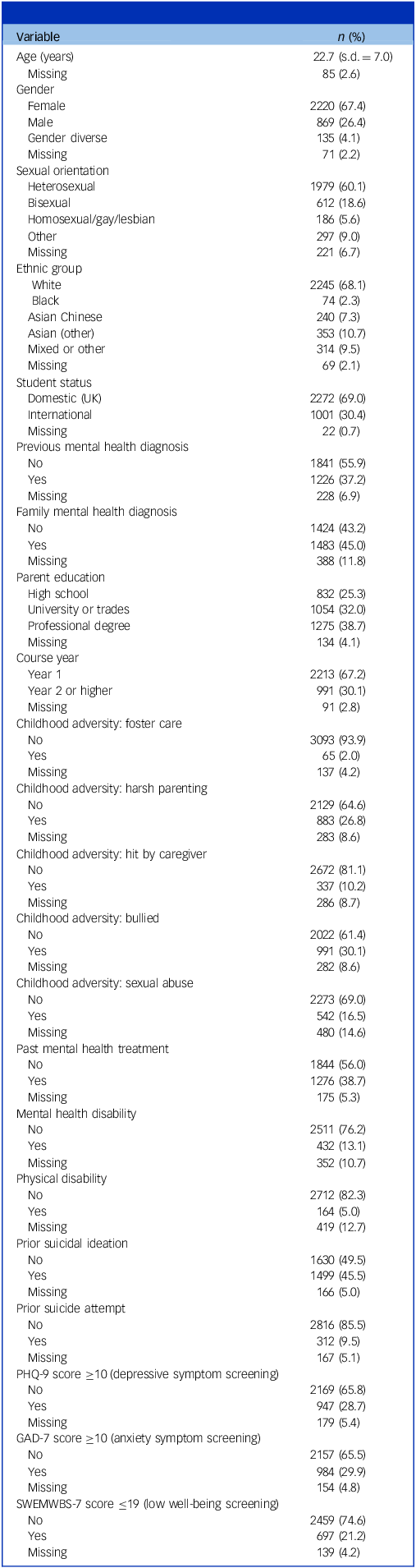
Participant demographics are presented in Table 1. Before analysis, participants with more than 50% missing data (n = 108) were removed; among the retained sample, missingness was low, with 2574 participants (78.1%) missing 0–10% of data. The final sample comprised 3295 students completing surveys in the same academic year. Participants were majority UK domestic/home students (69.0%), female (67.4%), White (68.1%) and heterosexual (60.1%), with a mean age of 22.7 years (s.d. = 7.0; median 20 years, with approximately 50% of students aged 21 years or younger). Most reported no physical (82.3%) or mental health disabilities (76.2%). The most common level of parental educational attainment was professional degree (38.7%). Approximately 45.5% reported lifetime suicidal ideation and 9.5% reported a past suicide attempt, whereas approximately 30% met clinical thresholds for baseline depression or anxiety symptoms (scores ≥10).
Participant demographic characteristics (N = 3295)

Table 1 Long description
The table presents participant demographics and characteristics for a sample of 3295 students. It includes 21 rows and 2 columns. The columns are labeled ‘Variable’ and ‘n (%)’. The table lists various demographic variables and their corresponding counts and percentages. Row 1: Age (years), Missing, 85 (2.6%). Row 2: Gender, Female, 2220 (67.4%). Row 3: Gender, Male, 869 (26.4%). Row 4: Gender, Gender diverse, 135 (4.1%). Row 5: Gender, Missing, 71 (2.2%). Row 6: Sexual orientation, Heterosexual, 1979 (60.1%). Row 7: Sexual orientation, Bisexual, 612 (18.6%). Row 8: Sexual orientation, Homosexual/gay/lesbian, 186 (5.6%). Row 9: Sexual orientation, Other, 297 (9.0%). Row 10: Sexual orientation, Missing, 221 (6.7%). Row 11: Ethnic group, White, 2245 (68.1%). Row 12: Ethnic group, Black, 74 (2.2%). Row 13: Ethnic group, Asian/Chinese, 353 (10.7%). Row 14: Ethnic group, Asian (other), 314 (9.5%). Row 15: Ethnic group, Mixed or other, 69 (2.1%). Row 16: Ethnic group, Missing, 200 (6.1%). Row 17: Student status, Domestic (UK), 2272 (69.0%). Row 18: Student status, International, 1001 (30.4%). Row 19: Student status, Missing, 22 (0.7%). Row 20: Previous mental health diagnosis, No, 1841 (55.9%). Row 21: Previous mental health diagnosis, Yes, 1226 (37.2%). Row 22: Previous mental health diagnosis, Missing, 228 (6.9%).
PHQ-9, Patient Health Questionnaire-9; AUDIT-C, Alcohol Use Disorders Identification Test for Consumption; SWEMWBS-7, Short Warwick–Edinburgh Mental Wellbeing Scale; GAD-7, Generalised Anxiety Disorder-7; BRS, Brief Resilience Scale.
Lifetime suicidal ideation at baseline
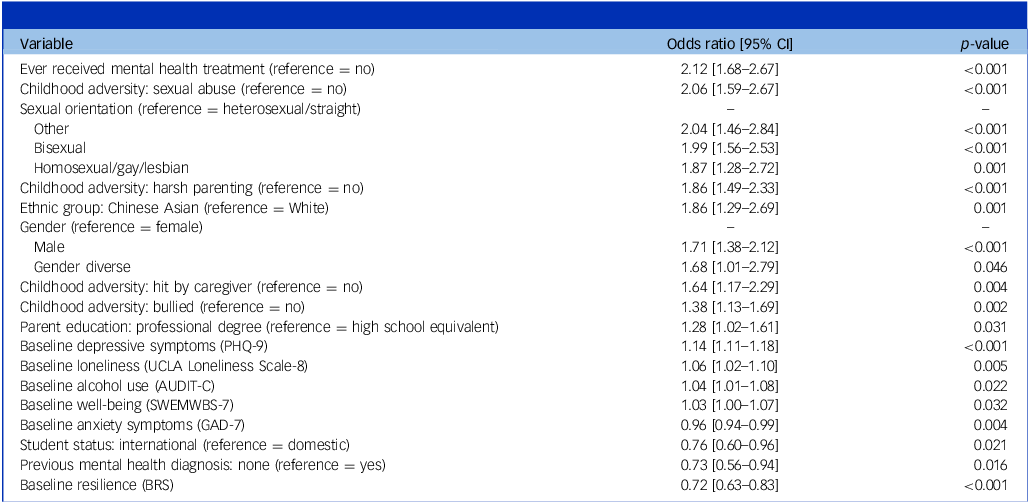
Table 2 presents factors associated with past or current suicidal ideation at baseline. The adjusted model significantly improved fit (F(40, ≥1000) = 18.15, p < 0.001). Students who reported a minority sexual orientation indicated higher rates of suicidal ideation: odds were highest among those who identified as other sexual minority (odds ratio 2.04, 95% CI 1.46–2.84, p < 0.001), followed by bisexual (odds ratio 1.99, 95% CI 1.56–2.53, p < 0.001) and homosexual/gay/lesbian orientation (odds ratio 1.87, 95% CI 1.28–2.72, p = 0.001), relative to those who identified as heterosexual. History of previous mental health treatment was also associated with suicidal ideation (odds ratio 2.12, 95% CI 1.68–2.67, p < 0.001), whereas those reporting no previous mental health diagnoses showed reduced risk (odds ratio 0.73, 95% CI 0.56–0.94, p = 0.016). Associations were also found with experiences of childhood adversity: experience of sexual abuse demonstrated the strongest association (odds ratio 2.06, 95% CI 1.59–2.67, p < 0.001), followed by harsh parenting (odds ratio 1.86, 95% CI 1.49–2.33, p < 0.001), being hit by a caregiver (odds ratio 1.64, 95% CI 1.17–2.29, p = 0.004) and bullying experiences (odds ratio 1.38, 95% CI 1.13–1.69, p = 0.002).
Factors associated with lifetime suicidal ideation at baseline

Table 2 Long description
A table with 19 rows and 3 columns. The columns are labeled Variable, Odds ratio [95% CI], and p-value. The table lists various factors associated with lifetime suicidal ideation at baseline, including mental health treatment, childhood adversity, sexual orientation, ethnic group, gender, parent education, depression symptoms, loneliness, alcohol use, well-being, anxiety symptoms, student status, and previous mental health diagnosis. Each row provides the odds ratio with a 95% confidence interval and the p-value for the association.
PHQ-9, Patient Health Questionnaire-9; AUDIT-C, Alcohol Use Disorders Identification Test for Consumption; SWEMWBS-7, Short Warwick–Edinburgh Mental Wellbeing Scale; GAD-7, Generalised Anxiety Disorder-7; BRS, Brief Resilience Scale.
Students identifying as male indicated higher risk of suicidal ideation compared with students identifying as female (odds ratio 1.71, 95% CI 1.38–2.12, p < 0.001), as did students identifying as gender diverse or another gender identity (odds ratio 1.68, 95% CI 1.01–2.79, p = 0.046). Among ethnic backgrounds, students who indicated a Chinese ethnicity demonstrated higher odds of suicidal ideation (odds ratio 1.86, 95% CI 1.29–2.69, p < 0.001) relative to White students. Students whose parents held professional degrees also showed elevated risk (odds ratio 1.28, 95% CI 1.02–1.61, p = 0.031) relative to those whose parents’ highest level of educational attainment was high school equivalent. International students showed reduced odds of baseline risk compared with UK domestic students (odds ratio 0.76, 95% CI 0.60–0.96, p = 0.021). Additionally, students at site 5 had comparatively lower risk relative to the reference site (odds ratio 0.60, 95% CI 0.37–0.98, p = 0.042).
Mental health and psychosocial measures were also associated with baseline suicidal ideation. Higher depressive symptoms showed the strongest association (odds ratio 1.14, 95% CI 1.11–1.18, p < 0.001), whereas higher loneliness (odds ratio 1.06, 95% CI 1.02–1.10, p = 0.005), alcohol use (odds ratio 1.04, 95% CI 1.01–1.08, p = 0.022) and higher well-being (odds ratio 1.03, 95% CI 1.00–1.07, p = 0.032) were also associated with increased odds. Conversely, higher baseline anxiety symptoms (odds ratio 0.96, 95% CI 0.94–0.99, p = 0.004) and resilience (odds ratio 0.72, 95% CI 0.63–0.83, p < 0.001) were associated with reduced odds of baseline suicidal ideation. Additionally, as the PHQ-9 includes an item assessing suicidal ideation over the past 2 weeks, subsequent sensitivity analysis examining PHQ-8 outcomes with this item removed did not change the significance or directionality of the association for depressive symptoms (odds ratio 1.13, 95% CI 1.10–1.15, p < 0.001).
Lifetime suicide attempts at baseline
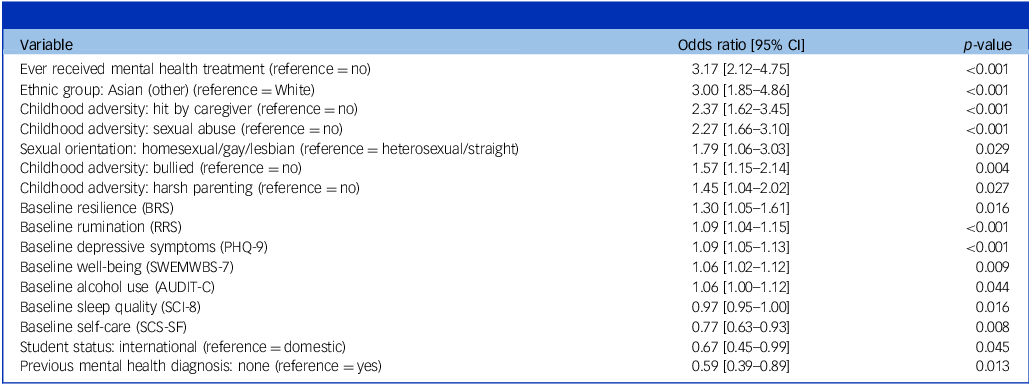
Table 3 presents factors associated with past suicide attempts reported at baseline. The adjusted model including demographic and psychosocial covariates significantly improved overall fit (F(40, ≥1000) = 10.16, p < 0.001).
Factors associated with lifetime suicide attempts at baseline

Table 3 Long description
A table with 18 rows and 3 columns. The columns are labeled Variable, Odds ratio [95% CI], and p-value. The table lists various factors and their associated odds ratios, confidence intervals, and p-values. Row 1: Ever received mental health treatment (reference = no), Odds ratio [95% CI] 3.17 [2.12, 4.75], p-value <0.001. Row 2: Ethnic group: Asian (other) (reference = White), Odds ratio [95% CI] 3.00 [1.85, 4.86], p-value <0.001. Row 3: Childhood adversity: hit by caregiver (reference = no), Odds ratio [95% CI] 2.37 [1.62, 3.45], p-value <0.001. Row 4: Childhood adversity: sexual abuse (reference = no), Odds ratio [95% CI] 2.27 [1.66, 3.10], p-value <0.001. Row 5: Sexual orientation: homosexual/gay/lesbian (reference = heterosexual/straight), Odds ratio [95% CI] 1.79 [1.06, 3.03], p-value 0.029. Row 6: Childhood adversity: bullied (reference = no), Odds ratio [95% CI] 1.57 [1.15, 2.14], p-value 0.004. Row 7: Childhood adversity: harsh parenting (reference = no), Odds ratio [95% CI] 1.45 [1.04, 2.02], p-value 0.027. Row 8: Baseline resilience (BRS), Odds ratio [95% CI] 1.30 [1.05, 1.61], p-value 0.016. Row 9: Baseline rumination (RRS), Odds ratio [95% CI] 1.09 [1.04, 1.15], p-value <0.001. Row 10: Baseline depressive symptoms (PHQ-9), Odds ratio [95% CI] 1.09 [1.05, 1.13], p-value <0.001. Row 11: Baseline well-being (SWEMWBS-7), Odds ratio [95% CI] 1.06 [1.02, 1.12], p-value 0.009. Row 12: Baseline alcohol use (AUDIT-C), Odds ratio [95% CI] 1.06 [1.00, 1.12], p-value 0.044. Row 13: Baseline sleep quality (SCI-8), Odds ratio [95% CI] 0.97 [0.95, 1.00], p-value 0.016. Row 14: Baseline self-care (SCS-SF), Odds ratio [95% CI] 0.77 [0.63, 0.93], p-value 0.008. Row 15: Student status: international (reference = domestic), Odds ratio [95% CI] 0.67 [0.45, 0.99], p-value 0.045. Row 16: Previous mental health diagnosis: none (reference = yes), Odds ratio [95% CI] 0.59 [0.39, 0.89], p-value 0.013.
PHQ-9, Patient Health Questionnaire-9; AUDIT-C, Alcohol Use Disorders Identification Test for Consumption; SWEMWBS-7, Short Warwick–Edinburgh Mental Wellbeing Scale; GAD-7, Generalised Anxiety Disorder-7; BRS, Brief Resilience Scale.
History of previous mental health treatment showed the strongest association with past suicide attempts (odds ratio 3.17, 95% CI 2.12–4.75, p < 0.001). Students reporting no personal mental health diagnosis demonstrated reduced risk (odds ratio 0.59, 95% CI 0.39–0.89, p = 0.013). Adverse childhood experiences exhibited several associations with past suicide attempts: being hit by a caregiver was most strongly associated (odds ratio 2.37, 95% CI 1.62–3.45, p < 0.001), followed by sexual abuse (odds ratio 2.27, 95% CI 1.66–3.10, p < 0.001), bullying experiences (odds ratio 1.57, 95% CI 1.15–2.14, p = 0.004) and harsh treatment (odds ratio 1.45, 95% CI 1.04–2.02, p = 0.027). Students who identified as homosexual/gay/lesbian indicated higher risk of past suicide attempts (odds ratio 1.79, 95% CI 1.06–3.03, p = 0.029) relative to students identifying as heterosexual. Non-Chinese Asian students also demonstrated substantially higher odds of past suicide attempts (odds ratio 3.00, 95% CI 1.85–4.86, p < 0.001) compared with White students. International students showed reduced odds compared with domestic students (odds ratio 0.67, 95% CI 0.45–0.99, p = 0.045).
Baseline mental health and psychosocial measures were also associated with suicide attempts. Higher depressive symptoms (odds ratio 1.09, 95% CI 1.05–1.13, p < 0.001), rumination (odds ratio 1.09, 95% CI 1.04–1.15, p < 0.001), well-being (odds ratio 1.06, 95% CI 1.02–1.12, p = 0.009), alcohol use (odds ratio 1.06, 95% CI 1.00–1.12, p = 0.044) and resilience (odds ratio 1.30, 95% CI 1.05–1.61, p = 0.016) were associated with increased likelihood of a past suicide attempt. Conversely, better sleep quality (odds ratio 0.97, 95% CI 0.95–1.00, p = 0.016) and engagement in self-care activities (odds ratio 0.77, 95% CI 0.63–0.93, p = 0.008) were associated with reduced likelihood of past suicide attempt.
Follow-up reduction of suicidal ideation
Among 1366 students reporting no lifetime history of suicidal ideation at baseline, 835 (61.1%) did not report suicidal ideation during the academic year. Coefficients are available in Supplementary Table 1. The adjusted model significantly improved overall fit (F(27, ≥1000) = 3.30, p < 0.001).
Suicidal ideation in students with prior mental health treatment was significantly less likely to reduce (odds ratio 0.52, 95% CI 0.37–0.74, p < 0.001). Older students demonstrated slightly higher odds of symptom improvement (odds ratio 1.03, 95% CI 1.01–1.05, p = 0.014), as did students reporting physical disabilities (odds ratio 1.68, 95% CI 1.04–2.71, p = 0.033). Increases in rumination over the academic year were associated with reduced likelihood of symptom improvement (odds ratio 0.95, 95% CI 0.91–1.00, p = 0.041). Students reporting harsh parenting in childhood also exhibited lower odds of symptom reduction (odds ratio 0.74, 95% CI 0.55–1.00, p = 0.052).
Follow-up onset of suicidal ideation
Among 1469 students reporting no lifetime history of suicidal ideation at baseline, 52 (3.5%) developed new-onset ideation during the academic year. Of these, 51 students reporting new symptoms were matched with 153 controls (ratio 1:3) on demographic characteristics and baseline GAD-7, PHQ-9 and SWEMWBS-7 outcomes, as described in the Method section.
Supplementary Fig. 1 presents baseline and follow-up mental health scores for matched groups. Groups were well-matched on demographic and baseline measures depressive symptoms (mean 6.71, s.d. = 3.94 in those with new-onset ideation; mean 6.81, s.d. = 4.92 in the matched group), anxiety symptoms (mean 7.74, s.d. = 5.44 in those with new-onset ideation; mean 7.80, s.d. = 5.32 in the matched group) and well-being (mean 22.47, s.d. = 4.99 in those with new-onset ideation; mean 22.37, s.d. = 4.61 in the matched group). At follow-up, students with new-onset ideation demonstrated substantially higher depressive symptoms (mean 11.37, s.d. = 6.47) compared with the matched group (mean 7.38, s.d. = 5.22), higher anxiety symptoms (mean 10.34, s.d. = 5.71 in those with new-onset ideation; mean 7.69, s.d. = 5.13 for the matched group) and lower well-being (mean 20.41, s.d. = 4.54 in those with new-onset ideation; mean 22.50, s.d. = 4.49 for the matched group).
Students with new onset showed significantly greater increases in depressive symptoms (estimated difference 4.06, 95% CI 2.36–5.76, p < 0.001) and anxiety symptoms (mean difference 2.69, 95% CI 1.12–4.25, p = 0.001), as well as greater decreases in well-being (mean difference −2.09, 95% CI −3.41 to −0.76, p = 0.002).
Relationship between past suicidal ideation and attempts
Figure 1 presents trajectories of student suicidal ideation and attempts over the academic year. Of the sample (n = 2832), 1469 students (51.9%) began the year without suicidal thoughts or attempts. Of these students, 1417 (96.5%) reported no suicidal ideation or attempts at follow-up, 52 (3.5%) developed new suicidal ideation without an attempt and no students reported attempting suicide, preventing a trajectory analysis for this subgroup.
Trajectories of suicidal ideation and suicide attempts in university students during the academic year.

Fig. 1 Long description
A Sankey diagram representing the trajectories of suicidal ideation and suicide attempts among university students during the academic year. The diagram includes three sets: No prior risk, Prior suicidal ideation, and Prior suicide attempt. The No prior risk set has 1469 individuals, with 1417 transitioning to No risk and 52 to Suicidal ideation. The Prior suicidal ideation set includes 1086 individuals, with 710 transitioning to Suicidal ideation, 362 to No risk, and 14 to Suicide attempt. The Prior suicide attempt set has 277 individuals, with 123 transitioning to Suicidal ideation, 125 to No risk, and 29 to Suicide attempt. The Suicidal ideation category includes 539 individuals, while the Suicide attempt category includes 43 individuals. The diagram highlights the transitions and overlaps between these categories, showing the dynamic nature of suicide risk among students.
Among 1086 students (38.4%) who began the academic year with suicidal ideation but no prior attempts, 710 (65.4%) reported no ideation in the spring, 362 (33.3%) continued to experience ideation without making an attempt and 14 (1.3%) made a new attempt.
Of 277 students (9.8%) who began the year with a history of both suicidal ideation and attempts, 123 (44.4%) experienced no suicidal ideation, with no attempts during the academic year; 125 (45.1%) continued to experience ideation without attempts and 29 (10.5%) made a new attempt.
The conditional probability of making an attempt at follow-up given the presence of lifetime suicidal ideation at baseline was calculated as approximately 3.2%. The conditional probability of making a suicide attempt at follow-up given the lifetime history of prior attempts was approximately 10.5%.
Suicide attempts during university reported at follow up
To identify factors associated with new suicide attempts over the course of the academic year, case–control analysis was conducted with 43 participants who made a new attempt during the academic year. Of these students, 40 were matched with 156 at-risk students who reported experiencing ideation only or ideation and attempts at baseline, with fixed proportions such that those experiencing both ideation and attempts comprised approximately 61–65% of both samples (96 students with both ideation and attempts and 60 with ideation only in the matched group; 26 with ideation and attempts and 14 with ideation only for those who made a suicide attempt). Participants were further matched on demographic characteristics (gender, ethnic group, sexual orientation, academic year) and baseline PHQ-9 scores (mean 16.67, s.d. = 6.23 for those who made a new suicide attempt; mean 16.16, s.d. = 5.84 for the matched group). Significant associations were found between increases in depressive symptoms (odds ratio 1.11, 95% CI 1.01–1.24, p = 0.039) and rumination (odds ratio 1.21, 95% CI 1.04–1.42, p = 0.016) at follow-up.
Discussion
The present study evaluated factors associated with suicidal ideation and suicide attempts in approximately 3000 UK university students over an academic year. Increased risk factors included previous mental health history, adverse childhood experiences, minoritised identities, and several psychosocial and mental health outcomes. Approximately 50% of students presented with no prior suicide history and 61% of students with lifetime suicidal ideation at baseline did not experience thoughts at follow-up. Notably, although suicidal ideation demonstrated limited association with subsequent attempts overall, students with prior attempt history faced elevated risk of recurrence, with increases in depressive symptoms and rumination presenting as key risk factors for new attempts reported. These findings highlight the importance of targeted screening for high-risk groups at university and better support for students with prior suicide attempt history.
Factors associated with lifetime suicidal ideation at baseline
Students identifying as a sexual minority or gender-diverse, male students, and those of Chinese ethnicity all showed elevated odds of lifetime suicidal ideation. These findings are consistent with research documenting higher suicide risk among minoritised populations, Reference Zhao, Xin, Bai, Zhang, Liu and Xu6 with minority stress theory suggesting that experiences of marginalisation may contribute to poorer mental health outcomes in these groups. Reference Frost and Meyer35 International students demonstrated reduced odds of risk compared with domestic students, although this warrants cautious interpretation given potential cultural differences in disclosure, Reference Ahad, Sanchez-Gonzalez and Junquera36 as well as the possibility that students with a prior history of mental health difficulties may be less likely to pursue study abroad. Elevated risk among students whose parents held professional degrees may reflect greater perceived pressure to achieve, willingness to disclose or selective participation, warranting future investigation. Lower risk at site 5 may reflect recruitment of all first-year students, reducing self-selection toward elevated risk or interest in mental health research.
Childhood adversity exhibited associations with baseline suicidal ideation, with experiences of sexual abuse demonstrating the strongest association, consistent with dose–response models linking adverse experiences to suicidality. Reference Tan and Mao37 Within the integrated motivational–volitional framework, early adversities may be conceptualised as diathesis factors increasing vulnerability to suicidal behaviour through effects on mood, interpersonal relationships and stress regulation. Reference O’Connor and Kirtley12 History of mental health treatment was associated with suicidal ideation, likely reflecting treatment history as a marker of severity and persistence of symptoms and a potential protective factor through access to support. Reference Franklin, Ribeiro, Fox, Bentley, Kleiman and Huang16
Baseline psychosocial functioning was strongly associated with suicidal ideation. Depressive symptoms showed the most robust association, consistent with models suggesting depressive symptoms often contribute to suicidal thinking. Reference Franklin, Ribeiro, Fox, Bentley, Kleiman and Huang16 Higher loneliness and alcohol use were also associated with increased odds, consistent with previous literature. Reference Campbell, Blank, Cantrell, Baxter, Blackmore and Dixon38 However, the positive association with wellbeing was unexpected, potentially reflecting statistical suppression, given the strong inverse correlation between well-being and depression, or collider bias from selective participation: students with a history of mental health problems may have been more motivated to participate, while having sufficient current well-being to complete the survey. Reference Tönnies, Kahl and Kuss39 Conversely, higher resilience and higher anxiety symptoms were independently associated with reduced risk. The latter contrasts with research reporting positive associations between anxiety and suicide risk, Reference Kabir, Syed, Vinnakota, Okello, Isigi and Abdul Kareem9 and may reflect a distinct relationship in this population, artefact of recruitment or sampling, or the predominantly subclinical anxiety severity in this sample, warranting future study.
Factors associated with lifetime suicide attempts at baseline
Previously receiving mental health treatment was most strongly associated with past suicide attempts at baseline, with over three times greater risk. Students identifying as non-Chinese Asian ethnic background showed elevated odds relative to White students, and those identifying as homosexual/gay/lesbian demonstrated increased risk compared with heterosexual students. As with ideation, international students showed reduced odds of reporting a past attempt, again warranting cautious interpretation. Reference Ahad, Sanchez-Gonzalez and Junquera36
Childhood adversity was also associated with past suicide attempts. Being hit by a caregiver demonstrated the strongest association, followed by sexual abuse, bullying and harsh parenting. The pattern mirrors that observed for suicidal ideation, consistent with dose–response models linking adverse childhood experiences to later suicidal behaviour. Reference O’Connor and Kirtley12
Baseline psychosocial functioning showed several associations with past suicide attempts. Depressive symptoms and rumination were both positively associated with lifetime attempt history, consistent with research highlighting repetitive negative thinking as a cognitive mechanism that may contribute to suicidal risk beyond ideation. Reference O’Connor and Kirtley12,Reference Watkins40 Higher alcohol use was also positively associated, whereas better sleep quality and greater self-care were protective, consistent with previous literature. Reference Zhao, Xin, Bai, Zhang, Liu and Xu6,Reference Kabir, Syed, Vinnakota, Okello, Isigi and Abdul Kareem9 Similar to ideation, higher well-being was also associated with past attempts, which may also reflect collider bias from selective participation. Reference Tönnies, Kahl and Kuss39 Likewise, higher resilience was also positively associated with past attempts, potentially reflecting adaptation or response bias among those with attempt histories. Students with no previous mental health diagnosis were less likely to report a past attempt, reinforcing the strong link between clinical history and suicidal behaviour. Reference Zhao, Xin, Bai, Zhang, Liu and Xu6
Reduction of suicidal ideation
Among students beginning the academic year with past suicidal ideation, 61% presented no symptoms at follow-up. Older students were slightly more likely to experience symptom reduction, potentially reflecting more developed coping strategies. Students reporting physical disabilities also showed higher odds of improvement, although this should be interpreted cautiously, given the heterogeneity of physical disabilities and varied support needs.
Conversely, students reporting prior mental health treatment were less likely to report no symptoms at follow-up, potentially reflecting treatment history as an indicator of severity. Reference Franklin, Ribeiro, Fox, Bentley, Kleiman and Huang16 Similarly, increases in rumination over the academic year were associated with lower risk of reduction, consistent with research linking repetitive negative thought to maintenance of depressive symptoms. Reference Watkins40 Notably, concurrent change in rumination and suicidal ideation does not suggest directionality, but highlights an association between the two across the academic year.
New onset of suicidal ideation
New onset of suicidal ideation occurred in 3.5% of students without baseline suicidal ideation. When matched with students on baseline risk and demographic characteristics, the transition to new ideation was associated with declines in mental health, particularly anxiety, depression and well-being, similar to associations with baseline symptoms. This aligns with ideation-to-action frameworks suggesting depression primarily functions as a risk factor for ideation rather than attempts. Reference Klonsky, Dixon-Luinenburg and May18
The rarity of new-onset suicidal ideation has potentially meaningful implications for university mental health screening practises. Findings suggest the majority of students who experience suicidal ideation during university already demonstrate lifetime risk factors or symptoms, indicating that early identification and intervention during the transition to university may be particularly important. Reference Franklin, Ribeiro, Fox, Bentley, Kleiman and Huang16 Additionally, findings suggest that among students without baseline risk, monitoring for symptoms of mental health deterioration may be useful in identifying students most at risk, consistent with research demonstrating that current psychiatric symptoms are better predictors of suicidal ideation than demographic risk factors. Reference Macalli, Navarro, Orri, Tournier, Thiébaut and Côté17
Relationship between suicidal ideation and attempts
Approximately 50% of students reported no suicidal ideation or attempts at either time point, with over 70% presenting without risk indicators at follow-up. Additionally, no risk at follow-up was the most common outcome for students with a history of risk, suggesting the university environment likely did not exacerbate existing vulnerability. Among students with suicidal thoughts but no prior attempts, 3.2% made a new attempt during the academic year, whereas 10.5% of those with a prior attempt made a new attempt, consistent with research demonstrating that the majority of individuals with suicidal ideation do not progress to suicide attempts. Reference Klonsky, Dixon-Luinenburg and May18 The ideation-to-action framework posits that development of suicidal ideation and progression to attempts are distinct processes with different predictors, with capability and thoughts operating as distinct mechanisms. Reference O’Connor and Kirtley12
These findings may have implications for how university systems approach suicide risk assessment. Although any suicidal ideation warrants clinical attention, presence of suicidal thoughts may have limited predictive potential in identifying those at risk of a future suicide attempt without considering additional risk factors. This may suggest that universal screening approaches focused primarily on detecting suicidal ideation potentially identify large numbers of students requiring support while having limited precision for identifying those at highest risk of a future suicide attempt. Reference Klonsky, Dixon-Luinenburg and May18 Alternative approaches might include screening that considers both ideation and broader risk profiles, or enhanced support for students with ideation who demonstrate other high-risk factors, such as previous suicide attempts, previous intervention for mental health difficulties and disclosure of mental health disability at university entry.
Strengths and limitations
Key strengths of this study include the large, multi-institutional sample and longitudinal design capturing changes over the academic year, use of validated measures and robust statistical methods. Additionally, examination of both baseline risk factors and trajectories of change provides further understanding of suicide risk patterns among UK university students.
Several limitations should be noted. First, although the sample is representative of student populations, it may not be representative of all UK young adults; the majority of students identified as female, White and did not report a disability, whereas male students and those from minoritised backgrounds generally present with greater risk, 3 and may be underrepresented in the study. Second, suicide risk was assessed with self-report questions from the Columbia Suicide Severity Rating Scale, rather than measures from clinical interviews and case records, potentially limiting specificity of measurement. The ideation question in particular may have been subject to variable interpretation, capturing momentary thoughts as well as active planning, potentially elevating lifetime prevalence relative to meta-analytic estimates. Reference Crispim, dos Santos, Frazão, Frazão, de Albuquerque and Perrelli7 Third, the sample was drawn from five UK universities and may not be representative of all UK higher education institutions. Moreover, although the sample included approximately 3000 participants, a relatively small number of students experienced new-onset suicidal ideation or made suicide attempts, limiting statistical power for some analyses; these subgroup findings should be considered exploratory. Finally, data were analysed over the course of a single academic year, making it difficult to draw conclusions about longer-term trajectories beyond the follow-up period. Additionally, data collection (2021–2025) overlapped with later stages of the COVID-19 pandemic, which disrupted social connectedness, academic experiences and support services, and may partly contribute to observed prevalence and within-year change; although academic year was adjusted for, generalisation to future cohorts warrants caution.
In conclusion, the present study provides important insights into patterns of suicidal ideation and attempts among UK university students. Findings suggest that minoritised and disadvantaged groups experience elevated baseline suicide risk, and that new onset of suicidal ideation and attempts during university are rare and difficult to identify beyond symptoms of mental health deterioration. Moreover, results suggest suicidal ideation in isolation may have limited predictive ability in identifying those most at risk of a future suicide attempt. These results underscore the importance of early identification and support for at-risk students during the transition to university, as well as ongoing monitoring of mental health symptoms and the need for screening approaches that consider both ideation and factors associated with progression to attempts. With further research to refine how to target and implement early interventions, universities may be better able to support student mental health within higher education settings.
Supplementary material
The supplementary material is available online at https://doi.org/10.1192/bjp.2026.10797
Data availability
The data supporting the findings of this study are available on reasonable request from the corresponding author, K.F.M. The data are not publicly available due to the sensitive nature of the data and potential to compromise the privacy of research participants.
Author contributions
K.F.M. contributed to study methodology, formal analysis and writing the original draft of the manuscript. E.R.W. contributed to study conceptualisation and funding acquisition. L.J.R. contributed to study methodology, supervision and funding acquisition. A.D., N.B., S.R.C., K.S. and L.F. contributed to funding acquisition. S.B. contributed to study methodology and data curation. K.F.M., S.B., K.A.M., J.D., L.D., A.N. and T.M. contributed to data curation. All authors contributed to reviewing and editing the manuscript, and approved the final version of the manuscript.
Funding
Funding for this paper was provided by the UK Research and Innovation Adolescent Mental Health and Developing Minds Scheme project (grant MR/W002442/1): Developing and Evaluating a Stepped Change Whole-University approach for Student Wellbeing and Mental Health. The study sponsor and funder have no influence on the conduct, delivery or reporting of the research. For the purpose of open access, the author has applied a Creative Commons Attribution (CC BY) licence to any Author Accepted Manuscript version arising from this submission.
Declaration of interest
S.R.C. receives an honorarium from Elsevier for journal editor work. S.R.C.’s research is supported and funded by the National Health Service (NHS) and the National Institute for Health and Care Research (NIHR) Applied Research Collaboration Wessex. K.S. is supported by the NIHR Oxford Health Biomedical Research Centre and the Office for Life Sciences (UK Government) and the NIHR Mental Health Translational Research Collaboration, hosted by the NIHR Oxford Health Biomedical Research Centre. In the past 3 years, K.S. has received grant funding from Boeringher Ingelheim, Wellcome Trust and NIHR; and non-financial support from Big Health in the form of no-cost access to the digital sleep improvement programme, Sleepio, for use in clinical research, outside the submitted work. The views expressed are those of the author(s) and not necessarily those of the NHS, the NIHR or the Department of Health and Social Care UK. All other authors have no declarations of interest. Artificial Intelligence use: no artificial intelligence tools have been used in the research or writing process for this manuscript.


 Open access


eLetters
No eLetters have been published for this article.