Introduction
Childhood maltreatment, defined as neglect, physical or sexual abuse, is a substantial public health problem. According to the United States Department of Health and Human Services (2009), there were approximately 3.2 million child abuse referrals and 794 000 confirmed victims of childhood maltreatment in the USA in 2007. Childhood maltreatment is associated with a variety of negative outcomes (National Research Council, 1993), including early alcohol use and problem drinking (Luster & Small, Reference Luster and Small1997; Bensley et al. Reference Bensley, Spieker, Van Eenwyk and Schoder1999; Simantov et al. Reference Simantov, Schoen and Klein2000; Moran et al. Reference Moran, Vuchinich and Hall2004; Hussey et al. Reference Hussey, Chang and Kotch2006; Rothman et al. Reference Rothman, Edwards, Heeren and Hingson2008; Shin et al. Reference Shin, Edwards and Heeren2009), and alcoholism in adolescence (Fergusson et al. Reference Fergusson, Horwood and Lynskey1996 a; Clark et al. Reference Clark, Lesnick and Hegedus1997; Kilpatrick et al. Reference Kilpatrick, Acierno, Saunders, Resnick, Best and Schnurr2000; Dube et al. Reference Dube, Anda, Felitti, Edwards and Croft2002) and adulthood (Kendler et al. Reference Kendler, Bulik, Silberg, Hettema, Myers and Prescott2000; Galaif et al. Reference Galaif, Stein, Newcomb and Bernstein2001; Molnar et al. Reference Molnar, Buka and Kessler2001). Although the majority of research suggests that childhood maltreatment is associated with alcohol-related outcomes among both genders, many studies have documented a stronger association among females than among males (e.g. Stein et al. Reference Stein, Golding, Siegel, Burnam, Sorenson, Wyatt and Powell1988; Widom et al. Reference Widom, Ireland and Glynn1995, Reference Widom, White, Czaja and Marmorstein2007; Simpson & Miller, Reference Simpson and Miller2002).
There are several possible explanations for the childhood maltreatment–alcoholism association. One possibility is that childhood maltreatment leads directly to alcoholism. Alternatively, background genetic and/or environmental risk factors may contribute to a shared vulnerability for both childhood maltreatment and alcoholism. For example, familial alcoholism and poor parenting are risk factors for both childhood maltreatment (Fergusson et al. Reference Fergusson, Horwood and Lynskey1996 b; McLaughlin et al. Reference McLaughlin, Heath, Bucholz, Madden, Bierut, Slutske, Dinwiddie, Statham, Dunne and Martin2000; Dube et al. Reference Dube, Anda, Felitti, Croft, Edwards and Giles2001; Dunn et al. Reference Dunn, Tarter, Mezzich, Vanyukov, Kirisci and Kirillova2002; Walsh et al. Reference Walsh, MacMillan and Jamieson2003) and alcoholism (Cotton, Reference Cotton1979; Holmes & Robins, Reference Holmes and Robins1988; Campo & Rohner, Reference Campo and Rohner1992; Sher et al. Reference Sher, Gershuny, Peterson and Raskin1997; Prescott, Reference Prescott2002; Anda et al. Reference Anda, Felitti, Bremner, Walker, Whitfield, Perry, Dube and Giles2006).
Parental alcohol problems could directly increase risk for alcoholism through genetic influences (Prescott et al. Reference Prescott, Madden and Stallings2006) and modeling of parent behavior (Andrews et al. Reference Andrews, Hops and Duncan1997; Hussong et al. Reference Hussong, Curran and Chassin1998), and/or indirectly increase risk by creating predisposing environments associated with dysfunctional family relationships and childhood maltreatment (Kilpatrick et al. Reference Kilpatrick, Acierno, Saunders, Resnick, Best and Schnurr2000). Parental psychopathology and parental alcohol problems are also associated with poor parenting (Chassin et al. Reference Chassin, Curran, Hussong and Colder1996; Berg-Nielsen et al. Reference Berg-Nielsen, Vikan and Dahl2002; Lovejoy et al. Reference Lovejoy, Graczyk, O'Hare and Neuman2005), potentially putting children at an increased risk for both maltreatment exposure (through direct parent to child maltreatment and/or increased exposure to other forms of maltreatment) and later development of alcoholism. Furthermore, contextual family risk factors, such as poverty, are also associated with risk for both childhood maltreatment (for a review, see Freisthler et al. Reference Freisthler, Merritt and LaScala2006) and problematic drinking (Van Oers et al. Reference Van Oers, Bongers, Van de Goor and Garretsen1999; Hasin et al. Reference Hasin, Stinson, Ogburn and Grant2007). Taken together, these overlapping risk factors make it difficult to determine the specific effects of childhood maltreatment on alcoholism risk, and suggest that the association may reflect a shared familial vulnerability to both.
Twin studies can be used to assess possible mechanisms underlying the childhood maltreatment–alcoholism association, and estimate the degree to which environmental and genetic factors contribute to individual differences in these outcomes and their overlap. Co-twin control analyses ascertain pairs discordant for childhood maltreatment and calculate alcoholism risk in the exposed twin compared with the unexposed co-twin control. This method statistically adjusts for family environmental and genetic factors and allows for the investigation of causal versus indirect interpretations. Available co-twin control studies provide evidence consistent with childhood sexual abuse as a direct risk factor for subsequent alcohol-related problems (Kendler et al. Reference Kendler, Bulik, Silberg, Hettema, Myers and Prescott2000; Nelson et al. Reference Nelson, Heath, Madden, Cooper, Dinwiddie, Bucholz, Glowinski, McLaughlin, Dunne, Statham and Martin2002), but there is also evidence that the association may be partially mediated by family factors (Dinwiddie et al. Reference Dinwiddie, Heath, Dunne, Bucholz, Madden, Slutske, Bierut, Statham and Martin2000). Less is known about the mechanisms underlying the association between physical abuse or neglect and alcoholism. Additional population-based research is needed to clarify the role of childhood maltreatment in the development of alcoholism among males, and to better distinguish the effects of childhood maltreatment on alcoholism from confounded risk factors such as family environment.
The goals of this research are threefold: (1) to examine the phenotypic childhood maltreatment–alcoholism association in males; (2) to examine whether there are familial factors (genetic or common environmental) that mediate the childhood maltreatment–alcoholism association in males; and (3) to explore whether measured environmental risk factors can account for the childhood maltreatment–alcoholism association.
Method
Subjects
The current sample comprised individuals from the Virginia Adult Twin Study of Psychiatric and Substance Use Disorders, a longitudinal study of psychopathology in adult twins. The sample was originally identified through the Virginia Twin Registry, and includes Caucasian twins born in Virginia between 1934 and 1974. Data for the current study come from wave 1 of data collection in male twin pairs, a telephone interview conducted 1993–1996 (for recruitment and non-participation details, see Kendler & Prescott, Reference Kendler and Prescott2006). The current study uses only data from same-sex male twin pairs. We excluded participants from male–female twin pairs because of large differences between sexes in reports of sexual abuse, and we did not assess these childhood maltreatment items in our parallel study of female twin pairs. Participants were informed about the purpose of the study and gave verbal informed consent before interviews.
The analyses for this study are based on data from a total of 3527 males who completed the clinical interview, including 3004 individuals from complete pairs (860 complete monozygotic (MZ) pairs and 642 complete dizygotic pairs (DZ)) and 523 individuals whose co-twin did not participate. Twin analyses use the fact that MZ pairs are genetically identical whereas DZ twins share on average 50% of their segregating genes.
Parental psychopathology and socioeconomic variables were collected during the second wave of data collection conducted 1995–1997. These variables are only available on a subset of 2927 twins who participated in both waves of interviews, including 2384 from complete pairs (704 complete MZ pairs and 488 complete DZ pairs) and 543 whose co-twin did not participate.
Measures
Alcohol abuse and/or dependence (AAD)
Lifetime AAD diagnosis was made using DSM-IV criteria based on a structured diagnostic interview assessment, adapted from the Structured Clinical Interview for DSM Disorders (SCID; Spitzer & Williams, Reference Spitzer and Williams1985) and administered by clinically trained interviewers. Test–retest reliability estimates for lifetime AAD were obtained among randomly selected participants re-interviewed 2–8 weeks after their original interviews [κ=0.74, 95% confidence interval (CI)=0.66–0.82, n=192]. Approximately 35% of the sample met the criteria for lifetime AAD, consistent with other surveys of general population samples of males in the USA (Hasin et al. Reference Hasin, Stinson, Ogburn and Grant2007).
Childhood maltreatment
Participants were asked if they had experienced nine traumatic events and, if so, the age they first occurred. For the current study, we selected three events consistent with childhood maltreatment: physical abuse (‘Have you ever been physically abused?’), sexual abuse or molestation (‘Have you ever been sexually abused or molested?’), and serious neglect (‘Were you ever seriously neglected as a child?’). This operationalization of childhood maltreatment (combining physical abuse, sexual abuse, and neglect) is frequently used in maltreatment research (Ireland & Widom, Reference Ireland and Widom1994; Schulz-Heik et al. Reference Schulz-Heik, Rhee, Silvern, Haberstick, Hopfer, Lessem and Hewitt2009; Topitzes et al. Reference Topitzes, Mersky and Reynolds2009; Zielinski, Reference Zielinski2009). Consistent with many prior studies of childhood maltreatment, we included childhood maltreatment if it occurred prior to age 15 years (e.g. Gibb et al. Reference Gibb, Wheeler, Alloy and Abramson2001; Dervic et al. Reference Dervic, Grunebaum, Burke, Mann and Oquendo2006; Showers et al. Reference Showers, Zeigler-Hill and Limke2006).
Approximately 6.2, 2.6, and 3.8% of the sample reported physical abuse, sexual abuse, and serious neglect, respectively, that occurred before age 15 years. There is substantial overlap among various types of childhood maltreatment in the literature (Dong et al. Reference Dong, Anda, Felitti, Dube, Williamson, Thompson, Loo and Giles2004), and bivariate correlations among the three types of childhood maltreatment in the current study were moderate to strong (tetrachoric correlations of 0.30 to 0.71). Overall, childhood maltreatment was reported by 9.1% of the sample.
Covariates
We examined several demographic variables that could affect the maltreatment–AAD association, including participant age and parental birth year, age at twins' birth, education, and income. In exploratory analyses, we examined several variables that could account for the childhood maltreatment–AAD association, including primary major depression, parent–child relationships, and parental psychopathology. Primary major depression was defined as a first episode of major depression occurring prior to the age of first alcohol problems (or at any age for individuals without alcohol problems). Lifetime major depression diagnosis was made using DSM-IV criteria based on a structured diagnostic interview assessment, adapted from the SCID and administered by clinically trained interviewers.
A shortened version of the Parental Bonding Instrument (PBI; Parker et al. Reference Parker, Tupling and Brown1979; Parker, Reference Parker1990), a widely used parenting scale, was administered in wave 1. Participants reported on the parenting they received during childhood using four response options ranging from 1 to 4 (‘not at all’ to ‘a lot’). Previous factor analyses of these PBI items support three scales reflecting parental protectiveness, authoritarianism, and warmth (Kendler, Reference Kendler1996). Participants missing one or more items on a single PBI scale were coded as missing on that scale. The distributions of parental warmth scores were positively skewed and scores were log-transformed prior to analysis.
As part of the second wave of interviews, the Family History Research Diagnostic Criteria Interview (Endicott et al. Reference Endicott, Andreasen and Spitzer1978) was utilized to assess parental psychopathology, including depression, anxiety, alcohol and drug problems, and antisocial characteristics (father's only) when the participant was a child. For each parent, participants were asked a stem question, for example, ‘Did your mother ever have drinking problems lasting >1 month?’. All parental psychopathology variables, except parental depression and father antisocial characteristics, included one stem question and six follow-up questions (parental depression included one stem question and 11 follow-up questions, and father antisocial characteristics did not include a stem question). Parental psychopathological variables were coded based on the quality of the information from 1 (high quality) to 4 (poor quality), based on how the participant acquired the information (his own experience versus hearing it from someone else). Variables of poor quality (n=129) were recoded as missing to increase overall accuracy. Each parental psychopathology variable was coded into a dichotomous yes/no variable based on answering yes to the stem question and endorsing one or more follow-up questions for depression, anxiety, alcohol problems and drug problems, and two or more follow-up questions for father's antisocial characteristics. Test–retest reliability estimates for these parental psychopathology variables among randomly selected participants re-interviewed 2–8 weeks after their original interviews were obtained: father [depression, k=0.66 (95% CI 0.48–0.83); anxiety, k=0.28 (95% CI 0.00–0.56); alcohol problems, k=0.80 (95% CI 0.67–0.91); drug problems, k=1.0 (no discordant pairs); antisocial characteristics, k=0.66 (95% CI 0.46–0.86]; mother [depression, k=0.46 (95% CI 0.30–0.61); anxiety, k=0.29 (95% CI 0.12–0.46); alcohol problems, k=0.46 (95% CI 0.30–0.62); drug problems, k=0.75 (95% CI 0.40–1.0)] (n=192). Co-twin information was combined for parental psychopathological variables, such that parents were coded positive for psychopathology variables if either twin reported parental psychopathology. In instances in which one twin was missing parental psychopathology information and the other co-twin was not [n ranging from 235 (mother alcohol) to 267 (father anxiety)], the missing parental psychopathological variable was coded based on the co-twin's response.
Statistical analyses
Analyses include all participants with lifetime AAD information regardless of whether their co-twin participated in the study. The childhood maltreatment–AAD association was investigated by logistic regression. Standard errors and statistical tests were adjusted to account for twins having correlated observations using the general estimating equation (GEE) option in sas (Genmod; SAS Institute, Inc., USA, 2004).
We used two different approaches to test the extent to which the childhood maltreatment–AAD association is explained by familial influences. First, a co-twin control design was employed to estimate the maltreatment–AAD association after adjusting for unmeasured family effects. The odds ratio (OR) for AAD was calculated in three groups: MZ twin pairs discordant for childhood maltreatment (87 pairs); DZ twin pairs discordant for childhood maltreatment (74 pairs); and risk for AAD based on childhood maltreatment status in the sample overall (n=3527).
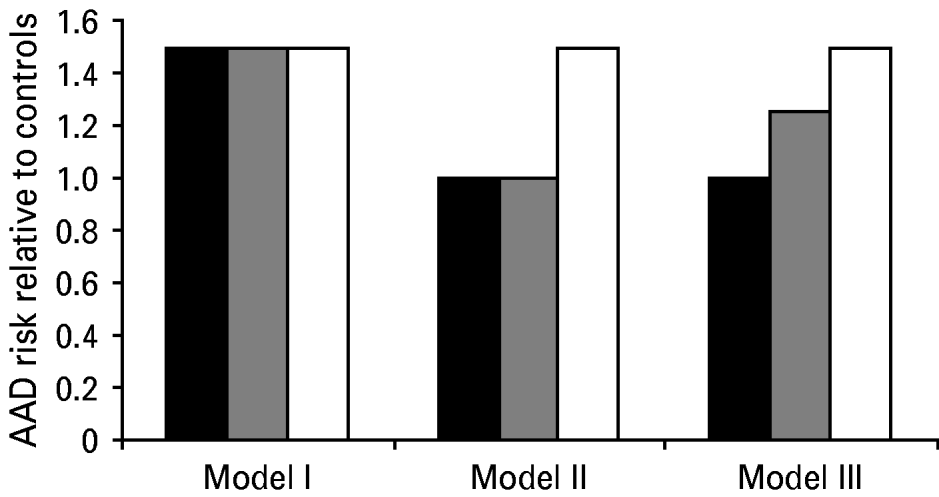
Fig. 1 depicts several possible outcomes in the co-twin control model. Overall, we expect individuals reporting maltreatment to have a higher risk for AAD than those unexposed to maltreatment. If childhood maltreatment directly leads to later AAD, individuals who experienced childhood maltreatment are expected to have higher prevalence of AAD compared with controls, in the discordant pairs as well as in the sample overall (model I, Fig. 1). If the childhood maltreatment–AAD association is non-causal, but arises because both are due to family environmental factors, the twin not exposed to maltreatment is expected to have equally elevated rates of AAD as his maltreated co-twin (i.e. OR 1.0) among MZ and DZ pairs. This is because the twin unexposed to maltreatment is still exposed to the aspects of the familial environment that predispose to the development of AAD (model II, Fig. 1). If the childhood maltreatment–AAD association arises because both are entirely due to genetic factors, rates of AAD in exposed individuals relative to unexposed individuals are expected to be equal among discordant MZ pairs (OR 1.0) but somewhat higher among discordant DZ pairs. This is because the MZ co-twins unexposed to maltreatment share all of the genetic risk factors that predispose to AAD in their maltreated co-twin, but the DZ co-twins share only half the genetic predisposition (model III, Fig. 1).
Risk of alcohol abuse and/or dependence (AAD) relative to controls (odds ratios) in monozygotic twins discordant for childhood maltreatment (▪), dizygotic twins discordant for childhood maltreatment ( ) and in unrelated pairs, i.e. those who had experienced childhood maltreatment versus no no childhood maltreatment (□). An odds ratio of 1 indicates no difference in AAD risk between cases and controls.

The availability of twin data also allows us to test whether there is evidence consistent with a causal interpretation of the childhood maltreatment–AAD association using bivariate structural twin models. Structural equation modeling partitions the sources of variation in a variable (or covariation between two variables) into: additive genetic (A) variance shared by twins due to genetic alleles that combine additively; common environmental (C) variance shared by twins reared together (as are all twin pairs in this sample); and non-shared environmental (E) unique to individuals.
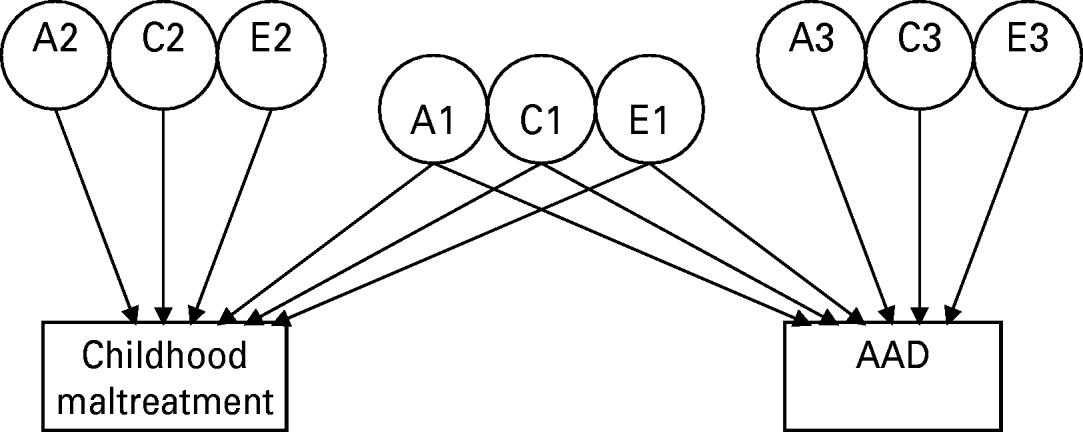
The extent to which overlapping genetic and common environmental influences explain the childhood maltreatment–AAD association can be estimated using a modified version of the Cholesky decomposition model (Neale & Cardon, Reference Neale and Cardon1992). In this modified Cholesky model, variance in the dependent variable is partitioned into variance overlapping with the independent variable and variance unique to the dependent variable. In the current model (Fig. 2), the first set of factors (A1, C1 and E1) contributes to both childhood maltreatment and AAD. The second set of factors are unique to childhood maltreatment (A2, C2 and E2), and the third set of factors are unique to AAD (A3, C3, E3)Footnote 1Footnote †. Analyses include incomplete pairs as well as subjects with incomplete data using the missing at random (MAR) assumption to account for individuals missing parental psychopathology. All twin models were fit using Mplus™ software version 4.2 (Muthén & Muthén, USA, 2006) using the WLSMV estimation option (for details of twin modeling with Mplus, see Prescott, Reference Prescott2004). We compared a fully saturated model to several reduced models. The goodness of fit of nested alternative models was evaluated using χ2 difference tests (with p<0.05 indicating worse fit).
Path diagram for association between childhood maltreatment–alcohol abuse and/or dependence (AAD). A, Additive genetic factors; C, common environmental factors; E, individual-specific environmental factors. The model shown is for one twin in a pair. For model identification, the corresponding childhood maltreatment and AAD loadings from A1, C1, and E1 are equated. Thresholds and means were estimated but not shown.

The mediating role of primary major depression on the childhood maltreatment–AAD association was investigated using multiple logistic regression. The influence of measured family-level variables (parental psychopathology, parenting, and parental demographic variables) on the childhood maltreatment–AAD association was investigated by structural modeling analyses of the phenotypic data. Family-level confounding was evaluated based on the change in the maltreatment–AAD correlation estimate in a baseline correlational model versus a partial mediation model that regressed AAD and maltreatment on each family variable. Standard errors and statistical tests were adjusted to account for correlated observations by allowing twins within pairs to be correlated (but the correlations across twins and among predictors were otherwise unstructured).
Results
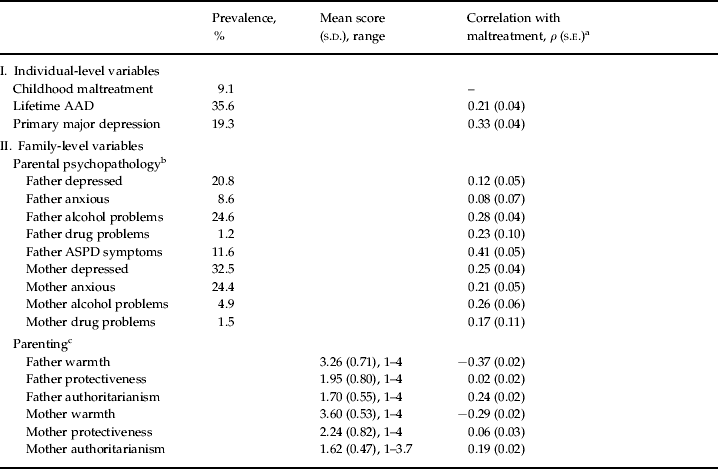
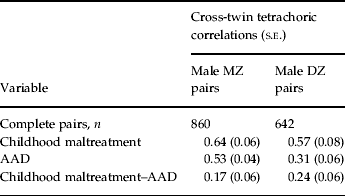
Descriptive statistics are listed in Table 1. Study participants were 35 years old on average (range 19–56 years). Preliminary analyses indicated that demographic variables (participant age, parental age at twins’ birth, parental birth year, parental education and parental income) were not significantly associated with childhood maltreatment, so these were not included in subsequent models. Twin pair correlations of key variables are shown in Table 2. Childhood maltreatment and AAD were positively correlated both within and across members of twin pairs. MZ pair correlations were greater than DZ pair correlations, consistent with genetic influences on childhood maltreatment and AAD. However, the cross-twin cross-trait (childhood maltreatment–AAD) correlations were not significantly different for MZ compared with DZ pairs, suggesting that the childhood maltreatment–AAD association was not explained by genetic influences.
Descriptive statistics for AAD, childhood maltreatment, primary major depression, and family history variables

AAD, Alcohol abuse and/or dependence; s.d., standard deviation; s.e., standard error; ASPD, antisocial personality disorder; n, number of participants.
a Correlations are tetrachoric for AAD and parental psychopathology and point-biserial for age and parenting.
b Parental psychopathology information only available for participants in the second wave of interviews (n range: mothers 3087 to 3099; fathers, 3020 to 3049). Other family-level variables are from the first wave of interviews (n range: mothers 3525 to 3527; fathers 3407 to 3415).
c Scores from Parental Bonding Instrument (Parker et al. Reference Parker, Tupling and Brown1979; Parker, Reference Parker1990).
Within-person and cross-twin correlations for childhood maltreatment and lifetime DSM-IV AAD

AAD, alcohol abuse and/or dependence; s.e., standard error; MZ, monozygotic; DZ, dizygotic.
Testing for biases from incomplete data
We found little evidence for bias from incomplete twin pairs. Prevalence of childhood maltreatment and AAD did not differ in participants from complete versus incomplete pairs (all p>0.05). The childhood maltreatment–AAD association differed minimally by completion status (i.e. among all individuals, tetrachoric correlation ρ=0.21, among individuals from complete pairs only, ρ=0.18). Individuals with and without parental psychopathological data did not differ on prevalence of childhood maltreatment or AAD, or in the maltreatment–AAD correlations.
Co-twin control analyses
Males who reported childhood maltreatment were 1.74 (95% CI 1.38–2.19) times more likely to meet criteria for lifetime AAD than were males who did not report experiencing childhood maltreatment.
In contrast, twins who experienced maltreatment were not at higher risk for AAD compared with their co-twins without maltreatment. Furthermore, risk for AAD was not significantly different for discordant MZ pairs (OR 0.92, 95% CI 0.40–2.01) and DZ pairs (OR 0.94, 95% CI 0.47–1.89). These results are consistent with there being common environmental influences that contribute to both childhood maltreatment and AAD.
Co-twin control analyses adjust for unmeasured familial effects and evaluate the strength of the relation between risk factors and outcomes. However, twin pairs discordant for childhood maltreatment are fairly atypical (here, 10% of twin pairs), so these results are primarily descriptive. The mechanisms for the childhood maltreatment–AAD association in discordant pairs may not be representative of the underlying mechanisms in the overall sample.
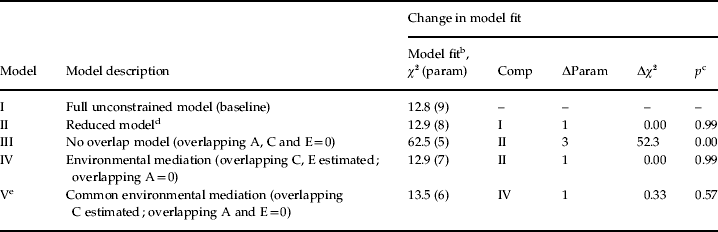
Bivariate twin models
First, a full bivariate model that estimated all possible unique and common parameters served as the baseline model (model I, Table 3; Fig. 2). In model I, the residual common environmental influence for AAD (C2 loading) was estimated at zero. A reduced model (model II, Table 3) with this parameter fixed to zero had no change in fit (Δχ2=0.0, df=1, p=0.99), and was thus used as the model to which subsequent models were compared. In model II, the maltreatment–AAD overlap was primarily explained by common environmental influences [C1=0.43 (s.e.=0.12)] in addition to the influences of non-shared environment [E1=0.15 (s.e.=0.17)]. There was no evidence for overlapping genetic influences [A1=0.05 (s.e.=1.2)]. Non-shared and common environmental influences account for 0.02 and 0.19, respectively, of the childhood maltreatment–AAD correlation (total ρ=0.21), providing substantial evidence that the childhood maltreatment–AAD association was due primarily to environmental sources shared by twins.
Goodness-of-fit results from twin models for associations between childhood maltreatment and lifetime AADFootnote a

AAD, Alcohol abuse and/or dependence; Param, number of free parameters (degrees of freedom); Comp, comparison model; A, additive genetic factors; C, common environmental factors; E, non-shared environmental factors.
a n=3004 twins from 1502 pairs.
b mplus WLSMV χ2 values are approximate, but χ2 difference test values (Δχ2) are exact.
c Values for p>0.05 indicate significantly better fit than the comparison model.
d Reduced model: no common environment specific to AAD.
e Best fitting model.
Model III (Table 3) was fit with no overlap by fixing the overlapping genetic, individual-specific, and common environmental influences at zero. This fit significantly worse than the reduced model (Δχ2=52.3, df=3, p<0.01), indicating good power to reject the hypothesis of no childhood maltreatment–AAD association. To test whether the overlapping risk for childhood maltreatment and AAD is due to environmental influences only, model IV (Table 3) was fit by fixing the overlapping genetic influences at zero. This model did not fit significantly worse than model II (Δχ2=0.0, df=1, p=0.99).
Finally, to test whether the overlapping childhood maltreatment–AAD risk is entirely due to common environmental influences, model V was fit by forcing the individual specific and genetic overlapping estimates (A1 and E1) to zero. Model V did not fit significantly worse than model IV (Δχ2=0.33, df=1, p=0.57).
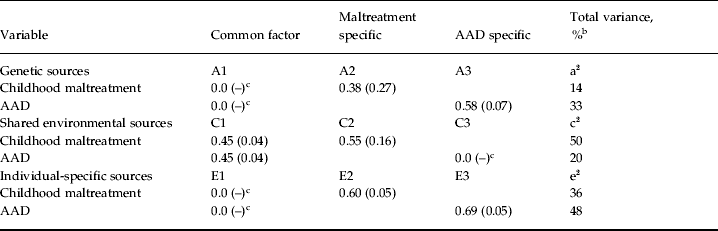
Based on these results, the common environmental mediation model (V) was selected as the best-fitting model for representing the basis for the childhood maltreatment–AAD association. Table 4 provides standardized parameter estimates and standard errors from model V. These results are consistent with results from the co-twin control analyses, and indicate little evidence for genetic or individual specific environmental influences on overlapping risk for childhood maltreatment and AAD.
Standardized parameter estimatesFootnote a and standard errors from best-fitting model for the sources of variance and covariance in childhood maltreatment and AAD

AAD, Alcohol abuse and/or dependence; a2, genetic influences; c2, common environmental influences; e2, individual-specific environmental influences.
a Estimates are from model V in Table 3. The first set of factors (A1, C1, E1) are factors shared between childhood maltreatment and AAD, A2, C2 and E2 are specific to maltreatment, A3, C3, E3 are specific to AAD.
b Variance totals do not all sum to 100% due to rounding.
c Parameter fixed to zero.
Mediation models
We examined the potential mediating role of primary major depression on the childhood maltreatment–AAD association using multiple logistic regression. Regressing the effects of AAD on primary major depression had a minimal positive effect on the strength of the childhood maltreatment–AAD association [before (β=0.56) and after (β=0.59) including primary major depression]. Therefore, no further analyses were conducted using primary major depression.
Given the evidence for familial confounding, we next examined the role of family variables as potential mediators of the childhood maltreatment–AAD association. We selected variables that correlated ρ=0.20 or greater with childhood maltreatment (see Table 1) and used these in a series of structural models. The correlation between childhood maltreatment and AAD (ρ=0.21) was compared with the residual correlation from a mediation model that regressed AAD and childhood maltreatment on the family-level variable. The change in the correlation reflects how much of the childhood maltreatment–AAD association could be accounted for by the family-level variable.
After regressing the effects of each family-level mediator, the reduction in R 2 (childhood maltreatment–AAD correlation squared) ranged from essentially 0% (mother depression) to 2.3% (father antisocial characteristics). The goodness of fit of complete mediation models was evaluated using χ2 difference tests. Forcing the maltreatment–AAD correlation to 0 (testing complete mediation) substantially worsened the model fit for each variable, indicating that none of the family-level variables individually accounted for the entire maltreatment–AAD association.
We also fit a combined family-level model that simultaneously included all family-level variables that explained ⩾1% of the childhood maltreatment–AAD association (ΔR 2 ⩾1%; father alcohol problems, drug problems, antisocial characteristics, warmth, and mother alcohol problems and warmth). The childhood maltreatment–AAD correlation was significantly reduced from 0.21 to 0.05 (p<0.001). After partialing the effect of all family-level variables, the residual childhood maltreatment-AAD correlation could be forced to zero without a significant worsening of fit (Δχ2=1.90, df=1, p=0.17). This indicates that the family-level variables mediate virtually the entire childhood maltreatment–AAD association.
Discussion
The purpose of this study was to examine the underlying influences that contribute to the childhood maltreatment–alcoholism association among males. Although research indicates that childhood maltreatment is associated with risk for alcoholism, no prior study has examined the mechanisms underlying this association among males.
Males who reported childhood maltreatment were 1.7 times more likely to meet criteria for lifetime alcoholism than were males who did not report experiencing childhood maltreatment. The results from the co-twin control and bivariate twin analyses suggest that the childhood maltreatment–alcoholism association largely reflects environmental factors in common to members of twin pairs.
Interestingly, these results differ from our findings for sexual abuse and alcohol dependence among females (Kendler et al. Reference Kendler, Bulik, Silberg, Hettema, Myers and Prescott2000), which are more consistent with the hypothesis that childhood sexual abuse is causally related to an increased risk for alcohol dependence. These differences reflect the importance of studying gender-specific mechanisms underlying the childhood maltreatment–alcoholism association.
Mechanisms for overlapping vulnerability
Given the evidence for unmeasured family environmental effects that influence risk for both childhood maltreatment and alcoholism, we next explored whether measured environmental risk factors can account for the childhood maltreatment–alcoholism association. Childhood maltreatment often occurs in the context of the same familial risk factors for alcoholism (Famularo et al. Reference Famularo, Kinscherff and Fenton1992; McCurdy & Daro, Reference McCurdy and Daro1994; Fergusson et al. Reference Fergusson, Horwood and Lynskey1996 b; Dong et al. Reference Dong, Anda, Dube, Giles and Felitti2003), possibly creating an association between maltreatment and alcoholism attributable to familial factors. We examined whether the environmental risk for alcoholism associated with childhood maltreatment would decrease in magnitude after adjusting for a variety of familial covariates (parental psychopathology, parenting style, parental demographic variables). Results were consistent with this hypothesis and provide evidence that alcoholism risk associated with childhood maltreatment is significantly attenuated after adjusting for the contributions of the familial risk factors we examined, including parental substance use, lack of parental warmth, and father's antisocial personality characteristics.
Limitations
The present study should be considered in light of several limitations. First, the clinical interview did not assess the number of occasions of maltreatment or the identity of the perpetrator. Therefore, the current study is limited in its ability to determine the importance of these aspects of maltreatment on alcoholism risk. In addition, we do not have measures of childhood maltreatment reliability and validity. However, previous studies indicate that retrospective acknowledgement of adverse childhood experiences is generally reliable and valid (Brewin et al. Reference Brewin, Andrews and Gotlib1993). Our definition of childhood maltreatment includes parent–child maltreatment, which could be a reaction to the child's behavior. It is possible that adolescent externalizing behaviors lead to harsh parenting and problematic alcohol use, rather than childhood maltreatment leading to alcoholism. Given the low prevalence of sexual abuse and neglect, we have insufficient power to conduct twin analyses separately for each type of maltreatment. Future studies should examine whether the mechanisms that underlie the maltreatment–alcoholism association differ for specific forms of childhood maltreatment. Our investigation of mediating variables was exploratory and other mechanisms are also possible.
We did not have data to test whether participants with alcoholism had worse memories than those without alcoholism, and we cannot rule out possible biases due to differential recall. However, if alcoholism is associated with greater forgetting of childhood maltreatment, the bias would reduce the maltreatment–alcoholism association, and we would underestimate the true effect.
The model results rely on the assumptions made in twin studies including: random mating with respect to genetic liability, equal environment assumption (EEA), and additivity and independence of genetic and environmental components. Although some evidence suggests that there is non-random mating for alcoholism (e.g. Maes et al. Reference Maes, Neale, Kendler, Hewitt, Silberg, Foley, Meyer, Rutter, Simononoff, Pickles and Eaves1998), the effect does not seem large enough to considerably bias the estimates in the current study. Previous studies of alcoholism in this sample are consistent with the validity of the EEA (Kendler & Gardner, Reference Kendler and Gardner1998). Assumptions of additivity and independence cannot be tested without information on other relatives, but studies of alcohol consumption in extended families suggest that gene–environment correlations contribute only a small amount of variance (Eaves et al. Reference Eaves, Eysenck, Martin, Jardine, Heath, Feingold, Young and Kendler1989).
Finally, our sample is limited to Caucasian Virginia-born twins. While the lack of minority representation is a significant limiting factor, results from this research can be used to inform future work using more diverse samples.
Summary and implications
Childhood maltreatment is associated with a wide range of problems that are correlated with both childhood maltreatment and alcoholism among males. After partialing the effects of parenting and parental psychopathology the childhood maltreatment–alcoholism association was dramatically reduced. Taken together, these findings are consistent with results from the co-twin control and bivariate twin models, and reflect a shared environmental vulnerability that co-occurs in families of males who experience childhood maltreatment. Given the evidence that the childhood maltreatment–alcoholism association is consistent with an indirect effect, preventive measures and interventions that target environmental vulnerabilities associated with childhood maltreatment may be effective in reducing alcoholism risk.
Acknowledgements
Data collection was supported by grants MH/AA-49492, AA/DA-09095 and AA-00236 from the National Institutes of Health and funds from the Carman Trust and the WM Keck, John Templeton, and Robert Wood Johnson Foundations. Analyses were supported by a Ruth L. Kirschstein National Research Service Award for Individual Predoctoral Fellowship 1F31AA018611-01 to K.C.Y.W. Patsy Waring, Frank Butera, Sarah Woltz, Barbara Brooke and Lisa Halberstadt supervised data collection; Indrani Ray and Steven Aggen provided programming and database management. Linda Corey and the staff of the Mid-Atlantic Twin Registry assisted with subject identification and recruitment.
Declaration of Interest
None.