Streptococcus pyogenes is a human pathogen causing a range of illnesses from pharyngitis and impetigo to necrotizing fasciitis and streptococcal toxic shock syndrome. The epithelial surfaces of the throat and skin are the principal sites of asymptomatic S. pyogenes colonization and the sites of most new S. pyogenes acquisition and transmission.Reference Lamagni, Darenberg and Luca-Harari 1 , Reference Walker, Barnett and McArthur 2
Healthcare-associated outbreaks of invasive S. pyogenes infections in both acute-careReference Daneman, McGeer and Low 3 – Reference Steer, Lamagni and Healy 5 and long-term care facilitiesReference Auerbach, Schwartz and Williams 6 – Reference Thigpen, Richards and Lynfield 12 have been well described. Between 5% and 12% of cases of severe S. pyogenes infection are healthcare associated.Reference Lamagni, Darenberg and Luca-Harari 1 , Reference Kakis, Gibbs and Eguia 4 , Reference Steer, Lamagni and Healy 5 The control of outbreaks in both acute-care and long-term care facilities is challenging, partly due to patients’ underlying medical conditions and behaviors.
In June 2016, S. pyogenes was isolated from 4 patients (1 bacteremia and 3 wound infections) from a male residential ward (ward A) in a mental health facility in Singapore. Because this was a surge in the baseline incidence of S. pyogenes (1–2 cases over the previous 6 months), an institution-wide outbreak investigation was initiated following the identification of these index cases. This facility is a 2,000-bed tertiary-care psychiatric hospital providing acute-care and chronic mental health services. It is situated on a large open-plan campus that includes 50 inpatient wards, 7 specialist outpatient clinics, and long-term residential care units, including assisted living quarters for patients with chronic mental health issues.
An outbreak control team was convened to determine the extent and epidemiology of the outbreak, to identify potential breaches in infection control practice, and to provide recommendations to prevent further transmission of infection. Because classical M protein gene (emm) typing for S. pyogenes was not available in Singapore, the outbreak control team decided to use whole-genome sequencing (WGS) as the primary typing method to assist traditional epidemiology during this investigation. Here, we report the utility of WGS in guiding the outbreak management, and we present a comparison if its performance with that of emm typing.
METHODS
Definitions
The study included patients and staff with S. pyogenes infection and/or asymptomatic throat or skin carriage between June 1, 2016, and December 31, 2016. Invasive disease was defined as the isolation of S. pyogenes from normally sterile sites. Community isolates were those with no known epidemiological link to the institution where the outbreak occurred. These isolates were collected from a different healthcare institution between November 2015 and April 2016.
Case Finding
To identify individuals with S. pyogenes infection, we collected oropharyngeal swabs from residents and staff members on the affected wards and swabs from residents with visible wounds on skin. Staff members were questioned regarding signs and symptoms of S. pyogenes infection in the month prior to the identification of the index cases. Medical records were reviewed to track the movements of patients and staff across the hospital to identify possible transmission routes.
Laboratory Investigation of Isolates
Samples taken from patients and staff members at the outbreak institution were processed remotely at the Department of Laboratory Medicine in Tan Tock Seng Hospital. The samples were cultured to detect S. pyogenes using standard methods (see Supplementary Methods). Cultured organisms were identified using matrix-assisted laser desorption/ionization time-of-flight mass spectroscopy (MALDI-TOF MS; Bruker, Bremen, Germany). Antimicrobial susceptibility testing was performed using the disc diffusion method according to the protocol established by the Clinical and Laboratory Standards Institute (M100-S25). 13 Thereafter, emm typing was retrospectively performed using polymerase chain reaction (PCR) and Sanger sequencing as described by the Centers for Disease Control and Prevention (CDC; http://www.cdc.gov /ncidod/biotech/strep/protocols.html). The emm types were assigned using the CDC database (http://www2a.cdc.gov/ncidod/biotech/strepblast.asp).
Whole-Genome Sequencing of S. pyogenes Isolates
The WGS of isolates took place on 3 occasions between June 17, 2016, and November 11, 2016, at the Genome Institute of Singapore. Genomic DNA was extracted from 43 isolates from patients and staff from the affected institution and from 24 randomly selected community-derived S. pyogenes isolates. The 24 community isolates (GAS001-024) provided background genetic information on S. pyogenes circulating locally. We performed single-nucleotide polymorphism (SNP)–based genome phylogenyReference Harris, Feil and Holden 14 , Reference Holt, Baker and Weill 15 using genomic regions filtered for mobile genetic elements (see Supplementary Methods section 1.2 for details) in silico emm typingReference Athey, Teatero, Li, Marchand-Austin, Beall and Fittipaldi 16 , Reference Kapatai, Coelho, Platt and Chalker 17 and in silico multilocus sequence typing (MLST)Reference Inouye, Dashnow and Raven 18 on the S. pyogenes WGS data (see Supplementary Methods). Clusters of closely related strains were identified by manual inspection of the phylogenetic tree; these are referred to as “genomic clusters” in the rest of the manuscript. Sequencing files (FASTQ) were submitted to the GenBank Sequence Read Archive (SRA; study accession no. SRP111309).
The outbreak control team determined the presence of person-to-person transmissions of S. pyogenes (directly or indirectly) based on integrating data from epidemiological investigations combined with pairwise SNP differences (from WGS) and emm types. We compared WGS and emm typing in their ability to support the correct identification of person-to-person transmissions and to guide the management of the outbreak.
RESULTS
As part of the outbreak investigation, 204 patients (11.4% of inpatients) and 152 staff members (6.9% of clinical staff members) were tested for S. pyogenes infection or colonization between June 1 and December 31, 2016. Streptococcus pyogenes was isolated from 35 patients (17% of all patients screened) in 8 wards (A–H) and 2 (1.3%) staff members. Of these 204 patients, 30 patients (14.7%) had dermal colonization and 1 patient (0.5%) had throat colonization. Also, 4 patients had soft-tissue infections requiring hospitalization in an acute-care facility. Of these 4 patients, 2 had bacteremia. One of the bacteremic patients had necrotizing fasciitis and required below-knee amputation, while the other was diagnosed with a psoas abscess. One patient had groin cellulitis requiring intravenous antibiotics, and the fourth patient required incision and drainage of a finger pulp abscess. All patients recovered. The characteristics of all the affected wards and infection control interventions are described in the Supplementary Methods.
Dermatological review of the patients in the affected wards showed that most patients suffered from xerosis. Dry skin is caused by abnormalities in the integrity of the barrier function of the stratum corneum, possibly due to overall reduction in the lipid production in the skin of elderly patients, to the constant use of harsh soaps for baths, and to the lack of adequate moisturizing. The dry skin leads to pruritus, and constant scratching of the itchy dry skin results in breaks and cracks of the skin, allowing for bacterial infection. These patients may also have poorer hygiene; hence, they are at higher risk for scabies or fungal infection. Once infected, the itch results in increased scratching, damaging the skin and allowing for bacterial infections.
Microbiological Results
All S. pyogenes isolates from the affected institution were susceptible to penicillin, erythromycin, and clindamycin and were resistant to tetracycline. Staphylococcus aureus was also isolated with S. pyogenes from many of the swabs taken from skin lesions. These S. aureus isolates displayed many different antibiograms and were not typed further as part of this investigation (see Supplementary Results).
Epidemiologic and Genomic Investigation of the Outbreak
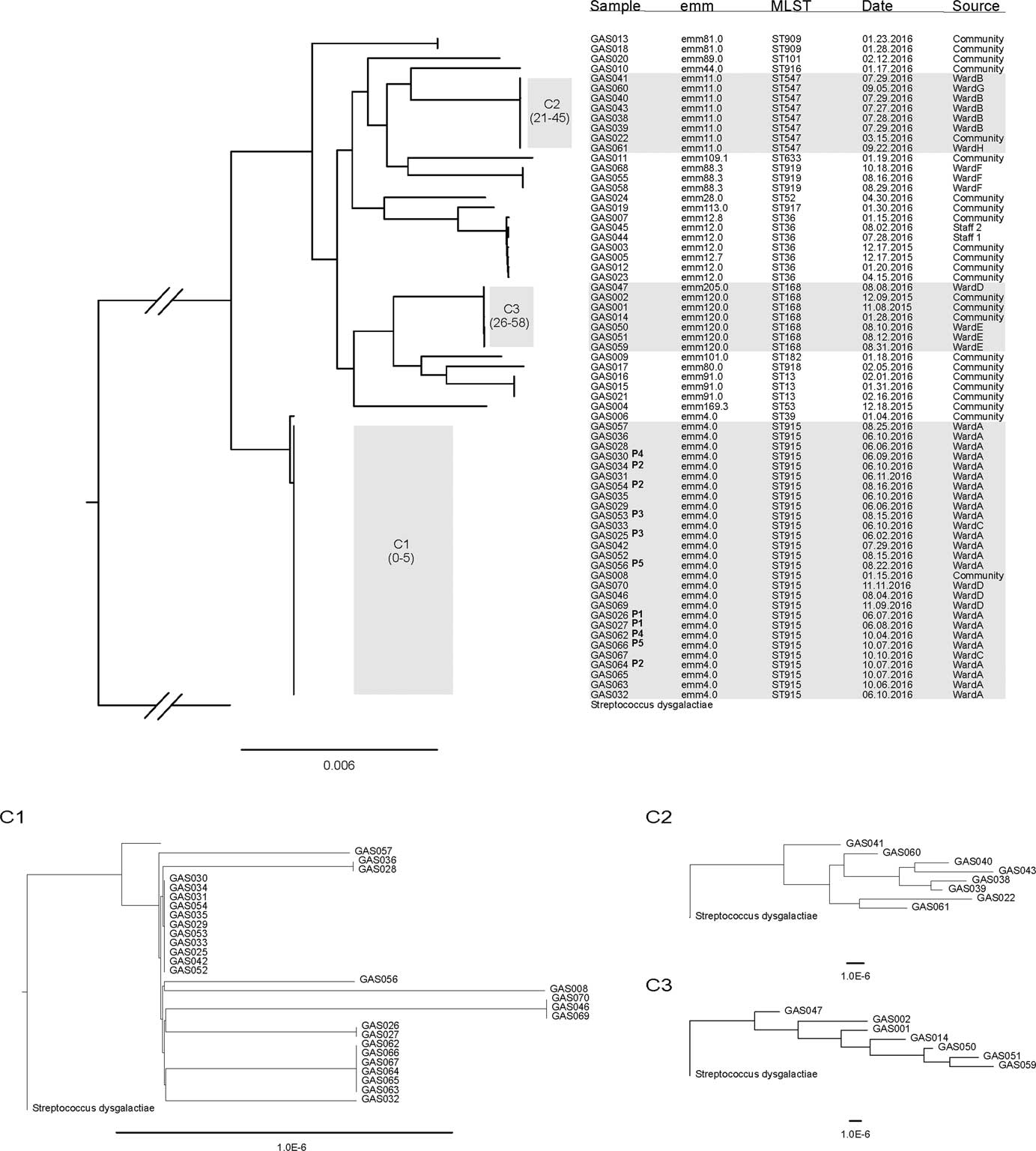
We performed WGS on 67 S. pyogenes isolates (22 from ward A, 5 from ward B, 2 from ward C, 4 from ward D, 3 each from wards D and F, 1 each from wards G and H, 2 from staff members, and 24 randomly selected community isolates) (see Supplementary Results). Sequencing identified 16 emm types that matched the emm types determined by Sanger sequencing (see Supplementary Results). In total, 16 different MLST types were identified, including 7 novel sequence types that were submitted to the PubMLST site (http://pubmlst.org). The new MLST types were ST547, ST909, and ST915–ST919 (Figure 1). Manual examination of strain genetic relatedness identified 3 genomic clusters (C1–C3) (Figure 1). Based on pairwise SNP differences, cluster C1 contained the most closely related strains and was the candidate cluster most likely associated with recent person-to-person transmission of S. pyogenes.
Approximately maximum likelihood phylogenetic tree of GAS isolates. A whole-genome phylogenetic tree, removed of mobile genetic elements that are comprised of 43 ward isolates and 24 community isolates was presented here and rooted relative to Streptococcus dysgalactiae (top figure). Grey boxes constitute the members in a given cluster. Symbols within the grey boxes; C1 denote the outbreak cluster, C2 and C3 denote the other 2 nonoutbreak clusters. Numbers in parentheses below the symbols C1–C3 represent minimum–maximum SNP differences between any pair of isolates within the given cluster. Bottom figures C1, C2, and C3 represent refined (recombination regions were further removed by Gubbins) rescaled versions of the relevant clusters shown in the top figure. The scale bars represent nucleotide substitutions per site. Five patients (P1-P5) had repeat S. pyogenes isolates.

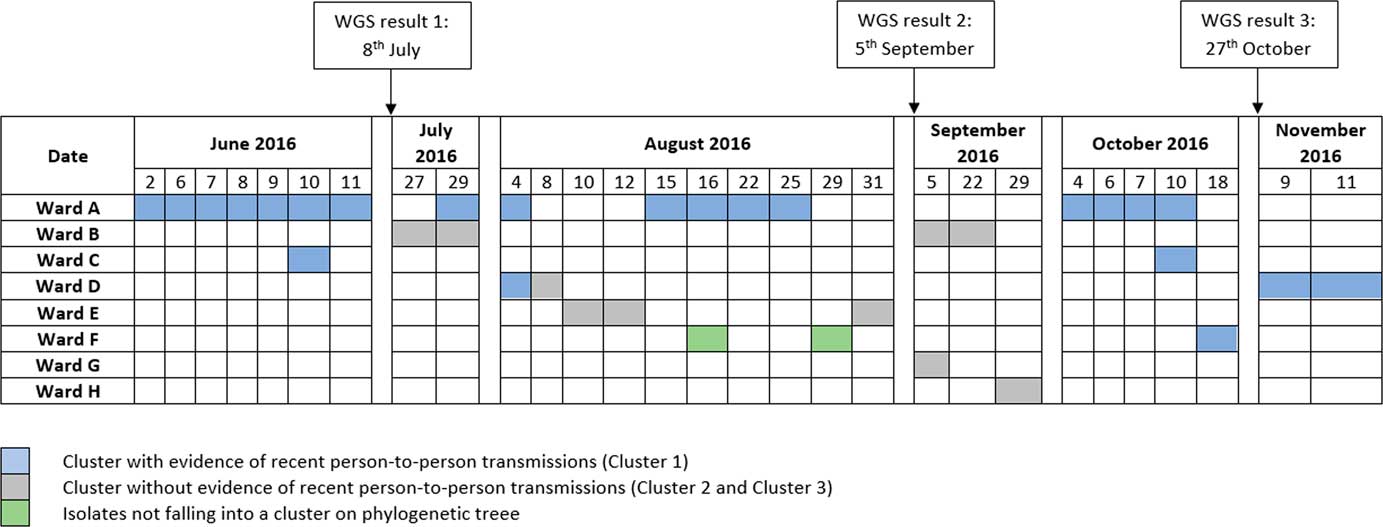
Cluster C1 included isolates from 16 patients from ward A, 2 patients from ward C, 3 patients from ward D, and 1 community isolate (GAS008). Ward A was the site of the initial temporal cluster of 4 infections that prompted the investigation in June 2016. Infections from this cluster occurred intermittently from June to the middle of October 2016 (Figure 2).
Temporal evolution of the S. pyogenes outbreak. Duplicate isolates are not reflected in the table. There may be >1 strain on some dates. Isolates from staff members are not reflected in this figure. NOTE. WGS, whole-genome sequencing.

Wards A and C are male residential wards for those with chronic mental heath issues. On investigation, most ward A patients (>80%) suffered with xerosis with a history of recurring superficial skin infections (Supplemental Material section 4). Most residents had frequent physical contact during their daily activities. Ward C was adjacent to ward A, and patients from these 2 wards shared communal living and dining areas, where they spent most of their time taking part in planned social activities. Most patients in ward C had no chronic skin lesions. Patients in ward D were mainly undergoing psychiatric rehabilitation, which included interacting with patients in other wards. These patients were independent in their activities of daily living, with no history of skin infections or chronic skin lesions. We could not establish an epidemiological link between patients from wards A and C, and those from ward D by assessing patient movement, staff cross-coverage, and shared activities. All patients and staff on these wards were negative for throat carriage of S. pyogenes. No link could be established between the community isolate GAS008 and the affected patients in the institution.
The results of WGS showed that the S. pyogenes isolates from June (wards A and C) and July, August, October, and November (wards A, C, and D) clustered tightly on the phylogenetic tree (cluster C1) and were genetically distinct from most of the background community isolates (GAS001–GAS024) (Figure 1). Cluster C1 isolates had pairwise SNP differences of 0–5 and were emm type 4 and ST915. The low pairwise SNP differences were consistent with recent transmission of S. pyogenes among patients involved in this cluster. Patients involved in this cluster received treatment for skin infections, eradication of throat carriage (if present), and 5 days decolonization with chlorhexidine body wipes. These measures were coupled with terminal cleaning of ward A.
Cluster C2 contained isolates from 5 patients from ward B, 1 patient each from wards G and H, and a community isolate, GAS022 (Figure 1). All ward B isolates were collected in July following a case of invasive infection, while isolates from wards G and H were obtained in September (Figure 2). Patients on these wards had xerosis but not recurrent skin infections or chronic skin lesions, which differentiated them from patients from outbreak ward A. Oropharyngeal carriage of S. pyogenes was identified in 1 staff member (STAFF 1) who worked on ward B. This discovery triggered a separate epidemiological investigation (see Supplementary Material). No epidemiological link could be established between ward B and wards G and H or the community isolate (GAS022). No further cases were related to cluster C2 after September 2016. The S. pyogenes strains in cluster C2 were all emm type 11 and ST 547. However, they were genetically more divergent than those in cluster C1 with pairwise SNP differences of 21–45, which is suggestive of a more distant common ancestor for this population and, therefore, independently introduced infections rather than recent transmissions in the wards. Additionally, the STAFF 1 isolate was genetically distinct from cluster C2 patient isolates.
Cluster C3 contained 3 isolates from the community, 3 isolates from ward E, and 1 isolate from ward D. These patients had xerosis but not recurrent skin infections, which differentiated them from the outbreak in ward A. Of these 7 samples, 6 were emm type 120.0, and all were ST168. These isolates had pairwise SNP differences of 26–58. No epidemiological link could be established between wards D and E or their community isolates. The outbreak control team therefore considered cluster C3 not to have arisen from recent person-to-person transmissions and likely to represent sporadic cases of infection with common community S. pyogenes strains.
Practicalities of WGS and Its Influence on Infection Prevention and Control Measures
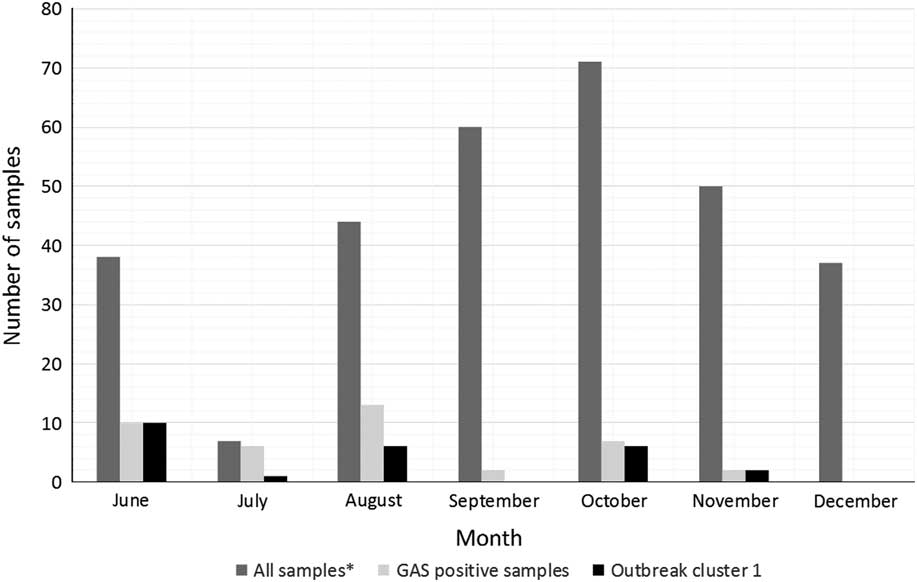
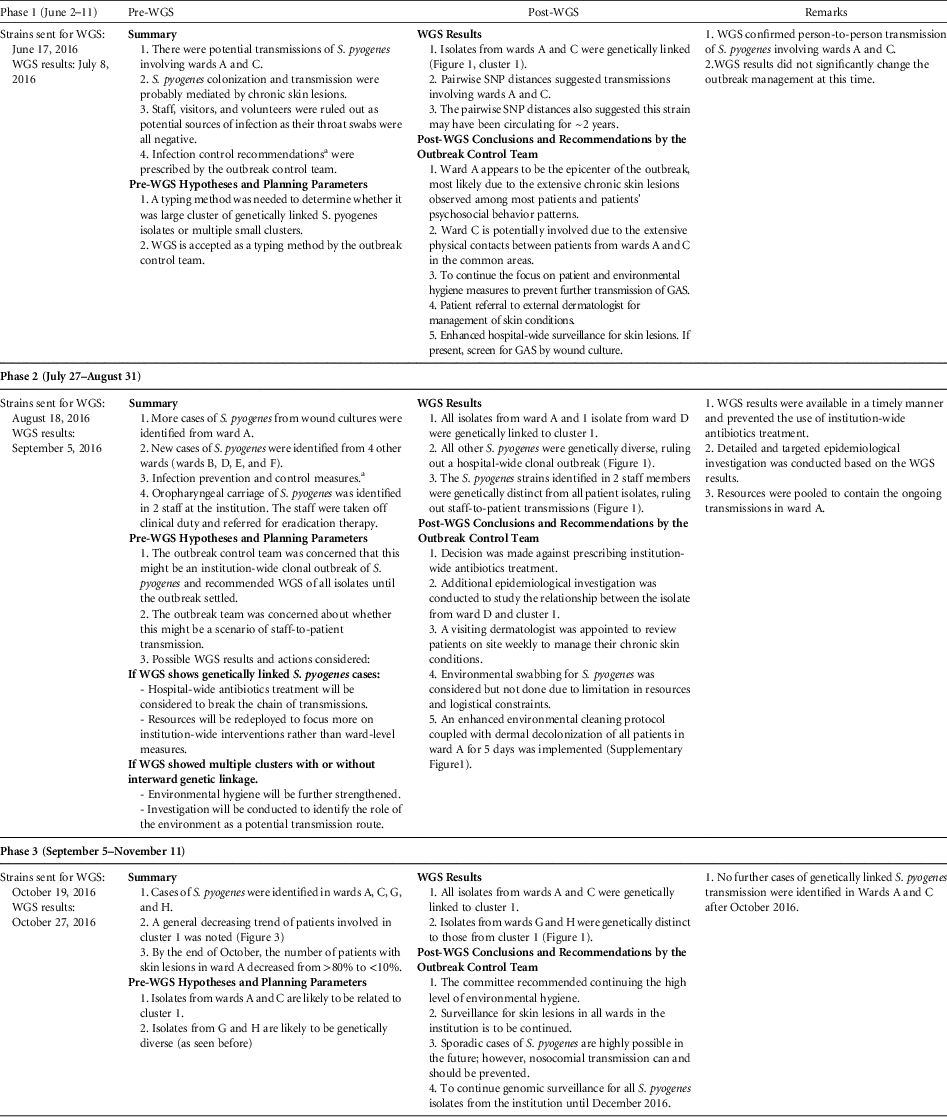
The outbreak control team decided on the timing of WGS depending on the number and characteristics of affected patients, the number of involved staff members, and the geographical distribution of the affected wards. The results of WGS-guided specific infection control interventions at different points in time over the investigation period are described in Table 1. The outbreak peaked between September and October and resolved by November 2016 (Figure 3).
Epidemiological curve of the outbreak. All samples collected and tested as part of the outbreak investigation.

Influence of Whole-Genome Sequencing (WGS) Results on Infection Prevention and Control Measures

NOTE. SNP, single-nucleotide polymorphism.
a Infection control recommendations by the outbreak control team differed depending on the stage of the outbreak, number of affected patients, and WGS results. Patients underwent screening for asymptomatic throat carriage, treatment for skin infections, eradication of throat carriage (if present), 5 days decolonization with chlorhexidine wipes, and measures to enhance personal hygiene. Staff members underwent screening for asymptomatic throat carriage, reinforcement of hand hygiene compliance, and education regarding S. pyogenes. Environmental hygiene was reinforced with terminal steam cleaning of the affected wards, and movement of patients, staff, and visitors was restricted. Visitors and volunteers who had entered the affected ward in the preceding 1 month were screened for asymptomatic throat carriage (Supplementary Table 1 and Figure 1).
The average cost of WGS over the outbreak period was US$220 per isolate, with a minimum turnaround time of 8 days. In contrast, the cost of emm typing by Sanger sequencing, once established at the Department of Laboratory Medicine in Tan Tock Seng Hospital was US$146 per isolate, with a turnaround time of 3 days.
DISCUSSION
Whole-genome sequencing generated typing data in a clinically relevant period for the management of this outbreak. Additionally, it provided greater resolution compared to emm typing in identifying a cluster with ongoing transmissions.
In this study, skin carriage acted as the main reservoir for S. pyogenes in cluster C1, with none of the patients having throat colonization. All cluster C1 isolates were of emm type 4, which accounts for 14% of emm types circulating in AsiaReference Steer, Law, Matatolu, Beall and Carapetis 19 and belongs to the emm E pattern group. The emm pattern genotype is used as a marker for tissue site tropism of S. pyogenes strains. Patterns A to C are associated with throat infections; pattern D is considered skin specific. Pattern E strains are considered general; they are associated with either throat or skin infection.Reference Steer, Law, Matatolu, Beall and Carapetis 19 – Reference Tewodros and Kronvall 21 A dermatologist was appointed to the institution, and individual patient skin care plans were implemented (Supplemental Material section 4). This intervention led to an improvement in the patients’ skin conditions, with no further S. pyogenes infections in the index ward.
Serious consideration was given to the use of institution-wide antibiotic treatment for S. pyogenes with the discovery of multiward involvement of S. pyogenes infections. This intervention has previously been described to control outbreaks of S. pyogenes in long-term care facilities.Reference Auerbach, Schwartz and Williams 6 , Reference Smith, Li, Tolomeo, Tyrrell, Jamieson and Fisman 11 , Reference Jordan, Richards, Burton, Thigpen and Van Beneden 22 Given the numbers of patients and staff members in the institution (at least 3,000), the cost, logistics, complexity, and possible adverse effects of this intervention would have been significant. The greater discriminatory power of WGS allowed detection of the recent transmission events in cluster C1 and the nonclonal sporadic nature of infections of clusters C2 and C3. This information allowed outbreak control interventions to be ward- and patient-based rather than institution-wide (Table 1). It also avoided unnecessary ward closures and restrictions on patient movement that would have disrupted the normal functioning of the facility for both inpatients and outpatients.
emm typing, which involves sequencing of the hypervariable region at the 5’ end of the emm gene, is the most commonly used S. pyogenes typing method in outbreak investigations.Reference Athey, Teatero, Li, Marchand-Austin, Beall and Fittipaldi 16 , Reference Facklam, Beall and Efstratiou 23 Sanger-based emm typing was performed in the laboratory at Tan Tock Seng Hospital to corroborate the WGS-derived emm types (see Supplementary Results). We concluded that the cases in cluster C1 constituted an outbreak of a single clone of S. pyogenes, which is supported by the strong epidemiological connection (nearly all from ward A), identical emm types, sequence types, antibiotic resistance profiles, and very close genome sequences (pairwise SNP distances of 0–5). Similar data (concordant epidemiology and pairwise SNP differences of <14 SNPs) have been used previously to support the conclusion of clonal outbreaks of S. pyogenes causing lethal puerperal sepsis,Reference Turner, Dryden and Holden 24 direct transmission between 2 closely related care homes,Reference Chalker, Smith and Al-Shahib 25 and emm59 invasive disease.Reference Engelthaler, Valentine and Bowers 26
The strains in clusters C2–C3 also had identical emm types (except for C3 wherein there was 1 strain with different emm type), sequence types, and antibiotic resistance patterns, but they had higher pairwise SNP differences: 21–45 for C2 and 26–58 for C3, respectively. Moreover, for cluster C3, there was little epidemiological connection between the patients. Higher pairwise SNP differences along with epidemiological data allowed us to preclude recent transmissions in clusters C2 and C3. Indeed, the genomic mutation rate of S. pyogenes has been estimated at 1.3–2.1 SNPs per strain per year,Reference Beres, Carroll and Shea 27 – Reference Turner, Abbott and Lamagni 29 suggesting that clusters with SNP differences in the range of cluster C2 and C3 may be independent non-outbreak infections by closely related (and probably locally circulating) S. pyogenes strains.
Importantly, the use of SNP counts in isolation as a proxy to help delineate clonal spread should be treated with caution. We believe that confounding variables pose difficulties in imposing a simple threshold for the number of SNPs between isolates to decide whether they are part of a recent transmission event. Koser et alReference Koser, Holden and Ellington 30 described the presence of a hypermutator phenotype in an MRSA isolate from an outbreak in a neonatal unit which resulted in that isolate having a higher number of SNPs than the other outbreak isolates. Other factors that may affect SNP differences include differing rates of accumulation of genome polymorphisms among S. pyogenes strains over time and organism population size.Reference Fittipaldi, Beres and Olsen 31 We also relied on a reference-based analysis, explicitly excluding annotated mobile genetic elements, to calculate SNP distances. This analysis, therefore, did not capture differences in these mobile genetic elements or other sequences not present in the reference used, which may have caused higher SNP differences.Reference Feil, Holmes and Bessen 32 Furthermore, the effect of environmental conditions, tissue site, or presence of other organisms (eg, S. aureus) on the mutation rate is unknown.
In future outbreaks of S. pyogenes, WGS should be considered the primary typing method to guide the outbreak management if rapid access to bioinformatics expertise to set up pipelines for assembly, alignment, and analysis of WGS is available. However, if this expertise is not immediately available, a 2-step approach with an initial traditional emm typing followed by WGS to further discriminate closely related isolates would be a reasonable strategy.
ACKNOWLEDGMENTS
We would especially like to thank the GIS platform for its support during the project in the areas of scientific and research computing (led by Chih Chuan Shih) and infection prevention and control unit of Institute of Mental Health of Singapore for their support in the outbreak investigation.
Financial support: The outbreak investigation was supported by Institute of Mental Health.
Potential conflicts of interest: K.M. is a consultant for bioMérieux for Global Point Prevalence Survey
SUPPLEMENTARY MATERIAL
To view supplementary material for this article, please visit https://doi.org/10.1017/ice.2018.101.