In this study, we analyze the representational field of two social objects, rural and urban, in a group characterized by a communitarian culture and an agricultural mode of production. In the domain of the rural community, its shared experience and memory trace interpretive theories, “which provide them with an understanding of the world around them, referring to the most diverse social objects that seem to have some importance – real or imaginary – for their existence, identity, continuity” (Oliveira, Fischer, Amaral, Teixeira, & Sá, Reference Oliveira, Fischer, Amaral, Teixeira and Sá2005, p. 126), a process that derives from the relationship between groups in the contemporary context and the history of the social categories to which they are linked.
Rural and urban are social categories that are in constant transformation and have marked the trajectory of human groups from the beginning (Endlich, Reference Endlich, Sposito and Whitacker2006; Williams, Reference Williams1990). Since the nineteenth-century Industrial Revolution, the wave of technological development has driven the productive system and provoked significant changes in different sectors of the organization and structure of societies, moving past a production system based on primary economic activities into the age of industrialization and progress. The same strategy is currently used in political calls for urbanization.
Solidified in social thought, representations of urban and rural categories express the contradictions between delay and progress, referenced in the idea of development, which entails antinomies caused by the logic supporting the mode of production. Cities came to be thought of as financial, political-administrative, commercial, technological, industrial, and knowledge centers, whereas rural areas were associated with agricultural activity and a natural way of life that was primitive in comparison to the advances of urban areas. According to Silva (Reference Silva2001), in Brazil, this myth of rural areas as primitive has historical roots and is linked to the nature of the colonial process in Brazil, from which emerges a new definition of rural:
As composed of both agribusiness and new social subjects: the neo-rural, who exploit the market niches of new agricultural activities (farming snails, exotic plants and animals, etc.); residents of high-end rural condominiums; clandestine subdivisions that house many domestic workers and retirees, who cannot survive in cities with the minimum wage that they receive; millions of family and pluriactive farmers, agricultural workers, and non-farmers; and still millions of excluded and disorganized without-withouts, who have neither land nor work, are homeless, in bad health, uneducated, and do not even belong to an organization such as MST that would be able to express their demands (Silva, Reference Silva2001, p. 37).
There are different expressions of rurality within this group that can be characterized by socioeconomic inclusion, by productive activities, or by identification with farmland as a social category and an identity space. The difficulty in the conceptualization of an object that is as multifaceted as rural also lies in the diversity of experiences and ways of appropriating space and in the possibility of applying criteria that differ from those used previously (demographic and economic characteristics of the population) and that focus on the territorial dimension, that is, the notion of rural and urban as ways of life. The approach to the rural-urban relationship contained in this latter perspective, although it presents an interesting alternative to understanding these territories as lived realities and forms of sociability, can serve to confirm the hypothesis that one overcomes the other.
In the era of mobility and the search for stability and security (Bell, Lloyd, & Vatovec, Reference Bell, Lloyd and Vatovec2010; Bell & Osti, Reference Bell and Osti2010; Halfacree, Reference Halfacree2011), rurality has been approached through various matrices integrated by reflections on the fate of urban and rural societies, from its socio-cultural organization and from its material and symbolic resources in the service of human groups (Oliva, Reference Oliva2010; Toledo, Alarcón-Cháires, & Barón, Reference Toledo, Alarcón-Cháires and Barón2009).
In studies of the rural reality in different nationalities and cultures, discussions of migrations and their impact on contemporary social organization are central to understanding the rural-urban relationship. From depopulated rural areas, even in countries with high rates of economic development, such as Italy (Osti, Reference Osti2010), to areas where resources are evenly distributed and poverty-rurality forms a historic dyad, the phenomenon of rural exodus is multifaceted and involves different variables in its genesis and process. In countries like Spain, a “masculinization of the field” has been observed (Camarero & Sampedro, Reference Camarero and Sampedro2008), which is a phenomenon also found in Brazil (Anjos & Caldas, Reference Anjos and Caldas2005). According to Brumer and Anjos (Reference Brumer and Anjos2008), selective migration through the removal of a given portion of women from rural areas would be motivated by employment opportunities in urban centers (attraction factor), a condition that could also be related to the exclusion of women from inheriting family property (expulsion factor). According to Nayenga (Reference Nayenga2008) and a report by the Food and Agriculture Organization (FAO) (Binswanger-Mkhize, Reference Binswanger-Mkhize2008), the reverse process was observed in Africa, where the field is being “feminized”. In this case, because of climatic factors and the lack of resources, the food security of the families that remain in rural zones, mostly women and children, is under question because a significant number of men migrate or die from HIV/AIDS (Lastarria-Cornhiel, Reference Lastarria-Cornhiel2006).
In contrast to the context previously described, the phenomenon of second home ownership (Halfacree, Reference Halfacree2011; Rye, Reference Rye2011) has grown worldwide in recent decades and has attracted the interest of researchers from various fields of study. The ownership of second homes shows a return to the rural world guided by the pursuit of the idyllic and the “need to enjoy one’s free time, which is reserved for relaxation, recreation, and leisurely activities,” by individuals or families with primary residences in urban areas (Larrabure, Reference Larrabure2009, p. 100).
Although we acknowledge that we cannot trace a dichotomous interpretation of interdependent contexts such as city and country (Bernardelli, Reference Bernardelli, Sposito and Whitacker2006), in actuality, a recurring problem falls within the speculative sphere regarding the rural world’s destiny, which would also involve the future of cities. From an analysis of functionally opposed perspectives, the complete urbanization of societies suggested by Lefebvre (Reference Lefebvre1975), and the “rural renaissance” offered by Kayser in 1972 (Kayser, Reference Kayser1990), Veiga (Reference Veiga2004, Reference Veiga2006) proposes what he calls “the middle path.” His first thesis is based on an erroneous reduction of the countryside to agriculture and the identification of this sector of production as industrialized, which leads one to consider the rural as less rural and, consequently, more urban. His second thesis is based on the idea of a “rural renaissance” and argues that the changing demographic trend is an indicator of the return to a village-based form of social organization and the redemption of a culture of local development. From Veiga’s perspective (2004), however, rurality is not dying or being reborn but being born. However, according to the author, this phenomenon of the “new rural” appears only in situations of great prosperity that are “capable of simultaneously driving three vectors: the conservation of biodiversity; taking economic advantage of their effects on the landscape, at least through various forms of ‘tourism’; and the alteration of the energetic matrix by increasing renewable resources” (Veiga, Reference Veiga2006, p. 348).
Discussions about the criteria that characterize the border between the two territories have motivated strong debates about the nature of geographical spaces and have verified that the classifications used to this point are inadequate (Caiado & Santos, Reference Caiado and Santos2004) because they require a contextual interpretation and must be considered as historical and relational realities (Abramovay, Reference Abramovay2003; Wanderley, Reference Wanderley2000). Attempts to update the concept of the objects in question, despite the complexity of the relationships established between the countryside and urban areas in the present context, still seek to approximate the diversity of the rural reality reflected in its social, economic, and cultural strategies and organizations; however, these attempts seem to obscure important weaknesses and shortcomings, such as the participation of a given rural population in defining what rurality actually is. If we refer to territories that include the way of life and that reflect the identity of the people, it seems important to recognize the identity dimension as a criterion for analyzing those territories.
In this sense, we believe that psychology, despite having been historically silent regarding the rural way of life (Albuquerque, Reference Albuquerque2002), could provide some strategic theoretical and methodological tools for understanding the various processes experienced by the rural category. When we discuss the country and the city, we refer not only to geographic territories but also to the relationship between two important social categories that have guided the formation of various social groups and organized movements. Souza (Reference Souza, Souza and Trindade2004) and Cabecinhas (Reference Cabecinhas, Martins, Sousa and Cabecinhas2006) have argued that despite the extensive debate on the future of local cultures motivated by economic and cultural globalization in the contemporary world, what has occurred is a strengthening of identity-forming processes aimed at preserving the uniqueness of local groups. Resistance by local groups makes us reflect on the ideological production of social categories, especially in terms of the confrontation between hegemonic thinking and minority groups.
In the case of the rural category, note the creation of images such as the “country man” –like the country bumpkin and the fool in Brazilian literature (Oliveira, Reference Oliveira2003)– based on the need to imagine a “national man” personified by the intellectual elite of the mid-twentieth century, an elite that made deals with the political classes and the economically affluent who were anxious for progress in Brazil. It was thought that progress would occur only if the industrial world overcame the agricultural, which helped spread a negative and inferior image of the rural man (Aleixo, Reference Aleixo2004). With the dissemination of this representation, a group of practices was established that confirmed a condition of passivity linked primarily to social policies that insist on demonstrating that:
“Laziness, fatalism, nomadism, ignorance, routine, passivity, submissiveness, naiveté, malnutrition, hardiness, and apathy are part of everyday life in the countryside. The formation of this stereotype, shaped by the perceptions of an urban mindset, aims to foster an entire model of development” (Martins quoted by Caliari, Reference Caliari2002, p. 69).
The construction of a social imagination full of negative stereotypes about rurality and its diffusion through communication, from didactic-pedagogic materials and cultural productions, also affects those who establish public policy. This situation is likely to result in propositions that are contrary to the legitimate interests of rural communities. Therefore, Souza (Reference Souza, Souza and Trindade2004) warns of the dangers of constructing negative categories and their interface with the very production of public policies because “considering that my group and I are not affected, and we are not responsible for the problem, then there is no commitment to a solution” (pp. 65-66). This logic produces disparate spaces of power by associating groups with territories and constructing objective and symbolic boundaries to ensure distance between them. Social representation theory seems to provide the epistemological and methodological foundations for adequately understanding this reality (Jovchelovitch, Reference Jovchelovitch2008; Permanadeli, Reference Permanadeli, Almeida, Santos and Trindade2011).
Social representation theory is used in this study because of its ability to elucidate the dimension of reality that is symbolized by individuals (Jodelet, Reference Jodelet2009; Marková, Reference Marková2006; Moliner, Reference Moliner2008). The concept identified the point of intersection between the psychological and social, and it began a robust discussion in social psychology about the content that mobilizes social practices from the contextualized field. The theory accepts the complexity of the phenomena given the uniqueness of the groups and their cultural, political, economic, and religious inclusion. From this perspective, studies of social representation become a major challenge for researchers who, when confronted with their own paradoxes and ambiguities, need to consider that “it is not reality as the experimenter imagines it that the subject reacts to, but another that may be distinct: a represented reality, that is, appropriated, structured, transformed – the reality of the subject” (Abric, Reference Abric and Jodelet2001, p. 156).
The reflections presented in this study were guided by the analytical-conceptual resources provided by social representation theory (Abric, Reference Abric and Abric1997, Reference Abric and Jodelet2001, Reference Abric and Abric2003a, Reference Abric, Moscovici and Buschini2003b; Doise, Reference Doise1989, Reference Doise2002; Jodelet, Reference Jodelet and Jodelet2001, Reference Jodelet2005; Moscovici, Reference Moscovici2003) and are based on the theory’s structural approach (Abric, Reference Abric and Abric1997, Reference Abric and Jodelet2001, Reference Abric and Abric2003a, Reference Abric, Moscovici and Buschini2003b; Guimelli & Rouquette, Reference Guimelli and Rouquette2004). Regarding the notion of meaning, which integrates the different approaches linked to the general theory of Moscovici (Reference Moscovici2003), Abric (Reference Abric and Jodelet2001) reports that the representation is “the product and the process of a mental activity through which an individual or a group reconstructs the real with which they are confronted and assigns it a specific meaning” (p. 156). Regarding the structural approach’s contributions to research in the field of social representations, which is used in the study of many social objects (Ajcardi & Therme, Reference Ajcardi and Therme2007; Camargo & Wachelke, Reference Camargo and Wachelke2010; Melista & Madoglou, Reference Melista and Madoglou2008; Wachelke, Reference Wachelke2009), Sá, Oliveira, Castro, Vetere, and Carvalho (Reference Sá, Oliveira, Castro, Vetere and Carvalho2009) highlighted that this perspective allows for a comparison of the representations for different groups and the identification of central themes that organize their content, thereby expanding the field research on a given phenomenon through the relational analysis between the objects that participate in their formation and dynamics.
The structural approach, which is more focused on the cognitive dimension of representation (Lo Monaco & Guimelli, Reference Lo Monaco and Guimelli2011), has made important contributions to the study of social identity and group processes, considering that the central nucleus theory (Abric, Reference Abric, Moscovici and Buschini2003b; Sá, Reference Sá1996a) has allowed us to understand themes that are fundamental to the organization of social groups. Despite its conceptual base, which is focused on the construction of more stable and consensual meanings within the research framework of a given object of representation, the analytical resources of the structural approach also consider the immediate context of production for meanings that emerge from a specific mobilizing situation. On the dynamics of the representational system, Sá (Reference Sá1996a, Reference Sá1996b) explains that, as phenomena, representations are simultaneously stable/mobile, rigid/flexible, and consensual/different between individuals, and those functions are organized according to central and peripheral systems. For the central nucleus, the functions are intended to generate meaning and organize other elements of the representational field, and the core is less prone to situational contingencies. In contrast, the peripheral system is more connected to reality and provides the representation with contextual elements without affecting its core meaning.
Considering the relationship between the social representations of two objects (Guimelli & Rouquette, Reference Guimelli and Rouquette2004), with a particular interest in discussing the identity-constructing function that the conjugated representational field may play in the social organization of the group investigated, this study aimed to analyze the structure of the social representation of the rural and city objects among the residents of a rural community.
Method
Participants
The characteristics of the community where the study was conducted made it a context conducive to investigating social representation: A sense of belonging to the collective, sharing beliefs and values, living among families in the territory, and deciding to ensure a certain unity to the choices that involve the common reality. In this sense, we speak of a field study of representations (Jodelet, Reference Jodelet and Jodelet2001) in which the knowledgeable subject is a member of a rural group and is embedded in a social community context. The rural community was composed of 167 families, with a production system based on family farming, a socio-religious model according to the basic ecclesial communities (Mainwaring, Reference Mainwaring2004), strong interaction between families, the development of communal activities, and a school system based on the pedagogy of alternation (Nosella, Reference Nosella2007) that focuses on the rural reality.
A total of 200 residents of a Brazilian rural community, aged between 7 and 81 years and distributed across four generations, participated in this study. The sample consisted of 50 members from each generational group, with the following age ranges defining each group: ages 7-12 years constituted the fourth generation, ages 15-25 constituted the third, ages 35-45 constituted the second, and those aged 60 years or more constituted the first. A total of 25 females and 25 males were interviewed from each generation. We note here that the sex variable was used only to balance the sample.
Procedure
To provide the respondent with an appropriate interview environment (Mantovani, Reference Mantovani, Mantovani and Spagnolli2003), the sample collection was conducted while following the routines of the family and the community. This strategy allowed access to local dynamics during the period in which the study was developed. Considering the agricultural and communal reality of the families, we collected the data while respecting the dispersion of individuals in the different spaces of the territory (bar, church, health center, soccer field, schools, farms, and residences). However, we note that, in agreement with the participants, the individual interviews were preceded by explanations about the objectives and procedures used in the research, and each participant read and signed an informed consent form to participate in the scientific research.
The content referring to the representational field of the objects covered in the study was obtained through the technique of free association (Abric, Reference Abric, Moscovici and Buschini2003b), with the production of associative responses to the terms “rural” and “city”. This technique consisted of first presenting the participants with an inductor term and then asking what each individual “thinks, feels, or imagines” relative to the object presented. The aim is to obtain words or expressions (three to five elements) that will compose the data corpus. Next, we asked the participant to explain the content evoked to contextualize the associated terms. This complementary strategy is interesting because it increases the probability of understanding the phenomenon in a more dynamic way that is closer to the reality symbolized by the subject. According to Trindade, Santos, and Almeida (Reference Trindade, Santos and Almeida2000), the methodological proposal of structural analysis still has limitations with regard to capturing the tensions between the meanings that form social representations.
For the treatment of the data gathered from the free association technique (Abric, Reference Abric, Moscovici and Buschini2003b), the EVOC-2003 software (Ensemble de Programmes L’Analyse dês Évocations) (Vergès, Reference Vergès2000) provides four quadrants with the most significant elements positioned according to their importance in the structure of the represented object according to the criteria of frequency and recall order. For the treatment of the data resulting from the explanation of free association, we categorized the information obtained in compliance with the guidelines for thematic categorical analysis, as suggested by content analysis (Bardin, Reference Bardin2002, Reference Bardin, Moscovici and Buschini2003).
Results and discussion
Configuration of the representational field of rural and city
The associative terms that referred to the objects of representation and composed the data corpora were classified by the participants according to their polarity (positive or negative elements), thereby providing complementary information about the content evoked. Thus, it was possible to identify the relationship between the individuals and the objects studied, considering that this procedure requires the subject to make an evaluation and take a position (Brown, Reference Brown2000).
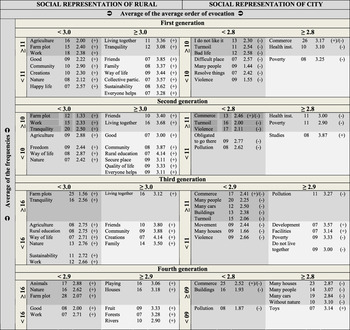
The content of the free associations linked to the countryside was generally evaluated as positive. In the first generation, 93.65% of the participants highlighted the positive elements of the representational field of countryside, and the percentages for the other generations stayed close to this value (94.07% in the second, 95.56% in the third, and 95.98% in the fourth), indicating cohesion between the value systems used as a reference by the generational groups. In treating territories with a historic relationship of conflict, which has possibly merged with the imaginations of the groups that belong to these territories, the logic of group discrimination (Brown, Reference Brown1997, Reference Brown2000) predicts the selection of primarily negative elements to signify the outgroup, in this case, the urban. However, in the representational field, we identified only negative evaluation as the main process in the three first generations (59.13% in the first, 73.63% in the second, and 54.73% in the third). Positive evaluations of the elements were prevalent (52.80%) in the fourth generation. Also related to the data for the object of the city, Figure 1 shows that the positive elements were more dispersed (less cohesion between meanings). The negative elements were more salient (Pecora & Sá, Reference Pecora and Sá2008), which favored their presence in the structural field of representation.
Hierarchical analysis of free associations for the inductor terms rural and city. The data are presented in the following order: term evoked –absolute frequency– mean of the average order of evocation. The quadrants for rural and city were condensed into this figure and specified according to the four generations studied.

Figure 1 shows the analysis of the free associations for rural and city in each generational group, and it is evident that only the positive elements remained in the representational field for rural. By contrast, we find elements that were negatively and positively evaluated for city. We identified an element (commerce) that was evaluated as positive by some participants and as negative by others.
According to Figure 1, the central nucleus of the social representation of rural differed between generational groups, keeping the similarities and specificities of the relationship between individuals and the object directly connected to their social reality. In general, the meanings that form the representation of rural complement one another without apparent contradictions but have idiosyncrasies that are consistent with the inclusion of individuals in the community of different ages. The farm plot is the only element common to the four generations and acts as a unifying and stabilizing element (Abric, Reference Abric and Jodelet2001), a summary of the social representation of rural, and a synonym in circulation in the everyday vocabulary of the group. The farm plot unites all of the other meanings present in the representational field (using the term “farm plot” as a synonym for rural can be found in a few fragments of the participants’ narratives in the section that includes explanations for the evocations listed).
With regard to generational singularities, using the central nucleus of the fourth generation as reference, we saw the construction of meanings that prioritize descriptions of the natural environment (animals and nature) in addition to the farm plot summary element. We also saw a periphery that contained elements linked to children’s activities (playing) and that recognized work as a fundamental dimension of the rural way of life (an element also present in the other generations). The positive rating of the context (good) and the element houses complement the profile that suggests identification with the represented object.
We found a set of similar meanings from the third generation. The elements agriculture, work, and tranquility form a strong central nucleus in the first three generations. They still appear in the first periphery, even when they are not present in the central nucleus. This set of meanings reflects the importance of agricultural activity for group survival, the significance of work as a value that structures the social and family constitution, and the characterization of the rural as an agreeable way of life to its members. These elements assume the function of protecting the nuclear meaning of rural and reinforce the symbolic strength of the term “farm plot,” thereby confirming its importance in the representation of the rural object despite the negative connotations that the term has acquired in certain discursive practices outside of the rural universe (Oliveira, Reference Oliveira2003). The peripheral system, in turn, provides complementary elements that describe the importance of the relationships between the members of the group, natural resources, the internal social organization according to the community model, and the values that guide the life of the people in this space. Above all, the peripheral system validates the construction of the social representation of the rural as a way of life that is recognized and appropriated by the participants in the study.
Through the explanations of the evoked content provided by the participants (N = 200), we contextualized the meanings that compose the studied representational field (certain fragments of the narratives are shown to illustrate the explanations used). Rural, as a reality conceived by the group of participants, consisted of the following factors: (a) basic organization with a network of relationships founded on practices of solidarity and shared daily experiences among the members of the community (f = 58), “Living together is good because it better enables you to be a farmer. People are willing to donate their time, will volunteer to help, and are better friends”; (b) transmission of certain values centered on family organization from generation to generation (f = 11), “It is a past culture, and people create a mindset, a rural identity. I see myself very differently from the city. We are in a rural environment and live accordingly; we have training ... schools, families”; (c) experience of time as freer and more flexible and as a function of family-based agricultural production (f = 20), “Here we are not ordered around; we have no boss. We have more time to do things and make plans. We enjoy things more; we have more tranquility”; (d) development of an integrated system of production and consumption based on agricultural work, which lends sustainability to the rural context (f = 47), “Everyone has the opportunity to work on what is theirs. They have a dignified life, with solidarity and unity. Each family works and lives on their land. Here we have everything, from chicken to birds, and do not have to buy everything”; and, finally; (e) fighting to stay on the field (because of drought, the devaluation of agricultural products, and the lack of effective public policies concerning rural issues) and understanding it as a way of life with which they identify (f = 12), “Those who can stay try to keep this lifestyle, to live in the country. It is a choice. It is a job that has suffered because it is discriminated against. They think people from the countryside are brutes, but our taxes are going to the city and are poorly distributed. Everything is concentrated there”.
An analysis of the representational field, derived from the inductor term city (Figure 1), suggests that commerce is the nuclear element common to all four generations (located in the closest periphery for the first generation) and that shows the greatest frequency (f = 26). The element commerce was rated positively (f total = 54), (1) considering its importance in granting access to products that are unavailable in the rural territory and (2) in commercializing agricultural production. However, commerce was also rated negatively (f total = 27) (1) for being concentrated in the city, thereby making immediate access difficult; (2) for representing control over agricultural production by establishing the value of the products from the field; and (3) for symbolizing excessive consumerism.
All other elements of the central nucleus were evaluated as negative. The affective (not like) and evaluative (bad life) components were specific to the first generation and reflect the restricted contact of this group with the urban space. The third and fourth generations, in addition to the common nuclear element, exhibited elements in the central nucleus that portray the functioning and structure of the city and were connected by the idea of concentration and excess (many people, many cars and buildings). These elements were still present in the near periphery of the first, third, and fourth generations. The logic of concentration associated with the city is also linked to the element turmoil (in the three first generations), thus reinforcing the meaning of city that is supported by the image of a centralized territory of commercial, political, and economic relationships. This image also presents social issues such as violence (present in the central nucleus of the second generation and in the near periphery of the first and third generations), pollution, and poverty (the latter two were in the peripheral system).
In the near periphery of the first and second generations, health institution, difficult place, resolve things, and forced to go there express the relationship of dependence on services offered exclusively in the city that are rated negatively because of difficult access, which indicates a problematic situation that should be resolved. We identified the first positive elements of the representational field of the city in the far periphery. These elements were specified according to the interests of the generational group: studying portrays a concern of the second generation in terms of education for their children; the third generation indicates, in turn, development and facilities as opportunities for employment and access to technological resources; and, finally, the fourth generation highlights the desired toys that are abundant in stores in the city.
The constitution of the city, as represented by the participants of the study, is interpreted as (a) the result of a rural exodus provoked by the lure of a given portion of the rural population who were misled by an overrated image of the urban, and by the lack of public policies focused on life in the rural environment (f = 23), “People aspire to leave the farm, go to the city, and have a better life there. They think that they will find a good life but are disappointed ... they add to the problem of overpopulation and expand the slums”; (b) generated by populational accumulation, which results in even more structural excesses (such as cars, stores, buildings, and others) (f = 47), “It is where there are more people, and the government favors them more there. So it all depends on the city, and all the people that accumulate there”; (c) determined by the position of the main center that brings together many different resources (f = 31), “It is an economic and political system of concentration. It is this way because of the structure of development and technology that is concentrated in the city to keep power there”; (d) the result of establishing poor social relations, based on individualistic values (f = 19), “People are afraid to know each other and think that it does not matter. They are so involved in work that they only worry about profit. I think there is a lack of interest in actually meeting other people because they are so individualistic”; (e) as a consequence of the capitalist model that drives their operations, which regulates competitive work relationships, production, and the consumption of high-end goods (f = 33), “The media also goes through this rush and competition. They are exploited there and have to give it their all to have what the others have. Their time is for working. For their work and the result of that work, I think production is what determines everything”; and (f) a result of the fragmentation of society into different levels of socio-economic inclusion as a function of a system that generates and maintains social inequality, which reveals its weakness concerning such issues as hunger, unemployment, and violence (f = 13), “The city has the bosses that give orders, that have the power in their hands and exploit the poor. There are many that do not have jobs, cannot obtain things and are stuck in the slums”.
Representational fields
The results reveal two important processes that help construct the social representations of the objects discussed: (I) the relationship between the rural and city objects as represented realities and (II) the function of these representations for the group.
It is appropriate to note Jodelet’s contribution (2001) on understanding the field of social representation. According to that author, social representation, as a form of knowledge, involves the relationship between a subject and an object, which gives the representation its own characteristics. Thus, the representation gives meaning to the object that in its practical sense or as a reference system acts as an important instrument in guiding individuals and social groups on how to act in the world and in relation to others. Jovchelovitch (Reference Jovchelovitch2004) complements this epistemic framework by stating that the social representation is a “structure that mediates between the subject-other, subject-object. It is formed by work, i.e., the representation is structured though a work of communicative action that links subjects to other subjects and to the object-world” (p. 22). The communicative action to which the author refers is linked to the ability of a representation to articulate meaning and elaborate on the symbolic dimension of an individual’s reality.
Such considerations clarify the interpretation of the empirical field studied in that they provide feedback on the analysis of the representational system in which the object is found. That system constitutes the endogroup’s own reality and assumes what we might call its opposite-complementary meaning. From this dynamic, the very identity of the object is called into question. By advancing the analysis of its organization and content, we have also strived to understand the construction of a space for social identification for the rural group because the subject and object share a field of meaning in this investigation.
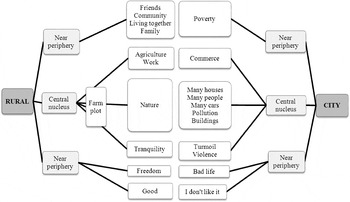
Guimelli and Rouquette (Reference Guimelli and Rouquette2004) highlighted the importance of considering an object of social representation together with the other objects that are, to some degree, associated with it. From this perspective, the type of relationship that exists between the objects involved is revealed by the set of meanings, which indicates the semantic interpretation (Bardin, Reference Bardin2002, Reference Bardin, Moscovici and Buschini2003; Barthes, Reference Barthes2006; Santaella, Reference Santaella2004) as the most appropriate path to analysis. To make a comparison between two fields possible, we integrated the data corpora of the generational groups into a single bank per object. From the hierarchical analysis of free associations generated by the EVOC-2003 software, we compared the central system and the near periphery of the objects, rural and city, as shown in Figure 2. It is important to note the salience of the content projected in the comparative schemes because they were subject to the criteria of frequency and recall order according to the structural analysis method.
Comparison between the social representations of the objects rural and city from the hierarchical analysis of free associations. For establishing the rural quadrant: limit frequency = 29 and evocation average = 2.9; for the city quadrant: limit frequency = 30 and mean evocation = 2.8.

The relationship between the content of the representational fields provided a mirror-type comparative scheme. In the central nucleus are the interconnected themes of nature/artificiality, agricultural production/commerce, tranquility/violence, and turmoil, surrounded by a periphery that reveals an investment in social relationships and is characterized by people living together harmoniously in the rural territory, in contrast to living in poverty, which is a response based on the lack of solidarity and integration among city dwellers and promotes social inequality among different social classes. In the first periphery, or contrast zone, we identified the presence of elements that indicate the evaluation of the social categories addressed in accordance with the direction of polarity expected for the processes that distinguish groups from one another (endogroup preference vs. assigning negative value to the exogenous group).
From the representations of the categories to the comparison between representational fields, the content analysis suggests the establishment of antinomy between the meanings that compose them. Through this dynamic field, the conceptual construction (what constitutes rural and city for the members of the group addressed) is established on a relational plane of meaning production (Barbosa, Reference Barbosa2004). According to the discussion by Coelho (Reference Coelho2006), meaning is not given to an object alone because the process of signification assumes the existence of relationships between objects as an inherent condition. In other words, in creating a concept, its relational meaning also emerges, which means that the objects rural and city as represented realities are constructed reciprocally. They impose their characteristics on each other and become defined through the process of comparison. It is important to note that in the case of the social representations of rural and city analyzed in this study, despite having two related objects, the given meaning depends on the context in which individuals are embedded. That is, such representations are not constructed as concepts outside of a reality but, above all, overlap in content and process.
From the proposed considerations, we highlight several themes, according to the comparative scheme, that drive the representational field of rural and city as dialogic objects (Marková, Reference Marková2006) (Figure 2): subsistence production vs. consumption and capital accumulation, social vs. individual, and natural vs. artificial. This thematization brings us to the historical relationship between the urban and rural contexts, marked by conflict, integration, opposition, and occasionally, the annihilation of one to affirm the other. The urban-centric political-economic perspective, guided by the developmentalist proposal to overcome the rural way of life that represents an obstacle to national progress, is reflected in this dynamic (Aleixo, Reference Aleixo2004; Caliari, Reference Caliari2002; Williams, Reference Williams1990).
Currently, this line of tension arrives in the group imagination loaded with symbolic force and is present in the everyday conversations of the group or in the circulation of negative stereotypes through the media (evident in characters from novels, sitcoms, and comedies in which the rural man is portrayed as the country bumpkin, ugly, or stupid, among others). These stereotypes generate further debate and grant the relationship a conflictive status, which is conducive to the group position.
Several studies (Dedej, Reference Dedej2005; Moreno & Moons, Reference Moreno and Moons2002; Nuvola, Reference Nuvola2005) have highlighted the comparative process, mediated by representations, as a key mechanism for establishing spaces of social identification. Arcuri and Cadinu (Reference Arcuri and Cadinu1998) state that the representations formulated by social groups about other groups do not consist of simply assigning characteristics but are driven by an active evaluation process that operates based on the simplification of the external group through the use of stereotypes. This system is based on categorization that, as mentioned by Brown (Reference Brown1997, Reference Brown2000), involves a cognitive process that is inherent to human existence by which the individual can appropriate the world because a confusing and complex context requires the development of a strategy for simplifying and ordering. The effectiveness of the “world in categories” allows individuals to understand and behave according to the standards of the group to which they belong and with opposing groups (in some contexts, this mechanism is fundamental to preservation, including the preservation of life itself, as in the case of ethnic conflicts). The product of this socio-cognitive equation emerges from a dynamic that minimizes internal differences and maximizes intergroup differences, therefore making explicit the positive rating of the endogroup and the negative rating of the opposing group in the established relationship, as revealed by the results of this study. Mazzara (Reference Mazzara1997) stresses, however, that the categorical mechanism of producing stereotypes is not determined solely by cognitive factors but also involves psychological processes that are activated in relationships between individuals and their social context, assuming the presence of tension between the group to which an individual belongs and other groups.
From the structural analysis of the social representations of rural and city, we understand that the investment in a relational semantic field, as expressed through antinomies as facets of the object, acts as a resource for constructing identity that is guided by the perception that the rural group has of both itself and the opposing urban group (Abric, Reference Abric and Abric2003a). We found that the endogroup representations seem to provide the coordinates for establishing an identity field with shared meaning between the symbolized groups and thus restrain the process of categorization required for organizing the rural way of life.
As constructed realities, the representations are determined “simultaneously by the subjects themselves (their history, their experience), by the social and ideological system in which they are embedded, and by the nature of the links that they maintain with this social system” (Abric, Reference Abric and Jodelet2001, p. 156). Thematization of the comparative fields, as previously discussed, reflects this connection based on the community system, the production method rooted in family agriculture, and the strong relationship with nature. The representations, in this dialogical context (Marková, Reference Marková2006), therefore, relate to conflict, memory, and recognition of differences because they emerge from a phenomenon that is salient to the rural group. Intra- and intergenerational sharing and cohesion suggest the existence of a strong controversy on the addressed phenomenon, and considering the intragroup consistency in terms of constructing endo- and exogroup images (as distinct and opposing but connected), we finally arrive at the central issue of the communicated meanings: the relationship between the objects contributes to the constitution of a lived social reality, that is, to create, maintain, and update this reality through representations and the basic goal of its dynamic and the effectiveness of its transmission, thereby ensuring that new generations can guide themselves through this symbolic reference system and appropriate a rural identity.
This study addressed the meanings that compose the representational field of rural and city for the residents of a rural community. From the representations linked to the social categories mentioned, the meanings contained in these representations revealed the current presence of group discrimination and confirmed the assumption of an interaction between the social insertion of individuals and how they signify the world and the different social objects in their imagination (Abric, Reference Abric and Abric1997, Reference Abric and Jodelet2001, Reference Abric and Abric2003a, Reference Abric, Moscovici and Buschini2003b; Jodelet, Reference Jodelet and Jodelet2001, Reference Jodelet2005; Moscovici, Reference Moscovici2003).
One issue that deserves to be highlighted is based on the discussion of the relationship between so-called hegemonic and minority groups. The representational field analyzed is linked to the imagination of a social group embedded in the context of a social minority. We cannot fail to observe, however, that the minorities also construct representations to distinguish and assert themselves in the face of hegemonic thought, and they adopt discriminatory patterns that assign negative meaning to opposing groups. On the group plane, this is an issue of affirmation and defense of the identity associated with the social category, a symbolic strategy equipped with stereotypes that are valued according to the interest of the groups. It is interesting to note that this dynamic is necessary to order a society and its social relationships, and it is not specific to the so-called superior groups or those with higher status and greater power (Arcuri & Cadinu, Reference Arcuri and Cadinu1998; Brown, Reference Brown1997, Reference Brown2000; Mazzara, Reference Mazzara1997). However, the problem of hegemony is found precisely in the impact of its defensive logic because the dynamic produces truths that are spread throughout everyday conversation and win over public opinion through different methods of communication while permitting the unequal manipulation of resources for different social groups, a reaction also present in the sphere of public policy (Souza, Reference Souza, Souza and Trindade2004).
Another point that deserves our attention is the issue of the construction of concepts without the participation of the subject of meaning. The permeability of the concept of rurality emphasized in this study is illustrative of this strong demand for participation of the social group in the institutionalization of its own concept of reality. With an understanding of the historical sense of the context of the groups and individuals who are in constant transformation, the group’s participation can help draft public policies that are more responsive to the demands of the population involved. From the territories to the groups, and from the groups to the signification of reality, we believe that social psychology provides important tools for thinking about the context of individuals while respecting the memory of the place and the methods by which people appropriate and experience their lives in these spaces. These reflections also apply to the urban area because it encompasses multiple social groups with their own histories and ways of life. The method of constructing a territorial concept based on the people who inhabit the place under consideration, such as rural and urban, adds to the logic of objectively classifying the symbolic dimension of reality in which beliefs, values, and ideologies become interpretive keys that guide social practices and impart cultural uniqueness.
The data obtained in this study highlight the importance of discussing the system of belonging to fully understand the relationship between social objects linked to the representational field of groups. As we observed, themes and their antinomies compete to produce the meanings associated with objects, suggesting that the constituent elements of this field are also anchored in the specificities of the life and history of the social groups. Finally, we focus on rurality as a possible object of study in psychology, a context that has historically been neglected in related studies (Albuquerque, Reference Albuquerque2002). With respect to the rural-urban relationship in contemporary society, as discussed, the rural reality has been largely considered from an urban-centric matrix. The possibilities for thinking about having a way of life in the large urban centers based on rural sociability and experiences have been rare or nonexistent. We understand that scientific investment in this area could help advance the analysis of phenomena common to both realities (albeit in different contexts and temporalities), thereby helping us to reflect on how we live and consider how we should guide our own society.