I. INTRODUCTION
“What do you mean by natural laws? Not any laws about wages?” In Stastny v. Southern Bell Tel. & Tel. Co. (1978), District Judge MacMillan rejected the results of a multiple regression analysis (MRA) brought to the court by the defendant’s expert, the economist James Gwartney. The judge blamed the expert witness for “getting [the court] back to Rousseau[’s natural laws]” (quoted in Fienberg Reference Fienberg and Fienberg1989, p. 152). What Gwartney was in fact trying to explain was the standard use of “natural log” to represent wage data. The misunderstanding was not only a matter of bad hearing, as “log” and “law” sound similar; in the published decision, the court dismissed the fundamental assumptions of the method as “intellectually questionable and not grounded in any solid evidence” (Stastny, p. 323). In the game of winning an argument in court, economists had to learn that their academic credentials would not confer a decisive advantage.
In employment discrimination cases, the “numbers game” was understood by journalists in the New York Times as one of “apply[ing] … microeconomic and computer techniques to a mountain of statistical data.”Footnote 1 The objective of the “game” was to produce quantitative evidence of discrimination. Translated into numerical or graphical exhibits, this evidence often accompanied a written or oral testimony by an expert witness. Hired by one or both parties, experts were generally cross-examined by the other party’s lawyer assisted by his own expert, and by the judge. The confrontation of two opposing experts and the examination of their testimonies by the court define the adversarial process in the US system (by contrast with the European use of experts appointed by the court and not by the parties). Starting in the 1970s, the “numbers game” intensified throughout the following decades and became a large part of forensic economics, a subfield of economics institutionalized in the late 1980s.
From the 1970s until the 1980s, MRA was economists’ primary tool for measuring discrimination. It did so by decomposing the observed differences in mean economic outcomes (wages, promotion rates) between two demographic groups (women and men, minority and majority) into a portion explained by mean differences in human capital characteristics (such as education or experience) and an unexplained residual. This residual was attributed to discriminatory practices. The technique was based on the use of a “Mincer earning function”: a single equation that models wage as a function of schooling and experience.Footnote 2 Using the “unexplained” wage gap between demographic groups as a measure of discrimination became standard practice in the 1970s as micro-econometric techniques reshaped the field of labor economics both in academia and in policy evaluation contexts.
This article describes how the use of MRA was received in US courtrooms and how economists made sense of judges’ and lawyers’ understanding of their practices. More specifically, it seeks to unpack how, over fifteen years, judges’ reactions evolved from blunt dismissal, as exemplified by MacMillan’s reaction, to widespread and largely unchallenged use. By the early 1980s, the use of MRA was considered standard practice in employment discrimination litigation (Finkelstein Reference Finkelstein1980; Fisher Reference Fisher1980; Fienberg Reference Fienberg1982). Ten years after the Stastny case, labor economists Orley Ashenfelter and Ronald Oaxaca celebrated how “economists entered the courtroom” through the dissemination of Gary Becker’s work on discrimination (Ashenfelter and Oaxaca Reference Ashenfelter and Oaxaca1987, p. 321). Their paper notified the economics profession that “[i]n practice, the economists’ view has made considerable headway in the courts,” a view initially thought as “irrelevant and hopelessly complex for legal minds” (Ashenfelter and Oaxaca Reference Ashenfelter and Oaxaca1987, p. 323).
The standard narrative by which economists explain this transformation relies on the epistemic power of economics to conquer unscientific judges’ minds.Footnote 3 My goal here is to challenge this linear model of “influence” of ideas. Influence is investigated by observing how practices of economist expert witnessing were recorded in legal decisions. By looking at practices, this article shifts the focus away from a uniform application of human capital theory and towards the coexistence of divergent “economists’ views.”Footnote 4
The use of quantitative methods in the legal arena was hardly new in the 1970s (Golan Reference Golan1999). Yet, in the case of employment, it was boosted with the enactment of a new litigation doctrine in 1971: “disparate impact” (also named after the court case, viz. the Griggs doctrine). This doctrine implied that indirect evidence of discrimination could be brought to courts, without evidence of intent to discriminate. Hence, quantitative methods demonstrating broad disparities between groups’ outcomes could then be examined by courts. Some years after Griggs, legal rules defining what type of expertise was acceptable in courts underwent a crucial change with the enactment of Federal Rules of Evidence (FRE) in 1975. The rules de facto replaced the “Frye test” (1923), which was loosely based on the “general acceptance” principle: an expert testimony is valid if the methods used are generally accepted within its field of origin. Rule 701 and 702 of the FRE defined experts’ role as helping the trier of fact by producing an opinion derived from specialized knowledge.Footnote 5
The same year as the revision of the FRE, a widely quoted note published in the influential Harvard Law Review advocated for a systematic use of MRA in employment discrimination cases (Note 1975).Footnote 6 As employers’ motivations were not directly observable, the note argued, “human capital theory” suggested the “formula” at the basis of their decisions (Note 1975, p. 408n90). In the following years, three Supreme Court decisions on statistics in 1977 have been seen as “opening the floodgates” of experts’ testimony based on quantitative analysis in the courts (Fienberg Reference Fienberg and Fienberg1989, pp. 88, 93).Footnote 7 These decisions paralleled the explosion of tort litigation (Berrey, Nelson, and Nielsen Reference Berrey, Nelson and Nielsen2017, pp. 38–50), producing, in the case of employment discrimination, an increasing demand for quantified expertise.
Economists entered the courtrooms due to changes in the legal setting. Yet, to understand how economists responded to these new demands, the changing institutional and intellectual academic landscape must be brought into the picture. The 1970s were a period in which economists had grown comfortable with their identity as purveyers of rigorous quantitative evidence, for which they were rewarded (Fourcade, Ollion, and Algan Reference Fourcade, Ollion and Algan2015; Fourcade Reference Fourcade2018). It is no coincidence that at the same time, the whole discipline of economics was entering the “applied age” (Backhouse and Cherrier Reference Backhouse and Cherrier2017a). Just as the rise of professional culture affected the whole American society in the postwar period, the professionalization of economics was paralleled with major changes in the corpus, methods, and standing of the discipline, especially relating to practices outside academia. However, economists did not enter the courtrooms with a homogeneous “economist’s view.” Knowledge produced in court was shaped through the interactions of economists within academia, and with judges and lawyers.Footnote 8
In the 1980s, the “numbers game” intensified and the financial stakes of expert witnessing increased. Media coverage amplified professional discussions regarding what had become a market with lucrative stakes for experts. Methodological discussions became intertwined with ethical issues faced by experts as “hired guns”: available for a price, the gun being expertise itself. Mark Twain’s aphorism “There are three kind of lies: lies, damned lies, and statistics” was eventually updated into “Lies, damned lies, and expert witnesses” (Meier Reference Meier1986).Footnote 9 Against the narrative of money necessarily corrupting science, this paper explores the way both economists and courts discussed how to maintain the objectivity of the judges and the credibility of the experts.
Despite a large literature on the history of law and economics, there are few historical contributions on what happened since the 1970s, on economists’ practices in courts, and on the field of forensic economics.Footnote 10 I thus analyze the courts’ and economists’ discourses on MRA with two types of sources. First, published court decisions are used as a proxy for reception of MRA by courts. The proxy is imperfect for several reasons: many disputes did not lead to a trial, and pre-trial settlements are usually not public; not all trials translate into a published decision; and decisions varied considerably in their recording of the experts’ testimony.Footnote 11 This paper is based on the analysis of twenty-six cases occurring between 1971 and 1989.Footnote 12 The economists’ discourses are also inferred from a second type of sources: articles published in academic journals—essentially law, law and economics, economics, and statistics journals. These discourses are embedded within three different contexts: the US litigation history, academic debates on wage differentials, and the institutional settings of expertise within the courts.
The three periods I identify are the early encounters of economists and judges in employment litigation from 1971 until 1980. I first show how the early reception did not involve systematic rejection but a large amount of skepticism (section II). One specific case (Vuyanich) is analyzed as a turning point towards a second period (1980 to 1986), characterized by the introduction of MRA in the “judicial tool kit,” as showed in published decisions (section III). The last period (1986 to 1989) is defined by the institutionalization of expert witnessing (section IV).
II. A TALE OF TWO EPISTEMIC CULTURES, 1971–1980
Judging Economics
In the early 1970s, two decisions established the underlying evidential pathway that most cases followed during the 1970s and 1980s. The 1971 Supreme Court decision in Griggs v. Duke Power & Co. inaugurated the disparate impact doctrine: “If an employment practice which operates to exclude Negroes [females] cannot be shown to be related to job performance, the practice is prohibited” (Griggs, pp. 430–434).Footnote 13 In McDonell Douglas Corp. v. Green (1973), the doctrine of disparate impact crystallized in a three-steps procedure. First, the plaintiff was required to establish a prima facie case of discrimination. This generally implied showing a clear disparity of a certain outcome (e.g., wage, promotion rates) between the majority and the protected group. Second, if the plaintiff was successful, the burden of proof shifted to the defendant, who had to articulate non-discriminatory reasons for the observed disparities. Third, if the defendant’s rebuttal was successful, the plaintiff had to show the defendant’s narrative was a “pretext.” In disparate impact cases, evidence of intention was not required, which considerably lowered one of the major evidentiary difficulties. By the mid-1970s, MRA was being used at every stage of this process to prove or disprove quantitatively a pattern of systematic discrimination. Courts had to assess the admissibility of the method itself, the probativeness of evidence, and the credibility of the expert. The evolution of litigation theory towards disparate impact led courts to judge what became identified as a landmark of labor economics.
MRA was used in few cases in the early 1970s and was usually not mentioned in the decision. This changed in the mid-1970s. I use two cases to illustrate how reception of MRA can be first cast as the meeting of two epistemic cultures.Footnote 14
In the 1970s, the Stockham Company was a major industrial employer in Birmingham, Alabama, producing valves, iron pipes, and fittings. In 1966, three employees filed a suit alleging racial discrimination with the Equal Employment Opportunity Commission (EEOC). They asked for back pay, the end of segregation, and a ban on discriminatory hiring and promotion practices. Two weeks before trial, a conciliation agreement between the EEOC and the company recorded the end of segregated facilities. The district court ruled in favor of the defendant in March 1975, and two years later the three employees appealed the decision. In 1982, a court settlement superseded the 1975 ruling: $1.65 million was transferred as back pay to 5,600 African American employees.
At the time of the second trial in 1975, the economists James Gwartney and Joan Gustafson Haworth served as the defendant’s experts.Footnote 15 They offered evidence that differences in earnings and job assignments reflected non-discriminatory factors. Eight “productivity variables” were included in a classical MRA: years of schooling, achievement, seniority, skill level, outside craft experience, outside operative experience, absenteeism, and merit ratings (James, pp. 332–333). The court considered the method relevant to the case but rejected the inclusion of skill level, merit ratings, and years of schooling as “tainted.” “Skill level” was rejected because it was based on employees’ job classes, and was unreliable, since the distribution of the workforce in the various job classes was part of the alleged discriminatory practices. The “merit rating” variable was deemed subjective. Ratings were made by the white foremen and department supervisors without any explicit standard or written guidelines, and were not subject to any evaluation. The court judged the education variable was wrongly used, as “education [wa]s not a job requirement at Stockham” (James, p. 332).
In 1976, or roughly a year later, James Gwartney was again called upon to testify, this time in the aforementioned Stastny case. Stastny involved a class action claim of gender discrimination in pay and promotion at Southern Bell Telephone & Telegraph in Charlotte, North Carolina. A subsidiary company of AT&T, Southern Bell had already been through a landmark gender discrimination case in the late 1960s.Footnote 16 Occupations were segregated according to sex, with women occupying the lower paying jobs. Contrary to prior lawsuits where only descriptive statistics were provided, both plaintiff Stastny and Southern Bell produced MRA to support their claims. The defendant used Gwartney’s results to claim that statistical disparities were either statistically insignificant or resulted from non-discriminatory factors such as levels of education. The court questioned the usefulness of the regression analysis because of errors in the data sets as well as its use of “intellectually questionable” assumptions (Stastny, p. 323). First, the court considered that Gwartney’s decision to exclude from his database the persons “who accepted relief under the 1973 and 1974 Consent Decrees” created the danger that “the most cognizable examples of sex discrimination may be excluded from defendant’s analysis” (Stastny, p. 323n2).Footnote 17 Second, the court rejected the use of salary class as a control variable: salary class “is not a productivity factor but rather is the result that, theoretically, productivity factors would explain” (Stastny, p. 323n3). The defense was also accused of offering its own definition of appropriate “labor pools,” which the expert defined as the groups of employees upon which the company has “historically drawn candidates” (transcript, pp. 828 and 955; Stastny, p. 327n5). The estimation procedure itself was also under criticism, as Gwartney was accused of not considering multicollinearity between variables (Stastny, p. 324).Footnote 18 The court then proceeded to question the objectivity of expert witnesses in general as “the conclusions produced by the regressions appear to depend in large part on the side producing them” (Stastny, p. 324). In the end, the judge relied heavily on descriptive statistics provided by the firm and very little on expert’s testimony, concluding that the overall opinion-based appraisal system of the firm “provides an ideal environment for disparate treatment of sexes” (Stastny, p. 328).
Several lessons can be learned so far from the early reception of MRA in court. First, it is worth noting that despite different historical contexts and socio-economic conditions underlying gender and racial discrimination, the finding of facts mobilized the same tools: litigation doctrine as well as MRA. Second, the method of MRA itself was usually deemed relevant; however, its practical application to the particular cases was often criticized. The inclusion of each variable was generally discussed in relation to other types of evidence. Third, non-statistical evidence was central: in the two aforementioned cases, plenty of evidence regarding still pervading discriminatory practices was available to the courts. Fourth, by bringing the tainted variables argument and the exclusion of education as being not job-related, the judge targeted the perceived arbitrary evaluation and promotion procedures in both companies and, especially, the absence of guidelines for such procedures. The questioning of the use of some variables by the judges was based on the courts’ interpretation of their applicability to the case in question, not on the proper use of a Mincer equation.
But the meaning of variables themselves and their articulation in a dynamic model of how employers made decisions were also interpreted differently by the judge and the economists. This last point raises a broader question related to the choice of what is given, what is controlled for in an analysis. James Gwartney’s testimony was praised in other trials (see, for example, Paxton v. Union National Bank). His credentials were not disputed. It was, rather, conflicting epistemic choices.Footnote 19 The hiring process in both cases analyzed in this section was considered as given by Gwartney. This hiring process was, however, considered to be explained by the courts. When rejecting the inclusion of specific variables used as control, the court relies mainly on non-statistical evidence. In other cases, with the absence of such contextual elements, the same variables used as control would not have been deemed “tainted.”Footnote 20 Just as the economists’ choices were contested by judges, judges’ choices were also open to criticisms by economists.
Teaching Economics to Judges
It is clear from the Stastny transcript that Judge MacMillan was not familiar with standard econometrics, even if he understood intuitively the collinearity of variables. On some occasions, judges’ decisions were very explicit about this lack of understanding. In Kyriazi v. Western Electric Company, for example, the court rejected expert testimony by Dr. John Ullman, “in large part because his criteria and their valuation were quite arbitrary and subjective, and, frankly, in larger part because his testimony was simply not comprehensible to the Court” (Kyriazi, p. 25).
Economists criticized the courts’ inability to deal with economic theory and basic econometrics. They usually focused on lawyers’ and judges’ lack of credentials: very few were in fact trained in statistics and economics in the 1970s. Yet, some economists produced a mixed discourse based on economics, but also fueled by value judgments regarding the proper sphere of law.
A strong reaction from economists concerned the way courts rejected the use of education as a control variable. Courts rejected such variables on the argument they were not “job-related.” The courts’ decisions to disqualify some variables usually used by economists as proxy for productivity were perceived as “disconcerting” (Gustafson Haworth and Haworth Reference Haworth, Joan and Haworth1976, p. 50). Gustafson Haworth, Haworth and Gwartney accused the courts of relying on what they framed as the “warm body hypothesis” (Gustafson Haworth and Haworth Reference Haworth, Joan and Haworth1976, p. 49), according to which “all people who have a warm body are equally qualified” (Gwartney et al. Reference Gwartney, Asher, Haworth and Haworth1979, p. 643). For Gwartney et al., this was considered “legally ambiguous, theoretically unsound and economically unreasonable” (Gwartney et al. Reference Gwartney, Asher, Haworth and Haworth1979, p. 641). The main theoretical basis to oppose such a narrow interpretation of Griggs was its rejection of the “cost conscious employers” hypothesis. “Such view implies that literally millions of employers in this country and other countries have been irrational in rewarding educational achievement” (Gustafson Haworth and Haworth Reference Haworth, Joan and Haworth1976, p. 50).
Criticisms of the courts’ resistance also raised questions about the proper sphere of law in economic life. Ronald Ehrenberg and Robert Smith lamented that “courts [were] now allowed to make judgments about the business necessity of a firm’s hiring agenda,” a step “fraught with serious implications for a market system” (Ehrenberg and Smith Reference Ehrenberg and Smith1983, p. 14). Title VII of the Civil Rights of 1964, Joan Gustafson Haworth and Charles Haworth argued, should not be used to assign the cost of “correcting past discrimination” to a private employer (Gustafson Haworth and Haworth Reference Haworth, Joan and Haworth1976, p. 49).
Gwartney et al. (Reference Gwartney, Asher, Haworth and Haworth1979) exposed at length this “economist’s view” in a publication widely acknowledged in courts’ decisions. Going back to Adam Smith’s “discovery” of the economic forces behind the impact of skill on earnings, the authors insisted that some unquantifiable differences between individuals were not considered by the courts. The main argument was that market forces produced strong incentives on employers to establish efficient reward structures. “Imperfect information and uncertainty” did “not change the basic structural relationship between skills and rewards” (Gwartney et al. Reference Gwartney, Asher, Haworth and Haworth1979, p. 634). At the very same time, however, other economists were questioning this structural relation between skills and rewards.Footnote 21
The early reception of MRA in the courts is better described as the collision of “two cultures” (Fienberg Reference Fienberg and Fienberg1989, p. 143) rather than the encounter of two disciplines that naturally fit together (Posner Reference Posner1999, p. 91).Footnote 22 Richard Posner’s “isomorphism” between law and economics does not describe the practices of economists and the legal community before the 1980s. Going back to Judge MacMillan’s confusion of natural log for natural law that opened this paper, it should be added that the confusion was followed by the expression of a clear epistemic rift with the expert witness. After explaining that the various “weights” of different factors were “determined by the computer program,” the judge asked the expert, “How does this theory cope with the absolutely arbitrary decision that an employer might make to pay one person $5 and another $10/hour for doing the same work?” (trial transcript as quoted by Fienberg Reference Fienberg and Fienberg1989, p. 152).
The judge was in fact challenging the applicability of a method based on the “law of large numbers” to a specific case. This exchange illustrates the different way judges and economists establish causality, what Federico Brandmayr refers to (in another context) as the difference between “‘the statistical probability’ of a scientific law” versus “the high ‘logical probability’ that the law applies to an individual case” (Brandmayr Reference Brandmayr2017, pp. 367–368). The judge seems to have in mind a different behavioral hypothesis from the economist’s concerning the motivation of an employer’s decision and the way to prove causality—hence, responsibility. The whole point of a trial was to establish responsibility by looking at the justification of employment decisions in a specific case. Motivation, if not observed by proof of intent, had to be scrutinized via justification of employers, procedures, or, more to the point, the absence of such procedures.
Judges did not reject MRA results only because they did not understand them, a narrative put forward by many economists early on, but instead rejected some model specifications used as matters of law and because they shared a different epistemic culture. Judges challenged behavioral hypotheses as well as economic theory in its capacity to provide local evidence. The early reception of MRA in court underscores the many difficulties to transfer knowledge from one sphere to another. Judges taught economists their vision of employment relations and economists judged the way the law was implemented, both sides producing a mixed discourse, based on their specific knowledge and value judgments. After early encounters in the 1970s, judges and economists moved toward less polarized positions than that of Judge MacMillan in Stastny or as expressed by economists in Gwartney et al. (Reference Gwartney, Asher, Haworth and Haworth1979).
III. WITNESSING FOR ECONOMICS, 1980–1986
Endorsing the “Human Capital Theory”
The unusual but widely read decision in Vuyanich v. Republic National Bank (1980) is worth considering at length, not because it is a representative case but because it is a significant one.Footnote 23 Judge Higginbotham’s long opinion is almost entirely based on the examination of “adjusted statistical evidence” (Vuyanich, pp. 251–386; 80 pages out of 127) with a lengthy section devoted to “the theory behind the parties’ mathematical modelling” (Vuyanich, pp. 261–279).
In 1969, plaintiff Joan Rance Vuyanich, an African American woman, was asked to resign after several months of employment at the Republic National Bank, Dallas (Texas), due to a “clash of personalities” with white coworkers. When she asked for a transfer instead, her supervisor replied that she “probably did not need a job anymore since her husband was white” (Vuyanich, p. 231).Footnote 24 She was later discharged. Employment decisions at the bank, the largest in the South, had already been met with several charges of discrimination.Footnote 25 At the trial, top executives described a “spiritual change” in the early 1970s, implicitly admitting previous systemic discrimination (Vuyanich, p. 260). An affirmative action plan was implemented in 1971 with the main result of producing a monthly status report on the percentages of hires who were minorities (women included). A lack of a qualified workforce in the protected classes—namely women and African Americans—became the main line of defense of the bank. After a complex procedural history, a consolidated Vuyanich case was certified as class action: claims for “across-the-board” race and sex discrimination were finally brought to a district court in 1978. The five-week proceedings focused on the MRA results produced by labor economists Francine Blau and Janice Madden, testifying for the plaintiff, and Judith Stoikov, for the defendant.Footnote 26
The decision displays first a discussion of the data, then of the theory and estimation techniques, before applying law to the results of the MRA. The section on data sources discussed at length the choices made by the parties. As a result of organizational changes, the bank computerized its “personnel jacket” (register of employees) in 1973 and applied a new system of job evaluation known as the “Hay system.”Footnote 27 This made for an “unusually rich source of data” and a “really large impressive sample” for a lawsuit, according to the court (Vuyanich, p. 255). The parties used the same tapes, but the plaintiff’s expert merged information in a different way to facilitate the use of a specific software.Footnote 28 Then, the decision went on to enumerate which variables and functional form should be adopted, which estimation techniques, robustness checks, and coefficient of determination, and finally asked the experts witnesses, “What can go wrong?” (pp. 273–275). The plaintiff’s experts found statistically significant disparities between men and women. However, Madden and Blau used “Hay points,” rather than job categories, to control for “comparable job.” The court therefore rejected the evidence of gender discrimination as a matter of law. Indeed, the Equal Pay Act of 1963 specified only equal pay for equal work—i.e., only the same job category was considered by the law. This restriction did not apply to racial discrimination. Hence, the huge disparities found by Maddden and Blau between African Americans and whites were “fully supported by the human capital theory,” and deemed sufficient to establish a prima facie case for racial discrimination. The defendant’s rebuttal was rejected as “mere ‘stereotyped’ impressions” (Vuyanich, p. 304).
Vuyanich was the first case to produce a substantive exposition of the theoretical bases of MRA. The court justified this long détour as a means “to ensure that any hidden value choices are not introduced by the quantitative techniques” (Vuyanich, p. 261). The novel aspect of the decision relied on the impressive list of economic literature quoted as secondary authority, including citations of economists’ papers published in law journals (Gwartney et al. Reference Gwartney, Asher, Haworth and Haworth1979; Fisher Reference Fisher1980) and a detailed description of “major findings” of the “widely accepted” human capital theory, quoting central contributions (Becker [1957] Reference Becker1971, Reference Becker1964; Mincer Reference Mincer1974), as well as relatively recent empirical studies published in economics journals (Blinder Reference Blinder1973; Oaxaca Reference Oaxaca1973; Gustafson Haworth, Gwartney, and Haworth Reference Haworth, Joan, Gwartney and Haworth1975), and a survey article (Blaug Reference Blaug1976).Footnote 29 The decision also referred to general economics textbook literature (Samuelson Reference Samuelson1980) and to a series of (advanced) econometrics handbooks (Kmenta Reference Kmenta1971; Johnston Reference Johnston1972; Maddala Reference Maddala1977; Wonnacott and Wonnacott Reference Wonnacott and Wonnacott1979; Pindyck and Rubinfeld Reference Pindyck and Rubinfeld1976).Footnote 30
The decision deemed MRA “an important addition to the judicial toolkit” (Vuyanich, p. 267), despite the court’s being “uncomfortable” with the “implications” of this “surrealistic cast” (Vuyanich, p. 394). The judge admitted “realizing” “that the esoterics of econometrics and statistics which both parties have required this court to judge have a centripetal dynamic of their own”: “[t]hey push from the outside roles of tools for ‘judicial’ decisions toward the core of decision making itself” (Vuyanich, p. 394).
As a good deal of anecdotal evidence suggests, beginning in the 1980s, time-consuming testimonies based on quantitative analysis took center stage in employment discrimination cases, at the expense of other types of testimony or evidence (see Fisher Reference Fisher1988; and testimonies of experts in Fienberg Reference Fienberg and Fienberg1989). The Vuyanich decision exemplifies the entering of economics within published decisions. The judicial endorsement of economic tools stemming from human capital theory also had a dynamic of its own: it assembled under the “human capital theory” label various strands of applied microeconomics. The courts, in fact, endorsed a set of tools, rather than one specific version of the “human capital theory,” allowing experts to produce different results with the same method or diverging interpretations of the same results.
Diverging Interpretations of the Smoking Gun
The absence of qualified minority applicants was the main line of defense for many of the companies accused of discrimination. It was also one of the main empirical results of many studies on minorities and on women in economics: groups’ human capital endowments differed on average. At the turn of the 1970s, contrasting interpretations of these “average differences” among groups led to diverging empirical strategies deriving from alternative theoretical hypotheses. If human capital endowments were thought of as voluntary labor supply decisions, enquiries turned to study the impact of other differences (from quality of schooling to IQ differences) or to measure the impact of larger trends such as the effect of migration from the US South. A second research perspective was to study the determinants of decisions to invest in human capital, not only on the supply side (private returns to education) but also on the demand side. Employers’ decisions were then modeled as decisions under uncertainty in a principal/agent asymmetric setting (Lundberg and Startz Reference Lundberg and Startz1983). Analyses looked at employers’ use of education level or gender as a proxy for unobserved characteristics (screening or filter theory and statistical discrimination). These two theoretical orientations were both compatible with observed differentials, but the second approach, especially the filter theory, did not assume that diplomas measured “acquired skills” (Arrow Reference Arrow1973, p. 194). A third (much more diverse) orientation developed out of criticisms of the “neoclassical” modeling of the labor market and included segmentation theories as well as feminist and radical perspectives.Footnote 31
Major debates included the role of occupational segregation and the effects of legislation and competition on labor force composition and wage differentials, and usually comprised implicit views of merit and how to measure it.Footnote 32 While most economists agreed on the basics of wage decomposition methods, there was no consensus on the interpretation of the “other residual,” or on how to measure the “smoking gun.”Footnote 33 In 1986, Blau and Marianne Ferber reviewed the empirical literature available on wage decomposition methods and outlined the same three orientations found in research on human capital from the 1970s and 1980s.Footnote 34
First, unexplained differences could reflect the incompleteness of the models—specifically, if omitted variables were correlated with average differences among groups, discrimination may be overestimated. Second, some variables could reflect the indirect effect of discrimination (e.g., pre-labor market discrimination) or the feedback effect of expected discrimination on choice of human capital investment, hence the method would, in this case, underestimate discrimination. A third perspective moved the focus to occupational segregation, where the choice of occupation itself could reflect the adverse effects of discrimination. Of course, multiple factors could be at work here, as Blau and Ferber noted, which further complicated the analysis: “In the not implausible case that both discrimination and choice play a role, neither procedure will be unbiased” (Blau and Ferber Reference Blau and Ferber1987, p. 317).
Due to the characteristics of the legal context itself, additions to the “judicial tool kit” from economics were not a perfect mirror of economists’ tool kit of the time and in-the-making. For example, instrumental variables and quasi-experimental methodologies were not introduced in the courts even if some experts did use or refer to them. Along with the fact that these methods were not widely used yet (see Panhans and Singleton Reference Panhans and Singleton2017), the constraints regarding the data also play an important part. Experts were usually required to work on exhaustive firm data sets (e.g., all the individuals of a firm) while those data were usually incomplete (because of high attrition rates and/or errors).
But the same debates, especially on the interpretation of results, were present in both academia and the courts.Footnote 35 In a Reference Killingsworth1993American Economic Review paper, labor economist (and frequent expert witness) Mark Killingsworth blamed both the courts’ lack of economics knowledge and the existence of unsettled debates between economists—such as “the widely divergent estimates of female labor supply elasticity that have appeared in the literature” (Reference Killingsworth1993, p. 77)—for the disparate impact of expert testimony in court. Experts, he said, should display how and why they chose their models and hypotheses, and quantify the impact of alternative choices on the results (Killingsworth Reference Killingsworth1993, p. 72).
Economists’ discourses started to acknowledge the social aspect in the construction of knowledge in court. As we move through the 1980s, the practice of expert witnesses in discrimination cases was increasingly defined along the lines set out by Franklin Fisher in his oft-quoted 1980 article, “Multiple Regression in Legal Proceedings.” This note can be seen as the equivalent to the Vuyanich decision from an economist’s point of view. Fisher was a central contributor to antitrust economics, an early contributor to the economic analysis of law (Fisher Reference Fisher1958), and a major participant in litigation as expert witness.Footnote 36 In his short and accessible paper, Fisher delivered a clear guide for the use of MRA in the courts, without quoting much literature, in a somewhat textbook style. Rather than endorsing a general theory of the labor market, Fisher insisted that MRA was a “device” well suited for use in employment discrimination cases.
After Vuyanich, the use of MRA became more visible in published decisions. The decision in Bazemore v. Friday (478 U.S. 385) in 1986 illustrated these developments. It constitutes the more extensive treatment of MRA by the Supreme Court. In this case, more than fifty employees had sued the North Carolina Agricultural Extension Services (NCAES)—whose mission was to provide “useful and practical information on agriculture and home economics”—for wage discrimination based on race. The Justice Department introduced regression analysis, showing statistically significant racial disparities for data regarding the years 1971 and 1974. The district and appeal courts ruled in favor of NCAES, rejecting the regression’s result because Charles Mann, the government expert, failed to account for all the relevant variables, such as “across-the-board and percentage pay increase” (p. 399). In a nutshell, the Supreme Court affirmed the broad consensus on the use of the method and stated that all measurable variables need not be included, that accounting for major factors was enough—hence, ruling against the two previous decisions. This decision was perceived by Ashenfelter and Oaxaca (Reference Ashenfelter and Oaxaca1987, p. 324) as “equivalent to applying the economists’ definition of market discrimination to the factual findings of the case.” It also provided latitude for theoretical interpretation of both the functional form and the specification of the models.
IV. CONTROLLING “HIRED GUNS,” 1986–1989
Together with the rise of economists as expert witnesses and the introduction of economics literature in published decisions, the period from 1971 to 1989 saw economists gaining “jurisdiction” (Abbott Reference Abbott1988) in the courts.Footnote 37 Economists, but more broadly some of their tools, became attached to the type of expertise required in employment discrimination cases. The increasing use of economists as expert witnesses brought with it many of the trappings of professionalization, among which was the issue of standards. Concerns over the use of “hired gun” expert witnesses led academic (and consultant) economists to broaden their efforts to shape how courts were using, interpreting, and judging economics. Economists not only began to lecture judges and courts in law and economics journals, as already described in section I, but they also urged “good” academics to step in and save the courts from “bad” expert witnesses. What emerged, in short, was an exercise in economics quality control, what sociologists of science call “boundary work”––which means the drawing of boundaries in terms of shared scientific practices that define the field as a community of interests and exclude the frauds (Gieryn Reference Gieryn1983). It first involved methodological and deontological discussions about how experts can maintain their objectivity, and then the creation of institutions such as journals and professional organizations aiming at building the credibility of the practice itself.
Maintaining Objectivity
In Penk v. Oregon State Board of Higher Education (1985), a dream-team of expert witnesses, all of them major actors in the early use of MRA in court, testified for the defendant in a sex discrimination lawsuit brought by twenty-two women faculty members. Bernard Siskin, at the time a senior research statistician in a consulting firm, led a team of “nationally recognized” (Penk, p. 15) experts including Joan Gustafson Haworth, Finis Welch, and Paul Meier.Footnote 38 The decision started with a “search of credibility.” The list of the experts’ consulting firms, previous testimonies, party’s side in previous trials, and outcomes of each cases were recorded along with their academic positions and publication logs (Penk, pp. 14–15). Beyond academic records, the objectivity of experts was searched in practices of expertise. The plaintiffs’ experts—Mary Gray, Barbara Bergmann, and Fred Ramsey—had testified only for the plaintiffs in previous employment discrimination cases, and, of the three, only Bergmann was considered a specialist in labor issues (Penk, p. 15).Footnote 39 The court also included Gray’s activities in teachers’ unions and women’s organizations as relevant information in ascertaining credibility. In comparing these teams of experts, the court endorsed the defendant’s experts based largely upon perceived “objectivity”: the defendant’s experts had testified for both defendant and plaintiffs in the past, including against each other. Moreover, the court found,
as nationally recognized experts, … they have personal and economic, as well as legal and ethical reasons not to “stretch” statistical or economic theory…. Although plaintiffs brought out the size of the fees paid to the Board’s experts, in order for these experts to continue to generate such fees, they must maintain their credibility.
(Penk, p. 15)Footnote 40By contrast, the court found Gray and Bergmann to be biased, as they “often appeared openly partisan and argumentative in their responses to the Board’s question” (Penk, pp. 16–17).
In the finding of facts that followed, the results of Gray and Bergmann’s MRA were dismembered. Criticisms were usually based on a mixed strategy: from merely pointing to errors and limits of the method, to displaying alternative interpretations, or suggesting many other causal factors, or, sometimes, rejection en bloc. Footnote 41 In this case, the rejection gave the impression that what mattered were elements beyond the method itself, from the politics of the judge to the political commitments of the experts. For example, it is clear from the decision that the fact that Gray and Bergmann stood in the public sphere as outspoken feminists played an important role in undermining their objectivity.Footnote 42
Institutionalization of expertise also played an important role in the reception of MRA. Influenced by the evolution of legal rules of evidence in the courts, the professionalization of forensic economics was also linked to its marketization. In a reflexive piece, Fisher warned it was “not easy to avoid becoming a ‘hired gun’ caught in the ‘game’” (Reference Fisher1986, p. 285). In stark contrast with other literatures by expert witnesses—notably by sociologists and psychologists—the economists’ discussions of the rules of the game were loudly silent on the human stakes (which involves the lives of human beings), personal emotions, and the type of moral responsibility implied.Footnote 43 When questioning the psychological aspect of expert testimony, economists were more inclined to discuss the “bias and heuristics” affecting judges (see Fienberg Reference Fienberg and Fienberg1989, pp. 149–154). The way economists collectively framed the dangers of expert witnesses illustrates how the profession projects itself in the public sphere as a rigorous provider of quantitative evidence (Fourcade, Ollion, and Algan Reference Fourcade, Ollion and Algan2015) but also as dispassionate empiricists. This self-identification did not prevent economists from developing an important literature at the crossroads of methodological and deontological questions. In the mid-1980s, the discussion turned to possible reforms of both legal procedures and experts’ practices: from reporting the results of “searching among alternative models” to agreement on the data set to be used prior to the trial (Rubinfeld Reference Rubinfeld1985, p. 1095), from the appointment of “neutral” experts on the model of private arbitration to better communication going beyond the mere display of “econometrics [as] black magic” (Fisher Reference Fisher1986, pp. 277, 285) and the necessity of ethical guidelines (Meier Reference Meier1986, p. 269). Beyond individual ethics, collective organization led to the institutionalization of an entire new field within economics.
Organizing Credibility
Calls for standardization and guidelines, driven by both the legal and economists’ communities, increased through the second half of the 1980s.Footnote 44 The central objective was to foster credibility of expertise as a collective practice.Footnote 45 One example is the establishment of the National Science Foundation’s “Panel on the Evolving Role of Statistical Assessments as Evidence in the Courts,” whose work from 1984 to 1986 led to the publication of a report in 1989.Footnote 46 Headed by statistician Stephen Fienberg, the panel focused on three litigation areas: damages calculus, employment discrimination, and antitrust.Footnote 47 The panel reviewed an exhaustive list of statistical issues, emphasizing when consensus was reached in academia (e.g., impact of sample size) and when it was not (e.g., the use of reverse regression). The panelists also argued for the sake of intelligibility and transparency that the “blackbox” of method should be opened. A section on the “psychological problems” that this type of expertise induced focused on the epistemic competence of the trier of fact, including references to Daniel Kahneman and Amos Tversky’s heuristic and biases approach to be applied to judges’ lack of understanding of probability theory (Fienberg Reference Fienberg and Fienberg1989, p. 151).
The panel also gave policy recommendations. They called for experts to avoid “mystification” (Fienberg Reference Fienberg and Fienberg1989, p. 180) and “maintain a degree of professional autonomy” (Fienberg Reference Fienberg and Fienberg1989, p. 164). No recommendation addressed the controversial issue of contingent fees, but the panel favored adequate funding by federal agencies in “cases in which the absence of such help would constitute a denial of justice” (Fienberg Reference Fienberg and Fienberg1989, p. 168). The use of “specific devices available to the court for controlling the battle of experts” (Fienberg Reference Fienberg and Fienberg1989, p. 156) was also encouraged: full disclosure of method and agreement on the data in pre-trial proceedings; more use of Rule 706 of the FRE, which allows a court to appoint its own expert; regular publication of critical reviews of expert testimonies, etc.
Two other recommendations addressed the legal and economics professions. To the first community, it was recommended that law schools introduce statistics and social sciences into curricula (pp. 15, 181–183). To the latter community, academics and experts were urged to develop guidelines on their own, via professional organizations (pp. 11, 162, 182). The report seems to have been well received by economists (e.g., Fisher Reference Fisher and Fienberg1990). Many authors insisted that the major problems in expert witnessing were now “institutionally based” and that the “creation and fate of statistical evidence [were] linked and affected by pretrial and trial procedures” (Kaye Reference Kaye1990, p. 1273; my emphasis).Footnote 48 Procedures, rather than the scientific content of MRA, were now at the center of focus.
If the recommendations did not translate into immediate reforms, some aspects targeted by the panel were already undergoing concrete changes. For example, economics and statistics were progressively introduced in law curricula during the same period (Dow Reference Dow2004). However, in the 1970s, law scholar Henry G. Manne had already organized economics training for judges and lawyers (Butler Reference Butler1999; Teles Reference Teles2008, pp. 101–118, 207–216; Gindis Reference Gindis2019). Manne’s objective, as reported in a New York Times article, was to help judges understand the “most recent thinking in economic theory” in order to “enable them to better understand the testimony of expert witnesses.”Footnote 49 By 1981, the program for federal judges had a solid training in econometrics, taught by Orley Ashenfelter. As many as 40% of sitting federal judges attended “Manne’s flagship program” by 1990 (Butler Reference Butler1999, p. 352). As reported in Fortune magazine, the program stirred a heated debate over the influence of conservative foundations and corporate money over the legal system (Teles Reference Teles2008, p. 113).Footnote 50 It is no coincidence, but does not count as causality, that the increasingly positive reception of the method by judges happened in the same period of implementation of major programs in economics aiming at educating judges.
Concerning the second recommendation, the most important move toward professionalization came precisely at the time the panel finished its work. The Journal of Forensic Economics and the (US) National Association of Forensic Economics (NAFE) were founded in 1987. In his institutional history of the NAFE, Michael Brookshire (Reference Brookshire2003) traced the origins of the association in small-group discussions happening prior to regional economics meetings and Allied Social Sciences Association meetings in the mid-1980s. Organized by John Ward and Jerry Olson with an institutional base at the University of Missouri, Kansas City, a “word-of-mouth” process led to the recruitment of the 153 economists charter members (among them Joan Gustafson Haworth) and the launch of both the journal and the association.Footnote 51
Two elements, both related to quality standards, help us to understand what were becoming recurrent issues for the association: the share of academics compared with that of consultants, and whether NAFE should certify its members. First, starting in the early 1990s, “the probability that a new [NAFE] member would be a Ph.D. economist” was diminishing (Brookshire Reference Brookshire2003, p. 24). The ratio of PhD compared with non-PhD members became framed as an issue of professional credibility for the organization, as fewer PhD members means less credibility. Second, the creation of the NAFE fueled a heated debate on whether the society should have a role in “certification and qualification” of expert witnesses. This discussion first occurred in 1988 (a questionnaire was sent to members), and a committee was appointed in 1991. The association rejected the certification role as too restrictive and complex an issue but released a “Statement of Ethical Principles” members should follow.
The discussions of methods published in the Journal of Forensic Economics echoed the ethical and deontological issues the organization faced, notably the need to organize the market with information such as certification of competence. On the publication side, the information became organized with the inclusion of a JEL code (K 13 for “Tort Law and Product Liability • Forensic Economics”) during the 1988 to 1991 revisions that created the separate field of “Law and Economics” (JEL Code K).Footnote 52 The JEL code validated forensic economics as a subfield of research within the discipline. Taken together, these new developments—a professional organization and a specialized journal validated by a JEL code—signaled the institutionalization of an area of research and ratified the development of academic consultancy in the domain of forensic economics.
Consultancy was also established within a specific technical context. Recall that by the end of the 1950s, “multiple regression analysis [was becoming] almost a free good in comparison with the previous situation” (Backhouse and Cherrier Reference Backhouse and Cherrier2017b, p. 107). David Bloom and Killingsworth recalled how in the 1970s, “[t]imes have changed” because the “development of powerful computer software … now permits analysis of larger data sets at much lower cost and greater speed than was previously possible” (Bloom and Killingsworth Reference Bloom and Killingsworth1982, p. 318). Personal computers were introduced in 1981, and the subsequent development of statistical software gave another push to the market of expert witnesses, considerably lowering the barrier to entry of micro-econometric analyses for individual experts and firms.
This market was also increasingly made of academics associated with legal consulting firms—the vast majority of economists who testified in the twenty-six cases I studied were associated with such firms, including Judith Stoikov’s National Economic Research Associates, Richard Posner and William Landes’s Lexecon, Joan Gustafson Haworth’s Economic Research Services, (Finis) Welch Consulting, or Bernard Siskin’s Center for Forensic Economics based in Philadelphia.Footnote 53 Activities of historic consulting firms were focused on the areas of antitrust, damages calculation, and employment litigation. Discrimination litigation was the third largest source of revenue for forensic economists in 1997 (Thornton and Ward Reference Thornton and Ward1999). With this growth in expected revenue, however, came criticism, particularly around the neutrality of expertise and ethical questions relative to the experts’ fees, a discussion avoided by the 1989 panel.Footnote 54
Expertise under Pressure
The discussion to this point has centered on the supply side of expertise. It gives a lot of importance to economists as experts, while the general impact of expertise also crucially depends on external elements to this expertise, from politics to other aspects of the legal system. The 1988 EEOC v. Sears Roebuck case, the last of several cases resulting from investigations by the EEOC task force, is a good example of the changing status of expertise in the courts.Footnote 55 In the Sears case, the two experts involved—Siskin for the plaintiff, Gustafson Haworth for the defendant—produced together 8,275 pages of trial testimony based on the use of MRA. A central feature of the case was the absence of victims’ testimony. According to one of the dissenting judges, in this “oversized and confusing case,” the EEOC’s “failing to produce any flesh and blood victims of discrimination” helped to explain “Sears’ lopsided victory” (Sears, p. 360). The central dispute concerned whether women were in fact “interested” in commission selling. Siskin, who testified for the EEOC, used four variables “highly correlated” with interest, and all related to job experience as a proxy for “interest in the job.” This measure was rejected by the court.Footnote 56 An analysis of the relative merits of the two reports would miss the issue at stake. The absence of flesh-and-blood victims explains much more the issue of the case than the substantive testimonies of two well-experienced expert witnesses—as do the dramatic changes in the politics of the EEOC.
In 1981 and the subsequent Reagan administration years, the EEOC policy changed. The initial strategy of supporting huge class actions against symbolic big employers stopped. At the time of the Sears case, Reagan had nominated Clarence Thomas as head of the EEOC.Footnote 57 Thomas made no secret that this was a case he wanted the EEOC to lose, alienating many EEOC staff members who had worked on it for years. If the final decision was the one of the court, who ruled in favor of Sears, Thomas more generally terminated the strategic promotion of class action by the EEOC. One of the major outcomes was that the plaintiffs were “pressured to accept settlement rather than go to trial,” as the EEOC was the major “gate” before litigation (Fienberg Reference Fienberg and Fienberg1989, p. 140). In this case, the political climate had much more impact on the ultimate resolution than the thousands of pages written by the economists.
By the end of the 1980s, major Supreme Court decisions led to the rejection of the disparate impact doctrine, essentially because of a reversal in the burden of proof.Footnote 58 It led the Congress to revise Title VII, especially to codify the concept of “job-relatedness” and to provide statutory (and not case law) guidelines for the disparate impact doctrine. The amended Civil Rights Act was signed in 1991.Footnote 59 Describing the changing politics of discrimination and pressure (and reconfiguration) of the social movement in the 1980s, as well as major shifts in legal doctrine, are outside the scope of this paper. It should be remembered, however, that economists’ expertise did not operate in the vacuum of specific court cases. Larger social and political forces played a major role in shaping the demand for and impact (or absence of impact) of economists’ expertise. While economists entered the courtrooms and altered the game, it did not mean their testimonies were always crucial to win a case, or that they actually controlled all the aspects of the game in which they were engaged.
V. CONCLUSION
The Griggs decision has been interpreted by many scholars as having fostered the use of quantitative evidence in employment litigation. Indeed, changes in legislation as well as judicial decisions had a huge impact on the way MRA did or did not matter in the courts. But other developments were also crucial in the evolution and stabilization of the use of this type of economic analysis, including the operationalization of human capital, the development of personal computers, and the state and status of academic economics in the public sphere. Looking at how economics was used in courts provides a window into how economics was judged for its ability to provide clear-cut evidence outside academia. But it underlines also the way evidence in economics fits the rules of evidence in the courts and the implications for the social authority of this field.
This paper described the reception of economists’ expert testimonies as recorded in decisions as well as how economists reflected on their own practice; and how, in the mid-1980s, economists started to organize their market. The establishment of standards within social sciences as well as the rules of evidence admissibility are moving targets. In this paper, I showed how the interaction of these two aspects of expert testimony first meet, confront, and then adapt. This paper has four results. I first show that early rejections of some economists’ results (e.g., James, Stastny) were usually based on matters of law that encapsulate different frameworks to make sense of human behaviors other than the one of economists. It was not a challenge to the admissibility of the method but rather a matter of the weight given to the economists’ analysis. Economists’ reports and testimonies became more and more important in the determination of facts in the second half of the 1970s but never seem to have played a major role in the resolution of a lawsuit before the 1980s. Second, economists never had the monopoly on the use of quantitative methods, but a clear increase in their standing as experts occurred in the 1980s. I frame this rise using the significant decision in Vuyanich. More research is needed on the relative standing of economics in comparison with other social sciences in court proceedings, but economists can be said to have clearly entered the courtrooms in the 1980s. Third, the diversity of the reception is not completely at odds with the academic debates of the time. This diffusion of tools, consistent with histories of human capital, is central to the type of discussions that occurred in courts. When the method became widely used, there were no more discussions concerning the underlying hypothesis, as in the first period. Rather, starting in the 1980s, the courts endorsed tools subject to “how well they were used,” and did not endorse a specific interpretation of economic theory. The court settings serve as a context to unpack the choice of the experts and provide a more diverse image of the practices of the economists. The focus on the diffusion of tools moves historiographical debates about what is external or internal to the evolution of economics towards the analysis of the social practice of sciences. The development of economists’ expertise in courts is not only a question of supply (the economics profession with its theory and models) meeting a demand (courts in need of expertise) in a market in partial equilibrium, but rather a set of constant interactions captured by more complex (and simultaneous) dynamics. The court system and the broader legal and political contexts—and especially the conservative legal turn (Teles Reference Teles2008)—played an important part in the diverging opinions in the courts, not just the content of economists’ expertise.
APPENDICES
Appendix 1: Corpus
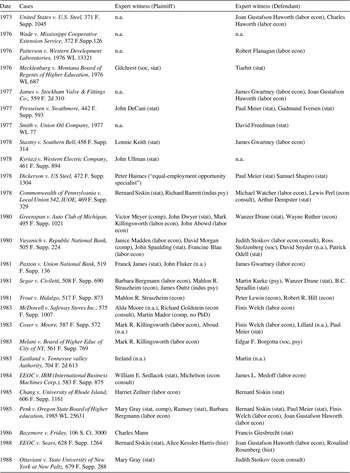
This paper is based on the study of fifty-five cases occurring between 1971 and 1989. I used WestLaw keys system (Civil Rights 78, Evidence k) and advanced search tools using keywords “expert witness” in conjunction with “employment discrimination.” I then turned to cases books, essentially Barbara Schlei Lindermann and Paul Grossman (Reference Schlei Lindermann and Grossman1983, 1985), who list the use of regression analysis in Federal Court from the mid-1970s until 1985. I also used the secondary literature. Of the final sample, I chose twenty-six cases with identifiable discussion on MRA and, most of the time, identifiable experts. As a matter of comparison, Stephen Fienberg (Reference Fienberg1982) found three occurrences before 1972. Using the Lexis database, Daniel Rubinfeld (Reference Rubinfeld1985) found twenty-six occurrences between 1969 and 1984. Catherine Connolly (Reference Connolly1991) conducted a quantitative analysis of the use of MRA in employment discrimination cases in Federal Court between 1971 and 1991 and found forty-six cases; she quotes thirty cases. The difference is my choice to look at decisions with lengthy discussion of the method and of the expert testimony, and not merely mention of MRA.
This must be compared with the actual number of cases filed and cases that go to trial. Fewer than 350 employment discrimination cases were filled in 1970, to a peak at 9,000 suits filed in 1983. Between 1970 and 1989, employment discrimination litigations grew much faster (+2,166%) than general civil disputes (+125%) (Donohue and Siegelman Reference Donohue and Siegelman1991, pp. 985–986). A more recent empirical analysis confirmed the growth of litigation for the same period, and the relative stagnation, around a bit fewer than 10,000 cases a year between 1983 and 1990, and the spectacular rise in litigation in the early 1990s (Berrey, Nelson, and Nielsen Reference Berrey, Nelson and Nielsen2017, fig. 2.1, p. 41). Keep in mind that, according to Ellen Berrey, Robert Nelson, and Laura Beth Nielsen’s model of litigation outcomes, fewer than 30% of cases filed went to trial, and 2% of cases filed in Federal Court led to a win by the plaintiff (pp. 61–64).
Appendix 2: List of Cases
Case list.

n. a.: not available; labor econ: professor or assistant professor of economics, specialist labor economics;econ: professor or assistant professor of economics; stat: professor or assistant professor of statistics or mathematics, specialist statistics; soc: professor or assistant professor of sociology; psy: professor or assistant professor of psychology; indus psy: industrial or organizational psychologist; comp: academic computer scientist; consult: primarily consultant; hist: historian.f.suppl.: federal supplement (federal district courts), f. 2d.: federal reporter second edition (federal courts of appeals); s. ct. or u.s.: supreme court reporter; wl: unpublished decision from district courts.
Appendix 3: Statutes List
Civil Rights Act, 78 Stat. 241, 1964
Civil Rights Act, 105 Stat. 1071, 1991
Equal Employment Opportunity Act, 86 Stat. 103, 1972
Appendix 4: Cases Not Included in Appendix 1
Griggs v. Duke Power & Co., 401 U.S. 424, 1971
McDonell Douglas Corp. v. Green, 411 U.S. 792, 1971
Loving v. Virginia, 988 U.S. 1, 1967
Price Waterhouse v. Hopkins, 490 U.S. 228, 1989
Wards Cove Packing Co. v. Antonio, 490 U.S. 642, 1989