INTRODUCTION
Tropical dry forests often show marked rainy and dry seasons and, in general, suitable periods for fruiting to achieve successful seed dispersal or seedling establishment vary seasonally in each species. The majority of zoochorous plants in tropical dry forests bear fruits during the rainy season because high moisture levels favour the production of fleshy fruits, seed germination and seedling establishment (Fenner Reference FENNER1998, Garwood Reference GARWOOD1983, Lieberman Reference LIEBERMAN1982, van Schaik et al. Reference VAN SCHAIK, TERBORGH and WRIGHT1993). On the other hand, selection pressure for seed-disperser acquisition (Stiles Reference STILES and Fenner1992) also affects seasonal fruiting patterns; fruiting can be synchronized with the temporal abundance of frugivores such as migratory birds (Herrera Reference HERRERA1995, Poulin et al. Reference POULIN, WRIGHT, LEFEBVRE and CALDERON1999), and fruiting can be separated from the peaks of other species to reduce competition for seed-disperser acquisition, as in Miconia spp. (Poulin et al. Reference POULIN, WRIGHT, LEFEBVRE and CALDERON1999, Snow Reference SNOW1965). Year-round fruiting, as occurs in figs and palms, is often successful for seed dispersal because it attracts resident frugivores during periods when fruit is scarce. Such fruits are recognized as keystone resources for maintaining frugivore populations in many tropical forests (Bleher et al. Reference BLEHER, POTGIETER, JOHNSON and BOHNING-GAESE2003, Lambert & Marshall Reference LAMBERT and MARSHALL1991, Wright Reference WRIGHT, Dew and Boubli2005). Several large-seeded plants whose dispersers are limited to large-bodied frugivores display long-term fruiting, which favours rare visits by limited numbers of dispersers (Mitani Reference MITANI1999).
This paper focuses on the relationships between seasonal fruiting in a wide range of zoochorous plants and seed dispersal by the largest-bodied frugivore, the common brown lemur (Eulemur fulvus fulvus É. Geoffroy; body weight 1.8–2.5 kg), in a tropical dry forest in Ankarafantsika National Park, north-western Madagascar. The frugivore guilds in Malagasy forests are composed of only a few taxa, including forest pigeons, bulbuls, fruit bats, mouse and dwarf lemurs, and some true lemurs (Bollen et al. Reference BOLLEN, VAN ELSACKER and GANZHORN2004, Fleming et al. Reference FLEMING, BREITWISH and WHITESIDES1987, Ganzhorn et al. Reference GANZHORN, FIETZ, RAKOTOVAO, SCHWAB and ZINNER1999). Within the depauperate guild in Madagascar, three genera (Eulemur, Lemur and Varecia) of true lemurs (Lemuridae) are the sole large-bodied seed dispersers (Bollen et al. Reference BOLLEN, VAN ELSACKER and GANZHORN2004, Ganzhorn et al. Reference GANZHORN, FIETZ, RAKOTOVAO, SCHWAB and ZINNER1999, Moses & Semple Reference MOSES and SEMPLE2011). In terms of the swallowing capacities of sympatric frugivores (lemurs: Lahann Reference LAHANN2007, Sato Reference SATO2011; flying foxes: Bollen & Van Elsacker Reference BOLLEN and VAN ELSACKER2002), the brown lemur is the sole seed disperser of large seeds > 10.0 mm in diameter in Ankarafantsika (Sato Reference SATO2012). For large-seeded plants, interactions with this large-bodied lemur for seed dispersal play a vital role in their reproductive success and population maintenance. Improved germination performance is related to lemur intake (Sato Reference SATO2012), and depressed regeneration has been observed in forests that lack large-bodied lemurs (Ganzhorn et al. Reference GANZHORN, FIETZ, RAKOTOVAO, SCHWAB and ZINNER1999). If the acquisition of limited dispersers is critical for large-seeded species, the situation with the limited number of large-bodied dispersers in Ankarafantsika raises the hypothesis that large-seeded species will have distinctive fruiting schedules (i.e. period and duration) for efficient seed dispersal by the brown lemur. Moreover, relationships between seasonal rainfall and fruiting patterns should also be examined because trade winds and monsoons divide western Madagascar into rainy and dry seasons (Jury Reference JURY, Goodman and Benstead2003). It can then also be predicted that the majority of zoochorous plants will bear fruit during periods with heavy rain as a general pattern of fruiting in tropical dry forests. As a consequence of the seasonal fruiting in the zoochorous plant community, the brown lemur will disperse a variety of seeds during the rainy season. To examine these two hypotheses, this paper presents detailed field data on fruiting phenology in the forest, feeding activity by the brown lemur, and faecal composition throughout the year.
METHODS
Study site
The study site was located at the Ampijoroa Forestry Station (16°31′S, 46°82′E) in Ankarafantsika National Park, north-western Madagascar. The hourly average (± SD) temperature was 26.1 °C ± 4.8 °C during the year-long study period (December 2006–November 2007). Based on rainfall data for 5 y (2005–2009) provided by the Durrell Wild Life Chelonian Breeding Centre in Ampijoroa, the year is typically divided into rainy (November–April) and dry seasons (May–October; Figure 1a). Most rainfall during the study period also occurred during the rainy season (rainy season = 1653 mm; dry season = 6.8 mm; Figure 1a). Surveys were conducted within Jardin Botanique A (JBA), a rectangular trail system in the primary dry deciduous forest grown on sandy soil. Based on the distributions of known seed dispersers (Garbutt Reference GARBUTT2007, Morris & Hawkins Reference MORRIS and HAWKINS1998), ten vertebrate species were recognized in the JBA disperser assemblage (birds: Treron australis Linnaeus, Alectroenas madagascariensis Linnaeus, Hypsipetes madagascariensis Statius Müller; fruit bats: Pteropus rufus É. Geoffroy, Eidolon dupreanum Pollen, Rousettus madagascariensis Grandidier; small-bodied nocturnal lemurs: Cheirogaleus medius É. Geoffroy, Microcebus murinus Miller, M. ravelobensis Zimmermann et al.; and a large-bodied lemur: E. f. fulvus). Although other large-bodied frugivorous lemurs (Eulemur mongoz Linnaeus) occurred in the Ankarafantsika forest, none inhabited the JBA.
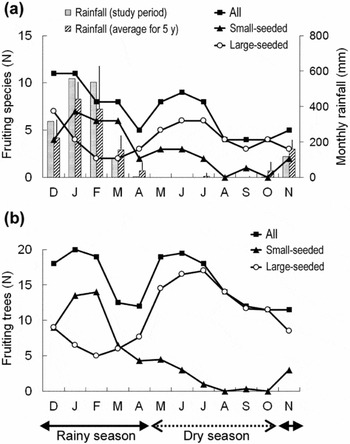
Fruiting phenology on the transect (490 × 6 m) from December 2006 to November 2007 in Ankarafantsika National Park, north-western Madagascar. Monthly rainfall during the study period, including average values for the 5-y period from 2005 to 2009 and monthly number of fruiting species in each category (all species, small-seeded species and large-seeded species) (a). Monthly mean number of fruiting individuals in each category (b).

Fruiting phenology
To assess seasonality in the numbers of fruiting species and individuals, a phenological survey was conducted along an existing trail (490 m long, 1 m wide) in JBA. A transect was laid along the sides of the trail (3 m wide per side) to create a monitoring area (490 × 6 m) that did not include the trail area. All trees (totalling 680 trees in 94 species) that were more than 5 cm in diameter at breast height (dbh) were identified. Based on dbh, the trees on the transect were small (8.6 ± 4.6 cm on average ± SD) and rarely exceeded 30 cm. The canopy layer of the forest was also low; 12–15 m in height and emergent up to 20 m. Because Malagasy primates use relatively smaller fruiting trees compared with other primates in Asia, Africa and South America (Wright Reference WRIGHT1999), all zoochorous trees > 5 cm dbh on the transect were examined. In total, 432 trees were examined from 31 zoochorous species (small-seeded: 296 trees from 17 species; large-seeded: 136 trees from 14 species) fortnightly for 1 y, beginning on 28 November 2006 (27 observation periods). By visually inspecting each crown, the trees were scored for the presence of fruit in the crown.
Observations
The observed troop of brown lemurs consisted of 12 individuals (six adult males, three adult females, one subadult male and two young females). The two young females were probably born in September 2006, and they were infants when the study began in November and juveniles by the end of the study. One troop member (an adult male at least 3 y old) was captured at the beginning of November 2006 using a blowpipe and injection darts containing 30 mg ketamine hydrochloride, and a radio collar (M1920, 35 g weight; Advanced Telemetry Systems, Inc., Isanti, MN, USA) was placed on him for tracking and observation. The animal capture complied with the protocols and principles for the Ethical Treatment of Non-Human Primates. The method was approved by the Primate Research Institute of Kyoto University and adhered to the legal requirements of Madagascar's Association Nationale pour la Gestation et Aires Protégées (Research authorization: No. 228/06).
The troop was habituated to the presence of an observer for 1 mo. After this period, the troop was followed from 6h00 to 18h00. Observations were conducted twice weekly (7–9 d mo−1) from December 2006 to November 2007. In total, the troop was observed for 1212 h, including 2.1% missing time, on 101 observation days (49 in the rainy season; 52 in the dry season). The troop was scanned at 1-min intervals and the activities of all visible members were recorded, except the two suckling infants (Altmann Reference ALTMANN1974). The two juvenile females were also observed starting in February 2007, after they had been weaned. Because the troop was highly cohesive and the members usually behaved synchronously, troop activity was able to be defined as that of the majority of visible members during each scan. The food items that were consumed were recorded during each scan of troop feeding activity. Food items were classified into seven categories: fruits, flowers, mature leaves, new leaves, animal matter, soil and unknown items. Plant items were identified from specimens deposited at Tsimbazaza Botanical and Zoological Park and at the Faculty of Science at Antananarivo University, Madagascar.
Faecal analysis
Dung samples were collected during 101 full-day observations (1126 samples in total, 6–19 samples d−1, 72–108 samples mo−1). Each sample was composed only of complete droppings that were recognizable as being all of the dung pieces deposited by one individual within 1 min and they were transferred to plastic bags. Dung samples were washed in a 1.0-mm-mesh size sieve and all of the seeds were identified. Species were determined morphologically by comparison with seeds from identified fruits collected in the forest. Because the brown lemur appears to be the only frugivore able to swallow seeds (or diaspores) > 10.0 mm in diameter in Ankarafantsika (Sato Reference SATO2012), large-seeded plants were defined here as those with seeds (or diaspores) > 10.0 mm in diameter and small-seeded plants as those with seeds (or diaspores) < 10.0 mm in diameter. The seed (or diaspore) size of each species was based on the data of Sato (Reference SATO2012).
Data analysis
To examine the relationships between the monthly rainfall and the numbers of fruiting species and individuals on the transect, Pearson's correlation coefficients (r) were calculated. Spearman's rank correlation coefficients (rs) were calculated to examine pairwise seasonal relationships among the numbers of fruiting species and individuals, feeding time on fruits, the monthly accumulated number of species in faeces. Mann–Whitney U tests were used to compare the duration of the appearance in faeces between rainy-season-fruiting and dry-season-fruiting species and between large-seeded and small-seeded species. Mean and standard deviations (± SD) are given throughout the paper.
RESULTS
Seasonal fruiting on the transect
Among the zoochorous trees on the transect, 100 individuals from 24 species bore fruit during the study period (small-seeded: 57 individuals of 13 species; large-seeded: 43 individuals of 11 species). The numbers of fruiting species and individuals of all plants were high at the beginning of both the rainy and dry seasons (Figure 1a, b), and the number of fruiting species was correlated with monthly rainfall (r = 0.61, P = 0.034, n = 12). However, the number of fruiting individuals was not correlated with monthly rainfall (r = 0.50, P = 0.098, n = 12). The numbers of species and individuals of small-seeded plants peaked during the rainy season and were low during the dry season (Figure 1a, b); both numbers were correlated with monthly rainfall (species: r = 0.80, P = 0.0020, n = 12; individuals: r = 0.94, P < 0.0001, n = 12). The number of fruiting species of large-seeded plants was high at the beginning of both the rainy and dry seasons (Figure 1a), but it was not correlated with monthly rainfall (r = −0.16, P = 0.62, n = 12). The number of fruiting individuals of large-seeded plants peaked during the dry season (Figure 1b); it was negatively correlated with monthly rainfall (r = −0.69, P = 0.014, n = 12).
Several small-seeded species that included many fruiting individuals formed a short fruiting peak during the rainy season (fruiting duration: Evonymopsis sp. (Celastraceae), n = 5, 2.6 ± 1.7 wk; Noronhia boinensis (Oleaceae), n = 17, 1.9 ± 2.0 wk; Scolopia inappendiculata (Salicaceae), n = 7, 4.4 ± 2.2 wk). In contrast, several large-seeded species made a long fruiting peak during the dry season (Astrotrichilia asterotricha (Meliaceae), n = 3, 9.7 ± 3.1 wk; Baudouinia fluggeiformis (Leguminosae), n = 10, 24.8 ± 17.6 wk; Vitex beraviensis (Lamiaceae), n = 4, 18.0 ± 6.8 wk).
Seasonality in dietary composition of brown lemur
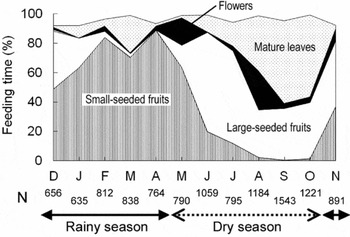
In total, 11 168 min of feeding activities of the troop were recorded throughout the year. The dietary composition of brown lemur varied from month to month (Figure 2). As more individuals of small-seeded plants fruited on the transect, the percentage of feeding time on small-seeded fruits increased during the rainy season (rs = 0.81, P = 0.0013, n = 12). The percentage of feeding on large-seeded fruits was high during the dry season and positively correlated with the number of fruiting large-seeded trees on the transect (rs = 0.65, P = 0.026, n = 12). During the late dry season from August to October, 50.4% of the troop's feeding time was spent on mature leaves, and 97.4% of leaf-eating occurred on Lissochilus rutenbergianus Kraenzl. (Orchidaceae). When feeding on leaves of L. rutenbergianus, the lemurs chewed the succulent leaves without eating the fibres. Therefore, its fibre was rarely seen in faeces. The lemurs occasionally consumed flowers, and the percentage of feeding time was slightly higher in May and August.
Monthly dietary composition of the brown lemur from December 2006 to November 2007 in Ankarafantsika National Park, north-western Madagascar. N = monthly accumulated time (min) of feeding activity observations.

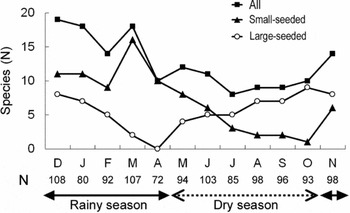
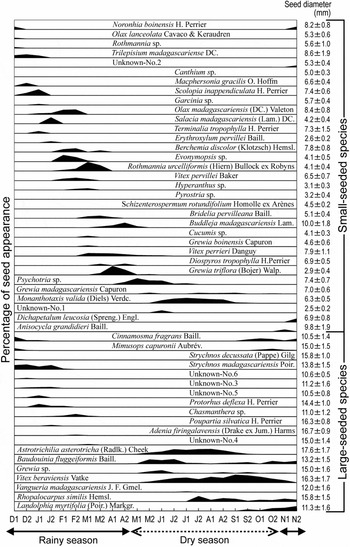
Through year-round faecal analysis, seeds of 70 species were found (small seeds: 47 species; large seeds: 23 species). The monthly accumulated number of species in faeces was high during the rainy season and was correlated with the number of fruiting species on the transect (rs = 0.67, P = 0.018, n = 12; Figure 3). Many small-seeded species were found in faeces during the rainy season, but few were observed during the dry season (Figure 4), which was consistent with the seasonal pattern of fruiting in small-seeded species on the transect (rs = 0.87, P = 0.0002, n = 12). In contrast, there was no correlation between the number of large-seeded species in faeces and that on the transect (rs = 0.26, P = 0.42, n = 12). The number of large-seeded species formed a moderate peak from the dry season to the beginning of the rainy season (Figure 3).
Monthly number of accumulated species of seed found in brown lemur dung from December 2006 to November 2007 in Ankarafantsika National Park, north-western Madagascar. Monthly number of accumulated species of seeds is presented by category (all species, small-seeded species and large-seeded species), and N indicates the monthly accumulated number of dung samples.

Percentage (0–100%) of seed appearances of each plant species in brown lemur dung samples in each half-month from December 2006 to November 2007 in Ankarafantsika National Park, north-western Madagascar. The graph plotted the 52 species commonly identified in both observations and faecal analysis (33 species of small-seeded plants and 19 species of large-seeded plants). Seed diameter (mm) values for each species are based on data from Sato (Reference SATO2012).

Seasonal appearance of each species in brown lemur dung
Among the seeds of 70 species that were found in dung samples, 52 species were eaten during the observations, and most of the species were successfully identified. The frequency and duration of appearance in dung samples varied among the 52 species (Figure 4). During the rainy season, small-seeded species appeared frequently and the composition rapidly changed from month to month. In April, 72.2% of 72 dung samples contained small seeds of Grewia triflora (Malvaceae). Brown lemurs consumed fruits of five species in April, and 49.1% of feeding time on fruits was spent eating fruits of G. triflora. Most of the large-seeded species that were dispersed during the rainy season appeared with low frequency in faeces, except for Strychnos madagascariensis (Loganiaceae).
During the dry season, the turnover of species found in dung samples decreased, and large seeds of several species consistently appeared for long periods, such as those of Astrotrichilia asterotricha, Baudouinia fluggeiformis, Rhopalocarpus similis (Sphaerosepalaceae), and Vitex beraviensis. In particular, V. beraviensis was the most frequently dispersed species throughout the prolonged dry season (27 wk). The duration of the appearance in faeces did not differ between the large-seeded species found in the rainy season (5.7 ± 4.2 wk, n = 13) and the small-seeded species found in the rainy season (5.5 ± 2.9 wk, n = 29; U = 177, P = 0.76). The duration of appearance for large-seeded species found in the dry season was longer (17.3 ± 8.3 wk, n = 6) than that of either seed group in the rainy season (vs. large-seeded species in the rainy season: U = 69, P = 0.0095; vs. small-seeded species in the rainy season: U = 158, P = 0.0019).
DISCUSSION
Fruiting and seed dispersal of various species during the rainy season
The diversity of fruiting species in Ankarafantsika increased with rainfall; in particular, the numbers of species and individuals of fruiting small-seeded plants were high during the rainy season. The brown lemur spent more time eating small-seeded fruits and dispersed various species during the rainy season. In seasonal tropical forests, zoochorous species generally show fruiting peaks during the rainy season (Africa: Lieberman Reference LIEBERMAN1982; Asia: Murali & Sukumar Reference MURALI and SUKUMAR1994; Australia: Bach Reference BACH2002; Central and South America: Griz & Machado Reference GRIZ and MACHADO2001, Justiniano & Fredericksen Reference JUSTINIANO and FREDERICKSEN2000, Smythe Reference SMYTHE1970). Because large-bodied frugivores handle seeds of a wide range of sizes (Noma & Yumoto Reference NOMA and YUMOTO1997, Wheelwright Reference WHEELWRIGHT1985), their long-term faecal analysis often reflects the seasonal fruiting patterns at the community level (Tobler et al. Reference TOBLER, JANOVEC and CORNEJO2010, Wright Reference WRIGHT, Dew and Boubli2005). In accordance with the fruiting peaks in a seasonal forest in the Peruvian Amazon, the number of species found in the tapir faeces increased during the rainy season (Tobler et al. Reference TOBLER, JANOVEC and CORNEJO2010). The fruiting of small-seeded species during the rainy season was similar to observed patterns in a humid forest in Panama (non-wind-dispersed fruits < 15 mm in seed length: Smythe Reference SMYTHE1970) and an evergreen forest in south-western Cameroon (fruits of bird–monkey syndrome: Mitani Reference MITANI1999). In rain forests in eastern Madagascar, the zoochorous plant community (Bollen & Donati Reference BOLLEN and DONATI2005) including small-fruited plants (< 1 g in fruit weight: Wright et al. Reference WRIGHT, RAZAFINDRATSITA, POCHRON, JERNAVALL, Dew and Boubli2005) formed a fruiting peak during the rainy season. Because the communities of frugivorous mammals synchronize weaning with the fruiting peak during the rainy season, the fruit availability of various plant species seems to improve the survival of their offspring (fruit bats: Andrianaivoarivelo et al. Reference ANDRIANAIVOARIVELO, RAMILIJAONA, RACEY, RAZAFINDRAKOTO and JENKINS2011; lemurs: Wright Reference WRIGHT1999, Wright et al. Reference WRIGHT, RAZAFINDRATSITA, POCHRON, JERNAVALL, Dew and Boubli2005). This hypothesis can be applied to brown lemur in Ankarafantsika, because the weaning occurred from January to February when both the diversity and density of fruiting plants were high (Sato unpubl. data).
Considering the advantages of fruiting during the rainy season, the timing is favourable for seed germination under water-rich soil conditions (Garwood Reference GARWOOD1983). Additionally, small-seeded plants would experience beneficial seed dispersal by fruiting during the rainy season because of the abundance of frugivores (sensu Herrera Reference HERRERA1995). In western Madagascar, small-bodied lemurs enter daily torpor (Microcebus spp.) or 4–6 mo of hibernation (Cheirogaleus spp.) during the dry season to cope with thermal stress from low ambient temperatures and the scarcity of water and food (Fietz & Dausmann Reference FIETZ, DAUSMANN, Gould and Sauther2006, Schmid Reference SCHMID2000). Therefore, the density of active small lemurs probably decreases during this period. On the other hand, brown lemurs spent less time feeding on large-seeded fruits and defecated those seeds with a lower frequency during the rainy season. Therefore, it is likely that large-seeded species are not favoured by the high competition for seed-disperser acquisition that occurs when various small-seeded species fruit.
Fruiting and seed dispersal of specific large-seeded species during the dry season
In contrast to eastern Madagascar, previous phenological surveys in dry forests in western Madagascar have reported a year-round availability of fruit resources (Rasmussen Reference RASMUSSEN1999, Sorg & Rohner Reference SORG, ROHNER, Ganzhorn and Sorg1996). This study also recorded a high density of fruiting trees during the dry season in Ankarafantsika. However, only a few large-seeded species (Astrotrichilia asterotricha, Baudouinia fluggeiformis, Rhopalocarpus similis and Vitex beraviensis) both fruited on the transect and were consumed by the brown lemur during the dry season. These species had prolonged fruiting durations, and the seeds appeared frequently in brown lemur faeces throughout the dry season. In terms of seed dispersal success, fruiting during the dry season appeared to favour these species by avoiding the intense competition for seed disperser acquisition that occurs during the fruiting peak of the zoochorous plant community (sensu Poulin et al. Reference POULIN, WRIGHT, LEFEBVRE and CALDERON1999, Snow Reference SNOW1965). Additionally, long-term fruiting is likely a bet-hedging strategy for lower-frequency visits by a limited number of dispersers, as is the case with the elephant-dispersed fruit Sacoglottis gabonensis in south-western Cameroon (Mitani Reference MITANI1999). Such long-term fruiting seemed to differ from the pattern of large-seeded plants (seeds > 15 mm in length) at the community level in Panama, which have short-term and interspecific synchronous fruiting to encourage rodents to cache (Smythe Reference SMYTHE1970). On the other hand, although the brown lemur also heavily used the succulent leaves of Lissochilus rutenbergianus during the late dry season, the nutritional analysis suggested this feeding activity occurred for water intake under the arid condition (Sato Reference SATO2011). Because the brown lemur does not have a specialized digestive system for fibrous materials, fruit resources appear to be the essential source of energy for the brown lemur rather than leaves or other fibrous materials (Campbell et al. Reference CAMPBELL, WILLIAMS and EISEMANN2004). Therefore, these large-seeded species interact with the brown lemur, serving as an important food resource during periods with a lower diversity of fruiting plants, while the lemur serves as the sole seed disperser in the Ankarafantsika forest. In particular, V. beraviensis seeds were found in the largest number of faecal samples, and moreover, the germination rate was improved by brown lemur consumption (Sato Reference SATO2012).
Fruiting during the dry season allows seeds to germinate rapidly and establish seedlings at the onset of the rainy season (Frankie et al. Reference FRANKIE, BAKER and OPLER1974, Selwyn & Parthasarathy Reference SELWYN and PARTHASARATHY2007). Considering the long time lag from the fruiting peak to the subsequent peak in rainfall, the seeds need to tolerate prolonged desiccation until germination. Several studies have demonstrated that large seeds germinate better and seedling survival is greater in arid environments compared with the case for small seeds (Baker Reference BAKER1972, Khurana & Singh Reference KHURANA and SINGH2004, Leishman & Westoby Reference LEISHMAN and WESTOBY1994). The greater amount of energy stored in large seeds also provides metabolic requirements during the quiescent period until suitable moisture conditions arise (Khurana & Singh Reference KHURANA and SINGH2001). The large seeds of several plants (A. asterotricha, B. fluggeiformis and V. beraviensis) are covered with a thick endocarp and form a large stone as a diaspore. This protective covering helps to prevent desiccation and/or inappropriate germination by sporadic showers during dry periods (Khurana & Singh Reference KHURANA and SINGH2001). Desiccation tolerance during the development of large-sized seeds and the protective covering may allow fruiting during the dry season and may enhance seed dispersal success by the acquisition of the limited large-bodied frugivores. Similarly, several fruit characteristics, such as fruit protection and fibrous fruit pulp, are likely to result from drier climatic conditions in western Madagascar (Bollen et al. Reference BOLLEN, DONATI, FIETZ, SCHWAB, RAMANAMANJATO, RANDRIHASIPARA, VAN ELSACKER, GANZHORN, Dew and Boubli2005).
Because of Madagascar's biogeographic situation, the diversity and abundance of figs (Ficus spp.) are lower than in other tropical areas (Goodman & Ganzhorn Reference GOODMAN and GANZHORN1997). Figs were never found in lemur diets or on the transect in this study. Instead of figs, the group of large-seeded plants that fruit during the dry season probably plays a role as an important resource for maintaining populations of the brown lemur during periods when fruit is scarce (sensu Bleher et al. Reference BLEHER, POTGIETER, JOHNSON and BOHNING-GAESE2003, Lambert & Marshall Reference LAMBERT and MARSHALL1991, Wright Reference WRIGHT, Dew and Boubli2005). Some of these plant species are commonly consumed by large-bodied lemurs during the dry season at other sites in western Madagascar: Astrotrichilia asterotricha is consumed by Eulemur fulvus rufus (Ostner et al. Reference OSTNER, KAPPELER and HEISTERMANN2008) and V. beraviensis is eaten by E. f. rufus and Lemur catta (Sussman Reference SUSSMAN and Clutton-Brock1977). Therefore, these distinct interactions between large-seeded plants and large-bodied lemurs for seed dispersal seem to occur in a wide range of tropical dry forests in western Madagascar. This study suggests a unique pattern of seasonal fruiting in a zoochorous plant community linked to different seed sizes and different assemblages of seed dispersers. To understand the adaptive significance of each fruiting strategy, we must evaluate the effects of seed size and the timing of fruiting on seed dispersal by frugivores at individual trees and survival of individual seedlings in each seasonal environment through prolonged monitoring in a future study.
ACKNOWLEDGEMENTS
The author is grateful to the director, R. Razafindrajery, and all of the staff at Ankarafantsika National Park for their permission and support in carrying out this study, to A. Mori, F. Rakotondraparany, B. Razafimahatratra and members of the research team for their support, S. Ichino and T. M. Randriamboavonjy for their help with capturing lemurs, to J. Rakotoroa, and Tsiahifika for their help with vegetation surveys, to the staff of Tsimbazaza Botanical and Zoological Park and R. H. Robuste for identifying the plant specimens, to the staff of the Durrell Wild Life Chelonian Breeding Center for providing climatic data, and to G. Yamakoshi for helpful comments on the manuscript. This work was partially supported by the MEXT Grants-in-Aid for Scientific Research (Nos 17405008, 18681036, 213399, 21405007, and 24405008) from Japan Society for the Promotion of Science.