In a landmark paper in 2000, Bonhoeffer described prolongation of the lifespan of a right ventricular outflow conduit via transcatheter placement of a new valve within the existing deteriorating prosthesis.Reference Bonhoeffer, Boudjemline and Saliba 1 Further developments of both percutaneous pulmonary valve implant technique and device followed, and the number of percutaneous pulmonary valve implants worldwide is now >7000.Reference Van Dijck, Budts and Cools 2 The standard surgical strategy requires repeated replacement of bioprostheses over the lifespan, these multiple redo surgeries being an unattractive prospect for both patient and surgeon. The use of a transcatheter valve in this setting has obvious appeal for reducing the number of re-operations and because the indication for pulmonary valve replacement is often to preserve the right ventricular function when symptoms are minimal.
In 2009, the first percutaneous pulmonary valve implants were performed in New Zealand. Clinical experience has been largely positive, and patients have usually benefited from relatively short procedural times, brief hospitalisation, and rapid recovery. This technology, however, remains relatively new, and conclusive data with regard to valve longevity and late complications are awaited.
In recent times reports of confirmed and possible Melody valve infective endocarditis have appeared.Reference Van Dijck, Budts and Cools 2 – Reference Villafane, Baker and Austin 10 Further data are needed both for the incidence of infective endocarditis following percutaneous pulmonary valve implant in this population and for comparative post-surgical infective endocarditis incidence. Risk factors for infective endocarditis following percutaneous pulmonary valve implant should be sought.
This paper reports on our institution’s experience of Melody valve implantation in 25 patients from October, 2009 to May, 2015. It includes four cases complicated by infective endocarditis, two with large obstructive vegetations seen within the implanted valves. In addition, we reviewed data on infective endocarditis following surgical bioprosthesis implant at our institution in the same time frame.
Methods
Institutional approval and ethics approval were obtained before commencing the percutaneous pulmonary valve programme. Our centre receives tertiary referrals for all patients, both children and adults, requiring congenital interventional catheterisation or congenital heart surgery in New Zealand. Patients referred from the Pacific Islands are also included in this series. Patients taken to the catheterisation laboratory for percutaneous pulmonary valve implant had been reviewed at the combined Cardiosurgical conference and accepted for this procedure.
To date, we have used the Melody valve only for percutaneous pulmonary valve implant. Standard criteria for Melody valve implantation were followed, with patients included having right ventricular systolic >75% systemic or severe conduit regurgitation in the context of progressive right ventricular dilation or mixed conduit stenosis and obstruction in the setting of symptoms or right ventricular dysfunction. Pre-catheter MRI was included as part of standard assessment. One patient had estimated right ventricular systolic ~2/3 systemic with mild pulmonary regurgitation and underwent her procedure as part of a multi-pronged strategy to try and mitigate the effects of protein-losing enteropathy. Patients in the Melody series all had undergone right ventricular outflow tract reconstruction with a homograft – aortic or pulmonary – or Hancock valved conduit with right ventricular outflow tract dimension at the narrowest point of 14–22 mm. Follow-up of both Melody and surgical pulmonary valves occurred in Auckland and other referring cardiac units.
Procedure
The procedure was performed in the standard manner as described for percutaneous pulmonary valve implant.Reference Lurz, Coats and Khambadkone 11 , Reference Eicken, Ewert and Hager 12 In brief, access was gained in the right femoral vein and heparin 5000 U was administered with the activated clotting time being maintained at >200 throughout the procedure. Three doses of cephazolin were given, one at the commencement of the procedure and two during post-valve implant. Coronary anatomy was ascertained initially with an aortic root injection during balloon conduit sizing, proceeding to selective coronary injection in the event of proximity to the conduit, suggesting potential risk of coronary compression with conduit stent placement. The right ventricular outflow tract was pre-stented in each case with a Cheatham-platinum stent, except in the case of one patient with a Hancock conduit. In one patient the Cheatham-platinum stent was implanted 2 years before the Melody implantation. All patients and their referring clinicians were informed with regard to the importance of ongoing endocarditis prophylaxis, and aspirin was advised for 6 months post procedure.
Follow-up
Follow-up data were obtained from the referring cardiologist. Review was requested at 1, 6, and 12 months and then annually thereafter. Data were collected with regard to symptoms, electrocardiogram, chest X-ray, and echocardiogram findings, particularly with respect to evidence of stent fracture, peak and mean gradients, and degree of pulmonary regurgitation.
In response to four cases of endocarditis seen in the follow-up we undertook a literature review and a detailed review of all case data. As the incidence of infection in the right ventricular outflow tract conduits/surgical bioprostheses was unclear, we reviewed a local contemporaneous surgical cohort (October, 2009 to May, 2015) of all surgically replaced pulmonary valves/conduits from our programme to serve as a comparator for endocarditis risk. For this surgical group, a detailed review of charts and correspondence was undertaken specifically for any diagnosis or suspicion of endocarditis on that bioprosthesis from implant date to May, 2015.
Statistical analysis
Data are reported as medians with interquartile range or as frequencies with percentages. The Mann–Whitney U-test was conducted to compare continuous data between the Melody group and the surgical group and within the Melody group, between unaffected and affected cases of endocarditis. The χ2-test was used to compare categorical data between the Melody and surgical groups and within the Melody group. Kaplan–Meier curves were generated to depict the distribution of survival by treatment method.
Statistical analyses were performed using the statistical package SAS version 9.3 (SAS Institute, Cary, North Carolina, United States of America). All p-values resulted from two-sided tests, and a p-value<0.05 was considered statistically significant.
Results
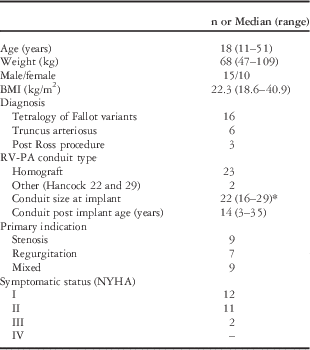
From October, 2009 through to May, 2015, 26 patients underwent cardiac catheterisation with intent to implant a Melody valve. In one patient it did not prove possible to advance a long sheath through the pre-existing conduit for pre-stenting. He was known to have a large right ventricular outflow tract aneurysm and, after further consideration, he was referred for surgical management. Finally, 25 patients, of whom 15 were male, underwent Melody valve placement at a median age of 18 years. Details on this group are summarised in Table 1. The primary indication for valve placement was conduit stenosis in nine, conduit regurgitation in seven, and mixed disease in nine, including the patient with protein-losing enteropathy.
Melody percutaneous pulmonary valve implant patient characteristics.

BMI=body mass index; RV-PA=right ventricle-to-pulmonary artery
* One unknown – implanted overseas
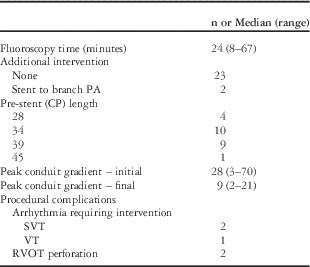
Procedural data are given in Table 2. At the time of the procedure, two patients had contained extravasation from conduit expansion with disruption of conduit integrity. Neither patient became haemodynamically unstable. In one patient this was managed with a covered stent, and in another case the Melody valve was placed but could not be advanced sufficiently to entirely exclude the area of extravasation. Angiographically, the small residual leak remained contained and stable. The patient was observed as an inpatient for 48 hours post procedure. A follow-up CT at 6 weeks post procedure was reassuring.
Procedural data.

CP=Cheatham-platinum; PA=pulmonary artery; RVOT=right ventricular outflow tract; SVT=supraventricular tachycardia; VT=ventricular tachycardia
Short-term outcomes
Clear improvement in functional class and symptoms was noted at early review in 14 patients, with specific improvements reported in energy levels, breathlessness, and frequency of palpitations. One patient was briefly readmitted 2 days following his procedure with chest pain. Investigations were reassuring and he was discharged after an overnight stay with simple analgesia. Another two other patients reported chest discomfort post procedure, and in one this was accompanied by fatigue and breathlessness that took several weeks to settle; no aetiology was established for the symptoms. In the remainder, many of whom had been asymptomatic approaching their procedure, reviews were reassuring.
Follow-up
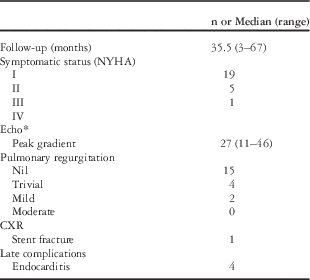
All patients are alive at the time of review. Follow-up data to date are summarised in Table 3. Median follow-up for the group is 2.9 years (interquartile range 1.6–5.4), with 23 patients (92%) having >6 months of follow-up. Only one patient to date has been found to have any stent fracture – minor or Type 1 fracture with ⩾1 individual struts fractured but with no loss of stent integrity.Reference Nordmeyer, Khambadkone and Coats 13
Outcome data: findings at most recent review.

CXR=chest X-ray
* n=21 endocarditis patients excluded
One patient who had a valve placed in an attempt to assist with protein-losing enteropathy had this removed with a full pulmonary artery overhaul 3 years post implant. In the 20 remaining patients without infective complication, echocardiography at last follow-up demonstrated no or trivial regurgitation in 16 patients, with no patient having more than mild regurgitation to date. Median peak gradient is 30 mmHg (interquartile range 20–38).
Endocarditis
The major concern in medium-term follow-up has been four patients who have developed infective endocarditis. Of these patients, two presented acutely with evidence of severe conduit obstruction and important right ventricular compromise – one with life-threatening low cardiac output – both requiring urgent surgical intervention.
The first young man had undergone a Ross procedure as his third surgical intervention on a background of coarctation and aortic valve disease. He represented at the age of 14 and 16 months post transcatheter pulmonary valve placement with evidence of sepsis, and had blood cultures positive for Staphylococcus aureus. Echo demonstrated that his conduit was now severely obstructed; the right ventricle was dilated with systemic right ventricular pressures.
At transfer to our hospital he had developed low cardiac output and oliguric renal failure, and 48 hours post transfer he was taken for emergent operative intervention. During the operation, the heart, particularly the right ventricle, was noted to be very distended and functioning poorly. There was no external evidence of infection, but once the Melody conduit was entered dense vegetations were seen distal to the valve. These were large and restricting the motion of the valve leaflets, which were themselves quite thickened. Oedema was noted around the pulmonary homograft with a track extending into the transverse sinus behind the aorta and eventually entering the aortic root at the level of the coronary button at the commissure between the left and the right coronary cusp. Frank pus was present around the previous Dacron graft. After careful dissection, removal of infected tissue, and extensive irrigation, both outlet valves were replaced with a new pulmonary homograft in the right ventricular outflow, a 23 mm On-X aortic prosthesis in the aortic outflow with Dacron graft reconstruction and coronary reimplantation. Once sensitivities were established, initial antibiotic therapy was started with intravenous flucloxacillin and rifampicin, but because of severe nausea after 3 weeks the flucloxacillin was exchanged for a further week of cephazolin. After 4 weeks, the patient was well enough for discharge but in light of some persisting low-grade temperatures – and non-diagnostic abnormality on bone scan – he received a further month of oral therapy including rifampicin (2 weeks) and cotrimoxazole. Unfortunately, at 18 months post procedure, the new homograft had become severely stenotic and this has subsequently undergone balloon dilation with gradient reduction.
The second patient, also male, was born with bicuspid aortic valve disease and underwent a Ross procedure at the age of 7. After 12 years, a Melody valve was implanted into the right ventricular outflow tract with a final post-implant catheter peak-to-peak valve gradient of 9 mmHg.
At 26 months post procedure he presented acutely to his local hospital with diarrhoea, lethargy, night sweats, and fevers. Blood cultures were repeatedly positive for Staphylococcus epidermidis, interestingly with variable sensitivities; chest X-ray revealed a circular lesion in the left mid-zone with left lower lobe consolidation. Echocardiogram showed a marked increase in the estimated conduit gradient and an associated mass suggestive of large vegetation within the conduit. The right ventricle was markedly dilated and severely impaired.
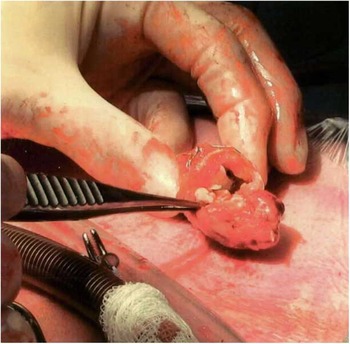
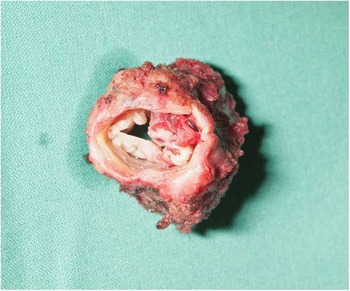
Despite aggressive antibiotic treatment he remained febrile, tachycardic, and unwell, and he proceeded to surgical conduit removal and replacement. During the operation, findings included evidence of infection running the length of the stented Melody valve and between the valve and the prior conduit. Vegetations were seen attached to the leaflets of the valve with a huge vegetation on one leaflet extending out to the pulmonary confluence (Fig 1). After Melody and pulmonary homograft removal and extensive irrigation with vancomycin, the conduit was replaced with a 24 mm homograft. Antibiotic therapy was continued for 6 weeks with vancomycin and rifampicin, with gentamicin included during the initial 2 weeks.
Explanted conduit with obstruction.

Two additional patients have presented with endocarditis more recently. These were patients 2 and 3 in our series and were both at 5.5 years post Melody placement. The first presented to his local hospital with pleuritic chest pain and grew a coagulase negative staphylococcus on blood cultures. Peak velocity through the conduit had risen to 4.9 m/second, and after careful consideration his 19-year-old homograft and the infected Melody valve were replaced. A vegetation was noted at explant behind one leaflet (Fig 2). The other young man was admitted with a febrile illness and blood cultures positive for Streptococcus salivarius – three sets of cultures. He is the only patient in our series managed medically to date. Post endocarditis treatment with gentamycin and penicillin, he remains under close surveillance.
Conduit explant with vegetation.

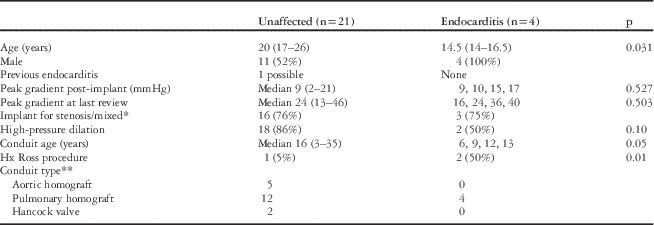
We reviewed our data to determine whether any of the risk factors for infective endocarditis postulated by other investigators were supported by this experience (Table 4). The transvalvar pullback gradients at implant in the patients who later developed endocarditis were not appreciably elevated. The peak gradient at the follow-up echo before the endocarditis had also not substantially increased. We have only undertaken one implant in a patient with a possible previous history of past endocarditis, and he has not shown any evidence of new or recurrent infection. Two infective endocarditis cases occurred in patients with previous Ross procedures and this will be further discussed below.
Comparison of the Melody group: endocarditis cases and unaffected.

* Mean gradient >40 mmHg
** n=23 as two patients homograft type unknown (placed overseas)
Surgical data
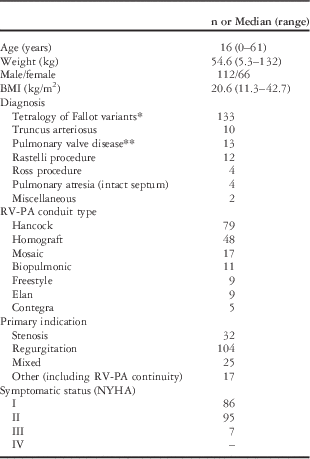
In the context of this concerning endocarditis incidence of 16% (4/25) in our Melody implants, we examined our Unit data for endocarditis documented on surgical pulmonic valve implants as a direct comparison (Table 5). From October, 2009 to May, 2015, 178 patients from infants to adults underwent bioprosthetic pulmonary valve or right ventricular to pulmonary artery valved conduit placement. Ages ranged from 3 months to 61 years with a median of 16 years. A variety of valves were implanted: Hancock, 79 (44.4%); homografts, 48 (27%); Mosaic, 17 (9.5%); Freestyle, nine (5.1%); Elan, nine (5.1%); biopulmonic, porcine stented, 11 (6.2%); and Contegra, five (2.8%). Overall, three patients returned with confirmed endocarditis, with one additional child with probable endocarditis based on fever, lethargy, and two positive blood cultures, giving a surgical bioprosthetic pulmonary valve endocarditis rate of four in 178, or 2%. All had tetralogy or tetralogy with pulmonary atresia. The infected valves were two Hancock conduits, a biopulmonic, and a Mosaic. Organisms were Enterococcus, S. aureus, Aggregatibacter actinomycetemcomitans, and a Haemophilus parainfluenzae. All patients with confirmed endocarditis underwent further surgical valve replacement. During this same time period, there were three further cases of infective endocarditis documented on older homografts implanted before October, 2009.
Surgical pulmonary valve implant patient characteristics (n=178).

BMI=body mass index; RV-PA=right ventricle-to-pulmonary artery
* Includes tetralogy with pulmonary atresia
** Isolated dysplastic/stenotic valves post valvotomy
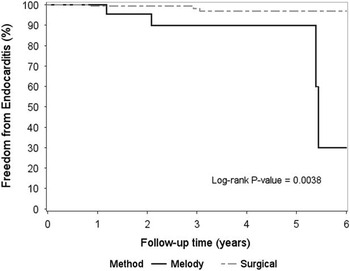
The two cohorts, Melody percutaneous pulmonary valve implant and surgical conduit/pulmonary valve replacement, were compared. The incidence of endocarditis in follow-up was substantially increased in the Melody group (16 versus 2%, p=0.0089). Freedom from endocarditis during follow-up is demonstrated in Figure 3. Median follow-up in the two groups did not differ (Melody 2.9 years, interquartile range 2.0–4.6 versus surgical 2.9 years, interquartile range 1.7–3.9; p=0.629). The surgical patients were younger (median 16 years, interquartile range 8–27 versus 18 years, interquartile range 16–24, p=0.042). Interestingly, the number of males in each group was similar (Melody 60% versus surgical 63%, p=0.804).
Kaplan–Meier survival curves depicting the probability of survival free from endocarditis in the Melody and surgical conduit groups.

Discussion
Our initial procedural experience with the Melody transcatheter pulmonary valve has been largely positive over 25 valve implants. Most patients have recovered quickly, were discharged on day 1 or day 2 post procedure, and have demonstrated improvement in symptoms and echocardiographic findings. We are concerned, however, that we have seen four cases of infective endocarditis in short- to medium-term follow-up with severe and potentially life-threatening impact. This review was undertaken to investigate potential contributing factors to these infective complications in our cohort, to examine and contrast our experience with reports from other centres, and in particular to look at our endocarditis incidence in the context of our surgical implant experience. In addition, we wished to highlight the possibility, noted by our French colleagues previously, that severe conduit obstruction can evolve rapidly in this context in association with right ventricular compromise and low cardiac output, which can be life threatening.Reference Fraisse, Aldebert and Malekzadeh-Milani 14
As in other series, our cases occurred remote from the valve implant procedure, and hence valve contamination at the time of the procedure appears unlikely. Other series have reported infection in this context being predominantly Streptococcal and Staphylococcal species and this was also our experience.Reference Van Dijck, Budts and Cools 2 , Reference Fraisse, Aldebert and Malekzadeh-Milani 14 , Reference Cheatham, Hellenbrand and Zahn 15
Of our infective endocarditis cases, two involved percutaneous pulmonary valve implant after previous Ross procedure. The Great Ormond Street group reported in 2009 12 successful percutaneous pulmonary valve implant procedures in patients who had undergone Ross procedures and noted one case of “medically treated” endocarditis over a mean follow-up of 18.8 months.Reference Nordmeyer, Lurz and Tsang 16 Gillespie et alReference Gillespie, McElhinney and Kreutzer 17 recently reported combined US experience in this group with a 10.7% incidence of endocarditis or blood stream infection. A concerning finding in one of our Ross patients was the extension of infected tissue from the homograft around and into the neoaortic root, which resulted in the requirement for extensive surgical intervention with a double valve replacement.
Our Unit is the only congenital cardiac centre in New Zealand and hence performs all pulmonary valve replacements. In addition, national follow-up for paediatric and congenital cardiac disease is supervised by our team. Correspondence for congenital heart patients is sent through to Auckland, and patients at follow-up are seen through a network of visiting cardiac clinics in adult units. It is possible, but unlikely, that a patient with a positive blood culture post valve replacement treated in other adult cardiac units would not be notified to our team. Over this time period, a number of different surgical prostheses have been used, including homografts, porcine, and bovine bioprostheses. We included in the surgical cohort all pulmonary valve and conduit replacements aiming to detect any relationship between particular types of valve and infection.
Surgical pulmonic endocarditis cases were relatively few. Of interest, no infections were seen in the five Contegra conduits placed. Overall, we obtained no particular reassurance with regard to the endocarditis seen in our Melody cohort, in which our infection rate locally is, to date, significantly higher than international data.
Van Dijck et alReference Van Dijck, Budts and Cools 2 have also recently compared rates of Melody valve endocarditis with local surgical experience. The overall endocarditis rate of 2.4% for the homografts is comparable to that of the homograft group in our series. The incidence of endocarditis reported in the Melody and Contegra groups, however, was similar (7.5% at 2 years for Melody and 20% at 8 years for Contegra) and significantly higher than that of the homograft group.
The importance of observing endocarditis prophylaxis recommendations in this setting has been noted, with anecdotal cases of infection seen in the context of recent dental treatment or other relevant procedures without appropriate antibiotic cover.Reference Lurz, Coats and Khambadkone 11 , Reference Butera, Milanesi and Spadoni 18 It is possible that this particular substrate of a bioprosthetic implant within a degenerated bioprosthesis may be exquisitely sensitive to colonisation, and in this era of more restricted endocarditis prophylaxis for CHD this recommendation may require more emphasis.
When we reviewed procedural data and in particular conduit factors during and at the conclusion of the catheter procedures, we found that final peak-to-peak catheter gradients in our series were comparable to those of other investigators.Reference McElhinney, Benson and Eicken 5 , Reference Lurz, Coats and Khambadkone 11 , Reference Eicken, Ewert and Hager 12 , Reference Butera, Milanesi and Spadoni 18 In light of potential negative impact of residual gradient, we have been cognisant of the need to redilate the original stent, or post-dilate the Melody, to minimise the final gradient. Peak gradient post implant was not shown to be predictive of endocarditis in our series, although the numbers are small.
The malignant potential of obstructive endocarditis has been highlighted in particular in papers from France including deaths in this setting.Reference Patel, Iserin, Bonnet and Boudjemline 6 , Reference Malekzadeh-Milani, Ladouceur and Patel 8 , Reference Fraisse, Aldebert and Malekzadeh-Milani 14 These reports also consider the potential role of residual gradient and of valve thrombosis, adding that thrombosis has affected the Contegra, from which the Melody is derived. We have occasionally observed thrombosis inside surgically placed Contegra conduits; however, we employ these as a bioprosthetic solution for right ventricle-to-pulmonary artery continuity in smaller children and infants, and hence the valve diameter in our patients would be less than those of a fully expanded Melody prosthesis. Schneider et alReference Schneider, Vogt and Boekenkamp 9 have demonstrated that these valves do develop a complete neointima, but also demonstrated thrombotic material in three of four cases of endocarditis at the base of valve cusps. In a discussion with our pathologists with regard to our explanted valves, they did not feel they would be able to histologically distinguish between thrombosis complicated by infection and a primary nidus of infection, and hence we cannot add additional data in this regard. In response to our endocarditis concerns we have now moved to advocating lifelong antiplatelet therapy with aspirin for all of our Melody valve patients.
Limitations
This is a retrospective experience, and numbers, particularly in the Melody group, are small. Follow-up is ongoing for both Melody and surgical patients and many of these patients were referred from and continue to be followed up in other centres. Although we maintain close collaboration with referring clinicians and regular visiting clinics occur throughout New Zealand and around the Pacific Islands, the post-surgical infective endocarditis rate may have been underestimated. Any patient requiring further intervention or surgery would, however, be referred back to our Unit.
Conclusions
Our initial experience with Melody transcatheter valve implantation has been positive and we remain enthusiastic with regard to this technique. This paper describes, however, four cases of endocarditis from 25 implants and a rate of infection that is substantially higher than the local surgical pulmonic implant rate. Further follow-up and investigation are required with regard to this important problem. The importance of endocarditis prophylaxis and good dental care and hygiene deserves particular emphasis in patient education.
Acknowledgements
The authors acknowledge the collaboration, particularly of referring cardiologists, in the care of these patients. The authors thank Karishma Sidhu for her statistical assistance and Charlene Nell for her assistance in manuscript preparation.
Financial Support
This research received no specific grant from any funding agency, commercial or not-for-profit sectors.
Conflicts of Interest
None.