INTRODUCTION
Only a few individuals would disagree with the fact that “cultural property” is not just about property. It carries with it values and sensitivities on the objects themselves, their place in time and history, their link to territories and countries, their symbolism, functions, and role in relation to the context in which they originally belonged. Footnote 1 That alone makes cultural property a distinct type of property in need of special handling, which, by definition, cannot easily be dealt with by the known legislative norms as they apply to other types of property. This should also be seen in conjunction with differences in mentality with regard to the protection of cultural property. For example, some states belong to the “export” or “source” countries, meaning that they are rich in cultural property and face problems of illegal excavation and illicit export, while others belong to the “import” or “market” countries, meaning that they have an interest in allowing for a more relaxed import and trade of art, especially through auction houses and galleries, or they have collectors or museums possessing important collections that originate from third (“export”) countries. Footnote 2
Resort to courts (that is, mostly national courts) necessarily means submission to rigid (national) law, which does not always take into account the particularities of cultural property. On most occasions, it also means that the parties have no choice on the jurisdiction (which courts hear the case), on the applicable law (which law applies), and on the judges (who decide the case). Alternative dispute resolution (ADR) provides a number of options and is far more flexible compared to any type of litigation. It also has a number of other advantages as well as disadvantages, which we shall examine further on.
This article aims first at examining the pros and cons of ADR. It will then provide two examples of cases in which cultural treasures were returned to their country of origin (from the United States to Greece) in which the author has been personally involved. These cases concern the J.P. Getty Museum and the Leon Levy and Shelby White collection. The Parthenon Marbles case will also be explored, especially in light of the United Nations Educational, Scientific, and Cultural Organization’s (UNESCO) recent (2013) invitation to the United Kingdom (UK) to accept mediation on the matter, and the UK’s even more recent (2015) rejection of the invitation. In all three cases, the facts will be set out and an assessment of the process followed will be attempted, although, in the author’s view, these cases (especially the Greek–US cases and the Parthenon Marbles case) differ and there is no particular typology to be found. Finally, conclusions will be drawn as to whether ADR is a feasible and beneficial option for the parties and whether, nowadays, it constitutes the norm in cases where cultural treasures are returned to their countries of origin.
AN OVERVIEW OF ADR
So far, our experience has proven that recourse to courts usually takes place (1) if the claim is crystal clear with regard to both its facts (for example, how the object has been alienated from the claimant, where it was found, and who owns or possesses it) and its legal bases (the applicable law in the case at issue clearly provides for its return/restitution, the claim is not statute barred, and so on) and (2) if there are private parties involved where the influence of a state cannot be used for the out-of-court settlement of the case. Footnote 3 However, not all cases present these characteristics. Cultural property cases demonstrate difficulties in proving how and when an object has left the country of origin illicitly, especially if there is no record of this object, as is usually the case (especially for objects that have been illicitly excavated). Footnote 4
THE PROS AND CONS OF LITIGATION AND ADR
Litigation is usually expensive and takes time. However, it also gives claimants the opportunity to act swiftly in order not to have their claim statute barred. The filing of a suit interrupts the running of any time limitations, and one can also file for preliminary measures/injunction in order to “freeze a situation” until a final decision is reached. Footnote 5 On top of that, the filing of a suit (or, worse still, recourse to the penal courts) can exert pressure for the resolution of the issue. In fact, the reason why so many cultural property cases, for which a lawsuit has been filed, have not been pursued further is that the parties have reached a mutually acceptable out-of-court settlement. Footnote 6 Moreover, litigation is capable of gathering strong evidence on the case (for example, through orders for disclosure), which can be helpful not only for the fair resolution of the matter brought before the court but also for the resolution of other matters linked to the case (for example, if more cultural objects are missing from the same museum or archaeological site, while the case refers to only some of them). Compliance with the judgment is mandatory, and non-compliance is followed by sanctions. In addition, the resolution of the matter is definitive, and there is no risk of further litigation (especially if the case is heard and decided at all levels). Finally, recourse to the courts does not preclude recourse to other modes of dispute resolution even during court proceedings.
On the other hand, courts are not well equipped and confident to deal with these types of cases, and the outcome is often uncertain and inflexible, which means that it fails to take into account the particularities of cultural property cases—that is, the ethical and public policy concerns that such cases involve. Therefore, alternative (to courts) dispute resolution may work as a means that, on most occasions, is flexible enough to take into account not only the legal, but also the ethical, social, scientific, and humanitarian, aspects. Footnote 7 The following issues should also be taken into account:
-
• There are very different legal traditions and attitudes among the various states. The outcome of a court decision cannot be predicted, and the parties are not always willing to enter into a process with uncertain results. This may prove detrimental not only to the case at issue but also to future cases since the outcome could set a precedent for the future.
-
• Litigation is a very costly process. However, it should also be noted that judges are free, while an arbitrator will have to be paid, and, usually, his or her fee is rather high. This is not the case for mediators or conciliators, who—if they choose—may not be paid. Yet again access to justice (that is, the courts) is not free since lawyers’ fees, filing fees, and other expenses can be rather high. In light of such costs, if the party claiming a cultural object is a poor state or a developing country, it is not easy to bear the costs of legal proceedings. The same applies to private parties who do not possess adequate financial resources. Footnote 8
-
• When one has a court judgment, one needs to enforce it. It is not always easy to enforce court judgments in other states on various legal grounds, including the grounds of public order.
-
• Private international law issues may also cause difficulties. In order to bring a case before a national court, matters of jurisdiction and applicable law should be decided. It is not always certain whether the court chosen by the claimant is competent to decide (issues of jurisdiction) or which law is applicable in the case at issue (the law of the state that claims the object, the law of the state where the object is situated, and so on). Even when the applicable law is sorted out, this law may contain loopholes or may be incomplete. This is because restitution of cultural property is an area that is not fully (if at all) developed in all countries. One may therefore run the risk of having the case dealt with in the same way that any case of illegally alienated objects would be Footnote 9 and not of cultural objects, in particular. This would mean risking short time limitations as well as risking the possibility that the claim will not be dealt with in the context of specifically drawn legal or other provisions.
-
• Even if issues of jurisdiction and applicable law are overcome, it is not always easy for the parties to produce the necessary proof needed to establish that a cultural object has been illegally alienated. This is especially true for cultural objects that have been the product of an illegal excavation or have never been documented or listed in a database as missing. Proof is not easy to find when it relates to the circumstances of the alienation of an object from a particular country. In ancient times, many neighboring countries had trading relations, and, therefore, objects could have travelled, or been exchanged, between them and ended up in different countries. It is also difficult to prove the date of such alienation, even though that is crucial in order for a claim to be filed admissibly.
-
• The law is not retroactive. Therefore, a considerable number of cases are not considered due to time limitations. In addition, many claims for return have been statute barred because of time limitations. At least in some states, and most likely in the states where the object is situated, time limitations are short. However, this does not mean that the claim is not sound on ethical, scientific, historical, humanitarian, or other grounds. Yet these grounds are not judiciable by the courts, which have to follow a rigid legal approach.
-
• Judicial recourse cannot take into account other interests of the parties, which might require them to be flexible. These interests are closely linked to the smooth closure of a case without attracting any bad publicity or harming good relations with the other party. States, museums, or collectors, for example, wish to preserve their good reputations and to co-operate with reputable museums. These parties would in some cases be in favor of assisting in the repatriation of an object that perhaps left its place of origin many years ago in an illegal, or even in a legal, manner. The restitution of an object may help foster good relations between two or more countries and may open the door for future co-operation. This can also work well for museums if they choose to exchange loans, exhibitions, make annexes in other countries, and so on. Footnote 10
ADR encompasses many well-known (as well as less well-known) forms of dispute resolution. In particular, it includes arbitration (which is a more rigid quasi-legal form of dispute resolution, which comes very close to litigation), mediation or facilitation, conciliation, good offices and inquiry (fact finding). There are also other forms of ADR, which do not necessarily amount to a resolution of the dispute but work as consultation tools. These include local panels set up by city councils, advisory panels set up by ministries, specialist not-for-profit dispute resolution services, and inter-professional agreements. Footnote 11 Of course, there is also the practice of direct negotiations between the parties, with the possible use of lawyers and experts in the field.
ADR is promoted by the Charter of the United Nations as well as by other international conventions in this field. Footnote 12 The same spirit is reflected in the specialized international conventions on the return of cultural objects. Article 17(5) of the 1970 Convention on the Means of Prohibiting and Preventing the Illicit Import, Export and Transfer of Ownership of Cultural Property (UNESCO Convention) provides that “at the request of at least two States Parties to this Convention which are engaged in a dispute over its implementation, UNESCO may extend its good offices to reach a settlement between them.” Footnote 13 According to Article 8(2) of the 1995 Convention on Stolen or Illegally Exported Cultural Objects, parties to a dispute under Part II or Part III of the convention “may agree to submit the dispute to any court or other competent authority or to arbitration.” Footnote 14
During its sixteenth session on 21–23 September 2010, the UNESCO Intergovernmental Committee for Promoting the Return of Cultural Property to Its Countries of Origin or Its Restitution in Case of Illicit Appropriation (ICPRCP) has adopted rules on mediation and conciliation in order to facilitate cultural property dispute resolution within the ambit of its activities and role. Footnote 15 This was initiated in order to strengthen the committee’s role and enhance it in comparison to the mere offering of its good offices. These rules are rather flexible and provide the opportunity to the parties wishing to submit a case on an ad hoc basis to change a number of these terms on the basis of which a pending case shall be decided, upon agreement. Footnote 16
TYPES OF ADR
Arbitration
The notion of judicial settlement is not entirely alien to arbitration. This is because the award in arbitration is usually based on strict legal doctrine, usually drawn from the law of a particular national legal system, as is the case with court decisions. Footnote 17 There may be cases, of course, where the parties may opt to ask the arbitrator to decide the dispute ex aequo et bono (on the basis of principles of fairness) or as an amiable compositeur, so as to restore the relationship between the parties. Footnote 18 Arbitration depends on consent, so in cases of looted or illegally possessed cultural objects, an ad hoc agreement between the parties is required. Footnote 19 The process followed is usually confidential (even the award can be confidential if the parties agree as such) Footnote 20 and relies on a formal procedure, which resembles court litigation in many respects. If this procedure is not followed, there are usually sanctions. The award is binding, and because of the provisions of the 1958 Convention on the Recognition and Enforcement of Foreign Arbitral Awards, arbitration awards are generally easier to enforce in other jurisdictions than court judgments. Footnote 21 Of course, this does not preclude cases where the courts in a particular jurisdiction resist such recognition and enforcement.
In most legal systems, there are very limited avenues for appeal of an arbitral award, which is sometimes an advantage because it limits the duration of the dispute and any associated liability. The applicable law can either be public international law or national law or both (if the parties so agree). The procedural law can be defined accordingly. The parties may also agree on the application of extra-legal principles. Footnote 22 Arbitration under public international law usually refers to disputes between states. If it is not states that are involved on both sides, then the case is known as “mixed arbitration.” A classic example of arbitration between states is Temple of Preah Vihear (Cambodia v Thailand), which was conducted by the International Court of Justice. Footnote 23 In this case, Cambodia sought and recovered from Thailand statues and other carvings that had been removed from the Preah-Vihear Temple by the Thai authorities since the date of the occupation of the temple by Thailand in 1954.
Mediation
Mediation is another form of ADR. As with arbitration, the consent and co-operation of the parties is needed. It is usually not conducted on the basis of law (in the narrow sense of the word), although on most occasions law is taken into account. The mediator is a person who has the approval and mutual consent of the parties to act as a facilitator (or else a diplomat) in the negotiations between them. The mediator usually acts confidentially (if the parties agree) and is not bound by any procedural rules. This means that he can meet any party as he wishes, in private, without disclosing the details of their discussion (unless a different agreement is made before the commencement of the process). Footnote 24 In addition, he does not need to be a lawyer, although a lawyer is usually needed at the end of the process if an agreement is reached in order to draft the final agreement. The claim submitted to mediation may change (expand or diminish) during the process and new elements may be added to it. Furthermore, it need not be a strictly legal claim. However, the outcome of mediation will be enforceable as a binding contract but will not be enforceable in the sense that a judicial judgment or an arbitration award are.
The main benefit of mediation is that it is a very flexible procedure. It allows parties to submit wider claims that are of interest to them, following a procedure that is mutually acceptable. Also, the resolution is not something that is imposed on them by a third party. Rather, it is an agreement that is reached by the free will of the parties and is mutually acceptable to them. In mediation, other interests apart from the law are taken into account. These include ethics, codes of conduct, national policies, public feeling, and so on, which would not be taken into account if the law were to apply as the sole basis for the resolution of the case. Mediation permits alternatives that are not possible under law, such as exchanges of objects, loans, exhibitions, co-ownership, and other forms of co-operation. It may be free, which makes mediation an attractive option. In other words, there may be instances where mediators may choose not to be paid. Expenses, though, will have to be paid (such as travelling or meeting expenses).
In public international law, mediation is defined as the intervention of a third party who assumes the task of “reconciling the opposing claims and appeasing the feelings of resentment which may have arisen between the States at variance.” Footnote 25 It seems that, to a large extent, the literature uses the terms “mediation” and “good offices” interchangeably. Footnote 26 However, these two notions may be distinguished on the basis that in mediation the third party involved in facilitating a mutually acceptable solution (which can either be a third state or a neutral third party, such as an interested individual or an organ of the United States) takes active steps in order for a compromise to be reached. “Good offices” consists of actions taken by a third party to bring about, initiate, or continue negotiations without the third party actively participating in the discussion of the dispute. Footnote 27 Good offices include services offered by the ICPRCP, which offers assistance in cases of requests for the return of cultural objects falling outside the 1970 UNESCO Convention. The Parthenon Marbles case remaining on the committee’s agenda forms one example where the committee offers its good offices. Footnote 28
Negotiations
Apart from arbitration, mediation, and good offices, there are also other forms of ADR, such as conciliation, inquiry and fact-finding, negotiation, not-for-profit dispute resolution services, inter-professional agreements (which facilitate dispute resolution), and local or governmental panels working towards this aim. Footnote 29 We shall only refer briefly to negotiations in this discussion. Negotiation constitutes par excellence the means by which the majority of disputes are resolved and settled. It is a direct process that usually involves only the parties in the dispute. It is not subject to any formal or prescribed process and may concern private parties (persons or entities) or states or private parties and states (mixed disputes). It goes without saying that it does not preclude resort to other settlement procedures including recourse to the courts. Negotiations sometimes run parallel to court action, which may exert pressure for the closure of the case.
The challenges one may face vary. The most important ones are, first, for the parties to agree to enter into negotiations with each other and engage in them in a constructive manner. Second, there should be a motive/incentive for a solution to be reached. And the party having the initiative for the negotiations should really work on this motive. Third, negotiations should aim at a solution/settlement within a reasonable amount of time. A party may use negotiations as a pretext in order to delay proceedings or to buy time so as to avoid the resolution of the matter. Fourth, the personality of the parties who are conducting the negotiations, as well as their skills and capacity, may play a crucial role in the resolution of the matter.
If one takes into consideration how most cultural property disputes, especially those concerning the return of cultural objects to their countries of origin, Footnote 30 have been resolved during recent years, one comes to the conclusion that there is a trend towards the out-of-court settlement of such cases. Of course, this does not mean that resort to litigation will not remain an important way to request the return of objects that have been stolen, or are illegally exported, from their country of origin and for which time limitations have not expired and considerable proof is available. However, most cultural property cases lie in the grey area with regard to time limitations and proof because of the particularities of the black market in art. Footnote 31,Footnote 32 On top of everything else, cultural property claims present ethical, moral, or humanitarian aspects, which on many occasions are at least as important as the legal ones. Court litigation, by its nature, is not sufficiently equipped to take such aspects into account. Therefore, the judgments delivered by the courts do not always amount to equitable solutions that are well suited to cultural property claims. In addition, they do not always correspond to the general public feeling. ADR and especially modes other than arbitration (which comes particularly close to litigation), offer flexibility and can adjust to the parties’ mentalities through proposals, discussions, and the possible offer of cultural exchanges. Enforcing the outcome reached by such types of resolution may not always be an easy task because of legal and public policy considerations. Yet these impediments can be overcome since the final result will usually take the form of a contract and will be enforced as such to the extent that it does not impinge on a state’s public order. Footnote 33
The fact that a considerable body of soft law has been developed in the field of cultural property restitution is another indication of the fact that the law seems inadequate to deal with these issues. Soft law starts transforming wider equitable principles into legal principles by practice and consistent application. These principles can easily be taken into account in ADR. ADR has been encouraged by many national legal systems as well as by international law because on most occasions it is cost-effective, flexible, can be conducted in a positive and friendly spirit, and helps towards the attainment of mutually acceptable solutions.
THE J.P. GETTY MUSEUM CASE
History
In 2007, four antiquities, thought to have been illegally exported, were returned from the J.P. Getty Museum to Greece. The sixth century bc Thasian relief and the fourth century bc Boeotian stele were returned in August 2006, while the other two objects, a fourth century bc gold funerary Macedonian wreath and a sixth century bc marble statue of a kore (namely a standing young woman), were returned in March 2007. The latter two objects formed part of the museum’s masterpieces.
The Thasian relief was stolen in 1911 from the French Archaeological School storehouse in Thassos and was illegally exported abroad. It was acquired by a number of collectors (among them an Austrian collector) and ended up at the Paul Getty collection in 1955. The Boeotian stele, a tombstone engraved with the image of a dead warrior bearing the name Athanias, was illegally excavated near Thebes in 1992 and was acquired by the J.P. Getty Museum in 1993 through the Safani Gallery in Manhattan. The stele had not been documented in published reports; it is considered to be a rare example of incised black limestone from the area of Thebes (Boetia) in ancient Greece.
The funerary wreath, an exquisite piece of work, was dug up by a farmer in 1990 near Serres in northern Greece and passed on to the art market through Germany and Switzerland before being sold to the J.P. Getty Museum by Christophe Leon in 1993 for the amount of US $1,150,000 (fig. 1). Such a wreath could only have originated from the area of Macedonia in Greece. It was also allegedly created by the same workshop that created the golden wreath found in King Philippos’ tomb. Greece alleged that Marion True, the curator of the museum who had proposed the acquisition, bought it knowing it was illicit. Footnote 34
Golden funerary wreath, 4th century BC. Currently exhibited at the Archaeological Museum of Thessaloniki, Greece. Source: With the compliments of the Directorate of the Management of the National Archive of Monuments, Documentation and Protection of Cultural Goods, Hellenic Ministry of Culture and Sports.

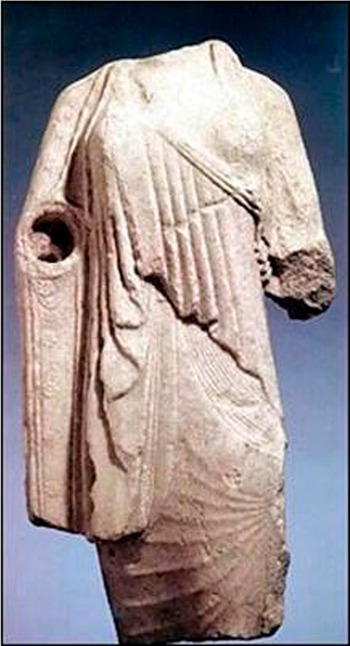
The marble kore also originates from Greece and is made of Paros marble (fig. 2). It was not documented or published anywhere, which means that it was illegally excavated and smuggled from the country. It was acquired by the J.P. Getty Museum from Robin Symes in 1993 for the amount of US $3,300,000. This particular antiquity was also claimed by Italy at the initial stages of the case. Yet, after arrangements with Greece, Italy dropped its claim.
Marble torso of a young woman (kore). Currently exhibited at the National Archaeological Museum of Athens, Greece. Source: With the compliments of the Directorate of the Management of the National Archive of Monuments, Documentation and Protection of Cultural Goods, Hellenic Ministry of Culture and Sports.

The Greek state was notified of the museum’s intention to buy the golden wreath and the kore in March 1993. The museum also sent photographs of the two antiquities to the Greek state, which replied that it disagreed with the acquisition, since such exquisite antiquities could not have been found on the market legally. Had they been legal, they would have been published or reported somewhere. The J.P. Getty Museum disregarded Greece’s reply and acquired them on the basis of standard guarantees concerning title, export, and import, in accordance with the museum’s acquisition policy at the time. Footnote 35 In the case of the wreath, Christophe Leon was reported to be the seller who acquired it from a Swiss collector, while Switzerland was indicated as its country of origin. At the end of 1997, the German police sent documents to the Greek Interpol, which demonstrated that Greek looters had illegally exported the golden wreath from Greece to Germany and had contacted Christophe Leon and Marion True with the aid of a painter of Greek origin who was a permanent resident of Germany. Footnote 36 The Greek Ministry of Culture initially tried to retrieve the wreath through diplomatic channels but with no success. In 2005, the Minister of Culture at the time asked the author to provide legal advice on the matter. Upon advice, a team was set up to pursue the case. In the meantime, charges were pressed against Marion True, the former director of the museum. A letter was sent to the J.P. Getty Museum unequivocally setting out the claim as well as the ministry’s intention to pursue the matter in the courts unless the museum entered into negotiations with Greece. Negotiations were opted for at this stage because they could achieve a timely and low profile resolution of the matter without incurring too much cost and effort for both sides.
At that time, Italy also pressed charges against Marion True and successfully demanded the return of a number of antiquities. Footnote 37 Although Greece and Italy pursued their cases independently, they had an excellent co-operation and understanding on the matter. The press, both in Greece and abroad, especially the Los Angeles Times, kept publishing information on the illegal acquisition of the antiquities. In response to the accusations against its acquisition policy, the J.P. Getty Museum announced a policy with stricter guidelines Footnote 38 in order to bring its procedures into line with the principles of the 1970 UNESCO Convention. Footnote 39
After the negotiations were concluded, all four antiquities were returned to Greece. Later on, Greece and the J.P. Getty Museum signed an agreement for future co-operation, according to which an exchange of know-how and exhibitions would be facilitated. This agreement was concluded on the basis of attaining a constructive co-operation between the parties, which could prove useful in relation to possible future claims. Footnote 40 In 2012, two more antiquities were returned from the J.P. Getty Museum to Greece. Footnote 41
An Assessment
This case undoubtedly involved looted antiquities, which had found their way into the museum’s collection in a dubious manner and under conspicuous circumstances. The museum had paid a significant amount of money to acquire them but was not diligent enough to have their title and origin thoroughly examined before their acquisition. It seems that this practice did not only relate to the particular antiquities but also was a practice followed by the museum with regard to all objects in its collection at that time. Initially, Greece followed the diplomatic track in order to have the antiquities returned. Yet this action did not seem to pay off. The museum responded to Greece’s invitation to negotiate only when charges were pressed against Marion True on offenses relating to antiquities smuggling in the criminal courts and when Greece’s intention to pursue the matter further became fierce and apparent. Footnote 42 The claim was set out clearly, there was an exchange of documentation, deadlines were set, and there was a consistent and continuous follow up in relation to each and every action. There was also a continuous flow of proof and documents that emerged from the active co-operation between the ministry’s team, on the one hand, and the officer of the specialist unit in Greek police and the prosecutor that had undertaken the case, on the other.
Although for Greece the case was clear-cut, pursuing the case in the US courts would be a costly and uncertain exercise, while there was no guarantee that a judgment by the Greek courts would be easily enforced in the United States. The timing of the negotiations was ideal. The efforts of Greece were coupled with those of Italy who had similar claims against the museum. These claims were also supported by the Greek and foreign press, which did not seem tolerant of practices that did not abide with what was expected from a reputable cultural institution in the United States. Illegal trafficking and the acquisition of illegal antiquities did not fit in well with the image of a prestigious institution. There was also the pending case in the Greek criminal courts against Marion True.
The negotiations were difficult. Yet both parties conducted themselves in a professional manner demonstrating good will and engagement in the process. Both parties were straightforward, sincere, and persistent towards their aim. Greece aimed at the unequivocal and immediate return of all four antiquities. The museum tried to retain the image of a prestigious institution that operated within the boundaries of law and ethics. The role of Michael Brand, the newly appointed director of the museum at the time, was also positive as it inspired a vision for the museum and respected ethics. All of these factors, namely Greece’s persistence based on thorough research, the engagement of the parties involved towards the resolution of the matter, the personalities and abilities of the negotiators, the museum’s change in acquisition policy (probably due to international Footnote 43 and media Footnote 44 pressure) as well as the then pending case before the Greek penal courts against Marion True (the former museum’s director), led to the case’s solution.
The main challenges for the negotiations from Greece’s perspective were, first, the fact that it took several years for Greece to convince the museum to enter into negotiations with it and accept that the matter had to be resolved. Second, in the beginning, the two parties differed in their mentalities. The museum believed that it had undertaken all necessary steps for the legal acquisition of the antiquities. The steps undertaken by the museum for the acquisition of the antiquities at issue resembled those of many museums worldwide. For example, a seller’s declaration alone that the antiquity either existed for several years in a private collection or had been imported legally from a third country (and not the real country of origin) into the country where the museum was established was considered to be sufficient. Greece insisted that further research had to be undertaken. Lastly, the museum had paid a considerable amount of money to acquire these antiquities and was not easy to relinquish them at no cost.
There are hardly ever cases where one factor alone makes the difference; it is usually the combination of a number of factors that works towards a positive result. In this case, there were positive results on both sides. Greece acquired the antiquities back, the J.P. Getty Museum restored its reputation and changed its policies to meet the high international standards in this area, and a fruitful co-operation between the parties, which provided for an exchange of know-how and exhibitions, was achieved.
Although this may sound like more of an out-of-court settlement rather than a form of ADR, I consider it to be the latter. The reason is that not much had changed from the time Greece originally asked for the four antiquities back from the J.P. Getty Museum compared to the time when substantial negotiations started and it was made clear that if negotiations did not succeed there would be recourse to the courts. In addition, as mentioned above, any recourse to the courts (US or Greek) presented the disadvantages of cost, uncertainty, and enforcement.
THE LEON LEVY AND SHELBY WHITE CASE
History
The closure of the J.P. Getty Museum case coincided with the beginning of the Leon Levy and Shelby White case concerning two antiquities. In Reference Despinis1991, Giorgos Despinis informed the Greek Ministry of Culture that the upper part of a grave stele depicting two men (a warrior and a teenager), dating to the early fifth century bc (410–400 bc) and originating from Porto Rafti area in Greece, was found in the United States in the Leon Levy and Shelby White collection. Footnote 45 The stele was included in the collection’s catalogue published by the Metropolitan Museum of New York in 1990. Footnote 46 The lower part of the stele was found at the beginning of the 1960s in a private property in Porto Rafti during an official excavation by the Ministry of Culture and has been exhibited since 1963 at the Archaeological Museum of Vravrona. It was only logical to assume that the upper part was the outcome of illegal excavation in the area and had left the country in an illicit manner.
The second antiquity was a bronze calyx krater dating approximately to 340–320 bc and originating from Pieria in northern Greece. Footnote 47 In fact, it was thought to have been found during an illegal excavation in a king’s tomb in the vicinity. The krater appeared in a special exhibition of the ΜcClung Museum from 17 September 2005 to 2 January 2006. Footnote 48 The krater was spotted for the first time on the Internet by Nikolas Zirganos, the Greek journalist who had also assisted with his investigations in the J.P. Getty Museum case and was later investigated by G. Gligoris from the specialist unit of Greek police.
In spring 2007, the Greek Ministry of Culture contacted Shelby White asking her to return the antiquities to Greece. The team of people that handled this case was the same as in the J.P. Getty Museum case. Negotiations on behalf of Greece were conducted by the author. Meetings took place both in Athens and New York, and an agreement was not easy to reach. Eventually, a contract was signed between the two parties on 10 July 2008, which provided for the return of the two antiquities to Greece. According to the agreement, the Greek Ministry of Culture acknowledged that Shelby White acted in good faith, and, for that reason, it did not intend to file any suit or pursue any legal claims before the courts in relation to the two antiquities. However, the Ministry of Culture reserved any right it may have in relation to any other antiquity in Shelby White’s collection. The handling of the antiquities took place at the Greek Consulate of New York on 30 July 2008, and the antiquities were returned to Greece on 1 August 2008. Footnote 49 Upon its return to Greece, the stele was reunited with its other half and is currently exhibited at the Vravrona Museum. Footnote 50
An Assessment
The factors of success in this case largely coincide with those actions that were applied in the J.P. Getty Museum case. Of course, one could allege that it is harder for an individual collector to bear the cost of a wrongful or “grey” acquisition, for which it paid a significant amount of money, compared to a museum that can somehow absorb such a cost more easily. The issue of compensation by Greece came to the surface on many occasions, yet Greece would not accept it.
Shelby White was a well-known and prestigious collector with links to important museums and cultural institutions. She was also considered to be a benefactor with regard to those institutions. Therefore, her reputation was at stake. The timing was favorable for the Greek advocates. The return of artifacts both to Greece and to Italy had taken place and had worked as a domino in relation to other claims. All of the returns had come from US institutions. Returns were also taking place worldwide and attracting a lot of publicity. In some of these cases, UNESCO was playing a pivotal role, Footnote 51 and so it seemed that the tide was changing after many years. Footnote 52 In such a climate, it would seem awkward for a prestigious institution or collector to navigate in the opposite direction. Greece had prepared its case in a very thorough manner through substantive research and the collection of information. Both parties were engaged in negotiations and worked persistently towards the resolution of the matter in a positive way that demonstrated professionalism and good will.
THE PARTHENON MARBLES CASE
History
The Parthenon Temple on the Acropolis hill in Athens was erected between 447 and 432 bc during the Golden Age of the Athenian supremacy (under the administration of Pericles) by the architects Iktinos and Kalikrates. The marble used for its construction came from the marble quarries of Mount Penteli. The temple was dedicated to the city’s goddess Athena to house the statue of her created by Pheidias. The edifice was intended to demonstrate the success of Athens, which was the leading part of the coalition of Greek city-states, which defeated the Persian armies of Darius and Xerxes. It is considered to be the emblematic piece of classical architecture of the ancient world and has occasionally been promoted as the absolute example of artistic excellence, fruit of democracy, and Western civilization. Footnote 53
The Parthenon Temple suffered its most devastating destruction and mutilation at the hands of Lord Elgin—the British ambassador to the Sublime Porte in Constantinople (1799–1803). Footnote 54 Lord Elgin used his influence in order to gain access to the Acropolis, which was still an Ottoman fort at the time, under the pretext that he would make casts of the sculptures on the frieze of the temple and take pieces of stone, which had fallen to the ground. This alleged authorization was given to him in the form of a letter, which was supposedly signed by a lower Turkish official (Kaymakam). Lord Elgin was never authorized to saw off the frieze or the sculpted metopes, an act that in fact destroyed the better part of both and inflicted serious damage to the whole architrave. Footnote 55 Even if that were not the case, his actions would still qualify as an act of vandalism. According to the laws of the time, the Parthenon Temple, which also housed a mosque, was the property of the sultan who was the only one competent to authorize such acts. No authorization of this sort (that is, a firman) was ever issued by the sultan. Footnote 56
The task of removing the Parthenon Marbles forced Lord Elgin to use exorbitant funds, which led him into bankruptcy by the late 1820s. He was then compelled to sell his collection to the British State, which acquired them in 1816 for the amount of 35,000 pounds sterling. Lord Elgin was reimbursed before the issue was discussed in the British Parliament Committee (!) and the Marbles were acquired irrespective of voices raised against any such action. Footnote 57 Lord Elgin’s activities were never thoroughly investigated by Parliament (and, in particular, the Parliamentary Select Committee). The committee members were presented neither with the document of authorization (that is, the kaymakam letter or bouyourdi) nor with its Italian translation. Besides, the parliamentarians knew little about Ottoman bureaucracy; it probably never crossed their mind that one of Her Majesty’s ambassadors would not have been legally authorized to remove the Marbles or would remove them on the basis of bribes.
Later that same year, the Marbles were transferred as property to the trustees of the British Museum. Britain promised to return the Marbles to Greece once Greece gained its independence from the Ottomans. Footnote 58 But this promise was never kept. During the 1940s, Britain reiterated its promise to return the Marbles as a way of compensation to its wartime allies for the losses they had incurred during the war. Footnote 59 Nevertheless, the Marbles were once more left in the hands of the British Museum under the pretext that the time was not deemed “appropriate” for such a decision.
Requests sent to Britain for the return of the Parthenon Marbles have been repeated ever since, mostly on an unofficial basis. In 1975, Constantinos Trypanis, the minister of culture at the time, set up a committee for the preservation of the monuments of the Acropolis. He asked Britain for the return of the Marbles, which would allow the fullest possible restoration of the Acropolis site with the restitution of some of its integral structural and decorative elements. In 1983, the Greek government (through Melina Merkouri, the minister of culture at the time) officially asked that the Marbles be returned to Greece, and the issue was submitted to UNESCO for the first time. The arguments put forward were that “they are an integral part of a unique building symbolic to the Greek cultural heritage; it is now universally accepted that a work of art belongs to the cultural context in which (and for which) it was created, and they were removed during a period of foreign occupation when the Greek people had no say in the matter.” Footnote 60
In 1983, a bill was introduced to the British Parliament, which would enable the British Museum trustees to return the Marbles. The bill was discussed and finally defeated in the House of Lords on 27 October 1983. It was claimed that the Marbles were well cared for in the British Museum and that their return would set a precedent, which could lead to the denuding of the world’s museums. In April 1984, the Greek official request was formally declined by the British government on the grounds that the Marbles were “secured” by Lord Elgin “as the result of a transaction conducted with the recognised legitimate authority at the time.” Footnote 61 Although the arguments evolved through the years depending on the circumstances and the timing, the official British position remained unchanged. The request for the return of the Parthenon Marbles to Greece has been one of the most prominent and long-lasting demands in the area of cultural property law.
An Assessment
The Parthenon Marbles issue has been the subject of negotiations between Greece and the United Kingdom since 2001. Negotiations were conducted under the auspices of UNESCO within the context of the ICPRCP. This committee is meant to deal with cultural property cases that do not fall squarely within the ambit of the 1970 UNESCO Convention and therefore have to be resolved on the basis of bilateral efforts and states’ good will. Within this context, the Secretariat of the committee offered its “good offices,” meaning that it facilitated meetings between the parties concerned. However, the Secretariat did not take sides nor did it assume a more active role.
The ICPRCP has dealt with a number of cases over its lifetime. So far, all of them have been solved on the basis of bilateral negotiations and with UNESCO’s good offices. The Parthenon Marbles case forms the sole exception up to now and is, therefore, still pending before the committee. The committee convenes every other year, and the parties involved draft a joint recommendation, which, in general terms, reiterates the positive spirit and the parties’ willingness to continue negotiations. It also invites UNESCO to keep facilitating the negotiations towards the resolution of the matter. Footnote 62
In 2007, Greece succeeded in having the UNESCO General Assembly provide that no item can be removed from the ICPRCP’s agenda unless it is resolved. In 2013, and in an effort to break the impasse, the Greek government (after a proposal submitted by the ministry’s Advisory Committee on the Parthenon Marbles at the author’s initiative) asked Irina Bokova, the general director of UNESCO, to extend an invitation to the UK for mediation, based on the agreed UNESCO Rules on Mediation and Conciliation (2010). Footnote 63 This was the first time that a state sought to make use of these rules. The Parthenon Marbles case was the sole case pending before the committee. It was an excellent opportunity for Britain to demonstrate its good will towards the resolution of the matter as this intention had been reiterated for several years in the various co-drafted recommendations.
Britain replied to this invitation only nineteen months later on 26 March 2015. Footnote 64 Its reply comes down essentially to one thing:
We have seen nothing to suggest that Greece’s purpose in seeking mediation on this issue is anything other than to achieve the permanent transfer of the Parthenon sculptures now in the British Museum to Greece and on terms that would deny the British Museum’s right of ownership, either in law or as a practical reality. Given our equally clear position, this leads us to conclude that mediation would not carry this debate substantially forward. Footnote 65
According to the author’s view, the reply reveals at least two things. First, it demonstrates that the UK does not value the role of UNESCO, although it starts by saying exactly the opposite in its reply. It can be argued that UNESCO traditionally favors returns, and in the case at issue, the UK is against the return of the Parthenon Marbles to Greece. In this sense, UNESCO’s role is against the UK’s interests on this matter. Some would also argue that the UK believes that UNESCO is responsible for escalating international pressure in this area. Second, the UK has demonstrated that it has no intention or willingness to resolve the matter. The issue of ownership (to which it refers) is just a pretext. Mediation is an open and flexible process, and the parties may bring to it any proposal they see fit. In addition, they do not have to agree on a particular solution if they do not believe that it serves their interests. They only need to make a genuine effort towards a solution. If the issue of ownership was really an obstacle for the UK, it could have set it in the process of mediation and could have worked towards a solution that would either respect or bypass it. There could be a number of solutions that do not need to focus or depend on ownership. By rejecting the invitation, the UK makes apparent that the negotiations (under the auspices of UNESCO) during all these years (since 2001) have operated as a pretext rather than as a genuine effort towards the resolution of the matter.
The UK’s reply came about after the expression of international dissatisfaction and the exertion of pressure, especially as this was made clear during the ICPRCP meeting in Paris on 1–2 October 2014. In this meeting, the presentation of the Greek claim was welcomed by the members of the committee with applause, while the British response was met with silence. The intervening states at the committee showed dissatisfaction with Britain’s disregard of the invitation since it still had not responded, some thirteen months after the invitation was extended. In the author’s view, the UK’s initial intention was not to reply.
It was during the same meeting (the nineteenth ICPRCP session) that a new recommendation—Recommendation 19.COM 6—was adopted, which provided that “Member States and Associate Members of UNESCO to which a request for mediation or conciliation is addressed respond to such requests on the basis of goodwill, co-operation and equity within six months calculated from the date the request reaches them.” Footnote 66 The issue of a member state not responding to a UNESCO request for mediation was something that could not have been envisaged by the drafters of the particular rules at the time.
In the case of the Parthenon Marbles, many types of ADR were used: negotiations, UNESCO good offices, and an attempt to invite the UK to the mediating table. All of these efforts have proved fruitless so far. The reason is not that they are ill-suited for the issue at hand but, rather, that Britain has never showed any real willingness or engagement in resolving the matter. UNESCO competences are also limited in this respect. The 2010 UNESCO Rules on Mediation and Conciliation were created specifically to strengthen its role.
If one were to assess what has been accomplished so far, the following conclusions could be drawn. First, through UNESCO’s involvement, the issue has been brought to the forefront and has been instituted as an interstate dispute for which there is an international interest. Second, Greece’s persistence in pursuing negotiations and talks has kept the matter open to discussion and has propelled the claim as one of the most well-known claims in the world arena. Third, the fact that this case remained unresolved for all these years (without any pause in the negotiations, which take place every two years during the ICPRCP’s meetings), in conjunction with the fact that there has been so much scientific and political literature on the matter, has caused cultural property law to evolve and take new dimensions. Footnote 67 Fourth, Britain’s refusal to accept mediation was not met with sympathy by either third countries or the international press. It seemed as if the UK’s willingness for all those years was just a pretext.
In light of these assessments, one could argue that although ADR’s success is inextricably linked to the willingness of the parties, ADR may also prove useful in order to pave the way towards this willingness or engagement or prepare the ground and let the morals ripen before a final agreement is reached between the parties. In other words, it may take several years of negotiations in order for an unwilling party to be convinced that the resolution of the matter is to the benefit of all sides. Some issues need more time to sink in compared to others. To offer just one example, the Stone of Scone, which was used for the coronation of the Kings of Scotland, and which was removed in 1296 by Edward I as one of the spoils of war, was only returned by England to Scotland 700 years later in 1996.
CONCLUSIONS
This article has dealt with a number of cases in which the author was personally involved. In the author’s view, the cases discussed (with the exception of the Parthenon Marbles) are considered “main stream” cultural property cases and have been resolved in the most common manner that such cases are resolved—through negotiations. Of course, this does not mean that the negotiations were without obstacles or challenges or that it was clear from the start that Greece will attain the return of the cultural property at issue. On the contrary, the negotiations were not easy. Their successful conclusion must be combined with other factors, as discussed above, such as pressure from courts and the press, a change in attitude concerning the acquisition policy of the museum, international trends in the subject area, the reputations and interests at stake, as well as sufficient preparation, research and collection of information and investigations, and the skills of the negotiators involved. Looking back, I can safely argue that negotiations were chosen due to the time constraints and their cost effectiveness (as well as for the low profile/smooth resolution of the matter since they involved disputes with a high profile institution and a high profile collector), but they also proved to be appropriate in terms of flexibility as they allowed the parties to take into account ethical and public policy concerns, to reach mutually acceptable solutions, and to move towards future co-operation and the establishment of good relations. In any case, the outcome of a court decision (including its enforcement) could not be guaranteed for either party.
If one attempts a general overview of all international cultural property cases, one gets the impression that ADR methods (and perhaps the most flexible ones—that is, mediation, conciliation, and negotiations) are indeed the best possible means for their resolution. Footnote 68 Cultural property law has evolved through the years, but this does not necessarily mean, of course, that all countries share the same views and interests in the field or abide with the same laws. Discrepancies and differentiations do exist. However, international conventions have helped to set some minimum standards and secure some minimum common ground of understanding. Cultural property comes with values and sensitivities that cannot always be accommodated by law. Law and justice do not always coincide. The former is subject to technicalities and formalities (for example, jurisdiction, applicable law, representation, time limitations, and so on) and is not flexible at all. The latter is about what is just and fair. One could argue that ADR (by default) may take into account factors other than law. It may also take into account the interests of the parties. In that sense, it constitutes the best possible means for the resolution of cultural property issues.