

1. Introduction
Concerns regarding global warming and the prospect of a future scarcity of fossil fuels brought the use of biofuel into the energy policy agenda. As a result, biofuel is gaining importance in the world energy matrix, and there are projections that it will account for 5 per cent of liquid fuels by 2025 (EIA, 2006). In this context, ethanol arises as one of the best alternatives among biofuels.
The use of sugar cane ethanol as a substitute for gasoline is widespread in Brazil.Footnote 1 The success of the Brazilian program is due to several factors. On the supply side, there were significant cost reductions over the last several decades due to heavy investments in technology that increased sugar cane productivity from 34 t.ha −1 in 1960 to 69 t.ha −1 in 2006 (IBGE, 2010a). On the demand side, there were three important factors: the implementation of flex-fuel technology, which allows automobiles to run on any proportion of ethanol and gasolineFootnote 2 , the mandatory blend of ethanol and gasoline,Footnote 3 and, perhaps more importantly, the increase in oil prices.
The effect of these shifts on supply and demand in the recent decades caused ethanol production and the sugar cane area to soar. In 2009, Brazil was responsible for about one–third of the world production of ethanol, while the area grew from 4.9 million ha in 2000 to 8.2 million ha in 2008, a growth rate of 6.7 per cent per year. Such a rapid expansion certainly has had a social and environmental impact, which has been addressed in the literature. There are studies on soil degradation (Giampietro et al., Reference Giampietro, Ulgiati and Pimentel1997; Moreira and Goldemberg, Reference Moreira and Goldemberg1999; Oliveira et al., Reference Oliveira, Vaughan and Rykiel2005), water pollution (Moreira and Goldemberg, Reference Moreira and Goldemberg1999; Gunkel et al., Reference Gunkel, Kosmol, Sobral, Rohn, Montenegro and Aureliano2007) and greenhouse gases emissions (Moreira and Goldemberg, Reference Moreira and Goldemberg1999; Moreira, Reference Moreira2000; Oliveira et al., Reference Oliveira, Vaughan and Rykiel2005; Crutzen et al., Reference Crutzen, Mosier, Smith and Winiwarter2008; Börjesson, Reference Börjesson2009), and air pollution (Allen et al., Reference Allen, Cardoso and da Rocha2004; Lara et al., Reference Lara, Artaxo, Martinelli, Camargo, Victoria and Ferraz2005; Andrade et al., Reference Andrade, Cristale, Silva, Zocolo and Marchi2010).
The connection between sugar cane ethanol production and air pollution is the harvesting of sugar cane. Sugar cane is a semi-perennial culture and has two different harvest systems: the mechanical harvest of raw sugar cane or the manual harvest of previously burned sugar cane. Because large areas are burned at once, this sort of harvesting has a significant impact on air pollution. In fact, there are studies presenting evidence that pre-harvest burning is responsible for the increase of fine particulate matter, coarse particulate matter and black carbon concentrations, especially in the time period the burning occurs (Lara et al., Reference Lara, Artaxo, Martinelli, Camargo, Victoria and Ferraz2005), which increases concentrations of substances such as nitrites, sulfites, carbon oxide and other substances (Allen et al., Reference Allen, Cardoso and da Rocha2004). As indicated in the literature, short- and long-term exposure to these pollutants can negatively affect human health capital (Sicard et al., Reference Sicard, Mangin, Hebel and Malléa2010), especially for the young and elderly (Braga et al., Reference Braga, Conceição, Pereira, Kishi, Pereira, Andrade, Gonçalves, Saldiva and Latorre1999; Farhat et al., Reference Farhat, Paulo, Shimoda, Conceição, Lin, Braga, Warth and Saldiva2005; Gonçalves et al., Reference Gonçalves, Carvalho, Conde, Latorre, Saldiva and Braga2005; Roseiro and Angela, Reference Roseiro and Angela2006).
Although the pollution from sugar cane pre-harvest burning may be as harmful as traffic and industrial pollution (Mazzoli-Rocha et al., Reference Mazzoli-Rocha, Magalhães, Malm, Saldiva, Zin and Faffe2008), there are few studies addressing the effect of the pre-harvest burning of sugar cane on health. Our literature review revealed only a handful of studies from recent years: Uriarte et al. (Reference Uriarte, Yackulic, Cooper, Flynn, Cortes, Crk, Cullman, McGinty and Sircely2009), Ribeiro (Reference Ribeiro2008), Arbex et al. (Reference Arbex, Martins, de Oliveira, Pereira, Arbex, Cançado, Saldiva and Braga2007), Cançado et al. (Reference Cançado, Saldiva, Pereira, Lara, Artaxo, Martinelli, Arbex, Zanobetti and Braga2006), and Arbex et al. (Reference Arbex, Böhm, Saldiva, Conceição and Braga2000). Most of these studies are restricted to the effect in specific municipalities and only Uriarte et al. (Reference Uriarte, Yackulic, Cooper, Flynn, Cortes, Crk, Cullman, McGinty and Sircely2009) considers a larger geographic area. Moreover, these studies do not present a well-defined identification strategy.
The identification problem of accessing the effect of the pre-harvest burning of sugar cane on respiratory health is the bias arising from unobserved heterogeneity and endogeneity of the total sugar cane area. Because total sugar cane area is likely to be endogenous in the equation for respiratory diseases, and the parameter of interest cannot be estimated consistently, it is therefore not identified.
The main contribution of this article is to present an estimation strategy that addresses unobserved heterogeneity and endogeneity, considering data from a larger geographic area and a long time span. In particular, we address unobserved heterogeneity using panel data methods and avoid endogeneity by using the change in the area harvested mechanically, without fire, instead of the total area harvested. We argue that exogeneity of the area harvested mechanically follows from the enactment of a state law establishing a schedule for the gradual elimination of pre-harvest burning.
Additionally, this paper contrasts with the existing literature by controlling for other sources of pollution, such as the automobile fleet and industrial production, socioeconomic variables, and the extent of the private sector health supply system. The introduction of additional control variables and the consideration of inpatient and outpatient visits separately provides a clearer picture of the effect of sugar cane harvesting on health.
To achieve these objectives, we collected data for the municipalities in the state of São Paulo, Brazil, for two different periods, 2000 and 2007, and estimate a fixed effects model considering three different proxies for health: hospital admissions due to respiratory conditions; the number of inhalation procedures; and the average length of hospitalization due to a respiratory condition.
2. Methodology
2.1. Estimation strategy
The main estimation problem to access the effect of sugar cane pre-harvest burning on respiratory health is the bias arising from the unobserved heterogeneity and endogeneity of the total sugar cane area. Total sugar cane area is led by economic growth, among other factors, which is likely to be related to other sources of air pollution and/or the quality of the health system. Thus, the change in the total sugar cane area is endogenous in the equation for respiratory diseases, and the coefficient of interest cannot be estimated consistently.
Our strategy to tackle the endogeneity problem is to estimate a fixed effects panel data model using the change in the area harvested mechanically instead of the total area. The changes in the area harvested mechanically are induced by the enactment of São Paulo State Law 11,241 in 2002. This state law requires farms with less than a 12 pre cent slope to completely eliminate burning by 2021, starting with a 20 per cent reduction in the burned area immediately. Farms with a greater than 12 per cent slope must completely eliminate buring by 2031, starting with a 10 per cent reduction in 2002.Footnote 4
Producers started adapting rapidly to State Law 11,241, and in 2007 approximately 47 per cent of the sugar cane area in the state of São Paulo was already harvested without burning (SMA, 2010). Apparently, such rapid adaptation facilitated accelerating the deadlines for the abolishment of pre-harvest burning to 2014 and 2017, in a protocol signed in 2007 by the São Paulo State Secretary of the Environment and the Brazilian Sugar Cane Industry Association (União da Indústria da Cana-de-Açúcar – UNICA).
We argue that the change in the area harvested mechanically induced by State Law 11,241 is exogenous in the equation for respiratory health because it is not related to factors such as economic growth. The reasoning is that the changes in area across municipalities depend basically on geographic characteristics, such as terrain slope, which are independent of the change in variables measuring respiratory diseases.
Because all municipalities are subject to the law, but it imposes different requirements for areas with slopes greater than 12 per cent, assuming exogeneity of the changes in the area harvested mechanically implies assuming that slopes are not related to respiratory health through unobserved factors. Thus we assume that respiratory health is conditionally not correlated to the area harvested mechanically or the terrain slope. Any unobserved factors that may be correlated are assumed to be time invariant, such that the coefficient of interest can be estimated consistently through a fixed effects model.
2.2. Data
As discussed before, our estimation relies on the variation in the area harvested of sugar cane without burning. This variation was induced by the São Paulo state law, enacted in 2002. For this reason, we limit our analysis to the state of Sao Paulo. It is worth noting that the state is the main producer of sugar cane, corresponding to 60 per cent of the total Brazilian production and 55 per cent of the total sugar cane area in 2008 (IBGE, 2010b).
We collected data from the 643 municipalities for 2000, before the state law, and 2007, five years later. We assume that in 2000 only pre-harvest burning was used.
In order to provide a more nuanced analysis of the effect of pre-harvest burning on health, three proxy variables for health were used. The first proxy is the number of inpatient visits or hospital admissions due to a respiratory condition. The second dependent variable is the number of outpatient visits due to the necessity of inhalation procedures. The third variable is the average length of hospitalization due to a respiratory condition.
Data on these proxy variables were collected from the database of the Brazilian Ministry of Health (DATASUS), according to the International Classification of Diseases 10th codes j00 to j99 (DATASUS, 2010). Because the observational units are municipalities, visits were measured per 1,000 inhabitants, per year. Additionally, because individuals living in smaller cities might seek treatment in neighboring cities, we accounted for the patient's city of residence to build the variables.
A shortcoming of using the Ministry of Health data is that only the free public health system visits are accounted for. This is important, because the private health system is relatively large in the State of São Paulo,Footnote 5 and the distribution between public and private systems varies considerably among municipalities. If patients using the private system were independent and identically distributed (iid), the share would be constant, facilitating the correction required to make inferences about the whole population. As discussed later, handling this complication requires an additional hypothesis to define the proper correction.
Considering that the characterization of air pollution is usually linked to the concentration of pollutants in the atmosphere, we use three indicators to account for the volume of pollutants per m3 of air, each controlling a different source of pollution: (i) area in thousands of hectares of raw sugar cane that was harvested without pre-burning (IBGE, 2010b; SMA, 2010); (ii) total fleet in 2002 as a proxy 2000 fleet, in thousands (SEADE, 2010); and (iii) the 2001 total consumption of industrial energy, as a proxy for 2000's consumption, in 1,000 MWh (SEADE, 2010). Implicit is the hypothesis that energy consumption is related to production, which is related to the amount of pollution generated.
Because the number of visits and length of hospitalization are likely to be correlated with environmental factors facilitating the spread of viruses and with the age of the population, we control for the municipalities' population densities and the percentage of the population above 60 years old to control for age (SEADE, 2010).
For the investment in health, two variables were used: the number of health professionals and nurses per 1,000 inhabitants registered in the regional council for each municipality (SEADE, 2010) and the percentage of the population covered by private health insurance, coded in three categories: all ages, 14 years old or younger and 60 years old or older (DATASUS, 2010).
Due to the fact that wages and education have a high correlation, we use the average of real salaries for formal workers to account for both factors that can affect the capacity to invest in health and the efficiency of such investment (SEADE, 2010).
Although the weather is an important variable for explaining respiratory conditions, the yearly average temperature, precipitation and humidity do not vary substantially for each city from 2000 to 2007 (CIIAGRO, 2010). For this reason, we assume that the annual average climate variables are constant variables over time, so that heterogeneity is captured by the panel data model.
2.3. Econometric specification
To circumvent the problem of the unobserved heterogeneity and endogeneity of the total sugar cane area presented above, we proposed a panel data model to estimate the effect of increasing the area of raw sugar cane harvest as follows:
 $$\eqalign{h_{it} &= \beta_1 \Psi_{it}^c + {\bf \beta}_{\bf 2} {\bf \Psi}^{\bf o}_{\bf it} + {\bf \beta}_{\bf 3} {\bf S}_{\bf it} + {\bf \beta}_{\bf 4} {\bf M}_{\bf it} + \beta_5 W_{it} + \varepsilon_{it} \cr \varepsilon_{it} & =u_{it} + \theta_i\comma \; \quad \hbox{and} \quad u_{it} \sim N\lpar 0\comma \; 1\rpar}$$
where i represents the 643 municipalities and t the two periods, 2000 and 2007. The variable h it * is the number of inpatient visits per 1,000 inhabitants, the number of inhalation procedures per 1,000 inhabitants, and the average length of stay. Ψ it c is the harvest area of raw sugar-cane, Ψ it o is the total fleet and total industrial energy consumption, S it is the population density and percentage of the population above 60, M it is the number of health professionals and nurses per thousand inhabitants and the percentage of the population covered by health insurance, and W it is the average salary. The error term u it is homoscedastic and non-autocorrelated and θ i is the time invariant individual and municipality specific effects, such as weather and individual behavior in the presence of pollution.Footnote 6
3. Results
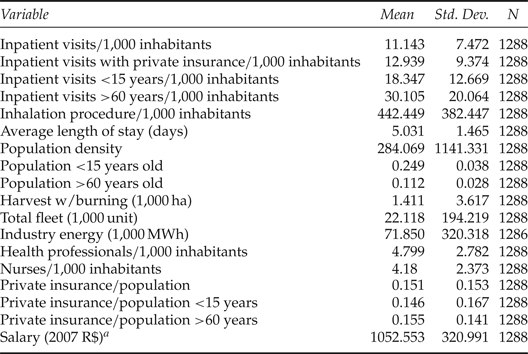
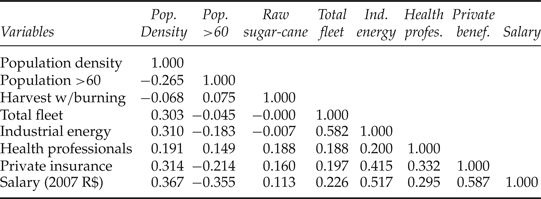
Descriptive statistics for the variables used in the models are presented in table 1, and the correlations among independent variables are presented in table 2. We note that these correlations are relatively small, even though there are some correlation coefficients close to |0.60|. Nonetheless, stability of the estimated coefficients and the results obtained for the t- and F-tests suggest that multicollinearity is not a concern.
Summary statistics for the variables used in the models

Note: a This series is in real price of 2007 deflated by INPC (National Price Consumer Index) for income (IPEADATA, 2010).
Linear correlation among variables used in the models

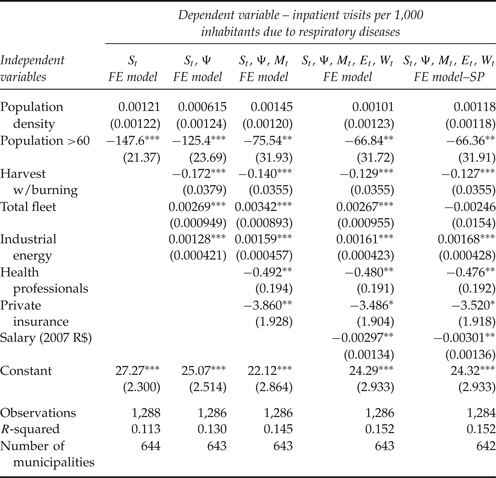
To analyze model sensitivity, we successively added blocks of independent variables and evaluated the changes in magnitude, sign and significance of the parameter estimates. table 3 presents the fixed effect regressions with cluster robust standard errors for inpatient visits due to respiratory diseases per 1,000 inhabitants.
Sensitivity analysis of the panel data model for inpatient visits due to respiratory condition

Notes: Clustered robust standard errors in parentheses.
***p < 0.01; **p < 0.05; *p < 0.1.
The first equation uses just the environmental factors, the second adds the pollution factors, the third adds health goods, and the fourth is the complete equation with salary. We observe that the magnitudes, signs and significance of the parameter estimates are reasonably stable. For instance, the effect of area of raw sugar-cane harvested on inpatient visits was −0.172 without controlling for health goods, education or salary and a decrease in module to −0.129 for the complete model. So, by not controlling for those factors, one might overestimate the effect of increasing the area of raw sugar cane harvest.
Considering the possibility of influential observations, we identified the city of São Paulo as the only obvious candidate. With a population of around 11 million and being the largest city in South America, São Paulo holds a considerable share of the Brazilian industry and of Brazil's vehicle fleet, which is certainly unlike any other Brazilian city. For this reason we also estimated the complete model, dropping the city of São Paulo, as shown in the last column of table 3. Comparing the parameter estimates with the previous estimates we can see that, in general, they agree in both sign and significance and magnitude, except for ‘total fleet’.
3.1. Inpatient visits
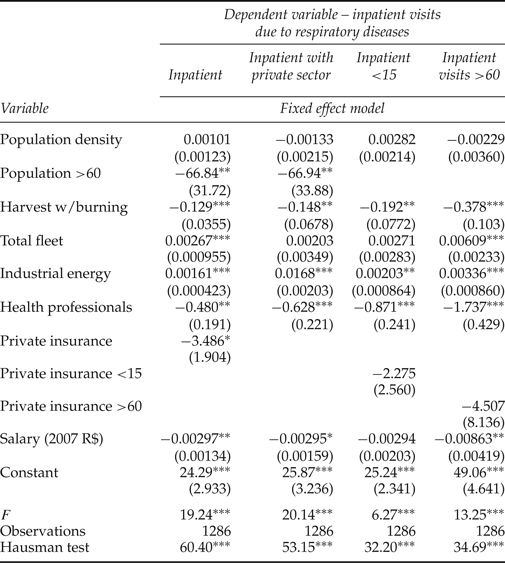
We specified four different models to account for the effect of the area of raw sugar cane harvest on inpatient visits due to respiratory diseases. The estimated models are presented in table 4. According to Hausman tests, presented at the bottom of table 4, we reject at 1 per cent the null hypothesis that the differences are in the coefficients of both models, suggesting that a fixed effects model is more appropriate.
Estimation results for distinct measures of inpatient visits due to respiratory conditions

Notes: Clustered robust standard errors in parentheses.
***p < 0.01; **p < 0.05; *p < 0.1.
The first model is for the number of inpatient visits, controlling for the percentage of individuals covered by private health insurance. In the second model, we assume that all inpatient visits correspond to uninsured individuals, covered only by the free public health system. We assume further that visits are equally distributed for both public and private systems. Therefore, the total number of visits were approximated by dividing the observed number of visits in the public system by the proportion of the population not covered by private insurance.
The third model considers the number of inpatient visits by individuals younger than 15 years old, and the last model considers the number of visits for the population older than 60 years old. Note that in these last two models, there is no correction to take into account visits in the private system, but they do include controls for the private coverage share, computed within each age bracket.
The variable of interest, the raw sugar cane harvest area (Ψ c ), has a negative and significant effect in all estimated models. The increase of 1,000 hectares harvested without burning decreases the number of inpatient visits by 0.129 per 1,000 inhabitants. Correcting the number of visits for private coverage, the estimated effect increases, in absolute value, to 0.148. The effect of the area of raw sugar cane harvest is more important for the population younger than 15 years old and older than 60 years old. The effect of an increase of 1,000 hectares of sugar cane harvested without burning decrease the inpatient visits by 0.192 and 0.378, respectively. Finally, it is worth noting that those coefficients are lower than the ones shown in table 3 without controlling for health goods, indicating that omitting control variables may result in overestimating effects.
These results relating the pre-harvest burning to health are in line with the literature. Uriarte et al. (Reference Uriarte, Yackulic, Cooper, Flynn, Cortes, Crk, Cullman, McGinty and Sircely2009), Arbex et al. (Reference Arbex, Martins, de Oliveira, Pereira, Arbex, Cançado, Saldiva and Braga2007), Cançado et al. (Reference Cançado, Saldiva, Pereira, Lara, Artaxo, Martinelli, Arbex, Zanobetti and Braga2006) and Arbex et al. (Reference Arbex, Böhm, Saldiva, Conceição and Braga2000), for example, present evidence of a positive relationship between pre-harvest burning and respiratory diseases. The literature on the relationship between urban air pollution and health is much more extensive, with a considerable number of studies presenting evidence in line with our results, such as Farhat et al. (Reference Farhat, Paulo, Shimoda, Conceição, Lin, Braga, Warth and Saldiva2005); Gonçalves et al. (Reference Gonçalves, Carvalho, Conde, Latorre, Saldiva and Braga2005); Roseiro and Angela (Reference Roseiro and Angela2006); Sicard et al. (Reference Sicard, Mangin, Hebel and Malléa2010) and Braga et al. (Reference Braga, Conceição, Pereira, Kishi, Pereira, Andrade, Gonçalves, Saldiva and Latorre1999).
Even though the controlling variables are included in the model mainly to isolate the effect of the variable of interest, the corresponding parameter estimates may shed some light on the internal validity of the models. An inspection of table 4 reveals that most parameter estimates for the controlling variables have the correct sign in most cases. An obvious exception is that the percentage of the population over 60 years old has a significant negative effect in the models regardless of correcting for private coverage. In other words, an increase in the population over 60 decreases the number of inpatient visits per 1,000 inhabitants.
For the variable controlling for other sources of pollution (Ψ o ), we observe that the coefficient for the total fleet is positive and significant for the model with the sample restricted to those older than 60 years old. Industrial energy consumption has a positive and significant effect in all the estimated models, with a slightly greater effect for the sample restricted to older individuals.
The number of health professionals has a negative and significant effect on the number of inpatient visits. This may be expected because better supply conditions facilitates access to health care, which in turn leads to less acute problems requiring hospitalization. On the other hand, more health goods imply better health conditions. This is especially important for individuals younger than 15 and over 60 years old. Thus, according to the inpatient visits model, an increase of one health professional per 1,000 inhabitants decreases the inpatient visits by 0.48 for the whole population, 0.628 for inpatient care in the private health sector model, 0.871 for the population younger than 15 years old, and 1.737 for the population over 60 years of age.
The percentage of the population in the municipalities covered by private health insurance has a negative and significant effect (at the 10 per cent level) in the model considering the whole population, and is not significant for the models with their samples restricted to younger and older individuals.
Finally, the average salary (W) in a municipality has a negative effect on inpatient visits. The argument here is that better salaries are correlated with better education, implying a greater and more efficient capacity to invest in health and so fewer inpatient visits. The effect of salary was higher for the population over 60 years old and it was not significant for the population under 15 years of age.
3.2. Outpatient visits and length of stay
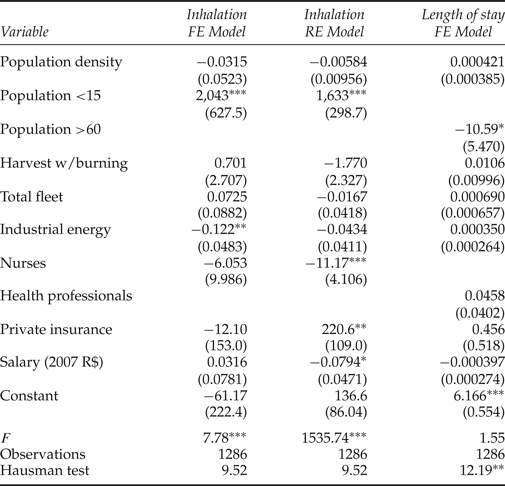
table 5 shows the estimation results for the other two proxies for health, namely outpatient visits and length of hospitalization due to a respiratory condition. The model for outpatient visits includes the number of inhalation procedures per 1,000 inhabitants as the dependent variable, and the corresponding estimates are shown in the first column of table 5. The second covers inpatient length of stay due to respiratory diseases.
Estimation results for outpatient visits and length of stay due to respiratory conditions

Notes: Clustered robust standard errors in parentheses.
***p < 0.01; **p < 0.05; *p < 0.1.
Unlike the model for inpatient visits, the null hypothesis of the Hausman test is not rejected for the outpatient visits model. Rejection of the null hypothesis suggests that the random effects model may be more appropriate in this case. Nonetheless, because the random effects model is difficult to justify in this setting, we present both fixed and random effects models. For the length of stay model, the null hypothesis is rejected, and thus only the fixed effects model is presented. See the test results at the bottom of table 5.
Starting with the variable of interest, the area of raw sugar cane harvest, it is clear from the results presented that there is no statistically significant effect on either outpatient visits or length of hospitalization. The contrast of this finding with the results obtained earlier for inpatient visits suggests that pre-harvest burning imposes a harsher toll on acute respiratory conditions, which require brief hospitalization and reduced variance in the length of stay. It also indicates that focusing on outpatient visits for inhalation may underestimate the health effect of air pollution.
Also contrasting with the model for inpatient visits, few of the control variables have statistically significant coefficients. The model for length of stay did not reveal any interesting health effect associated with the control variables, nor did the model for the number of outpatient visits. In this case, the proportion of the population younger than 15 years old seems to hold the main effect, with a positive and significant effect on outpatient visits, in both the random effects and fixed effects models.
4. Conclusion
This paper presented an analysis of the respiratory health effect of the air pollution caused by the pre-harvest burning of sugar-cane. As sugar cane has increased in importance in the energy agenda in Brazil and in the world, it is important to shed some light on the impact of its production on the environment and the health of the population. This article contributes to this body of literature by presenting evidence that there may be a significant health effect, using a novel identification strategy and a unique data set.
The proposed identification strategy relies on the enactment of a state law reducing the pre-harvest-burned area over time. After collecting data before and after the law took effect, we estimate a series of panel data models that control for endogeneity and make it possible to evaluate the health effect of reducing the area burned.
The results obtained suggest that reducing the area where sugar cane is harvested after burning reduced the number of inpatient visits in the state of São Paulo. Interestingly, we found that the effect of pre-harvest burning is relatively large, as compared to the estimated effects of the total vehicle fleet and industrial pollution, included as control variables in the models. On the other hand, the models estimated for the number of outpatient visits for inhalation procedures and for the length of stay did not reveal any significant relationship between pre-harvest burning and respiratory conditions.
These results suggest that the effect may be restricted to acute respiratory conditions, which require brief hospitalization and reduced variance in the length of stay. Moreover, based on these results, we may argue that the state law contributed to the improvement of the population's respiratory health in the state of São Paulo.