Due to the increasing spread of food allergies worldwide, donkey milk has become of scientific interest for use as an alternative food for children with cow's milk protein allergy.
Raw donkey milk generally has a lower total bacterial count than ruminant milks (Pilla et al. Reference Pilla, Daprà, Zecconi and Piccinini2010; Ragona et al. Reference Ragona, Corrias, Benedetti, Paladini, Salari, Altomonte and Martini2016). The good hygienic and health characteristics of donkey milk may be due to the content of antimicrobial enzymes such as lysozyme (Vincenzetti et al. Reference Vincenzetti, Polidori, Mariani, Cammertoni, Fantuz and Vita2008), and also to the anatomy of the udder that does not regularly come into contact with the soil. However, despite the low bacterial count, some authors have detected the presence of pathogenic bacterial species (Pilla et al. Reference Pilla, Daprà, Zecconi and Piccinini2010).
Since the consumption of raw milk may be a serious health risk to consumers due to the possible contamination with foodborne pathogens of animal or environmental origin, which may develop during the milking process or the milk storage, good hygienic practices and thermal treatment are important to prevent microbiological risk.
Pasteurization is one of the most common thermal treatments performed on milk. Although the effects of thermal treatments and storage on the quality and shelf life of cow milk are well known, few studies have been performed on the effects of thermal treatments and storage on hygienic quality of donkey milk (Polidori & Vincenzetti, Reference Polidori and Vincenzetti2010; Addo & Ferragut, Reference Addo and Ferragut2015; Giacometti et al. Reference Giacometti, Bardasi, Merialdi, Morbarigazzi, Federici, Piva and Serraino2016). The importance of monitoring nutritional characteristics are related to the fact that children who are allergic to cow milk proteins are at particularly high risk for developing growth retardation and nutritional deficiency (Mehta et al. Reference Mehta, Groetch and Wang2013). Therefore, they require a careful management for nutrition, from a quantitative and qualitative point of view, in order to avoid conditions of undernourishment and malnutrition. A further issue is that donkey milk is a niche product so it is not always or easily available on the market and domestic freezing of donkey milk is a common practice.
We designed a study aimed at providing information on the effects of thermal treatment and prolonged storage at refrigeration and freezing temperatures on some nutritional and hygienic characteristics of Amiata donkey milk.
Materials & methods
Once a week, three bulk raw milk samples were collected in duplicate from the morning milking of 20 jennies reared in the province of Grosseto (Central Italy). The jennies were routinely machine milked by a raised milking parlour as described by Bibbiani et al. (Reference Bibbiani, Biagini, Salari and Martini2017).
From each sampling, two raw milk aliquots were made: one was refrigerated at +3 °C, whereas the other one had previously undergone Holder type pasteurization (+65 °C for 30 min). The pasteurized milk aliquot was divided into 9 sub-aliquots, one of which was analysed on the day of pasteurization. The other pasteurized subaliquots were stored for up to 21 d at +3 °C (±2 °C) and up to 90 d at −20 °C (±5 °C) and analysed during storage (see online Supplementary Fig. S1).
The following analyses were carried out at the Department of Veterinary Science of University of Pisa and at the Istituto Zooprofilattico Sperimentale del Lazio e della Toscana (Florence) on the milk:
(a) Chemical analysis: pH was measured by pH meter, dry matter and ash were determined by gravimetric method of residues after drying and incineration respectively, fat was evaluated by gravimetric method after extraction of an ethanol-ammonia solution by ethyl ether, protein was calculated as total nitrogen (N) (determined by Kjeldahl) multiplied by 6·38, lactose was determined by infrared analysis; fatty acids were methylated using sodium methoxide solution 0·5 M in methanol (Sigma-Aldrich S.r.l. Via Gallarate 154 Milan, Italy, 20151) and analysed by gas chromatography.
(b) Microbiological Analysis: Colony count at 30 °C, Salmonella spp., Listeria monocytogenes, Campylobacter spp., coagulase-positive Staphylococci, Enterobacteriacee.
Detailed methods are reported in the online Supplementary Table S1.
Statistical analysis
Data on the chemical composition of raw donkey milk and pasteurized were compared (JMP, 2002) using ANOVA with heat treatment (presence or absence) as a fixed effect. Quality data for refrigerated and frozen milk, were evaluated using ANOVA for repeated mesurement that included the storage period as a fixed effect.
Data on pH and total mesophilic count variations were evaluated separately using the PROC ANOVA of SAS/STAT® (SAS, 2004), considering the storage condition as a fixed effect. Significant differences between data were considered at P < 0·05.
Results and discussion
The heat treatment did not significantly affect the gross composition of the milk (Table 1). The only statistically detectable variations in the chemical composition during storage were related to lactose, which significantly decreased at day 7 in refrigerated milk and at day 14 and 30 in frozen milk. The lack of changes in the gross composition during storage ensures a constant quality of the product and this is of interest as donkey milk is frequently used by allergic children in which nutritional deficiencies such as lower intakes of protein and fat have been reported (Henriksen et al. Reference Henriksen, Eggesbø, Halvorsen and Botten2000).
Gross compostion, pH and micorbiological analysis on raw and pasteurized donkey milk stored +3 °C (±2 °C) and −20 °C (±5 °C) for 21 and 90 d, respectively.

A,B,C: P ≤ 0·01
† D1, 7, 14, 21, 30, 90 = number of days of storage
‡ log CFU/ml or CFU/ml if <1
§ Analysis not performed
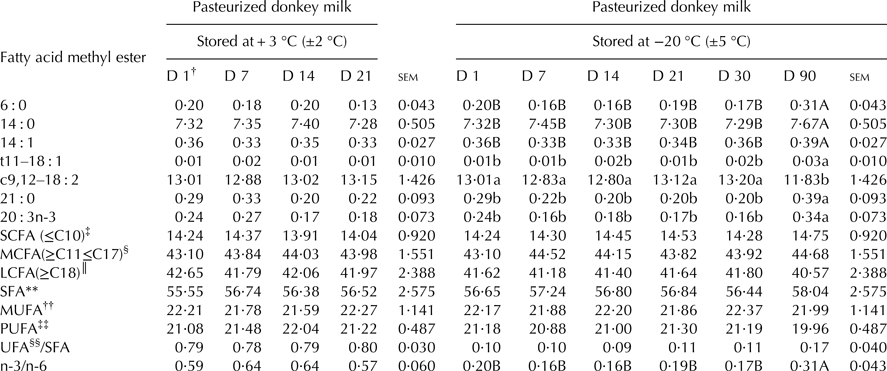
The major fatty acid composition of the stored milks is shown in Table 2 and the full fatty acid profile is shown in online Supplementary Table S2. Storage for up to 21 d at +3 °C(±2 °C) did not affect the total fatty acid profile of the refrigerated milk, while only with extended storage at −20 °C (90 d) did we observe significant changes in some fatty acids (decrease in c9,12–18 : 2 and increase in 6 : 0, 14 : 0, 14 : 11, t9–1 : 1, 21 : 0, 20 : 3n-3 and n3/n6 ratio). Furthermore, the saturated/unsaturated fatty acids ratio (SFA/UFA), the total polyunsaturated fatty acid (PUFA) and some essential fatty acids, such as 18 : 3n-3 (ALA), 20 : 5 (EPA) and 22 : 6 (DHA) were not affected by storage. The unchanged SFA/UFA ratio indicated a lack of degradation and/or oxidation processes during prolonged cold storage.
Fatty acid composition (g/100 g of total fatty acids) of pasteurized donkey milk stored for 21 and 90 d, respectively

In the table only the significant differences and the fatty acid classes and ratio are shown (the full table is available as Supplementary File)
A,B: P ≤ 0·01; a,b: P ≤ 0·05
† D1, 7, 14, 21, 30, 90 = number of days of storage
‡ SCFA (short-chain fatty acids): (≤C10)
§ MCFA (medium-chain fatty acids): (≥C11≤C17)
║ LCFA (long-chain fatty acids): (≥C18)
** SFA (saturated fatty acids)
†† MUFA (monounsaturated fatty acids)
‡‡ PUFA (polyunsaturated fatty acids)
§§ UFA (unsaturated fatty acids)
ALA, EPA and DHA are essential fatty acids (EFA), namely fatty acids that the human body is not able to synthesize, and that must be obtained from the diet. In infants, dietary lipids fulfil numerous metabolic and physiological function (Delplanque et al. Reference Delplanque, Gibson, Koletzko, Lapillonne and Strandvik2015), however, food allergy in children may lead to insufficient supply of EFA through allergic symptoms and food restriction. In addition, in allergic children dietary fat should provide a balanced combination of saturated, monounsaturated and polyunsaturated fatty acids (Paassilta et al. Reference Paassilta, Kuusela, Korppi, Lemponen, Kaila and Nikkari2014). Therefore, due to the higher risk for developing growth retardation and nutritional deficiency a constant quality of fat is relevant to support normal growth and mental development (Delplanque et al. Reference Delplanque, Gibson, Koletzko, Lapillonne and Strandvik2015).
The mean pH value of the milk was 7·19 (standard deviation: 0·03; range values: 7·17–7·22), consistent with the values reported in the literature (Addo & Ferragut, Reference Addo and Ferragut2015; Giacometti et al. Reference Giacometti, Bardasi, Merialdi, Morbarigazzi, Federici, Piva and Serraino2016) and did not show significant differences over the period of study either in the refrigerated or the frozen aliquots.
The average colony count at 30 °C of the raw milk was 4·84 log CFU/ml (standard deviation: 0·68; range values: 4·30–5·60), corresponding to 154 × 103 CFU/ml, much lower than the limit required by the Regulation (EC) 853/2004 (European Commission, 2004) for total plate count at 30 °C (≤1·500 × 103 CFU/ml). Pasteurization resulted in a reduction of colony count at 30 °C of 4-log at day 1, which remained <1 log CFU/ml during storage. In addition, colony count at 30 °C was lower than that described in other studies on donkey pasteurized milk (Giacometti et al. Reference Giacometti, Bardasi, Merialdi, Morbarigazzi, Federici, Piva and Serraino2016).
Coagulase-positive Staphylococci were found in the raw milk with an average count of 2·23 log CFU/ml (standard deviation: 0·03; range values: 2·20–2·26), corresponding to 1·7 × 102 CFU/ml, lower compared with the results of Malissiova et al. (Reference Malissiova, Arsenos, Papademas, Fletouris, Manouras, Aspri, Nikolopoulou, Giannopoulou and Arvanitoyannis2016), and in the pasteurized milk they were always lower than the detection limit of the method (<1 CFU/ml).
The Enterobacteriaceae count was lower than 1 CFU/ml in the pasteurized milk and during storage, in compliance with Regulation (EC) No 1441/2007 (European Commission 2007). In addition, in both raw and pasteurized milk samples, the bacteria responsible of food-borne outbreaks (Salmonella spp., Listeria monocytogenes, Campylobacter spp.) were never isolated.
In conclusion, the pasteurization adopted in this study was able to achieve and maintain a high hygienic quality over time. This study highlights that pasteurization and storage at refrigeration or freezing temperatures does not alter the milk gross composition and the nutritional quality of the fat. Considering that donkey milk is often not easily available on the market and it is a food intended for vulnerable groups of consumers, these findings are useful to improve knowledge on the milk shelf life in order to guarantee safety and nutritional quality for infants who need small quantities of daily milk. Our results suggest that donkey milk shelf life would extend beyond the normal duration of cow's milk; further investigations to guarantee the quality of donkey milk during an extended shelf life are required.
Supplementary material
The supplementary material for this article can be found at https://doi.org/10.1017/S0022029918000687
The research was funded by the Regional Government of Tuscany (Bando pubblico per progetti di ricerca nel settore Nutraceutica 2014–2015) ‘Amiata milk in the management of babies with allergies to cow's milk proteins: innovative, clinical, allergic and nutritional aspects’.