Emily Greene Balch was the second American woman to win the Nobel Peace Prize. A delegate at the International Congress of Women at The Hague in 1915, beside Jane Addams, her later work as secretary of the Women's International League for Peace and Freedom (WILPF) in Geneva in the 1920s, as well as on other League of Nations projects, earned her the prize in 1946. Yet it would not be a stretch to suggest that her name is largely unknown to most Americans. In the mid-1990s, Harriet Hyman Alonso and Mary Jo Deegan debated why Balch and Addams have had such different places in American memory. Alonso thought that Balch never acquired the revered status accorded to Addams because she worked more in the academy as an economist and sociologist, rather than in settlement houses; and because her open embrace of socialism and pacifism made her a political liability. Deegan, on the other hand, pointed out that on ideological grounds Addams and Balch were closely allied: both pacifists, both openly critical of industrial capitalism. Their main difference was probably little more than temperament. Addams was a charismatic speaker and an eloquent (not to mention prolific) writer. Balch often declined the spotlight. Even when she was fired from her position at Wellesley College in 1918 for political activism, she told her friends not to protest the decision.Footnote 2
Emily G. Balch as a student at Bryn Mawr College, 1887. Courtesy Swarthmore College Peace Collection, Swarthmore, Pennsylvania.

It is not easy to account for the ebb and flow of reputations. In a general sense, the disappearance of women intellectuals can be chalked up to generations of gender bias filtering out the activities of past women, Anne Firor Scott's pattern of “seeing and not seeing.”Footnote 3 But since, over the last thirty or forty years, historians of the Progressive Era have rightly placed women at the center of “the reform community,” in Shelton Stromquist's words, Balch's case is different for two reasons.Footnote 4 First, most studies of women's activism trace it to the maternalist insertion of “female” qualities that came to dominate “the practical improvement of community life”Footnote 5 during these years. Balch was a sometime maternalist, but her written work walked a line between woman-as-human and woman as caretaker-of-humanity. Second, the recognition of women as “enlarged housekeepers,” to use Addams's phrase,Footnote 6 means that scholars have not shown enough interest in the handful of women whose contributions to social reform were principally expressed in the intellectual world of the male academy.Footnote 7
Still, it remains debatable whether the neglect of women intellectuals was a function of their numbers or the quality of their research, even if quality could be objectively agreed upon.Footnote 8 Statistically it is improbable that a small band of researchers whose professional opportunities were comparatively limited could produce social theorists of the status given to, say, Lester Frank Ward, George Herbert Mead, Max Weber, Georg Simmel, or Émile Durkheim. So how do we empirically gauge if and why an individual might have been sidelined within a field? Again, the reasonable answer is to assume a disciplinary gender bias. In Balch's case, this is not self-evident insofar as her major contribution to sociology—a massive study of Slavic immigrants in the United States published in 1909—was well reviewed at the time. Gender bias may thus have entered into the narrative later, both as Balch's internationalism put her on the wrong side of things as far as her colleagues were concerned; and as the social sciences, in general, coalesced around organizing concepts that relegated Balch's early success and led the field's historians to focus on research and methods that fed genealogically into later disciplinary concerns.Footnote 9
Properly speaking, this means that any effort to explain Balch's subsequent reputation involves writing a history of the American social sciences searching for traces of things whose very absence is the object of study. While I am not prepared to go that far, my essay revolves around a twofold hypothesis. Balch's social science career, I suggest, was lost by the 1920s partly because of her departure from academic life into international activism, but also because her sociological orientation, which was rooted in a blurring of subjectivist and objectivist ontologies, became less appealing to a discipline that needed intellectual unity around a disinterested, positivist system. As sociology attempted, in other words, to carve out distinctive ground for itself—as neither psychology nor biology—it was attracted to positivism in ways that distanced itself from the work of an avowed feminist and pluralist such as Balch.
Although credited with cofounding Boston's Denison House in the 1890s, Balch turned away from settlement work and became a professor, researching public assistance; immigration policy; and, ultimately, international peace. She was acute and original in her examination of the social psychology of nationalism, race, and ethnicity.Footnote 10 This research, which grew out of her study of the contentious immigration question in the United States, became still more politically engaged during the Great War. She came to connect the “cause of progress” with the knitting together of world cultures, on condition that their points of contact were egalitarian and free of coercion. Her cultural pluralism and anti-imperialism connected her in New York with both Randolph Bourne and Franz Boas and distanced her from the pragmatist “war liberals,” who wrote for the pages of the New Republic—people with whom she had once shared a theoretical affinity.Footnote 11 It is my contention that Balch's reflexive and interactionist sociology—what I call her ontological transnationalism—was not only more pioneering than is widely recognized, but provides an excellent example of a kind of post-national metaphysics that lay uneasily inside the classical sociology of her age.Footnote 12
Balch's research on Slavic immigration, for example, was subsequently overshadowed by Florian Znaniecki and W. I. Thomas's study of Polish immigration a decade later. Znaniecki and Thomas advanced a meta-theoretical framework for understanding cultural identity formation that helped remove sociology from its ties to the ethical purposes of what Patricia Lengermann and Gillian Niebrugge have called “settlement sociology.”Footnote 13 That is, precisely because social work was in practice seen as gendered, sociology as a professional discipline worked increasingly toward developing abstract scientific methods as the marker of its disinterested gaze. Truth and objectivity, as the sublime objects of the new social sciences, required a deliberate distancing from the normative concerns of social reform, although in reality there was always implicit overlap between reform and sociology.Footnote 14 Indeed, as the state called increasingly upon social research to stand above partisan politics and to use these new frontiers of knowledge to provide a semblance of order to the national and international disruptions of the age, objectivity became an increasingly necessary fiction. But it tried to carry with it the prestige of natural science and a (largely masculine) claim to disinterestedness.Footnote 15 Balch, as both woman and inductive researcher openly committed to social change, failed to contribute to the sociology of immigration in such ontological terms, even though she and Thomas shared similar political agendas and even though she, too, was initially attracted to the authority of scientism in social research. Part of the empirical problem here is that because Balch's career was cut short by her political views, she lost the platform or desire to develop an academic account of her own theory and method. Later on, her diverse writings on cosmopolitanism and peace indicate something of her more radical ontology and anticipate a reflexive cultural sociology, but she had little motive to state her outlook in theoretical terms.
A survey of Balch's education and research from the 1890s to the end of the Great War reveals an affinity between her international training in Paris and Berlin—which exposed her to state welfare policies, German historicism, and Marxism—and her later positions on immigration and cosmopolitanism that would distance her from the American academy. There were four stages of this development: first, her international education as a young female economist drawn to social work as the praxis of social science research; second, as a professor of economics and sociology at Wellesley College; third, as an emerging scholar of immigration and racial identity on the eve of the First World War; and finally, during the war, as a feminist and pacifist attracted to a post-nationalist conception of subjectivity. The stance she had adopted by 1917–18 moved her to the margins of the American social science altogether at the moment that social science was acquiring its status as a disinterested purveyor of knowledge, in part through its affiliation with the state during the war.
Balch came eventually to see the international community of women, excluded politically by the war-state, as the one forum in which the social psychology of war and coercion might be resisted. But she also saw feminism as providing an indispensable critical perspective; she and her colleagues perceived connections between the nation-state and gender that were lost on men.Footnote 16 At times, Balch's polemical writings on women's identities leaned toward a kind of essentialism, portraying women as natural defenders of humanity because of their biological ties to motherhood. But on balance, her research pointed away from these essentialisms and posed a series of implicit questions about social identity writ large.
Balch's work began during a period of unprecedented internationalization in commerce, finance, technology, culture, philosophy, and education. Capitalist labor and service markets drove globalization in that period and later eras, but the growing interconnectedness of people—through migration, trade, and imperialism—was also a defining feature of modernity at the end of the nineteenth century. While the social sciences in the United States were nurtured by the search for racial and national conceptions of social solidarity, they were, by this same mode of inquiry, increasingly fascinated by the mutability of identity and the fragility of collective being in an age of continuous cross-cultural contact.Footnote 17 Feminists—and others at the margins of political and economic power, including African American intellectuals such as W.E.B. Du Bois and Alain Locke—were especially conscious of the parameters of national identity and thus suspicious of any sociology that took such identities as simply given. At the same time, women's entry into the public sphere via social work demanded research that many women—who understood quantification to be the path to authority and expertise in a male academic world—used to build new methods of sociological research.Footnote 18 Because Balch's work straddled the line between objectivity and meliorative practice, in the end no matter how well received her research was, it was eventually displaced by the more scientistic pretensions of her male colleagues.
Lengermann and Niebrugge have written about the “erasure” of the sociological research undertaken by women settlement workers in the early years of the development of sociology as a discipline. They attribute it to social workers' pursuit of a “radical middle” between theory and practice. The prestige of sociological work lay in the development of formal social theory that became increasingly distanced from the activism and social work of the Progressive Era, even in places like Chicago where activism had animated the development of Chicago sociology under Albion Small. Lengermann and Niebrugge credit this to a combination of gender beliefs (women are not fully rational, and their “natural” place is in the emotion-carrying work of grassroots social reform), the politics of knowledge (the theory that did emerge from settlement work was too radical for sociology to tolerate during the First World War), and the politics of professionalization (the Settlement House was too fragile a base to serve as the foundation for sociological theory).Footnote 19 This was by no means unique to sociology. Professionalization of all academic fields at the end of the nineteenth century entailed a hardening of the cognitive line between masculine and feminine forms of knowledge, the former being closely linked to scientism, objectivity, and authority over facts; the latter shunted to the margins as subjective, emotional, and, at best, partial.Footnote 20
Balch's experience supports this. But I would add that her basic pragmatist idea, focusing on the interrelation of theory and practice in creating new social realities, her feminist critique of the nation-state, and her Boasian turn on race and immigration issues, pushed her research outside the mainstream of a profession attempting to validate formal theory as the basis for its disciplinary authority.Footnote 21 While the discursive conditions of her conventional Boston religious upbringing often pulled her back from the radical alternatives that attracted her, Balch was nevertheless one American economist who took Marxism seriously (Veblen was another), tempering its internationalism with a pragmatist's anti-essentialism, which opened her to pluralism in ways incompatible with Marxist thought at the time.Footnote 22 Juxtaposing Balch's research with what had become acceptable within social science at the end of the First World War reveals much about the relationship between gender and intellectual authority.
Balch's education was a microcosm of the swirling, often contradictory, social and professional forces that moved through American intellectual life at the end of the nineteenth century. As a result, she encountered social scientists who held antagonistic positions. Raised in a stolid Protestant, professional New England family, she headed to Bryn Mawr in the late 1880s. There she became an advocate of women's equality and was inspired by Quaker good works and a longing to be “useful.” Franklin Giddings, later the first chair of sociology at Columbia but only thirty-six years old when Balch arrived at Bryn Mawr, became her mentor.Footnote 23 Her academic abilities earned her the first European fellowship offered by the college, enabling her to study at the Sorbonne with the French economist of the working class, Émile Levasseur.Footnote 24 She wrote a lengthy study of the history of French poor relief, a project, she admitted, done entirely from books and without engagement in the conditions of real poverty. In 1893, the American Economic Association published the study, which reads as a detached, vaguely comparative, account of French culture and the delivery of public welfare over centuries.Footnote 25 Balch was thus drawn to the scientific thinking of her age, imagining, one winter morning in Paris, that “a perfectly impartial scientifical [sic] description of society as it exists would be a very curious and I believe instructive thing. Such a view of it as a clairvoyant traveler from another planet might enjoy. The great differences in the intellectual life inheritance of different classes … the great stream of common consciousness, of transmitted & generalized experience, making the light in the lives and mores.”Footnote 26
This wistful reflection, imaginative but undeveloped in its offhand application of William James's recent concept of the stream of consciousness to the flow of “common” experience, suggests that the young Balch linked social improvement to objectivity, a view not uncommon in the social sciences of the 1890s. Yet, returning to Boston and finding the spirit of public service coursing through her and with no obvious professional path lying ahead, Balch worked briefly for the Children's Aid Society in Boston and then, in July 1892, attended Felix Alder's Summer School for Applied Ethics in Plymouth, Massachusetts. The curriculum featured lectures by numerous social reformers and academics, including Henry Demarest Lloyd, John Bates Clark, Henry Carter Adams, Franklin Giddings, and John W. Burgess. Also on the list of lecturers was Jane Addams, whose address, “On the Subjective Necessity of Social Settlements,” provided intellectual justification for the settlement movement.Footnote 27 After meeting Addams, Balch went to Chicago, stayed at Hull-House, and returned to open Denison House in Boston with her friend Helen Cheever. Settlement house work was unquestionably the easiest point of access into the public sphere for a female Christian philanthropist—a path that lay more or less unblocked by men, unlike universities. More than this, social work was, as Christopher Lasch has suggested, a form of sublimated religious activism in an increasingly secular age, a “substitute of ‘works’ for dogma,” as Addams confessed.Footnote 28 The theoretical orientation of this social work gravitated toward two more or less acceptable poles in the narrower American political spectrum: British Fabian socialism and American pragmatism.Footnote 29
Balch was drawn to both. The attraction of Fabianism lay in the faith that small, local action could make a difference to the vast, impersonal forces at work. Pragmatism's conception of truth—“Truth happens to an idea,” in James's formulation, it is verified by experience and action and not abstract principlesFootnote 30—was corrosive to the formalist ideas that held the status quo in place. This perspective gave reformers a chance to develop new social truths through activism. This very proposition breached, of course, the subject/object categories of scientific epistemology, leading some sociology toward what Anthony Giddens would call its “double hermeneutic” quality: the “objective” analysis of society generates knowledge that folds back into the object being studied to produce new social effects that in turn have to be analyzed. In this sense, social “laws” are perpetually moving targets. Pragmatists and their allies argued that social practice, experimentation, and democratic openness to diverse experiences would yield new realities. Whether this position on subjectivity could be reconciled with social science's larger project of professionalization was what remained to be seen.Footnote 31
Balch, however, was uncertain whether she wanted to devote herself solely to social work,Footnote 32 so she returned to academic study, spending a quarter at the Harvard Annex, where she was inspired by British economist William J. Ashley, one of the few English-speaking economists influenced by German historicism. She spent another eight months at the newly opened University of Chicago, taking courses with conservative economist J. Laurence Laughlin and the head of Chicago's new Sociology Department, Albion Small.Footnote 33 Laughlin and Small represented two opposing sides of the great social science debates of the 1890s: can a genuine social research method be objective and meliorative at the same time? Or, put another way, was there a place for ethical concerns in the application of social knowledge? The activists in political economy and sociology represented the young, historicist, German-trained and moralistic left, aligned periodically with labor, racial equality, the Social Gospel, and other radical causes. But by the mid- to late 1890s, many had either been cowed into more conventional positions by the threat of academic dismissal or had come by themselves to see the “ideological polarization” of socialism as a threat to the ideals of republican mutuality.Footnote 34 Fractiousness in the academy risked being taken as a sign of ideological passion, which was considered incompatible with true science.Footnote 35
Balch, by her later account, did not take to Small; when later asked to start a sociology course at Wellesley, she remarked that it would not be taught like Small's. Though more radical than Laughlin, he insisted that social work and moral uplift were unsuitable topics for genuine scientific research.Footnote 36 Yet, according to her journal, her reading at this time reflected an awareness of the work of social radicals: Richard Ely's The Labor Movement in America (1886) and Small's own Introduction to Society and Sociology (1894). On the other hand, her knowledge of political economy came largely from Alfred Marshall's standard text, Principles of Economics (1890) and from Laughlin. She confessed, even late in life, that she was an adherent of the “Austrian School” of marginalist economics.
Nevertheless, she was sufficiently interested in Ashley's tributes to German historicism that, in the summer of 1895, she opted to spend a year in Berlin, studying with the very state socialists so much despised by American orthodox economists.Footnote 37 Thus, in Berlin she worked with Gustav Schmoller and Adolph Wagner, the two mentors of so many young Americans, including W.E.B. Du Bois only a year and a half earlier. In preparation, Balch read Schmoller's and Wagner's major works, as well as sociologist Georg Simmel's Über soziale Differenzierung Soziologische und psychologische Untersuchungen [On social differentiation] (1890). While in Germany, she read more Fabian socialism, including the Webbs's History of Trade Unions (1894). Her reading also ranged from Henry Carter Adams to Friedrich Nietzsche's Thus spoke Zarathustra and, most important, Karl Marx's Capital, volume one.
Schmoller and Wagner, known and sometimes derided in Germany as “professorial socialists” or “socialists of the chair,” embodied the views of the newly formed German Verein für Sozialipolitik (Society for Social Policy) that believed in national control of economic processes for social and political ends.Footnote 38 While her fellow students were almost uniformly socialists, Balch was aware of the different conceptions of the state brought to reform by Germans and American progressives. “As my professors spoke of the State Government as if it were an independent entity, I remembering my American principles would remind myself that it is after all only an instrument to do for the public what the people will. It was only gradually that I began to understand how far this was from being the case in Germany, where the body of expert civil servants constituted mainly the state and were an almost independent more or less self-perpetuating body.”Footnote 39 Nonetheless, Balch listed hearing Wilhelm Liebnecht address a mass meeting of social democrats as one of the highlights of her Berlin year. She was also able to attend seminars by Simmel and was the first American woman invited to his salon.Footnote 40 Simmel's reformist socialism, tied to an inductive sociology, fit more naturally with Balch's methodological inclinations. Simmel was also, Jaworski suggests, one of the few regular foreign voices given an audience in Small's Journal of American Sociology, in part because he taught at the University of Berlin, where so many influential American social thinkers, including Small, studied and cultivated lasting ties to the man. Footnote 41 In Small's hands, Simmel's voice was intended to counterbalance the influence of Spencer's laissez-faire. Balch, for her part, described Simmel simply as “immensely clever.”Footnote 42
On her way back to the United States in July 1896, Balch attended the International Socialist Workers and Trade Union Congress in London, the fourth congress of the Socialist International. Her published reflection openly favored what she called “sturdy and by no means socialistic trade-unionism” over the “irresponsible reformers drunk with their enthusiasms.” She was struck especially by the divide between the anarchist/Syndicalist wing of the Congress and the social democratic parties—the German SPD and Jean Jaurès's parliamentary socialists in France—for whom such anti-statist activism was political suicide. She put the trade unionists on the “right,” the anarchists on the left, and the parties of “Social Democracy” in the center. And she gushed about Sidney Webb, whose words seemed better connected to “real experience,” with recommendations on child labor and democratically controlled free public education open to both sexes.Footnote 43
This devotion to the practical over the abstract was not what pushed her away from Marxism, however. It was the idea of class conflict that offended her residual Christian sensibilities. It was a stance encouraged by Addams, who had berated John Dewey not long after his arrival in Chicago in 1894 for believing that social antagonism was a fixed condition of human experience. Addams, at that stage more pragmatist than Dewey, insisted that the resistance individuals put up against each other was an investment of the personal into the abstract, a fight for the belief in truth rather than a genuine antagonism.Footnote 44 Balch had had a similar discussion on the Homestead Strike over dinner at Denison House in April 1893 with Vida Scudder and Jack O'Sullivan of the American Federation of Labor. At Denison House, she “got with the labor movement,” as she put it, but she retained her attachment to social harmony in arguing “that the identity of interest is deeper and more permanent than the conflict.”Footnote 45
At first, Dewey had taken Addams's position simply to be a courageous but naive statement of pure idealism. On reconsideration, he came to understand that social antagonism often rests on an essentialist claim of human identity that his instrumentalism and William James's pragmatism aimed to undo. Dewey drew on James's psychology in emphasizing that the mind evolves through its reflections on action, thinking about how habits encounter friction with the environment and therefore have to be adapted. The position of pragmatism was that ethics—like knowledge itself—could only be verified by action (“the proof was experimental”) and by always leaving room for revision in light of new experiences. Dorothy Ross thinks that Dewey smuggled in a dose of American exceptionalism by believing confidently that discordant acts and values could be harmoniously reconciled through the ongoing movement of society. Dewey seemed to believe that experience would demonstrate the evolutionary concord of individual and community that other absolutist theories denied.Footnote 46
Jane Addams, who had inspired this turn in Dewey, agreed. While Addams had been a member of the Anti-Imperialist League during the Philippines debate and shared the podium with William James at a banquet of the Universal Peace Congress in Boston in 1904,Footnote 47 her first real foray into foreign affairs was her 1907 book, Newer Ideals of Peace, which defined its agenda in a Jamesian manner as a study in “the gradual development of the moral substitutes for war.”Footnote 48 Like James, Addams admitted that war held a certain appeal in its capacity to bring people together, to sacrifice the extraneous elements of modernity for the heroic, dutiful, and higher goals of humanity. George Herbert Mead's positive review of the book called the patriotism that war induces the “highest form of social emotion.”Footnote 49 But Addams believed that there were others ways of satisfying a desire for self-sacrifice than violent, sublimated masculine aggression. Indeed, she insisted the modern age was gradually making war superfluous, as human energies were poured toward socially complex and cooperative production. A new international industrial order of mutual dependence was replacing the primitive need for warfare as the sole outlet for self-sacrifice.Footnote 50
American advocates, male and female, of a new internationalism mostly shared this position. Columbia University anthropologist Franz Boas, in a 1912 pamphlet for the American Association for International Conciliation entitled “An Anthropologist's View of War,” argued that human history demonstrated the constant enlargement of the basic units of social organization. He predicted this enlargement would ultimately displace the nation-state and its associated loyalties. “If we understand,” he wrote, “that the feeling of opposition to the stranger, which accompanies the feeling of solidarity of the nation, is the survival of the primitive feeling of specific differences, we are brought clearly face to face with those forces that will ultimately abolish warfare as well as legislative conflicts between nations.”Footnote 51
True, this optimism would be shattered in 1914, but Addams's approach to peace in 1907 was more modern than it sounded, however much it indulged maternalist rhetoric to help women enter the foreign policy sphere. Her conception of peace derived explicitly from a pragmatist interpretation of her experience in what she called “the immigrant city” of Chicago. The diverse laboring powers of the great American cities provided the motive force and evidence of a new internationalism. Hull-House was the centerpiece of this attempt to “socialize democracy” along pluralist lines, meaning that social relations of trust and solidarity, equality and mutuality, had to be so woven into the fabric of daily life that the tribalism of the past would simply be displaced. Her fellow pragmatists called this the “reconstruction of experience,” a process through which attitudes were changed and understandings of reality altered.Footnote 52 “Because this reconstruction of experience,” argues Marilyn Fisher, “is integral to the process of change and is in fact, one of the outcomes, ‘means’ and ‘ends’ cannot be separated. Democratic, just ends can only be obtained through democratic, consensual means. When violent methods are used, the violence affixes itself within the ‘reconstruction of experience’ and corrupts the outcome.”Footnote 53
It would be some years before Emily Balch would herself turn to foreign policy issues directly, but the imprimatur of Addams's evolutionary social theory and understanding of the problem of force in politics started to influence Balch's intellectual trajectory around the turn of the century. Her reading pattern after her German year still suggested a mixture of Christian ethics, democratic egalitarianism, and a cautious taste for the radical. She read, inter alia, British philosopher David G. Ritchie's Darwinism and Politics (1889), an attempt to divorce Darwin from “the dogma” of laissez-faire;Footnote 54 Nietzsche's Antichrist; Thomas Huxley's Evolution and Ethics (1893); Marx's Capital volumes 2–3; J. A. Hobson's The Problem of the Unemployed (1896); and Josef Schmöle, Die Socialdemokratischen Gewerkschaften in Deutschland seit dem Erlasse des Socialisten Gesetzes [Social Democratic Unions in Germany since the Socialist Law] (1896).
If Balch entertained controversial books, her scholarly practice was initially restrained. By the time she was ensconced in Wellesley, the incipient radicalism of many American economists and sociologists had been clipped. Balch's early teaching, however, remained grounded in social work and practical experience. She urged her students to spend time at Denison House and research Boston's working-class neighborhoods. Her economics courses also had a good deal of settlement house content, including sections on criminology, alcoholism, and prostitution, all of which she tied to the material conditions governing working-class life. Her economic views, in other words, were environmental, and her reading list for her students included not just standard economic texts, but Addams's work on prostitution, A New Conscience and an Ancient Evil (1912); Lavinia Dock's Hygiene and Morality (1910); Samuel Smith's Social Pathology (1911); Edward Lyttelton's Training of the Young in Laws of Sex (1900); George Bernard Shaw's Mrs. Warren's Profession (1893); Reginald Wright Kauffman's The House of Bondage (1910); and Eugène Brieux's Three Plays (published in English, 1913), which included the decidedly risqué Damaged Goods (Les Avariés), with its discussion of sexually transmitted diseases. Controversial as they were, all these works were also didactic arguments in favor of social environment over ontological individualism as a cause of social and economic inequities. They opened the door, in other words, for collective intervention to alleviate human suffering because poverty produced culture, not the other way around.Footnote 55
Balch's economics syllabus at Wellesley was outwardly conventional but still historicist.Footnote 56 Her “Outline of Economics” (1899) course was an account of the historical evolution of economic thought, from antiquity to mercantilism, when economic thought was still, she said, “unsystematic.” In the eighteenth century, the French economistes (Physiocrats) began exploring the economy as part of the natural order. This led to Adam Smith (the “Orthodox” School, she calls it), Malthus, and Ricardo, summarized by Mill's Principles of Political Economy (1848). Thereafter economic theory moved into a “critical period” in the second half of the nineteenth century, in which modern industrial problems seemed beyond the measure of classical theories. There was criticism and modification but no widely accepted new synthesis. In Germany, the new movement was led by Bruno Hildebrand, Karl Knies, and then Schmoller; in England by Thomas Cliffe Leslie, Walter Bagehot, Thorold Rogers, and William J. Ashley. Then there was “Socialism,” led in Germany by the “scientific” socialism of Karl Rodbertus and Marx, “Socialism of the Chair” (Wagner), and English Fabian Socialism (the Webbs). The “Ethical Movement,” identified with Arnold Toynbee and John Ruskin, tended to be closer to the historical and socialist movements. To Balch, the “most important contemporary work in economic theory is that based largely on subtler analysis of value and conception of marginal utility originated (among others) by W. Stanley Jevons,Footnote 57 and is represented in England by [Alfred] Marshall and others; in America by J. B. Clark and others; on the continent (and most conspicuously) by the ‘Austrian School,’ [Eugen von] Böhm-Bawerk, and others.” She did seek, nevertheless, to draw special attention to “the tendency of the school to psychological analysis and mathematical expression.”Footnote 58
This said, Balch, along with Vida Scudder, was one of the few American professors to offer an entire course on “International Socialism,” with Capital as required reading, along with a conference on the same subject in 1909.Footnote 59 By then she called herself a “half-way ally” of American socialism, having earlier, in 1903, been one of the founders of the Women's Trade Union League at the invitation of William English Walling. This led to later work on the Massachusetts Factory Inspection Commission and the Massachusetts Minimum Wage Commission. “To make the fundamental relation of men in the whole economic field competitive self-seeking,” Balch later wrote, “instead of cooperation or mutual benefit, appeared to me the negation of Christianity or any other decent ethical system.” Thus her moral inclinations recoiled from the inevitability of class conflict, because it negated the principle of universal harmony, and Marxism more generally because of its labor theory of value. Yet she also rejected the ethical underpinning of any system (that is, capitalism) that establishes classes in the first place.Footnote 60
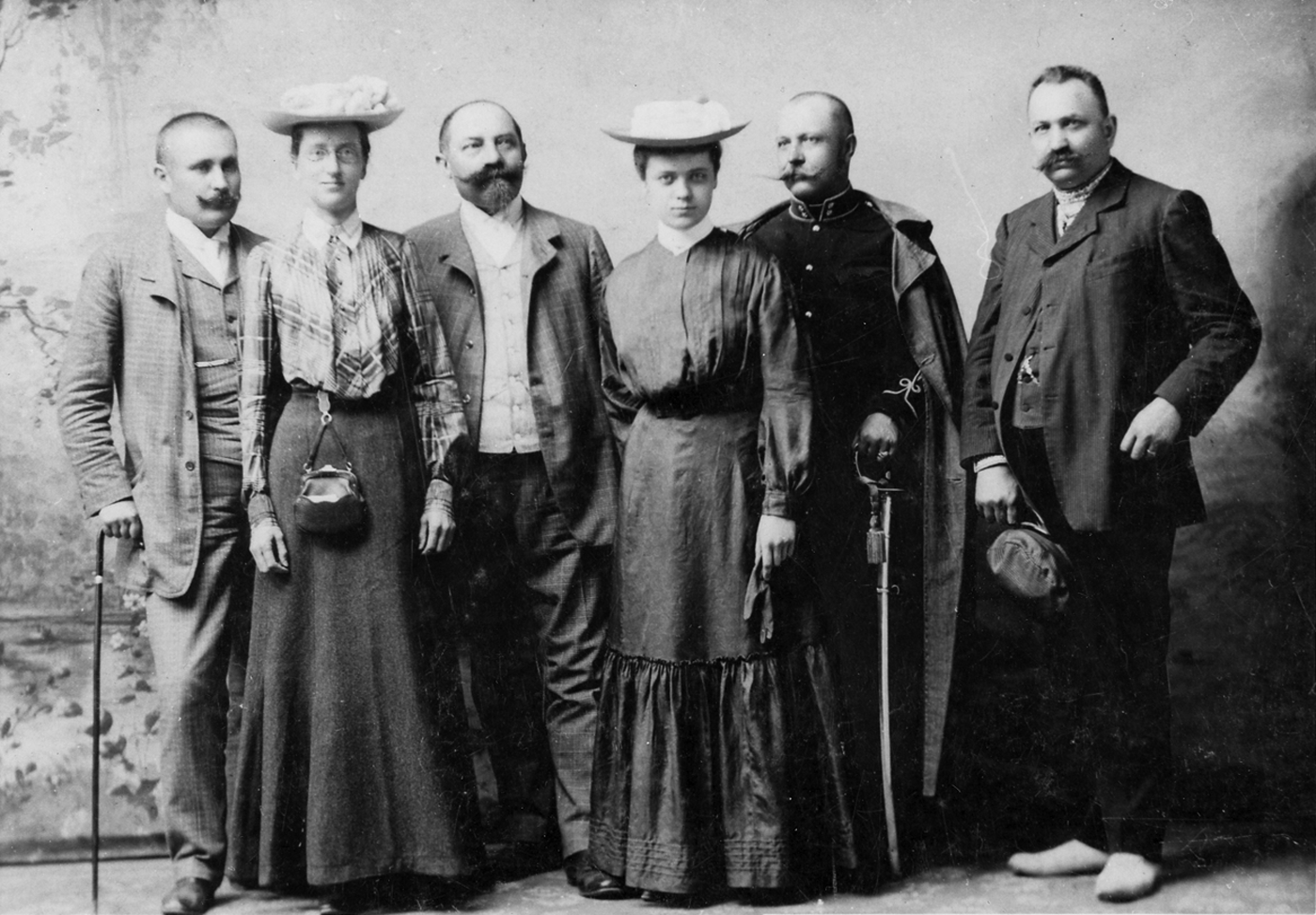
Emily G. Balch (2nd from left), with friends while on a research trip to Hungary, 1905. Courtesy Swarthmore College Peace Collection, Swarthmore, Pennsylvania.
By 1904–05, Balch's research moved away from poverty and economic maldistribution toward issues of immigration and ethnic identity. Immigration had long been a contentious issue in industrial America, but progressive reformers, armed with social science methods for quantifying assimilation and a greater will to use the powers of the state to foster the right conditions for national development, were increasingly equipped to respond to calls for immigration restrictions. President Theodore Roosevelt publicly fretted about “race suicide,” while his close friend Senator Henry Cabot Lodge penned “Efforts to Restrict Undesirable Immigration” in 1904. Even Balch's one-time mentor Giddings joined the restrictionist cause.Footnote 61 Congress's response was to establish the Dillingham Commission, which issued a final report in 1911 that concluded that southern and eastern European immigration was possibly an irreversible threat to American life.Footnote 62
Balch's interest in these controversies stemmed from her settlement work in Boston, her reading of Addams's writings on inner-city Chicago, and her personal awareness of ethnic conflict in central Europe. She decided to use her 1904–05 sabbatical to produce a comprehensive study of Slavic immigration to the United States. A foretaste came in a 1905 review of a three-volume analysis of what was translated (awkwardly) as “national possession status” in Bohemia. The author, Heinrich Rauchberg, was the leading German demographer of the region, and Balch criticized him for his advocacy of certain German Socialpolitik not on grounds of justice, but in the service of preserving and expanding the ethnic German position in Bohemia.Footnote 63 She understood, in other words, the international implications of essentializing ethnic identity.
Balch took more than two years away from Wellesley to study Slavic communities on both sides of the Atlantic. She stayed in Pennsylvania mining towns, Nebraska and Wisconsin farms, and industrial communities in Pittsburgh and Yonkers, before traveling extensively through the Austro-Hungarian Empire. While in Prague, she developed a close and lasting friendship with future Czech president Tomas Masaryk and his American wife Charlotte Garrigue.Footnote 64 When she finally finished writing in 1910, she published a 500-page tome entitled Our Slavic Fellow Citizens. It was one of the first sociological examinations of an American immigrant population, and a landmark in statistical and qualitative research into the mutability of modern cultures. More than that, its final chapter, “The Question of Assimilation,” was a volley in the immigration argument a year before the Dillingham Commission's report.
Balch argued that there was an indelible connection between assimilation and oppression. While acknowledging the positive power of nationalism in the nineteenth century—what it wrought culturally for the world and for democratization—Balch saw that “it has divided peoples who before were hardly conscious of difference and has narrowed men's sympathies to their own little group.” In an argument with a Polish American priest, she once remarked that “Americans” would not have much interest in Polish history. But she clearly meant English Americans, and she was chastised for assuming that America was anything other than a country into which people of other nationalities poured. It was a nation without ethnicity. This, she said, reintroduced the fundamental question, “What are Americans?”
For her part, Balch insisted that the United States had every right to consider itself an organic nation but one built around a common adherence to shared political principles or what Gary Gerstle would later call “civic nationalism.”Footnote 65 For that very reason, she found the “deep-seated antipathy or contempt for the unlike … especially to be regretted in a country like ours.” She notes—anticipating Randolph Bourne and Horace Kallen a few years later—that the problem of assimilation has tended to be that it is assimilation toward an existing ethnic norm, rather than one of mutual adjustment. Balch sided with the position that assimilation could only be a mechanism for social interchange that leaves both parties altered. She drew here on what she called the “brilliant sociological generalizations” of Gabriel Tarde's Les lois de l'imitation (1890).Footnote 66 Using Tarde's theory that people adopt habits according to their immediate social utility rather than any standard of universal superiority—an argument with a clear affinity to pragmatism—Balch asserted that new immigrants will find it more useful in time to adapt to “American” ways (language in particular was the only route to power and success), even when this meant rejecting perfectly good Old World traditions. Balch's book, acknowledged at the time as one of the most openly sympathetic accounts of immigrant life in America and yet also “thoroughly in line with the best thought in social science,” was favorably reviewed in the Annals of the American Academy of Political and Social Science, The Economic Bulletin, The Journal of Political Economy, and the American Journal of Sociology.Footnote 67
Here it is instructive to consider the difference between Balch's work and the reputation later enjoyed by William I. Thomas and Florian Znaniecki's multivolume The Polish Peasant in Europe and America (1918–19). Considered by some to be the “preeminent American sociological study of its era,”Footnote 68The Polish Peasant was intended to demonstrate a rough parallel between the development of national consciousness through voluntary association in Poland and, implicitly, the United States. Thomas began research as early as 1908, when he received a massive private grant for the sociological study of immigration. He combined traces of Boasian anthropology and social psychology, built on a massive empirical foundation of interviews and letters, to show how group identities adjusted to new environments. The ambitious study that finally emerged in five volumes, a 2,250-page collection of documents and a brief but influential conceptual scheme to interpret them, aimed to chart the correlation between individual personality and social organization in late nineteenth- and early twentieth-century Poland (and Polish America in Part 3). A century later, sociology students continued to refer to its “Methodological Note” on the interdependence of individual “attitude” and social “values.”Footnote 69
The book's social psychology draws on an implicitly structuralist account of culture: it seeks to understand institutions and behavior in the context of the “whole life of a given society,” rather than generalizing from particular sections or observations, a methodological sin the authors attribute to Herbert Spencer's influence on earlier social theory. They identify the basic practical problem of all social theory as the mutual dependence of the individual on social organization and vice versa—what we would call the agent-structure dilemma—which produces two categories of research data: the objective data are the cultural elements of the society or what the authors call values. The subjective data are the characteristics of individuals in the group or their attitudes. Their conclusions, even while describing immigrants to America as occupying a “lower” cultural level, nevertheless are closer to those of Bourne and Kallen and, indeed, Balch, in suggesting that American democracy depended on a process of mutual adjustment, the ability of “all to share vicariously in the inner life of each.”Footnote 70
Balch herself reviewed the first two volumes of The Polish Peasant when they were published in 1918. She thought the use of real letters as data was a kind of “spiritual vivisection in the name of science” that could only be justified by the as-yet unknown results of the research. She credited the “methodological note” with theoretical significance but gently wondered how useful it was to the “practical sociologist.”Footnote 71 Why Balch's work has not survived, and why Znaniecki and Thomas themselves made no reference to it in their book, is not easy to answer.Footnote 72 Thomas's wife Harriet knew Balch through their shared work in the Women's Peace Party. Indeed, some have speculated that Thomas's firing from Chicago on “moral” grounds in 1918 may have been intended to embarrass Harriet and the Women's Peace Party.Footnote 73 A more probable explanation of these divergent reputations is that The Polish Peasant was not simply an empirical study of immigration but a unifying theory of sociology that distinguished it from other social sciences. The value-attitude scheme, though at times imprecise, pointed sociology toward a social interactionist way of understanding individual cognition and meaning. By taking such meaning away from biological instinct—or an a priori mind—The Polish Peasant created a long-sought disciplinary space for sociology.Footnote 74
Balch's book never attempted such a meta-theoretical project. It contains no methodological introduction and makes clear that the audience she had in mind was the general public and, more importantly, “busy social workers.”Footnote 75 This reference to her didactic purpose, tying the book's vast empirical material to “settlement sociology,” likely allowed readers to locate Balch in a tradition of sympathetic reform. But her position was nonetheless significant for both its incipient pragmatist view of race and ethnicity and its normative preference for pluralism, something with which Thomas was less comfortable. Despite Thomas's attraction to unconventional politics and lifestyles, Thomas and Znaniecki were intent, as Dorothy Ross has put it, in conveying a powerful and self-conscious “scientism” in the face of public fretting about nationalism, patriotism, and ethnicity during the war.Footnote 76 This would lead Thomas in 1921 to write a book, attributed to former colleagues Herbert Miller and Robert Park, favoring assimilation. This positivist intention, however much betrayed by an interpretive and historicist method of dealing with the data they collected from Polish immigrants, made The Polish Peasant appealing to a discipline still trying to distinguish itself from psychology on one side and social work on the other and still trying not to upset too many parochial conventions of American life by fixing the imprimatur of objectivity onto the research.
Balch, by contrast, openly embraced a pluralist and cosmopolitan conception of ethnic identity that would clearly inform her interpretation of the war. Like Addams, Balch insisted that old-stock Americans needed to abandon efforts at coercive assimilation and focus on a common commitment to “justice, for humane conditions of living, for beauty and for true, not merely formal, liberty.” The resulting society would “preserve every difference to which men cling with affection, without feeling ourselves any the less fellow citizens and comrades.”Footnote 77 Here was an open-ended form of civic nationalism without the oppressions of assimilation. Balch's position was shared by Boas, who attacked immigration restrictions on scientific grounds by arguing that even physiology was mutable under different environmental conditions. Balch's book cited his influential 1909 article “Race Problems in America,”Footnote 78 and she read his Mind of Primitive Man (1911) shortly after it was published. The two remained intellectually allied, years later meeting in New York, when Balch took a course with Boas at Columbia. But her pioneering work on immigration—already at the ideological edges of the public discussion surrounding the Dillingham Commission—was soon displaced by both the ascendance of sociological positivism and Balch's own turn toward international pacifism and antinationalism.
By the time Balch made personal contact with Boas, the European War made appeals to ethnic nationalism even more malevolent in her mind. She penned an article for The Survey in 1915 that explored the malignant roots of identifying with one's “own kind,” a cutting turn of phrase that referred to her former mentor Giddings's main sociological slogan. She described it as an “ancient brute inheritance” that tied European nationalist intolerance to the Senate's immigration restrictions. Cooperative instincts were just as important in an evolutionary sense, and the historical tendency for the human species was toward greater integration or biological intermixture in a way that made the mythical bonds of race the least meaningful. She spoke to the intellectual damage done by “the pseudo-science of race,” citing Boas that “science knows of no inferior race.” Balch worried about a leveling form of cosmopolitanism in which diversity of group identities was erased altogether; it was important, she thought, not to attempt to destroy other civilizations and lose what they have to offer. Years earlier, in 1906, she had written an article in German for an Austrian magazine, pleading for mutual cultural respect as the basis for a new international order:
The noblest of all nations teach…that all people [Volk] nurture their own peculiarities, and yet at the same time have to learn to understand the peculiarities of others and to appreciate them. We all gradually strive together towards an international organization. The answer is not Pax Romana, whose answer is freedom with the help of the all-controlling Rome, but rather, Pax Grotiana,…a freedom through reciprocal understanding between strong and independent peoples. We are approaching a complete unity in science, we are building up a world literature and world art, within which individual pieces of particularly high quality must be deemed as such. We are proud of our cosmopolitan sympathies, which have, however, a firm basis in the patriotic rights of one's own land.Footnote 79
Balch's pluralism thus tried to retain space for the cultivation of group identities, but it lacked any whiff of essentialism and was, moreover, sensitive to the inability of coercion—explicitly war—to yield anything like a democratic order. “Men are less prone,” she wrote, “to learn from their victims.” Her social philosophy by 1915 saw the origins of war in the social psychology that connected prejudice to coercion.
National vanity, and national greed masking under national vanity, give us the war cries of the jingo and the imperialist, and of pan this and pan that. The dogma of the white man's burden veils the colony-grabbing that lies behind it. The idea that it is a national mission to force others into the national mold, springs from contempt for those who differ from us and takes on a thousand forms. In the United States we call it assimilation, using the same word to cover the most desirable and the most undesirable relations with the newly come elements of the population, and we shall be lucky of our fanatics of race do not lead us into war with the East.Footnote 80
Balch wrote this article just before she left for The Hague with Addams and other American women to attend the International Women's Congress that aimed to put forward proposals to end the European War. Balch's work on immigration did not prepare her for the Great War, which she thought was simply “a senseless interruption of social-economic progress.”Footnote 81 Although she claims to have become interested in international arbitration while at Wellesley, her peace writings reflected the imprint of Addams's Newer Ideals of Peace in asserting an evolutionary understanding of how the coming industrial order would make war irrelevant, if that order could reflect a pluralistic democracy. Because Balch's internationalism rested on extrapolating from the integrative model of American immigration, it also linked itself to the pragmatist position that people “defined themselves largely through changing relationships with others.”Footnote 82 Understanding the social nature of the “self” allowed Balch to conceive of nationalism as a macrocosm of this interdependent identity-building to which modern individuals had adjusted themselves. If antagonistic elements of the cities could acquire the tools of democratic engagement, so too could nation-states.
Such concerns led Balch, at Addams's invitation, to Lillian Wald's Henry Street anti-interventionist roundtable in 1914. The Henry Street group became the locus of New York's peace activism, although initially its aims were simply to urge the United States and other neutral states to do something constructive to stop the slaughter in Europe. In discussions with Carrie Chapman Catt and Balch, however, Addams decided that while she preferred men and women working together on public projects, the war posed unique questions about the urgency of women's agency. Women, she argued, were not better than men, but what she called the “enlarged housekeeping” of women's public activism gave them a powerful interest in stopping war and in thus claiming their citizenship. Using the suffrage infrastructure, she assembled a gathering of several women's groups to the New Willard Hotel in Washington in January 1915 to form the Women's Peace Party (WPP), which in 1919 became the U.S. section of the WILPF.Footnote 83
The WPP led to the trans-Atlantic voyage to The Hague International Women's Congress in April 1915, and the Women's International Committee for Permanent Peace in Amsterdam.Footnote 84 The Hague meeting sent delegations to fourteen capitals of both belligerent and neutral countries, including the Vatican. Addams met with the leaders of the belligerents, while Balch went north to Scandinavia and Russia. The Scandinavian countries had conveyed their willingness to sponsor a conference of neutrals if the United States would take the lead. Balch then returned to the United States to help Addams lobby President Woodrow Wilson. These meetings, through 1915 and 1916, were of course unsuccessful in recruiting the president for neutral mediation along these lines. But some historians suggest that much of the WPP's peace platform made its way into Wilson's liberal internationalism.Footnote 85
Balch was personally disappointed with her failure in Washington, but she claims that she left with her “greatest admiration” for Wilson still intact.Footnote 86 In October 1915, she wrote another article for The Survey repeating the case for neutral mediation, reminding Americans that however much the war might appear to be a conflict between “two conceptions of national policy,”—democracy and imperialism—in fact, once enjoined, war did its best to blur the distinction by ripping the forces of democracy to shreds. And any settlement produced by the battlefield alone would be an “abitrament [sic] of violence” in which relative power would beat out any just and stable adjustment of the international order.Footnote 87 She headed back to Scandinavia to work for the Committee on Constructive Peace, where she drafted a position paper on “International Colonial Administration” that anticipated the League of Nation's mandate system.Footnote 88 When she finally returned to the United States in 1916, the country had moved from neutrality into a bitter preparedness debate leading up to the 1916 presidential election. Balch took a sabbatical from Wellesley and moved to New York to be closer to the Henry Street Group and its Committee against Militarism, which became the American Union against Militarism (AUAM). Wilson's 1916 meetings with members of the AUAM brought out, at last, his conviction that military force was in the end the only thing that can vindicate moral force.Footnote 89 Balch did not relent, but clearly pacifist organizations lost the ear of the administration as it geared toward war. She attended Boas's lectures at Columbia, while preparing Approaches to the Great Settlement (1918), an anthology of proposals that AUAM chairman Amos Pinchot regarded as a work of “great public importance” in the debate over the postwar peace.Footnote 90 As the United States moved toward intervention in early 1917, she worked for even more radical peace groups, including the Emergency Peace Federation and the closely watched People's Council of Americans for Democracy and Terms of Peace. It was this, along with her increasingly long absences from the college, which got her fired from Wellesley.
Her academic career at an end, Balch continued to work for peace groups and eventually moved to Geneva as secretary of the WILPF. She felt too, as a pacifist, she had to respond to the question of what to do to stop German militarism. And she conceded there was no firm answer, but she at least mustered a sociological response.Footnote 91 Balch agreed with Wilson and John Dewey that there could be no a priori principles governing the morality of force; since energy is present in all actions, in and of itself force had “no moral color.” What mattered was coercion. “Violence is coercion by force, but the wills of others may be as effectually coerced by other means as by violence, and as wrongly. The essence of wrongful coercion is violation of that liberty which is the most sacred treasure of personality.” Drawing on her understanding of social psychology, Balch explained that coercion invokes “the heats and confusions of fighting animal instinct” and the refusal to acknowledge in one's self “the existence of any but the purest motives.” This clash of primitive wills invariably inverts the means-ends calculus by stirring counterproductive resistance and by causing each side to forget “rational aims” but to fight for victory per se, “if not for mere fighting's sake. It is an appetite, lust, as real as any other.”Footnote 92
It is likely that Balch's attachment to radical causes during the war and her pacifism—until the Second World War—did much to marginalize if not silence her contributions to social science. At the very least, it removed her professional platform in the academic world. But there was more to it than that. Her research paralleled that of Boas and W. I. Thomas in many respects, but it also stood at the pluralist and reflexive end of the methodological spectrum. Mary Jo Deegan has argued that because women sociologists came predominantly out of the settlement movement, they tended to see social work and research as intimately related, either because the purpose of research was to guide social work or, more seriously perhaps, because they blurred the fact/value distinction. This was especially true for women who were, as Deegan puts it, “critical pragmatists” whose understanding of social sciences was implicitly reflexive.Footnote 93 Social work not only provided an immediate and empathetic understanding of the social field, but it demonstrated the “reconstruction of experience” that changed social reality.
In the early 1920s, when Balch worked for the WILPF in Geneva, her writing took on something of the polemical and didactic tone of a lobbyist for peace. But her essays contain fragmentary glimpses of how her social science training combined with her international experience to examine the way in which knowledge, power, and gender were constructed simultaneously. She was rarely theoretically explicit, because of her audience or because she never devoted herself to systemic exegesis. But at least some of her articles in the early 1920s contend with the psychological habituation of male and female qualities, tied, in turn, to questions of peace. Internationalist women usually argued that greater women's access to public life would improve national and international politics by bringing to it the care and compassion of mothers. But this raised the double-bind question of whether their identity as mothers to the world then restricted their claim to equality.Footnote 94 The cultivation of an identity as women was repeatedly used by generations of feminists as their entry into the public sphere, and the abject failure of traditional diplomacy in 1914 created a space in which their status could be attached to the needs of a cataclysmic world. At the Zurich Congress of the WILPF in 1919, Balch shared a wry joke with the German delegates about how the war had permanently undermined “the claim of men to possess sole competence to manage public affairs.”Footnote 95 But this also risked relegating women to traditionally defined female domains of care and amelioration, albeit now on an international stage. While an improvement in many respects, it perpetuated their status as different and therefore still unequal.
On the other hand, some of the WILPF members appeared to argue from time to time that women's identities were not innate but were acquired through cultural socialization in symbiotic relationship with the competitive and aggressive socialization of men. This interactionist account of identity rejected psychological and sociobiological theories of personality that treated identity as innate. Balch at times appeared to argue that this disassembling of gender could be used, in a kind of dialogical negation, to change men, women, and the international system simultaneously. Balch had come to believe through her reading as a sociologist before the war, that women were not biologically different but had been acculturated in a form of master-slave dialectic that was simply passed on as normative from generation to generation. Such a sexual binary produced a type of man who was equally acculturated and whose reform contained the only seeds of world peace. The eventual political unity of male and female would occur through the transformation of the self-consciousness of both: woman would emerge as fully equal human agents, and men would relinquish their need for domination and coercion that had been used to hold the sexual order in place. In this way, women would not have to surrender the ameliorative qualities that their subjugation had taught them in order to be equal. A more peaceful world would come about not because the biological impulses of men had to be simply restrained by the supposed innately pacifistic natures of women, but because the elimination of the male self-understanding as dominators of women (and others) would itself create a new social order and a transformed international consciousness.Footnote 96
The fusion of subject/object—the recognition that the social world is not “out there” to be observed by social scientists who have purchase outside it, but to be understood internally and then altered through action—still had to be guided by some normative principle toward which such action must be aimed. Many women (especially those of a “cultural feminist” tendency) simply imported Christian idealism, which they then tied to feminine morality. Pragmatists like Balch and Addams tended—although not always consistently—to organize their social theory around a more radical concept of democracy, in which experience, defined as the deeply subjective account of individual engagement with a social world, must be collectively mediated without relations of power and authority crowding out plural voices.
Until the Great War, the lines between pioneer women sociologists and the profession as a whole were porous and constructive. Balch herself started her career espousing the objectivity of science as the model of constructive and useful knowledge. But her experience as a researcher of immigration and as a pacifist in search of an understanding of the social psychology of war, moved her closer toward not just cosmopolitanism, but a methodological hermeneutic that made formal, abstract sociological principles anathema. Precisely that which the discipline needed to establish its identity during the First World War was that which Balch could no longer accept. Where she blended theory-development with social practice, her male colleagues attempted to conceal political purpose behind disinterested discipline. After 1918, women sociologists were transferred into other fields, namely, back into social work.Footnote 97 In Balch's case, she turned to international organizations and the gritty practice of reconciliation, but her profile as a social scientist disappeared altogether.