Introduction
Bipolar disorder (BD) is a debilitating mental illness affecting between 1% and 3% of the general population (Kessler et al. Reference Kessler, Chiu, Demler, Merikangas and Walters2005; Merikangas et al. Reference Merikangas, Akiskal, Angst, Greenberg, Hirschfeld, Petukhova and Kessler2007; Fountoulakis, Reference Fountoulakis2008). BD is associated with significant morbidity and mortality, including elevated risks of suicide (Fajutrao et al. Reference Fajutrao, Locklear, Priaulx and Heyes2009), and with a host of serious medical problems (e.g. cardiovascular illness) (Kupfer, Reference Kupfer2005). All of the disorders in the BD spectrum, particularly bipolar disorder type I (BDI), are characterized by periods of elevated, expansive mood coupled with excitation, psychomotor agitation, increased risk-taking and goal-directed activities, or manic/hypomanic episodes, and in a preponderance of instances by intervening episodes of low, depressive mood (APA, 1994).
Challenges associated with the clinical diagnosis of BD include clinical course (i.e. depressive episodes preceding later mania/hypomania, thus delaying appropriate diagnosis) and patient denial of hypomania (which may be viewed as relief from depressive symptomatology and not as an impairment) (Fountoulakis, Reference Fountoulakis2008). In a clinical setting, physicians are well equipped to investigate the possibility of a BD diagnosis because they have the opportunity to follow patients over time. In cross-sectional epidemiological studies, however, researchers rely on the psychometric properties of one-time assessments of manic and depressive episodes and therefore the evaluation and psychometric performance of DSM-IV symptoms for these episodes is of considerable importance.
Some studies have examined the quality of criteria and the factorial structure underlying DSM-IV major depressive episodes (Muthén, Reference Muthén1989; Reiser, Reference Reiser1989; Aggen et al. Reference Aggen, Neale and Kendler2005) but none have focused on manic episodes. One aim of such an investigation is to test whether there is a single dimension of liability underlying multiple symptoms for mania and whether this continuum affords an increment in information content over and above a diagnostic (i.e. binary) measure of affection status. In addition, as demonstrated by numerous studies of substance abuse and dependence, item response analysis can identify symptoms that work poorly (i.e. have low factor loadings and are infrequently or too commonly endorsed) and those that work well (i.e. with high factor loadings and moderate levels of endorsement) at assessing liability. A study by Aggen et al. (Reference Aggen, Neale and Kendler2005) used a population-based sample of twins and found support for a unidimensional continuum underlying the DSM-IV criteria used to diagnose major depressive disorder with individual criteria performing well.
We are not aware of any study that has conducted a similar analysis of the psychometric properties of the symptoms constituting manic episodes, a cornerstone of BD. Therefore, in the current study, we used data from two independent samples representative of US adults, the National Epidemiological Survey of Alcohol and Related Conditions (NESARC) and the National Comorbidity Survey – Replication (NCS-R), to examine:
(1) whether a unidimensional liability distribution (i.e. a one-factor solution) underlies DSM-IV mania criterion B symptoms in both samples;
(2) the discrimination, threshold and total information (defined as the product of discrimination and threshold and representative of measurement precision) provided by the seven mania criterion B symptoms in each sample; and
(3) whether a continuous measure of mania provides superior prediction of manic/hypomanic disorder at the 3-year follow-up interview, when controlling for prior diagnoses of manic/hypomanic and major depressive disorder.
Method
Samples
Two epidemiological samples representative of US adult populations were used, the NESARC and the NRC. The NESARC is a nationally representative sample of 43093 participants aged 18–99 years (at wave 1). Comprehensive details regarding the survey design and sample characteristics are available elsewhere (Grant et al. Reference Grant, Kaplan, Shepard and Moore2003b). Wave 1 was collected during 2001–2002 by the US Bureau of the Census on behalf of the National Institute on Alcohol Abuse and Alcoholism and the sample includes data from adult, non-institutionalized US citizens and non-citizens (including Alaska and Hawaii). Approximately 57% of the sample are female and 19% of the sample are Hispanic (76% Caucasian), with an oversampling for non-Hispanic Black households and for young adults aged 18–24 years. After complete description of the study to the subjects, informed consent was obtained. Statements regarding the strict confidentiality of respondent privacy are available at http://niaaa.census.gov/confidentiality.html. The Alcohol Use Disorders and Associated Disabilities Schedule (AUDADIS-IV) was used to collect interview data from all participants. The reliability of assessments from the AUDADIS-IV is good and these have been discussed in detail previously (Grant et al. Reference Grant, Dawson, Stinson, Chou, Kay and Pickering2003a; Ruan et al. Reference Ruan, Goldstein, Chou, Smith, Saha, Pickering, Dawson, Huang, Stinson and Grant2008). However, the lifetime prevalence of mania is substantially higher than estimated in other studies (see below), and this may indicate difficulty in distinguishing bipolar subtypes in a non-clinical context. A 3-year follow-up interview was completed with 34 653 of these participants, when diagnostic measures of manic and hypomanic disorder were also collected. The study showed a response rate of 86.7% (Ruan et al. Reference Ruan, Goldstein, Chou, Smith, Saha, Pickering, Dawson, Huang, Stinson and Grant2008), or an effective sample size of 34 653, with exclusions due to death, deportation and mental or physical impairment. The cumulative response rate at wave 2 was 70.2% and this compares favorably with many cross-sectional studies.
The NCS-R is an independent sample of 9282 English-speaking US adults (Kessler et al. Reference Kessler, Chiu, Demler, Merikangas and Walters2005) interviewed in 2001–2003. The sample is 55% female. All 9282 participants were administered Part I of the interviews (which included the core assessment). Part II was administered to all those who met lifetime criteria for any disorder in Part I and also to a probability subsample of the population (n=5692). Informed consent was obtained from all subjects after the study protocol was explained. Further details regarding the study protocol may be found in other publications (Kessler et al. Reference Kessler, Chiu, Demler, Merikangas and Walters2005; Merikangas et al. Reference Merikangas, Akiskal, Angst, Greenberg, Hirschfeld, Petukhova and Kessler2007). Part I included assessments of mania and hypomania using the World Health Organization's Composite International Diagnostic Interview (CIDI; Kessler & Ustun, Reference Kessler and Ustun2004). Fifty respondents who met criteria for a mood disorder diagnosis on the CIDI were clinically reappraised using the Structured Clinical Interview for DSM-IV (SCID; Spitzer et al. Reference Spitzer, Williams and Gibbon1987), showing very high concordance between the two instruments for a bipolar spectrum diagnosis (Kessler et al. Reference Kessler, Akiskal, Angst, Guyer, Hirschfeld, Merikangas and Stang2006), but some differences when bipolar subtype [BDI, BDII and BD not otherwise specified (NOS)] was considered.
Measures
Mania items from both interviews were used to assess the seven DSM-IV criterion B symptoms. Each item (i.e. individual questions constituting a criterion B symptom) and each criterion B symptom was individually assessed for its psychometric properties. Much like the DSM-IV, both interviews used an initial criterion (criterion A) referring to a period of abnormally and persistently elevated, expansive or irritable mood to identify those at risk for further endorsement of the mania items (which were converted to symptoms).
In the NESARC, criterion A (⩾1 week of abnormally and persistently elevated, expansive or irritable mood) was assessed using three items (each experienced for ⩾1 week) that queried (a) excitement/elation that seemed not normal, (b) excitement/elation that made others concerned for the respondent, and (c) irritability/annoyance that led to shouting/breaking things/fighting. Only those subjects who endorsed experiencing (a), (b) or (c) (a total of 5148 individuals) were then queried using 13 items about their mania symptomatology.
In the NCS-R, individuals were asked screening questions about excitement/restlessness and irritability/grouchiness that was excessive and persistent (n=2074). In follow-up questions, those who responded positively to the screening questions were asked whether they started arguments/fights/hit people during an episode of high mood and whether the episode lasted ⩾4 days. Those that responded positively to this question (n=1258) were queried regarding 15 mania items. Of these individuals, 863 reported experiencing an episode that lasted ⩾1 week or being hospitalized and their responses to the 15 mania items were used to construct DSM-IV symptoms.
The use of a skip-out question poses challenges for the generalizability of item response parameters to the population. Those who do not satisfy criterion A are structurally missing on criterion B, yet by not incorporating the information contained within criterion A, threshold parameters arising from analyses on the criterion B items (i.e. the seven DSM-IV mania symptoms) are not population representative. Hence, we created ordinal measures to represent criterion A. In the NESARC, the three questions (a), (b) and (c) were summed. In the NCS-R, there were two distinct skip-outs, therefore two ordinal measures were created. The first was a three-level ordinal measure created by summing across responses to the first set of screening items and the second was a four-level ordinal measure created by summing across the second set of screening items. As responses on the criterion B items could now be examined in the multiple non-zero levels of the screening questions, we could model criterion A jointly with items comprising the seven DSM-IV symptoms that form criterion B.
Construction of DSM-IV criterion B mania symptoms
The seven DSM-IV symptoms (see Table 1) that are specified under criterion B were assessed using a series of items from the NESARC and the NCS:
(1) Grandiosity
(a) Felt unusually important or felt had special gifts/powers (one item, NESARC)
(b) Too much self-confidence or associated with celebrities (two items, NCS)
(2) Less sleep. Needed much less sleep than usual (one item, NESARC, NCS)
(3) Talkativeness
(a) More talkative than usual or talked too fast (two items, NESARC)
(b) Talk a lot more than usual (one item, NCS)
(4) Flight of ideas
(a) Couldn't keep track of thoughts or hard to follow thoughts (two items, NESARC)
(b) Thoughts jumped and raced (one item, NCS)
(5) Distractibility
(a) Had trouble concentrating (one item, NESARC)
(b) Constantly changed plans or hard to keep mind on tasks (two items, NCS)
(6) Goal-directed activity
(a) Increased activity at home/work or more sexually active or physically restless or restless/fidgety (four items, NESARC)
(b) Take on large amounts of work or overly friendly or talking/acting in unusual ways (e.g. tell embarrassing secrets) or restless/fidgety (four items, NCS)
(7) Activities with painful consequences
(a) Did things (foolish decisions, buying things, driving recklessly) that could cause trouble or did things later regretted (two items, NESARC)
(b) Involved in foolish schemes or get into financial trouble or do risky things or sexual indiscretions (four items, NCS)
Item response models (IRMs) were fitted to the seven DSM-IV criterion B symptoms and to the individual items (13 in the NESARC and 15 in the NCS-R) used to create the symptoms. As described above, criterion A was included in the analyses as an ordinal measure.
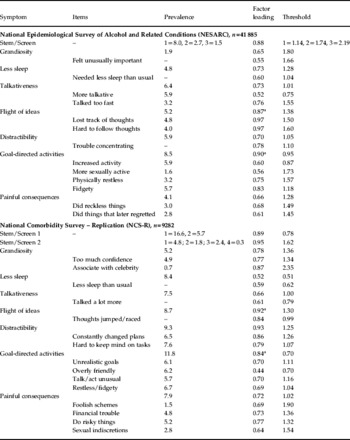
Frequency, standardized factor loadings and thresholds of the screening items and of individual mania symptoms and the items comprising them in eligible individuals in the NESARC and the NCS-R

The first row provides estimates for the composite symptom while remaining rows represent additional items used to assess the single symptom.
a Factor loading was statistically different across samples.
Manic and hypomanic disorders
The lifetime prevalence of DSM-IV mania was 3.6% in the NESARC (3.3% for BDI) and the prevalence figure for ‘bipolar disorder’ was 4.4% in the NCS-R (1.0% for BDI) (Merikangas et al. Reference Merikangas, Akiskal, Angst, Greenberg, Hirschfeld, Petukhova and Kessler2007). The corresponding lifetime prevalence for DSM-IV hypomanic disorder in the NESARC and the NCS-R was 2.4% and 1.1%, with the latter, lower estimate being for a hierarchical diagnosis. In the NESARC, test–retest reliability of BDI, estimated for a subset of NESARC participants, was 0.59 (Grant et al. Reference Grant, Chou, Goldstein, Huang, Stinson, Saha, Smith, Dawson, Pulay, Pickering and Ruan2008). Assessment using the Short-Form 12 Version 2 (SF-12v2) mental disability scores yielded significant disability and social/occupational impairment in those diagnosed with BDI (Grant et al. Reference Grant, Chou, Goldstein, Huang, Stinson, Saha, Smith, Dawson, Pulay, Pickering and Ruan2008). In the NCS-R, a probability sample of 50 subjects, including 10 subjects each with BDI, BDII and subthreshold BD and those endorsing a stem question on mania/hypomania, was reinterviewed using the lifetime non-patient version of the SCID. The prevalence of BDI in the reappraisal was estimated at 1.1%. Concordance across assessments ranged from 0.50 (BDII) to 0.94 (any BD spectrum disorder). A test of the utility of the screening questions (excitement/restlessness and irritability/grouchiness) suggested high sensitivity (0.72–0.96); however, positive predictive values ranged from 0.32 to 0.52 (Kessler et al. Reference Kessler, Akiskal, Angst, Guyer, Hirschfeld, Merikangas and Stang2006).
Statistical analyses
Exploratory factor analysis (EFA)
EFA was conducted using the maximum likelihood estimator in MPlus (Muthén & Muthén, Reference Muthén and Muthén2007). When there was evidence for a single-factor solution, item response modeling was conducted.
Item response modeling
One-factor confirmatory factor analysis (CFA), which allows the computation of item response parameters (Birnbaum, Reference Birnbaum, Lord and Norvick1968), was conducted in the NESARC and NCS-R using MPlus version 5 (Muthén & Muthén, Reference Muthén and Muthén2007) using the maximum-likelihood estimator with robust standard errors (MLR), which is particularly well suited for complex survey designs. Symptom difficulty (or threshold in the context of psychiatric symptoms) and discrimination (or factor loading, which shows how well a symptom correlates with the underlying construct that it is used to measure) were computed using a two-parameter (2P) logistic model, where a=discrimination, or the ability of a symptom to distinguish individuals with high liability from those with low liability (this parameter is also represented by factor loadings); b=threshold, or the location along the underlying distribution where the symptom functions (this parameter is termed ‘difficulty’ in traditional IRMs); and θ=the liability distribution for the disorder.
Parameters from the confirmatory factor model can be easily converted to discrimination and difficulty parameters (Muthén, Reference Muthén1985; Takane & de Leeuw, Reference Takane and de Leeuw1987; MacIntosh & Hashim, Reference MacIntosh and Hashim2003). An alternative, more parsimonious model, the one-parameter (Rasch, Reference Rasch1960) model, is also possible, where all symptoms are assumed to discriminate equally. We tested this model in both samples by constraining the factor loadings (i.e. equal discriminations) across symptoms; however, this led to a serious deterioration of model fit (p<0.0001) and hence the 2P model was selected for analysis.
The primary IRMs focused on the seven DSM-IV criterion B symptoms. Formal tests of differential symptom functioning were also conducted on the symptoms across the NESARC and NCS-R to examine whether discrimination and threshold parameters were statistically different across the two samples. We also factor analyzed the individual items that constituted the seven criterion B symptoms to determine their behavior in a series of secondary analyses.
Association between factor score and manic/hypomanic episodes at the 3-year follow-up
A factor score that represents an individual's liability to mania was created within the factor analysis on the wave 1 screening item(s) and seven DSM-IV criterion B symptoms: higher factor scores represent increased risk for mania. In the NESARC alone, data from the 3-year follow-up interview were used to also create the mania factor score at the 3-year follow-up and to examine whether the factor scores representing the underlying liability to mania at wave 1 were a better predictor of the factor score at the 3-year follow-up and of subsequent manic and hypomanic disorder when compared to diagnoses of mania/hypomania at wave 1. A series of linear and logistic regression models (SAS Institute, 1999) were fitted, with the mania factor score at the 3-year follow-up and manic and hypomanic disorder diagnosed at the 3-year follow-up as the outcomes, and the wave 1 factor score and age and diagnosis at wave 1 (mania, hypomania and/or major depressive disorder) as predictors.
Results
Mania symptoms
The frequencies of the seven DSM-IV criterion B symptoms and the items that were used to create the symptoms in NESARC and NCS-R are presented in Table 1. Although there were marked differences in the weighted prevalence of individual symptoms across the two samples, the most commonly endorsed symptom in both was an increase in goal-directed activities (69–87%) and the least commonly endorsed symptom was inflated self-esteem or grandiosity (15–38%).
Item response modeling
EFA revealed that underlying the seven DSM-IV dependence symptoms was a single factor [Comparative Fit Index (CFI)/Tucker–Lewis Index (TLI) >0.85]. We used confirmatory factor models to compute factor loadings and thresholds, which were also used to compute item characteristic curves (ICCs). Log likelihood ratio χ2 statistics from the confirmatory models were not significant, further confirming unidimensionality (p values ranging from 0.77 to 0.99, Akaike's Information Criterion (AIC)=81715.6 and 23980.6, Bayesian Information Criterion (BIC)=81817.1 and 24137.6]. Factor loadings from this one-factor model are presented in Table 1. Factor loadings for the seven DSM-IV symptoms ranged from 0.65 (grandiosity, painful consequences) to 0.90 (goal-directed activities) in the NESARC, and the NCS-R showed comparable factor loadings ranging from 0.52 to 0.93. Although some factor loadings seemed to differ across samples, after allowing for differing thresholds (i.e. endorsement rates) across the samples, only the factor loadings for flight of ideas and for goal-directed activities were statistically different across the NESARC and NCS-R. In both samples, the screening questions were jointly modeled with the symptoms and these screening items had fairly high factor loadings, suggesting that they fall on the same continuum and are highly correlated with the symptoms that are conditional on them.
CFA was also conducted on the individual items used to create the seven DSM symptoms; likelihood ratio χ2 statistics were not significant, suggesting that the unidimensional model fit the data well. Factor loadings for the individual items were high in both samples (Table 1), confirming that utilization of these individual items to create symptoms did not influence the factorial structure underlying the mania assessment.
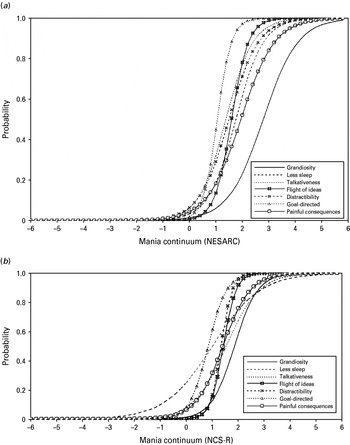
ICCs for the NESARC and NCS-R assessments of the seven criterion B symptoms are presented in Fig. 1(a, b), respectively. The steepness of each curve represents discrimination and its position on the x axis represents difficulty. Consistent with Table 1, in both samples the symptom assessing increase in goal-directed activities had the lowest liability threshold whereas the symptom assessing grandiosity had a high liability threshold (see Fig. 1a, b). In addition, as denoted by the higher factor loadings, the symptom assessing flight of ideas was highly discriminating (with only moderate threshold) across the NESARC and NCS-R. In the NESARC, an increase in goal-directed activities, although a frequently endorsed symptom, was also highly discriminating; its discrimination was somewhat lower in NCS-R.
Item characteristic curves for mania symptoms in (a) 5148 individuals reporting ⩾1 week of elevated mood, restlessness or irritability in the National Epidemiological Survey of Alcohol and Related Conditions (NESARC) and (b) 863 individuals reporting ⩾1 week of elevated mood, restlessness or irritability in the National Comorbidity Survey-Replication (NCS-R).

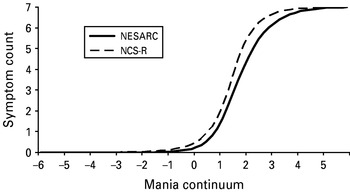
Information from ICCs for the seven criterion B symptoms were summed to create the test characteristic curve (TCC) for the seven DSM-IV symptoms (Fig. 2). The TCC for the two samples are highly comparable across the samples. Criterion B for manic disorder is met when at least three of the seven criterion B symptoms are endorsed. Those with factor scores >1.2 on the NESARC and >1.4 on the NCS-R would probably satisfy criterion B, which is a fairly low threshold, emphasizing the probability that epidemiological interviews tend to ‘cast a wider net’ in terms of their assessment of liability to mania.
Test characteristic curves (TCCs) showing the relationship between symptom endorsement and the liability to mania.

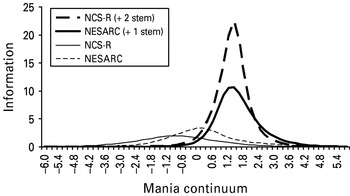
The total information curves (TICs), representing measurement precision for both samples, are shown in Fig. 3. The TIC represents the total (additive) information from all seven symptoms, where, for symptom i, the information at liability level θ is I i(θ)=a i2P i(θ)[1−P i(θ)], where P i(θ)=1/{1+exp[−a i(θ−b i)]} and a i and b i refer to the discrimination and threshold respectively of item i. TICs are shown (Fig. 3) with and without screening questions. When screening items were included, the NESARC mania symptoms performed with considerable precision but over a fairly narrow range of liability, whereas the NCS-R suggests somewhat lower precision. TICs without screening items is also shown; these curves are lower. Thus, variations in the screening items used in each study may have contributed to the total information.
Total information curves (TICs) for the seven mania symptoms with and without the screening items in the National Epidemiological Survey of Alcohol and Related Conditions (NESARC) and the National Comorbidity Survey-Replication (NCS-R). Note that the NCS-R used two screening items whereas NESARC used one.

Association between factor score and mania/hypomania at the 3-year follow-up
The mania factor was computed within the factor model using the screening items and seven DSM-IV criterion B symptoms created from items assessing manic symptoms in the 3-year period of follow-up; this factor was significantly correlated with the wave 1 factor score (r=0.26). Factor loadings of the seven symptoms ranged between 0.62 and 0.89 and the screening item also loaded well (0.86). Thresholds at the 3-year follow-up were modestly higher than at wave 1 (for instance, the threshold for goal-directed activities was 0.95 at wave 1 and 1.05 at the 3-year follow-up). Of the 41 885 individuals with valid factor scores at the first wave of the NESARC, 33745 also had data at the 3-year follow-up. Of these, 819 and 549 met criteria for manic and hypomanic disorder respectively since their wave 1 interview (i.e. new onsets). Scores on the underlying mania factor (while controlling for age) were excellent predictors of the 3-year follow-up mania factor score (β=0.22, p<0.0001) and also of diagnosis of manic [odds ratio (OR) 2.54, p<0.0001] and hypomanic (OR 2.24, p<0.0001) disorder at the 3-year follow-up. Lifetime diagnoses of manic/hypomanic disorder (combined to reflect either disorder at wave 1) and major depressive disorder were associated with increased risk for meeting the NESARC criteria for manic disorder at follow-up (OR 1.92–6.09). However, when the factor scores were added to this model (model 5), the effect of the diagnostic measure of wave 1 lifetime manic/hypomanic disorder was eliminated. This was largely replicated for hypomanic disorder as well. Intriguingly, for hypomanic disorder, when a factor score that excluded the screening item was included, a substantial decline in predictive utility was noted, demonstrating that individuals who may not endorse any of the seven symptoms but pass through a mania screen may be at risk for hypomanic disorder.
Discussion
We sought to characterize the symptoms used to assess manic disorders in two large-scale epidemiological samples representative of the US population. Item response analyses revealed a unidimensional liability to mania criterion B symptoms; certain symptoms, such as flight of ideas, were highly discriminating and displayed moderate thresholds whereas others, such as grandiosity, were found to have less utility. The quantitative liability measure was a good predictor of subsequent symptoms of manic disorder.
Factor analyses of mania
Although no study has conducted an item response analysis of the DSM-IV symptoms for mania in epidemiological surveys, several investigators have examined the factorial nature of mania scales in patient populations. For instance, Cassidy et al. (Reference Cassidy, Forest, Murry and Carroll1998) used data on items assessing mania and dysphoria in 237 BD patients to reveal five factors. Similarly, Picardi et al. (Reference Picardi, Battisti, de Girolamo, Morosini, Norcio, Bracco and Biondi2008) conducted a factor analysis of the 34-item Brief Psychiatric Rating Scale in an in-patient sample to identify four factors including a ‘mania’ factor indexed by elevated mood, psychomotor agitation and distractibility. Cassano et al. (Reference Cassano, Mula, Rucci, Miniati, Frank, Kupfer, Oppo, Calugi, Maggi, Gibbons and Fagiolini2009) used data on 617 patients diagnosed with bipolar spectrum disorders and reported that underlying 68 items assessing manic–hypomanic (and some vegetative function) features were five factors indexing aspects of pure and mixed mania. Although these studies have been largely informative in subtyping manic features in patient populations where item endorsement is higher, they do not address the core issue of whether items and symptoms assessing mania in population-based samples work reasonably well in distinguishing individuals at high versus low risk for BD. Our analyses suggest that, although several items, such as flight of ideas, distractibility and increased goal-directed activities, are good indices of liability to manic disorder, others, such as grandiosity, discriminated poorly and may require reworking in order to be optimized for use in epidemiological samples.
Screening items and item response modeling
Analyses were conducted to compare models including and excluding the screening item(s). Factor loadings were generally higher when the screening items were included. Furthermore, the convergence in factor loadings for individual symptoms across the NESARC and NCS-R dramatically increased upon jointly modeling the screening items with the criterion B symptoms. It is also noteworthy that certain symptoms, such as less sleep than usual, were assessed in both samples similarly (i.e. with a single item), whereas analyzing them in a population-based manner (i.e. by inclusion of the screening items) did not produce statistically significant differences in their factor loadings, when modeled in subsamples screened for mania, their liability threshold and discrimination were different across samples. This implies that the screens for mania in the NESARC and NCS-R may have been different in the subsamples they selected, such that rates of endorsement and factor loadings of the seven DSM-IV symptoms, subsequent to the screen, were very different across the samples. This is also reflected in the TICs, indicating increased measurement precision in the NCS-R, which uses multiple screening items.
Association between factor score and mania/hypomania at the 3-year follow-up
The factor score representing liability to mania at wave 1 was also associated with DSM-IV manic and hypomanic disorder at the 3-year follow-up. For manic and hypomanic disorder, when the wave 1 mania factor score was included in the model, a diagnosis of manic/hypomanic disorder at wave 1 did not retain significant predictive utility, suggesting that the wide range of liability captured by the mania factor score is a superior index of continued liability to manic and hypomanic disorders than prior diagnoses.
Mania in epidemiological surveys
An important question remains regarding whether mania assessed using the AUDADIS and CIDI capture similar individuals and whether these individuals would be diagnosed as ‘affected’ if a clinical assessment were to be made. For instance, although the prevalence of BD (BDI and BDII) was originally estimated to be similar in the NCS-R (3.9%) and the NESARC (5.7%), and somewhat greater than a prior assessment of mania using the CIDI in a Swedish cohort of older twins (2.6%) (Soldani et al. Reference Soldani, Sullivan and Pedersen2005), it is notable that subsequent clinical reappraisal in the NCS-R reduced the rate of BDI to 1.0%, which is more in keeping with classical estimates of BDI, whereas the NESARC rates for BDI remain close to 3% as a clinical reappraisal was not conducted in the NESARC. The reduction of NCS-R rates may reflect refined clinical assessments of impairment due to mania, which may not have been adequately captured by either epidemiological interview. It seems likely that NESARC-defined mania includes conditions that would generally be regarded as milder forms.
This raises the question: should mania assessments be included in non-clinical interviews? The aim of this study was to demonstrate the measurement properties of DSM-IV mania symptoms in population-based epidemiological samples. A preponderance of subjects in such samples are non-manic and thus the functionality of such instruments will be somewhat limited by the prevalence of the syndrome itself. Mania assessments, in addition to other major psychopathology (e.g. schizophrenia), lend themselves better to patient populations and their performance in general population settings may be hindered by multiple factors (e.g. interviewer's inability to verify level of impairment, confounds with other disorders or with substance use). However, in both samples, as a set of DSM-IV symptoms, mania items seem to have some utility. In addition, as shown by a high concordance for BD in general, but a more modest concordance for BDI between the NCS-R CIDI assessment and the clinical reappraisal interview, a subset of subjects qualifying as ‘manic’ in epidemiological surveys truly represent clinical cases whereas others are probably subthreshold or unaffected. Reducing such false positives may be challenging in epidemiological surveys and researchers may find greater utility in using quantitative assessments of mania, which capture a range of variation in risk, instead of using diagnoses.
Limitations
There are some important limitations to this study. First, neither epidemiological sample (for practical purposes) used an interview designed for the assessment of severe psychopathology, nor were any of the interviews administered by interviewers with clinical expertise in diagnosis of BD (for instance, DSM-IV mania requires ‘marked impairment’), and if this is not carefully assessed, diagnosis is often less precise. Although the aim of this paper was to examine the utility of general epidemiological interviews, access to data on the same individuals interviewed with a clinical interview schedule would have allowed for psychometric comparability. Second, the 3-year follow-up data in the NESARC used an interval instrument (i.e. questions were asked for the 3-year duration between the interviews); thus, our associations between the factor score and the factor score at the 3-year follow-up and also mania and hypomania at the 3-year follow-up represent a prediction of recurrence but not an assessment of diagnostic stability per se. Third, these are samples of US adults that may not generalize to other populations. Fourth, some of the younger participants in both studies may not have passed the age of risk for onset of manic disorders. Fifth, although the DSM-IV symptoms are the ‘gold standard’ for diagnosis of manic disorders, it would have been intriguing to compare the psychometric properties of DSM symptoms with those stemming from other mania/hypomania scales, but these were not available.
Conclusion
The finding of a single liability dimension underlying mania symptoms adds to a growing body of literature that has begun to view psychiatric disorders in a dimensional framework; this may have significant utility in studies where diagnostic dichotomies reduce power (e.g. gene-finding efforts). Caution, however, is needed in their interpretation. Concerns still exist surrounding the interpretation of mania constructs in epidemiological samples to confirm the extent to which these assessments are congruent with clinical evaluations of manic disorders.
Acknowledgments
The research reported here was supported by DA23668 (A.A.), DA18660 (M.T.L.), DA18267 (M.T.L.) and MH68009 (J.I.N.) and a grant to J.I.N. from the Indiana Division of Mental Health and Addictions.
Declaration of Interest
None.