I. INTRODUCTION
In recent years, organic–inorganic hybrids have gained worldwide research interests due to their potential applications in catalysis (Llabresixamena et al., Reference Llabresixamena, Abad, Corma and Garcia2007), storage (Rosi et al., Reference Rosi, Eckert, Eddaoudi, Vodak, Kim, O'Keeffe and Yaghi2003), sensing (Yanai et al., Reference Yanai, Kitayama, Hijikata, Sato, Matsuda, Kubota, Takata, Mizuno, Uemura and Kitagawa2011), ion conduction (Hurd et al., Reference Hurd, Vaidhyanathan, Thangadurai, Ratcliffe, Moudrakovski and Shimizu2009), nonlinear optics (Wang et al., Reference Wang, Zhang and Lin2012), piezoelectric, and ferroelectrics (Liao et al., Reference Liao, Zhao, Tang, Zhang, Li, Shi, Chen, You and Xiong2019). Among organic–inorganic hybrids, the perovskite structure (Li et al., Reference Li, Wang, Deschler, Gao, Friend and Cheetham2017) composed of metal cations, protonated organic amine, and acid ions form a genre that is characterized by low cost in synthesis and great diversity in chemical composition or structure. The rich choice of cations, anions, and organic amine molecules of proper size and configuration in a specific ratio allows one to synthesize a variety of hybrid organic–inorganic perovskites (HOIPs) with different polyhedra stacking from zero to three dimensions (Saparov and Mitzi, Reference Saparov and Mitzi2016; Ju et al., Reference Ju, Dai, Ma, Zhou and Zeng2018; Chen et al., Reference Chen, Song, Zhang, Li, Ge, Tang, Gao, Zhang, Fu, You and Xiong2020; Hu et al., Reference Hu, Florio, Chen, Phelan, Siegler, Zhou, Guo, Hawks, Jiang, Feng, Zhang, Wang, Wang, Gall, Palermo, Lu, Sun, Lu, Zhou, Ren, Wertz, Sundararaman and Shi2020). These HOIPs usually exhibit lower symmetry in structure but can be viewed as derivatives of perovskite regardless of the way cation polyhedrons are stacked. In comparison with HOIPs, organic–inorganic hybrids with other structural types are not so common and have been much less reported.
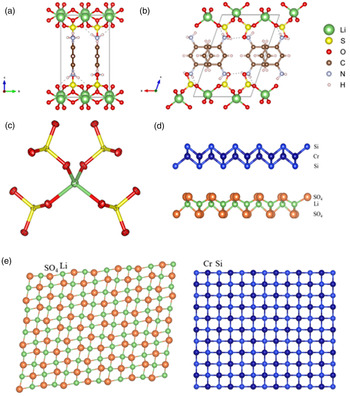
It is known that many inorganic compounds crystallize in ThCr2Si2 (Ban and Sikirica, Reference Ban and Sikirica1965) structural type. In this structure, each chromium atom is connected to four silicon atoms to form [CrSi4] tetrahedrons, and adjacent tetrahedrons are connected in an edge sharing way to form anti-fluorite layers. The thorium atoms are intercalated in the anti-fluorite layers. In this work, we report the synthesis and structure of a new organic–inorganic hybrid lithium m-phenylenediamine sulfate (LPS), Li2(C6H10N2)(SO4)2, with a regular layered structure. LPS can be regarded as a variant of ThCr2Si2 with a lower symmetry, where thorium, chromium, and silicon atoms are replaced by protonated m-phenylenediamine, lithium, and sulfate ions, respectively. Our findings lead to a new structural system of organic–inorganic hybrid with anti-fluorite type layers.
II. EXPERIMENTAL
Single crystals of LPS were prepared by mixing stoichiometric ratios of lithium sulfate (60 mmol) and m-phenylenediamine sulfate (60 mmol) into de-ionized water (160 ml) in a 200 ml beaker to get a clear solution. After evaporation of the solvent at 80 °C, colorless crystals were obtained from the beaker.
Powder X-ray diffraction (PXRD) data were collected from 100 to 600 K on a Rigaku SmartLab diffractometer with CuKα radiation (40 kV, 30 mA) and a germanium monochromator in a reflection mode (2θ = 5–80°, step = 0.01° 2θ, and scan speed = 1° min−1). The sample for PXRD was prepared by grinding the single crystals for 15 min to eliminate the grain-size effect. The powder was carefully scraped flat by a piece of glass to minimize the preferred orientation. To determine the crystal structure, a crystal of size 0.015 × 0.128 × 0.181 mm3 was selected for the single-crystal X-ray diffraction study. Data were collected using a Bruker D8 VENTURE PHOTO II diffractometer with multilayer mirror monochromatized MoKα (λ = 0.71073 Å) radiation at room temperature. Unit-cell refinement and data merging were performed using the APEX3 program, and an absorption correction was applied using the multi-scans method.
III. RESULTS
The PXRD data for LPS at 300 K are given in Table I, which is also contained in the Powder Diffraction File (Gates-Rector and Blanton, Reference Gates-Rector and Blanton2019), as entry 00-070-1250. All reflections were indexed successfully using the DICVOL14 program (Louër and Boultif, Reference Louër and Boultif2014) on a primitive monoclinic system unit cell, with unit-cell parameters a = 7.8759(9) Å, b = 6.6417(4) Å, c = 11.8378(12) Å, β = 109.393(10)°, and V = 584.09 Å3 at room temperature. A maximum absolute error of 0.013° 2θ was set as the Δ2θ limit for indexing a given observed diffraction line. All k-values in the (0k0) peaks are even, indicating the existence of a 21-screw axis along the b-axis. Further check of the symmetry by using CHEKCELL (Laugier and Bochu, Reference Laugier and Bochu2002) suggests P21/m (No. 11) as the possible space group, which is consistent with the systematic absences and with the crystal density. The unit-cell parameters of compound LPS were refined with the program NBS*AIDS83 (Mighell et al., Reference Mighell, Hubbard and Stalick1981). The crystal data, density, and figures of merit M20 (de Wolff, Reference de Wolff1968) and F20 (Smith and Snyder, Reference Smith and Snyder1979) are compiled in Table II.
PXRD data of lithium m-phenylenediamine sulfate at 300 K.

The wavelength used to convert 2θ to d-spacing is 1.54059 Å.
Temperature dependence of cell parameter for lithium m-phenylenediamine sulfate.

a M(20) = Q 20/2 $\bar{{\rm \varepsilon }}$ N 20.
b F(20)=N/|Δ2θN poss|.
Powder patterns taken at different temperatures (Figure 1) suggest that LPS has no structural phase transition from 100 to 600 K. The temperature dependences of cell parameters are shown in Figure 2, and the volume expansion of LPS from 100 to 600 K is approximately linear with a coefficient 2.79 × 10⁻⁵ K−1 (Figure 2). The cell parameters a, b, and c have anisotropic expansion coefficients, which are 6.38 × 10⁻⁶ K−1, 1.22 × 10⁻⁵ K−1, and 9.88 × 10⁻⁶ K−1, respectively, while β is approximately temperature independent.
Experimental PXRD patterns at different temperature and simulated ones from the room-temperature crystal structure. Inset: photograph of the crystal of LPS.

Change of (a) cell parameters, (b) β, and (c) volume with temperature. The error bars in (a) and (c) are too small to be displayed.

The crystal structure was solved by direct methods based on the single-crystal diffraction data collected at room temperature, and the structure is refined by the full-matrix method based on F 2 using the SHELXTL software package (Sheldrick, Reference Sheldrick2008). All non-hydrogen atoms were refined anisotropically, and the H atoms were placed at ideal positions and refined using a “riding” model with U iso = 1.2 U eq (C) or U iso = 1.5U eq (N). The crystallographic data for lithium m-phenylenediamine sulfate are listed in Table II, the fractional atomic coordinates and equivalent isotropic displacement parameters are given in Table III. It is confirmed that the compound crystallizes in space group P21/m with formula unit Z = 2. Both sulfate groups and m-phenylenediamine molecules are intact and are fully ordered in the compound (Figure 3). Different from the six coordination of metals in HOIPs, each lithium ion in LPS is connected to four  ${{\rm SO}_4}^{2-}$ forming a slightly distorted tetrahedron with Li–O bond lengths from 1.958 to 1.995 Å and O–Li–O bond angles from 106.49° to 120.03°. Such distorted [Li(SO4)4] tetrahedrons are also observed in Li2SO4 (Albright, Reference Albright1933). The lithium and
 ${{\rm SO}_4}^{2-}$ form quasi-two-dimensional anti-fluorite layers parallel to the ab plane [Figures 3(d) and 3(e)], and the interlayer distance is 11.161 Å (c⋅sin β). Hydrogen atoms on amino group in m-phenylenediamine are connected to oxygen atoms of
 ${{\rm SO}_4}^{2-}$ through hydrogen bonds. In this way, organic molecules lie between [LiSO4] layers, with their benzene rings perpendicular to the b-axis. Similar structures were recently found in FeSe-based superconductors such as Na0.39(C2H8N2)0.77Fe2Se2 (Jin et al., Reference Jin, Fan, Wu, Sun, Wu, Huang, Shi, Xi, Li and Chen2017), Na0.35(C3 H10N2)0.426Fe2Se2 (Fan et al., Reference Fan, Deng, Chen, Zhao, Sun, Jin and Chen2018), and Lix(C2H8N2)yFe2Se2 (Zhao et al., Reference Zhao, Wang, Huang, Wu, Sun, Fan, Song, Jin and Chen2019), in which alkali metals and organic molecules are co-inserted in between anti-fluorite FeSe layers. It should be noted that although protonated m-phenylenediamine is a polar cation with an electric dipole moment along the center of two nitrogen atoms and benzene ring, the two m-phenylenediamine molecules in the unit cell of LPS have opposite electric dipole moments (along [100] and
 $[ { {\bar{1}00} ] }$), maintaining a net-zero moment in the whole structure. There are one-dimensional channels between the m-phenylenediamine and extending along the a-axis. The size of the channels is around 7.8 Å × 3.3 Å, which may be used to selectively filter out some small molecules (Tables IV and V).
Projections of LPS along (a) a-axis and (b) b-axis, dashed lines represent hydrogen bonds. (c) The coordination environment of the Li+ with displacement ellipsoids drawn at the 50% probability level. (d) Projections along the direction parallel to the anti-fluorite layers both in ThCr2Si2 and LPS. (e) Projections along the direction perpendicular to the anti-fluorite layers both in ThCr2Si2 and LPS. For simplicity, the sulfates are replaced by orange balls at the center of mass of the sulfates.

Crystallographic data for lithium m-phenylenediamine sulfate.

Fractional atomic coordinates and equivalent isotropic displacement parameters for lithium m-phenylenediamine sulfate.

Selected bond lengths (Å) and bond angles (°) for lithium m-phenylenediamine sulfate.

IV. CONCLUSION
The lithium m-phenylenediamine sulfate was prepared under aqueous solution conditions. The incorporation of protonated organic amines, Li+ metal cations with four  ${{\rm SO}_4}^{2-}$ successfully stabilized a compound with organic amines intercalated in-between anti-fluorite type layers. The crystal structure was determined from the X-ray single-crystal diffraction data. The title compound possesses a layered monoclinic structure without phase transition between 100 to 600 K, and the volume expansion coefficient is determined to be 2.79 × 10⁻⁵ K−1 based on the PXRD data.
V. DEPOSITED DATA
The Crystallographic Information System files Li2(C6H10N2)(SO4)2-1.cif (for the PXRD data) and Li2(C6H10N2)(SO4)2-2.cif (for the single-crystal data) were deposited with the ICDD. The data files can be requested at info@icdd.com.
ACKNOWLEDGEMENTS
This work is financially supported by the National Key Research and Development of China (2016YFA0300301, 2018YFE0202600), the National Natural Science Foundation of China (Grant Nos. 51772323, 51532010), the Key Research Program of Frontier Sciences, CAS (Grant No. QYZDJ-SSW-SLH013), and the Youth Innovation Promotion Association of CAS (2019005).