


Introduction
Although having a baby is a time often associated with joy, the perinatal period has been associated with the onset and exacerbation of various psychiatric conditions (Brandes, Soares and Cohen, Reference Brandes, Soares and Cohen2004). Miller, Pallant and Negri (Reference Miller, Pallant and Negri2006) report that 29% of new mothers exhibited clinically significant levels of depression, anxiety or stress and state the “postpartum period arguably represents one of the most important life stages for which the accurate detection and treatment of psychological distress is required” (Miller et al., Reference Miller, Pallant and Negri2006). It has been suggested that the perinatal period may be a time associated with the onset and exacerbation of Obsessive-Compulsive Disorder (OCD) (Brandes et al., Reference Brandes, Soares and Cohen2004), although evidence for this is inconclusive (McGuiness, Blissett and Jones, Reference McGuinness, Blissett and Jones2011). Following a review of the literature, McGuiness, Blissett and Jones (Reference McGuinness, Blissett and Jones2011) suggest that OCD within the postpartum, although unlikely to represent a specific OCD subtype, does appear to have a distinctive clinical picture. Cognitive behavioural theories have suggested responsibility beliefs and interpretations may play a role in this (Fairbrother and Abramowitz, Reference Fairbrother and Abramowitz2007). The perinatal period is of particular relevance when exploring the relationship between responsibility and OCD, as it is a time associated with a predictable and objective increase in responsibility.
Cognitive-behavioural model of OCD
Intrusions, such as those seen in OCD, are reported by the majority of the general population (Rachman and de Silva, Reference Rachman and de Silva1978; Salkovskis and Harrison, Reference Salkovskis and Harrison1984; Freeston, Ladouceur, Thibodeau and Gagnon, Reference Freeston, Ladouceur, Thibodeau and Gagnon1991). Experiences of intrusions have also been found to be prevalent within perinatal populations (Abramowitz, Schwartz and Moore, Reference Abramowitz, Schwartz and Moore2003; Abramowitz, Khandker, Nelson, Deacon, and Rygwall, Reference Abramowitz, Khandker, Nelson, Deacon and Rygwall2006; Abramowitz, Nelson, Rygwall and Khandker, Reference Abramowitz, Nelson, Rygwall and Khandker2007; Abramowitz et al., Reference Abramowitz, Meltzer-Brody, Leserman, Killenberg, Rinaldi and Mahaffey2010; Fairbrother and Woody, Reference Fairbrother and Woody2008; Leckman et al., Reference Leckman, Mayes, Feldman, Evans, King and Cohen1999). Leckman et al. (Reference Leckman, Mayes, Feldman, Evans, King and Cohen1999) report that parental preoccupation with thoughts of harm occurring to one's infant peak near childbirth. Abramowitz et al. (Reference Abramowitz, Khandker, Nelson, Deacon and Rygwall2006) found that 89% of new parents reported experiencing distressing infant-related intrusions. Furthermore, 84.7% of participants reported using strategies to neutralize these thoughts. Most participants had symptoms falling within the subclinical range for OCD. Leckman et al. (Reference Leckman, Mayes, Feldman, Evans, King and Cohen1999) found that a subsection of parents reported experiencing thoughts of harming their infant (37% during pregnancy and at 3–4 months postpartum). The current study extends this by examining responsibility appraisals related to such thoughts, across the perinatal period.
Cognitive-behavioural theories of OCD suggest that obsessional difficulties arise due to maladaptive thinking patterns related to the occurrence of intrusions (Abramowitz, Schwartz, Moore and Luenzmann, Reference Abramowitz, Schwartz, Moore and Luenzmann2003). Salkovskis’ (Reference Salkovskis1999) cognitive-behavioural model of OCD states that the idiosyncratic interpretations of intrusions distinguish individuals with OCD from those without. In those with OCD the interpretations regarding intrusions are made in the context of general assumptions regarding a heightened sense of responsibility for potential harm (Salkovksis, Reference Salkovskis1999) and a tendency to overestimate probability of harm (Fairbrother and Abramowitz, Reference Fairbrother and Abramowitz2007). According to the model, compulsive behaviours develop as attempts to reduce perceived threat. Thus specific interpretations regarding intrusions (relating to responsibility) motivate individuals to engage in neutralizing and avoidance behaviour (i.e. compulsions).
The cognitive-behavioural model of postpartum OCD (Fairbrother and Abramowitz, Reference Fairbrother and Abramowitz2007) proposes that the perinatal period “lowers the threshold for OCD development/exacerbation by bringing with it a sudden and dramatic increase in responsibility”. Fairbrother and Abramowitz (Reference Fairbrother and Abramowitz2007) discuss possible factors underlying such increases in responsibility. They suggest an abrupt rise in care-giving responsibilities, a decrease in involvement of healthcare professionals, and a bombardment with risk information influence parental estimates of threat. Given the role of responsibility in the maintenance of OCD and the sudden increase in responsibility following childbirth, an elevated prevalence of OCD during the perinatal period is not surprising. Furthermore, consistent with Abramowitz et al.’s (Reference Abramowitz, Schwartz and Moore2003) findings, increases in subclinical symptoms of OCD may be expected.
Responsibility attributions and OCD
General beliefs about responsibility are distinguished from specific responsibility interpretations in particular scenarios. The idiosyncratic nature of responsibility interpretations has been a focus of research investigating the development and maintenance of OCD (e.g. Foa, Amir, Bogert, Molnar and Przeworski, Reference Foa, Amir, Bogert, Molnar and Przeworski2001; Foa, Sacks, Tolin, Prezworski and Amir, Reference Foa, Sacks, Tolin, Prezworski and Amir2002; Wroe and Salkovskis, Reference Wroe and Salkovskis2000). This research highlights the specific nature of obsessive-compulsive symptomatology, in that participants show increased responsibility interpretations and symptoms in areas about which they are most concerned, and not in areas unrelated to their OCD.
The role of general responsibility beliefs in developing postpartum OCD has been demonstrated by Abramowitz et al. (Reference Abramowitz, Khandker, Nelson, Deacon and Rygwall2006), who concluded that pre-existing beliefs regarding responsibility, threat, control and the need for certainty were related to obsessive-compulsive symptoms in the postpartum.
Cognitive-behavioural models propose that general beliefs and idiosyncratic interpretations of intrusions are linked but theoretically distinct (Salkovskis et al., Reference Salkovskis, Wroe, Gledhill, Morrison, Forrester and Richards2000). In order to understand the developmental and maintaining factors in the perinatal period, it is crucial to investigate both beliefs and interpretations related to perinatal obsessive-compulsive symptomatology. Abramowitz, Nelson, Rygwall and Khandker (Reference Abramowitz, Nelson, Rygwall and Khandker2007) examined interpretations of baby-related intrusions and found that a tendency to negatively interpret baby-related intrusions in early postpartum partially mediated the relationship between pre-childbirth obsessive beliefs and postpartum obsessive-compulsive symptoms. This suggests that specific interpretations regarding intrusions play a role in whether an individual presents with obsessive-compulsive symptoms. However, intra-individual differences in interpretations of intrusions in the perinatal period have not been investigated. Further research is required to understand the role of responsibility beliefs compared to interpretations of specific intrusions during the perinatal period. It is not clear whether general responsibility beliefs increase in the perinatal period, which might cause increased distress around intrusions, or whether increases are seen only in idiosyncratic interpretations of baby-related intrusions.
The current study aims to investigate how responsibility beliefs and interpretations regarding idiosyncratic baby and non-baby related intrusions vary across the perinatal period, and whether these differ from interpretations of intrusions in non-childbearing women. The study also investigates the relationship between responsibility interpretations and obsessive-compulsive symptomatology.
It was hypothesized: (1) there is no difference in general responsibility beliefs in women across the perinatal period (i.e. women in antenatal and postpartum stages), or compared to women who have not had children; (2) in the postpartum group, women have higher responsibility interpretations regarding intrusions concerning harm to their baby (baby-related intrusions) compared to intrusions that do not concern harm to their baby (non-baby related intrusions); (3) responsibility interpretations regarding baby-related intrusions (in antenatal and postpartum women) are higher than responsibility interpretations of non-baby intrusions in women who were neither pregnant nor parents; (4) responsibility interpretations regarding baby-related intrusions predict distress following intrusions and obsessive-compulsive symptomatology, above that predicted by general responsibility beliefs. Such findings would suggest that responsibility interpretations of idiosyncratic baby-related intrusions, as opposed to general beliefs, are key in the maintenance of perinatal OCD; therefore guiding cognitive-behavioural therapy for perinatal OCD.
Method
Participants
Participants consisted of three groups: an antenatal group (n = 26) of women currently pregnant (2nd/3rd trimester) with their first child; a postpartum group (n = 35) who gave birth to their first child in the last 9 months; and a control group (n = 33) of non-childbearing women, who did not have children, and were not pregnant at the time of the research. Recruitment took place using online advertisements detailing a study regarding women's experiences of worrying thoughts during pregnancy and following birth. OCD was not mentioned in the advertisement. Advertisements were placed on parenting websites including the National Childbirth Trust (NCT) and Mumsnet. The control group was recruited using online advertising for staff and students of a university. Participants were also recruited opportunistically through word of mouth. All participants were entered into a prize draw with the chance to win £40 of vouchers. The study received full ethical approval from the university departmental ethical committee and the National Childcare Trust peer review process. Prior to participation in the study information sheets were provided and consent forms completed in order to gain informed consent.
Measures
The Yale-Brown Obsessive Compulsive Scale (YBOCS; Goodman, Price, Rasmussen, Mazure, Fleischmann et al., Reference Goodman, Price, Rasmussen, Mazure, Fleischmann and Hill1989; Goodman, Price, Rasmussen, Mazure, Delgado et al., Reference Goodman, Price, Rasmussen, Mazure, Delgado and Heninger1989). This scale is closely related to DSM-V diagnostic criteria, and was chosen as it is a frequently used measure of Obsessive Compulsive symptomatology (Goodman, Price, Rasmussen, Mazure, Delgado et al., Reference Goodman, Price, Rasmussen, Mazure, Delgado and Heninger1989) that provides a clinical cut-off. Cronbach alpha revealed a good level of reliability (α = 0.86).
Obsessive Compulsive Inventory Revised (OCI-R; Foa, Kozak, Salkovskis, Coles and Amir, Reference Foa, Kozak, Salkovskis, Coles and Amir1998). This is a widely used self-report measure suitable for non-clinical populations. Cronbach alpha revealed an excellent level of internal consistency (α = 0.96).
Postpartum Thoughts and Behaviours Checklist (PTBC; Abramowitz et al., Reference Abramowitz, Khandker, Nelson, Deacon and Rygwall2006). The PTBC involves a checklist of common intrusions and compulsions based on the seven themes of postpartum thoughts listed by Abramowitz et al. (Reference Abramowitz, Schwartz and Moore2003), which include: (a) suffocation/SIDS; (b) accidents; (c) intentional harm; (d) losing the baby; (e) illness; (f) sexual thoughts; and (g) contamination. Participants rate how bothered they have been by various intrusions and how much time they engaged in different compulsions. This measure was chosen as it focused specifically on the obsessive-compulsive symptoms commonly reported in perinatal populations. A shortened version of the PTBC consisting of 9 key intrusions was used as the original version consisted of 32 different intrusions. It was felt this was more appropriate given the number of other measures used. As the PTBC focused specifically on baby-related intrusions a similar checklist of non-baby intrusions was created for controls, based on previous research of intrusions in non-clinical populations. This provided controls with a similar level of support to identify intrusions. The PTBC (and control version) was used to facilitate the identification of intrusions. Cronbach alpha revealed an acceptable level of internal consistency for the PTBC distress (α = 0.76) and compulsions (α = 0.79) scales.
Responsibility Attitudes Questionnaire (RAS; Salkovskis et al., Reference Salkovskis, Wroe, Gledhill, Morrison, Forrester and Richards2000). The RAS is a self-report measure that assesses general responsibility attitudes (higher scores indicate stronger responsibility beliefs). Cronbach alpha revealed an excellent level of internal consistency (α = 0.93).
Responsibility Interpretations Questionnaire (RIQ; Salkovskis et al., Reference Salkovskis, Wroe, Gledhill, Morrison, Forrester and Richards2000). The RIQ covers a range of responsibility interpretations focusing on self-reported intrusions (higher scores indicate greater perceived responsibility). Cronbach alpha revealed an excellent level of internal consistency for non-baby related and baby-related intrusions (α = 0.94 and 0.95 respectively).
Depression Anxiety Stress Scale (DASS; Lovibond and Lovibond, Reference Lovibond and Lovibond1995). The DASS is a measure of depression, stress and anxiety. This was selected because it has been recommended for use in perinatal populations (Miller et al., Reference Miller, Pallant and Negri2006). Only depression and anxiety subscales were used in the current study. Cronbach alpha revealed excellent levels of internal consistency for depression and anxiety scales (α = 0.93 and 0.91 respectively).
Socio-demographic and pregnancy related information were also collected.
Procedure
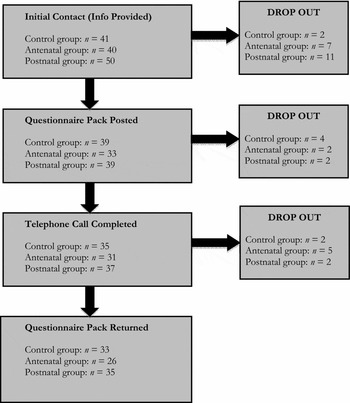
Figure 1 shows a flowchart describing the stages of recruitment and data collection. Participants initially completed a telephone interview with the researcher. Participants were given a definition of intrusions and asked to identify intrusions they had experienced in the last 2 weeks in order to complete the RIQ. The PTBC (or control alternative) was used to help participants identify intrusions. For the RIQ, participants were asked to identify a recent baby related intrusion, and an intrusion that was not relevant to their baby, if possible. The YBOCS was then completed over the telephone. The purpose of the telephone part of the study was to ensure participants had a consistent understanding of what intrusions are and to facilitate participants, through normalization, in identifying intrusions they had experienced. This was conducted by a trainee clinical psychologist, who was trained (using inter-rater reliability) and supervised in using the YBOCS by a clinical psychologist with experience of working with OCD. Participants then completed the questionnaire pack and returned this in a prepaid envelope.
Flow chart describing recruitment and drop out

Results
Sociodemographic variables
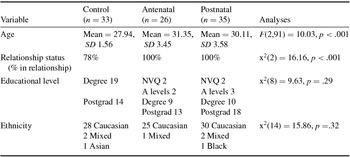
Analyses of variance and Chi square tests were conducted to compare the groups on demographic variables. A significant difference was found between the groups in age such that the control group were significantly younger than both the antenatal (t(33.03) = −4.67, p < .001) and postpartum groups (t(47.05) = −3.28, p = .002). There was no significant age difference between antenatal and postpartum groups (t(59) = 1.35, p = .18) (see Table 1). The groups significantly differed in terms of relationship status, with the control group being less likely to report being in a relationship than the other groups. Chi square tests revealed that the groups did not significantly differ in terms of education level or ethnicity.
Sociodemographics across the control, antenatal and postnatal groups

Depression, anxiety and obsessive compulsive symptomatology
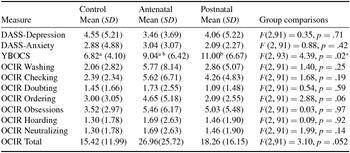
Group comparisons revealed no significant differences in terms of DASS and OCIR (see Table 2).
Mean scores on measures of psychopathology

Notes: On the DASS a score of less than 8 on anxiety or less than 10 on depression is deemed “normal”. On the YBOCS a score greater than 15 indicates moderate to severe OCD symptomatology.
*Statistically significant difference (p ≤ .05)
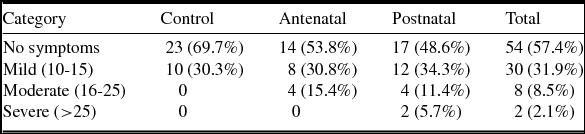
Analyses of variance revealed significant differences between the groups on YBOCS (F(2, 93) = 4.39, p = .02). Bonferroni corrected post hoc t-tests (corrected p value of .02) were carried out to compare the groups. No significant differences were found when comparing the antenatal group with either the control (t(40.36) = −1.53, p = .13) or postpartum group (t(59) = −1.15, p = .25). The postpartum group scored significantly higher on the YBOCS than the control group (t(66) = −3.09, p = .003). Overall, none of the controls, 15.4% of the antenatal and 17.1% of the postpartum groups had YBOCS scores indicative of moderate/severe levels of obsessive-compulsive symptomatology (see Table 3).
YBOCS categories across the control, antenatal and postnatal groups

All of the individuals in the antenatal and postpartum group reported experiencing at least one of the intrusions listed in the PTBC. The most commonly reported in the antenatal group were thoughts of illness, SIDS and accidents. In the postpartum group thoughts of accidents, SIDS and suffocation were most common. Similarly, all of the controls reported experiencing at least one of intrusions from the PTBC (control version). Thoughts of accidents, harm occurring to self, and illness to others were the three most commonly reported intrusions in the controls.
Participants rated levels of distress associated with the intrusions from the PTBC. As only the antenatal and postpartum groups completed the PTBC an independent t-test was used to compare the two groups on the maximum score for PTBC thoughts. This revealed a significant difference between the groups in terms of distress (t(40.07) = −3.34, p = .002) with the postpartum group reporting higher distress regarding intrusions (mean = 65.07, SD = 25.28) than the antenatal group (mean 44.35, SD = 27.93).
Hypothesis 1: general responsibility ratings
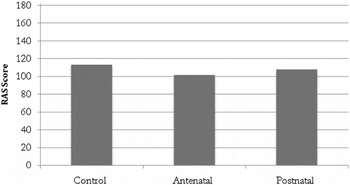
A one-way ANOVA was conducted comparing RAS scores across the groups. Analyses of variance revealed no significant differences between groups on RAS (F(2, 91) = 2.02, p = .14) (see Figure 2). This remained when controlling for age (p > .05).
Mean scores on the Responsibility Attitudes (RAS)

Hypotheses 2 and 3: Responsibility interpretations following intrusions
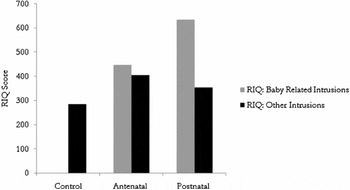
One-way ANOVAs were conducted to analyse scores on the baby and non-baby RIQ. There was no significant difference between groups on non-baby RIQ scores (F(2, 85) = 0.75, p = .48) (see Figure 3), and when controlling for age (p = .2).
Mean scores on the RIQ for baby related and non-baby intrusions

A second one-way ANOVA was used to compare baby RIQ scores across the groups. For the control group scores on the non-baby RIQ were used, as control participants understandably did not report baby-related intrusions. The groups differed significantly (F(2, 84) = 8.83, p < .001), and when controlling for age (F[4,80] = 6.29, p = .001). Bonferroni corrected t-tests (using a corrected p value of .02) were used to compare the baby RIQ scores, and corresponding control RIQ, between the three groups. The control group non-baby RIQ was significantly lower than the postpartum group on the baby RIQ (t(64) = −4.43, p < .001) but did not significantly differ from the antenatal group (t(51) = −1.51, p = .14). The antenatal and postpartum groups did not significantly differ on baby RIQ scores (t(35.30) = −1.97, p = .06).
Paired t-tests were conducted to compare RIQ scores for baby-related and non-baby intrusions. Both antenatal (t(18) = −3.43, p = .003) and postpartum (t(32) = −5.14, p < .001) groups scored significantly higher on the baby RIQ compared to the non-baby RIQ.
Hypothesis 4: Responsibility interpretations and obsessive-compulsive symptoms
Two hierarchical regressions were used to investigate the extent to which measures of responsibility interpretations regarding baby-related intrusions predict: i) obsessive-compulsive symptomatology (YBOCS total) and ii) distress following intrusions (PTBC distress), over and above that predicted by depression, anxiety and general responsibility ratings. The YBOCS total was chosen over the OCIR as this related closely to the DSM-V diagnostic criteria and captures interference more comprehensively. In order to do this data from the antenatal and postpartum group were combined. In both regression analyses depression and anxiety were entered as a first step, followed by RAS scores, and then finally RIQ scores.
When considering obsessive-compulsive symptomatology as a dependent variable, in Step 1 depression and anxiety explained a significant amount of variance in YBOCS scores (F(2, 52) = 14.03, p < .001, R2 = 0.35, adjusted R2 = 0.33). In Step 2 RAS scores contributed an increase in variance from 35% to 39% but this was not statistically significant (F(1, 51) = 3.09, p = .09, R2 = 0.39, adjusted R2 = 0.35). In Step 3 scores on the baby-related RIQ contributed a significant increase in variance from 39% to 53.9% (F(1, 50) = 16.37, p < .001, R2 = 0.54, adjusted R2 = 0.50). In the final equation baby RIQ (t(50) = 4.05, p < .001) and depression scores (t(50) = 3.47, p = .001) both made a significant independent contribution to YBOCS scores with beta weights of 3.47 for depression and 4.05 for RIQ.
When considering distress following intrusions as a dependent variable, in Step 1, depression and anxiety did not explain a significant amount of variance in self-reported distress (F(2, 52) = 2.21, p = .12, R2 = 0.08, adjusted R2 = 0.04). In Step 2 RAS scores contributed an increase in variance from 7.8% to 11.9% but this was not statistically significant (F(1, 51) = 2.35, p = 0.13, R2 = 0.12, adjusted R2 = 0.07). In Step 3 scores on the baby-related RIQ contributed a significant increase in variance from 11.9% to 49.2% (F(2, 50) = 36.67, p < .001, R2 = 0.49, adjusted R2 = 0.45). In the final equation only the baby RIQ (t(50) = 6.06, p < .001) made a significant independent contribution to self-reported distress following intrusions, with a beta weight of 0.57.
Discussion
The findings of the current study support the hypothesis that postpartum women show increased responsibility interpretations regarding intrusions focused on potential harm occurring to their baby, but not regarding intrusions about potential harm in non-baby related situations; and that responsibility interpretations in relation to baby-related intrusions predict obsessive-compulsive symptomatology and distress after controlling for depression, anxiety and general responsibility ratings. Alongside this, it was found that there was no difference in general responsibility beliefs between antenatal, postpartum and nulliparous women, suggesting that this increase in responsibility seen in the postpartum group was specific to baby-related intrusions.
These findings support the suggestion proposed in Salkovskis’ (Reference Salkovskis1985, Reference Goodman, Price, Rasmussen, Mazure, Delgado and Heninger1989) cognitive-behavioural model of OCD that individual responsibility interpretations regarding intrusions play a role in obsessive-compulsive symptomatology. The findings of the current study support Fairbrother and Abramowitz's (Reference Fairbrother and Abramowitz2007) suggestion that responsibility interpretations play a role in postpartum populations, and adds to this in distinguishing between responsibility interpretations regarding specific baby and non-baby related intrusions, as well as comparing general responsibility beliefs. These findings are consistent with the idea that new mothers do not experience general increases in responsibility beliefs, but that this increase in responsibility is specific to situations concerning potential harm to the baby. This distinction has not been made in previous research. This is of particular relevance given how commonly reported intrusions about infants are within perinatal populations (Abramowitz et al., Reference Abramowitz, Schwartz and Moore2003, Reference Abramowitz, Khandker, Nelson, Deacon and Rygwall2006, Reference Abramowitz, Nelson, Rygwall and Khandker2007, Reference Abramowitz, Meltzer-Brody, Leserman, Killenberg, Rinaldi and Mahaffey2010). However, it is important to note that only responsibility interpretations were examined, so it is unclear the extent to which other cognitions (such as thought-action fusion) may underlie the misinterpretation of intrusions.
Limitations
One of the main limitations of the current study was the small sample size. Comparison between antenatal and postpartum scores on baby RIQ is the one analysis that approached significance (i.e. p value between 0.05 and 1). In this case a medium effect size (d = 0.48) was found. Based on a power level of 0.8, an estimated sample size of 55 would have been required to detect a difference using a p value of .5. The recruitment strategy may also have had an impact as this provided a selected sample, due to the use of online advertisements. Recruiting from groups such as the NCT will influence the socio-economic make-up of the sample. The sample studied consisted predominantly of white, cohabiting, well-educated women, which is likely to have an impact on generalizability of findings. Further research is required to replicate these findings in other samples.
The respondents to particular web-based adverts are a self-selected sample and may not represent the general population. It may have been that women who were particularly troubled by intrusions directed towards their infant avoided the study for fear of the consequences of discussing such experiences. If this is the case, is it possible that group differences were diluted, as those who were more distressed may not have taken part. It is interesting that the postpartum sample scored higher on YBOCS but not the OCIR. This may be because the OCIR measures general symptoms of OCD across a range of domains, whereas the YBOCS concerns occurrence and responses to personally generated intrusions. This discrepancy is consistent with the idiosyncratic nature of distress around intrusions.
It is important to consider the impact of the researcher's normalization of intrusions during the telephone interview. Although it is possible that this influenced participants’ responses, it was felt essential in order to clarify the concept of intrusions and also reduce the impact on stigma regarding self-report of such experiences.
The predominantly cross-sectional nature of the study is also a limitation as it is not possible to establish cause and effect. Longitudinal studies are needed to investigate this further. Finally, this study focuses only on mothers but previous studies suggest men also report similar postpartum increases in obsessive-compulsive symptomatology (Abramowitz, Moore, Carmin, Wiegartz and Purdon, Reference Abramowitz, Moore, Carmin, Wiegartz and Purdon2001; Abramowitz et al., Reference Abramowitz, Schwartz and Moore2003, Reference Abramowitz, Nelson, Rygwall and Khandker2007). Future work could investigate these phenomena in fathers.
A key scientific implication of the current study is that it supports the suggestion that responsibility interpretations regarding intrusions predict obsessive-compulsive symptomatology, over and above depression, anxiety and responsibility beliefs. Clinically, the study highlights the prevalence of intrusions in the perinatal population. Although the majority of women who experience such thoughts do not meet diagnostic criteria for OCD, the findings highlight that many still find these experiences distressing, and the extent to which this is the case is associated with responsibility interpretations related to specific baby relevant intrusions, rather than general responsibility beliefs. This highlights the importance of addressing the idiosyncratic interpretations in cognitive-behavioural therapy for perinatal OCD. The findings, and relevance to the nonclinical population, may suggest the need for more widespread normalization of these experiences by health professionals, so that mothers are supported in understanding the nature of intrusions. Education regarding such symptoms within perinatal populations was identified by Timpano, Abramowitz, Mahaffey, Mitchell and Schmidt (Reference Timpano, Abramowitz, Mahaffey, Mitchell and Schmidt2011) as being a key component of a postpartum OCD prevention programme. Further education of health professionals regarding perinatal obsessive-compulsive symptoms is likely to reduce the likelihood of health professionals responding in an inappropriate manner when presented with such symptoms. Therefore, offering such interventions may reduce the distress experienced by mothers in the nonclinical population, as well as having a preventative role in the development of OCD.
Acknowledgements
This work was conducted as part of a Clinical Doctoral thesis at Royal Holloway University of London. Fiona Challacombe was funded by PRT Peggy Pollak Research Fund.
Conflict of interest: The authors have no conflicts of interest with respect to this publication.



Comments
No Comments have been published for this article.