Asymptomatic bacteriuria (AB) is defined as the presence of a positive urine culture in the absence of clinical symptoms of urinary tract infection (UTI) including fever, increased urinary frequency, dysuria, or suprapubic tenderness.Reference Horan, Andrus and Dudeck 1 Treatment of AB offers no benefit in the majority of patients and is only indicated in select clinical circumstances, including patients who are pregnant and those undergoing urological intervention in which disruption of the mucosa is anticipated.Reference Nicolle, Bradley and Colgan 2 , Reference Cai, Mazzoli and Mondaini 3 Despite having no clinical benefit, antimicrobial therapy is frequently provided to patients with AB in an inpatient setting.Reference Lin, Bhusal and Horwitz 4 , Reference Silver, Baillie and Simor 5 Inappropriate provision of antimicrobial therapy for AB increases the risk of adverse events, including infection with Clostridium difficile.Reference Owens, Donskey and Gaynes 6
Antimicrobial stewardship programs guide the rational use of antimicrobials to optimize patient outcomes and minimize adverse events.Reference Piacenti and Leuthner 7 , Reference Dellit, Owens and McGowan 8 The efficacy of interventions within the microbiology laboratory to promote antimicrobial stewardship has previously been demonstrated.Reference Leis, Rebick and Daneman 9 Recognizing that urine cultures are frequently submitted in patients with AB, the role of modifying urine culture results in noncatheterized patients has previously been shown to be an effective means by which the treatment of AB can be reduced.Reference Leis, Rebick and Daneman 9 Laboratory-based interventions provide an opportunity to reduce treatment initiation in response to a positive culture and force clinicians to reflect upon a patient’s clinical status prior to antimicrobial prescription.Reference Leis, Rebick and Daneman 9 Our study further evaluated the use of this intervention within the context of a broader UTI management bundle in catheterized and noncatheterized patients. The aims of the intervention were to decrease inappropriate treatment of AB, to ensure that urine cultures are collected for an appropriate indication, to improve antimicrobial selection and duration of therapy for the treatment of symptomatic UTI, and to decrease unintended consequences of unnecessary antimicrobial therapy.
Methods
This study was a retrospective before-and-after intervention study of the implementation of UTI management bundle for inpatients. Aspects of the study and UTI management bundle design were based on studies completed by Leis et alReference Leis, Rebick and Daneman 9 and Landry et al.Reference Landry, Sulz and Bell 10 The Moncton Hospital is a 381-bed tertiary-care hospital in New Brunswick, Canada. The preintervention study analysis was completed in January 2014; it consisted of a chart review for ∼300 consecutive inpatients with positive single or mixed-predominant urine cultures reported while admitted to the hospital in late 2013. The results of the preintervention audit were used to assist in finalizing the main components of the UTI management bundle. The postintervention analysis commenced in February 2015 and consisted of a review of ∼300 consecutive inpatient positive single and mixed-predominant urine cultures for subjects meeting inclusion criteria on hospital wards where the UTI management bundle had been implemented. Patients excluded from the study analysis included those with duplicated urine-culture results within the same clinical encounter, age <18 years old, renal transplant recipients, those admitted to an intensive care unit, those who were neutropenic at the time of the positive urine report, those who died prior to report of urine culture results or who were palliative and not treated, and those who were discharged from hospital or study ward prior to healthcare team assessment and intervention. We excluded several nursing units from the UTI management bundle and postintervention analysis: emergency medicine, obstetrics/gynecology/maternal health, oncology, pediatrics, and intensive care units.
The intervention, a UTI management bundle, consisted of 4 components: nursing education, prescriber education, laboratory intervention, and pharmacy prospective audit and feedback. Nurses and prescribers were observed to be initiating urine cultures for symptoms not specific for UTI; therefore, targeted education was provided and concentrated on appropriate indications for urine culture, UTI diagnosis, and appropriate treatment according to an institutional guideline. Nursing education also highlighted that urine cultures were not to be obtained without a prescriber order. The laboratory and pharmacy components were present in the bundle to sustain the changes. The laboratory intervention consisted of a modification in culture reporting. Single or mixed-predominant urine cultures for both noncatheterized and catheterized patients meeting inclusion criteria from study wards were no longer routinely reported according to the usual process. Urine samples were processed according to usual procedures; however, the following message appeared on the microbiology report unless documentation of suspected UTI, pyelonephritis, or urosepsis was available to the laboratory technologist at the time of processing:
“The majority of positive urine cultures in inpatients represent asymptomatic bacteriuria. Please call Microbiology laboratory at XXX-XXXX if your patient is symptomatic and you require microbial identification and susceptibility results.”
Any healthcare professional contacting the microbiology laboratory during normal working hours would immediately obtain the results. During nonworking hours, a messaging service was available for healthcare professionals to leave a request for urine results to be released immediately the following work day. Pharmacists provided prospective audit and feedback of positive urine cultures for inpatients admitted to study wards according to the institutional UTI management guideline. All pharmacists were provided education sessions prior to the implementation of the UTI management bundle.
The institutional UTI management guideline classifications and therapy options were based on standard definitions and followed the Treatment of Adult Urinary Tract Infections guideline from the New Brunswick Provincial Health Authorities Anti-Infective Stewardship Committee (NB-ASC) (see supplementary material).Reference Nicolle, Bradley and Colgan 2 , Reference Gupta, Hooton and Naber 11 – 13 The guideline provides both preferred and alternative treatment options for empiric therapy as well as recommended durations of treatment for both uncomplicated cystitis and complicated UTI. Considering high rates of resistance in uropathogens, the guideline discouraged the use of fluoroquinolone therapy. Education sessions for physicians, pharmacists, and nurses began in January 2015, and the modification to routine laboratory reporting and pharmacists’ prospective audit and feedback started in February 2015.
Data were collected using a standardized data collection form and included the following data: patient demographics; medical comorbidities; allergies; immunocompromised status; source of urinary culture and date; urinalysis results; white blood count (WBC) on day of urine collection (or most recent prior to collection); urinary culture isolate and antibiogram; previous urinary tract microbiology within the previous 1 year of the current UTI; blood culture isolate and date; C. difficile diagnosis within 30 days of current UTI; documented symptoms; documented urine culture order; prescribed antibiotic, dose, and duration, including any subsequent changes in antibiotics; and attending service. In the postintervention analysis, pharmacist interventions, and the following data were recorded: any recommended changes to antibiotic, dose, route, or duration of therapy, and the acceptance of the pharmacist’s recommendation. UTIs were classified according to the institutional UTI management guideline.
Management of the positive urine culture was assessed according to the adherence to the institutional UTI management guideline. UTI diagnosis was established based on documented symptoms or prescriber documentation of a UTI. Indication to culture was considered appropriate if the patient had symptoms referable to the urinary tract, if the patient was pregnant, or if a urologic intervention with mucosal bleeding was anticipated in an asymptomatic patient. Antimicrobial therapy was considered appropriate if either a preferred or alternative antimicrobial option was chosen. Fluoroquinolones were considered appropriate only when all preferred or alternatives options were not appropriate due to allergy, intolerance, or known resistance. Appropriateness of duration of therapy was assessed based on recommendations as per the institutional UTI management guideline and deemed appropriate if within 24, 48, and 72 hours for indications for which 3, 7, and 14 days, respectively, are recommended. In the event of multiple urine cultures performed in close proximity, the culture on which empiric antimicrobial selection was based was used for study purposes. In the presence of a competing infectious disease diagnosis, treatment of urinary tract infection was deemed appropriate if localized urinary tract symptoms were documented or systemic symptoms were documented to be out of proportion or duration to that expected from the primary diagnosis. When broader antimicrobial therapy was prescribed for other concurrent infections, treatment was considered appropriate if prescribed antimicrobial therapy covered the implicated urinary pathogen. Empiric therapy was defined as antimicrobial therapy administered after urine-sample culture was obtained but prior to reporting any preliminary results. Directed therapy was defined as a new antimicrobial agent or change in antimicrobial therapy after preliminary urine culture results were reported.
The pooled data were compiled and coded by at least 2 study investigators. Each case was assessed jointly by 2 investigators for appropriateness to collect culture, antibiotic selection, dose, and duration of therapy. Treatment of AB was noted for each sample. The final data entry and assessment were verified by an additional study investigator for consistency and accuracy. Disagreements in assignment of appropriateness were reached by consensus.
Primary outcome measures were overall adherence to the institutional UTI management guideline with respect to appropriateness of obtaining a urine sample for culture; appropriate antibiotic use and duration of therapy; and the rates of inappropriate therapy for AB. Secondary outcome measures included appropriateness of pharmacist intervention, acceptance of pharmacist intervention, number of urine cultures ordered without a prescriber order, total and average days of avoidable antimicrobial therapy, incidence of untreated symptomatic UTI or AB requiring therapy, untreated patients with sepsis at 72 hours of positive urine culture, and C. difficile infection within 30 days of positive urine culture.
For continuous response variables, the mean and standard deviation for each group are reported. For nominal variables, the frequency table and proportions by group are reported. The Student-Welch t test was applied for continuous response variables. The Fisher exact test was applied for 2 × 2 tables dichotomic response variables. The Fisher exact test for 2 × r tables was used for nominal response variables with r > 2 values, using 5,000 simulations; therefore, in these cases, the smallest P value reported is .0002. Computations were carried out using R statistical software version 3.3.3 (R Foundation for Statistical Computing, Vienna, Austria). The study was reviewed and approved by the Research Ethics Board of Horizon Health Network, New Brunswick, Canada.
Results
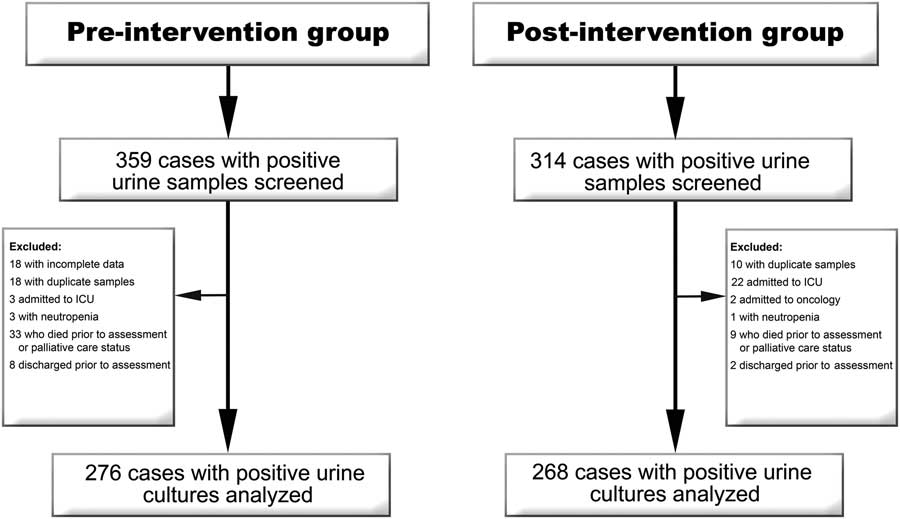
In total, 359 samples were screened for inclusion in the preintervention analysis; among these, 65 were excluded and 18 had incomplete data (Fig. 1). For the postintervention analysis, a total of 314 samples were screened, and 46 of these were excluded.
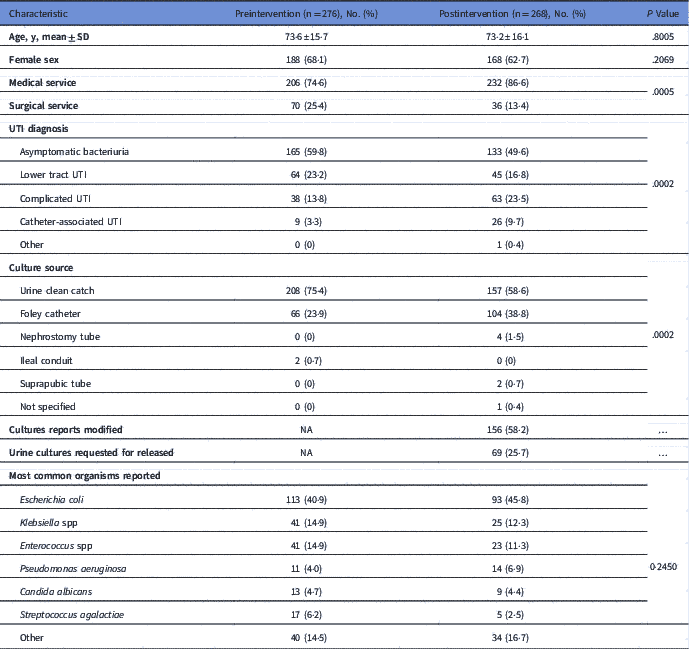
The pre- and postintervention study populations were similar with respect to age, sex, and uropathogens, but they showed variability in terms of service group, UTI diagnosis, and culture source (Table 1). The clear majority of both study populations (74·6% and 86·6%, respectively) were treated by medical as opposed to surgical services. The most frequently identified uropathogens in both groups were Escherichia coli, Klebsiella spp, and Enterococcus spp. Asymptomatic bacteriuria was the most frequently assigned UTI diagnosis, accounting for 59·8% and 49·6% of the pre- and postintervention study populations, respectively. Complicated and catheter-associated UTIs were more commonly identified in the postintervention study population.
Cases with positive urine culture eligible for assessment.

Patient Characteristics

NOTE. SD, standard deviation; UTI, urinary tract infection; NA, not applicable.
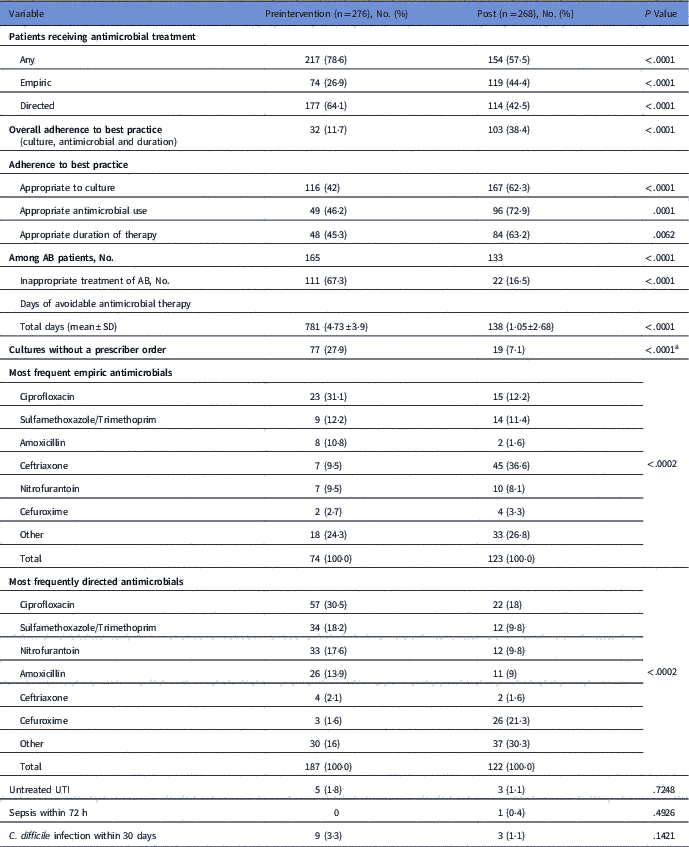
As a result of the UTI management bundle, 156 of the 268 urine samples analyzed (58·2%) had their cultures report modified within the postintervention study population, and 69 (44·2%) of these were requested for release. Significantly fewer patients in the postintervention study population received any antimicrobial therapy: 217 of 276 patients (78·6%) preintervention versus 154 of 268 patients (57·5%) postintervention (Table 2).
Outcomes Before and After Implementation of the UTI Management Bundle

NOTE. AB, asymptomatic bacteriuria; SD, standard deviation; UTI, urinary tract infection; No., number.
a Refers to a single Fisher exact test.
Overall adherence to best practice was observed for 103 of 268 patients (38·4%) in the postintervention study population compared to only 32 of 276 patients (11·7%) in the preintervention study population.
Within the preintervention study population, 165 patients were identified to have AB, of whom 111 (67·3%) inappropriately received antimicrobial therapy. After implementation of the UTI management bundle, 133 patients in the postintervention study population were identified as having AB, and only 22 (16·5%) inappropriately received antimicrobial therapy, representing a 75·5% reduction in the rate of AB treated. The absolute risk reduction in AB treated after implementation of the UTI bundle was 50·8% (95% CI, 40·3%–59·3%), with a number needed to treat of 2. Total days of avoidable antimicrobial therapy, based on the number of days of therapy received for treatment of AB, decreased from 781 to 138 from the pre- to postintervention study periods. The average days of antimicrobial therapy for this group decreased from 4·73 (SD, ± 3·9) to 1·05 (SD, ± 2·68).
Cultures collected without a doctor’s order decreased from 77 of 276 (27·9%) to 19 of 268 (7·1%). Fluoroquinolones were used less often for the postintervention study population for both empiric and directed therapy, whereas the use of ceftriaxone increased (Table 2).
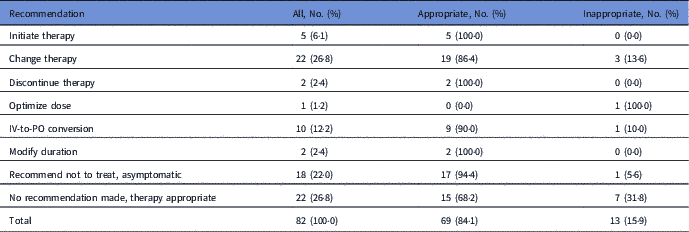
Due to workload limitations, only 75 of 268 patients with positive cultures were assessed by pharmacists. In total, 82 types of interventions were completed, and 69 of these 82 (84·1%) were considered appropriate (Table 3). The most common pharmacy intervention type assessed as inappropriate were cases in which the pharmacist assessed an inappropriate therapy as appropriate with no recommendations for change provided. A total of 53 patients had active pharmacist recommendations; of these, 46 (86·8%) were accepted by prescribers.
Pharmacist Prospective Audit and Feedback

Note. IV, intravenous; PO, per oral.
No significant differences were observed in the rates of untreated UTI, sepsis within 72 hours, or C. diff infection within 30 days (Table 2). During the postintervention chart review, 2 patients were found to have evidence of symptomatic UTI in which a modification of the culture report occurred and no release of the culture results was requested. One of the cases was appropriately managed with adherence to best practice; however, the other patient developed a complicating bacteremia at 72 hours that was promptly identified and managed by the bloodstream infection surveillance program without significant clinical sequelae.
Discussion
When faced with a positive urine culture, prescribers often inappropriately provide antimicrobial therapy in the absence of UTI symptoms and without detailed clinical assessment. Our study has shown that the laboratory-based intervention, in both noncatheterized and catheterized patients as part of a UTI management bundle, is effective in reducing the inappropriate treatment of AB and improving overall adherence to best practice. Improvements were observed in all 3 domains assessed as part of the overall adherence to best practice assessment with respect to appropriateness to culture, appropriate antimicrobial use, and appropriate duration of therapy. In addition, no significant safety signal was noted during the study, with similar rates of untreated UTI and sepsis at 72 hours between the groups.
The durability of the intervention was assessed by the local antimicrobial stewardship committee in a small repeat audit (n = 47) completed 2 years after the initial implementation of the UTI management bundle. The rate of adherence to best practice continued to show evidence of improvement (43%), and treatment of AB remained low at 10·6%.
The impact of the UTI bundle on the laboratory workload was published as a separate analysis. Our results showed that the number of urine specimens submitted for culture from study units decreased from 863 to 581, a decrease of 33% for the same calendar period before and after implementation of the UTI bundle, with a 50% savings in material costs.Reference Ellis, MacLaggan, Wilcox-Carrier and Hussain 14
This study has several limitations. Although the current study included all positive urine cultures with the exception of high-risk patient groups, the lack of a controlled design resulted in a difference between the study populations with respect to the types of UTI observed. We believe the difference in types of UTI, with more complex and catheter-associated UTIs observed in the postintervention analysis, is a result of the impact of the educational component of the UTI bundle. After the implementation of the bundle, there was a significant improvement in the appropriateness to culture, and the proportion of patients with AB decreased. Second, a lack of physician documentation of symptoms may have led to misclassification of patients as having AB; however, this impact would likely have been similar in the pre- and postintervention groups and, therefore, would only minimally affect the final results. Third, interventions were not staggered with regard to data collection, so we were unable to determine the individual effect of each component of the UTI bundle. Although it would be beneficial to know the weighted impact of each or whether their synergy is the key to success, this was not possible with our study design. Finally, the pharmacist intervention was limited to 28% of patients, largely due to staffing issues on intervention wards. Considering the high number of appropriate recommendations from the pharmacy team, the impact of the bundle may have been even greater with improved pharmacy access.
In conclusion, implementation of an UTI management bundle resulted in a dramatic improvement in the rate of adherence to best practice and a 75·5% decrease in the inappropriate treatment of AB. Based on these results, 1 case of inappropriate treatment of AB will be prevented for every 2 patients with a positive urine culture reported under the UTI management bundle.
Acknowledgments
We acknowledge the help and support of Dr. Gordon Dow and the infectious diseases service as well as the pharmacy department and microbiology laboratory at The Moncton Hospital during the development and implementation of this project.
Financial support
No financial support was provided relevant to this article.
Conflicts of interest
All authors report no conflicts of interest relevant to this article.
Supplementary material
To view supplementary material for this article, please visit https://doi.org/10.1017/ice.2018.276