Papa—maman—ma femme—mon mari—a propos—Marianna—Roma—madame—la reine—le roi—a Paris—allons.Footnote 1
These were among the first babbled words of Wolfgang von Kempelen’s speaking machine when it was exhibited in 1783. Kempelen’s design, which consisted of bellows that pumped air through trachea-like attachments, forsook its native German to speak largely in French. A contemporary observer remarked that, though the machine was clearly at an early stage of development, it gave a fairly accurate imitation of a five-year-old child, with only one minor speech impediment: ‘its voice is pleasant and sweet, only the R is pronounced gutturally and with a little rumbling’ (‘la voix en est agréable & douce, il n’y a que l’R qu’elle prononce en grasseyant & avec un certain ronflement’).Footnote 2 Elsewhere, the machine seems to have made the most of a limited vocabulary by making friends, declaring love and hailing rulers of empires past and present.Footnote 3
A sound technology’s first words may be made to bear weighty burdens. Kempelen’s script for the machine has been widely interpreted in recent years; as, for example, the early stirrings of humanoid subjectivity.Footnote 4 It has also been understood as initiating a tradition of ‘simulating’ human voices (along with audible sounds of all kinds) that persists beneath the dominant perceptual regime of their ‘inscription’ and ‘reproduction’. For film scholar James Lastra, sonic simulation has constantly re-emerged between the eighteenth century and the twentieth, particularly at moments when new sound technologies have been staged.Footnote 5
The slow-breaking dawn of sound cinema is a case in point. As is well known, the premiere of Don Juan at New York’s Warner Theatre in 1926 promised cinemagoers the first truly sounding pictures, by means of the Vitaphone: a formidable mechanism that synchronised the image track to a kind of gramophone turntable.Footnote 6 Due to their superior bandwidth, discs, as opposed to sound-on-tape, were understood to deliver a richer, more suitably life-like analogue for optical reality.Footnote 7 On the occasion of its first public outing, the Vitaphone was promoted as a technology for simulating human presences – those of performers’ bodies in particular. Not that the concern with inscription was absent on the opening night. The programme commenced with a filmed address urging that the performer’s art would no more fade away; that ‘good’ music would be saved forever, and could henceforth be delivered throughout the nation. Yet the sequence of short entertainments that preceded the feature might well have reinforced the impression that it was the simulation of performers’ bodies that the technology hoped to achieve, as live, onstage performances of the overture to Tannhäuser and Beethoven’s ‘Kreutzer’ Sonata gave way to short films that featured musicians performing within single-shot, static frames.
Among the musical selections screened was ‘Vesti la giubba’ (‘Put on the costume’), the most famous number from I Pagliacci (1892) by Ruggiero Leoncavallo. There are several reasons why this particular recitative-plus-aria might have been chosen. It is relatively short, and so would have been able to fit on a single disc, thus avoiding the danger of image and sound falling out of sync in switching between discs. Within a relatively short space of time, the aria explores a condensed series of emotions, moving through resignation, ironic detachment, tragedy and despair – providing the opportunity for multiple impassioned high notes along the way. ‘Vesti la giubba’ may also have seemed an obvious choice in the wake of the song’s pre-existing entanglements in new media. Enrico Caruso had made the song famous two decades earlier, in a gramophone recording that was the earliest to ‘go platinum’.Footnote 8 Yet another, more general explanation for the use of opera (which would be extensive among early Vitaphone shorts) is that the venerable artform, rendered newly audible, could serve to mystify picture-palace audiences. For cinemagoers drawn from the rapidly expanding middle class, so this argument goes, there were few expectations as to what opera should be beyond its secure signification of high art; it projected an aura of upward mobility, an aura from which the as-yet-undefined Vitaphone could borrow in order to suggest its own cultural prestige.Footnote 9 This sociological explanation hints at an answer to the question, ‘why opera?’, while the technological and media-historical justifications given just now suggest reasons why ‘Vesti la giubba’ in particular might have been used. None of these hypotheses make recourse to the aria’s dramatic significance in its source opera, or to the meaning of the aria’s foreign-language words, which, it can be safely assumed, few people would have understood.
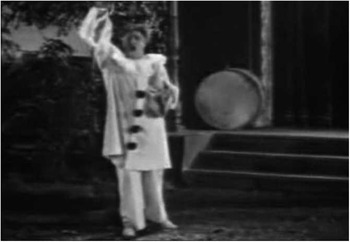
The aria’s historical significance – in providing the Vitaphone machine with some of its earliest words – may remain elusive unless we consider the film as a performance, which is to say as the simulation of a particular singer’s body. It was performed by veteran Met tenor Giuseppe Martinelli, clothed in the customary billowing clown’s garb.Footnote 10 The initial scene fades in to reveal him sat alone amid a theatre set. He gazes towards the screen’s bottom left-hand corner, decidedly not addressing the camera or the audience. At the sound of the viola’s opening semiquavers, he stands up and stumbles towards the camera as the timpani and double bass echo the viola. Against this sparse texture, a string chord flares up and Martinelli simultaneously clasps the back of his head with his right hand. Still lurching forward, and as he begins to sing, he releases his head and slowly lowers his hand, bringing it to rest in mid-air in a pose of oration. He remains standing in this position, having reached the depth of field that he will maintain for the rest of the film. The fluidity with which he earns this position in the frame is clearly planned: he takes impetus from the music for his posture of despair and transforms it into a gesture of recitation, as if merely to lower his hand.
As Martinelli begins to sing, the dramatic pulse drops. This much is perhaps to be expected, as conventionally slow-motion pantomime takes over. The effect is particularly noticeable if the image track is viewed in isolation from the sound: Martinelli’s naturalistic acting slackens into gestures of timelessness as soon as he opens his mouth. Following his pose of oration, his hand moves slowly towards his chest (while he sings ‘mentre preso dal delirio’), but this action takes ten seconds – as long as the entire opening sequence.
There is a special synergy between Martinelli’s right hand and his voice. Both of his hands mime the words, but his right hand also traces the contours of the melody, making visible the vocal peaks and troughs. As his hand approaches the top of the screen, it constantly threatens to exceed the frame – and on one occasion does so, reaching beyond and then quickly back into the filmed world (see Fig. 1). This moment comes towards the end of the recitative, and coincides with the aria’s notorious, self-ironising cackle (after the words, ‘sei tu forse un uom?’). Here the interruption of singing brought about by laughter spreads to the simulation itself: the hand’s brief journey outside of screen space corresponds to a momentary malfunction within Martinelli’s machine-assisted performance. In other words, the loss of the hand briefly disrupts the effect of the body on screen producing a voice. It is the exception that serves to reinforce the rule that, in perfect tandem with the voice blaring from the loudspeaker, the whole of the performer’s body should be kept constantly in view.
Martinelli’s hand exceeds the frame; still taken from ‘Vesti la giubba’ (Vitaphone, 1926).

This incipient logic of simulation would quickly be swept away. Following Martinelli’s screen debut, Vitaphone made more complex opera shorts in which the camera chased after the voice more dynamically, involving close-ups, pans, cuts and occasionally even focal shifts to manipulate the placing of the voice on the screen. ‘Vesti la giubba’ precedes these subsequent audio-visual innovations, and allows us to imagine an alternative trajectory never pursued by sound film: one in which the performer’s body would have been produced as though present in the cinema. As though recording had never taken place and the human/machine were singing the words here and now.