Many hospitals have established inpatient antibiotic stewardship programs (ASPs), but outpatient activities remain limited. In 2016, the United Hospital Fund (UHF), an independent nonprofit working to build a more effective healthcare system for every New Yorker, launched a 2-stage grant-funded initiative to evaluate outpatient antibiotic stewardship, focusing on adults with acute respiratory infections (ARIs). Conclusions from stage 1 included few outpatient antibiotic stewardship activities, variation in prescribing, macrolides as the most commonly prescribed antibiotic, and provider interest in improving prescribing.Reference Guzik, Patel, Kothari, Sharp and Ostrowsky1
In stage 2, clinics from 2 hospitals and health systems in New York City implemented evidence-based interventions to reduce inappropriate prescribing. The interventions were site-specific, and they leveraged available resources, workflow, and perception of need. Review and comparison of pre- and postintervention visits were conducted to detect differences in ARI antibiotic prescribing.
Methods
Over the course of the initiative (May 2017–June 2018), each hospital or health system engaged in a learning and sharing collaborative. UHF provided technical assistance and data analysis. Using facility-specific data from stage 1, clinics tailored interventions, applying the Centers for Disease Control and Prevention (CDC) Core Elements of Outpatient Antibiotic Stewardship.Reference Sanchez, Fleming-Dutra, Roberts and Hicks 2
In this observational study, we aimed to assess changes in prescribing pre- and postintervention. The Biomedical Research Alliance of New York Institutional Review Board deemed the study exempt from review. Where appropriate, the participating site(s) received local institutional review board approval. Chart abstraction utilized the same randomization and data collection tools previously described.Reference Guzik, Patel, Kothari, Sharp and Ostrowsky 1 Data were analyzed using SAS, version 9.4 software (SAS Institute, Cary, North Carolina); χ2 tests assessed prescribing variation by patient characteristics, and t tests assessed changes in prescribing rates.
Results
Interventions implemented
In total, 34 clinics participated in stage 2; each implemented between 3 and 13 interventions, including augmented patient and provider education, clinical decision support, provider audit and feedback, and communication skills training.
Antibiotic prescribing practices, pre- and postintervention
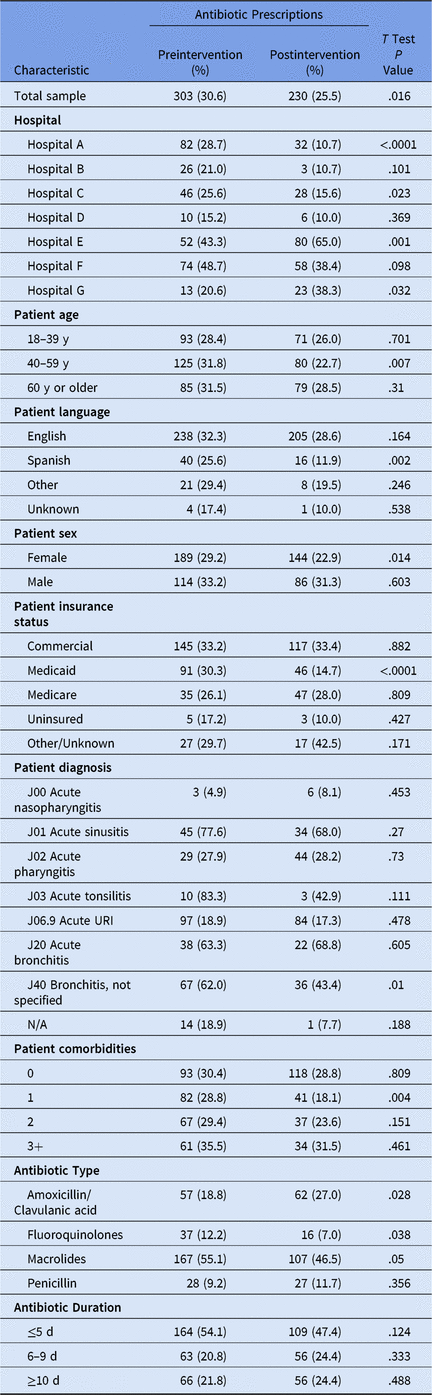
In total, we reviewed 991 ARI visits preintervention and 902 postintervention (Table 1). In aggregate, we detected a significant decrease in antibiotics prescribed, from 30.6% of ARI visits to 25.5% (P = .016). Postintervention, substantial variation in system-level prescribing remained, from 10.0% to 65.0% (P < .0001). Overall, 5 hospitals or health systems demonstrated decreased prescribing postintervention, 2 of which were significant (hospital A,P < .0001; hospital C,P = .023). Prescribing for patients with “bronchitis, not specified” decreased from 62.0% to 43.4% (P = .01). Although not statistically significant, prescribing for patients with acute sinusitis decreased from 77.6% to 68.0% (P = .27).
Pre- and Postintervention Antibiotic Prescribing Rates with T Test Results

Note. URI, upper respiratory infection.
The antibiotic prescribed shifted pre- and postintervention. The proportion of macrolide and fluoroquinolone prescriptions decreased from 55.1% to 46.5% (P = .05) and from 12.2% to 7.0% (P = .038), respectively. Amoxicillin/clavulanic acid prescriptions increased from 18.8% to 27.0% (P = .028).
Prescribing for patients aged 40–59 years decreased from 31.8% to 22.7% (P = .007). Prescribing for Medicaid patients, compared with patients with other insurance types, declined even further, from 30.3% to 14.7% (P < .0001). Prescribing rates among Spanish-speaking patients decreased from 25.6% to 11.9% (P = .002). When comparing cohorts based on number of comorbidities, the largest decrease, from 28.8% to 18.1%, occurred for patients with a single comorbid condition (P = .004).
Discussion
This collaborative sought to address a lack of outpatient antimicrobial stewardship initiativesReference Guzik, Patel, Kothari, Sharp and Ostrowsky 1 and to prompt participants to institute evidence-based interventions and measure their effects. The postintervention assessment revealed a significant decrease in aggregate ARI antibiotic prescribing, but with variation by hospital or health system.
Although the overall decrease was modest, some organizations experienced larger improvements, but 2 organizations reported increased prescribing. By self-assessment, these increases may have resulted from leadership and staffing disruptions, limited resources, and competing priorities.
The CDC Core ElementsReference Sanchez, Fleming-Dutra, Roberts and Hicks 2 are an effective guide for outpatient antibiotic stewardship implementation, but providing simple tools for assessment of activities is challenging in the setting of competing priorities. The role of clinical champions in promoting quality improvement is well documented.Reference Weiner, Shortell and Alexander 3 Organizations with the most engaged and invested clinical and administrative leaders were successful in gaining staff buy-in, intervention implementation, and decreasing prescribing—which support the CDC Core Element, commitment.
Many interventions addressed the element of education and expertise by targeting patients and providers. Materials from the CDC and the New York State Department of Health 4 were utilized to improve patients’ knowledge of appropriate antibiotic use and antibiotic resistance. Most clinics used communication skills training, and some employed clinical decision support strategies included in the core element action for policy and practice. Few were able to implement delayed prescribing, citing electronic prescribing as a barrier. Data transparency is reflected in the core element of tracking and reporting. Successful implementation of provider-specific feedback varied. However, organizations able to provide meaningful provider-level data achieved larger decreases in prescribing.
Due to simultaneous implementation of multiple interventions, we were unable to ascertain which interventions were most effective. Our observations suggest that targeting both providers and patients works best. Despite the review of >900 visits, the number of visits abstracted per individual clinic were limited; thus, our findings may not be generalizable. Although prescribing decreases were observed for certain patient insurance types, languages, genders, and age groups, further analysis revealed that these results were likely confounded by a single health system with larger proportions of these patient populations.
Likewise, the increase in amoxicillin/clavulanic acid use was likely influenced by the prescribing behavior of another large health system. Nevertheless, the resources developed for this initiative, Reference Guzik and Kothari 5 along with the CDC Core Elements, can be used to begin implementing and assessing outpatient antibiotic stewardship interventions. The journey of our participants offers examples of how to assess antibiotic stewardship needs, develop early activities, and attempt to measure their effects.
Acknowledgments
The UHF Quality Institute would like to thank all the organizations that participated in the Outpatient Antibiotic Stewardship Initiative for their commitment to improving stewardship in their organizations. We also acknowledge the work of Deborah Halper, MS, MPH, and Anne-Marie Audet, MD, MSc, SM, at UHF for their guidance and input throughout the project.
Financial support
This project was supported by a grant from the United Hospital Fund, which provided seed funding to each clinical site.
Conflicts of interest
All authors report no conflicts of interest relevant to this article.