In the United States, one-third of births occur by cesarean delivery (CD),Reference Martin, Hamilton, Osterman, Driscoll and Mathews 1 for medical and potentially nonmedical indications.Reference Barber, Lundsberg, Belanger, Pettker, Funai and Illuzzi 2 Although lifesaving in some circumstances, CDs also confer risks for adverse maternal outcomes such as surgical site infection (SSI), including endometritis and wound infection.Reference Declercq, Barger and Cabral 3 , Reference Clapp, Little, Zheng and Robinson 4 Cesarean delivery is one of the most common inpatient surgical procedures in the United States,Reference McDermott, Freeman and Elixhauser 5 which heightens the importance of developing effective interventions and prevention strategies to lower the risk of complications following CD. Previous studies have identified patient- and procedure-level risk factors that can be successfully targeted in SSI prevention effortsReference Carter, Temming and Fowler 6 ; however, the role of socioeconomic and healthcare system determinants of post-CD SSI risk is incompletely understood.
Evidence suggests that risk of SSI following CD may be higher for women covered by public health insurance than for women covered by private health insurance.Reference Clapp, Little, Zheng and Robinson 4 , Reference Olsen, Butler, Willers, Gross, Devkota and Fraser 7 , Reference Shree, Park, Beigi, Dunn and Krans 8 This evidence has been limited to single-center studies, though, because large surveillance systems, such as the National Healthcare Safety Network (NHSN), do not collect patient primary payer information. With >40% of CDs covered by Medicaid, 9 it is important to determine whether disparate risk of SSI by payer is a more widespread phenomenon.
In this study, we investigated whether women with Medicaid coverage had a differential risk of SSI following CD compared to women with private insurance coverage. We used a large, multicenter cohort, assembled from patient-level data containing primary payer from California’s state inpatient discharge database linked with corresponding procedure and event records from the NHSN database. In addition, we performed a secondary analysis on a small set of facilities from New York State to study the effect of Medicaid coverage on the risk of SSI following CD.
Methods
Study design
Using a retrospective cohort design, we examined CDs reported to NHSN in accordance with the NHSN Patient Safety Component SSI surveillance protocol 10 linked at the procedure level to the California Office of Statewide Health Planning and Development (OSHPD) 11 and New York Statewide Planning and Research Cooperative System (SPARCS) 12 state inpatient discharge databases. The protocol was approved by the institutional review boards of the Centers for Disease Control and Prevention and the California Health and Human Services Agency under expedited reviews. The work was conducted under data use agreements with OSHPD, SPARCS, and NHSN.
Study population
The study population consisted of CD procedures reported to NHSN and statewide information systems. We had access to statewide inpatient discharge data from California hospitals (ie, OSHPD) between January 1, 2011, and December 31, 2013, and New York hospitals (ie, SPARCS) between January 1, 2008, and December 31, 2013. We also had access to NHSN data for the corresponding years for both states. Cesarean delivery was defined as using International Classification of Disease, Ninth Revision, Clinical Modification (ICD-9-CM) procedure codes 74.0, 74.1, 74.2, 74.4, 74.91, 74.99, consistent with NHSN definitions (see Supplementary Material 1 online).
Data restriction and linkage
Prior to linkage with discharge data, observations from NHSN data were limited to CD procedures reported during facility months designated as “in-plan.” 13 In-plan event reporting to NHSN indicates the healthcare facility’s commitment to adhere to the NHSN surveillance protocol for that event and triggers the system’s automated edit and consistency checks.
A one-to-one exact deterministic linkage between the NHSN and state inpatient discharge data at the CD procedure level was performed using unique combinations of values for the 3 linkage variables: hospital identifier, patient date of birth, and patient procedure date. Records missing values for any of the linkage variables were excluded. To prevent many-to-many linkages, records with nonunique combinations of values were also excluded (see Supplementary Material 2 online). After linkage, records were excluded if the expected primary payer was neither Medicaid nor private insurance. Additional exclusions were extreme CD duration (ie, <5 or >171 minutes),Reference Mu, Edwards, Horan, Berrios-Torres and Fridkin 14 missing or potentially implausible body mass index (BMI) values (height < 70 cm, height > 208.4 cm, 15 and BMI ≤ 10.49 kg/m2 13 or BMI >109 kg/m2 Reference Alanis, Villers, Law, Steadman and Robinson 16 ), as well as NHSN exclusions not specific to CD including undefined wound classReference Mu, Edwards, Horan, Berrios-Torres and Fridkin 14 and implausible procedure date (procedure date ≤ birth dateReference Mu, Edwards, Horan, Berrios-Torres and Fridkin 14 ). Patients who died during the risk period were also excluded.
Outcome
The main outcome of interest was SSI, which included superficial incisional primary, deep incisional primary, and organ/space infections 10 as reported to NHSN. The NHSN protocol calls for SSI surveillance for 30 days following CD and includes 3 time periods: index hospitalization, postdischarge, and hospital readmission. Protocol-suggested surveillance methods include conducting patient record reviews, talking with hospital patient care staff, and surveying patients and surgeons by mail or telephone. 10
Exposure
The main exposure of interest was Medicaid or private insurance as primary payer for the index hospitalization for CD.
Potential confounders
Potential confounders at the patient-level included age,Reference Wloch, Wilson, Lamagni, Harrington, Charlett and Sheridan 17 – Reference Olsen, Butler, Willers, Devkota, Gross and Fraser 19 race, BMI,Reference Mu, Edwards, Horan, Berrios-Torres and Fridkin 14 , Reference Wloch, Wilson, Lamagni, Harrington, Charlett and Sheridan 17 , Reference Olsen, Butler, Willers, Devkota, Gross and Fraser 19 – Reference Krieger, Walfisch and Sheiner 21 emergency CD,Reference Olsen, Butler, Willers, Devkota, Gross and Fraser 19 active labor presenceReference Shree, Park, Beigi, Dunn and Krans 8 , Reference Ketcheson, Woolcott, Allen and Langley 18 , Reference Olsen, Butler, Willers, Devkota, Gross and Fraser 19 and duration, American Society of Anesthesiologists (ASA) physical status classification,Reference Shree, Park, Beigi, Dunn and Krans 8 , Reference Olsen, Butler, Willers, Devkota, Gross and Fraser 19 general anesthesia,Reference Olsen, Butler, Willers, Devkota, Gross and Fraser 19 procedure duration,Reference Olsen, Butler, Willers, Devkota, Gross and Fraser 19 , Reference Killian, Graffunder, Vinciguerra and Venezia 22 and wound class. These data were obtained from the NHSN database. Data regarding prior CD,Reference Olsen, Butler, Willers, Devkota, Gross and Fraser 19 , Reference Krieger, Walfisch and Sheiner 21 planned admission, perioperative maternal blood transfusion,Reference Olsen, Butler, Willers, Gross, Devkota and Fraser 7 , Reference Ketcheson, Woolcott, Allen and Langley 18 chorioamnionitis,Reference Shree, Park, Beigi, Dunn and Krans 8 , Reference Ketcheson, Woolcott, Allen and Langley 18 premature rupture of membranes,Reference Krieger, Walfisch and Sheiner 21 and several comorbidityReference Olsen, Butler, Willers, Gross, Devkota and Fraser 7 , Reference Shree, Park, Beigi, Dunn and Krans 8 , Reference Ketcheson, Woolcott, Allen and Langley 18 , Reference Krieger, Walfisch and Sheiner 21 variables were obtained from inpatient discharge data. Comorbidities were identified via ICD-9-CM diagnosis codes (see Supplementary Material 1 online) for conditions including gestational hypertension, diabetes or abnormal gestational blood glucose, antepartum anemia, depression, obesity, tobacco use, drug and/or alcohol abuse, and a combined comorbidity score.Reference Gagne, Glynn, Avorn, Levin and Schneeweiss 23
Hospital-level confounders such as hospital teaching status, 13 ownership, and bed size 13 were obtained from the annual NHSN facility survey data. 24 Area wage,Reference Ketcheson, Woolcott, Allen and Langley 18 rural/urban location indicator, and disproportionate share hospital indicator, which identifies hospitals that receive additional payment due to a higher proportion of low-income patients, were obtained from CMS cost report files. If missing from cost report files, area wage for a given hospital year was obtained from the CMS wage index files 25 according to the core-based statistical area of the hospital. Hospital annual CD countReference Ketcheson, Woolcott, Allen and Langley 18 and annual case mix index (CMI) were calculated for each hospital calendar year from respective state inpatient discharge data. CMI was calculated from these all-payer state inpatient discharge data using Medicare severity diagnosis-related group (MS-DRG) codes. Corresponding MS-DRG weights for each fiscal year were obtained from public use data files compiled by the National Bureau of Economic Research (see Supplementary Material 3 online). 26
To account for possible temporal trends in Medicaid coverage and SSI, year and quarter of delivery were included in the model to account for possible temporal trends in Medicaid coverage and SSI.
Analytic and statistical methods
Data analysis was conducted using SAS version 9.4 software (SAS Institute, Cary, NC). P values ≤.05 were considered statistically significant. In accordance with data use agreements, actual number and corresponding percent of total were suppressed or combined with adjacent cells when cell sizes were ≤10. Simple comparisons were conducted using the Wilcoxon rank-sum test for continuous variables and the χ2 or Fisher exact test for categorical variables.
The overall payer–SSI relationship was assessed using multivariable logistic regression adjusting for potential confounding factors. Facility-level clustering was accounted for using generalized linear mixed modeling with a random intercept fitted to each facility. The main measure of interest was an adjusted odds ratio (OR) that compared the odds of SSI following CD among women covered by Medicaid to women covered by private insurance. An explanatory model building approach was conducted using a variable selection process focused on the validity and precision of the main effect estimate, as outlined by Kleinbaum et al. Reference Kleinbaum, Klein and Pryor 27 For presentation purposes, continuous confounders were preferentially categorized into quartiles after assessing the impact of functional form on the main effect estimate and model fit characteristics. A similar model was built for the small set of facilities from New York State. In a subanalysis, the aforementioned multivariable logistic regression model was also fitted to the data from the California cohort for each of the 3 surveillance periods.
Results
Overall, 89% of NHSN records with unique linkage variable combinations linked with corresponding California inpatient records. After applying restriction criteria, 291,757 CDs performed in California hospitals were available for descriptive analysis (Fig. 1); complete information was available for 291,742 CDs in the multivariable analysis.
Flow diagram of NHSN CDs linked with state inpatient discharge data: California, 2011–2013. Note. BMI, body mass index; CD, cesarean delivery; NHSN, National Healthcare Safety Network; OSHPD, Office of Statewide Health Planning and Development; procs, procedures; SPARCS, Statewide Planning and Research Cooperative System. aNumber of hospitals refers to count of distinct CMS Certification numbers. bUnique refers to having a unique combination of hospital identifier, procedure date, and date of birth in preparation for exact deterministic data linkage. cPatients may have been excluded for multiple reasons, therefore the summed reasons for exclusion may exceed the total number of CDs excluded. dIn accordance with data use agreements, actual number and corresponding percent of total were not displayed or combined with adjacent cells when cell size ≤10.

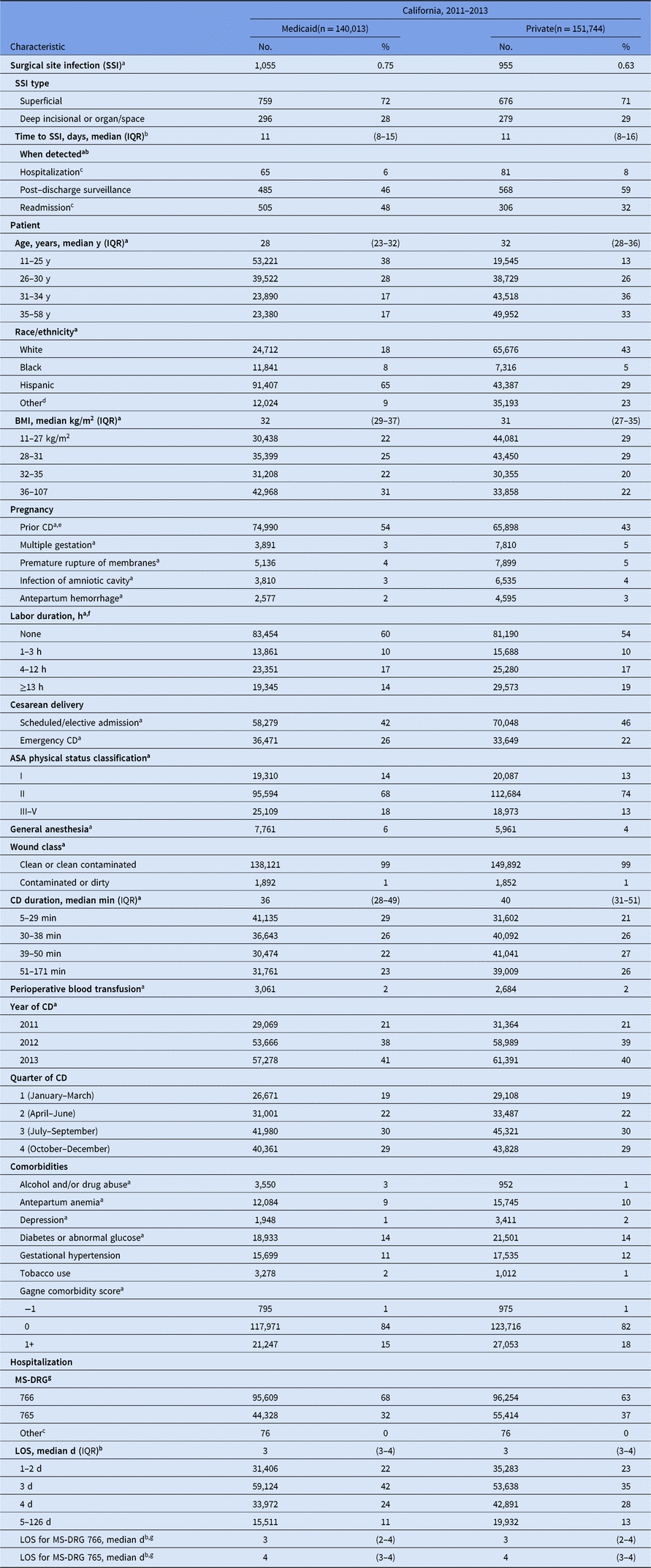
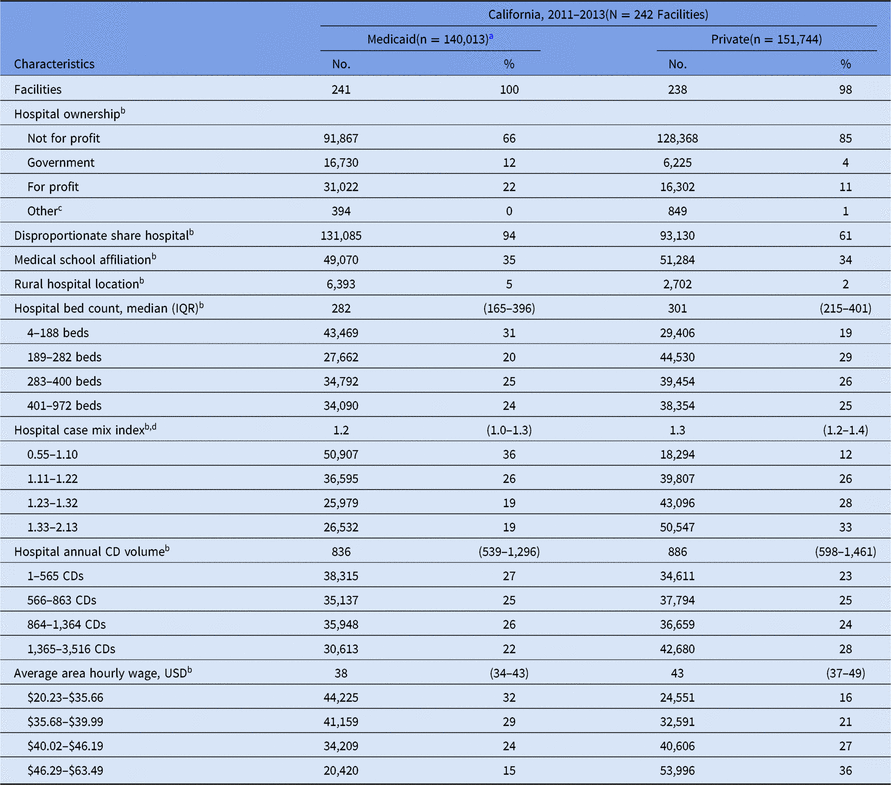
Medicaid was the primary payer for 48% of included CDs. Women covered by Medicaid were younger, with a median age of 28 years (IQR, 23–32) compared with a median age of 32 years (IQR, 28–36) for women covered by private insurance (P < .0001). Additional patient and hospital characteristics stratified by payer are shown in Tables 1 and 2.
Patient Characteristics of NHSN CDs Linked With State Inpatient Discharge Data: California, 2011–2013

Note. ASA, American Society of Anesthesiologists; BMI, body mass index; CD, cesarean delivery; CC, complication/comorbidity; MCC, major CC; MS-DRG, Medicare severity diagnosis–related group; NHSN, National Healthcare Safety Network; IQR, interquartile range; SSI, surgical site infection. aCalifornia: Medicaid vs private payer, P < .05. bDenominator is limited to CDs with SSI for the following characteristics: SSI type, time to SSI, and when detected. cIn accordance with data-use agreements, actual number and corresponding % of total were not displayed or combined with adjacent cells when cell size was ≤10. dOther includes Asian + Pacific Islander (California: n = 33,614), Native American (California: n = 1,428), other (California: n = 10,373), unknown/blank (California: n = 2,278). ePrevious CD defined as presence of ICD-9-CM diagnosis code 654.2 on inpatient discharge record. fMissing data, California: labor duration (n = 15).gMS-DRG 766: cesarean section without CC/MCC; MS-DRG 765: cesarean section with CC/MCC.
Hospital Characteristics of NHSN CDs Linked With State Inpatient Discharge Data: California, 2011–2013

Note. CD, cesarean delivery; NHSN, National Healthcare Safety Network; USD, United States dollars. aNo. of hospitalizations. bCalifornia: Medicaid vs private payer, P < .05. cOther ownership includes managed care organizations and physician owned. dCase mix index for each hospital is based on mean DRG for each facility year calculated from respective state inpatient discharge data. State identifier was used as the facility identifier
SSIs were detected following 1,055 CDs (0.75%) covered by Medicaid and 955 CDs (0.63%) covered by private insurance (unadjusted OR, 1.2; 95% CI, 1.1–1.3; P < .0001) among the 291,757 total CDs. The adjusted odds of SSI following CD among women covered by Medicaid was 1.4 times (95% CI, 1.2–1.6; P < .0001) that of women covered by private insurance, accounting for confounding as well as facility-level clustering (Table 3).
Risk of SSI by Payer Among NHSN CDs Linked With State Inpatient Discharge Data Adjusting for Patient, Procedure, and Hospital Characteristics and Hospital-Level Clustering: California, 2011–2013

Note. ASA, American Society of Anesthesiologists; BMI, body mass index; CO/D, contaminated/dirty; C/CC, clean/cc; NHSN, National Healthcare Safety Network; USD, United States dollars. aType III tests of fixed effects. bOther includes: Asian + Pacific Islander, Native American, other, unknown/blank. cExclusions: 15 of 291,757 observations were excluded due to missing labor duration (noted in Table 1). dOther ownership includes managed care organizations and physician owned. eCase-mix index for each hospital is based on mean DRG for each facility year calculated from respective state discharge data. State identifier was used as the facility identifier.
Overall, SSIs were more frequently detected during postdischarge surveillance (52% of all SSIs, 0.36% of all CDs) and hospital readmission (40% of all SSIs, 0.28% of all CDs) than during index hospitalization. In both detection periods following discharge, women with Medicaid had a higher adjusted odds of SSI compared to women with private insurance: OR, 1.4 (95% CI, 1.2–1.7; P < .0001) for postdischarge surveillance (Supplementary Material 5 online) and OR, 1.6 (95% CI, 1.3–1.9; P < .0001) for readmission (Supplementary Material 6 online). The SSIs during the index hospitalization represented only 7% of all SSIs and were detected following 0.05% of all CDs; adjusted odds of SSI during index hospitalization did not differ by payer (OR, 0.8; 95% CI, 0.5–1.2; P = .34) (Supplementary Material 4 online).
Among the 13 New York facilities, 88% of NHSN records linked with corresponding state inpatient records (see Supplementary Material 7 online). Patient and hospital characteristics stratified by payer are shown in Supplementary Material 8 and 9 online. In the New York facilities, SSIs were detected following 80 CDs covered by Medicaid (2.86%) and 72 CDs covered by private insurance (1.50%) (unadjusted OR, 1.9; 95% CI, 1.4–2.7; P < .0001) among the 7,583 total CDs. The adjusted odds of SSI following CD among women covered by Medicaid was 1.5 (95% CI, 1.0–2.4; P = .06) times that of women covered by private insurance, accounting for patient and procedure-level confounders and facility-level clustering (see Supplementary Material 10 online).
Discussion
We present findings from the first multicenter and largest cohort study to compare risk of SSI following CD performed in California between women whose CD hospitalizations were covered by Medicaid with those covered by private health insurance. Women with Medicaid were 40% more likely to develop an SSI than women with private insurance even after adjusting for known patient- and hospital-level risk factors and confounders. This increased risk was driven by SSIs detected after the index hospitalization. The increased risk among women covered by Medicaid was also seen in a small cohort of CDs performed in New York hospitals. These findings provide further support of a relationship between type of healthcare coverage and risk of SSI following CD.
The explanation for this relationship may be multifactorial. One broad interpretation of these findings is that despite consistent provision of care, unobserved patient factors may lead to increased vulnerability among patients covered by Medicaid. Cognitive ability and health literacy are proposed mediators of perinatal health inequitiesReference Yee, Kamel and Quader 28 and, along with living situation and social support following hospital discharge, may influence understanding of and adherence to discharge instructions, including wound and dressing care. The transition to postdischarge care can pose special challenges and negatively impact clinical outcomes if inadequate. In a study based on interviews with patients diagnosed with postabdominal surgery SSIs after hospital discharge, ineffective discharge teaching, decreased self-efficacy in wound assessment, and poor patient–provider communication following discharge were associated with SSI.Reference Sanger, Hartzler and Han 29 Ensuring adequate discharge education and readiness for discharge may be important interventions to improve outcomes among patients with social, economic, and other vulnerabilities.Reference Jing, Bethancourt and McDonagh 30
A second broad interpretation is that provision of care may differ based on patient payer type. Previous work has shown differential quality of care for a number of procedures and diagnoses within a given facility between patients covered by public versus private insurance, which has been hypothesized to stem from differences in payment.Reference Spencer, Roberts and Gaskin 31 Others, though, have suggested that care for patients covered by Medicaid is more consistent with guidelines or standard practice (eg, women covered by private insurance have increased rates of CD, which may be inconsistent with guidelines).Reference Kozhimannil, Shippee, Adegoke and Vemig 32 Differential experience and expertise of surgeons may also play a role, with referral networksReference Spencer, Gaskin and Roberts 33 or likelihood of teaching service potentially differing by payer. Although our ability to identify the underlying mechanisms(s) was limited, our findings signal that patients covered by Medicaid have an increased risk of SSI following CD. Additional attention to this population is warranted, potentially through inclusion of patient primary payer type in surveillance efforts.
These findings are comparable with prior single-center studies. A recent study conducted in a university-affiliated teaching hospital identified increased odds of SSI among patients covered by Medicaid compared with private insurance (unadjusted OR, 2.0; P < .01).Reference Shree, Park, Beigi, Dunn and Krans 8 Another study in a large, academic hospital similarly found increased odds associated with lack of private health insurance (unadjusted OR, 1.7; 95% CI, 0.99–3.0; P = .057).Reference Olsen, Butler, Willers, Gross, Devkota and Fraser 7 Our multicenter study uniquely strengthens the evidence base, showing differential risk of SSI following CD across a large sample of hospitals.
Because only a small number of SSIs were observed during index hospitalization, the findings were driven by SSIs detected after the index hospitalization. SSIs developed a median of 11 days following CD, well after the median length of stay of 3 days. Variation in SSI surveillance methods between hospitals reporting to surveillance systems has been reported,Reference Ju, Ko, Hall, Bosk, Bilimoria and Wick 34 with differences in postdischarge surveillance intensity likely contributing to this variation.Reference Moro, Morsillo and Tangenti 35 In particular, SSIs managed in the outpatient setting following discharge may be less likely to be identified than those managed at hospital readmission.Reference Ju, Ko, Hall, Bosk, Bilimoria and Wick 34 Because women covered by Medicaid may be more likely to present to the ED instead of an outpatient clinic than those with private insurance,Reference Garcia, Bernstein and Bush 36 , 37 there could be differences in SSI identification rates during postdischarge surveillance.
This study has several strengths. First, this is the largest study to date to examine the role of health insurance coverage in the risk of SSI. By leveraging multiple data sources to link patient-level payer and infection surveillance data as well as hospital-level characteristics, we assembled an informative, multicenter dataset that allowed us to account for patient, procedure, and hospital characteristics. A second strength is the representation of a variety of hospitals. In particular, 95% of California hospitals performing CDs in 2011–2013 were included. California has required quarterly reporting of SSIs following surgical procedures including CDs by general acute-care hospitals since June 1, 2011. 38 California CDs reported to the NHSN represented 68% of CDs performed in California during the 3-year study period. Limiting California CDs to those performed in California during 2012 and 2013, after NHSN reporting was mandated, the linkage rate increased to 80% of hospitalizations and 99% of hospitals. This level of representation allowed for greater generalizability of the findings. A third strength of this study is that we obtained similar findings in a separate cohort from a different state (ie, New York). Fourth, we observed a robust match of NHSN data to inpatient data for both states. The vast majority (88%–89%) of deliveries and hospitals (96%–100%) reporting to NHSN linked with a corresponding hospitalization in the SPARCS or OSHPD inpatient data, suggesting a successful linkage strategy. Fifth, estimates for other risk factors included in the model were comparable with those observed previously,Reference Mu, Edwards, Horan, Berrios-Torres and Fridkin 14 which provides confidence in the findings.
This study has several limitations. First, we lacked information on postdischarge surveillance methods. Because setting of healthcare receipt following discharge may differ by insurance typeReference Garcia, Bernstein and Bush 36 , 37 and intensity of postdischarge surveillance may differ by healthcare setting,Reference Ju, Ko, Hall, Bosk, Bilimoria and Wick 34 , Reference Moro, Morsillo and Tangenti 35 there may be differential detection of SSI between postdischarge surveillance and readmission among women covered by Medicaid compared with private insurance. Second, due to data limitations, we were unable to account for other potential confounders, including antibiotic prophylaxis,Reference Ketcheson, Woolcott, Allen and Langley 18 , Reference Olsen, Butler, Willers, Devkota, Gross and Fraser 19 , Reference Killian, Graffunder, Vinciguerra and Venezia 22 duration of ruptured membranes,Reference Killian, Graffunder, Vinciguerra and Venezia 22 repeated pregnancy loss,Reference Krieger, Walfisch and Sheiner 21 marital status,Reference Ketcheson, Woolcott, Allen and Langley 18 prenatalReference Killian, Graffunder, Vinciguerra and Venezia 22 and postnatal care, duration of insurance coverage, and timing of chronic conditions and comorbidities beyond those listed as part of the index hospitalization. Additionally, we lacked the timing for height and weight measurement. The NHSN protocol requests the most recent BMI, which effectively combines prepregnancy BMI with pregnancy weight gain and has been postulated to result in misclassification of risk for SSI following CD.Reference Anderson, Chaboyer and Gillespie 39 Regardless, increased BMI was associated with SSI risk, consistent with expectation.
A third limitation was the limited representativeness of the data from New York. Unlike California, the state of New York did not require surveillance of SSIs following CD 40 during the entire study period. As a result, CDs reported to NHSN represent 2% of CDs performed in New York (Fig. 1). For this reason, the results of the New York cohort were limited to a secondary focus in this study.
In this largest and only multicenter study of SSI risk following CD by primary payer, Medicaid-insured women had a higher risk of SSIs than privately insured women. These findings suggest the need to evaluate and better characterize maternal healthcare as delivered to women covered by Medicaid. Such information can inform targeted infection prevention efforts by hospitals serving vulnerable patient groups.
Supplementary material
To view supplementary material for this article, please visit https://doi.org/10.1017/ice.2019.66
Author ORCIDs
Sarah H. Yi 0000-0003-0913-5836; Sophia V Kazakova 0000-0002-5783-4829; David G Kleinbaum 0000-0002-6544-2972; James Baggs 0000-0003-0757-4683; Rachel B Slayton 0000-0003-4699-8040
Acknowledgments
Data from the New York Statewide Planning and Research Cooperative System (SPARCS) and California Office of Statewide Health Planning & Development (OSHPD) were provided at no charge. The findings and conclusions in this report are those of the authors and do not necessarily represent the official position of the Centers for Disease Control and Prevention.
Financial support
This work was supported through salary funds from the Division of Healthcare Quality Promotion (DHQP) of the Centers for Disease Control and Prevention.
Conflicts of interest
All authors report no conflicts of interest relevant to this article.