Since Alberto Ruz Lhuillier's 1952 discovery of the now-famous tomb of K'inich Janaab’ Pakal of Palenque, many royal tombs have been documented archaeologically across the Maya lowlands. Such discoveries tell us much about the interred individuals, and in tandem with hieroglyphic, iconographic, bioarchaeological, and archaeological evidence, round out details of political history (Fash and Sharer Reference Fash and Sharer1991; Sharer and Golden Reference Sharer, Golden, Golden and Borgstede2004). For both royal and non-royal decedents, studies of Maya mortuary practices and ancestor veneration have elucidated the customs by which the living shepherded the dead through transitions from death to the afterworld.
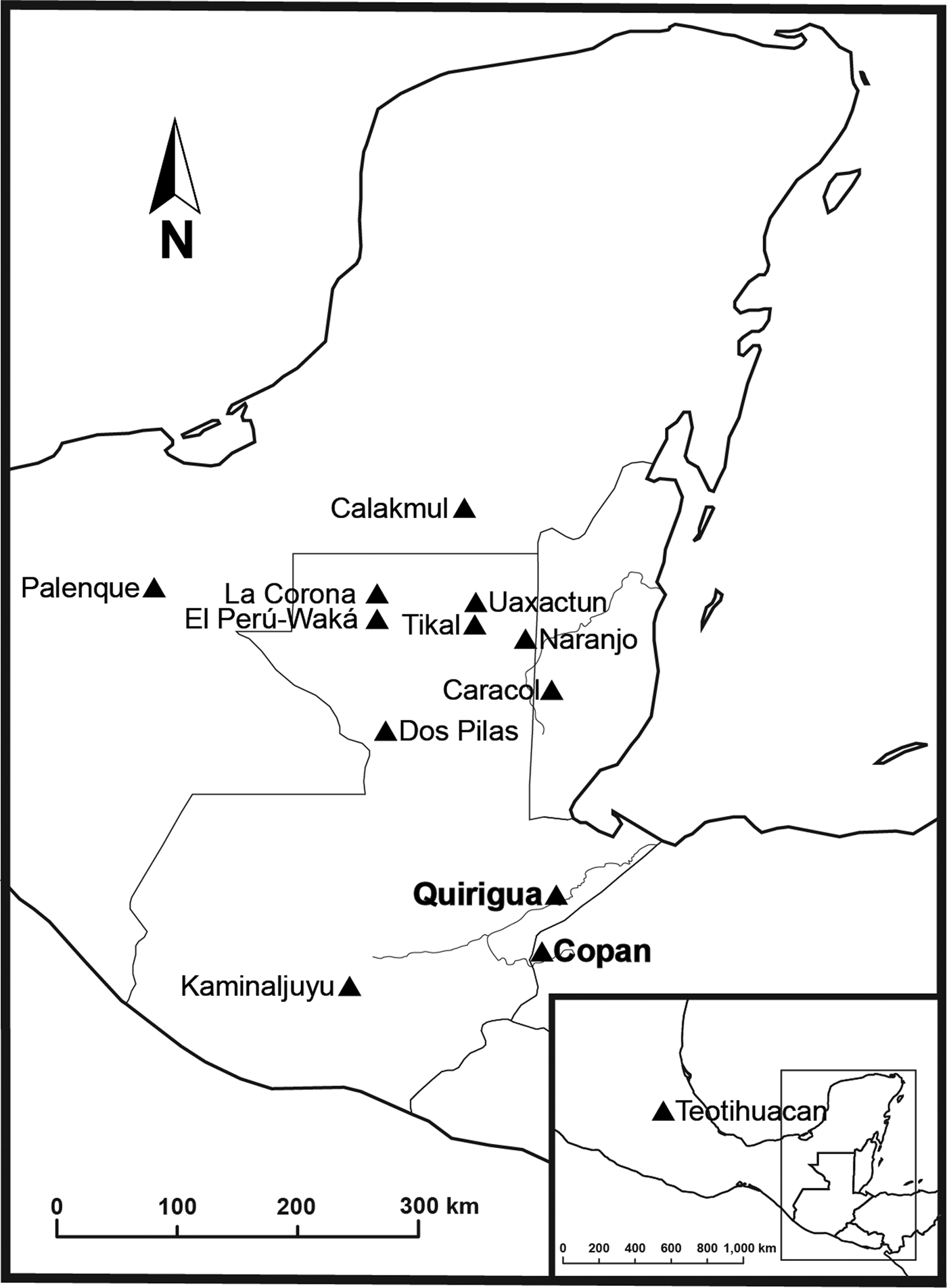
This essay is an experiment in directly comparing mortuary practices over time for rulers at politically and economically linked centers. Most specifically it seeks to consider how acts of remembrance in royal ancestor veneration articulate across time with local and regional politico-economic dynamics. As is widely acknowledged, Maya history is deeply political, and religious and political activities frequently inseparable. The focal case here pairs Classic-period Copan and Quirigua, where for centuries, the former was overlord to the latter. The four rulers selected are the fifth-century founders of dynasties in each place and two eighth-century royal adversaries whose actions overturned established relations among Copan, Quirigua, and their neighbors (Figure 1). The evidence suggests that treatments of each of the four were contingent on the role each of the decedents held at particular points in political history, and on temporal orientation of those commissioning remembrance.
Regional map with sites mentioned in text (prepared by Eric Heller).

Narrative begins with grounding notions of temporality and lived experience, and provides a brief review of mortuary practices associated with ancient Maya royalty, offering some examples of how acknowledgment of the deceased could change with shifts in local or regional political dynamics. Closer examination of evidence about the cited four kings from Classic-period Copan and Quirigua illustrate diversity in treatments of deceased Maya kings that were contingent on shifts or stability in sociopolitical relations.
TEMPORALITIES OF LIVED EXPERIENCE IN ARCHAEOLOGICAL INFERENCE
This attempt to model the interplay of mortuary practices and political dynamics is based on the importance of people's direct encounters with places, objects, and actions as cumulatively building their knowledge about the world around them (Appadurai Reference Appadurai1986; Barrett Reference Barrett1990, Reference Barrett, Ashmore and Knapp1999; Miller Reference Miller2009; Tilley Reference Tilley1994). Elizabeth Brumfiel (Reference Brumfiel1992) and other archaeologists (for example, Dobres and Robb Reference Dobres and Robb2000; Meskell Reference Meskell1999, Reference Meskell and Hodder2001; Schortman Reference Schortman1989) have effectively challenged homogenizing models of society, to foreground instead multiplicity and flux in people's identities and standpoints in society, ancient and modern, in lived time (see also Patterson Reference Patterson2005 for a cautionary critique). The picture created is one of constant mutual shaping of individual actors and the societies of which they are a part. Scholars such as E. P. Thompson (Reference Thompson1963:9–11), Marshall Sahlins (Reference Sahlins1981, Reference Sahlins1985), and William H. Sewell, Jr. (Reference Sewell and McDonald1996) echo complementary ideas of constant reworking of ever-emergent relationships, of articulations among “structure,” “event,” and making history. Cultural traditions and social structures do not fully determine what people do. Indeed, arguing for an end of the “essential” archaeological subject, Adam Smith (Reference Smith2004:12,14) urges colleagues to examine “how subjects were constituted in the past in relation to specific sociopolitical apparatuses” and to “detail subjectivity in reference to the polity.” Potential dynamism between actors, circumstances, and events is a strong thread connecting interpretations in pages that follow.
Also pertinent are calls for more finely worked concepts of time: beyond working with longstanding archaeological chronologies of absolute dates and culture complexes, what George Cowgill (Reference Cowgill1992) labels “clock time” and “phase time,” analysts within and beyond our discipline give increasing thought to time frames of lived experience, both of the people studied and of the archaeologists and historians. Long or generalized time units are deemed insufficient for interpreting human lives on more than the most generalized social scale. For example, Charles Golden emphasizes the multiplicity of time scales in lived experience:
We are constantly negotiating, and often struggling, with the social flux inherent in the nested chronologies of our daily lives. This provides a great deal of room for ambiguity in social relations. We should expect nothing else from our professional chronologies and we should search for this kind of flux in the societies that we study, for it is fundamental for understanding the social behaviors that are the basis of our field of inquiry (Golden Reference Golden2002:20).
John Barrett (Reference Barrett and Rosen2004:21; Barrett and Ko Reference Barrett and Ko2009) urges moving beyond a focus on event and process—which he sees as mere descriptors in and of time—to emphasize human agency: “temporal definition comes with an understanding of how it was possible for the agents to establish a place for themselves in their own histories, and what the larger consequences of those strategies may have been.” Those consequences, intended or not, can involve protagonists orienting forward into the future, as well as looking backward into the past. Disruptions in political succession are particularly fraught, with royal actors’ need to affirm their legitimacy via these multiple temporal frames of past, present, and future (Baron Reference Baron2013; Gillespie Reference Gillespie2010; Sharer and Golden Reference Sharer, Golden, Golden and Borgstede2004). David Stuart (Reference Stuart1992:170) makes a parallel point about thematic shifts in rulers’ choices for Copan inscriptions, and E. Wyllys Andrews and William L. Fash (Reference Fash, Andrews and Fash2005:424) for choices in media for expression by the final five sovereigns (“cult of personality” in stelae vs. allegiance to the founder in buildings). Again actors and practices are key: the foregoing temporal dimensions and orientations figure prominently in inferences about political conditions and mortuary practices in this essay.
This essay relies on a combination of archaeological and historical evidence. Pre-Columbian hieroglyphic texts offer information on prospective actors, events, and sociopolitical circumstances, while ethnohistoric sources give analogies for interpretation of the other two sources. Individually, each category of evidence requires its own source-side criticism, along with recognition that the categories do not always provide compatible bases for inference. One must also acknowledge that decipherments and archaeological inferences are always subject to alteration. With these cautions in mind, the assemblage of evidence available is deemed sufficient for this experimental essay.
BECOMING AN ANCESTOR
The transformation of a deceased individual to venerated ancestor or deity is not automatic; it requires a suite of active practices by the living, whether direct descendents or otherwise (Parker Pearson Reference Parker Pearson and Hodder1982, Reference Parker Pearson1999). Multiple scholars have drawn from observed and inferred Maya-specific data, as well as cross-cultural and theoretical models about mortuary customs, to detail intricate processes that took place in and around burial contexts (for example, Becker Reference Becker1972, Reference Becker, Saunders and de Montmollin1988, Reference Becker, Danien and Sharer1992; Bell Reference Bell2007; Chase and Chase Reference Chase, Chase, Robertson and Fields1994, Reference Chase and Chase1996, 1998, 2011; Duncan Reference Duncan, Rakita, Buikstra, Beck and Williams2005; Fitzsimmons Reference Fitzsimmons1998, Reference Fitzsimmons2002, Reference Fitzsimmons, Fitzsimmons and Shimada2011; Fitzsimmons and Shimada Reference Fitzsimmons and Shimada2011; Geller Reference Geller2004, Reference Geller, Robertson, Seibert, Fernandez and Zender2006, Reference Geller2012; Gillespie Reference Gillespie2001, Reference Gillespie, Silverman and Small2002; Houston et al. Reference Houston, Stuart and Taube2006; McAnany Reference McAnany1995, 1998; Reese-Taylor et al. Reference Reese-Taylor, Zender, Geller, Guernsey and Reilly2006; Welsh Reference Welsh1988). For kings and commoners alike, these processes addressed ancient Maya death, mourning, departure of multiple souls, and—in all—social transformation of both the decedent and the living. Notably, and especially pronounced for royalty, these diverse activities potentially extended almost indefinitely in time, material evidence for which includes reentry of burial chambers, censing the chamber interior, burning events, removing or adding select skeletal elements, and refurbishment of associated shrines (Table 1). Any of these acts could be repeated, particularly at anniversaries of the death or burial of the individual (Fitzsimmons Reference Fitzsimmons1998; Stuart Reference Stuart and Houston1998:396–399). As in other societies as well, specific practices mobilized and their particular expression could also change through time as circumstances varied (for example, McAnany et al. Reference McAnany, Storey and Lockard1999; see also Cannadine Reference Cannadine, Hobsbawm and Ranger1977; Crossland Reference Crossland2009; Parker Pearson Reference Parker Pearson and Hodder1982, 1999 for views of temporal ritual diversity in other, very different cultural contexts).
Ancient Maya Mortuary Practices
NOTE: Sources for this table are collectively the publications cited in text.
Patricia McAnany (Reference McAnany1995:128) accentuates the importance of bloodline in becoming an ancestor, noting that:
the apotheosis of a progenitor is more a function of the purity of the bloodline than it is of lifetime achievement. A great political leader is recognized by virtue of his or her bloodline first (“those who are of the lineage”) and by superior qualities of leadership second.
The journey of the soul toward ancestor standing is then routed in part by means of “body treatment, form of disposal [individual or collective], grave location, and kinds of grave goods” (Duncan Reference Duncan, Rakita, Buikstra, Beck and Williams2005:221). In mutually independent analyses, Duncan (Reference Duncan, Rakita, Buikstra, Beck and Williams2005), Fitzsimmons (Reference Fitzsimmons2002), and Geller (Reference Geller2004), cite bundling, wrapping, dismemberment, or excarnation as among the specific body treatments of Classic Maya times. For kings and other members of the royal house, individual interment chambers tend to be quite formal, although they can range materially from relatively simple, stone-lined cists to elaborate vaulted tombs. These are choices made among acceptable alternatives, not a single, inviolate option. At the same time, royal interments tend to be associated with temples or shrines for venerating the honored deceased; some, like their subjects, were interred under the floor of what had been their residences. As outlined below, the relative embellishment, disregard, or even physical termination of interments and shrines implies much about the politics of royal ancestor veneration.
Once established, both interments and funerary shrines began life histories of their own. Many continued to be honored by later rulers and subjects, with architectural elaboration of the shrines, and celebration of the deceased in sculpture and hieroglyphic texts. In other historical contexts, however, intra-dynasty or intra-polity conflict, inter-polity warfare, or other, outside intrusion disrupted continuity of reverence for particular deceased rulers or ruling families. Examples of disjunction in dynastic histories and construction programs abound, as at Tikal in the fourth-century arrival of Teotihuacan “visitors” (Martin Reference Martin and Sabloff2003; Martin and Grube Reference Martin and Grube2008:29ff; Stuart Reference Stuart, Carrasco, Jones and Sessions2000), or the arrival at Naranjo by Lady Six Sky of Dos Pilas, as long-term regent for her young son (Martin and Grube Reference Martin and Grube2008:74). Displacement of ruling houses together with repurposing of their dynasts’ funerary shrines as deity shrines have been documented recently at La Corona (Baron Reference Baron2013; Martin and Grube Reference Martin and Grube2008:109); dynastic change was marked by destructive reentry of royal tombs at the base of Structure B19, Caracol (Chase and Chase Reference Chase, Chase, Fitzsimmons and Shimada2011:94). A series of post-dynastic deposits at El Perú-Waka’ gave evidence “that certain of the [deposition] activities were aimed at the desecration and obliteration of Structure M13–1 as a royal memorial while others were perhaps meant to heal and memorialize it reverentially” (Navarro Farr et al. Reference Navarro Farr, Freidel, Lucia, Prera, Stanton and Magnoni2008:136 [see also Duncan Reference Duncan, Rakita, Buikstra, Beck and Williams2005; Fitzsimmons Reference Fitzsimmons2002:274; Navarro Farr Reference Navarro Farr2009]). Indeed, the continued (or resumed) visitation of ruined Classic Maya buildings and monuments is well known to the present day (Stanton and Magnoni Reference Stanton and Magnoni2008).
Increasingly, scholars recognize as well that intact bodies were only one option for interment, and that, in fact, their presence was not an absolute requirement to constitute a burial. Especially for members of Maya royalty, femurs, fingers, and especially skulls or faces could be kept as “heirlooms,” worn in the attire of descendants; displayed and handled during rites of ancestor veneration or earth offerings, or displayed as trophies (for example, Ashmore Reference Ashmore, Lozada and Donnabháin2013; Becker Reference Becker, Saunders and de Montmollin1988, 1992; Chase and Chase Reference Chase and Chase1996, Reference Chase, Chase and Houston1998, 2011; Duncan Reference Duncan, Rakita, Buikstra, Beck and Williams2005; Fitzsimmons Reference Fitzsimmons1998, 2011; Geller Reference Geller2012; Houston et al. Reference Houston, Stuart and Taube2006; Joyce Reference Joyce1998, Reference Joyce, Joyce and Gillespie2000; Kunen et al. Reference Kunen, Jo Galindo and Chase2002; McAnany Reference McAnany1995, 1998; Mock Reference Mock and Mock1998). As Fitzsimmons (Reference Fitzsimmons, Fitzsimmons and Shimada2011:53) puts one example succinctly: “In the case of Tikal Burial 48, thought to house the body of Siyaj Chan K'awiil II,Footnote 1 the king was clearly the product of a secondary interment; his complete lack of a head was probably not the result of taphonomy or absentmindedness!”
If neither the body nor its individual elements were available for interment, the deceased could still be acknowledged. And if the lack of a corpse were due to capture or other violence, the crypt's material recognition as a place for connection and recollection could assume added importance (for example, Duncan Reference Duncan, Rakita, Buikstra, Beck and Williams2005; Metcalf and Huntington Reference Metcalf and Huntington1991; Parker Pearson Reference Parker Pearson, Silverman and Small2002). Such an instance is inferred for a noble of Quirigua who was commemorated with a well-prepared stone chamber containing three pottery vessels, but devoid of human remains (Ashmore Reference Ashmore, Lozada and Donnabháin2013).
Let us turn now to Copan and Quirigua, and to the political and economic contexts in which mortuary practices and acts of remembrance, including most of those just described, were applied for those four kings of Copan and Quirigua (see Figure 1).
Copan and Quirigua
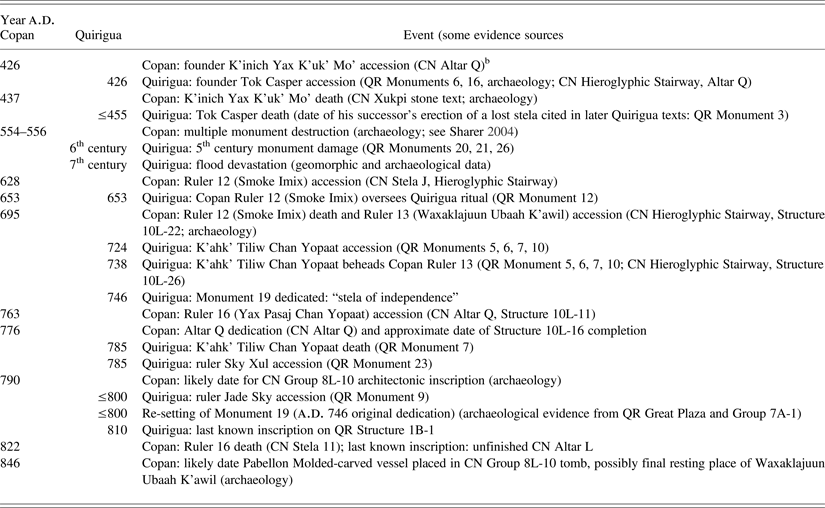
This section highlights pertinent aspects of economic circumstances and political history at Copan and Quirigua. The key point is to situate the four rulers—dynasty founders and the two antagonists in a.d. 738—in the larger sweep of local and regional history attested by texts and material evidence. Each ruled polities with abundant human, agricultural, and mineral resources, and Copan dominated Quirigua affairs for much of the four centuries of dynastic rule (Table 2).
Chronology of Key Events and Individuals Cited in Texta
NOTES:
a. Ruler numbers in dynastic sequence are not always available for Quirigua (Looper 2003:205). Name spellings follow Martin and Grube (Reference Martin and Grube2008). b. CN = Copan; QR = Quirigua
First, as noted, both had abundant human resources and raw materials available to them. Each occupied agriculturally fertile river-valley lands, alongside respectively the Copan and Motagua Rivers. Copan, however, is located in the largest—25 km2—of several “pocket” highland valleys along the Copan River. In contrast, Quirigua occupies the spot where the lower Motagua Valley opens into a 2100 km2 expanse stretching northeast to the Caribbean. Today's commercial crops of tobacco at Copan and bananas extending east from Quirigua attest to the continued agricultural value of these lands. Although maize was likely a principal crop in antiquity in both places, high-status cacao was plausibly part of local harvests as well.
Each polity capital was also well situated to control extraction and exchange of rare and greatly valued minerals—jade upstream in the Motagua Valley from Quirigua, and high-quality obsidian, especially from the Ixtepeque source relatively near both capitals. Moreover, each city was well positioned to monitor or even control movement of people and goods along rivers and overland corridors, linking in multiple directions with more distant people and material resources. Although each polity played a role in managing and moving these resources, Copan's political dominance from early times gave it the critical edge (Aoyama Reference Aoyama2001; Golitko et al. Reference Golitko, Meierhoff, Feinman and Ryan Williams2012; Seitz et al. Reference Seitz, Harlow, Sisson and Taube2001; Sharer Reference Sharer1978; Sheets Reference Sheets, Sharer, Schortman and Urban1983; Taube et al. Reference Taube, Sisson, Seitz and Harlow2004).
These two advantageous locations supported well-established populations centuries before Classic times, of people who may or may not have been ethnically or linguistically “Maya” (Ashmore Reference Ashmore2007; Canuto Reference Canuto, Bell, Canuto and Sharer2004; Fash Reference Fash, Andrews and Fash2005, 2008; Manahan and Canuto Reference Manahan and Canuto2009; Schortman Reference Schortman1993; Schortman and Urban Reference Schortman, Urban, Bell, Canuto and Sharer2004; Sharer Reference Sharer, Love, de Hatch and Escobedo2002; Sharer, Canuto, and Bell Reference Sharer, Canuto, Bell, Love and Kaplan2011; Sharer and Traxler Reference Sharer and Traxler2006). By the fifth century, however, events in politics and economies farther afield were redefining the courses of history and politico-economic conditions for several kingdoms in the lowland Maya world, a key influence being distant Teotihuacan, in Central Mexico (Fash Reference Fash, Andrews and Fash2005, 2008; Jones et al. Reference Jones, Sharer, Paredes, Pallan, Cobos and Canton2008; Manahan and Canuto Reference Manahan and Canuto2009; Martin and Grube Reference Martin and Grube2008; Sharer Reference Sharer1978, Reference Sharer, Love, de Hatch and Escobedo2002, Reference Sharer and Braswell2003; Sharer and Traxler Reference Sharer and Traxler2006; Stuart Reference Stuart, Carrasco, Jones and Sessions2000). Hieroglyphic texts indicate that “strangers” from Teotihuacan entered the Maya lowlands late in the fourth century and redirected dynastic rule at Tikal and Uaxactun; initial bone chemistry analysis at the former does not support the texts concerning intrusion at Tikal (Wright Reference Wright2005), however, and no such data at all are available from Uaxactun. Nonetheless, in the early fifth century, and attested by texts and material remains, Classic-style Maya dynastic rule with material Teotihuacan connections was imposed on established society at Copan and Quirigua, where bone chemistry confirms that non-local men—perhaps Copan's from Caracol, or both from Tikal—were installed to govern the local populace (Buikstra et al. Reference Buikstra, Price, Wright, Burton, Bell, Canuto and Sharer2004; Price et al. Reference Price, Burton, Sharer, Buikstra, Wright, Traxler and Miller2010; Sharer Reference Sharer2001; Sharer and Traxler Reference Sharer and Traxler2006:354; Stuart Reference Stuart2007; Wright Reference Wright, Lozada and Donnabháin2013).
At Copan, texts and archaeology indicate that an outsider named Yax K'uk’ Mo’ wrested authority from existing local powers, at least partly through military means. Having been invested by distant powers with insignia and titles of his office on Maya date 8.19.10.10.17, or September 5, 426, he arrived formally at Copan as king K'inich Yax K'uk’ Mo’ — “Radiant First Quetzal Macaw” —some five months later, on 8.19.11.0.13, or February 8, 427 (Martin and Grube Reference Martin and Grube2008:193; Sharer and Traxler Reference Sharer and Traxler2006:342). Relations with ousted leaders seem to have involved a fair amount of diplomacy, as well, with apparent marriage of K'inich Yax K'uk’ Mo’ to a local woman from a leading family. Such diplomacy was also manifest in preservation for at least some of the court buildings of his predecessors as the new king built his own capital adjoining and slightly to the southeast of the earlier one (Traxler Reference Traxler, Inomata and Houston2001:66–67; Reference Traxler, Bell, Canuto and Sharer2004). In ensuing centuries, subsequent Copan kings solidified dynastic rule, and fortunes were generally good for Copan even though individual reigns tended to be relatively brief. This was a time in which ancestor remembrance looked both backward to the revered dynasty founder and projected forward toward continued dynastic and politico-economic stability
At Quirigua, fewer details are known, but temporal orientations were plausibly similar to those at Copan. Its imposed Maya king, nicknamed Tok Casper, was invested with insignia of his new office on 8.19.10.11.0, or September 8, 426, under supervision of K'inich Yax K'uk Mo’ only three days after the latter was so invested. For at least another three centuries, the hierarchical relation between Copan and Quirigua persisted, such that—among other things—resources directly available to the latter were most likely managed from Copan. Quirigua was perhaps a central communication and exchange link between Copan and other “Tikal-friendly” polities, from the Lower Motagua Valley north to the Belize River (Looper Reference Looper1995:56; Sharer Reference Sharer, Boone and Willey1988, 1990:101). As indicated below, such long-distance alliances figure importantly in later events, reflecting ongoing political competition between Tikal and Calakmul, far to the north (see Figure. 1).
At sixth-century Copan and Quirigua, conditions were more turbulent, clearly subject to conflict, and potentially changed temporalities. Extensive destruction of stone monuments at Copan between ca. a.d. 554 and 564 suggests “a major disruption” there, perhaps related to the “premature death of [Copan] Ruler 9” after only two years’ reign, or even to faraway Calakmul defeat of Copan's long-time ally, Tikal (Sharer Reference Sharer, Bell, Canuto and Sharer2004:305; Sharer and Traxler Reference Sharer and Traxler2006:351; see also Martin Reference Martin and Sabloff2003; Martin and Grube Reference Martin and Grube2008). Even so, archaeological evidence, especially construction then of the magnificent ancestral shrine known as Rosalila (see below), points to continuing orientations both to the past and the dynastic founder, and forward to continuation of the dynasty and its subjects’ lives.
Jones, Sharer, and Paredes consider construction histories in the Quirigua Acropolis to indicate that the “[f]ifth and [s]ixth [c]entury beginnings were modest in scale and focused on veneration of the eastern burial place of the founding ancestor” (Jones et al. Reference Jones, Sharer, Paredes, Pallan, Cobos and Canton2008:9). For reasons unknown but perhaps similar to those at Copan, however, the sixth-century lacks monuments and texts at Quirigua, and definitely includes defacement of at least two late fifth-century portrait stelae there, whether by local or non-local agents (Ashmore Reference Ashmore2007; Looper Reference Looper2003:50; Sharer Reference Sharer1990). This situation begs answers to the foregoing implicit questions of who, when, and why, and hints at disruption in temporal orientation, then or relatively soon thereafter.
In the seventh century, disaster struck Quirigua. Both archaeological and geomorphic evidence suggest major flooding that damaged, destroyed, or washed away an immeasurably large part of the capital, including civic buildings—maybe even an early ballcourt—associated with its first four rulers (Ashmore Reference Ashmore2007, 2009). Immediately gone were the bountiful maize and cacao harvests, happening at a time when John Wingard (Reference Wingard and Fedick1996; Fash Reference Fash, Andrews and Fash2005:94) proposed that Copan had begun to require maize tribute from valley pockets upstream to the northeast (but see Wingard [Reference Wingard, Wingard and Hayes2013] and his Models A and F). In parallel, Fash (Reference Fash2008:101) notes a seventh-century increase in population in Copan. I suggest that Copan's Ruler 12—also known as Smoke Imix—might have begun to press for such tribute from vassal Quirigua as well.
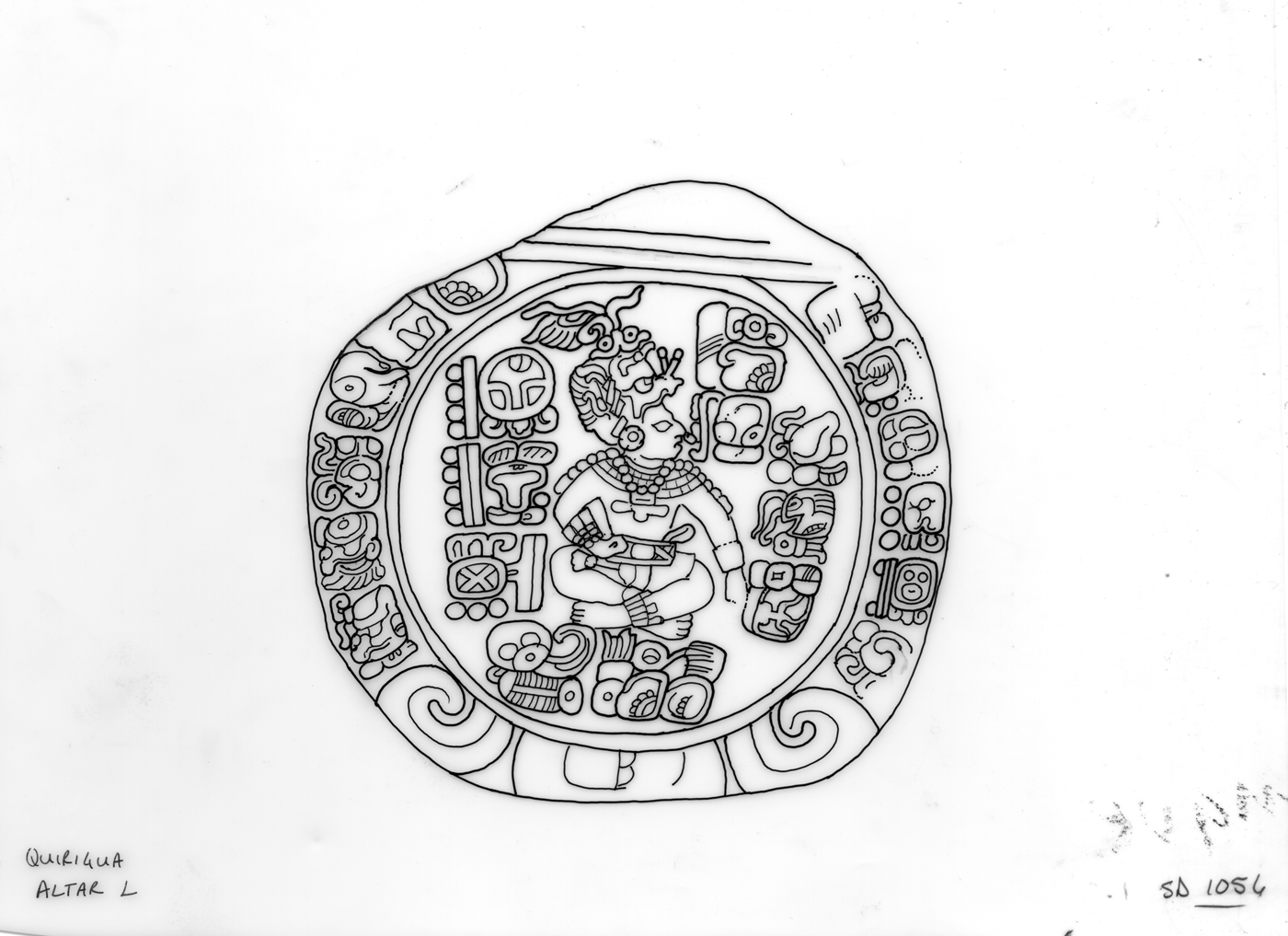
In a.d. 652, Quirigua artisans completed Monument 12, anticipating a house-censing ritual and/or dance performance at Quirigua's celebration soon thereafter for a k'atun (Maya twenty-year) period ending, 9.11.0.0.0, a.d. 653 (Figure 2; Ashmore Reference Ashmore2007; Looper Reference Looper2003:50–53; Martin and Grube Reference Martin and Grube2008:217; Sharer Reference Sharer1990). Copan ruler Smoke Imix oversaw the event, and epigrapher Matthew Looper sees the monument as reaffirming “participation of Quirigua in Copan's political sphere” (Looper Reference Looper1995:60). Notably, its inscription also includes a verb phrase associated with recovery from warfare (Looper Reference Looper2003:234, n. 25). The inferred reaffirmation might relate in part to a changed temporal orientation for the Quirigua king, looking forward into a potentially new stability under renewed aegis of Smoke Imix and Copan. Perhaps such recovery and reaffirmation on an important period-ending date coincided with aid to Quirigua during its recovery from the flood, plausibly as well as with reaffirmation of Quirigua's tribute requirements to address Copan's increasing need for imported food. And so one might well suggest that Quirigua's inferred indebtedness to Copan grew.
Quirigua Monument 12. Portrait shows Quirigua Ruler; name of Copan Ruler 12 appears in circular inscription, bottom three glyphs at far left (Drawing by Linda Schele © David Schele).
In a.d. 724, however, a new and ambitious Quirigua king, K'ak’ Tiliw Chan Yopaat, acceded to rule under the supervision of Copan's Ruler 13, Waxaklajuun Ubaah K'awil. Twelve years later, in a.d. 736, plausibly having inherited a growing tribute load and perhaps seeing a way to throw off Copan's yoke, K'ak” Tiliw accepted support from far-off Calakmul, the perennial enemy of Tikal and its allies—including Copan. His temporal orientation was to the future, not to a problematic past. On April 29, 738 (9.15.6.14.6), K'ak’ Tiliw Chan Yopaat successfully captured and, six days later, beheaded his Copan overlord, the very same Waxaklajuun Ubaah K'awil who had overseen K'ak’ Tiliw's accession (Looper Reference Looper2003; Martin and Grube Reference Martin and Grube2008). The result was an end to Copan's centuries-old, unchallenged hegemony over political and economic relations in the region, at which point some dozen new polities took advantage of the partial vacuum to assert their own autonomy (Schortman and Ashmore Reference Schortman and Ashmore2012; Schortman and Nakamura Reference Schortman and Nakamura1991).
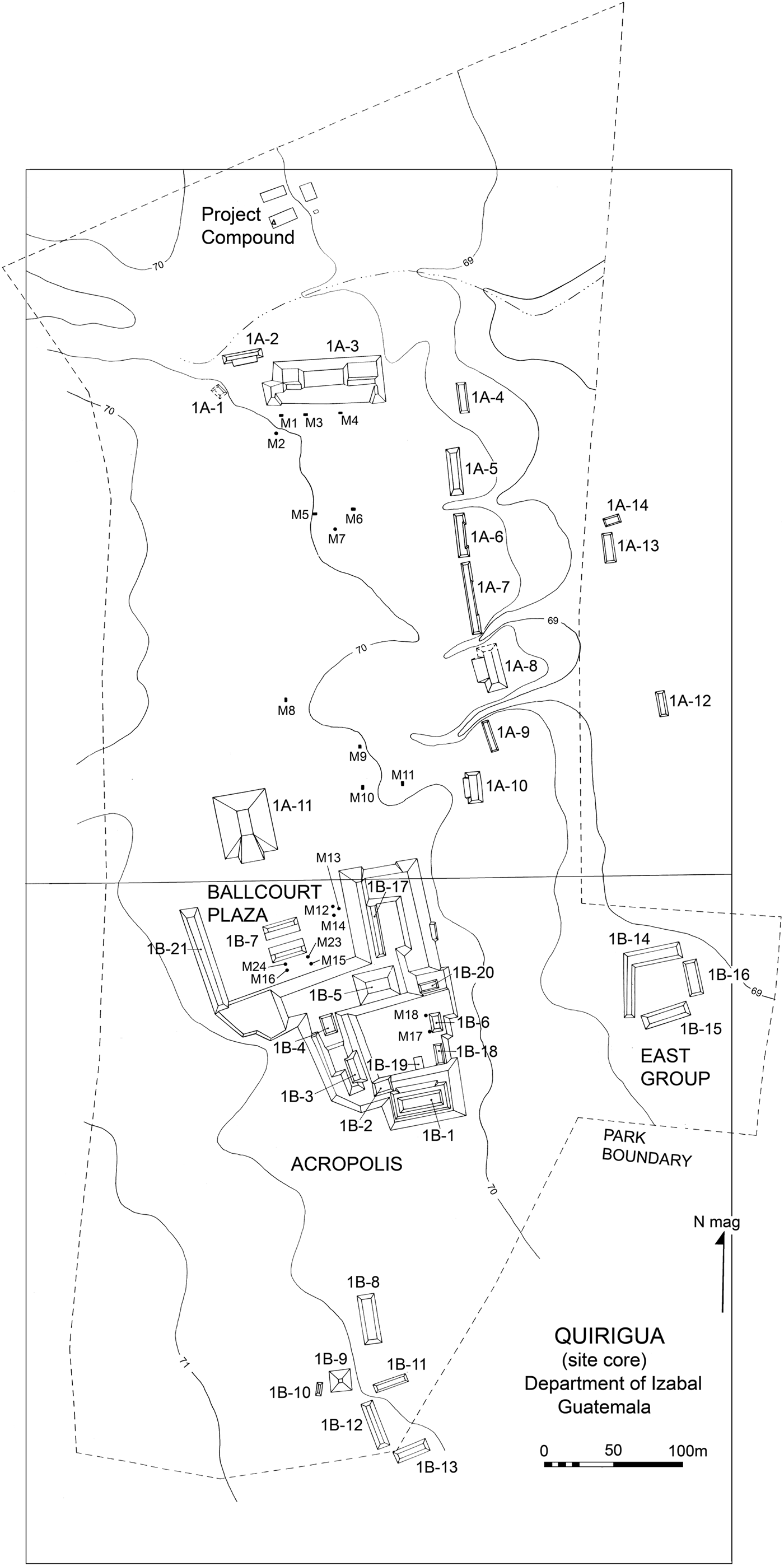
In the aftermath, K'ak’ Tiliw refurbished the Quirigua civic center dramatically, especially the Great Plaza, its expansive public arena studded with monuments—to himself (Figure 3). Indeed, this plaza is “symbolically identified with the place of sacrifice of Waxaklajuun Ubaah K'awil” (Monument 6; Looper Reference Looper2003:83). Earlier, Waxaklajuun Ubaah K'awil had populated Copan's Main Plaza with self-portraits of himself, and William Fash and David Stuart (Reference Fash, Stuart and Culbert1991:163) have characterized K'ak’ Tiliw's emulation as almost a parody (Figure 4).
Main Group, Quirigua, highlighting Acropolis and Great Plaza (Reproduced from Ashmore Reference Ashmore2007:Figure 1.4, by permission of the University of Pennsylvania Museum).
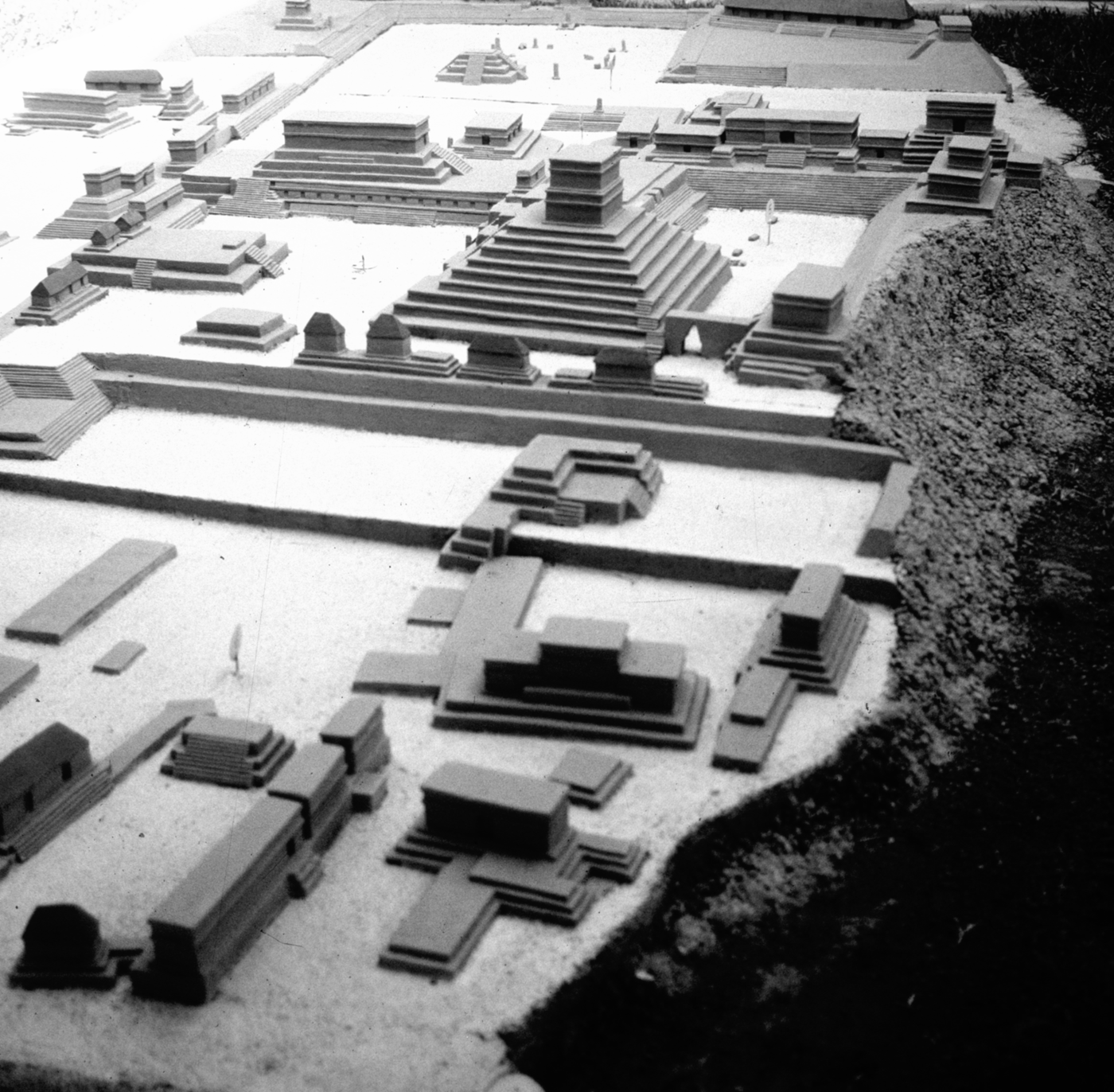
Model in Visitors Center, Copan, indicating layout of the Main Group, with the Great Plaza in the distance and Acropolis in the middle ground. Structure 10L-16 is the tallest structure near center of the image. Ragged edge at right marks erosion from the Copan River (author photo).
Themes in text and sculpture on his portrait monuments prominently featured allusions to events of creation in 3114 b.c. (Monuments 3, 16), one of multiple means used to assert his association with universe creation events deep in time (Grube, et al. Reference Grube, Schele and Fahsen1991; Looper Reference Looper2003; Martin and Grube Reference Martin and Grube2008:221–222; Gabrielle Vail, personal communication, May 2013). While this might seem to best the primacy of dynasty founder Tok Casper that extended only back to his investiture in the fifth-century, Monument 3 does hearken back to a king thought to have been Tok Casper's successor (Looper Reference Looper2003:38). Grube et al. (1991:110) suggest that the pertinent creation passage on Monument 16 might be interpreted as equating “the founding of a lineage to the creation of the universe.” These kinds of competitive assertions Golden (Reference Golden2002:76) and others link to concerns about political legitimacy. This king's temporal orientation was forward looking, from this important juncture, not backwards within dynastic time. Although we cannot know definitively, he could have been partly responsible for cited defacement of earlier dynastic monuments, or perhaps their destruction in creating his new Great Plaza. In addition he declared himself the fourteenth ruler of Quirigua, but since the preceding dynastic record and succession numbers are incomplete to analysts, the latter have sometimes inferred that he was declaring himself successor to Ruler 13, of Copan (Riese Reference Riese, Urban and Schortman1986; but see Looper Reference Looper2003).
The effect on Copan was profound: its next and fourteenth ruler lost significant economic resources as well as political and military face. Instead of erecting a self-portrait stela, in a.d. 746 he built a Council House, or popol na (Structure 10L-22A), where he consulted with the heads of the districts under his newly weakened authority (Fash et al. Reference Fash, Fash, Lane, Larios, Schele, Stomper and Stuart1992; Fash Reference Fash, Andrews and Fash2005, 2008:134). Importantly, this building was erected next to the governing “palace” of his beheaded predecessor, atop the Copan Acropolis. In these acts, Copan Ruler 14 was orienting explicitly backward, to past glories of his dynastic predecessors, and perhaps more timidly forward to increased sharing of governance.
Subsequent decades witnessed gradually renewed prosperity in both Quirigua and Copan amid continued conflict with other parties, and saw equally gradual restoration of diplomatic relations between the two—including the old dominance of Copan. Following a time of trouble (Andrews and Fash Reference Andrews, William L., Andrews and Fash2005), the end of the Copan dynasty is recognized in the tellingly incomplete Altar L depicting the intended accession of Ukit Took’, in a.d. 822. Its single completed scene depicted transfer of authority from Yax Pasaj Chan Yopaat in a manner reminiscent, in abbreviated form, of the latter's receipt of a scepter of office from K'inich Yax K'uk’ Mo’ as shown on Altar Q (see Figure 7). Temporal orientation was still toward the past, but perhaps in a truncated temporal reference, only to the immediate predecessor. The last known inscription at Quirigua was earlier, recording its Copan overlord overseeing a ritual at Quirigua in a.d. 810 (Looper Reference Looper2003; Martin and Grube Reference Martin and Grube2008; Sharer Reference Sharer1990). The commissioning king's orientation in this sculpted inscription was to the past, but at least here with reference to Copan superiority. Quirigua dynastic rule might have continued some years longer, but if so, with no known texts to tell us so.
The key point of the foregoing paragraphs has been to situate the four rulers—dynasty founders and the two adversaries of the a.d. 738 upheaval in the larger sweep of history and politico-economic relations. Each ruled polities with abundant human, agricultural, and mineral resources, and Copan dominated Quirigua affairs for much of the 400 years of dynastic rule.
FOUR ROYAL ANCESTORS AT COPAN AND QURIGUA
Thanks largely to the last four decades of research at Copan and Quirigua, we are learning much about the men—and occasionally women—of each polity's royal dynasty. As stated at the outset, the article considers just four of the dynastic kings: the founders of each dynasty in the fifth century a.d., and the pair of royal adversaries in Quirigua's eighth-century overthrow of Copan's longstanding control. How were these individuals treated at and after their deaths? What acts of remembrance are evident for each? (See Table 1.)
Fifth-Century Founders
Copan: K'inich Yax K'uk’ Mo’. The life and death of dynasty founder K'inich Yax K'uk’ Mo’ had profound impact on Copan's political, ritual, sculptural, and architectural history. Text on the Xukpi stone bench re-set over his presumed wife's tomb, suggests his death likely came in a.d. 437, a decade after he had become king (Fash Reference Fash2008; Sharer and Traxler Reference Sharer and Traxler2006). He was laid carefully on his back for burial, on a huge, elevated stone slab set in a vaulted chamber, together with a mortuary offering assemblage of 21 pottery vessels, four with pottery lids, and other high-status objects of “carved jade, shell and bone” (Reents-Budet et al. Reference Reents-Budet, Bell, Traxler, Bishop, Bell, Canuto and Sharer2004:169; Bell Reference Bell2007; Bell et al. Reference Bell, Sharer, Traxler, Sedat, Carrelli, Grant, Bell, Canuto and Sharer2004:133–135).
The chamber itself was intruded more than two meters into the north-facing building known by archaeologists as Hunal, constructed as the founder's principal residence during his reign (Figure 5; Sharer et al. Reference Sharer, Sedat, Traxler, Miller, Bell, Andrews and Fash2005:160). Its talud-tablero façade profile is strongly reminiscent of buildings in Central Mexico. And the scene painted on a vivid polychrome vessel placed outside the later tomb of his probable wife is thought to represent the Hunal building, with the face of K'inich Yax K'uk’ Mo’ in its doorway (Figure 6). The “goggle-eyed” visage is the same as later depictions of the man, notably a censer cover from a seventh century royal tomb, and the famous dynastic portrait gallery of late eighth-century Altar Q (Figure 7).
In the Hunal tomb, Copan, Robert J. Sharer examines the individual identified as K'inich Yax K'uk’ Mo’. On and beneath the slab supporting the skeleton lay a remarkable assemblage of grave goods, as described in text (Copyright © Kenneth Garrett. All Rights Reserved).
Margarita tomb vessel thought to show K'inich Yax K'uk’ Mo’ in the doorway of his residence (Copyright © Kenneth Garrett. All Rights Reserved).
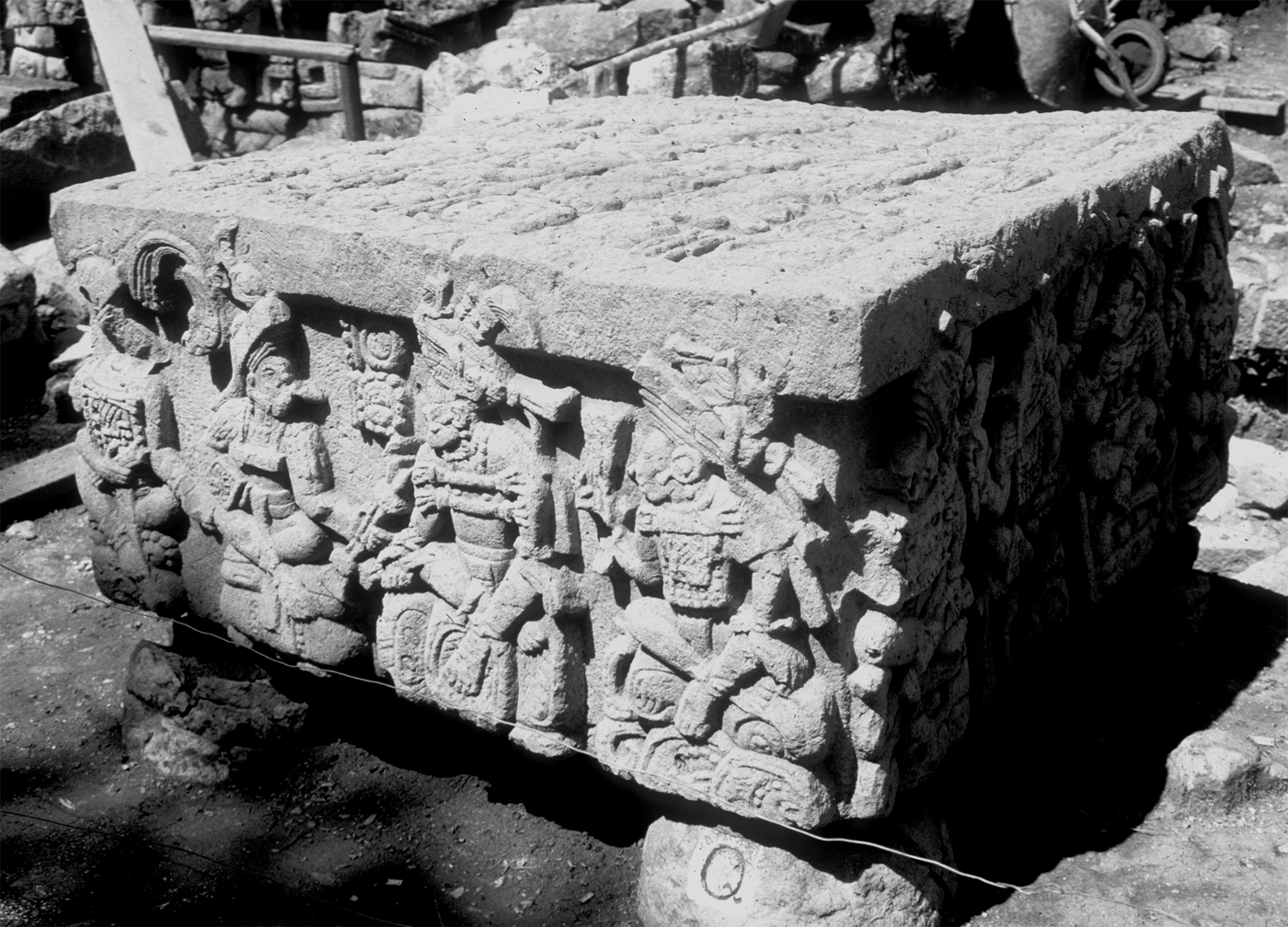
Copan Altar Q, west side looking northeast, showing founder K'inich Yax K'uk’ Mo (left) transferring authority to 16th Ruler, Yax Pasaj Chan Yopaat (right), facing each other across a pair of glyphs for the date of the latter king's accession (author photo).
Contents of the Hunal tomb bore multiple references to a far-flung, Teotihuacan-linked network, with Hunal tomb finds resembling others from Tikal, Kaminaljuyu, and Teotihuacan itself. Neutron activation analysis of tomb pottery identifies Tikal as the actual source of two vessels in the Hunal tomb; Central Mexico the source of five; the Copan Valley, 11—and the Quirigua vicinity, two more (Reents-Budet et al. Reference Reents-Budet, Bell, Traxler, Bishop, Bell, Canuto and Sharer2004:170–172; Sharer and Traxler Reference Sharer and Traxler2006:347). Material allusions to Teotihuacan and Central Mexico would recur with varying intensity at Copan for nearly four centuries, to the dynasty's end. Even Yehnal, the platform that Ruler 2 constructed atop Hunal and sealing the founder's tomb, bore the Mexican year sign and torches on its sculpted façade, in the headdress of the Sun God, which Karl Taube describes as “surely the apotheosized K'inich Yax K'uk’ Mo” (Taube Reference Taube, Bell, Canuto and Sharer2004:277). Yehnal's architectural profile, however, did not include Mexican-style talud-tablero forms; instead it was more like the apron molding style of the Maya lowlands to the north, attesting to dynastic Copan's varied heritage. The importance of bloodline (per McAnany) was prominent, but required negotiation of both lines in Ruler 2's past, those of his foreigner father and of his locally elite mother (Figure 8; Sharer Reference Sharer2001:28).
Cutaway view of Hunal tomb with sequential construction overlying the axis mundi, culminating in Structure 10L–16, whose frontal, western stair is visible at right. Note earliest visible construction (Margarita structure and with that, Yehnal (with apron molding platform profiles) and anciently preserved Rosalila (Image 526714; copyright © Christopher Klein/National Geographic Creative).
In death then, Copan's founder was treated with great reverence, with tomb contents moveable at least until his body decomposed, when the red of cinnabar was spread on his bones (Sedat and Lopez Reference Sedat, López, Bell, Canuto and Sharer2004:91). Acts of reverent remembrance continued with the reign of his son, Ruler 2, and then through the end of the Copan royal dynasty in a.d. 822. In Loa Traxler's words, Ruler 2 “probably represented the foreign ancestry of his father as well as the local prestige of his mother” and his works “could represent a resolution to the conflict between the foreign usurper and the local elite” (2001:67).
Ultimately the most dramatic aspect of these acts of remembrance is that the founder's tomb, Hunal, became the spot above which subsequent shrines for the founding ancestor were erected, repeatedly re-establishing the axis mundi, the world center of Copan the city and Copan the polity (Sharer and Golden Reference Sharer, Golden, Golden and Borgstede2004:40). Temporal orientation celebrated immediate past heritage even as it established and reaffirmed the enduring importance of this king and his dynasty for generations of the future.
The principal orientation of subsequent shrines on this axis mundi shifted to west facing—such that the sun rises behind the shrine, from the honored east—in contrast to the north-facing Hunal residence. Ever after, the shrines faced onto an open patio or plaza, practices common to many Classic Maya lowland burial sites in what are now Guatemala and Belize (Becker Reference Becker1972, Reference Becker and Sabloff2003:258–262; Chase and Chase Reference Chase, Chase, Robertson and Fields1994).
Ellen Bell details the sequence of Acropolis tombs, burials, and offerings on this spot in the Early Classic period (here, a.d. 400–600), which she identifies with the process of “materializing and extending the dynasty,” and anchored especially by Hunal, its tomb, and the Margarita structure and tomb of his inferred wife (Bell Reference Bell and Ardren2002, 2007:xii, 36). Indeed, Bell and her colleagues consider the Margarita platform and tomb as part of a grand remodeling of the dynastic shrine, begun by their son, Ruler 2. Constructed atop Hunal and Yehnal platforms, the Margarita platform façade bears “an emblematic depiction of the founder's name, K'inich Yax K'uk’ Mo’” (Bell Reference Bell2007:323; Sharer et al. Reference Sharer, Sedat, Traxler, Miller, Bell, Andrews and Fash2005:165; Traxler Reference Traxler, Inomata and Houston2001). In addition, preconstruction offerings placed at the corners of the Margarita platform may have “marked the four cardinal directions with [a fifth deposit,] the most elaborate offering marking the center … the axis mundi” (Bell Reference Bell2007:341; see also Taube Reference Taube and Ragavan2013). Like the founder's tomb, that of his presumed wife in Margarita remained accessible at least until her bones were exposed and painted with cinnabar. The latter tomb was subject to much burning during that time (Stuart Reference Stuart and Houston1998). In both cases, then, reentry was a prominent feature of remembrance for the individuals whose son was promoting quickly to venerated ancestors.
A century later, the deliberately and magnificently preserved Rosalila temple was Copan's imposing ancestor shrine of the late sixth century, situated on the same axis mundi as the founder's tomb (Agurcia Fasquelle Reference Agurcia Fasquelle, Bell, Canuto and Sharer2004; Agurcia Fasquelle and Fash Reference Agurcia Fasquelle, Fash, Andrews and Fash2005:230; Taube Reference Taube, Bell, Canuto and Sharer2004, 2013:96,103). As Martin and Grube (2008:198) remark, “Rosalila's interior was blackened by … smoke and incense—rituals appropriate to its role at the heart of ancestral veneration—and vents in its façade were designed so that billowing clouds would interact with the sculpture in an animated tableau.” Burning and censing were still key components of veneration for K'inich Yax K'uk’ Mo’ nearly a century after his death. This was an emphatic look back, and in light of the coeval evidence for monument destruction, as well as subsequent careful subsequent entombment of the structure, one might see this as a publicly materialized reaffirmation of the dynasty's legitimacy in challenging times.
The final version of Copan's royal ancestor shrine sequence was Structure 10L–16, dedicated in a.d. 776, with its multiple sculptural allusions to K'inich Yax K'uk’ Mo’ and to the Mexican motifs prominently featured in the founder's imagery (Martin and Grube Reference Martin and Grube2008:210; Ramos Reference Ramos2006; Taube Reference Taube, Bell, Canuto and Sharer2004). At the base of this final temple's stair, Altar Q recounts dynastic foundation events on the top surface, with portraits of all the 16 kings, in order, on its four sides (see Figure 7). A sub-floor, stone-crypt offering just east of Altar Q included 15 jaguar skeletons, thought to represent the royal predecessors of the king who commissioned Structure 10L–16 and the altar at its base. The altar's west face pointedly proclaims the momentous importance of the dynasty founder, in the passage of the scepter of royal authority from K'inich Yax K'uk’ Mo to Ruler 16, Yax Pasaj Chan Yopaat, as they face each other across glyphs for the date of the first king's accession. In sum, the acts of remembrance for Copan's founder and his official bloodline were varied in nature, both public and private, and quite persistent across time. They consistently looked both backward to the founder and arguably forward to dynastic continuation, despite Altar Q's “completion” of the four panels of dynasts leaving future such commemoration unclear. The Hunal tomb had remained accessible for some years after his death, and his name was invoked repeatedly in architectural and other sculpture. Burning and censing were prominent in his remembrance acts. From the reign of his son to the dynasty's end, he was remembered with great honor.
Quirigua: Tok Casper
At Quirigua, the story is parallel, but different in significant ways. We have considerably less information about its dynasty founder, Tok Casper. Based on retrospective hieroglyphic accounts of his accession events in a.d. 426 (Monuments 3, 16; Looper Reference Looper2003:38), he was an “outsider” to the area, but the bone and tooth chemistry analyses done at Copan are lacking at Quirigua, to specify this founder's original home more precisely. Sharer and Traxler (Reference Sharer and Traxler2009) suggest that he may have accompanied Yax K'uk’ Mo’ from Tikal. He died before a.d. 455, by which date his successor had assumed the throne (Jones et al. Reference Jones, Sharer, Paredes, Pallan, Cobos and Canton2008:4; Martin and Grube Reference Martin and Grube2008:217).
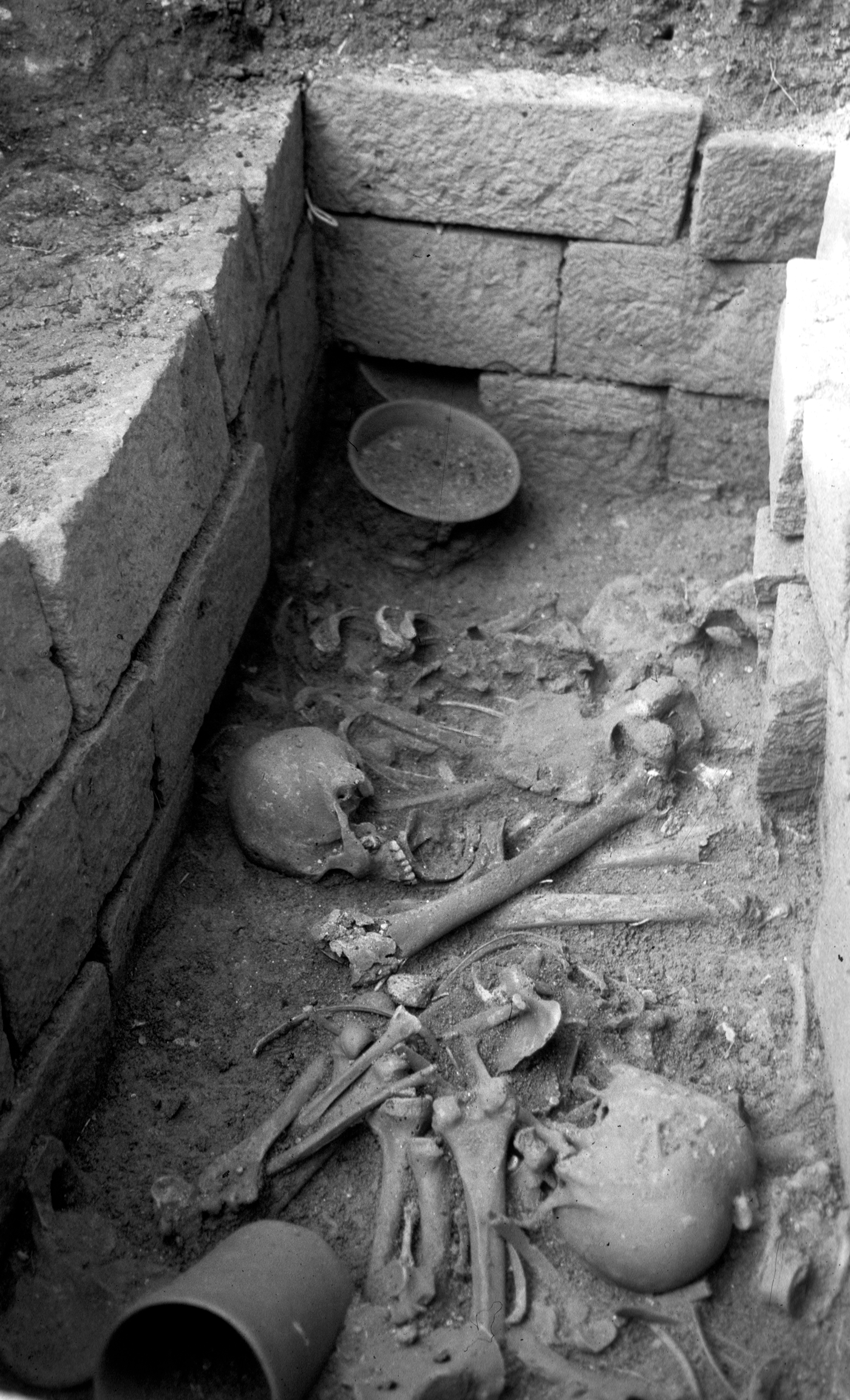
Some time ago, Robert Sharer (Reference Sharer, Love, de Hatch and Escobedo2002; Sharer and Traxler Reference Sharer and Traxler2006, Reference Sharer and Traxler2009) identified this founder's probable burial site, a cist grave lined by stone slabs, beneath one of the earliest buildings of the Quirigua Acropolis, the red-painted adobe Structure 1B–6–3rd (Figure 9). This dynastic founder, too, was laid on his back, but directly on the slab flooring of his grave. Sharer (Reference Sharer, Love, de Hatch and Escobedo2002:469) based his linking of this burial with that of the Copan founder on four observations: (1) its occurrence at an appropriate and datable stratigraphic level within the Quirigua Acropolis; (2) its position on the east side of the Acropolis compound—akin to royal burial placement elsewhere in the Maya lowlands, as noted earlier (Becker Reference Becker1972, Reference Becker and Sabloff2003:258–262; Chase and Chase Reference Chase, Chase, Robertson and Fields1994); (3) subsequent renewals of shrines in this location for the duration of the dynasty; and (4) Tok Casper's similarity to Copan's founder in the pattern of their notched and jade-inlaid teeth. Other than those similarities, however, the Quirigua founder's burial is strikingly different from that of his Copan counterpart, perhaps a reflection of Quirigua's status as sometimes restive subordinate to Copan from the onset of dynastic time.
Individual identified as Quirigua dynastic founder Tok Casper, in the stone-slab burial cist with accompanying grave goods (author photo).
Quirigua dynastic founder Tok Casper was buried with much simpler grave preparation and strikingly fewer and less elaborate grave offerings. Whereas the Copan founder's tomb was intruded with great effort two meters into the heart of his principal residence, Quirigua's Structure 1B–6–3rd was newly created as a shrine to cover the Quirigua founder's grave. The shrine may have had an east-facing stairway, but in any event did not face west; all of its successor shrines did so, like those of Copan and many other Maya cities. The location of Tok Casper's residence is unknown, although possible locations would be unexcavated areas to west or north, associated with the same plaza floor of the nascent Acropolis; excavations on the south probed deep enough to encounter a candidate, but came across none (Jones et al. Reference Jones, Sharer, Paredes, Pallan, Cobos and Canton2008:3).
The stone slab-lined chamber for Tok Casper differs in construction investment from the stone-vaulted founder's tomb at Copan, and in contrast to the rich assemblage of local and exotic grave offerings in Hunal, the offerings at Quirigua were a set of three simple bowls and the jade bead placed in his mouth, a frequent Maya custom. In the fill of the burial pit, excavators came across an offering of two red, flaring-wall flat-bottom vessels (Jones et al. 1983:4; Jones et al. Reference Jones, Sharer, Paredes, Pallan, Cobos and Canton2008). Although surmounting construction by unstable cobble-fill might have complicated understanding of the vessels’ deposition, there is no stratigraphic evidence of pit reentry to place those bowls. And the Quirigua founder's bones were certainly not painted red with cinnabar.
From that point on, the principal contrasts in acts of remembrance for the two founders are not the practices, per se, but instead continue the lesser scale and elaboration of their expression. Remember that repeated renovation of the Copan Acropolis axis mundi yielded a towering architectural monument, with culminating construction of Structure 10L–16 being the tallest and most visible building of the Acropolis, in view far beyond the royal precinct there. At Quirigua, however, although founder Tok Casper was acknowledged with periodic renovation of the ancestor shrine overlying his grave, that eastern building remained small in expanse, height, and decoration.
Kings and builders following Tok Casper at Quirigua were more changeable in temporal orientation than were their counterparts at Copan: that is, markedly inconsistent attention and effort were given to celebrating the Quirigua founder materially. Whereas veneration of K'inich Yax K'uk’ Mo’ was stable in message, that of Tok Casper was often ambivalent, correlating with shifts in, especially, relations with Copan. Indeed, as residential and ceremonial architecture rose around the other sides of the emerging Quirigua Acropolis, these buildings collectively dwarfed the founder's ancestral shrine, which became invisible to anyone not close by within the royal compound.
It even appears that no new enhancement of the ancestor shrine took place at all in the seventh century, the time of flood recovery, when Copan's Smoke Imix arguably stepped in to help. Instead, Quirigua Acropolis construction efforts went most prominently into creating a ballcourt on its west flank, for which Monument 12 was possibly the central alley marker, stylistically like markers at Copan (Jones et al. 1983; Jones et al. Reference Jones, Sharer, Paredes, Pallan, Cobos and Canton2008). As Christopher Jones has suggested, Quirigua Monument 12, on which Copan's Smoke Imix (Ruler 12) is named, may even have been the central marker for the alley of that ballcourt, inferring that Monuments 17 and 18 were other smaller potential markers; regrettably all were encountered out of any firm context, on the site surface (see Figure 2; Jones et al. Reference Jones, Ashmore, Sharer, Sharer, Schortman and Urban1983:4–5; Jones et al. Reference Jones, Sharer, Paredes, Pallan, Cobos and Canton2008:5; Sharer Reference Sharer1990; but see Looper Reference Looper2003:53). In short, one might well posit that reaffirming the power differentials between Copan and Quirigua was apparently more important at that point than celebrating Quirigua's founding ancestor, so acts of remembrance were muted. Orientation toward securing the future outweighed valorizing the local past.
Eighth-Century Adversaries
Shifting to the other pair of highlighted kings in these cities, the antagonists of a.d. 738 are relatively well known from inscriptions and from their material legacy. As suggested earlier, a principal impetus for their clash plausibly lay in growing tribute demands on Quirigua and in the opportunistic ambition of its most famous king, K'ak’ Tiliw Chan Yopaat (Ashmore Reference Ashmore2007). His overlord at Copan, its Ruler 13 or Waxaklajuun Ubaah K'awil, was certainly ambitious too, though known more for his grand architectural and sculptural legacy than for his military “triumphalism” (Martin and Grube Reference Martin and Grube2008:203; see also Fash and Agurcia Fasquelle Reference Fash, Agurcia Fasquelle, Andrews and Fash2005:28). Quirigua's K'ak’ Tiliw seems to have leapt at an opportunity to undo the inferred tribute obligations, and to do so, opted for alliance with and support from distant Calakmul, longstanding enemy of Tikal and its alliance network (Looper Reference Looper1995, 2003). In April 738 he captured the Copan king, and six days later, beheaded him in an act reported hieroglyphically and unceremoniously at Quirigua as an “axe event.” The action essentially reversed hierarchical relations between the two cities during K'ak’ Tiliw's reign. Quirigua's rebel king died nearly five decades later, in a.d. 785, with regional politics and economy still in disarray.
How were these two eighth-century kings treated at and after their deaths? What acts of remembrance are evident for each? The mortuary practices in these cases are quite unlike those following the founders’ deaths.
Copan: Waxaklajuun Ubaah K'awil
For Copan's Ruler 13, no tomb has been identified conclusively, despite the impressive set of royal tombs that archaeologists have documented at that site. His remains might lie undetected in areas untouched by excavation. Or it might be that his death at Quirigua deprived his heirs and subjects of his formal interment. Initially, at least, Copan's Waxaklajuun Ubaah K'awil was remembered materially in other ways, a prominent expression occurring in the final renovation of Copan's Hieroglyphic Stairway and its late eighth century record of dynastic history as commissioned by Ruler 15. About Ruler 13 and this stairway, William Fash (Reference Fash2008:146) writes:
The date of Ruler 13's death is cited in the final stairway text, ennobling it by saying that he perished “with his flint, with his shield,” i.e., on the field of battle. [Rather more respectful and less graphic than the “axe event” stated in Quirigua texts cited!] So it may well be that a good deal of the martial iconography on the final version of this singular monument does, in fact, as we had originally thought, represent an attempt to compensate for the loss of Ruler 13 to a former vassal from Quirigua.
Half a century after Ruler 13's death, the sixteenth Copan king, Yax Pasaj Chan Yopaat, acknowledged his revered if unfortunate predecessor—his dynastic ancestor—to a degree that some have characterized as “a consistent preoccupation” (Stuart, Schele, and Grube Reference Stuart, Schele and Grube1989:2). Among other acts of remembrance, the later sovereign likely commissioned the imposing architectural compound where Ruler 13 was celebrated in ritual acts and permanent architectonic display of a text bearing his name (Waxaklajuun Ubaah K'awil), royal title, and a hieroglyphic Calendar Round date most plausibly marking an anniversary of his death (Figures 10, 11; Ashmore Reference Ashmore1991; compare Fitzsimmons Reference Fitzsimmons1998, 2011; Houston and McAnany Reference Houston and McAnany2003; McAnany Reference McAnany and Houston1998). This set of actions manifest Yax Pasaj Chan Yopaat's backward-looking orientation, to honor this particular king in the past, and perhaps by extension the dynasty as a whole. Ruler 16 also looked forward, toward repairing the breach in the dynastic record with hopes to reinstate continuity.
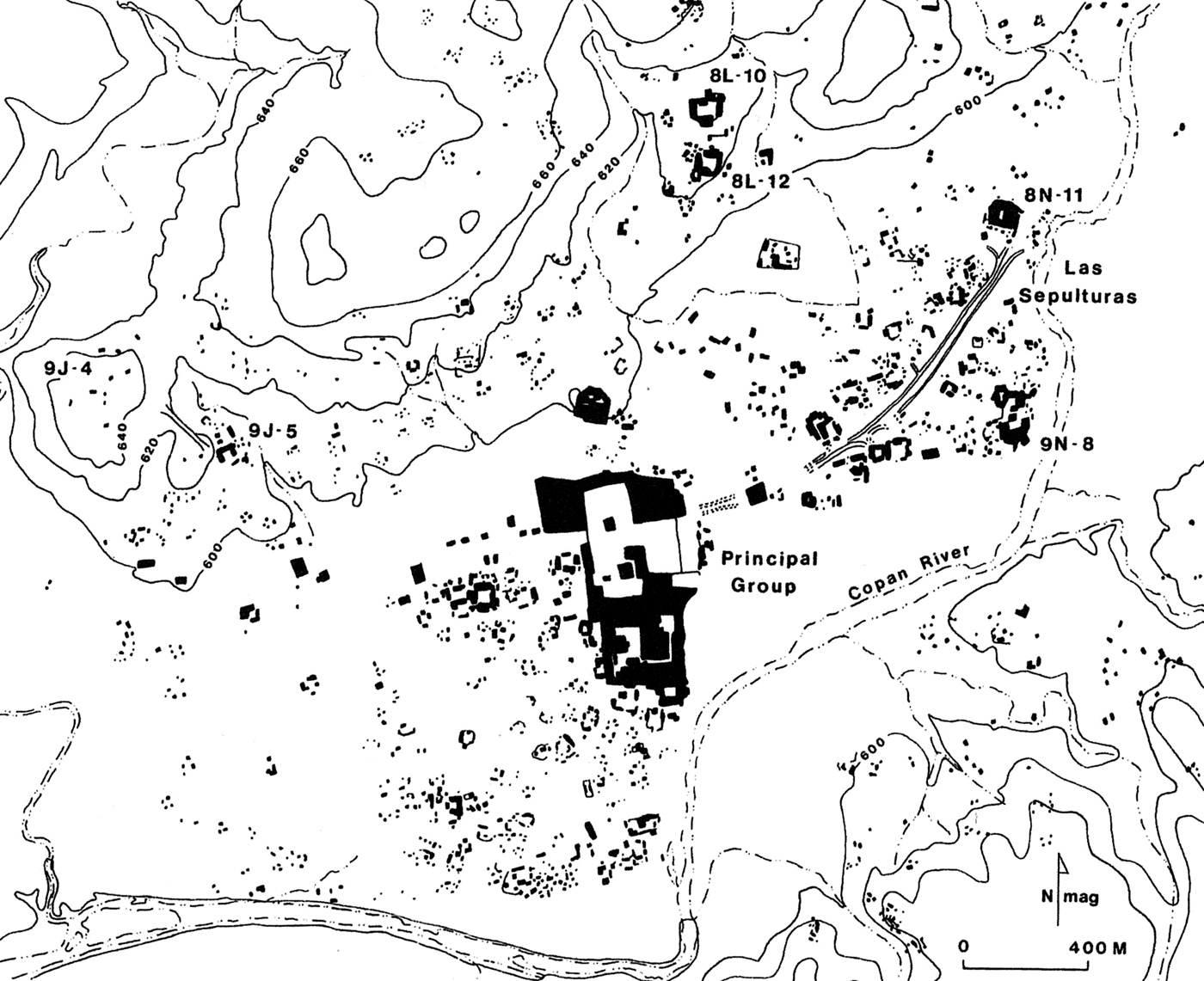
Eastern part of Copan Valley, highlighting Groups 8L–10 and 8L–12, near top, and Main Group (Principal Group) (Reproduced by permission of the Society for American Archaeology, from Latin American Antiquity 1991:204).
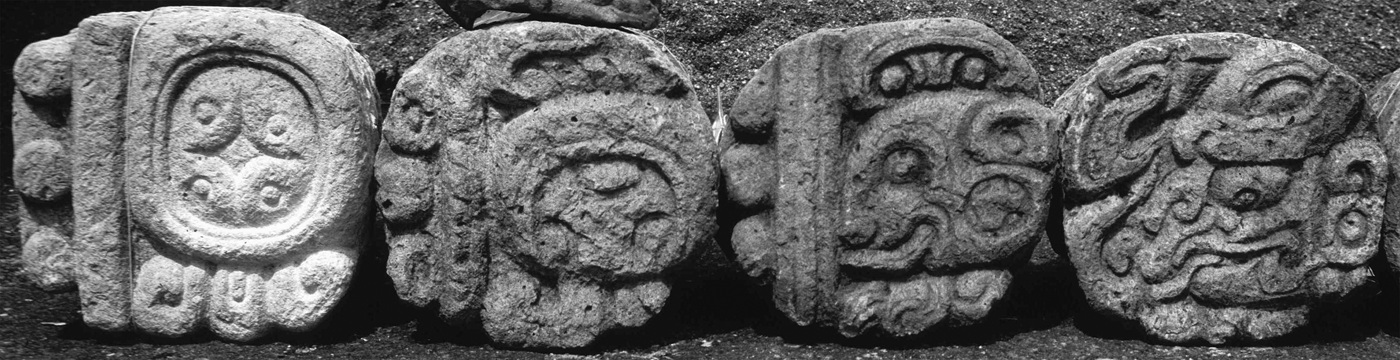
Elements of architectonic inscription fallen from Copan Structure 8L–74, including (left to right) Calendar Round date 8 Lamat 6 Tzec, in two stones, and in the remaining two stones, Waxaklajuun Ubaah K'awil name. Individual stones had fallen separately from building façade, re-positioned here in north to south order as recovered (author photo).
Elsewhere, Christine Kitchin (formerly Carrelli), Pamela Geller, and I have proposed that this architectural compound, now known prosaically as Copan Groups 8L–10 and 8L–12, and nicknamed the Copan North Group, ultimately sheltered fragments of Ruler 13's skull, plausibly returned to his home by later, re-pacified lords of Quirigua, on a Calendar Round anniversary of the axe event of a.d. 738 (Ashmore Reference Ashmore1988, Reference Ashmore1991, Reference Ashmore, Lozada and Donnabháin2013; Ashmore and Geller Reference Ashmore, Geller, Rakita, Buikstra, Beck and Williams2005; Carrelli Reference Carrelli1990:183). The skull fragments in question, accompanied by two jade-inlaid teeth, were encountered within and adjacent to a simple bowl that was ostensibly a grave offering for the sole tomb burial in the more northern Group 8L–10 (Figure 12; Ashmore Reference Ashmore1988; Carrelli Reference Carrelli1990:39). But the two intact skeletons in the tomb, a man and a woman, were not, in our view, the ones honored in this funerary chamber.
Tomb burial XLII-5, from Copan Group 8L–10, in which cranial fragments and jade-inlaid teeth, in and next to the vessel at upper left, just outside the niche, might be the physical remains of Copan Ruler 13, Waxaklajuun Ubaah K'awil (author photo).
Rather, I propose that the skull fragments, much more weathered than the intact skeletons, were components in a complex act of remembrance for Ruler 13 that was expressed across the entire compound—its buildings, architectonic sculpture, this interment, and even an offering placed at the entry to the compound that would have commemorated the decapitation that took his mortal life in a.d. 738—one and then two Calendar Round completions, that is, some 52 and 104 years later or both (Ashmore Reference Ashmore1991). The former date would fall in the reign of Yax Pasaj (a.d. 790); the latter (a.d. 842) was well after his death and the end of the Copan dynasty. Both sets of acts extolled the dynastic past, and as suggested next, that of 842 arguably looked forward to new networks that might reinvigorate the polity.
I suggest that, in a.d. 790, Yax Pasaj Chan Yopaat originally commissioned the architectural compound in remembrance of Ruler 13. The final form of the burial, however, must be later by another Calendar Round (a.d. 842), for it included a Pabellon Molded-carved vessel, an imported pottery type not circulated before a.d. 830. Stratigraphically, the burial is wholly outside of the footprint of adjacent Structure 8L–77; although the slabs capping the tomb did not appear on encounter to have been moved, an evident cut line at the eroded plaza surface above suggested reentry, perhaps to add the bowl with the skull fragments, or the Pabellon Molded-carved vessel, or both (Ashmore Reference Ashmore1988:8). The fragmented skull, that most potent of body elements, came to stand in for the whole man, to be commemorated at last by the act of interment and continued mortuary ritual at the spot.
Probably not coincidentally, the tomb of his loyal successor, Yax Pasaj Chan Yopaat, is believed to be the anciently looted tomb in Structure 10L–18, located in the Copan Acropolis, and due south of the proposed mortuary shrine to Ruler 13 (see Figures 4, 10). This would have been along the appropriate north-south axis, in the appropriate direction for royal ancestral recognition (Ashmore Reference Ashmore, Hanks and Rice1989, Reference Ashmore1991, Reference Ashmore, Atkin and Rykwert2005). As Gabrielle Vail reminded me, north is often associated with the maize god, and the maize god is closely associated with Maya divine kings (Taube Reference Taube and Robertson1985, Reference Taube and Houston1998, Reference Taube and Carrasco2001).
Quirigua: K'ak Tiliw Chan Yopaat
The case of Quirigua's rebellious K'ak Tiliw Chan Yopaat differs from the others yet again, at least in part. Before his death in a.d. 785, after some 60 years on the throne, this king had re-written the history materialized in the civic center of his polity through architecture and sculpted monuments, acknowledging predecessors but most emphatically singing the praises of his new regime, its association with creation events, and its new political superiority to Copan. In fact, the central message for visitors to the civic center became tightly bound up with this single, aggressively assertive king. As hinted earlier, it was left to his Quirigua successors, Sky Xul and Jade Sky, to manage his legacy and ultimately to repair relations with Copan.
The immediate successor, Sky Xul, returned attention to the Quirigua dynastic founder, sealing the ancestor shrine with a long, low platform on which he then commissioned a newer, larger version. He celebrated the founder in new construction and in texts on new sculpted monuments. This same king also performed in rituals honoring both rebel king K'ak’ Tiliw and his vanquished lord, Copan's Ruler 13, at each of their capitals (Jones et al. Reference Jones, Sharer, Paredes, Pallan, Cobos and Canton2008; Martin and Grube Reference Martin and Grube2008:224). In all, Sky Xul sought to honor his founding ancestor and promote better relations with Copan without directly castigating rebel king K'ak’ Tiliw.
The next successor and final documented Quirigua ruler, Jade Sky, had a distinctly different diplomatic strategy—seeking favor from Copan's king, while pushing Quirigua's rebel king and his actions out of the picture as much as possible. There is some irony in the fact that the Copan king in question was its Ruler 16, the staunch devotee of his predecessor, Ruler 13, who had been beheaded at Quirigua.
How did these strategies shape remembrance of rebel king K'ak’ Tiliw within his capital? There are no direct indications of where or how he was buried after his death in 785, although Fitzsimmons (Reference Fitzsimmons2002:186–187) calls attention to hieroglyphic remarks about these matters.
Indeed, no royal burials except that of the founder have been encountered at Quirigua, but there are material hints about where this king might have been interred. Martin and Grube give some tantalizing clues: on “the quarter-Katun ending … in [a.d.] 795 [, the rebel king's immediate successor, Sky Xul] ‘scattered droplets’ at the ‘13 Kawak House’—the burial site and memorial shrine of [his predecessor], K'ak’ Tiliw Chan Yopaat” (2008:224).
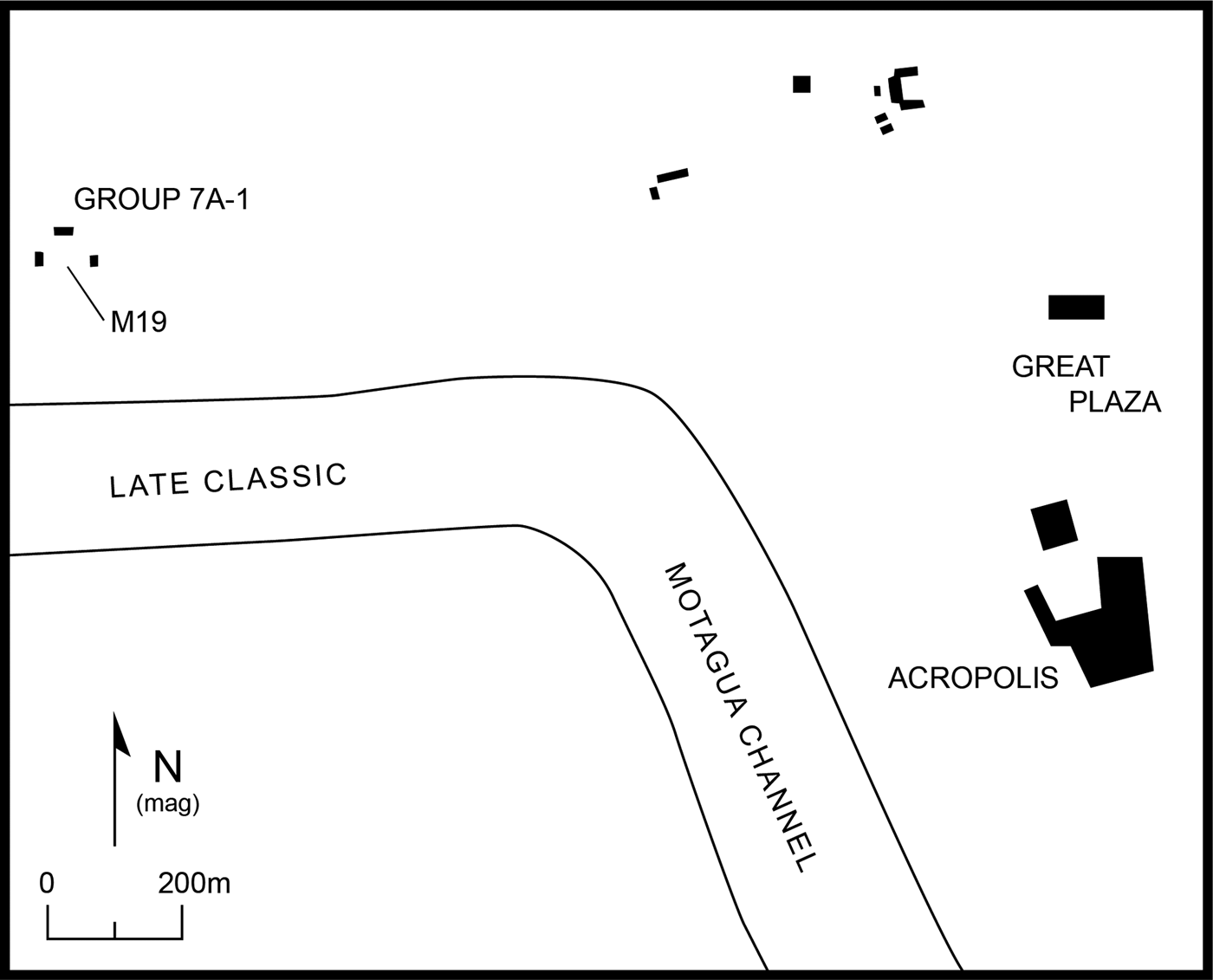
This event came ten years after K'ak’ Tiliw's death, and its location is not at all clear from inscriptions. Its original location might have been somewhere within the Quirigua royal precinct. Elsewhere, however, I have suggested that 13 Kawak House, or the final version of it, might have been part of Group 7A–1 (Morley's [Reference Morley1923, Reference Morley1935] “Group B”), by 1975 an unimposing, plowed-over patio group a kilometer and a half west of the modern Quirigua Park—just north of the modern access road—and now shrouded in banana trees (Figure 13; Ashmore Reference Ashmore2007, 2009). The key in this argument is Monument 19, the earliest of K'ak’ Tiliw's portrait stelae, dedicated in a.d. 746, six years after the successful revolt from Copan.
Schematic map of Quirigua floodplain settlement, highlighting location of the Great Plaza, Acropolis, Group 7A–1 and Monument 19 (Adapted by Eric Heller, from Ashmore Reference Ashmore2007:Figure 4.10, by permission of the University of Pennsylvania Museum).
Archaeological evidence from both the Quirigua Great Plaza and Group 7A–1 suggest that Monument 19 had been moved and re-erected in a new location (Ashmore Reference Ashmore2007; Jones et al. Reference Jones, Ashmore, Sharer, Sharer, Schortman and Urban1983:10, 19–20; Sharer Reference Sharer1990:68). Excavations in the Great Plaza encountered remains of a masonry cap for a stela foundation, but lacking the stela. Its location would mark the third or northeast corner of a triangle with the other two earliest of the Quirigua rebel king's portrait monuments following the Copan break—a logical place for Monument 19.
In Group 7A–1, on the other hand, the foundations archaeologists encountered for Monument 19 are unlike those of the two other early post-revolt Great Plaza monuments, 8 and 10, and more similar to the cribbing support beneath Monument 9, one of the final Quirigua king's portrait monuments, dedicated in a.d. 800. In short, twentieth century archaeologists encountered a stela dedicated in a.d. 746 which proved to have a foundation style appropriate to a.d. 800—more than 50 years out of synch (Ashmore Reference Ashmore2007, 2009; Jones et al. Reference Jones, Ashmore, Sharer, Sharer, Schortman and Urban1983:19–20).
If the inferred chronology above is roughly correct, re-setting followed the rebel king's death by perhaps some 15 years. Because Monument 19 was re-set in the center of a small, publicly accessible plaza, it seems plausibly a place where continued royal veneration could have taken place, with its somewhat removed location a diplomatic step by royal peacemaker Jade Sky, to allow local commemoration of his rebellious predecessor. In Sharer's felicitous phrase, Monument 19 was the rebel king's “stela of independence” (personal communication, 2006). Local respects to the king and his earliest post-revolt monument could still be paid, but in a more isolated location for its expression, and thereby perhaps less offensive to visiting Copan dignitaries, disembarking from the Motagua River at the Great Plaza, west of Structure 1A–11 (see Figures 2, 9; Ashmore et al. Reference Ashmore, Schortman, Sharer, Sharer, Schortman and Urban1983:56–57).
In that regard, Group 7A–1 might parallel the previously mentioned memorial at Copan's North Group as a place to commemorate a venerable but either lost or controversial king—in the Copan case, honoring the very same king who had fallen victim to the Quirigua revolt (Ashmore Reference Ashmore1991, Reference Ashmore, Bowser and Zedeño2009, Reference Ashmore, Lozada and Donnabháin2013). However, while the Copan king who sponsored this memorial recognition of his assassinated predecessor also honored that sovereign in multiple other ways, Quirigua's final king, Jade Sky—at about the same time—pointedly distanced himself from his own, disruptive forerunner. Jade Sky's “distancing” was material and literal in the relocation of Monument 19, in contrast to more muted distancing in texts, where Looper says the uprising is dismissed “as a thing of the past, engineered by a now defunct foreign power” (Looper Reference Looper1995:193; Reference Looper1999:276–277).
Neither Sylvanus Morley's excavations in Reference Morley1923, nor our own in 1977, encountered any evidence of a tomb in Group 7A–1, although probes might have stopped short of an appropriate location, and the entire compound had been severely damaged and eroded by the time of our 1977 inquiry. Nevertheless, I offer the possibility that Group 7A–1 could well have been the final resting place of K'ak' Tiliw, a meaningful placement for which the relocation of Monument 19 perhaps provided closing accentuation. In this case, mortuary practices would have been spread, if perhaps intermittently, over some 15 years. If the preceding is correct, the place of inferred final interment was certainly situated appropriately, at the western edge of the legendary king's capital, at the western end of the Quirigua settlement, a direction leading toward death.
DISSCUSSION
The foregoing narrative has discussed mortuary practices and ancestor veneration for four Classic Maya kings, the dynasty founders at Copan and Quirigua, and the eighth century adversaries who caused a reversal of centuries-old relations between the same two polities. What I have sought to show is that the customs scholars have documented for Classic Maya death and commemoration were prominent in the case of these four rulers. For each, however, the specifics of remembrance actions and the intensity of their expression varied considerably, as did the implied temporality of their commissioners (see Table 1).
That is, both dynasty founders were honored at their death and celebrated in creation of later ancestor shrines overlying their places of interment. Each was buried soon after death in the polity capital, in its emerging royal center. The political hierarchy in Copan/Quirigua relations, however, from the time of early fifth-century establishment of the two dynasties, seems evident in the kinds of interments, relative abundance of grave offerings, and scale of subsequent ancestor shrine elaboration.
In contrast, for the two eighth-century kings our knowledge is “equivalent” in that we can't say definitively where or how either of these rulers was buried. Their posthumous commemoration is clear in texts postdating their deaths, and to some extent in construction acts by their successors.
At Copan, the death of Waxaklajuun Ubaah K'awil (Ruler 13) was lamented from the time of his beheading, his loss prompting profound changes in Copan governance thereafter—sharing royal authority with local leaders in a Council House—and softening the portrayal of revered Ruler 13's death as lost nobly in battle rather than by stark allusion to beheading by his captor. If the Group 8L–10 skull fragments discussed are his, acts of remembrance conceivably lasted more than 100 years, until final interment north of the Copan civic center in a compound dedicated to his memory.
At Quirigua, on the other hand, its rebel king's death elicited serially different responses from his two royal successors. Temporal orientations differed between these two. Immediately after his death, the rebel king K'ahk’ Tiliw Chan Yopaat was still honored, although actions of the new Quirigua king, Sky Xul, sought quickly to assuage Copan's disfavor. And Quirigua's final king, Jade Sky, sought to distance himself as far as possible from his rebellious predecessor, in inscriptions and construction acts, and perhaps involving (re-)interment of that king's mortal remains some 15–20 years after death.
CONCLUSIONS
The aim of this article has been to explore the value of comparing mortuary practices over time for rulers at politically and economically linked centers, to develop experimental interpretations integrating events and actions from independent but in the end, largely convergent lines of available evidence. Certainly others have reported deeply insightful considerations, highlighting individual dynasties or exploring the kinds of acts of remembrance from which people chose (for example, Baron Reference Baron2013; Bell Reference Bell2007; Coggins Reference Coggins1975; Martin and Grube Reference Martin and Grube2008). The particular case presented here has paired Classic period Copan and Quirigua, where for centuries, the former was overlord to the latter.
The four rulers selected—the fifth-century founders of dynasties of each place and two eighth century royal adversaries—were instrumental in shaping the course of political and economic history of their own polities and the wider region. Examining these particular cases has shown that many of the known ancient Maya mortuary actions were brought into play, varying in specific customs mobilized and in messages those practices conveyed. Closer examination of evidence about the cited four kings led to this experimental consideration of possibly contingent diversity in ancient attitudes toward and treatments of deceased Maya kings.
From the fifth century on, Copan kings consistently looked back, honoring their dynasty founder, and later, the thirteenth king, whose capture and assassination disrupted earlier, unmatched Copan authority in the region. They also looked forward, toward continuity or re-establishment of dynastic and polity success. At Quirigua, kings immediately following the founder are substantially less known, and by the seventh century were fluctuating between looking back toward the founder and forward toward Copan. The rebel king, K'ahk’ Tiliw Chan Yopaat, altered temporalities by focusing on himself and his deep-time links to creation, far more than to his dynastic ancestor. His two successors vacillated between renouncing their immediate ancestor, honoring the founder, and catering to Copan.
This is far from the last consideration of the topics broached herein. What seems to me the relative success of the experimental study will hopefully inspire others, both to critique the result and perhaps to extend it in other cases.
RESUMEN
La historia de los mayas del período clásico es sumamente política y, por ende, las actividades políticas y religiosas son a menudo inseparables. Con base en esta premisa, el presente ensayo se propone de comparar diacrónicamente las prácticas funerarias dirigidas a los gobernantes de centros relacionados por vínculos políticos y económicos. De manera más espécifica, queremos esbozar un modelo para entender cómo las acciones de conmemoración en la veneración de los antepasados reales se conectaban con las dínamicas políticas y económicas locales y regionales. Queremos, además, abordar este tema enfocándonos en aquellas prácticas para las cuales tenemos detalladas informaciones arqueológicas, bioarqueológicas, textuales e iconográficas. Este ensayo propone un modelo para integrar las evidencias procedentes de un caso específico en una interpretación de la secuencia de acontecimientos y acciones a llevarse a cabo. Para este fin es menester abordar la gama de prácticas funerarias existentes entre los mayas clásicos de las tierras bajas. Tal discusión ilustra la heterogeneidad de las acciones que hubieran podido desempeñarse en diferentes ocasiones.
En específico, consideramos cuatro gobernantes de dos ciudades del período clásico, Copan y Quirigua, en donde la primera estuvo dominando la segunda por muchos siglos. Los personajes elegidos incluyen a los dos fundadores de las respectivas dinastías en el siglo V y a dos gobernantes adversarios del siglo VIII, cuyas acciones subvirtieron las relaciones establecidas entre Copan, Quirigua y sus vecinos.
Los cuatro reyes considerados tuvieron un papel fundamental en moldear el curso de la historia política y económica de sus reinos y de las regiones circunvecinas. Un análisis puntual de sus contextos mortuorios ha puesto en luz que también para estos gobernantes se llevaron a cabo mucha de las prácticas funerarias mayas conocidas hasta la fecha. Éstas variaban en términos de costumbres y en los mensajes transmitidos, lo que evidencia una patente diversidad en las acciones de conmemoración de los difuntos reyes mayas.
ACKNOWLEDGMENTS
My thanks go first to Loa P. Traxler, who invited me to prepare the precursor to this essay as keynote address for the 31st Annual Maya Weekend, April 2013, and to the late Robert J. Sharer, who was honored there, for decades of his innovative scholarship, unselfish mentoring, and invaluable collegial generosity. This paper is dedicated to Bob and to Loa.
Research at Quirigua (1974–1979) was pursued under contract between the Instituto de Antropología e Historia (IDAEH), Guatemala, and the University of Pennsylvania Museum. William R. Coe and Robert J. Sharer directed research for the University of Pennsylvania Museum, with funding from the National Geographic Society, National Science Foundation (BNS 7602185, 7624189, 7603283), University of Pennsylvania Museum (Francis Boyer Museum Fund), Ford Foundation, Tikal Association, Guatemalan Ministry of Defense, Museum Applied Science Center for Archaeology (University of Pennsylvania Museum), Department of Anthropology (University of Pennsylvania), Landon T. Clay, Alfred G. Zantzinger, and Dr. John M. Keshishian. At IDAEH, I thank directors Dr. Luis Luján Muñoz, Lic. Francis Polo Sifontes, Arq. Marcelino Gonzalez Cano, and Sr. Enrique Monterroso R.
The Proyecto Arqueológico Copan de Cosmología (Copan North Group Project; 1988–1989) was formed by contract with the Instituto Hondureño de Antropología e Historia (Lic. Victor Cruz Reyes, former director, and Lic. Jose Maria Casco, director) and carried out investigations with support from the National Geographic Society (Grants Nos. 3774–88, 4029–89) and Rutgers-The State University of New Jersey (Office of the Provost and the Graduate School).
I would like to thank the following, besides Bob and Loa, for critical input at various junctures: Ricardo Agurcia F., Marshall Becker, Jane Buikstra, José Crasborn, Barbara Fash, Bill Fash, Pamela Geller, Christina Halperin, Christopher Jones, Christine Kitchin, Richard Leventhal, Ed Schortman, Pat Urban, Gaby Vail, and most of all, Tom Patterson. Normand Hammond and an anonymous reviewer provided important, thought-provoking comments that helped me strengthen the arguments presented here. Nicoletta Maestri capably translated the Spanish summary, and Eric Heller skillfully created or adapted Figures 1 and 10. I am grateful to all; none is responsible for any errors I've made.