1. Introduction
There is no doubt that a ‘nation-wide enthusiasm for learning English’ (Jiang, Reference Jiang2002) has spread across China. English, as a global language, has been widely used in international politics, trade and business, and information communication (McArthur, Reference Pituch and Lee2001); mastering English could enable Chinese people to participate in global competition more effectively (Wu, Reference Yang and Chan2009). China has the largest population currently learning English, varying from 440 to 650 million (Bolton, Reference Bolton2003; He & Zhang, Reference He and Zhang2010). A high level of proficiency in English will enable users to score extra points in job hunting and career advancement in an increasingly competitive job market (e.g., 51 candidates competed for one civil service post in China in 2013), thus, a huge number of school students in China are keen on learning native-like English and spend large amounts of time learning the language (Shen & Yuan, Reference Shield and Kukulska-Hulme2013).
Technology, particularly the internet, is widely used in everyday life, even in underdeveloped western areas in China. Technology has become invisibly embedded in people’s everyday practice (Bax, Reference Bax2003). By the end of June 2013, China’s population of internet users reached 591 million, with 78.5% of them (464 million) using mobile phones to access the internet (CNNIC, 2013). It has been long accepted that the internet, computers and mobile devices should be applied in learning English in China (Li, Reference Li2008). The internet has offered a unique learning channel and opportunity for English language learners to learn and practise English (Yang & Chan, Reference Yu and Shen2008). The new College English Curriculum Requirements has proposed that Chinese university students acquire linguistic and cultural knowledge to achieve adequate language competence with the support of advanced technology, such as computers and the internet (Chinese College English Education and Supervisory Committee, 2007).
English language learning (ELL) websites serve as platforms for language learners to acquire and practise their language knowledge, particularly for non-native English speakers (Vogel, Reference Wilkinson, Bennett and Oliver2001). Many ELL websites have been constructed to attract different levels of Chinese English language learners. Most of these websites are operated by government institutions, such as China Daily and China Central TV University, or enterprises, such as Shanghai Hu Jia Cultural Media Ltd. Co. and Foreign Language Teaching and Research Press. English training institutes, such as The New Oriental School, have set up their own websites, which are used by their enrolled students for independent learning. Online curriculum support courses and English websites are other digital resources used by Chinese English learners and users to acquire their knowledge of English language and culture. These resources provide language learners with up-to-date information as well as authentic learning materials assisting Chinese English language learners to enhance their language competence.
As Chinese EFL teachers play an indispensable role in this changing process of English language teaching and learning, this study investigates their views on the design and use of ELL websites from the users’ perspectiveFootnote 1. This article reports on the findings of Chinese university teachers’ perceptions of online English language practice by analyzing in detail a number of popular ELL websites as well as a variety of language materials. The key research questions examined in this study are:
1) How do Chinese EFL teachers perceive ELL websites and digital resources in terms of their usefulness in teaching English practice in China?
2) What counts for a good ELL website in the eyes of Chinese EFL practitioners?
2. Components of ELL website analysis and design
As good websites provide valuable information and insights for their users, there is an increasing amount of literature focusing on the criteria for evaluating overall website information. Objectivity, content, navigation, currency and authority, for example, are scrutinized carefully (Laura, Reference Laura1999; Wilkinson, Bennett & Oliver, Reference Williams and Burden1997). While learning websites serve as teaching aids or self-directed learning opportunities, they need to consider users’ abilities, qualities, motivations, materials, and potential interaction among website users (Furner & Daigle, Reference Furner and Daigle2004). Recent armchair research (Kettle, Yuan, Luke, Ewing & Shen, Reference Kettle, Yuan, Luke, Ewing and Shen2012) has indicated that the most popular Chinese ELL websites have been predominantly pedagogical, providing a wide range of learning materials, linguistic or cultural, as well as instructional scaffolding, learning strategies, and self-directed practice for diverse English language learners.
Moreover, English language learning is not different from other language learning as the language embodies part of a person’s identity, and is used to convey one’s identity to others (Yang & Chan, Reference Yu and Shen2008). Learning a language involves learning cultural knowledge, social rules, linguistic functions, and psychological reactions apart from language knowledge itself (Davies, Reference Davies2001; Liu, Liu & Hwang, Reference McArthur2011; Saville-Troike, Reference Shen and Yuan2006; Williams & Burden, Reference Wu1997).
Hubbard (Reference Hubbard1988) has proposed that learner and teacher are two essential components in the evaluation of courseware to fit the development and implementation of Computer Assisted Language Learning (CALL). As not every language teacher has the opportunity to receive professional training in using computers, they may have limited knowledge of how to utilize technology in their teaching practice (Hubbard, Reference Hubbard2006). This study focuses on examining Chinese EFL teachers’ views of the application of technology and web-based English materials in ELL websites for their classroom English teaching and learning.
Major language areas, skills and learning materials are chosen as various components in eliciting Chinese EFL teachers’ views of English learning websites as they help language users develop both linguistic and communicative competence through online learning practice. Additionally, language users’ preferences and website usability might directly affect the options of ELL websites. These various components will be taken into consideration when examining language users’ opinions of ELL websites.
2.1. Major language areas and skills
Grammar, vocabulary, reading, writing, pronunciation, listening, speaking and culture are major language areas attracting a diverse range of CALL technologies and approaches in second language or foreign language learning (Levy, Reference Levy2009). Major language areas are closely connected with all language modes: reading, writing, viewing, listening and speaking, which influence learners’ communicative competence in their language development process (Liu et al., Reference McArthur2011). An effective integration of these language modes in ELL websites may help learners to develop their language knowledge as well as skills of the target language. As major language areas and skills have played key roles in the process of achieving language competence, this study invites teachers’ views of how these language and skill areas are being developed in ELL websites and other sites with appropriate digital resources.
2.2. ELL website learning materials
Rich and diverse language learning materials can assist learners to better achieve their aims in the teaching of the target language (Tomlinson, Reference Vogel2003). ELL website materials provide a variety of teaching and learning resources, including a range of texts and audio-visual materials, for language users to nurture their target language (Shield & Kukulska-Hulme, Reference Sykes and Cohen2006). With high technologies, it is much easier for language users to utilize ELL website learning materials through multi-channel opportunities to practice their language skills as well as language areas that help to develop their language competence (Chapelle, Reference Chapelle2009). Hence, functionally integrating learning materials with information and communication technology (ICT) can enable language users to interact with the website learning materials to achieve success in language learning (Liu, Reference Liu, Liu and Hwang2005; Liu et al., Reference McArthur2011). Recent research (Kettle, et al., Reference Kettle, Yuan, Luke, Ewing and Shen2012) conducted a detailed content analysis of various ELL websites by PageRank (a technical method to measure the level of popularity of websites in a number of components as determined by Google Internet search engine). Our study examines the teachers’ point of view of the materials provided by ELL websites, which could offer valuable data for the design of ELL websites, particularly in material selection and task development to better cater for users’ needs.
2.3. Language users’ preferences
Consideration of users’ preferences is essential when evaluating the design of a language learning website (Karoulis, Demetriadis & Pombortsis, Reference Karoulis, Demetriadis and Pombortsis2006; Shield & Kukulska-Hulme, Reference Sykes and Cohen2006). Users are able to benefit from the learning system of a website that is based on their preferences (Pituch & Lee, Reference Preece2006). Website content and the practical use of the website may influence the users’ perceptions (Hughes, Mcavinia & King, Reference Hughes, Mcavinia and King2004; Sykes & Cohen, Reference Tomlinson2008). Users choose to use the online content as well as the website according to their preferences (Liu et al., Reference McArthur2011). Thus, the language user’s preference, which is a significant factor in the evaluation and design of an effective language learning website, is a major focus in this study.
2.4. Website usability
Website usability, which makes systems easy for users to access and learn, affects users’ choice of website (Preece, Reference Saville-Troike1995). Ease, user experience, and interaction design are the three key components of generic website usability (Shield & Kukulska-Hulme, Reference Sykes and Cohen2006). A highly interactive website is marked by ease of use of the functions. This could provide a better user experience and ensure the popularity of the website. Language learning websites are often used as a supplementary learning tool in classroom teaching and learning, or as a method to acquire language competence independently (Pituch & Lee, Reference Preece2006). Accordingly, it is crucial to engage users in a website of content-rich learning contexts and hypermedia-based programs with an easily functional system that can help users to achieve better learning outcomes (Liu et al., Reference McArthur2011).
All these components have been considered in the research design and methods of this study.
3. Method
3.1. Participants
A total of 1519 English language academics from 139 universities across 25 out of 31 provinces or municipalities in China, who were attending pedagogical training workshops in Beijing, China, completed the online survey. One hundred and sixty-four of them voluntarily participated anonymously in interviews. The workshops were organized and supported by the China National Research Centre for Foreign Language Education of Beijing Foreign Studies University and the Foreign Language Teaching and Research PressFootnote 2 aiming at improving English language teaching standards across China. Prior to these workshops, there had been no training workshops designed for introducing online English language practice. All participants were informed of the aims of this study by the researchers and showed their interest in participating in the research, as online English learning is an emerging trend as well as a new requirement in classroom English instruction in China (as stipulated in College English Curriculum Requirements by Chinese College English Education and Supervisory Committee (2007)).
Among these academics, 689 of them (45.34%) had over ten years of experience in teaching English; 449 of them (29.54%) had taught English from six to ten years, and 381 academics (25.12%) had taught English for less than six years. Only 243 of them (16.03%) had more than three months of overseas language learning experience. The interviewees were divided into eighteen groups, sixteen groups of nine participants and two groups of ten participants for focus group interviews.
3.2. Online survey
The purpose of the online survey for this study was largely to capture a broad picture of Chinese EFL teachers’ perceptions of English language teaching and learning with the integration of computers and supported by web-based English resources. Specifically in this study, it helps set the scene for a more exhaustive study of the participants’ views of the emerging instructive mode and the English resources carried by these ELL websites. The online survey was also used as a means of recruiting interviewees for this qualitative study. The survey consisted of close-ended and Likert-type questions. Questions were developed on the basis of the findings of previous studies (for example, Chapelle, Reference Chapelle2009; Kettle, et al., Reference Kettle, Yuan, Luke, Ewing and Shen2012; Liu et al., Reference McArthur2011; Sykes & Cohen, Reference Tomlinson2008). It took participants approximately twenty minutes to complete the online survey.
There were 30 Likert-type questions with 7-point scales ranging from: 1=strongly disagree; 2=disagree; 3=disagree somewhat; 4=neutral; 5=agree somewhat; 6=agree; 7=strongly agree, to collect statistical data. The use of Likert-type scales can effectively avoid loading participants with immense work and ensure an accurate report. A sample Likert-type question applied in the study was: Chinese ELL websites provide sufficient materials for a variety of examinations (see Appendix 1: Online survey). Percentages, means and standard deviations were used to analyze the questions. Results were presented in tables as well as described in words. The Statistical Package of the Social Sciences (SPSS) Version 17 was used to obtain descriptive analysis of the data only as the research sample of this study was large and it was not appropriate to employ inferential analysis, which was used to analyze a small number of research samples.
Influenced by traditional Chinese Confucian culture, the participants avoided showing their extreme preferences, for example, strongly disagree/agree (Category 1 or 7), when they completed Likert-type statements. They were more likely to give the moderate answer to each statement. A number of them (around a quarter) preferred to choose the neutral reply (Category 4), indicating their uncertainties about the emerging digital English learning resources, such as ELL websites or English news/magazine websites. In order to present a clear and concise data report, the researchers employed ‘positive’ (Category 5–7) or ‘negative’ (Category 1–3) aspects to report the results of the Likert-type statements. As indicated earlier, this was a qualitative study that focused primarily on the interview data and only engaged some online survey data as illustrative or supportive evidence. A separate quantitative study will follow to analyze in great detail the online survey data gathered from a large sample to map statistically the scope and scale of EFL teaching and learning in Chinese universities as part of a large project.
3.3. Interviews
The interviews in this study aimed to collect data about Chinese English academics’ viewpoints on ELL websites or English news websites. Their opinions on the current supporting online resources for English textbooks used in China were also sought. Due to the various roles these academics had played, such as language mentors and learners, they were able to provide related data on both teaching and learning aspects. Interviews were conducted after the workshops in order not to disturb the normal training programs. Each focus group interview lasted 60 minutes, and interviewees’ replies were recorded by the researchers.
Interview questions were developed on the basis outlined in the online survey, and were prepared in both English and Chinese. Sample interview questions utilized in this study were:
∙ Do you often visit English learning websites or English news/magazine websites?
∙ What is your opinion of the examination materials provided by Chinese English learning websites?
∙ What other teaching resources and self-study materials are needed apart from those provided by the online learning course? (See Appendix 2: Interview questions)
The interviews were carried out in Chinese as all participants could better understand the interview questions and express themselves much more freely and accurately in their first language (L1). All the written records were in Chinese and back translated (Brislin, Reference Brislin1970) by a professional translator: translating from Chinese to English, and back to Chinese to ensure the reliability of the data. Across the eighteen group interviews there was a convergence of interviewees’ opinions. The collected data were compared and reported in one voice as the overlapping data were removed in order to avoid redundancy in data reporting. Pseudonyms in place of real names were used in data categorization and report. Participants were given identification codes to ensure anonymity.
Prior to this research being conducted a detailed ethics application was prepared and approval was obtained from the Human Ethics Committee of the University of Sydney, Australia.
4. Data results and analysis
The collected data from both online survey and interviews were grouped and presented by means of word description as well as descriptive statistics, such as frequency and percentage. As all participants attended the interviews anonymously, pseudonyms were used in data reports and discussion. The data were reported in three broad categories: (1) Chinese English academics’ viewpoints of the online support courses compared to classroom teaching and learning materials; (2) their opinions of both Chinese and overseas ELL or English news/magazine websites, and (3) their understanding of a popular ELL website among Chinese English language users. An attempt was made to arrange into various categories data regarding major language areas and skills, learning materials, users’ preferences, and website usability.
4.1. Online support courses compared to classroom teaching and learning materials
As computers are required to be integrated into the pedagogy of English as a foreign language (Chinese College English Education and Supervisory Committee, 2007), almost all materials used in Chinese EFL classrooms have been provided with online support courses for classroom teaching and learning, and students’ independent learning and self-assessment. All interviewees (100%) agreed:
“The EFL classroom teaching and learning materials published by various large publishing houses have their online support courses, for instance, Experiencing English, New Horizon College English, New College English, and 21 stCollege English.”
One hundred and nine interviewees claimed that online support courses were applied in their classroom teaching, while 92 teachers indicated that online courses were utilized for students’ independent learning after class. There appears to be some overlapping in the number of responses from the interviewees. This could be explained by the fact that some teachers indicated one purpose (for classroom teaching only or students’ independent learning only) and some teachers (37 out of 164 participants) indicated more than one purpose. The following table displays the major purposes of the application of supporting online courses (Table 1):
Major purposes of supporting online courses

Fifty interviewees (30.49%) indicated they would not search for additional online resources to supplement their teaching. They believed that the current online courses were mainly composed of listening and speaking sessions, focusing on the assessment of classroom teaching and learning (for example, interviewees Lin, Mike, Peter & Young). Almost all materials came from the US and the UK (Martin). Ann highlighted:
“The online courses should include more cultural knowledge of English speaking countries, and materials should be from diverse countries or areas, for example, Canada and Australia, instead of the US and the UK only.”
More than half of those who used online courses for students’ independent learning (51.83%) pointed out that materials provided by online courses were not adequate (for instance, Fan, Jane & Zhang). Most online courses were electronic versions of hardcopies of textbooks, and there was no point in students taking extra time to repeat the same learning content in their self-study (Jenny). Many academics (for example, Dai, Ni & Zhou) thought that online courses should include audiovisual materials and cultural knowledge, as well as testing materials to assist students in improving language competence in their independent learning. Additionally, they suggested that the selected materials should cover various countries or areas, not solely concentrating on the USA and the UK.
A large number of participants (114 interviewees) indicated that they would search for extra online materials to support their teaching in addition to those provided by publishing houses. The most common resources they liked to access were authentic audiovisual materials, such as English songs or movies, Voice of America (VOA) news or the British Broadcasting Corporation (BBC) recordings, which could provide students with up-to-date information and language. Students could also acquire some cultural knowledge and practise their listening ability while using these materials. Videos or pictures could help students better understand the context of the situation and acquire language knowledge (for example, Jane & Tom). The interviewees also indicated that they would try to acquire from the websites some testing materials to be utilized in their teaching (for example, Wang & Yu). Thus, online learning materials, to some extent, have provided additional information or knowledge for English language practitioners in China. The following section provides more detail about participant teachers’ opinions of the design and use of ELL or news/magazine websites in China and overseas.
4.2. Chinese and overseas ELL or English news/magazine websites
With respect to ELL or English news/magazine websites, 1232 participants (81.13%) in the online survey indicated that they often visited these websites. Distribution of source countries of the ELL and/or English news/magazine websites used by the respondents are listed in Figure 1.
Distribution of source countries of ELL or English news/magazine websites.

It was found that China-, US- and UK-based ELL or English news/magazine websites were frequently visited by Chinese EFL academics, with respective percentages of 38.46%, 34.25% and 22.84% among all accessible websites. Australian or Canadian websites each took up around 2% of the user market share in China. On the other hand, thirteen interviewees (for instance, Kim, Lucy & Xiao) claimed:
“We do not visit any of ELL or English news/magazine websites as we do not have time. Current English textbooks have provided enough information for Chinese learners.”
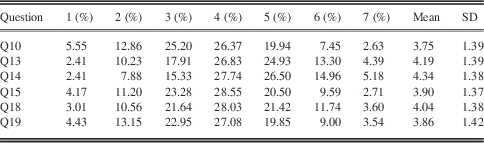
Chinese EFL teachers are much divided in terms of their preferences for Chinese ELL or news/magazine websites. Table 2 shows the range of this differentation.
Chinese EFL teachers’ preferences for Chinese ELL or new/magazine websites
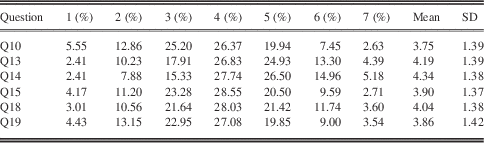
Note: 1=strongly disagree, 2=disagree, 3=disagree somewhat, 4=neutral, 5=agree somewhat, 6=agree, 7=strongly agree, SD=Standard Deviation.
Q10 Chinese ELL websites satisfy users’ needs in learning English.
Q13 Chinese ELL websites provide support and supplement to the classroom teaching and learning.
Q14 Chinese ELL websites provide sufficient materials for a variety of examinations.
Q15 Chinese English news/magazine websites satisfy users’ needs in learning English.
Q18 Chinese English news/magazine websites provide support and supplement to the classroom teaching and learning.
Q19 Chinese English news/magazine websites provide materials for a variety of examinations.
Data showed that less than one-third of the participants in the online survey thought that Chinese ELL websites (30.02%) or Chinese English news/magazine websites (32.80%) could meet users’ needs in learning English. On the other hand, more than two-fifths of academics agreed that Chinese ELL websites provided support and supplement to the classroom teaching and learning (42.62%) as well as adequate materials for different examinations (46.64%). Also, more than two-fifths of participants (40.53%) indicated that Chinese news/magazine websites did not include examination materials, and only around 36% of respondents agreed that these websites supported the classroom teaching and learning.
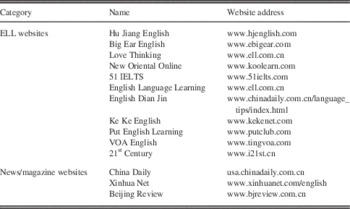
In the interviews, 79 participants indicated that they often visited China-based websites, while 85 responded that they frequently visited overseas websites. The most frequent Chinese ELL or news/magazine websites that the interviewees visited are listed in Table 3.
Frequently visited Chinese ELL or news/magazine websites

The interviewees gave a variety of explanations as to their options for these Chinese ELL or news/magazine websites. Victor indicated:
“We are able to acquire language learning and teaching materials as well as testing materials from various Chinese ELL websites. These websites are helpful to language users to acquire language knowledge as well as testing materials to pass a variety of examinations.”
Flora commented that:
“Language users can access various Chinese ELL websites focusing on different English tests or examines, such as Hu Jiang English, Ke Ke English and Put English Learning. Both written and audiovisual learning materials and testing materials can be downloaded from these websites.”
As examinations are still used as the benchmark in evaluating English language users’ achievement, it is common for many Chinese ELL websites to provide testing materials besides language knowledge. The academics believed that whether the ELL websites provided testing materials or not directly influenced the popularity of the websites. Additionally, the topics, informative or directive language options, and webpage design also had effects on the popularity of ELL websites. Victor added:
“Though the content provided by ELL websites covers a wide range of topics, the topics appear to centre around western countries. We hope that topics concerning Eastern/non-Anglophone countries can be included in the content of the websites.”
In addition, Nelson believed that:
“Whether the Chinese language or the English language is used as informatives or directives does not influence users’ options of the websites. However, the Chinese language allows easy access to various sessions of the website.”
Cindy states that:
“The webpage design of Chinese ELL websites is similar to Chinese news websites, for instance, Yahoo, SOHU and SINA. The webpages have exhibited all information that is easy for users to achieve. The Bulletin Board System (BBS), forum, blog, or similar network systems of the websites provide a platform for users to interact with each other or with language education experts.”
Only nine interviewees indicated that they frequently visited China-based news/magazine websites to read news, such as China Daily and Beijing Review.
“As these China-based news/magazine websites do not provide testing materials, the number of website users is certain to shrink a lot.” (Sen)
“Due to the high English language standard and wide-range topics, it is hard for lower level or even intermediate level language users to understand all the information provided by these websites.” (Wei)
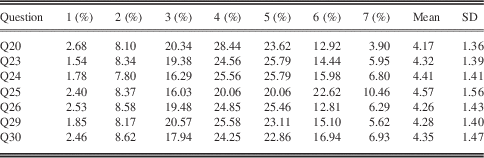
On the other hand, Chinese EFL academics identified their perceptions of overseas ELL or news/magazine websites in the online survey. Table 4 illustrates key statements of related aspects.
Chinese EFL teachers’ preferences for overseas ELL or new/magazine websites
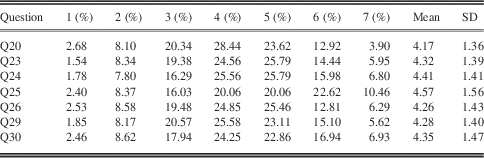
Note: 1=strongly disagree, 2=disagree, 3=disagree somewhat, 4=neutral, 5=agree somewhat, 6=agree, 7=strongly agree, SD=Standard Deviation.
Q20 Overseas ELL websites satisfy users’ needs in learning English.
Q23 Overseas ELL websites provide support and supplement to the classroom teaching and learning.
Q24 Overseas ELL websites provide materials to pass TOFEL, IELTS, etc.
Q25 Overseas ELL websites seldom consider Chinese English language users’ and learners’ language proficiencies and needs.
Q26 Overseas English news/magazine websites satisfy users’ needs in learning English.
Q29 Overseas English news/magazine websites provide support and supplement to the classroom teaching and learning.
Q30 Overseas English news/magazine websites provide materials to pass TOFEL, IELTS, etc.
More than two-fifths of them believed that overseas ELL websites (40.44%) or news/magazine websites (44.56%) could satisfy Chinese users’ needs in learning English. Also, around 45% of the participants were sure that these websites could provide support and supplement to classroom teaching and learning. Nearly half of them (48.57%) agreed that overseas ELL websites provided materials for exams, such as TOFEL and IELTS, and 46.73% agreed that overseas news/magazine websites provided examination materials. However, more than half of the participants (53.14%) indicated that overseas ELL websites seldom considered Chinese English language users’ and learners’ language proficiencies and needs.
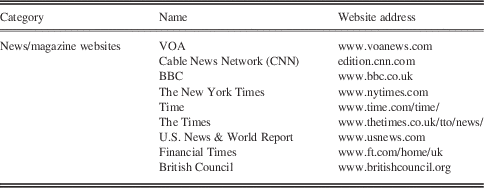
In the interviews, those who often visited overseas websites listed the websites they frequently accessed (see Table 5).
Frequently visited overseas news/magazine websites
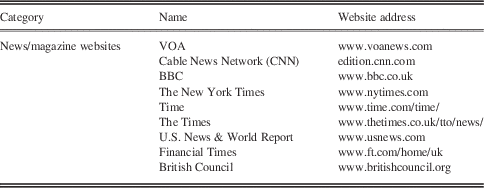
It is not difficult to observe that all the websites listed in Table 5 are overseas news/magazine websites. The interviewees indicated that they did not know any overseas ELL websites and only tried news/magazine websites.
“We can acquire pure native English language and cultural knowledge from the overseas news/magazine websites. These websites update the content in a fast speed and provide a huge amount of stuffs, for example, reading and audiovisual materials.” (Candice & Ying)
“The authentic language and materials provided by overseas news/magazine websites can nurture Chinese language users’ language competence and comprehensive cultural quality.” (Anson)
“The webpage design of overseas websites is scattered and interactive. Only the most recent and important stuffs are displayed on the first page. It might not be convenient for users to find the information if they are not familiar with the layout of the website.” (Benson)
During the interviews, participants also expressed their preferences on the countries of origin of various websites. More than half of the interviewees indicated that they would like to access US- or UK-based websites.
“We can acquire updated information, cultural knowledge as well as related language knowledge from the US or UK news/magazine websites, such as VOA, BBC, CNN, New York Times.” (Gao, Li & Wang)
Only four interviewees indicated that they would choose to use the websites of English-speaking countries other than the US and the UK, for example, Australia and Canada.
“I choose to use Australia-based websites because I often visited these websites when I studied in Australia.” (Yu)
The interviewees also discussed the possibility of the application of overseas websites to English language teaching and learning in China. Edgar indicated:
“The focus of the overseas news/magazine websites goes far away from Chinese English language teaching and learning. The websites do not provide any testing materials.”
At the same time, Ying was concerned that:
“The English language, especially the vocabulary and genres of texts, used in these websites go beyond the knowledge of Chinese English users. The content is westernized and hard to apply to the Chinese English language teaching and learning context.”
It has been observed that Chinese teachers see it as crucial to effectively incorporate ‘Chinese characteristics’ (for example, website focus, target audience, content coverage and materials and tasks) into the design of a popular ELL website to satisfy users’ needs. A better alignment between the web designer and the user appears to be even more important, taking into account the largest English language learning and using population in the world. This will be further discussed when we examine Chinese academics’ ideas of a popular ELL website among Chinese English language users.
4.3. A popular ELL website in China
Literature on the evaluation of ELL websites indicates that a popular ELL website needs to consider the target audience, learners’ needs, learning resources, language choices, and website format, feasibility and operation in its design (Bradin, Reference Bradin1999; Chapelle, Reference Chapelle1998; Comer & Geissler, Reference Comer and Geissler1998; Furner & Daigle, Reference Furner and Daigle2004; Hubbard, Reference Hubbard1988; Kettle et al., Reference Kettle, Yuan, Luke, Ewing and Shen2012). All academics involved in the interviews agreed that a popular ELL website had to satisfy a wide range of learners’ needs, with specific content and relevant topics if learners of various levels, from beginners to advanced learners and ESP learners, were to choose to use the website. David suggested that Chinese ELL websites should also include a variety of tests/examinations, for example, CET – Band Four and Band Six, IELTS, TOFEL, GRE, GMAT and TOEIC. Considering Chinese learners’ actual English levels, the website should provide a substantial amount of teaching and learning materials covering every aspect of language areas and skills that users could select from.
“The design of Chinese ELL websites needs to consider the users’ preferences. The webpage design should employ the Chinese pattern, with all functions easy to access. It is better to use the Chinese language as informatives and directives.” (Ming)
“The content of the website should be authentic materials focusing on both western and eastern countries. Various learning activities and tasks, especially examination-oriented materials and practices, should be included. All content should be updated timely.” (Wilson)
“The network system of the website should involve language experts in interactive communication. Setting up a self-learning evaluation system in the website is sure to add importance to an ELL website.” (Raymond)
It appears that a popular ELL website needs to effectively contextualize Chinese elements in its website design in order to cater for learners’ needs. This poses a challenge for website design and content writers, particularly for those who work in a transnational context. The findings of this study, as well as implications, are further discussed below.
5. Discussion
In contrast to traditional materials used in English language teaching and learning in China, ELL websites are emerging as important learning environments supported by high technology (Yang & Chan, Reference Yu and Shen2008). Our analysis highlights that incorporating digital materials into English teaching and learning has become a tendency in China in part due to the Curriculum Requirements (2007) as well as language learners’ and practitioners’ requests to acquire additional authentic information about the target language and culture. The interviewees (for example, Jiang, Ken & Shane) indicated that current English language teaching and learning in China was shifting from a teacher-centered model to a learner-centered model, particularly through integrating high technology into the EFL classroom. However, English teaching and learning materials, classroom pedagogies as well as evaluation systems were not always in keeping with the new shift. Often, they represented an obstacle to this change due to deeply-entrenched traditional teaching and learning styles and perceptions of language users (Lim & Shen, Reference Liu2006), as Chinese education, even at the tertiary level, still adopts a meritocratic system that remains highly competitive and only a limited number of high achievers will have a chance to get into a prestigious university (there are only 88 key universities among 2138 universities/institutions in China).
China has the largest population of English learners and users in the world. This has provided opportunities and challenges for web designers and classroom practitioners as they need to consider the unique characteristics and needs of this target population to cater for their learning needs and learning styles. More importantly, the materials and tasks to be included in the learning websites may also expose them to information that would facilitate cross-cultural interaction and best pedagogy for teaching and learning informed by research in different contexts (Shen & Yuan, Reference Shield and Kukulska-Hulme2013; Yu & Shen, Reference Zhong and Shen2012).
Though almost all existing published teaching and learning materials for Chinese university English learning have online support courses, they are not always able to provide adequate authentic materials for learners to obtain language knowledge and, to a lesser degree, for learners to study cultural authenticity (Feng & Byram, Reference Feng and Byram2002). A lot of Chinese ELL websites have been used by Chinese English academics to simply source related teaching materials for reading and listening (see Section 4.1). This is consistent with the findings reported in a recent study on popular ELL websites identified by using a technical methodFootnote 3. In this study, it was found that the high ranking websites, such as Hu Jiang English (Level 7), New Oriental Online (Level 7), 51 IETLS (Level 6), and Big Ear English (Level 6), were among the common websites that the interviewees had utilized to access various teaching materials (see Table 3).
Kettle, et al. (Reference Kettle, Yuan, Luke, Ewing and Shen2012) believed that these websites suited Chinese pedagogical needs as they were highly examination-oriented, with ample materials and tasks for users to practise both discrete language items and related examination skills. Learners of different levels can find a variety of learning materials to satisfy their individual learning needs and examination preparation (see Section 4.2). This implies that a test-orientated language learning website will remain popular among Chinese EFL users (teachers and students) for as long as a meritocratic education system continues to exist.
As participants of this study were highly proficient English language users and learners, they also chose to use more information-focused websites, including news/magazine websites, to acquire updated news, cultural knowledge, as well as native English language knowledge (see Tables 3 and 4). However, it might be difficult for beginners or intermediate learners to recognize the language used in news reports and cultural introductions due to their lower language proficiencies. This group of language users comprises the vast majority of users in China (Shen & Yuan, Reference Shield and Kukulska-Hulme2013), and they commonly do not choose to visit these websites. It could be inferred that not everyone is interested in using sites containing general information/news to acquire their language knowledge. Learner preferences could influence the choice of different websites for acquiring English language knowledge (Sykes & Cohen, Reference Tomlinson2008). This could also explain why ELL websites are more popular than information/news websites in China, as these ELL websites strongly emphasise learner preferences (Karoulis et al., Reference Karoulis, Demetriadis and Pombortsis2006; Pituch & Lee, Reference Preece2006) and are designed to be more effective in assisting learners to achieve their learning goals.
It was observed that the presence of content relevant for examinations considerably influences users’ preferences for ELL websites (see Section 4.2). As various tests/examinations are still used as benchmarks to assess users’ language levels in China, users of different language proficiency levels would like to acquire testing materials as well as related learning information, such as texts, tasks, skills and strategies, from websites. A popular Chinese ELL website would provide materials closely related to a range of examinations and related information, which features more frequently in Hu Jiang English, as discussed.
Additionally, it was found that Chinese English language practitioners hope to include more topics or materials relating to Eastern/non-Anglophone countries in order to add diversity in the English learning materials (see Section 4.2). This finding recalls Zhong and Shen’s (Reference Zhong and Shen2002) work around designing cross-cultural websites for learning. However, most learners preferred to use the US- or UK-based websites and neglected the websites of other English-speaking countries (see Figure 1). This situation could arise from the fact that traditional Chinese teaching expects learners to learn American or British English only (Shen & Yuan, Reference Shield and Kukulska-Hulme2013). There is perhaps a need to add diversity to the English language content of websites as English is regarded and used as a lingua franca in global communication (Canagarajah, Reference Canagarajah2006; House, Reference House2010; Jenkins, Reference Jenkins2006). Including varieties of English, for example, Australian English and Canadian English, might effectively enable learners to enhance their language competence in communication.
Meanwhile, audio-visual materials are welcomed, as one respondent (Wilson) indicated in the interview that audio-visual materials could reduce the level of boredom when language learning and better facilitate learners to achieve optimal learning outcomes (media reports reveal a general discontent among Chinese EFL teachers with existing language teaching materials). Overseas websites are information-focused though users are able to gain cultural insights through such authentic materials. Yet the unfamiliarity of text genres, cultural nuances and sophisticated vocabulary might lead to Chinese language users misunderstanding the materials. Meanwhile, if there are no examinations and related learning materials, users may not opt for these websites (see Section 4.2). It could be concluded that language learning materials and language areas and skills (Hubbard, Reference Hubbard2006; Liu et al., Reference McArthur2011) provided by ELL websites are certain to influence the popularity of the choice of websites.
It was also highlighted in the interviews (for example, Edgar, Ming & Nelson) that the use of the Chinese language as informatives and directives in ELL websites was preferred. As Chinese is their first language (L1), Chinese English language users are then able to obtain and retrieve information easily from the websites. Nelson, one interviewee, added that using the Chinese language with the English translation or vice versa was also acceptable. This finding resonates with what was reported in a recent study (Kettle, et al., Reference Kettle, Yuan, Luke, Ewing and Shen2012), that the informative and directive language used by ELL websites, affects learners’ choice of websites to some degree. This is contrary to a common perception that EFL learners prefer the use of the target language as the language of instruction or navigation (Liu et al., Reference McArthur2011).
One finding of the current study affirms Preece’s (Reference Saville-Troike1995) point that website usability has an impact on the choice of ELL websites (see Section 4.3). It was recorded in the interviews that Chinese users preferred the webpages of ELL websites that displayed all accessible information (Cindy), and it was inconvenient and time-consuming to search for the information from ‘westernized scattered and interactive webpages’ (Benson). Although exhibiting all the accessible information may make webpages appear to be dense, it is convenient and time-saving for language users. This could be inferred as one of the reasons why overseas news/magazine websites are not as popular among Chinese English language users.
It was suggested that interactive functions such as BBS, forums and blogs, be included in ELL websites as they could provide opportunities for users to interact and communicate with each other via the target language (for example, Cindy & Raymond). Data also show that it is helpful to consider the technical logistics of website usability when designing ELL websites to provide better services for users. Specific variables such as the speed of updating language materials, free access and downloading of the materials, and technical connections to websites (see Section 4.3), may also influence the popularity of ELL websites among Chinese English language users. All these are possible factors that may need to be taken into consideration when designing an ELL website in order to satisfy Chinese EFL users’ needs.
6. Conclusion
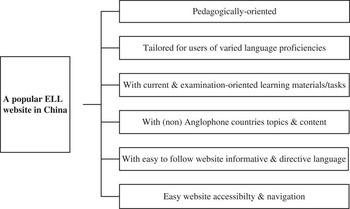
By investigating Chinese EFL practitioners’ perceptions of the various components of major language areas and skills in ELL websites, website materials, language users’ preferences, and website usability, this study captures systematically the key features of a popular ELL website in China (see Figure 2).
Key features of a popular ELL website in China.

A popular ELL website in China, as Figure 2 shows, is obviously pedagogically-oriented, targeting audiences with varying language proficiencies. Language learning materials, activities, tasks and texts provided by the website are constantly updated and examination-oriented. In addition to western topics, there is a balanced inclusion of content from Eastern/non-Anglophone countries as well as an acceptance of different varieties of English. The webpage informative and directive language was also carefully selected and integrated into the design of these ELL websites. In addition, ease of website usability remains a key design feature.
The major findings derived from the empirical evidence collected in this study may help provide a broad framework to allow ELL website designers and content writers to consider the specific needs of a particular user population. A well-designed ELL website informed by sound pedagogy and best practice may also have a positive impact on the Chinese EFL curriculum that is gradually moving away from an examination-oriented approach. In a broader sense, the findings of this study may contribute to further understanding of online English language learning, such as telecollaboration, e-tandem learning, and participating in established e-communities. Obviously, these web-based learning platforms were not discussed in this paper, which is a limitation of this study. It will be interesting to examine how Chinese English teachers perceive teaching and learning in these alternative web-based environments and compare the findings with what is reported in this current study. Such comparative studies may provide insights into English instruction in Chinese universities assisted by these technological tools, and help build an empirical base for Chinese EFL curriculum innovation at university level.
Acknowledgement
This is to acknowledge the support from Australian Research Council, Foreign Language Teaching and Research Press, Fudan University Press, The University of Sydney and Queensland University of Technology in conducting this study. Thanks also go to the anonymous reviewers for their constructive comments.
Appendix 1
Online Survey
Section I Demographic information
1. What courses do you teach?
Course name 1 ______________________
Course name 2 ______________________
2. How many years have you taught English?
A. Less than 6 years. B. 6-10 years.
C. More than 10 years.
3. Do you have over three-month overseas English learning experience?
A. Yes. Which country? a. UK. b. US. c. Canada. d. Australia. e. Others.
B. No.
4. Does the course you taught use the online teaching and learning pattern?
A. Yes.
B. No.
5. Do you often visit English language learning (ELL) websites or English news/magazine websites?
A. No. B. Yes.
- If your choice is B, please choose which country the websites belong to (you can choose more than one answer):
a. China. b. UK. c. USA. d. Canada. e. Australia
f. Other countries. Please list: __________________________________________
Section II Your views on English teaching and learning (Please circle the number that represents how you feel about the current English teaching and learning in China.)
Scale: Strongly Disagree – 1 – 2 – 3 – 4 – 5 – 6 – 7 – Strongly Agree

Appendix 2
Interview questions
1.Supporting online courses to the classroom teaching and learning
1)Does the teaching material you are using have a corresponding online learning course?
2)Is the online learning course used in the classroom teaching and learning?
3)Is the online learning course used in students’ self-study?
4)What are the major content areas of the online learning course?
5)Is the online learning course helpful to your classroom teaching and learning? Explain.
6)What other teaching resources and self-study materials are needed apart from those provided by the online learning course?
7)Will you search for other online information/resources for your teaching?
2.English language learning or English news/magazine websites
1)Do you often visit English learning websites or English news/magazine websites? Why?
2)Do you like Chinese or overseas websites? Why?
3)What are the differences between Chinese websites and overseas websites in terms of design, content areas, content and resources?
4)What is your opinion of the examination materials provided by Chinese English language learning websites?
5)Are there any overseas websites that provide various examination materials to facilitate website users to pass different examinations?
6)Are there any overseas English language learning websites or English news/magazine websites designed to satisfy Chinese English users’ and learners’ needs? Explain.
7)What aspects have to be considered when designing an English language learning website for Chinese English language learners and users?