Undergraduate programs in international studies (IS) first began to appear at colleges and universities in the 1970s, ostensibly to provide an interdisciplinary lens through which students could study an increasingly globalized and interconnected world. The initial idea for such an approach was that the world’s growing interdependence was fracturing traditional disciplinary lines, and that a more holistic and multidisciplinary perspective was necessary to understand fully the dynamics underlying global events (Rosenau Reference Rosenau1973, 19). In response, some universities developed multidisciplinary curricula to better address this changing global landscape. The IS undergraduate programs that emerged challenged students to examine global phenomena from several different social science perspectives, including but not limited to political science, history, economics, geography, and sociology. This new interdisciplinary approach was not without detractors, however, and some universities found that their extant departments resisted “interdepartmental arrangements that threaten[ed] vested interests” and displayed a “myopia” in terms of viewing their own more traditional training as superior to this multidisciplinary approach (Adams Reference Adams1972, 1).
Despite these initial reservations, undergraduate IS programs multiplied throughout the university landscape and have become increasingly popular—in the past decade alone, many programs have doubled in size within only a few years (Blanton Reference Blanton2009). University IS faculty also have become players in a new wave of revamped general-education curricula that feature “global awareness and intercultural competencies” as major components (Ishiyama and Breuning Reference Ishiyama and Breuning2006, 327). What is perhaps most impressive is that IS programs have achieved this rapid growth in a time when higher education faces dwindling financial resources.
Ultimately, the “tension between the pull of disciplinary and the push of interdisciplinary work affects all of the social sciences”; this dynamic is especially important for political science because of its reciprocal relationship with IS (Katzenstein Reference Katzenstein2001, 789). Indeed, political scientists frequently publish in international relations (IR) journals, political science classes often dominate IS curricula, and IS programs most often are administered by political scientists and/or political science departments. Previous scholarship on IS identified important trends within the structure and curriculum of such programs; however, at present, very little literature exists that investigates the perceptions of IS among political scientists.
As a result, we approached this study with two overarching research questions: (1) How do political science chairs view the academic rigor and job prospects of IS programs(2) For department chairs that have IS programs on their campus, how do they rate the level of competition for majors, financial resources, and the best students?
What Do We Know about International Studies?
There is no obvious roadmap indicating which types of colleges and universities decide to create IS majors. The literature suggests that factors influencing the decision to create an IS major include the size of a school, the number of faculty, and its location near an urban population center that allows for international-interaction opportunities, such as the opportunity for travel, proximity to cultural centers, and ability to practice foreign-language skills (Ishiyama and Breuning Reference Ishiyama and Breuning2004). Another factor in determining whether an institution has an undergraduate IS major is the existence of a graduate program with an IS component (Ishiyama and Breuning Reference Ishiyama and Breuning2004).
Where IS programs exist, they often lack cohesion and a sense of identity. Indeed, the IS field has become “a little like the Tower of Babel, filled with a cacophony of different voices”; as a result, IS programs sometimes lack “an intellectually coherent area of inquiry” (Hermann Reference Hermann1998, 606). On most campuses, IS programs are loosely structured, allowing students “wide latitude” in terms of their choice of classes (identified in the literature as the “big-umbrella approach”), whereas other programs are more structured and emphasize a “key set of common courses” that act as the core of the major’s curriculum (Ishiyama and Breuning Reference Ishiyama and Breuning2004, 134). Exacerbating this confusion, the term “international studies” often is used synonymously with the term “international relations,” which is a subfield of the political science discipline (Brecher Reference Brecher1999, 213).
The Connection between International Studies and Political Science
A common thread among IS programs is that they often are dominated by political science (Hey Reference Hey2004). Although there is some diversity in the training of IS directors, a 2009 study found that political science retains a “hegemony” within IS programs; that is, 52.6% of IS undergraduate program directors received their graduate training in political science. At 15.4%, history was the next largest disciplinary category of IS program directors. Only 9% of IS program directors had specific graduate training in IS (Blanton Reference Blanton2009, 227).
Although there is some diversity in the training of IS directors, a 2009 study found that political science retains a “hegemony” within IS programs; that is, 52.6% of IS undergraduate program directors received their graduate training in political science.
Moreover, the influence of political science over IS is evident in the administrative arrangements surrounding undergraduate IS programs. Administratively, IS programs sometimes “fall between the cracks” in terms of support because of their interdisciplinary nature; however, they most often are housed within either a traditional department—most commonly political science—or a larger administrative entity (Blanton Reference Blanton2009, 229). The literature suggests that IS programs often are administered by political science departments because of the primacy of international politics in their curricula, even though they are fundamentally interdisciplinary programs of study (White, Malik, and Chrastil Reference White, Malik and Chrastil2006).
The influence of political science over IS is further exemplified within the IS academic research community; IS research often draws from the same body of theory and literature as IR. Thus, although interdisciplinarity “may be at the heart of undergraduate IS programs…it is still not central to IS research” (Hey Reference Hey2004, 397). Indeed, the primary professional group for IS scholars is the International Studies Association (ISA), which sponsors several peer-reviewed scholarly journals, the articles of which are dominated by academics with a political science background. Additionally, the research questions explored in these articles “overwhelmingly emanat[e]from the discipline of political science” (Hey Reference Hey2004, 397). At the core, then, ISA as a research organization is not as much about an interdisciplinary approach to international affairs as it is IR-centric, focusing on “that branch of political science that deals with questions of conflict, peace, trade, foreign policy, and other matters of cross-border politics” (Hey Reference Hey2004, 397). Thus, IS—as envisioned by its premier professional association—“is primarily IR a la political science” (Hey Reference Hey2004, 398).
Certainly, many scholars dispute the conflation of IS and IR, claiming that IS is a multidisciplinary field of study primarily focused on a broad range of international and global issues. According to these scholars, this means that IS is influenced by IR but remains a distinct scholarly field on its own merits (Breuning and Ishiyama Reference Breuning and Ishiyama2004; Brown, Pegg, and Shively Reference Brown, Pegg and Shively2006). Ultimately, however, although interdisciplinarity and independence of the field may be the goal of its advocates, the literature suggests that in practice, political scientists and the subfield of IR tend to dominate the bureaucratic administration of IS programs, as well as the research and curriculum emphases surrounding them. Thus, because of the strong influence of political science, it is important to assess empirically how political science chairs view undergraduate IS programs.
Data and Methods
To investigate these issues, we drew from a December 2013 web-based survey of political science department chairs listed in the American Political Science Association’s Directory of Political Science Faculty and Programs. The survey included 25 open- and closed-ended questions that focused on opinions about IS programs. Our population included 786 chairs with valid e-mail addresses: 134 from PhD departments (17%), 163 from MA departments (21%), and 489 from BA departments (62%). We obtained 273 surveys, for a total response rate of 35%. Fortunately, the breakdown by department type in our sample was similar to the distribution in our population. We received 46 completed surveys from chairs of PhD departments (17%), 55 from chairs of MA departments (20%), and 172 from chairs of BA departments (63%). To supplement our survey, we also obtained university characteristics (e.g., school size and whether the school is public or private) from College Results Online.
Results
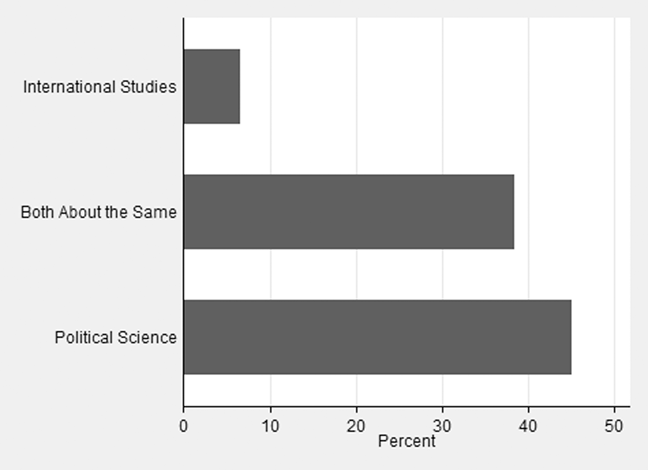
To begin, we asked all chairs in the survey whether they favored having an IS program at their institution. The response was largely positive, with 71% in favor, 19% in opposition, and 10% with no opinion. To further explore the level of support, we asked all chairs to compare the academic rigor and job prospects of IS and political science graduates. Figure 1 displays results of the question, “Which major is more academically rigorous?” As seen in the figure, the plurality of chairs (45%) rated political science more academically rigorous. A slightly lower percentage (39%) rated the academic rigor of political science and IS as about the same. Only 7% rated IS as more academically rigorous than political science.
Which Major Is More Academically Rigorous?
Source: December 2013 Survey of Department Chairs, N = 246

The open-ended responses provided context for how department chairs perceive the academic rigor of IS programs. One chair described IS as “usually thin, not rigorous”; another stated that “our IS program is very cultural…almost anthropological” and noted that “they don’t study IR or power of any kind…just society and culture.” Other chairs were even more pointed in their critique. One chair described IS as “a floating signifier, a catch-all that doesn’t connote a disciplinary or intellectual tradition. String together a grab bag of courses, throw in some econ and stats…and call it a major.” There also was some indication that program leadership affected program quality. For example, one chair stated that “the quality and rigor of the program, as well as the quality of the experience for the student, seems to depend far too much on the characteristics of the particular director at any given time.” Another chair noted, “We have trouble with IS here because it is run by one person who does whatever he wants, expects everyone to accommodate him, and has very little interest in overall program articulation or quality.”
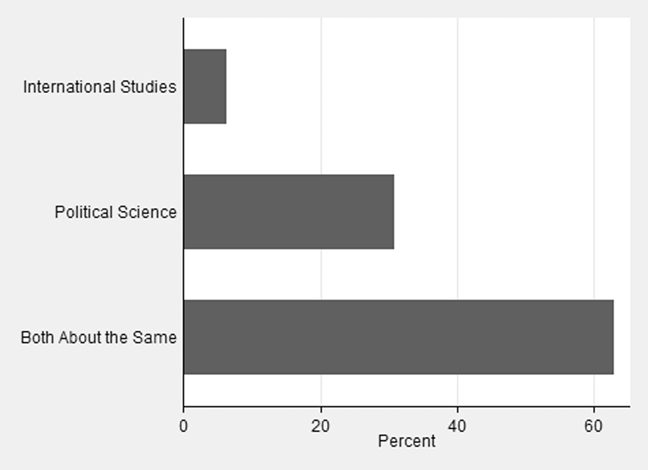
We also asked department chairs to compare the job prospects between IS and political science majors. The results of this question are shown in figure 2. The majority of chairs (63%) stated that job prospects for political science and IS majors were about the same. A lower percentage (31%) stated that political science majors had better job prospects. Only 6% of chairs indicated that job prospects for IS majors were higher.
As one chair noted, “Students who graduate with the [IS] degree have little in the way of marketable skills, and the degree is largely unknown in the market.”
Which Major Has Better Job Prospects for Graduates?
Source: December 2013 Survey of Department Chairs, N = 237
Again, the open-ended responses provided an important context to the ways that department chairs are thinking about these issues. As one chair noted, “Students who graduate with the [IS] degree have little in the way of marketable skills, and the degree is largely unknown in the market.” The same chair also stated, “I have had a number of IS graduates tell me that their degree is viewed as of little value when they are job hunting.” Other respondents were more positive about the job prospects of IS majors. One chair observed that “an international studies major with [a] focus on economy and/or political capital risk would be competitive” and noted that “both are increasingly sought after in the private sector.” We focused on undergraduate IS programs in our survey; however, one chair commented about job prospects for graduate students by noting that “Graduate studies in IR particularly with a transdisciplinary and computational analytics focus are on the rise” and “students with such characteristics can be assured of effective jobs in government and IGOs.”
To investigate our questions about academic rigor and job prospects in more detail, we used ordinal logistic regression models. Our dependent variables were responses to the following questions: “Which major is more academically rigorous?” and “Which major has better job prospects for graduates?” In both cases, we had three response categories (i.e., 1 = International Studies, 2 = Both About the Same, and 3 = Political Science). We also included six independent variables in our model. Most important, we created a variable to indicate whether an IS program was administratively located in the chair’s department. Our expectation was that chairs with IS programs housed in their department would have a sense of ownership and be less likely to rate political science higher on these two questions. We also included several other controls: campus location (1 = urban/suburban, 0 = rural), BA department (1 = BA department, 0 = non-BA department), MA department (1 = MA department, 0 = non-MA department), public university (1 = public, 0 = private), and university size (measured in thousands).
Table 1 shows the results of the “academic rigor” and “job prospects” models. As shown, chairs from MA departments were less likely to agree that political science was more academically rigorous. The probability of an MA department chair indicating a high level of academic rigor was 0.26; the probability of a non-MA department chair indicating the same was 0.56. Perhaps most important, our expectations about the ratings from chairs with IS programs were confirmed. We discovered that chairs from departments with an IS program were significantly less likely to rate political science programs more academically rigorous (0.26), whereas those from departments without an IS program had a 0.60 probability of the same rating. None of the other variables included in the model achieved standard levels of statistical significance.
Ordinal Logistic Regression Model for the Perceived Academic Rigor and Job Prospects of Political Science and International Studies Graduates
Notes: Predicted probabilities refer to the change in probability of indicating political science when that entry is held at its low and high points for dichotomous or from one standard deviation above and below the mean for continuous variables, while holding all other variables at their sample means.
*p < 0.10, **p < 0.05, ***p < 0.01; two-tailed test.
In the “job prospects” model, we discovered that chairs located on an urban/suburban campus rated political science job prospects higher than IS job prospects compared to chairs on a rural campus. There was a 0.36 probability that chairs on an urban/suburban campus would indicate that political science majors had better job prospects than IS majors compared to a 0.23 probability of those on a rural campus. The model also indicated that chairs at public universities were significantly more likely than those at private universities to indicate higher job prospects for political science majors (i.e., 0.38 versus 0.22 probability, respectively). Similar to the “academic rigor” model, chairs from departments with IS programs were significantly less likely to indicate that political science majors had better job prospects than IS majors. Similarly, the predicted probabilities also indicated substantive importance for this variable. Chairs from departments with an IS program had a 0.21 probability of rating the job prospects of political science majors higher compared to 0.34 for those without the major.
The discussion of results now focuses on the perceived level of competition between political science and IS programs on college campuses. In the survey, we included questions about three types of potential competition: competition for majors, competition for the best students, and competition for financial resources. Only those department chairs who indicated an IS program on their campus were asked these questions.
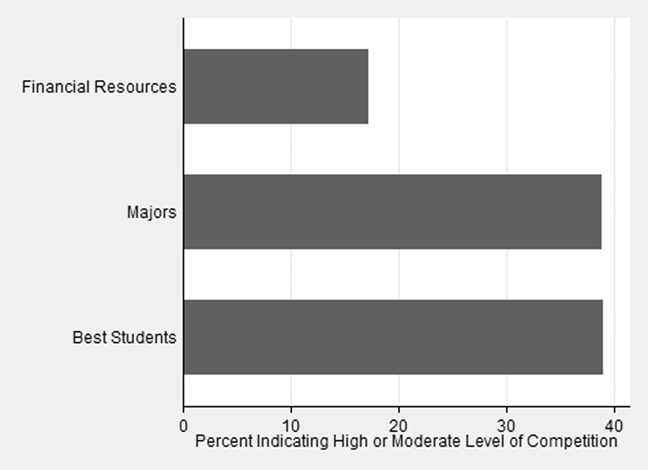
Figure 3 displays the results of the survey for the three competition questions. Chairs perceived the lowest level of competition for financial resources. In fact, only 17% indicated a moderate or high level of competition for financial resources. Chairs perceived much higher levels of competition in terms of majors and the best students. In both cases, 39% indicated a moderate or high level of competition.
Competition for Resources between Political Science and International Studies
Source: December 2013 Survey of Department Chairs, N varies from 157 to 162
Again, the open-ended responses contextualized how department chairs view the level of competition. As one chair remarked, “The program is a drain on our majors and has very little coherence.” Another noted, “We lose students to IS most often because of our sophomore-level research class; it has a reputation as being more rigorous than a similar class offered by IS (and scares away students who don’t ‘do math’).”
To explore responses to the competition questions in more detail, we again relied on ordinal logistic regression. Each dependent variable had three possible values (i.e., 1 = low level of competition, 2 = moderate level of competition, 3 = high level of competition). We included all independent variables from the models in table 1 but added another variable that accounted for whether the political science department had a specific concentration in IR. We wanted to determine whether an IR concentration—the most closely related political science subfield to IS—affected the perception of competition. As a point of interest, 48% of all chairs indicated that the political science major had a concentration in IR and 45% of those on a campus with an IS major had an IR concentration in the political science department. Our general expectation was that chairs of departments with an IR concentration would perceive higher levels of competition from IS.
Table 2 displays the results of these three models. Chairs from an urban/suburban campus, BA departments, and MA departments indicated less competition for majors. In each case, the substantive findings also were noteworthy. Chairs at an urban/suburban campus had a 0.09 probability of indicating a high level of competition compared to 0.14 at a rural campus. Likewise, chairs in a BA department had a 0.07 probability of perceiving a high level of competition contrasted with 0.25 in a non-BA department. For the MA and non-MA department variable, the predicted probabilities were 0.04 and 0.14, respectively. As expected, chairs with IS programs housed in the political science department also indicated significantly less competition. Chairs with an in-house IS program had a 0.07 probability of indicating a high level of competition compared to 0.15 for chairs without an in-house IS program. We also discovered that chairs from departments with an IR concentration perceived significantly higher levels of competition. For those chairs, the probability was 0.16, contrasted to 0.08 for chairs of departments without an IR concentration.
Ordinal Logistic Regression Model for Level of Perceived Competition between Political Science and International Studies Programs
Notes: Predicted probabilities refer to the change in probability of expressing a high level of competition when that entry is held at its low and high points for dichotomous or from one standard deviation above and below the mean for continuous variables, while holding all other variables at their sample means.
*p < 0.10, **p < 0.05, ***p < 0.01; two-tailed test.
Two variables achieved statistical significance in the “best students” model. Chairs of BA departments perceived less competition and chairs of departments with an IS major again rated the level of competition lower. Chairs from BA departments had a 0.02 probability of indicating a high level of competition for the best students compared to 0.09 for those from only non-BA departments. For chairs with an IS program in the department, there was a 0.02 probability of perceiving a high level of competition compared to 0.06 for those from departments without an IS major. The only significant factor in the “financial resources” model was university size, and this coefficient was significant only at p < 0.10. We found that the level of competition for financial resources decreased as the size of the university increased. The predicted probabilities were quite modest as well: a 0.05 probability of indicating a high level of competition for financial resources at larger universities compared to 0.09 at smaller colleges.
Although we found that most department chairs support the concept of IS programs, it was clear that they do not necessarily agree on how the major should be structured or the utility of such a degree.
Conclusion and Discussion
Overall, the relationship between political science departments and IS programs is largely positive. We found that a majority of political science chairs supports the existence of an IS major at their institution, a majority believes that job prospects for both majors are about equal, and a low percentage perceives competition for financial resources between the majors. Political science and IS seem to have a complementary relationship; however, our analysis indicates two potential points of contention: (1) the perception of lower academic rigor of IS programs, and (2) the level of competition for majors and the best students between political science and IS.
Although we found that most department chairs support the concept of IS programs, it was clear that they do not necessarily agree on how the major should be structured or the utility of such a degree. By highlighting the overarching theme of dissonance across universities and departments regarding the configuration of the IS major, the answers to the open-ended questions were particularly enlightening in this respect. Although many respondents indicated that IS and IR were virtually identical programs at their university, the remainder of the open-ended responses suggested myriad alternate approaches to the IS major. Only one clear commonality was cited among the alternate approaches: the idea that IS was a more multidisciplinary program than IR. Respondents stressed a variety of program emphases, including international development, the humanities, and culture and anthropology.
Moving forward, it is imperative to foster a consensus regarding a basic definition of “international studies” so that students who choose to major in IS can graduate with a degree that is meaningful, consistent, and understood and appreciated by future employers. Political science departments must play a primary role in this definitional debate because, as a practical matter and as the literature suggests, IS and the subfield of IR share many commonalities and often are considered synonymous fields of study.
Finally, we envision two viable courses of action for the discipline. Political science could claim ultimate ownership of IS to mitigate the dissonance that remains among universities regarding what the term “international studies” signifies in the broader academic debate. Another option is for universities to consider either rebranding and/or re-creating IS as a product of the humanities rather than the social science field or as a more specialized major that focuses on a particular thematic area of scholarship distinct from the typical IR curriculum. Regardless of the options, the political science community must engage in these discussions sooner rather than later to best serve its students by offering a useful and cohesive IS degree that will contribute to their future success—rather than rendering that degree almost meaningless due to the myriad inconsistent approaches that currently characterize the field.