Introduction
Climate change is a major threat to biodiversity (Bellard et al. Reference Bellard, Bertelsmeier, Leadley, Thuiller and Courchamp2012) and understanding the species response to, and threat posed by, climate change is a central theme in conservation biology (Scheffers et al. Reference Scheffers, De Meester, Bridge, Hoffmann, Pandolfi, Corlett, Butchart, Pearce-Kelly, Kovacs and Dudgeon2016; Pecl et al. Reference Pecl, Araújo, Bell, Blamchard, Bonebrake, Chen, Clark, Colwell, Danielsen and Evengård2017). Species climate change response is generally considered as combining three processes: 1) individuals of a species may migrate to track the changing distribution of their suitable climate space (Parmesan & Yohe Reference Parmesan and Yohe2003; Chen et al. Reference Chen, Hill, Ohlemüller, Roy and Thomas2011), constrained by habitat fragmentation (Travis Reference Travis2003; Hodgson et al. Reference Hodgson, Thomas, Dytham, Travis and Cornell2012); 2) individuals of a population may evolve and adapt in situ, effective across generations, to tolerate climate change (Hoffman & Sgrò Reference Hoffman and Sgrò2011; Kelly Reference Kelly2019); 3) individuals may acclimate in situ through plasticity in morphology or physiology that allows persistence under climate change (Seebacher et al. Reference Seebacher, White and Franklin2015; Rohr et al. Reference Rohr, Civitello, Cohen, Roznik, Sinervo and Dell2018). In the latter case, different species appear to have different modes of plasticity, with some species being more limited in their ability to acclimate than others.
Lichens have become established as an excellent study system for understanding acclimation to different environments through phenotypic plasticity. Lichens are poikilohydric, responding to the ambient environment by desiccating when the environment is dry (Kranner et al. Reference Kranner, Beckett, Hochman and Nash2008), and rehydrating only with ambient moisture (Jonsson et al. Reference Jonsson, Moen and Palmqvist2008) to become physiologically active (Lange et al. Reference Lange, Kilian and Ziegler1986, Reference Lange, Büdel, Meyer and Kilian1993; Phinney et al. Reference Phinney, Solhaug and Gauslaa2018). Lacking homeostatic control over their hydration status, and therefore physiological outcome, the lichen phenotype is thought to provide regulatory control of thallus water relations and for lichen epiphytes the phenotype varies among species in a way that reflects adaptation to different forest moisture regimes (Gauslaa Reference Gauslaa2014). A key parameter in this regard, analogous to specific leaf area (SLA), is specific thallus mass (STM), the mass per unit area of the lichen thallus. Different lichen species have different values for STM (cf. fig. 6 in Gauslaa (Reference Gauslaa2014), and also Gauslaa & Coxson (Reference Gauslaa and Coxson2011); Wan & Ellis Reference Wan and Ellis2020; Trobajo et al. Reference Trobajo, Fernández-Salegui, Hurtado, Terrón and Martínez2022), which combines with a species-specific water content (WC), the volume of water absorbed per unit mass, to determine the volume of water that can be absorbed internally per unit area, as the water-holding capacity (WHCinternal). The species-specific value of WHCinternal appears to be the point at which the photosynthetic rate is maximized (Solhaug et al. Reference Solhaug, Asplund and Gauslaa2021). Accordingly, species with low STM have been referred to as having an ‘opportunistic’ moisture strategy (sensu Gauslaa Reference Gauslaa2014), tending to saturate their internal capacity (and maximize their photosynthetic rate) with lower volumes of water available as vapour or light dewfall. These species will also dry quickly and may be at particular risk of suprasaturation under high moisture conditions, since relatively low volumes of water can meet the requirement of WHCinternal, with subsequent moisture accumulation onto their outer surface limiting gas exchange across the thallus (Lange et al. Reference Lange, Green, Reichenberger and Meyer1996, Reference Lange, Büdel, Meyer, Zellner and Zotz2000, Reference Lange, Büdel, Meyer, Zellner and Zotz2004). In contrast, species with high STM have been referred to as having a ‘conservative’ water strategy (sensu Gauslaa Reference Gauslaa2014), requiring higher water volumes as heavy dewfall or rain to saturate their internal capacity (and maximize their photosynthetic rate), though drying more slowly (cf. Gauslaa et al. Reference Gauslaa, Solhaug and Longinotti2017; Phinney et al. Reference Phinney, Solhaug and Gauslaa2018; Hovind et al. Reference Hovind, Phinney and Gauslaa2020).
Species with a more conservative strategy (relatively high STM) may be at particular risk of prolonged desiccation and extended physiological dormancy, since relatively low volumes of water may be insufficient to optimize thallus hydration at WHCinternal. It has been suggested that a key acclimation of such species, in response to lower water availability, may actually be to increase thallus STM. This pattern of acclimation in STM has previously been observed at multiple scales comparing wetter and drier sites regionally (Gauslaa et al. Reference Gauslaa, Palmqvist, Solhaug, Holien, Nybakken and Ohlson2009), for wetter and drier microhabitats (Gauslaa & Coxson Reference Gauslaa and Coxson2011; MacDonald & Coxson Reference MacDonald and Coxson2013; Merinero et al. Reference Merinero, Hilmo and Gauslaa2014), and for wetter and drier periods seasonally (Larsson et al. Reference Larsson, Solhaug and Gauslaa2012). It has been suggested that acclimation towards higher STM allows for the absorption of more water per unit thallus area when it is available, and with slower drying to prolong photosynthesis. If this is the case, then lichen thallus STM appears to be a viable metric with which to explore the lichen phenotypic response to climate variability at multiple scales, including climate change.
To aid our understanding of lichen epiphyte climatic response, including potential acclimation to climate change, we asked three questions: 1) to what degree might it be possible for individual lichen thalli (of a given species) to acclimate their STM in response to a changed climate; 2) what is the relative importance of regional larger-scale climate compared to buffering microclimatic conditions on this response; 3) can we identify the limits to this phenotypic response, marking the point at which acclimation is no longer possible? To answer these questions, we used a spatial design, growing the model lichen species, Lobaria pulmonaria, in different experimental microhabitats, corresponding to microclimates, nested within different regional larger-scale climates. We then quantified the relative dry matter growth as mass gain/loss, and the change in STM over the period of one year.
Methods
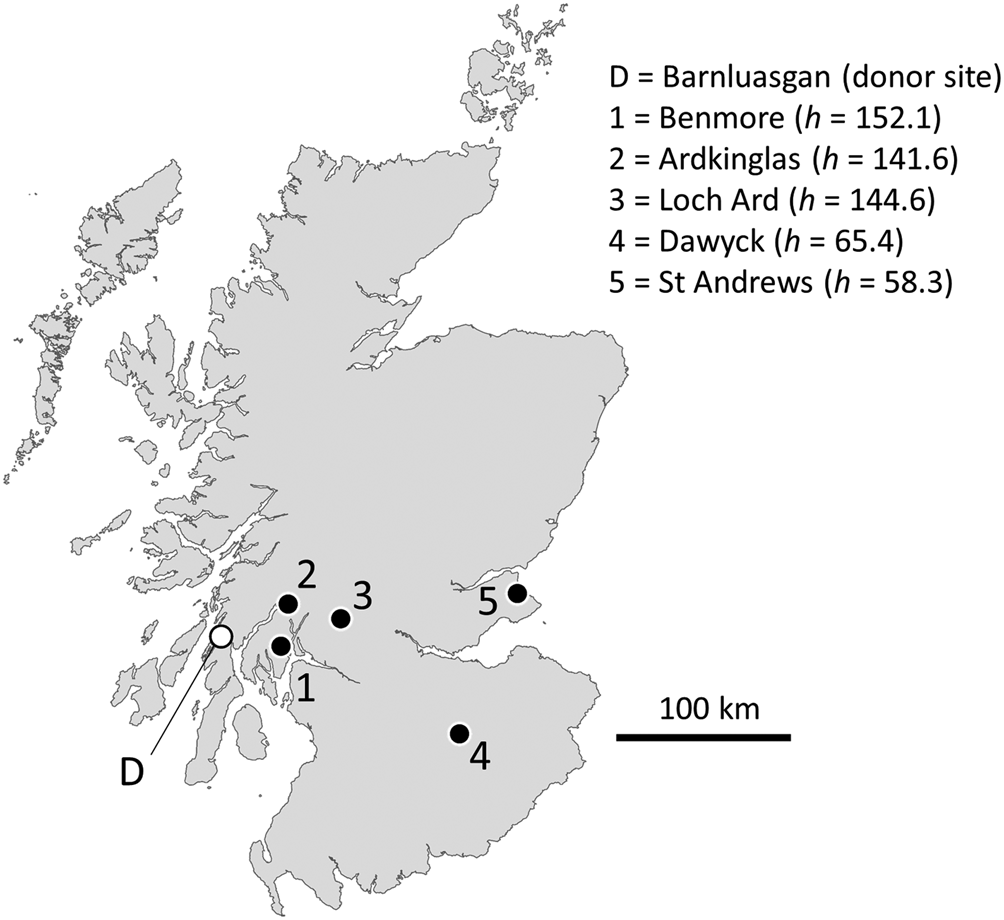
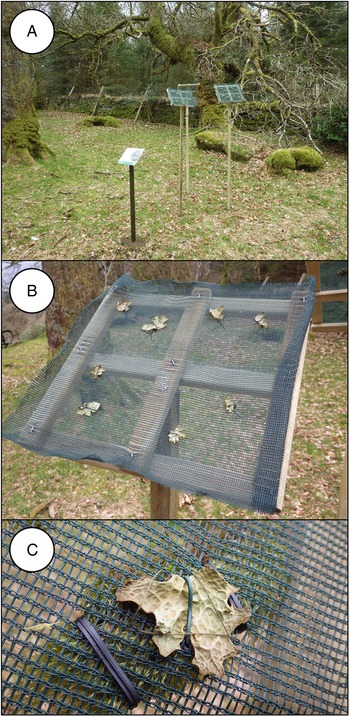
One-hundred and twenty juvenile thalli of Lobaria pulmonaria (L.) Hoffm. were collected from a donor site in the oceanic ‘temperate rainforest’ zone of western Scotland (Fig. 1; Barnluasgan Oakwood, 56.0619°N, 5.5488°W). They were transported to the Royal Botanic Garden Edinburgh (RBGE), cleaned of extraneous debris, fully hydrated by repeat spraying with distilled water, shaken and gently blotted to remove excess surface water, and then photographed when lightly pressed under a glass sheet (with millimetre scale), before being air-dried and weighed. Air-drying was in a climate-controlled laboratory at 21 °C with average relative humidity at 40%. The maximum time elapsed from field collection to deployment in the experiment was 10 days, with air-dried thalli stored in the dark when not undergoing measurement or experimental preparation. Individual thalli were gently bound, with cotton thread and a single length of plastic-coated wire, to mesh stretched onto frames that were angled at 45° at c. 1.5 m above ground height (Fig. 2). The mesh was horticultural shade-netting, with a major weave of 2 mm and a minor (intermediate) weave of 1 mm. The frames were distributed across five climatically contrasting study sites (Fig. 1) based on previous calculations of a regional hygrothermy index (Ellis Reference Ellis2016), which is a proxy for the transition from an oceanic to continental biogeography. Within each site the frames were orientated to face towards north-west and south-east aspects, with the thalli facing south-east either bound alone onto the mesh or placed above an underlying mat of the moss Isothecium myosuroides, which is often closely associated in an epiphyte community with Lobaria pulmonaria (Ellis et al. Reference Ellis, Eaton, Theodoropoulos and Elliott2015). There were eight thalli per microhabitat treatment, for different aspects, and with or without moss for south-east aspects, at each site.
Location of the Lobaria pulmonaria donor site for the experimental lichen thalli (D), and the five experimental sites for lichen growth in Scotland; h = hygrothermy index according to Ellis (Reference Ellis2016) which is a proxy for the transition from an oceanic to continental biogeography.

Examples of the experimental design for lichen growth using the epiphyte Lobaria pulmonaria, with thalli positioned onto angled mesh surfaces with or without an associated moss mat, located at sites across Scotland (see Fig. 1). In colour online.

Frames were positioned into different ecological settings that reflected the local character of each study site. At Benmore and Dawyck Botanic Gardens, frames were positioned in open areas adjacent to meteorological stations. At Ardkinglas and Loch Ard sites, frames were positioned beneath woodland canopies, and at St Andrews Botanic Garden, frames were in a gladed parkland setting. To account for these local differences, which might otherwise confound the contrasting hygrothermy among sites, the frames were accompanied by iButton hygrochron dataloggers (Analog Devices, Wilmington, USA) recording temperature and humidity at 2-h intervals over the course of the year and used to calculate a vapour pressure deficit. Vapour pressure deficit (VPD) was calculated as follows:
 $${\rm VPD\ } = ( {1 \ndash ( {{\rm RH}/100} ) } ) \times {\rm SVP}$$
where RH is the relative humidity and SVP is the saturated vapour pressure for the given air temperature. The VPD values recorded at 2-h intervals were summed into cumulative monthly values, which were then plotted as an annual time-series and as box plots for each site, with an annual mean also calculated.
Lichen thalli were grown for 12 months, from March 2017 to March 2018, and collected for return to RBGE, cleaned of extraneous debris, fully hydrated by repeat spraying with distilled water, shaken and gently blotted to remove excess surface water, and then photographed when lightly pressed under a glass sheet (with millimetre scale), before being air-dried and weighed. First, having compared the start weights of lichens across the different sites, and microhabitat treatments (combination of aspect and presence of moss), using a nested analysis of variance, we calculated the relative dry matter growth (DMgrowth) of the lichen thalli, as follows:
 $${\rm D}{\rm M}_{{\rm growth}}( {{\rm mg\ m}{\rm g}^{{-}1}{\rm y}{\rm r}^{{-}1}} ) = ( {{\rm D}{\rm M}_{{\rm final}}\ndash {\rm D}{\rm M}_{{\rm start}}} ) /{\rm D}{\rm M}_{{\rm start}}$$
Second, having compared the start STM of lichens across the different sites, and microhabitat treatments, using a nested analysis of variance, we compared the DMgrowth of the lichen thalli with the percent change in specific thallus mass (ΔSTM) over the course of the experiment, using ordinary linear regression; STM was calculated as follows:
 $${\rm STM\ } = {\rm DM\ }/{\rm A}$$
The photosynthetic surface area (A) of the lichen thalli was measured from their original photographs using ImageJ v.1.53 (National Institute of Health, USA).
Third, we calculated residuals from the regression between DMgrowth and STM, plotted these as box plots, and calculated the variance explained by site, and microhabitat treatments, using a linear mixed effects model to accommodate thallus losses over the duration of the experiment and which resulted in an unbalanced design (Zuur et al. Reference Zuur, Ieno, Walker, Saveliev and Smith2009; Crawley Reference Crawley2013).
Results
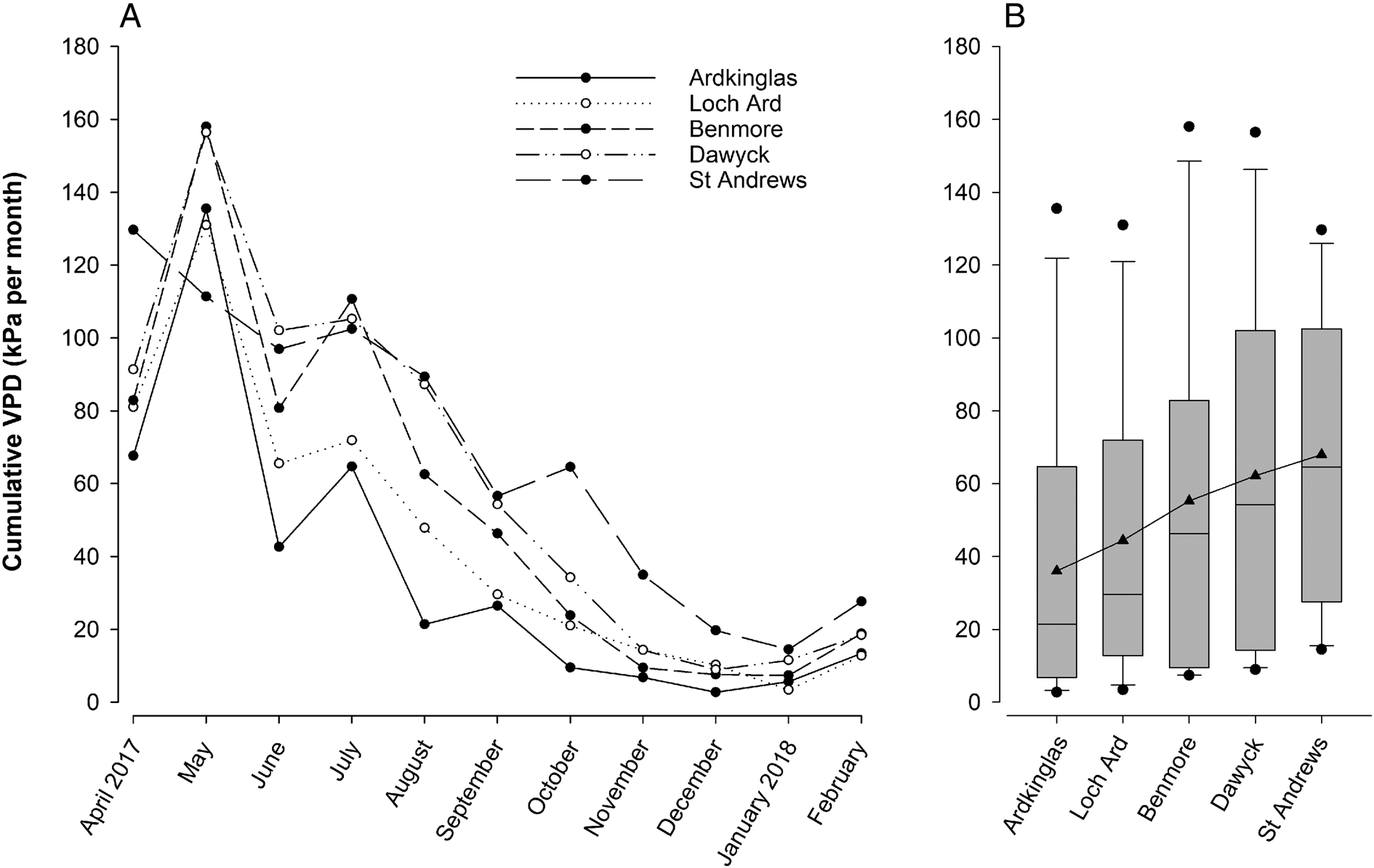
Calculated values of VPD, as a cumulative total per month, showed a pattern of seasonal change that was broadly coherent across the five study sites (Fig. 3), though being different in magnitude so that the microclimates experienced by lichen thalli were contrasting. Ardkinglas and Loch Ard were oceanic sites (hygrothermy = 142 and 145, respectively), with frames positioned in a sheltered woodland that explained low VPD. Benmore was also an oceanic site (hygrothermy = 152), but with frames positioned in a more open setting with intermediate VPD, while Dawyck was a drier site (hygrothermy = 65) with higher VPD, and St Andrews the driest and most continental site (hygrothermy = 58) with the highest VPD.
Microclimatic data at experimental sites for Lobaria pulmonaria growth across a regional climatic gradient in Scotland. A, time-series of monthly cumulative vapour pressure deficit (VPD) over the period of the growth experiment (line graph), for different experimental sites. B, the annual median and variability in monthly cumulative VPD within and among the sites (boxplots; showing inter-quartile range, 90th and 10th percentiles as whiskers, and 95th and 5th percentiles as dots), with the means (triangles).

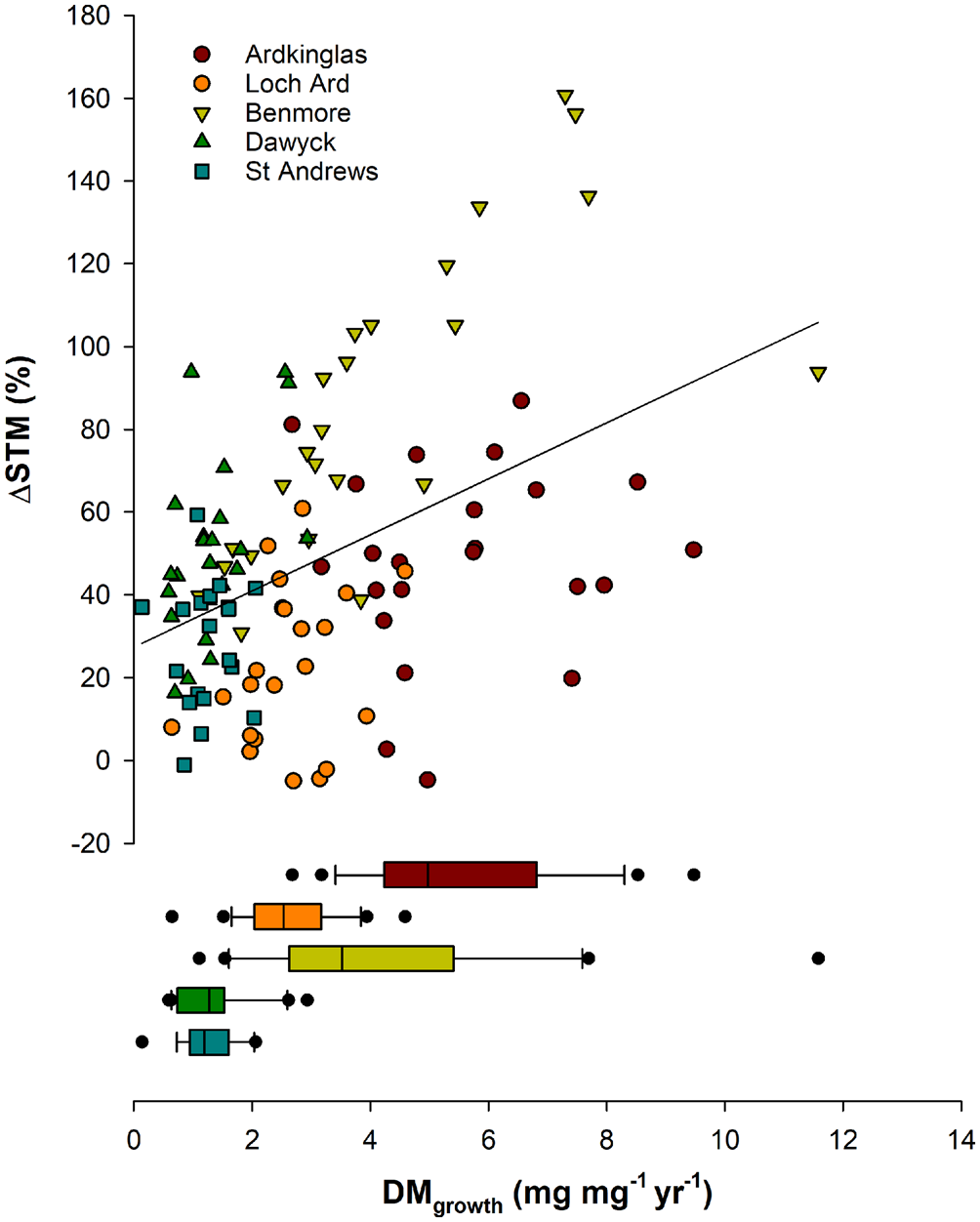
The mean start weight of individual lichen thalli was 42.75 ± 1.57 mg (± 1SE), with no significant difference among sites (F = 0.508, P = 0.73 with df4,104) or among microhabitat treatments within site (F = 0.834, P = 0.597 with df10,104). However, thallus growth was different among the sites (Fig. 4). Using GLMM for hierarchical partitioning, site explained c. 60.2% of the variance in growth, and its effect was broadly consistent with the different climates. Thallus growth was higher in wetter climates with lower VPD (Ardkinglas, Loch Ard) as well as for the intermediate Benmore site, becoming lower for progressively drier climates with higher VPD (Dawyck and St Andrews). Microhabitat treatment explained < 1% of the variance in growth (residual variance = 39.8%).
The change in specific thallus mass (STM) compared to growth (scatter plot; coded by experimental site) of Lobaria pulmonaria, and the median and variability in growth within and among the experimental sites (boxplots; showing inter-quartile range, 90th and 10th percentiles as whiskers, and 95th and 5th percentiles as dots). In colour online.

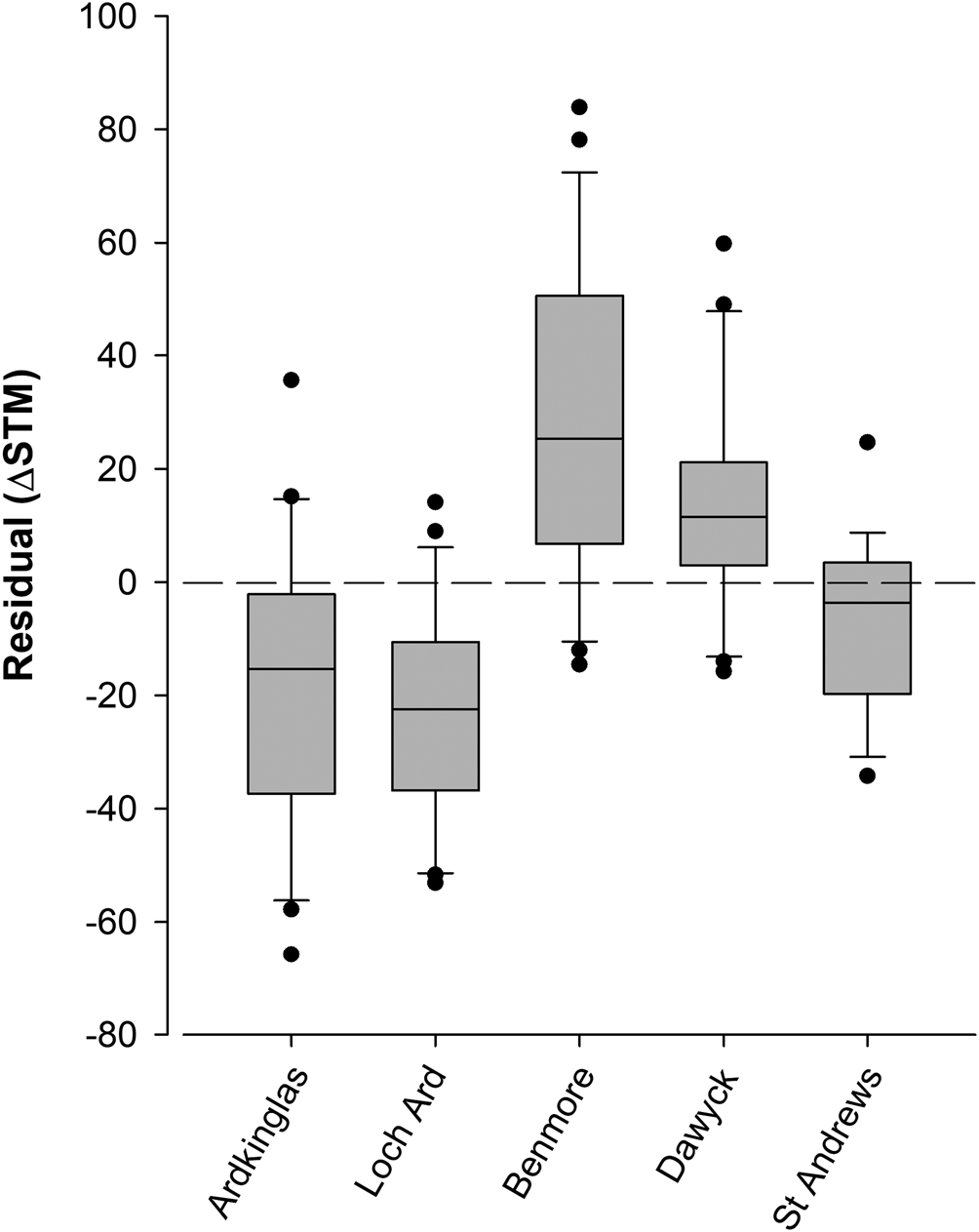
The mean start STM of individual lichen thalli was 9.2 ± 0.13 mg cm2 (± 1SE), with no significant difference among sites (F = 0.676, P = 0.61 with df4,104) but with a difference in STM among some of the microhabitat treatments within site (F = 3.123, P = 0.0016 with df10,104). Thallus growth significantly explained the percent change in STM (ΔSTM) over the course of the experiment (adjusted R 2 = 0.199, P < 0.0001 with 109 df). Allowing for the positive relationship between growth and ΔSTM (Fig. 4), and using GLMM for hierarchical partitioning, site explained c. 46.5% of the residual ΔSTM and microhabitat treatment explained c. 6% (residual variance = 47.5%). Accordingly, ΔSTM tended to be lower than expected (Fig. 5) for the two wettest sites (Ardkinglas and Loch Ard), increasing for the intermediate Benmore site, with a smaller increase for the drier Dawyck site, and with little overall change (±normally distributed residuals) for the driest site (St Andrews).
Residual values of the change in specific thallus mass (STM) of Lobaria pulmonaria when accounting for the effect of growth (cf. Fig. 4) at sites across a climatic gradient in Scotland.

Discussion
Phenotypic acclimation is an important biological response to environmental change, including climate change (Matesanz et al. Reference Matesanz, Gianoli and Valladares2010; Nicotra et al. Reference Nicotra, Atkin, Bonser, Davidson, Finnegan, Mathesius, Poot, Purugganan, Richards and Valladares2010). Acclimation under environmental change can therefore determine individual fitness, population viability, and moderates the risk to species. Considering the importance of moisture and thallus hydration in lichen photosynthesis and respiration (Green et al. Reference Green, Nash, Lange and Nash2010; Palmqvist et al. Reference Palmqvist, Dahlman, Jonsson, Nash and Nash2010), phenotypic change that modifies thallus water relations is thought to be a key route to lichen acclimation (Gauslaa et al. Reference Gauslaa, Palmqvist, Solhaug, Holien, Nybakken and Ohlson2009; Larsson et al. Reference Larsson, Solhaug and Gauslaa2012; Merinero et al. Reference Merinero, Hilmo and Gauslaa2014), including in response to climate change. In this study we were interested in the limits to this process of acclimation, and how any such limits might shape the lichen realized niche.
First, we demonstrated for Lobaria pulmonaria that growth was higher in wetter compared to drier climates. Although a widespread species in old-growth forest stands, this matches with a more general skew towards oceanic climates in terms of the species frequency of occurrence and abundance (James et al. Reference James, Hawksworth, Rose and Seaward1977; Ellis Reference Ellis2016), being consistent with bioclimatic trends observed in previous experimental growth studies (Eaton & Ellis Reference Eaton and Ellis2012; see also Gauslaa et al. Reference Gauslaa, Palmqvist, Solhaug, Holien, Hilmo, Nybakken, Myhre and Ohlson2007; Ellis et al. Reference Ellis, Geddes, McCheyne and Stansfield2017). However, there is evidence, both experimental (Gauslaa et al. Reference Gauslaa, Alam and Solhaug2016, Reference Gauslaa, Solhaug and Longinotti2017) and from field observations (Ellis Reference Ellis2020), that in the very wettest habitats L. pulmonaria growth might be constrained by suprasaturation. In establishing these patterns, VPD seems a useful compound metric for determining the moisture conditions relevant to L. pulmonaria growth (see e.g. Gaio-Oliveira et al. Reference Gaio-Oliveira, Dahlman, Máguas and Palmqvist2004), being consistent with the ability of the species to rehydrate under high humidity conditions. It is also related to dew formation as an additional source of moisture and reflects the ambient drying effect of the air (Barry & Blanken Reference Barry and Blanken2016), all of which will determine the extent to which the lichen thallus remains hydrated. VPD has been used previously to explain the growth and distribution of lichen epiphytes (Rambo Reference Rambo2010b; Ellis Reference Ellis2020), including their responses to environmental change at different scales (Rambo & North Reference Rambo and North2012; Song et al. Reference Song, Liu, Zhang, Tan, Li, Qi and Yao2014), and more broadly to explain general patterns of epiphyte biomass and community structure (Rambo Reference Rambo2010a; Gotsch et al. Reference Gotsch, Davidson, Murray, Duarte and Draguljić2017).
Second, we show a relationship between thallus growth and percent change in STM (ΔSTM), since thalli that had grown more also tended to accumulate greater mass per unit area. This is consistent with previous growth studies for L. pulmonaria under field and laboratory conditions (Gauslaa et al. Reference Gauslaa, Palmqvist, Solhaug, Holien, Nybakken and Ohlson2009; Bidussi et al. Reference Bidussi, Gauslaa and Solhaug2013) and may explain the widely reported allometric pattern in which larger thalli of a given species tend to have higher STM (Gauslaa & Solhaug Reference Gauslaa and Solhaug1998; Merinero et al. Reference Merinero, Hilmo and Gauslaa2014; Longinotti et al. Reference Longinotti, Solhaug and Gauslaa2017). It is important to take account of this allometry when attempting to characterize acclimation, and we did this by considering whether residual values of ΔSTM appeared to have a climate signature. Accordingly, we found that, despite relatively high growth for the two wettest locations, residuals were negative, indicating that the gain in thallus area was higher than might be expected relative to the increase in dry mass. Previous studies (e.g. Gaio-Oliveira et al. Reference Gaio-Oliveira, Dahlman, Máguas and Palmqvist2004; Gauslaa et al. Reference Gauslaa, Palmqvist, Solhaug, Holien, Nybakken and Ohlson2009; Larsson et al. Reference Larsson, Solhaug and Gauslaa2012) have suggested that this could occur in wetter environments, specifically conditions under which thallus hydration is sufficient to maintain turgor pressure required for the consistent expansion of fungal hyphae (Money Reference Money, Howard and Gow2007, Reference Money2008; Lew Reference Lew2011). In contrast, at an intermediate location, residuals were positive, indicating that the increase in thallus dry mass was higher than might be expected relative to the gain in area. Again, previous studies (e.g. Gaio-Oliveira et al. Reference Gaio-Oliveira, Dahlman, Máguas and Palmqvist2004; Gauslaa et al. Reference Gauslaa, Palmqvist, Solhaug, Holien, Nybakken and Ohlson2009; Larsson et al. Reference Larsson, Solhaug and Gauslaa2012) have suggested that this could occur in environments where thallus water content tends to be below a threshold invoking two conditions: (i) photosynthesis still remains active, for example estimated at a minimum of c. 15–25% thallus water content (Gauslaa et al. Reference Gauslaa, Solhaug and Longinotti2017; Phinney et al. Reference Phinney, Solhaug and Gauslaa2018), thus allowing an increase in dry mass, despite (ii) turgor pressure being lost, which is estimated at c. 40–60% thallus water content (Beckett Reference Beckett1995, Reference Beckett1996), and therefore preventing the expansion of fungal hyphae. However, the increase in residuals remains coupled to positive growth since the thalli become acclimated to maximize water storage, achieving longer periods of hydration. At the two driest locations, growth was highly limited or did not occur, and the consequence of this seems to have been an inability to sufficiently adjust STM. This would presumably be the case if both photosynthesis and turgor pressure remain low. Especially at the driest location, residual values were normally distributed and did not decline as might have been the case when acclimating to a drier environment. Incidentally, the driest site also suffered the highest rate of thallus mortality, at c. 21%.
There are several important limitations to our study. For example, our growth experiment lasted over the period of a year, and we assume that ΔSTM reflects the annual pathway of climatic contrasts between sites. However, previous work has demonstrated that STM may acclimate over shorter seasonal timescales (Larsson et al. Reference Larsson, Solhaug and Gauslaa2012), and it is possible that our final values of ΔSTM reflect the climate over a shorter preceding period, such as the winter season prior to the samples being measured. Nevertheless, this shorter period sufficiently retains the climatic contrasts, with VPD for the winter season being strongly correlated with annual VPD among the sites (Pearson's product moment correlation for mean VPD: r = 0.9, P = 0.036 with 4 df). Considering the potential for extreme events under climate change (O'Gorman Reference O'Gorman2015; Horton et al. Reference Horton, Mankin, Lesk, Coffel and Raymond2016), it is important to establish the shortest timescale over which the lichen thallus may acclimate to changed environmental conditions, referred to as the ‘rate of reversible phenotypic plasticity’ (Horton et al. Reference Horton, Mankin, Lesk, Coffel and Raymond2016). Our results suggest that phenotypic changes relevant to hydration are limited by thallus growth, and extreme events that exceed or limit a growth rate response will weaken this aspect of acclimation. However, there may be more rapid constitutive responses to a changed environment, as demonstrated by effective acclimation of L. pulmonaria photosynthesis over monthly (MacKenzie et al. Reference MacKenzie, MacDonald, Dubois and Campbell2001; Schofield et al. Reference Schofield, Campbell, Funk and MacKenzie2003) to weekly timescales (MacKenzie et al. Reference MacKenzie, Johnson and Campbell2004), and a rapid regulatory response to temperature observed through gene expression (Kraft et al. Reference Kraft, Scheidegger and Werth2022). Additionally, it was surprising that we found a minimal effect of microhabitat on growth and ΔSTM, with respect to aspect and an accompanying moss layer, both of which can affect microclimatic conditions (see Veneklaas et al. Reference Veneklaas, Zagt, Van Leerdam, Van, Broekhoven and Van1990; Colesie et al. Reference Colesie, Scheu, Green, Weber, Wirth and Büdel2012; Larsson et al. Reference Larsson, Solhaug and Gauslaa2012). It is possible that the climatic contrasts among sites was, owing to the experimental design, far greater than that realized by the microhabitat treatments within each site, while also having a higher statistical sample size (n = 24), so that the sample size available to test microhabitat treatment (n = 8) was just too small to detect an effect. Furthermore, a tendency for aerial extension of Lobaria pulmonaria lobes during growth, extending away from the substratum, may have weakened the effect of the moss layer.
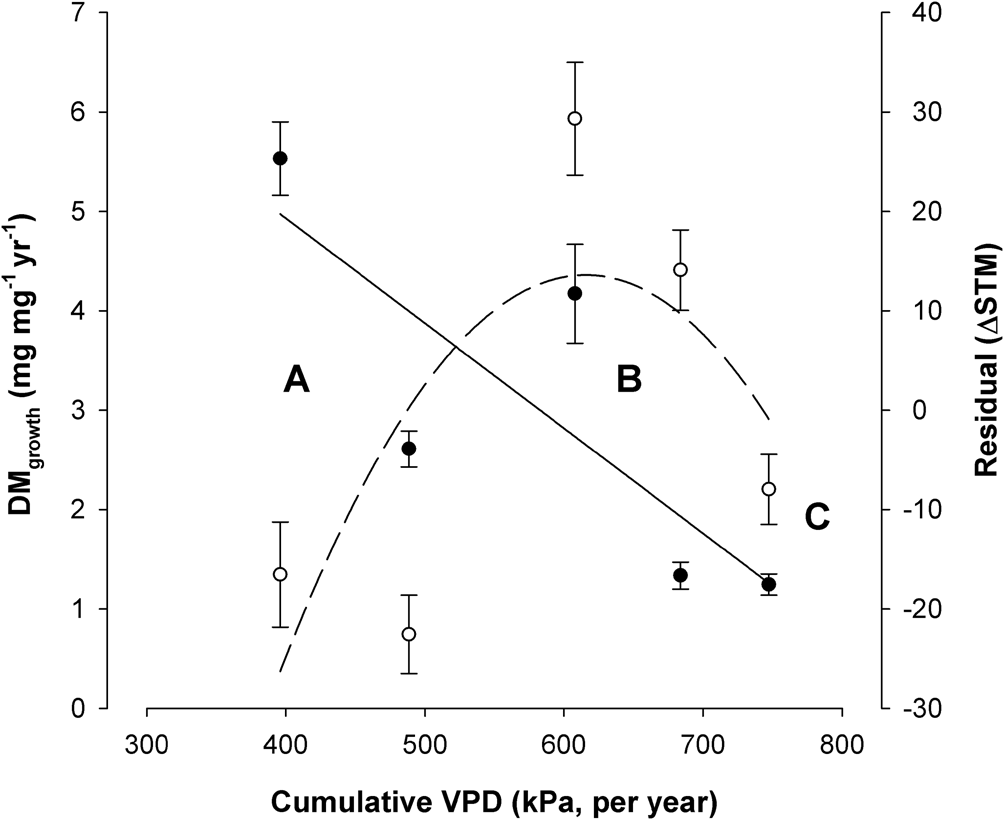
Despite these limitations, we cautiously propose a simple three staged acclimation response for L. pulmonaria (Fig. 6), this being relevant within the context of the species’ overall phenotypic adaptation to moisture regime. First, in a sufficiently wet environment both growth and turgor pressure are high, and consequently the relative STM decreases in favour of area gain. This thallus thinning increases the risk of suprasaturation, though with this risk being offset through aerial extension of lobes away from the substratum, facilitating airflow and evaporative drying (Zone A in Fig. 6). Second, in an intermediate environment, growth declines but remains positive, while turgor pressure is compromised, and consequently the relative STM increases in favour of thallus thickness, facilitating prolonged hydration during periods of water availability (Zone B in Fig. 6). Third, in a dry environment growth is very low or stops, preventing acclimation and representing the boundary of the species realized niche (Zone C in Fig. 6). On this basis, measures of thallus growth (as dry mass gain or loss) remain a useful functional metric for climate change response (see e.g. Ellis et al. Reference Ellis, Geddes, McCheyne and Stansfield2017; Smith et al. Reference Smith, Nelson, Jovan, Hanson and McCune2018; Ellis Reference Ellis2019; Meyer et al. Reference Meyer, Valentin, Liulevicius, McDonald, Nelson, Pengra, Smith and Stanton2023) since they incorporate the ability to acclimate to environmental change. If climate change crosses a threshold beyond which growth is no longer possible, then phenotypic acclimation would no longer be effective for L. pulmonaria, and the species would be considered at risk.
Summary acclimation response of Lobaria pulmonaria; closed symbols (± 1SE) and the solid line show the growth (linear response), open symbols (± 1SE) and the dotted line show the residual values of the change in specific thallus mass (ΔSTM) (unimodal response, as a polynomial). In Zone A (wetter), growth is high and STM declines as the thallus becomes relatively thinner; in Zone B (intermediate), growth is lower but sufficient to increase STM prolonging thallus hydration; in Zone C (dry), growth is lowest and poses a limit to phenotypic acclimation.

Acknowledgements
We thank the staff of each of the Botanic Gardens for their support in conducting the experiment; data analysis was completed while EC was on placement from the University of St Andrews to RBGE. The research was supported by the Rural and Environment Science and Analytical Services Division of the Scottish Government. We thank two reviewers for their comments that corrected errors and improved our submitted manuscript.
Author ORCID
Christopher Ellis, 0000-0003-1916-8746.