Background
Master Classes are typically a staple feature of Conservatoire culture. The generic term ‘Master Class’ is used variously to describe public events where high-profile artists coach advanced students or young professionals, smaller-scale instrument-specific Master Classes with professional players, stylistic Master Classes led by experts in a particular musical style or genre and, finally, more intimate performance classes given by instrumental or vocal teachers for their own students (or for other students within their own faculty). While there has been extensive research on the role of a ‘Master’ in contributing to the development of expertise within the context of the one-to-one student–teacher relationship (Jorgensen, Reference JORGENSEN2000; Purser, Reference PURSER2005; Sosniak, Reference SOSNIAK, Ericsson, Charness, Feltovich and Hoffman2006; Gaunt, Reference GAUNT2008), there has been little research concerned with the purpose of Master Classes, nor is there a substantial evidence-base relating to the value of this type of ‘Master–student’ interaction.
Master Classes, according to the violin soloist Midori (Goto, Reference GOTO2004, p. 37), offer a platform where ‘artists could take an active role in the education departments of performing arts institutions’. They have been described as potentially life-changing events, offering the opportunity for participants ‘to touch a legend, to gain insights into the music business, to test their value as singers and to learn new repertoire’ (Lalli, Reference LALLI2004, p. 24). Jorgensen (Reference JORGENSEN1995, p. 71) talks of the importance of ‘community’ in music education, using the example of a Master Class to portray ‘a community in which music making and taking plays a central role’. This context, according to Jorgensen (Reference JORGENSEN1995, p. 81), offers the potential for learners to ‘come to understand their place within a growing community, value differences as well as similarities, feel connected to others, accept and love their own musical traditions, and (become) empowered to change those things that should be changed and embrace new perspectives’.
Lalli (Reference LALLI2004) emphasises that Master Classes are no substitute for consistent and long-term one-to-one work between student and teacher, highlighting their principal value as being the opportunity to come into contact with new ideas and approaches to music-making. This view is reiterated by Wagner who states that ‘a fresh perspective from a professional musician offers a priceless commodity and an unforgettable experience for students’ (Wagner, Reference WAGNER2005, p. 42). McCoy suggests that while Master Class performers benefit from a fresh diagnosis of their musical habits, audience members may ‘learn vicariously, internalising suggestions for future personal application’ (McCoy, Reference MCCOY2008, p. 329).
Wider benefits of learning in Master Classes were reported by Taylor (Reference TAYLOR2009). Outside of a Conservatoire context, Taylor explored the meaning of learning the piano in a Master Class context for mature amateur musicians. All eight of her participants found the Master Class to be a positive experience, reporting enhanced confidence and motivation. Furthermore, it was reported that the participants’ identity as ‘pianists’ had been verified by the opportunity to take part in Master Classes with a professional whom they held in high esteem.
However, public Master Classes have also been described as having the potential to be harmful for participants, providing the context where a student performer may be cast in the role of ‘sacrificial offering who can come away wounded or destroyed’ (Lalli, Reference LALLI2004, p. 24). To protect against a negative outcome, Lalli advises students to go into Master Class performances with an open mind and yet with clear goals in relation to whether the purpose of participating in the class is to, for example, gain performance experience, catch the public attention or receive help for specific or general musical development.
The potential for performance anxiety to diminish the potential benefits of Master Classes has been noted. In this vein, Wagner (Reference WAGNER2005) stresses the need for Master Class participants to be prepared with strategies to counteract performance anxiety. The possibility for student performers to feel intimidated or overwhelmed by very high-profile ‘Masters’ is noted by Berg (Reference BERG2008, p. 121) who describes a Master Class given by Christa Ludwig where the young performers were ‘excited by this opportunity, entirely open to her guidance, but not unduly intimidated by the prospect of sharing the stage with one of the truly legendary singers of the twentieth century’. While Ludwig reportedly responded with warmth and charm, Heifetz famously used a metal stick as a symbol of control over his Master Class participants. ‘This stick was at hand all the time . . . a symbol of authority over his students . . . With it he struck the desk in front of him whenever something was going on that displeased him or if he needed attention. Sometimes he resembled a schoolmaster as he banged on the desk’ (Agus, Reference AGUS2001, p. 29).
While many reports and reminiscences of Master Classes thus raise salient issues and propose some plausible responses to the question of where the Master Class ‘sits’ in terms of its relevance to a Conservatoire curriculum, there is little empirical evidence to support or challenge these views. In this spirit, the present research was devised, with the aim of gathering empirical evidence relating to the value and purpose of Master Classes, from the perspective of Conservatoire students. The rationale for focusing on the ‘student voice’ was that student ‘insights warrant not only the attention but also the responses of adults; . . . they should be afforded opportunities to actively shape their education’ (Cook-Sather, Reference COOK-SATHER2009, p. 233). Accordingly, the specific research questions were: (1) what do Conservatoire students deem to be the purpose of Master Classes; (2) do Conservatoire students consider Master Classes to comprise a valuable component of their curriculum; and (3) what factors contribute to the success or non-success of Master Class experiences for students?
Methods
Procedures
A questionnaire was developed and then completed by 37 students at the Guildhall School of Music & Drama, London, between July and October 2008. As the purpose of the survey was to gather information about Conservatoire students’ views relating to the value and purpose of Master Classes the questionnaire comprised several open questions where students were asked to generate answers and suggest reasons relating to some of the issues raised above. The questionnaire also included 20 statements relating to these issues that students responded to on a five-point Likert scale ranging from strongly disagree (point 1), disagree (point 2), neutral (point 3), to agree (point 4) and strongly agree (point 5). Thus, the quantitative findings could be used to triangulate the qualitative responses, offering opportunities to examine where ‘the different data intersect’ (Silverman, Reference SILVERMAN2000, p. 98). In particular, the process of triangulation served to (a) enhance the reliability of the coding of qualitative data and (b) create deeper understanding of student interpretations of the quantitative scale items.
Questionnaires were handed out to vocal students at a number of Master Classes at the Conservatoire, given by visiting performers of international standing. The students were asked to fill in the questionnaire after the Master Class and to return it to one of the researchers. Wind, brass and percussion students were asked to fill in the questionnaire during a regular performance class attended by one of the researchers in September 2008. They were asked to reflect on a Master Class or Master Classes of their choice which they had attended recently in the Conservatoire and they completed the questionnaire during the last section of the performance class.
The sample
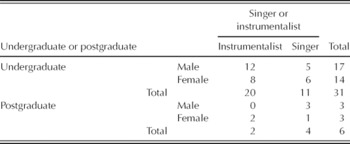
Twenty males and 17 females completed the questionnaire; the majority (N = 31) were undergraduate students and six were postgraduate students. The age range of the students was 18–27, with 51% of the sample aged 18–20 and the other 49% aged 21–27. Fifteen were vocal students, ten played wind instruments, nine were brass players and there was one each representing strings, percussion and piano (Table 1).
Characteristics of the sample

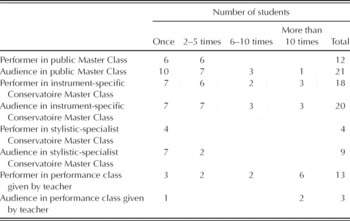
The students had a range of prior experience of Master Classes (Table 2). Twenty-one students had attended a public Master Class in the past at least once as a member of the audience, while others reported having been a member of the audience at instrument-specific Master Classes, stylistic-specialist Master Classes and performance classes for Conservatoire students. Twelve students had performed in public Master Classes, 13 had performed in performance classes given by their teachers, 18 had performed in instrument-specific Master Classes and four students had performed in stylistic-specialist Master Classes.
Prior Master-Class experiences amongst the students

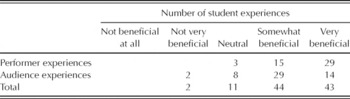
Generally, the students reported that these prior experiences had been beneficial, particularly when they were participating as performers (Table 3). The great majority of prior experiences of Master Classes were described as somewhat beneficial or very beneficial.
Students’ judgements of the value of prior Master-Class experiences

Analysis
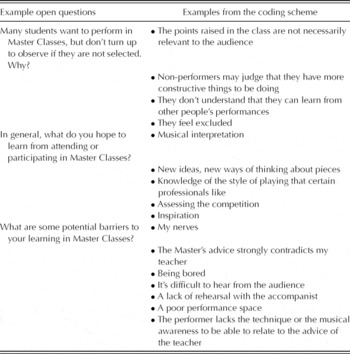
The survey included qualitative open questions as well as some closed Likert-scale questions. The qualitative text was subjected to a thematic analysis whereby themes relating to the research questions were identified. These themes were grounded in the text and translated into coding categories drawn directly from the text itself (Cooper and McIntyre, Reference COOPER and MCINTYRE1993). The coding scheme was tested and revised until all text had been examined. The principal researcher repeated the coding process on two separate occasions, thus establishing a degree of intra-rater reliability (Silverman, Reference SILVERMAN2000). The final version was agreed after four researchers monitored the coding scheme, comparing the codes to examples of text in each category. In accordance with the guidelines stipulated by Cooper and MacIntyre (Reference COOPER and MCINTYRE1993) and other qualitative researchers whose aim is to ‘retain some sort of direct access to raw data’ (Silverman, Reference SILVERMAN2000, p. 186) the words of the participants themselves were recontextualised as codes (Table 4). These coded themes were translated into variables that were then entered into SPSS (Statistical Package for the Social Sciences), making it possible to present the results both qualitatively and numerically. The quantitative Likert-scale responses were entered directly into SPSS and descriptive statistics were analysed.
Example open questions and codes

Findings
Benefits of Master Classes
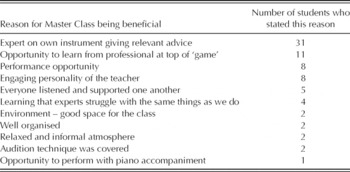
The students were asked to suggest reasons that they thought contributed to the success of Master Classes, in terms of the Master Class being a beneficial experience for the student. A wide range of reasons was given, with the most frequently cited being ‘expert on own instrument provides relevant advice’ (Table 5).
It was very useful to have an expert on your instrument telling you about technique and posture problems that my teacher may have missed as he got used to my playing.
(Undergraduate wind player)Students specifically noted that the expert advice was most beneficial when they were facilitated in understanding its relevance.
He explained techniques . . . that we could easily put into practice. When he told a player to do something he explained WHY it is beneficial.
(Undergraduate brass player)It was good to have a top specialist in my instrument who gave really constructive, yet still positive, advice.
(Undergraduate wind player)Some students valued the performance opportunity as well as the chance to learn from individuals whom they described as being at the ‘top of their game’:
You get to stand up and play in front of an audience and you get to learn from professionals at the top of their game
(Undergraduate brass player)A strong theme in relation to the benefits of Master Classes was that this represented a performance opportunity for students.
(It is beneficial because) it is an opportunity to gain performance confidence as well as gaining knowledge from an expert.
It is a real life performance opportunity.
(Undergraduate singers)Four singers and four instrumentalists identified ‘engaging personality’ of the ‘Master’ as potentially having an impact on how beneficial the Master Class could be.
The teacher was amazing and caught my attention from the first second until the end!
(Undergraduate brass player)
The teacher was very communicative with the audience overall as a performer.
(Undergraduate singer)Reasons for Master Classes being beneficial to students

What students hoped to learn from Master Classes
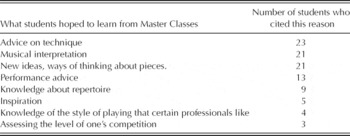
The students were also asked to state what they hoped, in general, to learn from Master Classes. Again, there was a range of responses, with the most frequently cited being related to specific aspects of advice such as technical advice and musical interpretation (Table 6). Students were interested in gaining ‘interpretation, new ideas, new ways of thinking about pieces, advice on technique, musical thinking suggestions, knowledge about a piece's context’ (Undergraduate wind player).
What students say they hope to learn from Master Classes

Students also indicated that they hoped to be inspired: ‘it is inspiring to see what I could achieve with focus, how to be a better musician’ (Undergraduate brass player).
‘The main aim for me is to get inspired. A little bit technical, but most in musical ideas and aims!’
(Undergraduate brass player)Students valued the opportunity to gain advice about performance from professionals, ‘learning about a professional singer's experiences and opinions . . .’ and ‘how to be a more relaxed performer, getting an idea of how professionals work and their stylistic ideas’ (Undergraduate singers).
Why Master Classes may not be beneficial
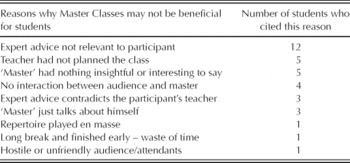
The students were asked to identify reasons that would potentially render a Master Class not beneficial. The most frequently cited reason was, again, related to the relevance of the expert advice (Table 7). Unless what the ‘Master’ had to offer was considered relevant, the Master Class was deemed to be potentially non-beneficial to students.
(A reason the Master Class was not beneficial) the Master Class was given by someone with an extensive knowledge of the composer but little knowledge of the voice.
(Undergraduate singer)Furthermore, if the ‘Master’ largely reiterated advice that the participants had heard from their teachers, the value of the Master Class was deemed to be diminished.
(A barrier to learning in Master Classes) is when there is repetitive advice from the ‘Master’ – sometimes it may be worthwhile for them to outline their aims before the performers begin.
(Undergraduate singer)I found that the advice given was less than inspiring or different to my day to day learning – not particularly insightful.
(Postgraduate singer)Students found Master Classes to be beneficial when there was evidence that these classes had been planned and were well-organised.
The Master Class was beneficial because it was well organised – we had time to work with a highly qualified Master
(Undergraduate pianist)We each had an allocated time slot – it was well organised and there was a relaxed and informal atmosphere
(Postgraduate wind player)Four singers (but no instrumentalists) identified lack of interaction between the audience and the ‘Master’ as being detrimental to the success of Master Classes. ‘A ‘Master’ who is unenthusiastic and who doesn't involve the audience’ and ‘an uninvolved audience’ were cited as reasons for Master Classes not being beneficial.
Reasons for Master Classes being NOT beneficial to students

Potential barriers to learning in Master Classes
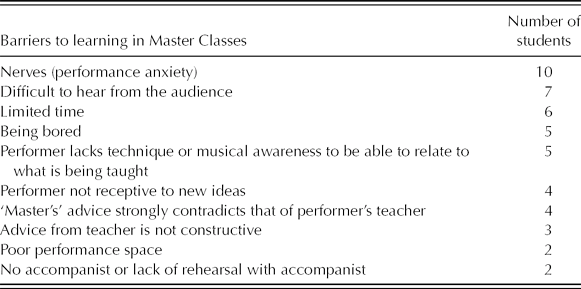
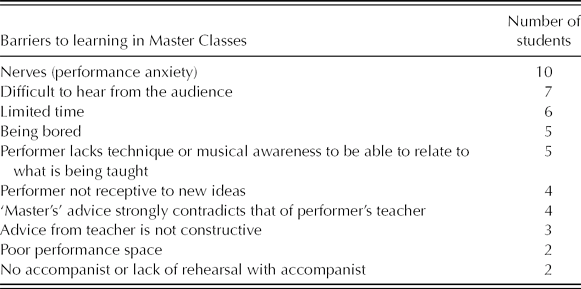
A number of potential barriers to learning in Master Classes were identified by the respondents. The most frequently cited theme related to performance anxiety (Table 8).
. . . pressure of performing in front of many peers. In Master Classes there will be moments when your voice isn't at its best when you are working on particular phrases/notes with the ‘master’. There may be a fear that your peers may see the ‘non-performance’ side of your voice. There is so much competition in conservatoires this can be troubling for performers. There is pressure of the actuality of performing and ‘worshipping’ in front of peers. One is very on show during such large Master Classes.
(Undergraduate singer)Along with performance anxiety, other barriers to learning that might be classified as ‘intrinsic’ rather than the ‘extrinsic’ factors cited above included boredom, the performer not being sufficiently musically aware or technically competent to be able to relate to the Master's advice and the performer lacking in receptiveness to new ideas.
If there are barriers to learning, they are always within oneself, such as bad self-confidence, jealousy, muscle tensions or unwillingness to commit. The barriers do not have anything to do with Master Classes or any other classes, I think.
(Undergraduate singer)Other potential barriers reinforced the points that had been raised in response to the earlier questions; difficulty of hearing the Master from the audience, limited time, poor performance space and no accompanist or lack of rehearsal time were all barriers to learning that related to lack of engagement between the Master and the audience and (in the case of the latter factors noted above) poor organisation. Four respondents identified potential problems in cases where the Master's advice contradicted that of the performer's teacher.
One Master Class involved a professional who had an aspect of technique that only worked for him and not other professionals – this strongly contradicted the advice of my teacher at the time.
(Undergraduate wind player)Notwithstanding this, the potential benefits of access to fresh ideas and advice was acknowledged.
I feel it is good to be taught by one main teacher but also to have as many Master Classes and views as possible so that one can better decide how they see music and relate to it with a less narrow perspective to technique, interpretation and musicality.
(Undergraduate wind player)Barriers to learning in Master Classes
Disincentives to observing Master Classes, for students
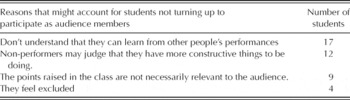
Anecdotally, there is evidence within Conservatoire communities that many students want to perform in Master Classes, but do not turn up to observe if they are not selected to perform. Students were asked to comment on why they considered this to be so.
Seventeen student respondents speculated that students who were not interested in participating as audience members did not understand that they could learn from other's performances (Table 9).
This is ridiculous. People think they are too important to learn from their peers. Something should be done about this.
They don't understand that learning from others is probably much more effective than just by themselves – selfish.
They probably question the usefulness of the class, not understanding that comments given to other performers probably will apply, at least to some extent, to them also.
(Undergraduate brass players)Another possible reason, proposed by 12 respondents, was that Master Classes were thought to be useful only for the performer and therefore non-performers would often have more constructive things to do with their time.
Master Classes can be quite long . . . if you don't have the chance of playing to look forward to. Also if you have a very busy week, you can feel you have other things you need to do. Master Classes are more useful when you do play.
Sometimes it is easier to prioritize other subjects if you are not playing. A Master Class can be a bit too long if you're not playing.
(Undergraduate wind players)Nine students suggested that the content of the Master Class may not be relevant to the students; this would be a disincentive to attend. This was a particular issue for those who felt that there were not enough Master Classes offered by experts on their own instrument.
It seems that the number of Master Classes given is inconsistent across the instruments. Flute players have many Master Classes whereas the double basses get next to none. All students should get the same amount of tuition, especially since we all pay for it.
(Undergraduate wind player)A further four made the related point that non-performers felt excluded and uninvolved, suggesting that Master Classes could be more beneficial if repertoire were set before the class and aims clearly stated.
Non-performers feel un-included. (It would be) helpful if pieces are set so everyone is included.
(Undergraduate wind player)Sometimes it may be worthwhile for the Master to outline their aims before the performers begin . . . There is a lack of inspiration because they feel uninvolved . . . Programme is usually not presented until the actual date . . . advance warning of what and who were performing might inspire people.
If one never is selected, one might feel rejected or not welcomed or even bad. If someone does feel this personally about the matter – that might be the reason for him or her not showing up.
(Undergraduate singers)One Undergraduate singer made the suggestion that vocal ensembles could perform in Master Classes, giving more individuals the performance experience and the opportunity to feel included in the class.
There are not yet enough solo Master Class opportunities (in ratio to number of singers) but if there could also be a chance to Master Class small vocal ensembles it would also be very beneficial to raise awareness.
(Undergraduate singer)Notwithstanding their speculation about why students may be disinterested in Master Classes, there was a strong sense amongst the responses to this survey that Master Classes were a valued and important part of their musical training.
The only reason I would miss a Master Class is if I was ill or already had a prior engagement. I go to most because you never know what you might learn
(singer)What I like is that you never know exactly what you will learn. Often these things are very subtle. I hope to learn anything from their overall experience.
(singer)Master Classes are vital in developing as a musician. We should have more!
(wind player)We need more Master Classes especially with outside teachers and made aware of other instrument Master Classes.
(wind player)They are an important factor to the course . . .Hearing different people is so important.
(brass player).Reasons for non-participation as audience members in Master Classes

General attitudes to Master Classes
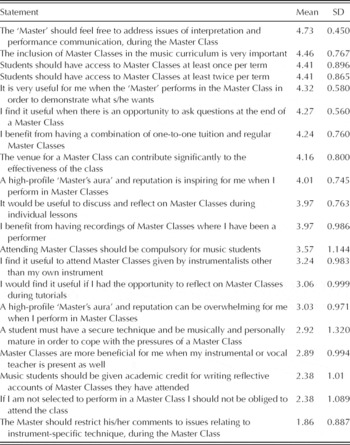
The students responded to a series of statements reflecting attitudes towards Master Classes, indicating their agreement with each statement on a five-point Likert scale ranging from 1 (strongly disagree) to 5 (strongly agree). The mean responses and standard deviations (representing the variability in responses) to these statements are set out in Table 10. In accordance with the guidelines provided by Howell (Reference HOWELL1997) standard deviations were inspected and deemed to indicate acceptable variation when the values were equal or less than approximately one fifth of the range. In all but three instances (discussed below) the standard deviations met this criteria.
Mean responses and standard deviations for attitudes to Master Classes

The responses indicated that there was widespread strong agreement (M = 4.73, SD = 0.450) amongst these students that in a Master Class context the ‘Master’ should feel free to address a range of issues including musical interpretation and performance communication, widening the scope of comments beyond instrument-specific technical advice. These data lend support to the qualitative responses, where students indicated that successful Master Classes were ones where the ‘Master’ provided inspiration and deep insights into wide-ranging musical matters. The Likert scale responses also supported the qualitative data noted above that suggested these Conservatoire students generally valued Master Classes (M = 4.46, SD = 0.767) and considered relatively frequent and regular access to Master Classes to be an important part of their curriculum, in addition to one-to-one tuition (M = 4.41, SD = 0.865).
The qualitative data were again supported by the quantitative results that indicated generally strong agreement that Master Classes were more useful and effective when consideration was given to the quality of the performance venue (M = 4.16, SD = 0.800) and when they included practical demonstrations from the ‘Master’ (M = 4.32, SD = 0.580) as well as the opportunity for question and answer sessions (M = 4.27, SD = 0.560). Although there was strong agreement that a high-profile performer could be inspiring (M = 4.01, SD = 0.745), there was evidently ambivalence in relation to the suggestion that the ‘aura’ and high-profile reputation of some ‘Masters’ could be overwhelming for student performers (M = 3.03, SD = 0.971).
The potential value to be gained from reflection on Master Class experiences was acknowledged in the responses. Despite the relatively low agreement that Master Classes were more beneficial when the one-to-one teacher was also present (M = 2.89, SD = 0.994) there was reasonably strong agreement amongst the students that it would be useful to discuss and reflect on Master Classes during individual lessons (M = 3.97, SD = 0.763). In this vein, there was a similar level of agreement that recordings of their Master Classes could be a useful tool (M = 3.97, SD = 0.986). Nevertheless, evidently the interest in reflection did not extend to formalising this process; there was low agreement with the suggestion that students should be given academic credit for written reflective accounts of their Master Class experiences (M = 2.38, SD = 1.01).
Less agreement and greater variability was found in responses relating to whether it should be compulsory for music students to attend Master Classes (M = 3.57, SD = 1.144). There was particularly low agreement with the statement that suggested students should be obliged to attend Master Classes even when they were not performing (M = 2.38, SD = 1.089).
Relatively low agreement but the greatest amount of variability was found in relation to the statement concerned with which students might benefit most from Master Class performance opportunities (M = 2.92, SD = 1.32). Whether or not ‘a student must have a secure technique and be musically and personally mature in order to cope with the pressures of a Master Class’ seemed to be a contentious issue amongst these students.
Discussion
This research focused on the student voice, providing a forum where Conservatoire students might concur with, challenge or contradict established beliefs relating to an accepted part of Conservatoire culture. Ramsden (Reference RAMSDEN2003, p. 97) reminds us that high-quality teaching involves fostering a ‘sense of student control over learning’. In this spirit, this research aimed to articulate the views of twenty-first century Conservatoire students, with a view to contributing to an understanding of how Master Classes might be developed in such a way as to engage students in relevant, creative and cooperative learning.
These data suggest that amongst this sample of Conservatoire students traditional discourses relating to Master Classes (Lalli, Reference LALLI2004) were to some extent reinforced. For example, the students generally considered the principal purpose of Master Classes to be to offer valuable performance opportunities, to gain fresh ideas on musical interpretation, instrumental technique and performance strategies and to make contact with high-profile professional performers. However, the students raised several issues relating to why participation as an audience member may not always offer the opportunity to learn vicariously, as McCoy (Reference MCCOY2008) suggested should be the case. Perhaps the most important of these issues was the suggestion that some students, as non-performers, feel excluded from benefiting from the Master Class experience. Clearly there is an equity issue here; all students need to be facilitated to take maximum advantage of the opportunities that are available within a Conservatoire. If, as one student suggested, aims were to be clearly stipulated and repertoire set in advance, audience participants may have more chance to engage in a meaningful way with the Master Class and to find the class to be relevant for their own performance practice. Furthermore, although the students themselves were sometimes quick to be disparaging about their peers who did not see the relevance of attending Master Classes, responsibility for enhancing this relevance and for maximizing the potential of Master Classes to contribute to the musical development of all participants, be they performers or audience, surely lies with the institution itself.
In this vein, it was notable and rather surprising that amongst this sample only 21 Conservatoire students had experience of attending a Master Class as an audience member. This seems to suggest that Conservatoire leaders need to address the question of whether their curricula should include more Master Classes so that increased numbers of students may benefit as performers or, alternatively, whether resources should be directed at enhancing the interactive possibilities of Master Classes and equipping students with skills that will enable them to benefit as audience members.
In addition to practical considerations relating to the performance environment and adequate rehearsal and preparation, students focused on the quality of the ‘Master’ as being of central importance to successful Master Classes. Quality, in this case, seemed to be conceptualised as comprising an engaging and communicative personality as well as a high level of expertise, knowledge and insight. Although many students privileged the notion of fresh ideas and new musical insights, some also stipulated that the Master Class could be a negative experience if the ‘Master’ gave advice which contradicted that of their one-to-one teacher. Notwithstanding this, others indicated that Master Classes were dull and unsuccessful when the ‘Master’ simply reiterated advice or knowledge that they had heard repeatedly from their teachers. Thus the role of the ‘Master’ could evidently be complex, attempting to strike a delicate balance between, on the one hand, offering new ideas, and on the other, reinforcing the messages that the regular teacher routinely delivered. Again, the responsibility must lie with the Conservatoire itself to prepare students for the Master Class experience, facilitating the development of receptiveness to new ideas together with skills to reflect upon and critique these new approaches. Although the students were generally less than enthusiastic about the idea of writing reflective accounts, they did indicate an interest in listening to recordings of their Master Class performances and reflecting on these within the context of their one-to-one lessons. This is possibly a strategy that could provide some continuity, bridging a possible gap between one-to-one lessons and Master Classes.
A further benefit of Master Classes was related to the theme of acquiring professionalism. The student responses suggested that they believed Master Classes had the potential to provide a context where they could work alongside ‘top’ professionals, participating as a member of the professional musical community in a performance arena. This suggests possibilities for Master Classes to be formally recognised and developed accordingly, within Conservatoire curricula, as vehicles for facilitating transition into professional communities of practice.
Performance anxiety was a prominent theme, cited as a potential barrier to learning in Master Classes. This may relate to the issue of students being overwhelmed by very high-profile artists, so aptly described in accounts of Master Classes with some iconic figures (Agus, Reference AGUS2001; Berg, Reference BERG2008). Furthermore, students themselves were evidently ambivalent over whether students at various levels of musical and personal maturity would be able to cope with the pressures of a Master Class. These data would suggest that students, again, need to be prepared for the Master-Class experience, equipped with strategies for coping effectively with performance anxiety and also perhaps matched with appropriate ‘Masters’ whose advice and level of expertise is accessible and relevant.
There were evident differences, amongst this sample, between students representing different instrument groups. While the sample was too small to be able to draw robust conclusions, the responses suggested that the brass players, who in this Conservatoire have an established collaborative culture, working with several teachers at a time and having weekly instrument classes together, had perhaps developed their peer learning skills more than other instrumentalists who did not have the same group learning experience. This suggests the need for further research that would address the question of whether there are clear distinctions amongst instrument groups, in terms of the value they attach to Master Classes, with a view to highlighting opportunities for sharing of best practice.
While this exploratory study was clearly limited by small numbers and under-representation of many instruments and musical genres, the findings do point to the need for further research that investigates how Master Classes may best be organised in such a way that will enhance the learning outcomes for all participating students, including audience and performers. Further research is also needed that will examine the issues that have been touched on in this paper from the perspective of the ‘Master’ as well as that of the one-to-one teacher. Master Classes, in various shapes and formats, continue to occupy a prominent place in Conservatoire curricula. For the benefits of this valuable resource to be truly realised further evidence is needed that will inform practice.