Headaches in childhood occur frequently and are characterized by a complex set of symptoms (Laurell, Larsson, Mattsson, & Eeg-Olofsson, Reference Laurell, Larsson, Mattsson and Eeg-Olofsson2006; Lewis, Yonker, Winner, & Sowell, Reference Lewis, Yonker, Winner and Sowell2005). Studies applying the International Headache Society criteria have reported that the prevalence rate in children ranges from 3% to 11% (Aromaa, Sillanpää, Rautava, & Helenius, Reference Aromaa, Sillanpää, Rautava and Helenius2000; Battistella et al., Reference Battistella, Fiumana, Binelli, Bertossi, Battista, Perakis and Soriani2006; Hernández & Roig, Reference Hernández and Roig2000; Kienbacher et al., Reference Kienbacher, Wöber, Zesch, Hafferl- Gattermayer, Posch, Karwautz and Wöber-Bingöl2006), but prevalence increases in as development advances (Aromaa et al., Reference Aromaa, Sillanpää, Rautava and Helenius2000; Battistella et al., Reference Battistella, Fiumana, Binelli, Bertossi, Battista, Perakis and Soriani2006).
Headaches are diagnosed through clinical assessments but, depending on the age of the population studied, the clinical manifestations can vary (Battistella et al., Reference Battistella, Fiumana, Binelli, Bertossi, Battista, Perakis and Soriani2006; Kienbacher et al., Reference Kienbacher, Wöber, Zesch, Hafferl- Gattermayer, Posch, Karwautz and Wöber-Bingöl2006). Some pediatric studies have revealed that the prevalence of headaches varies with the definition of a headache, the diagnostic methods, and the data collection procedures (Battistella et al., Reference Battistella, Fiumana, Binelli, Bertossi, Battista, Perakis and Soriani2006; Vannatta et al., Reference Vannatta, Getzoff, Powers, Noll, Gerhardt and Hershey2008).
Headaches may significantly impact the personal, familial, and social well-being of the affected children, influencing health status, functional status, i.e. the children’s ability to perform activities that are essential to meet basic needs, such as attend school and participate in social activities with their families, and quality of life (Kernick & Campbell, Reference Kernick and Campbell2009).
Behavioral problems in childhood are of interest to clinicians and researchers because of their influence on concurrent psychological and social adaptive patterns, their roles in influencing later functioning across peer and school contexts, and their potential to constrain the development of a range of emotional, cognitive, and social skills (Calkins & Fox, Reference Calkins and Fox2002; Calkins, Blandon, Williford, & Keane, Reference Calkins, Blandon, Williford and Keane2007). Moreover, there are two broad sets of behavioral problems, those characterized by aggression and acting-out behaviors (externalizing problems) and those characterized by anxiety, withdrawal, and depression (internalizing problems) (Achenbach & Rescorla, Reference Achenbach and Rescorla2000).
The association between behavioral problems (especially internalizing problems) and headaches has been reported in school-aged children and adolescents who were clinically referred in tertiary-care health centers (Galli, Canzano, Scalisi, & Guidetti, Reference Galli, Canzano, Scalisi and Guidetti2009; Just et al, Reference Just, Oelkers, Bender, Parker, Ebinger, Weisbrod and Resch2003; Mazzone, Vitiello, Incorpora, & Mazzone, Reference Mazzone, Vitiello, Incorpora and Mazzone2006; Riva et al., Reference Riva, Aggio, Vago, Nichelli, Andreucci, Paruta and Bulgheroni2006; Vannatta et al., Reference Vannatta, Getzoff, Powers, Noll, Gerhardt and Hershey2008).
As far as we know, very few studies about headaches and behavioral problems have included non-referred children (Just et al., Reference Just, Oelkers, Bender, Parker, Ebinger, Weisbrod and Resch2003) or preschool-age (Galli et al., Reference Galli, Canzano, Scalisi and Guidetti2009). Most of the studies were conducted with children of school age who were clinically referred in tertiary-care health centers for the treatment of headaches; therefore, differences between these children and headache-free controls may have been overestimated (Galli et al., Reference Galli, Canzano, Scalisi and Guidetti2009; Just et al., Reference Just, Oelkers, Bender, Parker, Ebinger, Weisbrod and Resch2003; Mazzone et al., Reference Mazzone, Vitiello, Incorpora and Mazzone2006; Riva et al., Reference Riva, Aggio, Vago, Nichelli, Andreucci, Paruta and Bulgheroni2006; Vannatta et al., Reference Vannatta, Getzoff, Powers, Noll, Gerhardt and Hershey2008). According to these studies, conclusions based on assessments of clinically referred children may not be appropriate for generalization to broader samples of children from the community. In addition, parents are the main source of information, especially with regard to the assessment of headache symptoms in preschool-aged children (Shonkoff, Boyce, & McEwen, Reference Shonkoff, Boyce and McEwen2009).
Temperament may be involved in the development of behavioral problems (Rutter, Reference Rutter2002). Temperament is defined as a constitutionally based individual difference in terms of reactivity and self-regulation of affect, activity, and attention (Rothbart, Ahadi, Hershey, & Fisher, Reference Rothbart, Ahadi, Hershey and Fisher2001). Constitutional refers to the biological basis of temperament influenced over time by heredity, maturation, and experience. Reactivity refers to the onset, intensity, and duration of positive and negative emotionality, whereas self-regulation is defined as the child’s ability to modulate behavior according to the cognitive, emotional, and social demands of a particular situation. Studying temperament allows us a greater understanding of both normative characteristics of temperament and individual differences (Rothbart & Bates, Reference Rothbart, Bates, Damon and Eisenberg2006). To the best of our knowledge, no study has been published using Rothbart’s approach to understand the relationship between headaches and temperament in preschool-aged children.
The aim of the present study was to assess and compare the temperament and emotional and behavioral problems of community-samples of young children with headaches and children without headaches.
Method
Participants
The present study was conducted from 2006 to 2008. The sample consisted of preschool children (3–5 years old), who were registered in the Family Health Program (FHP), which is a public health assistance program affiliated with the Faculty of Medicine at Ribeirão Preto, University of São Paulo. The FHP district includes five primary health care assistance centers for families in Ribeirão Preto city in Southeast Brazil. The majority of families, who are attended in the FHP, were classified as low socio-economic level.
The inclusion criteria in the present study were the following: children with age from 3 to 5 years, living with their biological mothers. The children whose mothers presented sensory deficits or/and psychiatry history were excluded. Figure 1 presents the flowchart of the sample.
Flowchart of the sample (children three to five years).

As seen in Figure 1, the initial sample assessed for eligibility was comprised of 158 community- sample children, aged 3–5 years. However, the mothers of 19 children refused to participate, and 49 children were excluded for the following reasons: some children did not live with their biological mothers (n = 40), some children had mothers who had psychiatric problems assessed by the Structured Clinical Interview for DSM-III-R (SCID) Non-Patient (Del Ben, Reference Del Ben1995; Spitzer, Williams, Gibbon, & First, Reference Spitzer, Williams, Gibbon and First1989) (n = 8), and some children had mothers with sensory deficits (hearing deficit, n = 1). A sample of 90 eligible children was obtained; however, 15 children (16%) subsequently dropped out of the study (the residences of 11 children changed and the new addresses were not known, and the mothers of four children stopped participating in the study).
The final sample consisted of 75 children. These 75 participants (S-IN) were similar to the 15 children who did not participate in the study (S-OUT) in terms of their mean age (S-IN, 56 months; S-OUT, 59 months; p = .14) and gender composition (S-IN, 53% female; S-OUT, 60% female; p = .63).
The presence of headache symptoms was assessed in the 75 children using the questionnaire by Aromaa, Rautava, Helenius, and Sillanpää (Reference Aromaa, Rautava, Helenius and Sillanpää1998). The presence or absence of headache symptoms in these children was based on the mothers’ reports, as used by Aromaa et al. (Reference Aromaa, Rautava, Helenius and Sillanpää1998) and Bille (Reference Bille1997), for non-referred samples. The children were divided into two groups according to the presence or absence of headache symptoms. The children with headache complaints comprised Group H (n = 22) and the children with no evidence of headaches comprised Group NH (n = 53).
Ethical Approvals
This study was approved by the Investigation Review Board, School of Medicine at Ribeirão Preto, University of São Paulo, Brazil, and by the Research Ethics Committee. The Free and Informed Consent Form was obtained from all participants.
Instruments and Measures
The Child Behavior Questionnaire (CBQ) (Rothbart et al., Reference Rothbart, Ahadi, Hershey and Fisher2001), Brazilian version (Klein, Putnam, & Linhares, Reference Klein, Putnam and Linhares2009), was used to assess child temperament. The CBQ presents content, construct, convergent, discriminate, and transcultural validities and also reliability (Rothbart et al., Reference Rothbart, Ahadi, Hershey and Fisher2001; Rothbart & Bates, Reference Rothbart, Bates, Damon and Eisenberg2006). In addition, the CBQ shows internal consistency in both, the English version (Rothbart et al., Reference Rothbart, Ahadi, Hershey and Fisher2001) and the Brazilian version (Klein, Reference Klein2009). The CBQ is composed of 195 items that assess 15 temperament domains. The CBQ consists of three broad factors: (1) Extraversion, which consisted of four dimensions (activity level, high-intensity pleasure, impulsivity, and shyness); (2) Negative affectivity, which consisted of five dimensions (anger/frustration, discomfort, fear, sadness, and soothability); and (3) Effortful control, which consisted of four dimensions (attention focusing, inhibitory control, low-intensity pleasure, and perceptual sensitivity). According to the instrument, dimensions including approach/positive anticipation and smiling/laughter, did not correspond to any of the three broad factors described above and were therefore analyzed independently. For each question, mothers were asked to rate the presence of specific behaviors observed during the previous six months, on an ordinal scale ranging from 1 (extremely not true) to 7 (extremely true). The total score was 7 for each factor and dimensions.
Emotional and behavioral problems were assessed using the Portuguese (Brazil) version (Santa Maria-Mengel, Reference Santa Maria-Mengel2007) of the Child Behavior Checklist (CBCL 1 ½–5) (Achenbach & Rescorla, Reference Achenbach and Rescorla2000). The CBCL 1 ½–5 is a checklist of 99 items which are ranked as being not true (0), somewhat or sometimes true (1), or very/often true (2). The CBCL 1 ½–5 enables users to quickly obtain standardized ratings and descriptive details of children’s functioning as seen by their parents. The checklist consists of two axes including: internalizing problems (emotionally reactive, anxious/depressed, somatic complaints, and withdrawn) and externalizing problems (attention problems, and aggressive behavior). In additional, the checklist includes sleep problems. In the present study, the syndrome scales were not used for children 3–5 years old, as recommendations by Rescorla (Reference Rescorla2005), Skovgaard, Houmann, Landorph, and Christiansen (Reference Skovgaard, Houmann, Landorph and Christiansen2004), and Skovgaard et al. (Reference Skovgaard, Houmann, Christiansen, Landorph, Jørgensen, Olsen and Lichtenberg2007). T-scores were obtained based on CBCL 1 ½–5 norm-reference and used to classify the children as normal (< 65), borderline (65–70) or clinical (above70). The cut-off for emotional and behavioral problems was ≥ 65, considering that the borderline and clinical range significantly discriminate between children who are referred for mental health or special education services for behavioral/emotional problems and children who are not referred (Achenbach & Rescorla, Reference Achenbach and Rescorla2000).
The presence of headache in children and in their family was based on the questionnaire by Aromaa et al. (Reference Aromaa, Rautava, Helenius and Sillanpää1998). The questionnaire was given to the mothers in order to examine the presence or absence of headache complaints in the children, using the Headache Development topic information, and the presence or absence of headaches in other family members, using the Headache Heredity topic information. In order to identify the presence of headache was taking into account, the duration and characteristics of episodes over the last six months was taking into account. In the Aromaa’s study (1998), the headache was defined by the occurrence of repeated episodes of headache, that may be associated with abdominal symptoms (nausea, vomiting, and stomachache), but not with other diseases, such as a sinus problems or occlusion faults. This questionnaire was not used to discriminate the type of headache (migraine or tension).
The Headache Screening Test (Speciali, Reference Speciali2003), which is recommended by the International Headache Society, was used to identify the presence or absence of headaches in the mothers. Headaches were assessed for the frequency of the episodes, duration of the episodes, and the presence of nausea, photophobia, or phonophobia, within the last three months.
In order to control relevant confounding variables, other validated instruments were used to characterize the families. The Social Readjustment Rating Scale (Holmes & Rahe, Reference Holmes and Rahe1967) translated and validated in Brazilian Portuguese (Savoia, Reference Savoia1999) was used to assess the occurrence of stressful life events and their impact. The Stress Symptom Inventory (Lipp, Reference Lipp2000) measured stress levels in the mothers. This instrument was used to identify the symptoms presented by the individuals, evaluating their stress, the predominant kind of symptom establishment by Lipp (Reference Lipp2000). The assessment of the results was done by percentage that indicated the presence or no of stress symptoms.
The socioeconomic status of the participant families was assessed according to the Brazilian Association of Company of Search scale (BACS), based on the year 2000 census data Footnote 1 . The results revealed 7 income levels: A1 (scores 42–46), A2 (scores 35–41), B1 (scores 29–34), B2 (scores 23–28), C1 (scores 18–22), C2 (scores 14–17), D (scores 8–13), and E (scores 0–7). Income status declined from level A to level E. High levels included categories A1, A2 and B1; average levels included categories B2 and C1; and low levels included categories C2, D, and E.
Procedure
All assessments were conducted by an expert and trained psychologist. The participant mothers were first screened using the SCID Non-Patient in order to exclude mothers with psychiatric symptoms. This exclusion was performed as an important cautionary measure, because the child assessments were based on maternal reports. For data collection, home visits were scheduled, and questionnaires were administered in two sessions by interviewing the mothers face-to-face. In the first session, the BACS scale was applied. In the second session, the CBQ and CBCL 1 ½–5 were conducted alternately in order to neutralize any potential order effects (carry-over effects). At the end of the session, the questionnaire by Aromaa et al. (Reference Aromaa, Rautava, Helenius and Sillanpää1998) was administered to detect the presence or absence of headaches in the children and families. This questionnaire was always used last so that the examiner remained blind with respect to the information about the children’s headaches. When headaches were suspected in the children, characteristics of the headache symptoms were explored and confirmed with the Aromaa’s Questionnaire (1998).
Data analysis
Descriptive statistical analyses were performed by calculating the frequencies, percentages, means, and standard deviations. The data were first analyzed with the Kolmogorov-Smirnov normality test to determine the best statistical analysis. Non-parametric statistics were used. Comparisons were made between the two groups using the Mann-Whitney test (for continuous variables) and Chi-Square test (for categorical variables). The Statistical Package for Social Sciences for Windows (SPSS, version 17.0) was used for all data analyses, and statistical significance was established at the 5% level.
Results
Characteristics of the Sample
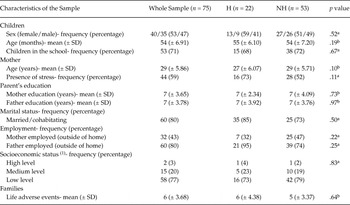
As displayed in Table 1, 75 children (35 males and 40 females), aged 3–5 years, were studied. The mean age of the children was 54 months (± 6.91), and most were attending preschool. Most mothers were young, and 80% had a stable marital union. The parents had approximately seven years of formal education, and most of them (77%) were of low income status. The mean number of adverse life events was six events per family. Also, 59% of the mothers reported the presence of symptoms of stress. Both groups of children (Group H vs. Group NH) were similar in terms of their demographics, income, number of adverse life events, and mother’s stress variables.
Characteristics of the sample - whole sample and groups of children with Headache (H) and with No Headache (NH)

Note:
a Chi-Square test, b Mann-Whitney test, p ≤ .05.
Headache Symptoms in the Families of the Children
Regarding the sample of 75 children, 55% of the mothers and 57% of the other family members (father, grandmother/grandfather, aunt/uncle, and brothers/sisters) presented headache symptoms. The mothers of children with headaches were significantly more likely to have headache symptoms compared to the mothers of children without headaches (Group H, n = 18 [82%]; Group NH, n = 23 [43%]; p ≤ .003). The group of children with headaches also had significantly more family members exhibiting headache symptoms compared to children without headaches (Group H, n = 18 [82%]; Group NH, n = 25 [47%]; p ≤ .006; χ2). Data not shown in the table.
Temperament
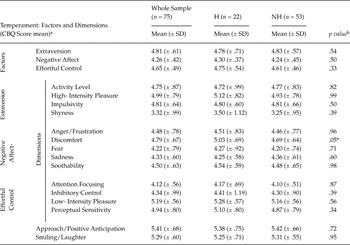
As shown in Table 2, children with headaches had higher mean scores for discomfort (negative affect dimension) compared to children without headaches. No group differences were observed for the other dimensions of temperament.
Temperament; Factors and Dimensions (CBQ Score mean) - whole sample and groups of children with Headache (H) and with No headache (NH)

Note:
a CBQ Score- range from 1 to 7 points, b Mann- Whitney test, * p ≤ .05.
Emotional and Behavioral Problems
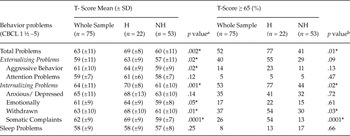
Significant group differences were observed with regard to childhood emotional and behavioral problems (Table 3). Means (T-scores) on the CBCL 1 ½–5 were significantly different between groups for total behavioral problems and externalizing, and internalizing behavior problems. Mean T-scores for aggressive behavior, emotionally reactive, withdraw, and somatic complaints were significantly higher for children with headaches than headache-free controls, regarding the subscales.
Behavior problems examined by CBCL 1 ½ –5 (T-Score) - whole sample and groups of children with Headache (H) and with No headache (NH)

Note:
a Mann- Whitney test, b Chi-Square test, * p ≤ .05.
Focusing on the T-Score ≥ 65, children with headaches were more likely to present emotional and behavioral problems (77%), especially internalizing problems (77%), than children without headaches. Furthermore, on both somatic complaints and withdrawn subscales, 54% of the children of Group H were classified with T-Score ≥ 65, which was a significantly higher percentage than for the children of Group NH.
Discussion
In the present study, temperament and emotional and behavior behavioral problems were evaluated in a community-sample of preschool-aged children with or without headache symptoms. Both groups were very similar concerning the great part of the dimensions of temperament. The findings show that children with headaches were more likely to have higher scores on the discomfort dimension of temperament compared to controls. According to Rothbart’s psychobiological approach to the development of temperament, discomfort is the amount of negative affect to the sensory qualities of stimulation, including intensity, rate, or complexity of light, movement, sound, texture, or a combination of these modes of stimuli (Rothbart et al., Reference Rothbart, Ahadi, Hershey and Fisher2001). Discomfort associated with light and sound is a common symptom of a kind of headache (migraine) where photophobia or phonophobia symptoms are present during headaches (Puccini & Bresolin, Reference Puccini and Bresolin2003).
According to Hernández and Roig (Reference Hernández and Roig2000), the earlier onset of headaches can be a predictive factor of an unfavorable clinical course. As such, children with headache symptoms may have a higher risk for developing headaches of high severity through later phases of development.
The findings of the present study confirm a significant association between headache symptoms in childhood and the presence of emotional and behavioral problems, even in a non-clinically referred sample of children. Children with headaches presented higher scores for the total number of problems and for the internalization and externalization of problems, assessed with the CBCL 1 ½–5, compared to children without headaches.
Although the study sample was composed of non-referred children of the community, the group of children with headaches had clinically significant elevations in the total number of behavioral problems, especially with respect to internalization of problems, as assessed with specific subscales of the CBCL 1 ½–5, compared to the control group. Somatic complaints and withdrawn disorders (the internalizing axis) were found more often in children with headaches than children without headaches.
Our findings regarding the emotional and behavioral problems of preschool-aged children with headaches are consistent with other studies of school-aged children and adolescents (Galli et al., Reference Galli, Canzano, Scalisi and Guidetti2009; Just et al., Reference Just, Oelkers, Bender, Parker, Ebinger, Weisbrod and Resch2003; Mazzone et al., Reference Mazzone, Vitiello, Incorpora and Mazzone2006; Riva et al., Reference Riva, Aggio, Vago, Nichelli, Andreucci, Paruta and Bulgheroni2006; Vannatta et al., Reference Vannatta, Getzoff, Powers, Noll, Gerhardt and Hershey2008). In older children, headaches are also a risk factor for internalizing rather than externalizing problems (Laurell et al., Reference Laurell, Larsson, Mattsson and Eeg-Olofsson2006; Vannatta et al., Reference Vannatta, Getzoff, Powers, Noll, Gerhardt and Hershey2008). According to Pulkkinnen (1995), the model of emotional and behavioral regulation refers to redirection, control, and modification of emotional arousal to enable an individual to function adaptively in emotionally arousing situations. Accordingly, intense emotions are associated with suppressed behavior during the internalization of problems, whereas intense emotions yield active behavior during the externalization of problems.
With regard to the associations between somatic complaints and headache status, our results are consistent with previous studies conducted in tertiary-care health centers (Galli et al., Reference Galli, Canzano, Scalisi and Guidetti2009; Just et al., Reference Just, Oelkers, Bender, Parker, Ebinger, Weisbrod and Resch2003; Mazzone et al., Reference Mazzone, Vitiello, Incorpora and Mazzone2006; Riva et al., Reference Riva, Aggio, Vago, Nichelli, Andreucci, Paruta and Bulgheroni2006; Vannatta et al., Reference Vannatta, Getzoff, Powers, Noll, Gerhardt and Hershey2008). Co-occurrence of multiple somatic complaints by children with headaches may be inherent to headache disorders (Just et al., Reference Just, Oelkers, Bender, Parker, Ebinger, Weisbrod and Resch2003), showing that different functional disorders may share a common substrate of genetically-based variations in physiological adaptation. Alternatively, parents of children with chronic pain may pay more attention to other complaints of somatic and physical problems, which may be further exacerbated if the parents also suffer from headaches, reflecting the effects of “parental pain modeling” (Chambers, Craig, & Bennett, Reference Chambers, Craig and Bennett2002).
We found that headaches aggregated in families, a well-known fact (Aromaa et al., Reference Aromaa, Sillanpää, Rautava and Helenius2000; Kienbacher et al., Reference Kienbacher, Wöber, Zesch, Hafferl- Gattermayer, Posch, Karwautz and Wöber-Bingöl2006). In our study, the children with headache symptoms were more likely to have mothers and other family members with histories of headache symptoms compared to children without headaches. A 40-years follow-up study demonstrated that approximately one-third of school-aged children with headaches and a positive family history for headaches eventually developed migraines, suggesting that heredity, psychosocial factors, parental pain modeling, or a combination of these factors influence outcome (Raieli et al., Reference Raieli, Eliseo, Pandolfi, Vecchia, La Franca, Puma and Ragusa2005).
Our results validate the relevance of early detection of headache symptoms in children less than six years of age, as demonstrated by Raieli et al. (Reference Raieli, Eliseo, Pandolfi, Vecchia, La Franca, Puma and Ragusa2005). These authors found a significant prevalence for “potentially dangerous” headaches in preschool children younger than six years of age, who required a lot of attention to prevent a negative impact on health and development. The main findings of the present study concern that pre-school children with headache could develop emotional and behavioral problems, which could threaten their adjustment along the developmental pathway.
This study presents some limitations. First, temperament, behavioral problems, and headache symptoms were reported by the mothers, and were therefore subject to bias of a single informant. Nonetheless, in clinical practice, the mother is the main source of health histories for preschool children, which is acceptable. Furthermore, mothers, because they are generally the primary caregivers, are better positioned to recognize behavioral changes associated with pain in their children. Second, the headache examined in the present study was based only on the presence or absence of headache. Because the children’s headaches may not be uniform in their characteristics, future research is needed to expand the classification system of children’s headaches in order to better understand the specific symptoms associated with behavioral problems. Third, future studies should be extended to include a larger community sample to test the generalizability of our findings. The small sample of the present study, along with the uneven group numbers, may have influenced our preliminary findings regarding child temperament. Furthermore, future studies of temperament should be expanded to include associations with headache symptoms and behavioral problems.
In conclusion, the preschool-aged children with headaches presented more externalizing and internalizing behavior problems than the control group.