Introduction
Animal manure is the major source of organic matter used in agriculture, although wastes from food processing and other industrial processes, together with municipal wastes, are also often usedReference Pascual, García and Hernández1, Reference Lalande, Gagnon, Simard and Côte2. The uncontrolled application of fresh pig slurry to soil can generate environmental problems, including an excess of nitrates and salts and/or the accumulation of phosphorus and metals in soils; the potential transport of pathogens via air or water; and air emissions of ammonia, methane, hydrogen sulfide, nitrous oxide and odorantsReference Amberger, Merckx, Vereecken and Vlassak3, Reference Diéz, de la Torre, Cartagena, Carballo, Vallejo and Muñoz4. In past decades, increasing environmental regulation concerning farming has resulted in great attention being paid to animal manures for land applicationReference Miner, Humenik and Overcash5, Reference Westerman and Bicudo6. Separation of pig slurry solid fraction and composting are two possible pre-treatment alternatives to obtaining a safer organic matter from animal manures in particular and organic wastes in general.
Although, sometimes the composting process may turn out to be expensive, the final compost is a mature organic matter without pathogens and/or toxic compoundsReference Garcia, Hernandez and Costa7, Reference Ros, Garcia and Hernandez8, that can be recycled in the soil as a source of organic matter and plant nutrients, improving soil quality and crop production and substantially contributing to the sustainability of soil functionsReference Ros, Hernandez and Garcia9, replacing as much inorganic fertilizer as possible to avoid environmental problems and energy consumptionReference Garcia, Hernandez and Costa7.
Microorganisms, especially bacteria and fungi, and soil enzymes, mostly of microbial origin, are responsible for the biological transformations that make nutrients available to plants and they are involved in many processes essential for the long-term sustainability of agricultural systemsReference Wardle10. Thus, the effects of particular organic amendments on soil microbial activity under a given cultivation system and climatic conditions need to be assessed. Biochemical properties such as microbial biomass carbon, basal respiration and hydrolase activities (urease, phosphatase and β-glucosidase) have been used widely to evaluate the impact of different organic and inorganic fertilizers on the entire soil and plant resourceReference Ros, Hernandez and Garcia9, Reference Kandeler, Tscherko and Spiegel11.
The objective of this experiment was to study the effects on yield and microbiological soil properties of multi-applications of mineral fertilizer compared with a single application of different pig slurry composts or multi-applications of fresh pig slurry, to a semi-arid soil under horticultural plant cultivation, as well as to evaluate the possibility of reducing or substituting mineral fertilizers with fresh or composted pig slurry without reducing crop yield.
Materials and Methods
Experimental design
Two successive horticultural crops, broccoli (November 2002–January 2003) followed by lettuce (March–May 2003), were grown in experimental plots located in Lorca (SE, Spain), very close to a pig farm. The soil had a pH (H2O) of 7.7 and electrical conductivity (EC) of 1.35 dS m−1. The soil contained 18 g kg−1 total organic carbon, 0.3 g kg−1 Kjeldahl N, 1.8 g kg−1 total P and 8.9 g kg−1 total K. The soil had been cultivated conventionally with lettuce until 1992. Since then, it had been abandoned, and no vegetation had grown in it during this time.
Randomized plots (4 m×6 m) were set up with the following treatments:
(i) Mineral fertilizer (MF) applied one week before planting each crop and according to the crop requirements (broccoli 182 kg N (NH4NO3) ha−1, 155 kg P2O5 ha−1, 112 kg K2O ha−1; lettuce 170 kg N (NH4NO3) ha−1, 100 kg P2O5 ha−1, 170 kg K2O ha−1).
(ii) Fresh pig slurry (PS) applied one week before each crop at a rate of 100 t ha−1 by spreading from a tank and incorporation by ploughing into the top 0–20 cm of the soil.
(iii) Compost from the solid fraction of pig slurry at equivalent of 15 t ha−1 (dry weight) (CSFPS).
(iv) Compost from a mixture of pig slurry and wood shavings (1:1, v/v) at equivalent of 15 t ha−1 (dry weight) (CPS+WS).
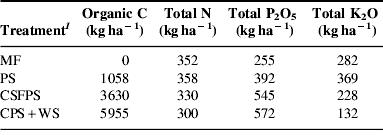
Treatments were set up in triplicate. Composts were applied only once, one week before the first crop and were incorporated by ploughing into the top 0–20 cm of the soil. The quantities of fresh pig slurry and composts added to the soil were calculated to give a total N amount similar to that provided by the successive additions of mineral fertilizer (Table 1).
Total amount of C, N, P and K added to the soil with each treatment in the experiment period.
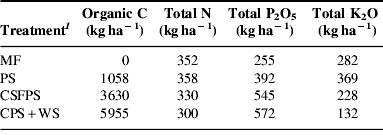
1 MF: mineral fertilizer; PS: fresh pig slurry; CSFPS: compost from the solid fraction of pig slurry; CPS+WS: compost from a mixture of pig slurry and wood shavings.
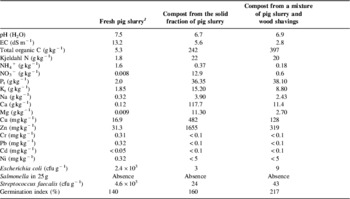
The solid fraction from pig slurry was obtained using a ‘compactor’ type solid–liquid phase delimiter, with a cylindrical sieve and a never-ending screw (GEA Westfalia-Separator, Germany). Composting was carried out in outdoor piles with periodical turning over a period of 3 monthsReference Ros, Garcia and Hernandez8. The main characteristics of the organic amendments are shown in Table 2. Pathogen content was below the limits established in the literatureReference Strauch12 and the heavy metal content was below the limits established by Spanish legislation (Real Decreto 1310/1990).
Characteristics of organic amendments (dry weight).

1 Average of each application.
Soils were sampled, in October 2002, before planting the broccoli crop (after adding the different organic amendments and mineral fertilizer to the soil), on March 2003, after broccoli harvest, and on May 2003, after lettuce harvest. Ten soil cores (0–20 cm) from each treated plot were randomly collected and bulked. The samples were immediately transported to the laboratory, sieved (<2 mm) and stored at 4°C for analysis.
Chemical analysis
EC and pH were measured in an (1:5) aqueous extract. Total organic carbon (Corg) was determined by oxidation with potassium dichromate in an acid medium and measurement of the remaining dichromate with Mohr's saltReference Yeomans and Bremner13. Nitrogen (N) was determined by the Kjeldahl method modified by Bremner and MulvaneyReference Bremner, Mulvaney and Burns14. The nitrate content was determined by high performance liquid chromatography (HPLC) after extraction for 2 h with hot water (40°C) (1:10, w/v). Ammonium was determined by ammonium selective electrode after extraction with 2 M KClReference Keeney, Nelson, Page, Miller and Keeney15. Total P, K and heavy metals were determined by atomic absorption spectroscopy after wet acid digestion of the samples.
Microbial activity and microbial biomass carbon
Soil respiration was measured as the CO2 evolved during an incubation period of 40 days from 30 g of soil moistened at 60% of its field capacity and placed in hermetically sealed flasks kept in the dark at 28°C. The CO2 emitted was measured by infrared (IR) spectrophotometer daily during the first week and once each week thereafter. Basal respiration was calculated by dividing the CO2 evolved during the incubation period by the duration of the incubation experiment. Microbial biomass carbon (Cmic) was determined by fumigation with ethanol-free CHCl3 and extraction with K2SO4Reference Vance, Brookes and Jenkinson16.
Soil enzyme activities
Dehydrogenase activity was determined by Skujins' method modified by Garcia et al.Reference Garcia, Hernandez and Costa17. Sample (0.5 g) at 60% of field water holding capacity was treated with 0.2 ml of 0.4% 2-p-iodophenyl-3-p-nitrophenyl-5-phenyltetrazolium chloride (INT) in distilled water for 20 h at 22°C in darkness. The iodo-nitrotetrazolium formazan (INTF) formed was extracted with 10 ml of a mixture of 1:1.5 ethylene/chloride acetone and measured spectrophotometrically at 490 nm.
Urease was determined by incubation of 0.48% urea with borate buffer at pH 10 (2 h at 37°C). Activity was determined by measuring the released NH4+ with a spectrophotometer (HeλΙos α, Thermo) at 690 nmReference Kandeler and Gerber18. Protease activities were determined by incubation of 0.03 M N-α-benzoyl-l-argininamide (BAA) with 0.1 M phosphate buffer at pH 7 (1 h at 40°C)Reference Bonmatí, Ceccanti and Nannipieri19. Activity was determined by quantification of the released NH4+ with a spectrophotometer (HeλΙos α, Thermo) at 690 nmReference Kandeler and Gerber18. Phosphatase and β-glucosidase activity were determined using 0.115 M p-nitrophenyl phosphate (PNPP) dissolved in 0.1 M maleate buffer (pH 6.5) (1 h at 37°C)Reference Tabatabai and Bremner20 and 0.05 M p-nitrophenyl-β-d-glucopyranoside (PNG) dissolved in modified universal buffer (MUB-HCl buffer pH 6)Reference Eivazi and Tabatabai21, respectively, as substrates. These assays are based on the release of p-nitrophenol (PNP) which was measured with a spectrophotometer (HeλΙos α, Thermo) at 400 nm.
Statistical analysis
Statistical analysis was performed using SPSS 13.0. The statistical model was a completely randomized design with four treatments and three replicates per treatment, sampled at three times. Two-way ANOVA for treatments and sampling time, and one-way ANOVA for treatments at each sampling time were used followed by Tukey'sReference Tukey22 significant difference (P⩽0.05) as a post hoc test.
Results
Chemical characteristics of treated soils
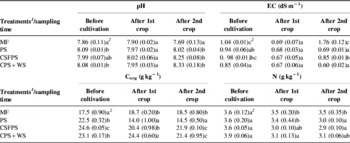
For pH and EC, an interaction (P⩽0.05) between treatments and sampling time was observed. The pH values ranged from 7.9 to 8.3, with organically treated soils showing higher pH values throughout the experiment than mineral fertilized soils. In general, before cultivation and after the second crop EC values in organically treated soils were lower (P<0.05) than in mineral fertilized soil. EC values in organically treated soils diminished significantly with the successive crops (Table 3).
Chemical properties in the treated soils (dry weight). (Number in parenthesis indicates standard deviation, n=3).

1 MF: mineral fertilizer treated soil; PS: fresh pig slurry treated soils; CSFPS: soil treated with compost from the solid fraction of pig slurry; CPS+WS: soil treated with compost from a mixture of pig slurry and wood shavings.
2 For each parameter and sampling time, values followed by the same letter are not significantly different according to Tukey's test (P⩽0.05).
The Corg content in the compost-treated soils (CSFPS and CPS+WS) was higher (P⩽0.05) than that in the soils treated with mineral fertilizer and fresh pig slurry throughout the experiment (Table 3). In organically treated soils Corg content diminished with time (PS 35%; CSFPS 11%; CPS+WS 7%). While no decrease in Corg content was observed in the MF treated soil (Table 3). No differences (P⩽0.05) were found as regards Kjeldahl N between organically and inorganically treated soils before cultivation. However, N content in the organically treated soils decreased from 17 to 21% with the two successive crops, N content in these soils being significantly lower than in MF treated soils after the second crop. A significant interaction between treatments and sampling time was observed for Corg and Kjeldhal N.
Crop yield
Broccoli yields (commercial edible part of the plant) ranged from 51,075 to 52,000 kg ha−1 (fresh weight), while lettuce yields ranged between 20,915 and 23,561 kg ha−1 (fresh weight). In both crops, no yield differences (P⩽0.05) were observed between the different treatments.
Microbial activity and biomass carbon
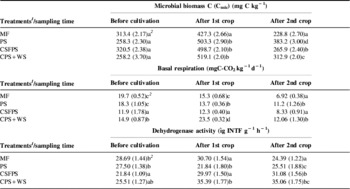
Microbial biomass C and basal respiration showed an interaction (P⩽0.05) between treatments and sampling time (Table 4). Before cultivation, the MF treated soil showed a microbial biomass carbon (Cmic) content similar to that of the organically treated soils (Table 4). However, from the end of the first harvest onward all the organically treated soils showed a higher Cmic content (P⩽0.05) than the MF soil. As regards basal respiration before cultivation, the MF and PS treated soils showed higher (P⩽0.05) basal respiration values than those of the compost-treated soils. These values decreased in the former soils during the course of the experiment, basal respiration values in the MF treated soil being, in general, lower (P⩽0.05) than those of the organically treated soils at the end of the experiment (Table 4). Between the different organic treatments CSFPS treatment showed the lowest values throughout the experiment.
Biomass C (Cmic), basal respiration and dehydrogenase activity in the treated soils (dry weight). (Number in parenthesis indicates standard deviation, n=3).

1 MF: mineral fertilizer treated soil; PS: fresh pig slurry treated soils; CSFPS: soil treated with compost from the solid fraction of pig slurry; CPS+WS: soil treated with compost from a mixture of pig slurry and wood shavings.
2 For each parameter and sampling time, values followed by the same letter are not significantly different according to Tukey's test (P⩽0.05).
Enzyme activities
Before cultivation, dehydrogenase activity in the organically treated soils before cultivation was similar or lower than in the MF treated soil. However, this trend was inverted with time (Table 4) and, after the two successive crops, dehydrogenase activity was higher in organically treated soils than in the soil receiving mineral fertilization.
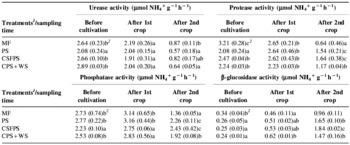
Urease and protease activities showed an interaction (P⩽0.05) between treatments and sampling time. Urease activity decreased (P⩽0.05) with crop rotation in all treated soils (Table 5). Protease activity was initially higher (P⩽0.05) in the MF treated soil than in the soils receiving fresh or composted pig slurry. However, after two successive crops, the organically treated soils showed higher (P⩽0.05) values of protease activity than the MF treated soil; this increase with respect to MF treated soil ranged from 183 to 256% (Table 5). All treated soils showed lower values of protease activity after the second crop than before cultivation.
Hydrolase enzyme activities in the treated soils (dry weight). (Number in parenthesis indicates standard deviation, n=3).

1 MF: mineral fertilizer treated soil; PS: fresh pig slurry treated soils; CSFPS: soil treated with compost from the solid fraction of pig slurry; CPS+WS: soil treated with compost from a mixture of pig slurry and wood shavings.
2 For each parameter and sampling time, values followed by the same letter are not significantly different according to Tukey's test (P⩽0.05).
An interaction (P⩽0.05) between treatments and sampling time was observed for phosphatase activity. Before cultivation, all treated soils showed similar values of this enzyme but after the two successive crops, the organically treated soils showed higher (P⩽0.05) values than the MF treated soil, the increase in enzyme activity with respect to MF treated soil ranging from 141 to 178% (Table 5). All values were lower after the second crop than before cultivation. β-glucosidase activity showed an increase (P⩽0.05) during the experiment in all treated soils (Table 5). After the two successive crops, organic amendments favored an increase (P⩽0.05) in the activity of this enzyme over mineral fertilization, ranging from 153 to 192%.
Discussion
Physico-chemical and chemical properties
The soil pH was compatible with a healthy vegetal growth since the optimal pH value for broccoli and lettuce growth is in a range of 6.5–8.023. Since the organic amendments had a pH range of 6.7–6.9 and the soil pH was 7.7, a decrease in soil pH with the organic amendments might have been expected. However, soil pH increased, which may have been due to the action exerted by the high CaCO3 and soluble salt content of the pig slurry products derived from the pig dietReference Sommer and Husted24. Bernal et al.Reference Bernal, Roig, Madrid and Navarro25 and Whalen et al.Reference Whalen, Chang, Clayton and Carefoot26 also reported that soil pH increases with increasing pig slurry amendment. The EC values observed in the soils were below the 2 dS m−1 threshold value which indicates a hazardous level of salt concentration in the soil solution. The diminution in the EC values of the organically treated soils with successive crops is attributable to salt leaching through the soil profileReference Ros27. It should be noted that after the second crop the MF soil showed an EC value higher (P⩽0.05) than that of the organically treated soils, which can be explained by the successive applications of mineral fertilizer, pointing to the risk of soil salinization with such a practise.
The addition of composts increased (P⩽0.05) the soil Corg content with respect to the MF treated soil. This is attributable to the organic matter incorporated with the organic amendments as well as to root exudates and vegetal remains, and confirms that the incorporation of stabilized organic amendments has the advantage compared with mineral fertilization of improving the soil organic matter content and contributing to the maintenance of soil humic substance pool and soil fertilityReference Ros, Hernandez and Garcia9. Nevertheless, changes in the quality and quantity of soil organic matter content are difficult to quantify in short-term studies because they are small compared with the large background of organic matter and natural soil variabilityReference Bosatta and Agren28.
The lower (P⩽0.05) Corg content measured after the first and second crop in the PS treated soil with respect to the compost soils, despite the multi-application of fresh pig slurry, may be attributable to the lower organic matter content of this waste compared with its derived composts and its more unstable character. Data were similar to those indicated by Plaza et al.Reference Plaza, Hernandez, Garcia-Gil and Polo29 who observed significant lower Corg values in soils amended with pig slurry at 150 m3 ha−1 yr−1 than in compost treated soils.
The nitrogen content is one of the most important factors for plant growth, and after the two successive crops, the nitrogen values in some organically treated soils were lower (P⩽0.05) than the observed in the MF soil, suggesting a certain depletion of the N incorporated in the soil with the organic amendment. This indicates that another organic amendment or alternative N supply would be necessary after two successive crops before planting a new crop. The decreases observed can be attributed to the loss of NH3-N by volatilization, N-uptake by crops and NO3− leaching. Since all treatments led to similar yields in the two successive crops, it can be stated that a sole application of pig slurry composts was able to provide the nutrients required for this kind of crop. Due to its stable character, organic compost mineralizes slowly, acting as a slow release fertilizerReference Castellanos and Pratt30.
The possibility of obtaining similar broccoli and lettuce yields by applying one dose of slurry composts as by applying two successive doses of mineral fertilizer clearly represents an economic, energetic and environmental advantage. The addition of fresh pig slurry can also be an effective alternative. However, it does have associated problems, such as producing unpleasant smells, risk for users and environment of contamination by pathogens and opens up the possibility of nitrate contaminationReference Diéz, de la Torre, Cartagena, Carballo, Vallejo and Muñoz4, Reference Pahl, Godwin, Hann and Waine31, Reference Sarrantonio32. In addition, it must be added before planting each crop since it does not possess such a high residual nutritional effect as compostsReference Castellanos and Pratt30.
Microbial activity
The incorporation of nutrients with the mineral fertilization as well as the incorporation of easily degradable organic matter and nutrients with the organic amendments stimulated the growth of a soil's indigenous microorganismsReference Sakamoto and Oba33; in addition, organic amendments contributed to the microorganisms they containReference Ros, Hernandez and Garcia9. Nevertheless, differences between mineral and organic fertilization with respect to the Cmic content were not noticeable at the beginning of the first crop, which may be due to the slower availability of the nutrients provided by the composts and/or to the need for a period of time for compost microorganisms to adapt to the new environmental conditions.
After the two successive crops, Cmic values in the organically treated soils were higher (P⩽0.05) than in the MF soil. This lower Cmic value in the MF soil could be due to shortage of available carbon after an initial boost of mineralization activitiesReference Dilly and Munch34. Ritz and RobinsonReference Ritz and Robinson35 and Stevensson and PellReference Stevensson and Pell36 found no consistent effect of mineral N-fertilization on microbial biomass under spring barley and in three Swedish long-term field experiments, respectively. Fresh pig slurry treated soils showed similar Cmic values to compost-treated soils. However, it should be borne in mind that compost was only added to the soil once, while PS was incorporated twice. Soil respiration is considered as an useful indicator of microbial activityReference Nannipieri, Grego, Ceccanti, Bollag and Stotzky37. Before cultivation, MF and PS treated soils showed higher (P⩽0.05) microbial activity values, as estimated by basal respiration, than the compost soils, which may be due to the higher available nutrient content of the mineral fertilizer and fresh pig slurry with respect to pig slurry composts. Although differences between the basal respiration values of the compost treated soils were not significant, basal respiration tended to be higher in the soil treated with the compost containing wood shavings (CPS+WS). In previous workReference Ros, Garcia and Hernandez8, it was observed that the amount of CO2 released (microbial respiration) from pig slurry composts with bulking agent was always higher than that of the same composts without bulking agent, suggesting that the higher porosity and improved aeration provided by the bulking agent to the compost as well as the nature itself of this agent (wood shaving) stimulated compost microbial activity.
Metabolic microbial activity was also evaluated by measuring dehydrogenase activity, which is an enzyme involved in the respiratory chains of all microorganisms and has been used to evaluate the overall microbial activity in soilsReference Serra-Wittling, Houot and Barriuso38. Before cultivation soil dehydrogenase activity in the MF and PS treated soil was, as observed for basal respiration, similar to or higher than that of compost treated soils, which, as indicated above, can be explained by the higher available nutrient content of the mineral fertilizer and fresh pig slurry compared with pig slurry composts. As the organic matter of compost mineralized and the medium was enriched in available nutrients, microbial activity in compost treated soils increased, all the organically treated soils showing dehydrogenase activity values higher (P⩽0.05) than the MF treated soil after the second crop. These results again confirm that organic fertilization has a greater and more durable positive effect on microbial population growth and activity than mineral fertilization.
Enzyme activities
The statistical analysis of some enzymes assayed pointed to significant variations in activity as a function of sampling time. Martens et al.Reference Martens, Johanson and Frankenberger39 stated that in a soil receiving constant organic amendments, the processes of promoting and suppressing enzyme activities may be balanced.
Urease activity hydrolyzes urea type substrates to NH4+Reference Tabatabai, Page, Miller and Keeney40. Urease activity was very similar in all treatments, diminishing (P⩽0.05) with cultivation in all treated soils, which might be due to the lack of specific substrates and/or the presence of a sufficient concentration of NH4+ in the medium making the synthesis of the enzyme unnecessary. The activity detected could be also due to the existence of immobilized enzymes since urease is an enzyme of microbial origin prone to form bonds with soil mineral and organic colloids, thus being protected against denaturizationReference Bremner, Mulvaney and Burns41, Reference Diáz Marcote and Polo42.
Protease activity hydrolyzes N-α-benzoyl-l-argininamide and catalyzes the hydrolysis of simple peptides (dipeptides) to ammonium. Immediately after the incorporation of the different treatments, MF treated soils showed higher protease activity than organically treated soils. This agrees with lower values of Cmic and microbial activity (basal respiration and dehydrogenase activity) detected initially in organically treated soils, which may be due to the need for a period of time for microorganisms to adapt to the new environmental conditions. However, after the two successive crops, protease activity was significantly higher (P⩽0.05) in the organically treated soils than in the MF treated soil, suggesting a higher amount of specific substrate in the former soils.
Phosphatases play an essential role in the mineralization of organic P to inorganic P compounds available to plants. After the first crop, a general increase in phosphatase activity was observed in all treated soils, which can be attributed to the influence of the crop itself since plants contribute to phosphatase activityReference Garcia, Roldan and Hernandez43. After the two successive crops the compost treated soils showed higher activity than the MF treated soil. Similar results were observed by Dick et al.Reference Dick, Rasmussen and Kerle44 who observed activity increases in manure treated soils with respect to the control, ranging from 36 to 190%. This can be explained by the higher amount of specific substrate in the organically treated soil and the possible immobilization of this enzyme in the compost organic matrixReference Garcia, Hernandez, Costa, Ceccanti, Masciandaro and Gallardo-Lancho45. Pascual et al.Reference Pascual, Moreno, Hernández and García46 showed that total and immobilized urease and phosphatase persisted in soils for 360 days after compost application.
After the two successive crops, the organically treated soils showed higher β-glucosidase activity than the MF treated soil. The significant degree of activation during cultivations of an enzyme such as β-glucosidase, which is directly involved in the C cycle, is of great importance, since this implies hydrolysis of the C proceeding from the incorporated organic matter and from roots and plant residues remaining after harvest, which provides substrates for β-glucosidaseReference Garcia, Hernandez and Roldan47. The C cycle will be activated in the search for equilibrium between mineralization and humification processes.
Conclusions
From this study it can be concluded that both fresh and composted pig slurry can be used as an alternative for mineral fertilizer in horticultural crops since they produce the same yields, providing the nutrients required for crop growth through organic matter mineralization and improving soil microbial community and organic matter (maintains soil quality). However, composts make a more sensible choice than fresh pig slurry because of the smell and risk of pathogen contamination and nutrient leaching derived from uncomposted pig slurry. In addition, due to the gradual mineralization of the compost organic matter as a result of its stable nature, one sole application of compost supplies nutrients to cover the nutrient requirements of two successive crops whereas two successive applications of mineral fertilizer are necessary.