Introduction
The extent of Western and Russian interference in Ukraine's domestic politics was a particularly prominent and controversial issue during the 2004 presidential elections and the mass mobilisation that followed, known as the Orange Revolution. Russian President Vladimir Putin made high-profile visits to Ukraine before the first and second rounds of the election, leaving many to wonder whether the Kremlin had selected Viktor Yanukovych as Leonid Kuchma's successor. Liudmyla Yanukovych claimed before a rally of her husband's supporters that the demonstrators in Kyiv's Independence Square were fuelled by narcotics-laced oranges and outfitted in American-made felt boots. One could easily question the veracity of Madame Yanukovych's claims about the content and provenance of the oranges and boots, yet her diatribe about Western involvement expressed a popular concern about the putative Western financing of the Orange Revolution. This article seeks to understand the nature of foreign interference in the Ukrainian electoral process and how the people of Ukraine view this intervention. The question of the legitimacy of foreign interference in domestic affairs is hardly unique to Ukraine. In a globalising world where state sovereignty is challenged from a variety of external political, economic, and cultural forces, people have mixed attitudes toward attempts by foreigners to shape the process by which they select their leaders.
The empirical and theoretical study of the effect of foreign interventionFootnote 1 in the electoral processes of states remains surprisingly weak. In particular, we do not have a good sense of the nature and sources of the domestic reaction to external intervention. In the last several years scholars and policymakers have devoted increasing attention to democracy promotion by the West in post-communist countries and the developing world. State and non-state actors have a wide variety of means at their disposal, both material and non-material, to try to spur democratisation in other states.Footnote 2 However, perhaps the most direct way to promote democracy is to try to ensure the implementation of free and fair elections. Electoral revolutions have proven to be the main vehicle for democratisation in post-communist Europe in what Bunce and Wolchik call the second wave of post-communist democratisation. These revolutions, they claim, were the result of both favourable domestic factors and extensive foreign democracy promotion.Footnote 3 Foreign interference in the electoral processes of democratising states, however, carries its own set of risks. In recent years a backlash has been growing against Western efforts to export democracy. During the 2008 Serbian presidential elections, for example, apparent Western support for the incumbent, Boris Tadić, helped to fuel Serbian and pro-Russian nationalist reactions.
Several commentators have noted that we simply do not know much about how people and governments in target states react to Western efforts to shape their domestic political environment.Footnote 4 The dearth of knowledge over domestic reactions to foreign intervention in the electoral process is of particular importance, given the centrality of free and fair elections to the consolidation of democracy in transitional states.
If Western states, international organisations and NGOs are to succeed in assisting democratic transitions in the rest of the world, we need to have a better understanding of what types of direct and indirect intervention in elections are considered legitimate or illegitimate, and by whom, in target countries. Can attempts to promote democratic elections ever be seen by local electorates as totally neutral? Or, because some parties and candidates are hurt by free and open elections and the development of civil society, must such outside interference always carry a risk of tainting the electoral process, and thus, paradoxically, of inhibiting support for democratic norms and institutions?
The study of nationalism offers important insights into the expected nature of reactions to foreign interference in a state's political system. One central aspect of nationalism is the desire to promote or protect the autonomy of the nation (here nation-state). However, most of the study of national autonomy by scholars of nationalism has focused on movements for independence or enhanced autonomy by ethnonational groups inside a state.Footnote 5 Scholars of nationalism and International Relations have paid surprisingly little attention to how the drive for national (nation-state) autonomy conditions the views and behaviour of nation-states and their citizens. One key issue relates to how robust desires for national autonomy are across regions and ethnic groups within a state. Are some regions and ethnic groups less concerned about foreign dependence and foreign interference in domestic matters than others? If so, why? Another key issue relates to whether desires for national autonomy are uniform and consistent vis-à-vis foreign states. That is, does the desire for national autonomy mean that people support non-interference and independence from all foreign states equally, or is interference by, and dependence on, some states deemed more illegitimate than others? Or indeed, can nationalism even cause people to welcome intervention by certain foreign states in their domestic affairs? By focusing on public reactions to foreign interference in the political process most closely identified with national self-determination – elections – this article hopes to shed light on these critical questions in the Ukrainian case.
Our empirical analysis reveals a striking paradox that many supporters of the Orange Revolution might find difficult to swallow. Despite the seemingly underhanded nature of Russian intervention in the 2004 Ukrainian elections, average Ukrainians generally consider Western intervention to be more improper. Support for these claims comes from the results of a nationally-representative public opinion survey conducted by the Kyiv International Institute of Sociology (KIIS). KIIS implemented the survey from 22 February to 5 March 2006, on the eve of the 2006 parliamentary elections.
The article proceeds as follows. First, using insights from the study of nationalism, we present a theoretical argument on the nature of domestic reactions to foreign intervention in a state's electoral process. Then, on the basis of this theoretical discussion and an empirical analysis of the details of Western and Russian intervention in the 2004 presidential elections, we derive predictions about the contours of the Ukrainian people's response to this intervention. Finally, we test these predictions through analysis of the results of the KIIS survey. We conclude with a discussion of the implications of this study for scholars of Ukrainian nation-building and policymakers engaged in democracy promotion in Ukraine and other states.
I. A theory of domestic reaction to foreign interference in internal politics: national autonomy and national identity
The nationalism literature offers the ingredients for a theoretically informed discussion of domestic reactions to foreign interference in elections. It is helpful to first unpack the concept of nationalism. Nationalism is so complex in part because it is a multifaceted ideology. This ideology seeks to achieve three quite different goals: promotion of the autonomy, identity, and unity of the nation.Footnote 6 The search for national autonomy reflects the core belief that ‘the people’ (nation) should rule themselves. Some scholars argue that during the early stages of the development of nationalism the main expression of this desire for self-rule was the transfer of sovereignty from the person of the ruler to the people.Footnote 7 However, even in the early stages of nationalism there arose the goal of establishing the people's autonomy not only from an individual, but from other peoples.Footnote 8 In the current era, when virtually all states already to one degree or another base their legitimacy on the notion of popular sovereignty, the nationalist desire for self-rule expresses itself most strongly at the inter-group level. That is, nationalists seek autonomy first and foremost from other nations.
The desire for autonomy most clearly manifests itself in movements seeking the political independence (statehood) of the nation, or for greater national control over political and economic affairs through federalism and other means of regional devolution within a multinational state.Footnote 9 However, attitudes toward international (inter-state) political and economic integration, and to foreign intervention in the internal affairs of a state, may also be determined by the nationalist pursuit of autonomy. Understanding how people perceive foreign intervention in their state's domestic affairs therefore requires taking into account the effect of that intervention on national autonomy. Steven Fish distinguishes between ‘prickly’ and ‘smooth’ nationalisms. Democracy promotion in countries with a prickly nationalism, Fish argues, is less fruitful because foreign involvement in domestic politics is broadly considered to be illegitimate.Footnote 10 National autonomy concerns are strong in such settings.
The nature of perceptions toward such foreign intervention is conditioned by its effect on national identity as well. There are two aspects of identity that nationalist doctrine focuses on. First, national identity entails an assessment of relative position or rank. Nationalism is a highly affect-laden ideology whereby members of the nation take comfort in its power, accomplishments, and standing.Footnote 11 It therefore prompts people to monitor their nation's status vis-à-vis others, and to take actions to ensure that at a minimum such status is not low, and ideally is high. Just as ethnic groups compete for status and respect, so do nations.Footnote 12 The second aspect of national identity is the set of characteristics or traits that simultaneously distinguish and unify members of the nation. National identity ‘content’ is thus based on the comparison and contrast of the cultural, political, economic, and historical features of the nation to those of other nations. If national identity concerns predominate, cultural similarities between democracy promoters and their target audiences become central to the success of foreign involvement. Steven Fish makes somewhat similar claims when he writes: ‘If the nationalism of target country is generally friendly to the place from which the outsiders hail, the cultural milieu for democracy promotion will be less problematic.’Footnote 13 The two nationalist goals of autonomy and identity may be in harmony or in tension, and it is essential for analysing the response to foreign intervention in a nation-state's domestic politics that the relationship between these two goals be taken into consideration.
National autonomy and characteristics of foreign electoral intervention
Bearing in mind these understandings of nationalist doctrine, we propose three features of foreign intervention into a state's internal affairs that will likely strongly condition the public's responses to such infringement on national autonomy: the agents of interference, the partisanship of interference, and the salience of interference.
Agents of interference
It very much matters who exactly is intervening in a nation-state's domestic affairs. States, international organisations (IOs), non-governmental organisations (NGOs), and individuals can all attempt to influence the domestic politics of other states. The nature of nationalist doctrine gives us strong clues as to which kind of actor's meddling is likely to be most, and least, resented.
All else equal, intervention by states is most likely to elicit a negative response. As related above, nationalism is primarily a doctrine that promotes autonomy from other nations. Further, nations (here again, nation-states) compete for status not with international organisations, NGOs, or individuals, but with other states.Footnote 14 Only states have territory, governments, culture, and citizens. Therefore, non-state actors cannot offer genuine status competition for other states.
We would expect intervention by international organisations to generate somewhat less resistance than states, but more than NGOs and individuals. International organisations are commonly seen as agents of international cooperation and peace, and at a minimum represent themselves as such because they seek to transcend the narrow interests of their member-states.Footnote 15 Moreover, IOs do not embody or represent a particular national culture. Thus, intervention by IOs does not present the status threat to national identity that intervention by states does. International organisations, however, can still pose threats to both the autonomy and status of nation-states. IOs are, of course, made up of states and are commonly dominated by one or a few states. Moreover, most IOs do have some cultural grounding. NATO and the EU, for example, are perceived as ‘Western’, despite the diverse national cultures of their membership. So the disassociation between IOs and status concerns is far from complete.
States also cede elements of their sovereignty when they join international organisations. In such cases, we can expect the influence of international organisations to create incentives for nationalist politicians to mobilise domestic reactions to counter this external influence. International organisations, including most notably the European Union (EU), have reached deeply into the domestic politics of post-communist states. European Union accession has reshaped the legal infrastructure of new member states and, in doing so, challenged the role of national politicians in many policy arenas.Footnote 16 The asymmetric nature of the power wielded by international organisations over states that are desperate to join also raises status concerns. In response to the initiative of the Parliamentary Assembly of the Council of Europe (PACE) to set up a commission to monitor Ukraine's political reforms, Leonid Kuchma replied: ‘We are aware that the Council of Europe needs Ukraine no less than we [need] the Council of Europe. This makes ultimatums irrelevant. You shouldn't behave like our opposition. Our opposition is just some ten years old, and you are much older, so, behave like adults.’Footnote 17 Kuchma's colourful discussion of adult-child dynamics demonstrates how both unequal status and threats to autonomy can serve as the ingredients of a nationalist reaction.
NGOs are further removed than IOs from the status competition with states. They are comparatively small in membership and wealth, and are not typically objects of strong collective identification. While they are political, they are not actual or potential loci for authoritative rule as are states and IOs. But international NGOs (or INGOs) have some country of origin, or at least some geographic locus, and as a result are not totally divorced from the competition between nations and their cultures. Further, these actors may work in tandem with states and IOs to promote democratisation or otherwise interfere in states’ domestic politics.Footnote 18 Despite their relative lack of power, NGOs are routinely criticised or shut down by autocratic leaders, who fear that the foreign financing of opposition parties and civil society groups represents a real threat to their staying in power.
Finally, intervention by individuals should pose the least challenge to nationhood. In contrast to IOs and NGOs, individuals are not, naturally, groups, and the power differential between states and individuals is enormous. But because individuals are members of nation-states and the carriers of national culture, any domestic interference by foreign individuals at least at the symbolic level implicates states to some degree.
Partisanship of interference
Another characteristic of foreign intervention in a state's domestic politics that likely affects the degree to which it is seen as legitimate by its citizenry relates to the degree of neutrality of the intervention. Foreign actors may seek to primarily affect the broad institutions and processes within which politics occurs in a state. Alternatively, they may directly assist particular individuals, groups, parties, and ideologies. Trying to make a state more democratic by assisting with the writing of its constitution, training legislators in parliamentary procedure, developing civil society, etc. are some of the ways foreigners can shape the context within which the political game is played, rather than influencing the specific outcome of the game. This distinction is a matter of degree since any institutional or procedural change is likely to empower some domestic actors over others. Still, the nationalist goal of political autonomy is more clearly abrogated when the partisan, and thus likely self-interested, nature of a foreign actor's intervention is strong. This is all the more so since foreign attempts to forge a more democratic institutional environment can be justified by, and indeed interpreted as, returning to ‘the people’ their sovereignty over themselves, a principle at the heart of the nationalist enterprise.
Salience of interference
Because nation-building is in part about promoting the status and image of the nation, the weakening of national autonomy is likely to be more resented when it is salient than when it is non-salient. Salient intervention into a state's domestic politics makes clear not only to one's co-nationals that self-rule is being attenuated, but to members of other nations as well. Several commentators of ethnicity and nationalism emphasise the power of symbols in these phenomena.Footnote 19 Interventions that are salient are more easily interpreted as symbols of dependence and low status. Salience, as understood here, has two elements. The first is transparency: how obvious and well-known is the interference? A well-reported statement by a foreign leader that electing the ‘wrong’ candidate will result in a cut-off in aid is vastly more salient than a wire-transfer of funds into the coffers of a political party. The second element of salience is intelligibility: how clear and understandable is the intervention? Direct, simple, and visible interventions are likely to cause a greater backlash than indirect, complicated, and hidden interventions.
Thus, our discussion so far leads us to predict that foreign intervention in a country's domestic politics will elicit a stronger negative reaction to the extent it is partisan, salient, and directed by states rather than neutral, hidden, and undertaken by non-state actors.
National identity and types of intervening states
Besides enhancing our understanding of the effect of different characteristics of foreign intervention on domestic reactions, insights from the study of nationalism shed light on the question of how intervention by different types of states influences domestic reactions. The key consideration here is the consequences of foreign intervention for the content of the target state's national identity.
The content of national identity emerges from the perceived unifying and distinguishing characteristics of a nation-state. National identity can be reinforced and developed through the building of integrative ties with foreign states perceived as culturally similar to a particular state, or breaking ties with foreign states perceived as culturally dissimilar.Footnote 20 This is because foreign ties forge the identity of nation-states through both symbolism and cultural diffusion. This insight suggests that foreign interference in the domestic political process by foreign states and their offspring (IOs, NGOs, individuals) deemed culturally similar will be less resented and perhaps even welcomed due to its identity-building consequences compared to interference by culturally alien states.
In many states there are disagreements over the desired national identity and the degree of cultural distance between the country and others. Samuel Huntington calls states that debate their cultural relationship with outsiders ‘torn’ states, and notes that internal cultural divides (in so-called ‘cleft-states’) complicate the building of national identity and agreement on foreign policy.Footnote 21 Usually disagreements about national identity and external cultural comparisons coalesce around ethnic and/or regional lines. We would expect substantial disagreement within a state over the legitimacy of a foreign country's intervention in its domestic affairs if there is disagreement over the proper national identity of the state and/or its cultural relationship with the foreign intervening country.
National identity versus national autonomy
Having shown how national identity and national autonomy concerns are likely to mould domestic reactions to foreign intervention in a state's domestic affairs, we turn to the tradeoffs between these goals. Individuals or nations as a whole may place different emphasis on these two constituent parts of the nationalist project. If people in the target state primarily assess foreign interference in their domestic politics according to the degree to which it impedes their country's autonomy, then which foreign state is doing the intervening should have little effect on the reaction. Likewise, if autonomy concerns are dominant, we have little a priori reason for anticipating ethnic or regional differences in the public response to such intervention. Thus, a National Autonomy Model of domestic reaction predicts consistency (toward foreign states) and uniformity (across domestic groups) of views about external interference in a state's electoral process.
If, however, national identity, not national autonomy, concerns are paramount, then we expect quite a different set of reactions. In this case, whether the intervening state is perceived by the country as a whole as culturally similar to or different from the target state will likely have a strong effect on the public's reactions. Similar states’ intervention is less likely to be resented and will possibly be welcomed due to the identity-building consequences of the intervention. Intervention by culturally distant states is more likely to be considered illegitimate, all else equal. Furthermore, states demonstrating ethnically and regionally based disputes over the desired content of the state's national identity and over which foreign states are culturally similar and different, should display substantial variation among these groups in their response to foreign intervention. In sum, the National Identity Model predicts inconsistency (toward foreign states) and diversity (across domestic ethnic and regional groups) in the public's views on foreign electoral intervention.
II. Hypothesising domestic reactions to foreign intervention: the Orange Revolution in Ukraine
In order to derive theoretically informed hypotheses on the response of the people of Ukraine to foreign intervention in their electoral politics, it is necessary to empirically assess the degree to which Western and Russian interference were state-directed, partisan and salient and to analyse the nature of the national identity debate in Ukraine. The Ukrainian Orange Revolution represents an ideal case to study domestic responses to foreign intervention. As the expanding literature on the Orange Revolution documents, Russia and the West not only extensively intervened in Ukrainian domestic affairs, but also used different types and means of interference.Footnote 22 Additionally, relations with both the West and Russia play a central role in defining the content of Ukraine's national identity.
Agents of interference in the Orange Revolution
States, IOs, NGOs and individuals intervened in the 2004 Ukrainian elections and the mass mobilisation that followed. The Russian state interfered much more directly in the Ukrainian election than did Western states. President Vladimir Putin, as the head of the Russian state, personally offered his support for Viktor Yanukovych and made visits to Ukraine on his behalf before the first and second rounds of the election. During his first visit, which came only three days before the first round vote, Putin participated in a 90 minute town hall-style meeting in which he praised Yanukovych. Before the second round, on 11–12 November, Putin visited the Crimea, where he met with both President Kuchma and Yanukovych. Putin also congratulated Yanukovych no less than three times after his ‘win’ in the highly criticised second round of the election, before the official results had been declared.
Western states also interfered in the 2004 Ukrainian elections, although much of their assistance was channelled to local NGOs. Kempe and Solonenko go as far as to claim that ‘the West did not seek to directly interfere in domestic Ukrainian politics, as it would have violated international law and also have caused a serious confrontation with Russia. The important Western goal was to strengthen democracy, rather than to support particular candidates verbally or financially.’Footnote 23 Western states, however, were crucially involved in the election and the indirect means that they used to influence a democratic outcome were the product of years of planning and investment. The US and Canada – together with neighbouring Poland and Slovakia – allocated millions of dollars to build political parties and strengthen civil society in Ukraine.Footnote 24
Western international organisations, including the European Union, the Council of Europe and the Organisation for Security and Cooperation in Europe (OSCE), also played prominent roles in the Orange Revolution. EU monies, like those of Western states, were used to fund political party development and local NGOs. In March 2004, more than six months before the first round of voting, the Council of Europe dispatched a monitoring mission to Ukraine. The Council criticised a number of institutional failings that prevented a level playing field for the upcoming presidential contest.Footnote 25 International organisations, including the OSCE, sent thousands of election monitors to Ukraine. The OSCE's monitoring of the 2004 Ukrainian elections was its largest to date. During the third round of the election, the number of observers from international organisations, including the large contingent from the OSCE, totalled nearly 9,000 individuals.Footnote 26 There were also election observers from the Commonwealth of Independent States (CIS), but their numbers pale in comparison to those of Western observers.
Western INGOs and NGOs were also deeply involved in the Orange Revolution. Grants to fund political party organisation and development in Ukraine were distributed by international non-governmental organisations, including the American political party-based National Democratic Institute and the International Republican Institute. It is worth noting that Western support went chiefly to opposition parties either because opposition parties were invited to participate or because governing parties did not seek out support. Non-governmental organisations such as the Soros Foundation and its Ukrainian arm, the International Renaissance Foundation, helped to fund myriad civil society organisations.Footnote 27
The civil society organisations funded by Western states, IOs, INGOs, and NGOs ultimately proved effective in preventing Yanukovych from claiming victory in the second round of the election, much to Putin's surprise and disapproval. Organisations funded by the West carried out the various exit polls, including the Democratic Initiatives Foundation's National Exit Poll, which were used to question the results made public by the Central Election Committee. The 10,000-odd members of the Committee of Ukrainian Voters (CUV) helped to amass numerous complaints about voting irregularities that were provided to the Ukrainian Supreme Court, perhaps helping to sway its decision to conduct a repeat of the second round of the election. The CUV received technical assistance from the National Democratic Institute and financial support from Western donors, including Soros's International Renaissance Foundation. Student organisations, including the Yellow Pora, received valuable training on non-violent means of mobilisation, which brought together activists who had been involved in Slovakian, Serbian, and Georgian electoral revolutions. These collaborative encounters were financed by multiple Western NGOs, including Freedom House and the German Marshall Fund.Footnote 28 The Black Pora group, however, appears to have only received domestic financial support.Footnote 29
Individuals, mainly political consultants, played minor roles in the Orange Revolution. Prominent Russian political consultants, including Gleb Pavlovskii and Sergei Markov, were dispatched by the Kremlin to Ukraine to coordinate the Yanukovych campaign. The team of Russian advisors was itself overseen by none other than the current Russian President Dmitrii Medvedev, who was then head of Russia's presidential administration. The Russian ‘image makers’ are credited with exporting underhanded election techniques perfected in Russia. These techniques included the use of administrative resources to get out the vote for the government candidate, multiple voting, the printing of fake ballots or ‘cookies’ in Russia, smear campaigns against Yushchenko in the Russian and oligarch-controlled press, and outright electoral fraud.Footnote 30 Western political advisors also worked for both Viktor Yushchenko and, to a lesser extent, Viktor Yanukovych.
Partisanship of interference in the Orange Revolution
Although Russian advisors made it abundantly clear that Russian officials had not handpicked or vetted Viktor Yanukovych, Russia's interference was nakedly partisan. As previously mentioned, President Putin made visits to Ukraine on the eve of the first and second rounds of the election, during which he campaigned for and advised Viktor Yanukovych. Russian resources and expertise were also channelled directly into the Yanukovych campaign or into the Ukrainian government, which Yanukovych headed. Russian concessions to Ukraine allowed Yanukovych's government to double the size of pensions before the first round of the election. Some political analysts claim that this populist move financed in part by Russia helped to increase Yanukovych's poll numbers before the first round of voting in October.Footnote 31 If anyone was unclear whom the Russian government supported, banners reading ‘Yanukovych – Our President’ were ubiquitous in Moscow, surprising even jaded Russians.Footnote 32
Western intervention was less overtly partisan and more focused on institution-building, although Western help went primarily to opposition parties and NGOs. Western criticism of the elections was couched in terms of Ukraine's failure to meet democratic standards and its obligations to Western international organisations. The West was careful not to campaign on behalf of Yushchenko, in part because of the fallout from previous electoral revolutions. For example, the victor of Georgia's Rose Revolution, Mikheil Saakashvili, was criticised by domestic opponents for being imposed by the West. And while the leaders of Western countries and the representatives of Western-backed international organisations clearly favoured the challenger Viktor Yushchenko, these same officials did not actively campaign on his behalf. US Ambassador to Ukraine, John Herbst, stated on 7 October 2004, that the US government was willing to work with whichever candidate won the election, but underlined that, ‘what matters is the election process's honesty and transparency’.Footnote 33 No monies from Western governments went directly into Yushchenko campaign coffers.Footnote 34 Opposition parties and NGOs, however, were disproportionately helped by Western grants and training.Footnote 35 On the eve of the 2002 parliamentary elections, Volodymyr Lytvyn, then head of Kuchma's presidential administration, warned of the partisan nature of Western support for civil society organisations in an article published in the Kyiv weekly Zerkalo Tyzhnia.Footnote 36 The article gained additional traction when it became clear that Lytvyn had plagiarised from a 1998 piece by Thomas Carothers in Foreign Policy.
Salience of interference in the Orange Revolution
As the previous section outlined, the salience of intervention includes two separate components. First, how obvious or visible is the interference? Second, how understandable is the interference to the average Ukrainian? Using these two criteria, Russian interference was less salient than Western interference in the Orange Revolution, with the noted exception of Vladimir Putin's two highly publicised visits to Ukraine. Putin, whose popularity exceeded that of most Ukrainian politicians, was shadowed during both visits by both the Russian and Ukrainian press.
Other elements of Russian interference in the Orange Revolution were much less obvious or understandable to the average Ukrainian voter. Russian ‘image makers’ by design work behind the scenes and their underhanded techniques are not meant to see the light of day.Footnote 37 Only those Ukrainians with access to alternative media would necessarily have seen Russia or its surrogates behind various nasty campaign tactics or voting irregularities. Russian image makers, however, have been implicated in political scandals across the post-Soviet world and these figures have in some sense entered into popular culture. For example, in his popular Penguin Lost, Kyiv-based crime novelist Sergey Kurkov includes fake Russian image makers who actually hail from the Ukrainian countryside.
The monies Russia transferred to the Yanukovych campaign and the concessions made to the Yanukovych government by Russia were by their very nature less obvious and potentially unclear to many Ukrainians. While Ukrainians are well aware of Ukraine's dependence on Russian oil and natural gas and also highly cognisant of the fact that lower prices on both depend on good relations with Moscow, they might not all have known that RosUkrEnergo – the shadowy intermediary between Turkmenistan, the Russian energy giant Gazprom, and Ukraine – had channelled large sums of money into the Yanukovych campaign.Footnote 38 Average Ukrainians also might not have followed or understood all of the ins-and-outs of the energy concessions made by Russia to Ukraine on the eve of the first round of voting. The Russian government's reduction of Ukraine's gas debt and the transfer of value-added taxes (VAT) for the transit of oil and gas to Ukraine resulted in an estimated $800 million dollars for the Ukrainian budget.Footnote 39 And while analysts claim that these concessions by Russia allowed Yanukovych to double the size of pensions, the shadowy and highly technical nature of these deals makes these aspects of Russian interference much less salient than Putin's two visits.
Interference by Western states, IOs, INGOs, and NGOs in the Orange Revolution, whatever the good intentions of those involved, was more salient than Russian interference. The best example of this is the sustained and massive election monitoring apparatus of international organisations and Ukrainian NGOs trained by Western organisations. This effort started months before the elections and, as previously mentioned, involved nearly 9,000 election monitors from international organisations during the third round of the vote in December.Footnote 40 The large number of boots on the ground played a crucial role in exposing fraudulent electoral practices and efforts to rig the vote.Footnote 41 The very size and visibility of the election monitoring, however, also inadvertently exposed the tremendous extent of Western involvement in the Orange Revolution.
A similar paradox emerges in the manner in which the Western states, IOs, and NGOs distributed funds to Ukrainian NGOs and supported alternative media in the Orange Revolution. Western donors, unlike their Russian peers, publicly declared the sums involved and explained in detail the important role that these local NGOs played in the electoral process. By divulging the amounts of money they distributed and the names of the organisations involved, the West hoped to increase the ‘transparency’ of its involvement. In doing so, however, the West also increased the visibility and clarity of its interference. The West's support for alternative media, especially the internet, also unwittingly highlighted the outsized role played by Western states, IOs, and NGOs in the Orange Revolution.
What can this analysis of the agents, partisanship, and salience of interference tell us about the likely legitimacy of Western and Russian actions? In terms of the agents of interference, the Russian state intervened more directly in the Orange Revolution than did Western states. Vladimir Putin made highly publicised visits to Ukraine before the first and second rounds of the election and dispatched his Kremlin-based team of political consultants to influence the outcome of the election. Western international organisations and NGOs did play prominent roles, though such interference by non-state actors is less likely to be perceived as illegitimate than that perpetrated by states. Individuals, mainly political consultants, also were involved, with Russian ‘image makers’ more influential than their Western colleagues. We do not assume that the actions of these individuals significantly alienated ordinary Ukrainians. In terms of partisanship, Russian interference was nakedly partisan, leaving little doubt about which candidate Russia favoured. Western interference can also be seen as partisan, even if Western leaders officially favoured no candidate and voiced their concerns in terms of treaty obligations and democratic standards. Western states’ indirect support favoured opposition parties and NGOs, and Western interference was credited with helping to facilitate the Orange Revolution's ultimate victory. Finally, in terms of salience, Western interference was more salient than Russian involvement. While Western states and their leaders tried to remain above the fray, Western international organisations, NGOs, and their Ukrainian surrogates were everywhere to be seen. While support by the West helped Ukrainian NGOs to expose the electoral fraud and unseat the Kremlin's presumptive winner, Western actions also paradoxically increased the salience of Western interference in the election. For example, Western concern for ‘transparency’ heightened awareness of the dependence of Ukrainian NGOs on Western support and the crucial role of the West in the Orange Revolution's outcome. Most Russian assistance – whether in the form of the underhanded work of Russian image makers, donations to the Yanukovych campaign or concessions to the Ukrainian budget – was either secretive or unclear to the average Ukrainian. Consequently, Russian interference was less salient than Western interference, despite Putin's outsized role.
Our empirical analysis of the nature of the intervention undertaken by the West and Russia in the 2004 presidential elections allows us to make two theoretically-derived predictions regarding the Ukrainian public's reaction to the national autonomy infringing aspects of such intervention. First, Russian and Western interference exhibit a fairly balanced array of characteristics likely to lead to a negative public reaction.
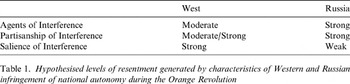
Hypothesised levels of resentment generated by characteristics of Western and Russian infringement of national autonomy during the Orange Revolution

Two of the three features of Russian interference should elicit a strongly negative reaction (agents and partisanship of interference) and one feature should elicit only a weak negative reaction (salience). Western intervention has one feature that should provoke a strong negative reaction (salience) and one that should provoke a moderately negative reaction (agents). The third feature, partisanship, is on the borderline between moderate and strong. The overall balance here suggests that we should find approximately similar levels of popular resistance to Western and Russian interference. The second prediction this analysis permits is that the degree of the negative reaction to each region's interference should be fairly strong, since each side's ‘scores’ concentrate toward the strong end of the simple scale we employ.
National identity dynamics, as we argued before, also likely influence how Ukrainians react to foreign intervention. Since Ukrainian independence in 1991, two main alternative national identity projects have battled for pre-eminence, each with different implications for the identity-building effect of ties with foreign countries.Footnote 42 According to the Ethnic Ukrainian national identity project, what unites most (approximately four-fifths) of the people of Ukraine is their common Ukrainian ethnicity, whose culture is seen as quite different from that of Russians. Ukrainian culture is seen as fundamentally European, and Ukraine and Russia are alleged to have travelled distinct historical paths. The Eastern Slavic national identity project, in contrast, envisions Ukraine as a bi-ethnic, bi-cultural state whose two major ethnic groups, comprising about 95 per cent of the population, are very similar between themselves and to Russians in Russia. Russians and Ukrainians are seen as ‘brotherly peoples’ who emerged from the cradle of the same ancient Kievan Rus state and have a shared historical destiny.
According to the argument presented earlier, foreign ties – including the ties represented by foreign intervention – between Ukraine and Russia help consolidate the Eastern Slavic identity. Such ties symbolically reinforce the closeness of the two countries and facilitate the exchange of people, ideas, goods, and services so that the cultures become more alike, and thus are likely to be welcomed or at least not resisted by supporters of this identity. Likewise, advocates of the Eastern Slavic national identity should find Western electoral interference illegitimate. The West is the main Other for this identity, and thus Western interference in Ukraine's domestic affairs lowers its status and hinders the ability of Ukraine to construct a non-Western foundation for the content of its national identity.
In a similar fashion, foreign ties between the West and Ukraine help consolidate an Ethnic Ukrainian national identity, with a ‘return to Europe’ symbolically and actually strengthening the Western components of Ukrainian culture. Promoters of an Ethnic Ukrainian identity should find foreign interference by Russia anathema, as it reinforces the sense of humiliation and subjugation of Ukrainians by Russians that adherents of this identity believe has deep historical roots, and weakens the creation of a separate and distinct Ukrainian national identity.
While some citizens in Ukraine – particularly Russian speaking Ukrainians – subscribe to aspects of both the Ethnic Ukrainian and Eastern Slavic identity projects, earlier research has shown that for the Ukrainian public as a whole, the Eastern Slavic national identity has stronger support than the Ethnic Ukrainian national identity.Footnote 43 As a result, national identity considerations would predict that Western interference in the Ukrainian electoral process is more resented than Russian interference. The leg of our theoretical analysis based on how the characteristics of intervention (agents, partisanship, salience) affect national autonomy thus predicts approximately equal and fairly high Ukrainian resentment toward Russian and Western electoral interference, while the leg of our theoretical analysis based on how foreign ties shape national identity predicts that Ukrainians as a whole should either welcome Russian intervention, or at least find Russian intervention more tolerable than Western intervention. To the extent that our theoretical framework is valid, pressures from the combined effect of national identity and national autonomy concerns should result in an overall Ukrainian response that is less negative toward Russian interference compared to Western electoral interference, but that overall emphasises the illegitimate nature of foreign intervention.
While the Eastern Slavic national identity is arguably more popular than the Ethnic Ukrainian national identity for the country as a whole, there are large variations in support among Ukraine's ethnic and regional groups. Previous research has generally shown that the Eastern Slavic identity is strongest among ethnic Russians and in the East and South of the country, while the Ethnic Ukrainian identity is strongest among ethnic Ukrainians and in the Centre and West. The greater popularity of the Eastern Slavic identity for the country as a whole is in large part a consequence of the fact that the population of the eastern and southern regions of the country exceeds that of the western and central regions. The regional and ethnic differences in identity are rooted in the different historical trajectories Ukrainian lands have taken. Much of western Ukraine, for example, was part of the Austro-Hungarian and Polish-Lithuanian empires for hundreds of years before being forcibly incorporated into the USSR in 1939, whereas much of eastern and southern Ukraine was long part of the Russian empire before the creation of the USSR. Thus to the extent that national identity concerns motivate Ukrainians’ response to foreign interference, our model predicts that we should find large variations in the attitudes of Ukraine's ethnic and regional groups toward Western versus Russian electoral intervention.
Finally, our theoretical framework permits us to test whether national autonomy concerns or national identity concerns dominate in the minds of Ukrainians when assessing foreign intervention. The National Identity Model of domestic reaction predicts that Ukrainians will approve of one foreign region's (West or Russia) interference but disapprove of the other's. Individuals, regions, ethnic groups, linguistic groups, and the country as a whole will exhibit discriminatory views toward the agents of foreign interference based on their preference between the two competing Ukrainian national identities. In contrast, the National Autonomy model of domestic reaction predicts uniformity of significantly strong negative attitudes within Ukraine toward Western and Russian interference, both at the group and the individual level.
III. Domestic reaction to foreign intervention in Ukrainian elections
To evaluate empirically our predictions about the Ukrainian people's response to Western and Russian meddling in the Ukrainian electoral process, we turn to the KIIS public opinion survey.Footnote 44 This survey polled 2000 respondents about their attitude toward improper foreign interference (nevypravdane inozemne vtruchannia in Ukrainian; neopravdannoe inostrannoe vmeshastel'stvo in Russian) in the 2004 presidential elections. Note that the Ukrainian vtruchannia and Russian vmeshastel'stvo are translated in English as either ‘intervention’ or ‘interference’. Specifically, the interviewer asked:
Next, we would like to know how much you think foreigners improperly interfered in the 2004 presidential elections in Ukraine. Please keep in mind that what's important here are your opinions, and that there are no right or wrong answers to these questions.
In the 2004 presidential elections, how would you characterise the degree of improper West European and American interference? Please use this scale, where the highest score of ‘10’ shows that you think there was an extremely high degree of improper West European and American interference in the electoral process, and the lowest score of ‘0’ shows that you think there was no such interference.

Using the same scale, how would you characterise the degree of improper Russian (Rosiis'ke in Ukrainian) interference in the presidential elections of 2004?
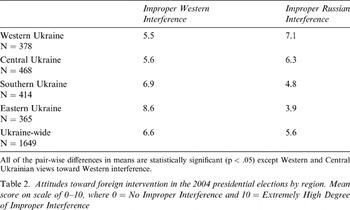
Table 2 shows that for the sample as a whole, people perceived higher levels of improper Western interference than improper Russian interference in the 2004 presidential elections. The average score on the eleven-point scale for Western interference is 6.6, while that for Russian interference is 5.6, and the difference is statistically significant. Many in the West may be surprised by this finding, believing that well-intentioned intervention by leading democratic countries surely would be more welcomed than the self-interested meddling of a clearly authoritarian regime. Still, Ukrainians as a whole believe that both the West and Russia improperly interfered in the Orange Revolution to a fairly high degree. Thus, our primary prediction about the combined effects of national autonomy concerns and national identity concerns is confirmed. Threats to national autonomy are driving the scores toward the high end of the scale given the nature of the salience, partisanship and agents of interference, while threats to national identity lead to greater condemnation of Western intervention given the greater strength of the Eastern Slavic national identity.
Attitudes toward foreign intervention in the 2004 presidential elections by region. Mean score on scale of 0–10, where 0=No Improper Interference and 10=Extremely High Degree of Improper Interference

All of the pair-wise differences in means are statistically significant (p<.05) except Western and Central Ukrainian views toward Western interference.
Considerable domestic regional differences also are evident. Southern (average=6.9) and Eastern Ukrainians (8.6) find considerably higher degrees of improper Western interference than do Central (5.6) and Western (5.5) Ukrainians. Likewise, Southern (4.8) and Eastern (3.9) Ukrainians are much less critical of Russian intervention than are Central (6.3) and Western (7.1) Ukrainians. Each individual region is also more critical of one foreign region than another, with Eastern Ukraine showing the largest gap (8.6−3.9=4.7). The West and Centre disapprove more of Russian intervention than of Western intervention, and the East and South disapprove more of Western than Russian intervention. These domestic and foreign regional disparities lend weight to the National Identity model of public reaction. Regions (West and Centre) where the Ethnic Ukrainian national identity is strong are less critical of Western intervention and more critical of Russian intervention than regions where the Eastern Slavic national identity is strong (South and East). However, national autonomy concerns are also evident. The South and East both find Russian efforts to influence the elections to have been substantially illegitimate, and the West and Centre both find Western meddling to have been illegitimate at surprisingly high levels – with the average scores in the latter cases exceeding the midpoint of the scale. This is one of several pieces of evidence showing the somewhat greater priority Ukrainians place on autonomy concerns compared to identity concerns.
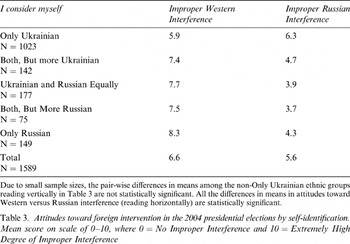
Breaking down the sample by ethnic self-identification reveals a similar pattern of attitudes toward the role foreigners played in the presidential elections.
Attitudes toward foreign intervention in the 2004 presidential elections by self-identification. Mean score on scale of 0–10, where 0=No Improper Interference and 10=Extremely High Degree of Improper Interference

Due to small sample sizes, the pair-wise differences in means among the non-Only Ukrainian ethnic groups reading vertically in Table 3 are not statistically significant. All the differences in means in attitudes toward Western versus Russian interference (reading horizontally) are statistically significant.
‘Only’ Ukrainians (5.9) and ‘Only’ Russians (8.3) disagree about the propriety of Western interference, with those declaring mixed identities occupying a middling position. Attitudes toward Russian interference also differ substantially, with the intriguing result that Only Russians are more critical than those who consider themselves mostly Russian or equally Russian and Ukrainian. ‘Only Ukrainians’ find Russian interference less palatable than Western inference, while all other ethnic groups find it more palatable. Such diversity of views again generally supports our theory about the role of national identity in conditioning domestic responses to foreign intervention. But as with domestic regional comparisons, all ethnic groups are critical to a substantial degree of both Russia and the West. Even Only Ukrainians give a score of 5.9 to Western electoral influence, and even Only Russians give a score of 4.3 to Russian electoral influence. Hence we find that the National Identity model's prediction of diversity of reactions is moderated, and even overcome, by the National Autonomy model's prediction of conformity.
Another way to assess the relative influence of national identity and national autonomy concerns is to determine what the correlation is between individuals’ views on the impropriety of Western versus Russian intervention. If individuals are basing their decisions solely on the effect of foreign intervention on national identity, then there should be a strong negative relationship between attitudes toward Russian versus Western intervention. Someone who finds Russian intervention strongly illegitimate because it degrades the Ethnic Ukrainian national identity would find Western intervention acceptable, or at least not distasteful, because it degrades the Eastern Slavic national identity. Likewise, those who dislike Western intervention for identity-related reasons would tend to like or at least not dislike Russian intervention. On the other hand, if individuals are assessing the legitimacy of foreign intervention solely based on its effect on Ukraine's autonomy, we would expect a strong positive relationship between their assessment of Russian and Western behaviours. People who are against electoral interference by Russia because it infringes on Ukraine's self-determination will also be against interference by the West. Similarly, people who find Russian interference unobjectionable because they do not want high levels of Ukrainian autonomy would also find Western interference unobjectionable. Thus, correlational analysis can show the relative mix of identity versus autonomy considerations behind Ukrainians’ reaction to foreign electoral interference:

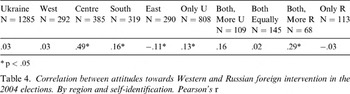
Table 4 shows the correlations across individuals in their attitudes toward Russian versus Western interference in the 2004 elections for Ukraine as a whole, and for various regional and ethnic groups. On balance, the results suggest that national autonomy considerations trump national identity considerations in Ukraine. While there is virtually no correlation between attitudes toward Western and Russian intervention for the sample as a whole, most of the subgroups do display positive correlations. For the Centre, South, Only Ukrainians, and Both-More Russian, these relationships are statistically significant. The dominant pattern to emerge from this analysis suggests that citizens assess foreign interference more by its implications for national autonomy than for national identity.
Correlation between attitudes towards Western and Russian foreign intervention in the 2004 elections. By region and self-identification. Pearson's r

* p<.05
Still, our analysis of the survey questions on degree of impropriety of Western and Russian intervention in the 2004 elections indicates that both identity and autonomy concerns play an important role for Ukrainians. Moreover, Western intervention appears to be more resented than Russian intervention. Many analysts, policymakers, and activists in the West will undoubtedly be surprised and distressed at this result. Part of the explanation of this puzzle lies precisely in the fact that Ukrainians do seem to give priority to national autonomy considerations over national identity considerations, and foreign electoral interference perforce erodes national autonomy. Additionally, many in the West fail to realise that the Eastern Slavic national identity is more popular in Ukraine than the Ethnic Ukrainian national identity. Therefore, to the extent that national identity considerations are operative, we would expect Western interference to elicit greater resistance than Russian. Finally, as the previous discussion indicated, the salience of Western intervention was greater than that of Russian. And while Western intervention was to a greater degree channelled through NGOs and international organisations and thus less status threatening than Russia's typically direct interference, the partisanship of Western intervention was nearly as great as Russia's.
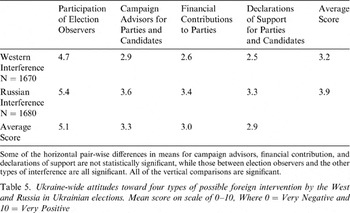
In addition to showing how Ukrainians reacted to Western versus Russian electoral intervention in general, the survey data reveal how they view particular types of foreign meddling in the Ukrainian electoral process. The KIIS survey asked specifically about four possible types of ‘foreign influence on the electoral process’ in Ukraine: participation of foreign observers in the monitoring of elections, use of foreign campaign advisors by parties and candidates, foreign financial contributions to parties, and foreign leaders’ declaration of support for particular parties and candidates. Respondents were asked how they feel about these types of possible intervention by the West and by Russia, indicating their views on a scale from 0–10, where 0=very negatively and 10=very positively.
Table 5 presents the results of the question for the sample as a whole. Scores range from a low of 2.5 for Western leaders’ declaration of support for parties and candidates to a high of 5.4 for Russian election observers. This latter score is the only one revealing a positive attitude on the part of the Ukrainians. The average score across the four types of intervention by Russia is 3.9, while the West's average is even less at 3.2, a substantial and statistically significant difference. Consistent with our earlier findings and further confirming our predictions, Ukrainians are generally negatively disposed to foreign electoral intervention (average scores for both Russia and the West are less than the midpoint of 5), but find Western variants more disturbing. Averaging the score of each method across the two regions reveals their relative acceptability in the eyes of Ukrainians. Three of the four possible types of interference elicit negative reactions of roughly equal intensity, while the participation of election observers occupies the approximate midpoint of the scale, signifying affective indifference.
Ukraine-wide attitudes toward four types of possible foreign intervention by the West and Russia in Ukrainian elections. Mean score on scale of 0–10, Where 0=Very Negative and 10=Very Positive

Some of the horizontal pair-wise differences in means for campaign advisors, financial contribution, and declarations of support are not statistically significant, while those between election observers and the other types of interference are all significant. All of the vertical comparisons are significant.
Part of the explanation for this important finding lies in the fact that all four of these methods have weaknesses from the standpoint of the arguments made earlier about the salience, partisanship, and agents of intervention. When a leading government figure declares support for parties or candidates in a foreign election, this action is salient and partisan, and can easily be seen as an official view of the state. Foreign financial contributions to parties are clearly partisan if not all parties receive equal support, though such contributions may not be very salient and may be given by or through individuals and NGOs as opposed to the state. Foreign campaign advisors similarly are partisan, and their salience is relatively high since their role is easy to understand and often easy for the press to discover and report. However, these advisors are individuals, even though they may be sent at the behest of a state, and thus the agent of intervention least likely to undermine national identity. Finally, even though election observers portray themselves as impartial and are generally coordinated through NGOs and IGOs, their intervention is very transparent and salient.
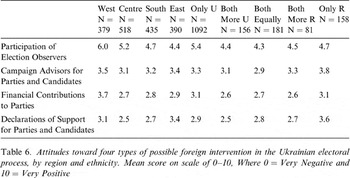
We can assess the robustness of these negative or indifferent attitudes toward these four possible types of intervention in the Ukrainian electoral process by breaking down the sample of survey respondents by region and ethnicity (see Table 6). The figures in the table represent the average of the scores of Western and Russian intervention for each of the four types. Overall, each of the regional and ethnic groups dislikes foreign campaign advisors, financial contributions, and partisan declarations of support, as the scores range from 2.5 to 3.8. The greatest variation is found on the remaining form of intervention, election monitors. Six of the nine demographic subcategories have scores less than 5.0 and thus are critical of these monitors, though the West and Centre and the ‘Only Ukrainians’ have slightly positive feelings for them. Why these three groups feel positively toward foreign electoral observers is not entirely clear, though it likely is because the role played by Western electoral observers has been far greater in Ukraine than that of observers from the Commonwealth of Independent States and Russia, and the pro-Western Ethnic Ukrainian national identity is relatively strong in these groups. Still, the results speak to the broad foundation of the resistance in Ukraine to these four methods across Ukrainian demographic groups that typically show large disparities in their views on a wide range of political issues, though of course the picture is more subtle with respect to the election monitors.
Attitudes toward four types of possible foreign intervention in the Ukrainian electoral process, by region and ethnicity. Mean score on scale of 0–10, Where 0=Very Negative and 10=Very Positive

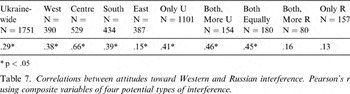
Lastly, we can use the data on Ukrainians’ feelings for the four possible types of intervention to again assess the balance between national identity and national autonomy concerns. Taking the correlation between the average score of the four Western variants of intervention and the average score of the four Russian variants of intervention for the sample as a whole yields a Pearson's r of +.29 (see Table 7). The positive sign suggests that national autonomy concerns dominate national identity concerns in the respondents’ assessments of foreign electoral intervention. All the regional and ethnic subcategories reinforce this conclusion. Each has a positive correlation, though the figure for two smaller groups is not statistically significant (More Russian than Ukrainian and Only Russian). The other groups show generally moderate positive correlations, signifying that the tradeoffs between an Ethnic Ukrainian and Eastern Slavic national identity are substantially less important drivers of their views than their calculus of the effects of foreign intervention on Ukrainian autonomy.
Correlations between attitudes toward Western and Russian interference. Pearson's r using composite variables of four potential types of interference.

* p<.05
IV. Alternative explanations for the domestic reaction to foreign intervention in Ukrainian elections
This article's theoretical framework, deduced from the literature on nationalism, overall performs well when applied to the case of Ukraine. It correctly predicts, when operationalised using empirical facts related to the characteristics of foreign intervention during the Orange Revolution and the nature of the national identity debate in the Ukrainian case, that the Ukrainian response to foreign electoral intervention should overall be negative due to national autonomy concerns, but that Western intervention should be more unappealing than Russian intervention due to national identity concerns. Moreover, the framework correctly predicts substantial ethnic and regional variation in attitudes toward the propriety of Western and Russian intervention. Finally, the framework is useful in generating inferences about the relative balance of national autonomy versus national identity concerns in the Ukrainian case.
One may argue, however, that there are two additional factors not addressed by the model that may be affecting the empirical findings in this case. The first factor relates to partisanship. Our model incorporates the partisanship of foreign intervention, arguing that this affects how severely it encroaches on national autonomy: the greater the partisanship, the more illegitimate foreign intervention is perceived to be. However, one may argue, in contrast, that individuals will welcome foreign electoral intervention whose intent is to aid their preferred party or candidate, and reject intervention intended to hurt their preferred party or candidate. This voter-centred partisanship argument would, like the national identity leg of our model, also predict ethno-regional variation in the Ukrainian case. This is because of long-standing ethno-regional voting patterns in national parliamentary and presidential elections in Ukraine.
The first thing to note in response to this argument is that in the Ukrainian case, ethno-regional differences in voting preferences are largely a result of national identity differences. Differences in support for democracy and the market across ethnic groups and regions are insignificant or absent, for example, and cannot explain the gaping electoral cleavages that attend national elections.Footnote 45 National identity and the policies it implicates are the only major issues on which there are large ethno-regional disparities. The political programmes of the most popular political parties and figures in Ukraine are extremely similar, except as they relate to issues that affect or reflect national identity (for example, language and foreign policy). So, a voter-partisanship based argument ultimately relies on the importance of national identity in driving perceptions of the legitimacy of foreign intervention, just as this article, in part, argues. In any case, there is still reason to believe that this argument is less effective than the ones we have offered here.
First, we know that in the reasonably fair and free third round of the 2004 elections, the more popular candidate – the winner – was Viktor Yushchenko. A voter-partisanship model would therefore predict that Western intervention would, overall, be welcome and Russian intervention unwelcome in Ukraine. This is because Western intervention had the effect and perhaps implicit intentionFootnote 46 to assist challengers to the party in power (as represented by Viktor Yanukovych), while Russian intervention had the intention to assist Yanukovych. However, the empirical results show that not only is Western intervention deemed improper by the country as a whole, but that it is perceived as more improper than Russian intervention. Second, while a voter-partisanship model can indeed explain why ‘only ethnic Ukrainians’ and those living in the west (groups most likely to have supported Yushchenko) find Russian interference distasteful, it cannot account for the fact that these same groups find Western interference wrong – indeed this evidence explicitly contradicts the model. Likewise, such an argument, while supported by the illegitimacy of Western electoral intervention in the eyes of ethnic Russians and those living in the South and East (supporters of Yanukovych), it is undermined by these groups’ criticism of Russian interference. Our model, relying on a combination of national autonomy and national identity factors, is superior to a model focusing on voter partisan preferences.
That said, voter partisanship may still play some role in perceptions of foreign electoral intervention, and further study is needed to control for the effect of this variable in the Ukrainian case. If the dataset available to the authors had included information on respondents’ favoured candidate and national identity preferences, then a regression analysis could have been run to separate out these two factors and determine the independent strength of each in determining attitudes toward Western and Russian interference.
The second factor that lies outside of our model that may help explain the empirical results in the Ukrainian case is the effectiveness of foreign electoral intervention. Regardless of whether foreigners attempt to assist a voter's preferred or non-preferred candidate or party, the effectiveness of such efforts may drive popular perceptions of the legitimacy of such intervention. Thus, it may be that foreign efforts to help a particular candidate or party in a state that in fact seemed to have worked – especially as measured by the victory of such party or candidate – will be resented more than attempts that fail. As with the previous argument, to a large extent this concern is consistent with our framework – effectiveness of partisan foreign intervention is a factor that relates to the degree of encroachment on national autonomy, and certainly depends in the first place on the role of foreign partisanship, which is already in our model, in affecting target country perceptions. Still, one may argue that such a variable explains the most striking finding of this research: the greater overall illegitimacy of Western interference compared to Russian interference in the 2004 elections. It is precisely because Western intervention seems to have been more effective in altering the outcome of the election that most Ukrainians have reacted more negatively to it, according to this argument.
While plausible, this objection is not convincing. This is because the section of this article that analysed attitudes toward four possible types of electoral interference in the Ukrainian electoral process found the same patterns of attitudes regarding propriety of Western versus Russian interference as the section that focused on views toward interference in a particular election with a particular outcome. That is, the questions about attitudes toward foreign election observers, campaign advisors, financial support for parties, and declarations of partisan support mention nothing about the effectiveness of such methods of intervention, and certainly there are no election winners or losers in the given scenarios to judge such effectiveness. Yet, for each method, Western intervention elicits more displeasure than Russian intervention, and the average across the four methods shows that Ukrainians generally are more negatively disposed to Western intervention (3.2 on the 0–10 scale) than Russian intervention (3.9). Moreover, if it is precisely the effectiveness (consequences) of intervention that causes a negative reaction according to this alternative explanation, then questions which focus only on the attempts to influence an election should not be revealing attitudes mostly concentrated on the negative end of the scale. The results for this set of questions also weakens the thrust of the voter partisanship model discussed above, since there is no particular candidate or party involved around which the respondent assesses the legitimacy of foreign intervention, yet the findings are again consistent with those related to the 2004 elections. Still, the effectiveness variable still might contribute to some degree to perceptions of the propriety of foreign intervention, and may, for example, in conjunction with the voter partisanship argument, help explain why Eastern Ukrainians reacted more negatively toward Western intervention (8.6 on the 0–10 scale of degree of improper inference) in the presidential elections than Western Ukrainians reacted negatively toward Russian intervention (7.1). Precisely because the West more effectively helped the candidate opposed by Eastern Ukrainians than Russia helped the candidate opposed by Western Ukrainians, the degree of resentment we would expect to be felt by Eastern Ukrainians would be higher than that felt by Western Ukrainians.
In short, the theoretical model deduced from the nationalism literature in this article does a strong job in explaining multiple features of the Ukrainian case, and is certainly better than seemingly competing intervention effectiveness and voter partisanship arguments. Nevertheless, these and other factors outside the current theoretical framework may be at work to some extent. We hope our research constitutes a fruitful focal point for further theoretical work on the question of domestic reactions to foreign electoral intervention.
V. Conclusion and policy implications
This study should serve as a cautionary tale for would-be democracy promoters in the West. It is easy to think that Western intervention in Ukraine's Orange Revolution played a critical and laudatory role in preventing a corrupt regime from brazenly stealing an election. What better case is there to display not only the necessity but the justifiability of Western democracy assistance abroad? While perhaps well-intentioned, the extensive efforts by Western governments, non-governmental organisations, and international organisations to shape the contours of Ukraine's electoral landscape appear to be unwelcome for most Ukrainians. Potentially even more disturbing is the finding that the electoral interference by a clearly non-democratic state, Russia, is less alienating than that of the world's most developed democracies. Moreover, even the most pro-Western parts of Ukraine disapproved of actions by the West that helped assure, through the exposing of electoral fraud in the tumultuous 2004 contest, the ultimate victory of their favoured candidate, Viktor Yushchenko. While Western activists and policymakers may be operating on the assumption that human beings everywhere long for and deserve a political order promoting liberal values of freedom and equality, they must keep in mind that their efforts at spreading democracy must be made in a world permeated by an equally, if not more, powerful ideology: nationalism.
Foreign influence over any aspect of a state's political development, especially one that so closely symbolises self-rule such as elections, risks unleashing a backlash fuelled by citizens jealously guarding their national autonomy and national identity. The desire for self-government and self-esteem, where the self is represented by the nation, vastly complicates the ability of foreigners to legitimately intervene in a state's internal political affairs. In a nationalist age, the export of democracy cannot escape its core contradiction: intervening in the affairs of others in the name of their self-rule. This dilemma for democracy promoters is exacerbated by the difficulty in finding methods for such intervention that are not salient, partisan, or affiliated directly or indirectly with states. Even a method of democracy promotion that many in the West might think garners a great deal of support in target countries – the monitoring of elections by foreign observers – fails to find much favour in Ukraine.
This study is unable, unfortunately, to examine the wider relevance of views toward the propriety of foreign electoral intervention for the legitimacy of elections themselves and of the governments that emerge from them in Ukraine. Further research is needed to determine whether negative views toward foreign electoral intervention lower peoples’ confidence and trust in elections, the ruling party or politicians, and the political system more broadly. One step in this direction would be the development of public opinion surveys that simultaneously ask about perceptions of foreign electoral intervention and the legitimacy of such institutions.
For students of Ukraine, this research displays in sharp relief the effects of the national identity debate on Ukraine's foreign relations. The contest between the Eastern Slavic and Ethnic Ukrainian national identities is not just about what should be the official language(s) of Ukraine or what kind of history should be taught in schools. It is also about who Ukraine should associate with in the broadest sense. Because ethnicity and region play such an important role in determining which of the two competing national identities one supports, it should not be surprising that we therefore find ethnic and regional variations in the degree to which Ukrainians feel positively or negatively about Western versus Russian electoral intervention. Moreover, the greater overall popularity of the Eastern Slavic identity helps us explain the greater resistance Ukrainians have toward Western as opposed to Russian intervention.
Finally, we have shown that sovereignty is alive and well in Ukraine, across both regions and ethnic groups. Before the American vice-presidential and presidential candidate John Edwards spoke of two Americas, the Ukrainian social critic Mykola Riabchuk wrote about Two Ukraines.Footnote 47 Significant differences between western and eastern Ukraine do exist, of course, and show up in polling data and electoral results. Cultural and political differences are, in turn, amplified by segmented media markets. This said, divisions between eastern and western Ukraine are also somewhat of a cliché. One is led to assume that there is no Ukraine without a geographic qualifier before it. The data in this study show that whatever their ethnicity or region, Ukrainians generally do not wish their elections to be meddled with. Most strikingly, even in Western Ukraine intervention by the West is illegitimate, and even in Eastern Ukraine intervention by Russia is illegitimate. While the identity debate divides Ukrainians, the greater strength of a desire to protect national autonomy unites them. Though the Ukrainian state is still young, it clearly has developed a mature sense of independence of which foreigners best be cognisant. The institutions and political processes of young states or regimes might appear to be particularly malleable and susceptible to easy outside manipulation, but the Ukrainian case demonstrates that this may be an illusion.