Introduction
Joint replacement surgeries, particularly hip and knee arthroplasty, belong to the most frequent major surgeries in people older than 65 years of age in Europe and Northern America (Wengler et al., Reference Wengler, Nimptsch and Mansky2014). These surgeries can lead to perioperative complications in this age group, such as infection and thrombosis (Nanjayan et al., Reference Nanjayan, Swamy, Yellu, Yallappa, Abuzakuk and Straw2014). A further important complication in older people is post-operative cognitive dysfunction (Rasmussen et al., Reference Rasmussen2001) characterized by reduced memory and attention. As pointed out in an international workshop on perioperative neurotoxicity, the clinical characterization of this syndrome is still in flux (Terrando et al., Reference Terrando, Eriksson and Eckenhoff2015). Pointing to the role of neurodegenerative changes as vulnerability factor, recent research has suggested common pathogenetic mechanisms for both Alzheimer's disease like neurodegeneration and post-operative cognitive decline (Bilotta et al., Reference Bilotta2010). An even more serious complication post-surgery is delirium; delirium symptoms overlap with a syndrome of post-operative cognitive decline, but include alterations of consciousness and drive, and vegetative symptoms (Bitsch et al., Reference Bitsch, Foss, Kristensen and Kehlet2004). Potential risk factors for both post-operative cognitive decline and delirium are pre-operative mild cognitive impairment (MCI) or dementia (Inouye and Ferrucci, Reference Inouye and Ferrucci2006), and characteristics of the surgery, anesthesia, and post-operative treatment (Zywiel et al., Reference Zywiel, Prabhu, Perruccio and Gandhi2014). The link between post-operative cognitive decline and delirium is still unclear (Franck et al., Reference Franck2016). The risk of post-operative delirium is greatly increased in older people with MCI or dementia (Chaudhry et al., Reference Chaudhry, Devereaux and Bhandari2013). In turn, both conditions post-operative cognitive decline and delirium are associated with increased rates of incident dementia (Davis et al., Reference Davis2012). Several studies have investigated co-occurrence of joint replacement surgery and dementia (for review see (Chaudhry et al., Reference Chaudhry, Devereaux and Bhandari2013)) and the effect of dementia on post-surgery outcomes in geriatric patients (Feng et al., Reference Feng, Scherer, Tan, Chan, Fong and Ng2010; Jamsen et al., Reference Jamsen, Peltola, Puolakka, Eskelinen and Lehto2015; Tsuda et al., Reference Tsuda, Yasunaga, Horiguchi, Ogawa, Kawano and Tanaka2015). However, little data are available on the mid- to long-term outcome of dementia after joint replacement surgery (Sprung et al., Reference Sprung2017).
In our study, we tested two hypotheses. Based on the high incidence of post-operative delirium and cognitive decline, our first hypothesis was that endoprosthetic joint replacement surgery would be associated with a short-term incident diagnosis of dementia. Our second hypothesis was that in the mid- to long-term perspective joint replacement surgery would be associated with lower rates of dementia diagnoses. The rationale for this latter assumption is that people surviving the post-operative phase without a diagnosis of dementia would represent a cohort with a particular resilience against cognitive decline. In addition, successful joint replacement should reduce the long-term level of pain and pain medication, and increase the level of mobility. Similar effects have been observed after cardiac surgery after one year (Sauer et al., Reference Sauer, Veldhuijzen, Ottens, Slooter, Kalkman and van Dijk2017). These factors would lead to a long-term reduction of dementia risk. Thus, we hypothesized that in long-term observation after survival of the post-surgery phase without dementia the risk of a dementia diagnosis should decline.
We controlled the effects for the presence of prescription of sedative or analgesic drugs (SAD). Benzodiazepines were associated with a mildly to moderately elevated risk for dementia in previous cohort and claims data studies, particularly with long half-life benzodiazepines (Gomm et al., Reference Gomm2016; Shash et al., Reference Shash2016). Opioid analgesics were found associated with a mildly elevated risk for dementia in one prospective cohort study (Dublin et al., Reference Dublin2015), whereas non-steroidal anti-inflammatory drugs were found associated with lower risk of dementia in several studies (Yip et al., Reference Yip, Green, Huyck, Cupples, Farrer and Group2005; Cote et al., Reference Cote, Carmichael, Verreault, Lindsay, Lefebvre and Laurin2012).
We tested these two linked hypotheses (increased short-term incidence of dementia diagnoses that levels off during mid- to long-term observation) in German claims data comprising 154,604 cases 65 years and older retrieved from the largest German statutory health insurance, the “Allgemeine Ortskrankenkasse” (AOK). We determined incidence rates of dementia diagnoses following joint replacement surgery (upper and lower extremities) over an observation period of 0 up to 28 quarters for joint replacement surgery before incident dementia diagnosis or censoring. Effects were controlled for cerebrovascular and vascular risk factors, age, sex, the presence of a diagnosis of delirium, and regular prescription of SAD, including opioid analgesics, non-steroidal anti-inflammatory drugs, and benzodiazepines.
Design and methods
Data
We analyzed dementia diagnosis incidence using routine claims data from the years 2004 to 2010 of the largest German statutory health insurance, the AOK. In Germany, 70 million people are covered through statutory health insurances; about one-third of these are insured through the AOK. Among the oldest-old population, the coverage through the AOK is even more than 50% (Doblhammer et al., Reference Doblhammer, Fink, Fritze and Günster2013).
A random sample of 250,000 insured persons born in or prior to 1954, who had at least one day of insurance coverage by the AOK in the first quarter of 2004, was drawn by the WIdO (Scientific institute of the AOK). Using a unique person ID, these persons were followed quarterly over time between 2004 and 2010, establishing a longitudinal sample. The data include complete records of the inpatient and outpatient treatment that each insured patient received.
Dependent variable: transition to dementia diagnosis
Dementia was defined according to the codes of the International Classification of Diseases, 10th Revision (ICD-10): Alzheimer's disease (G30), circumscribed brain atrophy (G31.0), Lewy body dementia (G31.82), progressive supranuclear palsy (G23.1), dementia in Alzheimer's disease (F00), vascular dementia (F01), dementia in other diseases classified elsewhere (F02), unspecified dementia (F03), and delirium superimposed on dementia (F05.1). We applied an internal validation procedure to rule out false-positive diagnoses because we were not able to validate dementia diagnoses in face-to-face examinations. First, only diagnoses from the outpatient sector flagged as “verified” and from the inpatient sector flagged as “discharge” or “secondary” diagnosis were considered. Second, diagnoses were considered valid if they occurred simultaneously in the inpatient and outpatient sector, or if at least two physicians (general practitioners, neurologists/psychiatrists, other specialists) made a diagnosis of dementia in the same quarter. Dementia diagnoses were also confirmed by co-occurrence over time. If the patient died in the quarter with the first dementia diagnosis, the diagnosis was considered valid even though the initial diagnosis could not be confirmed by a second diagnosis (see (Doblhammer et al., Reference Doblhammer, Fink, Fritze and Günster2013) for details). Incident dementia cases were defined as the first occurrence of a valid diagnosis. Furthermore, to avoid confusion between firstly diagnosed incident cases and prevalent cases with a history of dementia, a period of at least two years without valid dementia diagnoses was warranted. Thus, incident dementia diagnosis is defined for all persons who did not have a valid dementia diagnosis in 2004 and 2005, and who were diagnosed for the first time between 2006 and 2010.
Independent variables
Endoprosthetic joint replacement surgeries were defined according to the classification of operational procedures (OPS – “Operationen- und Prozedurenschlüssel”; http://www.dimdi.de/static/en/klassi/ops/index.htm, assessed: May 10, 2017).
The classification is an adaptation of the International Classification of Procedures in Medicine by the World Health Organization, the former version of the current International Classification of Health Interventions (ICHI) (http://www.who.int/classifications/ichi/en/, assessed: May 10, 2017). Following OPS codes were used for surgical procedures on upper and lower extremities: 5820–5828. We explored whether the time since last joint replacement surgery modulates the risk of a dementia diagnosis by distinguishing 0, 1–3, 4–6, and ≥7 quarters.
To address potential consequences on dementia diagnoses following post-operative and other deliria, we included a variable comprising ICD-10-codes F05 (delirium, not induced by alcohol and other psychoactive substances; F05.1 excluded) and F06 (other mental disorders due to brain damage and dysfunction and to physical disease). Likewise to surgeries we explored whether time since the last delirium diagnosis affects the risk of a dementia diagnosis by distinguishing 0, 1–3, 4–6 and ≥7 quarters.
We adjusted the regression models for regular prescription of SAD according to the Anatomical Therapeutic Chemical (ATC) Classification System (http://www.dimdi.de/static/en/klassi/atcddd/index.htm, assessed: May 10, 2017). Regular SAD-prescription is defined by having filled prescriptions of opioid analgesics (ATC-code N02A), NSAIDs (non-steroidal anti-inflammatory drugs, M01A), and long-acting benzodiazepine derivatives (N03AE01; N05BA01-03, 05, 08, 09, 11, 16; N05CD01-03) in each of four sequential quarters during the observation time. Occasional prescriptions are defined by having non-regular prescriptions. No use was defined as no prescription in any quarter during the observation period. To avoid a protopathic bias due to SAD-prescription for prodromal symptoms of dementia, we introduced a lag time of two years before the effective quarter. We further adjusted for vascular and cerebrovascular diseases, as well as for age and gender. The diseases were coded according to ICD-10 classification: diabetes mellitus (E10–E14); hypertension (I10–I13, I15); hypercholesterolemia (E78.0); cerebrovascular diseases (I60–I69, G45, G46, H34.0).
Statistical analysis
Excluding persons with inconsistent or missing information on date of birth, date of death, and sex, excluding persons with dementia diagnoses in 2004 or 2005, and studying ages 65 years and above we arrived at a study sample of 154,604 persons.
Methods of survival analysis were conducted to analyze the risk of incident dementia diagnosis. Calendar time of the study period (2006–2010) was used as underlying process time. Cox-models were performed to explore the effect of joint replacement surgeries on dementia diagnosis incidence. We controlled for the occurrence of delirium diagnoses and additionally SAD-prescription, as well as for gender, and time-dependent information on age, cerebrovascular diseases, diabetes mellitus, hypertension, and hypercholesterolemia. Individuals were followed up until incident dementia diagnosis, death, withdrawal from the insurance, loss to follow-up, or December 31, 2010.
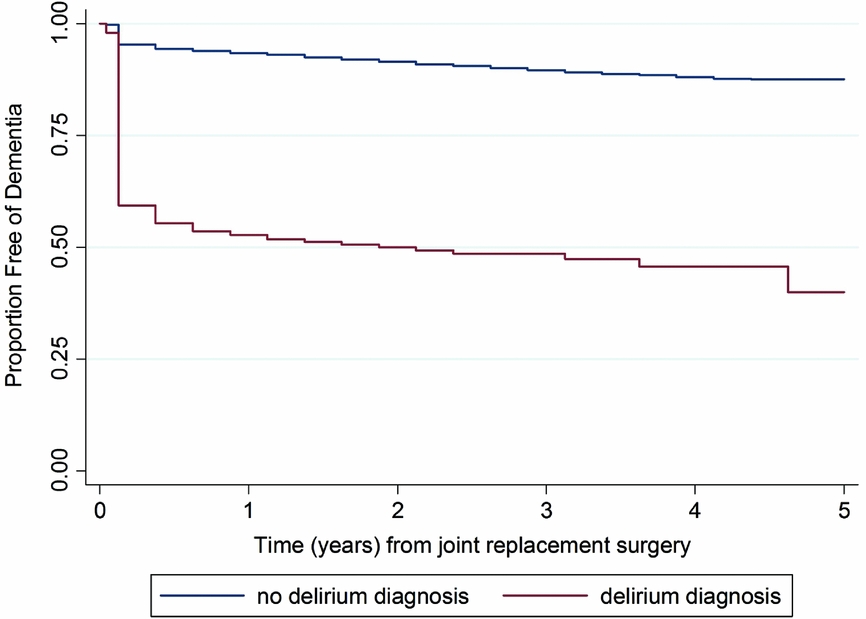
Additional analysis was performed for 10,563 persons with at least one joint replacement surgery between 2006 and 2010. The process time started from the quarter with the latest observed surgery. We used Kaplan–Meier curves showing time to dementia diagnosis between patients with and without diagnosis of delirium in the surgery quarter.
Results
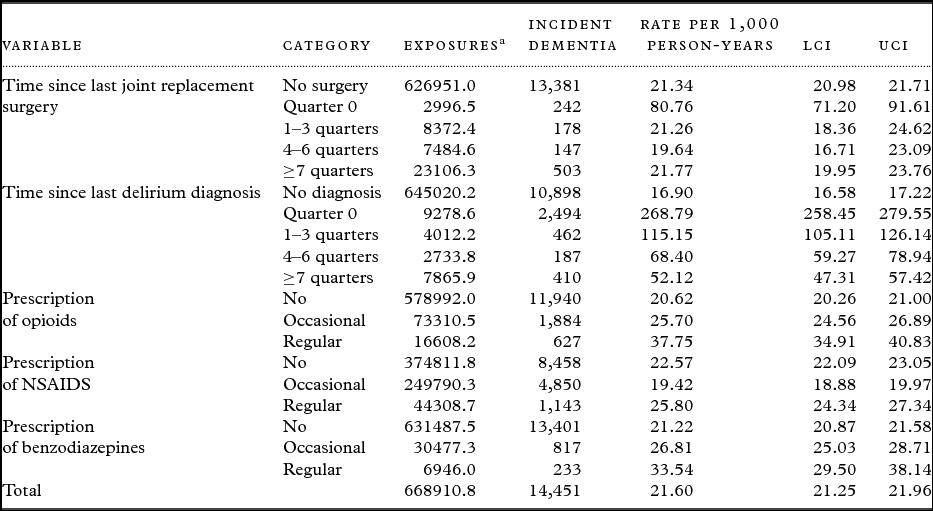
In 154,604 cases the rate of incident dementia diagnosis in people without a joint replacement surgery within the observation period was 21.34 per 1,000 person years, compared with 80.76 incident cases when joint replacement surgery was conducted during the same quarter as the dementia diagnosis; rates declined to 21.77 incident cases 7 and more quarters after joint replacement surgery had taken place (Table 1).
Dementia incidence rates by latest joint replacement surgery, latest delirium diagnosis, and SAD use (N = 154,604)

Source: Health claims data AOK 2004–2010.
Rate*1,000 = Rate per 1,000 person years.
aIn person-years; LCI 95 % lower confidence interval, UCI 95 % upper confidence interval.
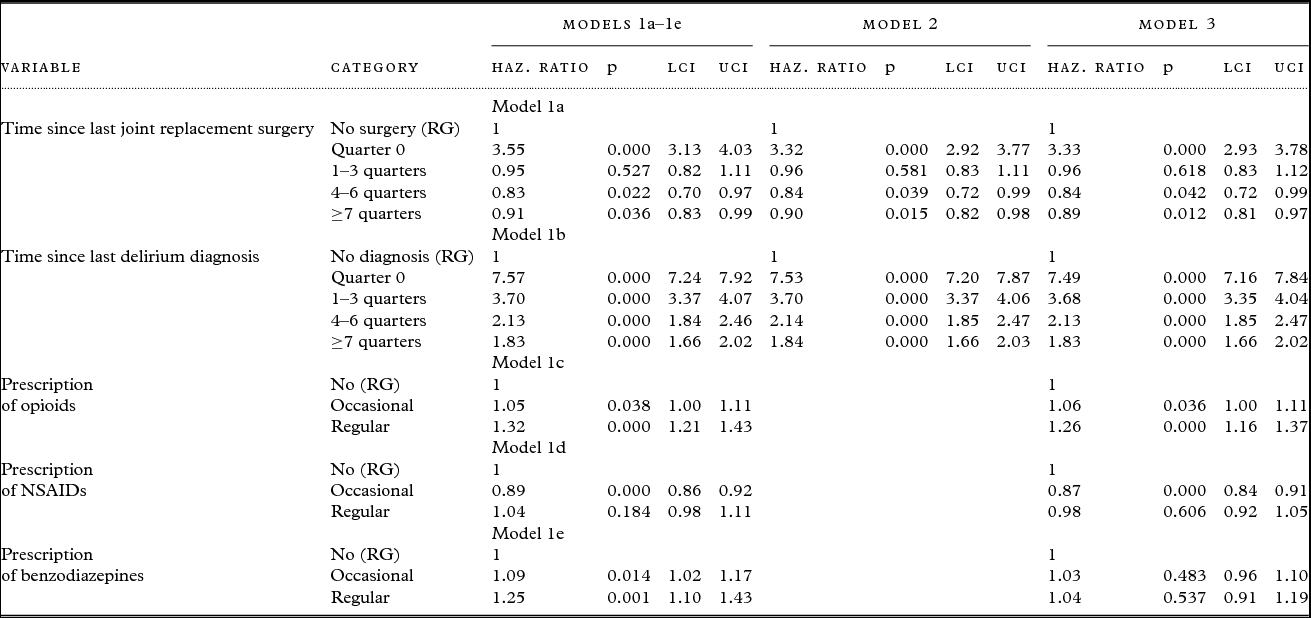
Table 2 shows the hazards ratios for incident dementia diagnoses by time since surgery as well as for the covariates. In model 1a, compared to cases without joint replacement, the hazard ratio of dementia diagnosis was significantly increased during the quarter of surgery (quarter 0: HR = 3.55, p value = 0.000), but was significantly decreased 4 and more quarters after joint replacement surgery (HR = 0.83, p value = 0.022). This pattern was maintained when model 1a was extended to control for a diagnosis of delirium (model 2) and delirium and SAD-use (model 3).
Cox proportional hazard models for the complete sample with outcome incidence dementia diagnosis
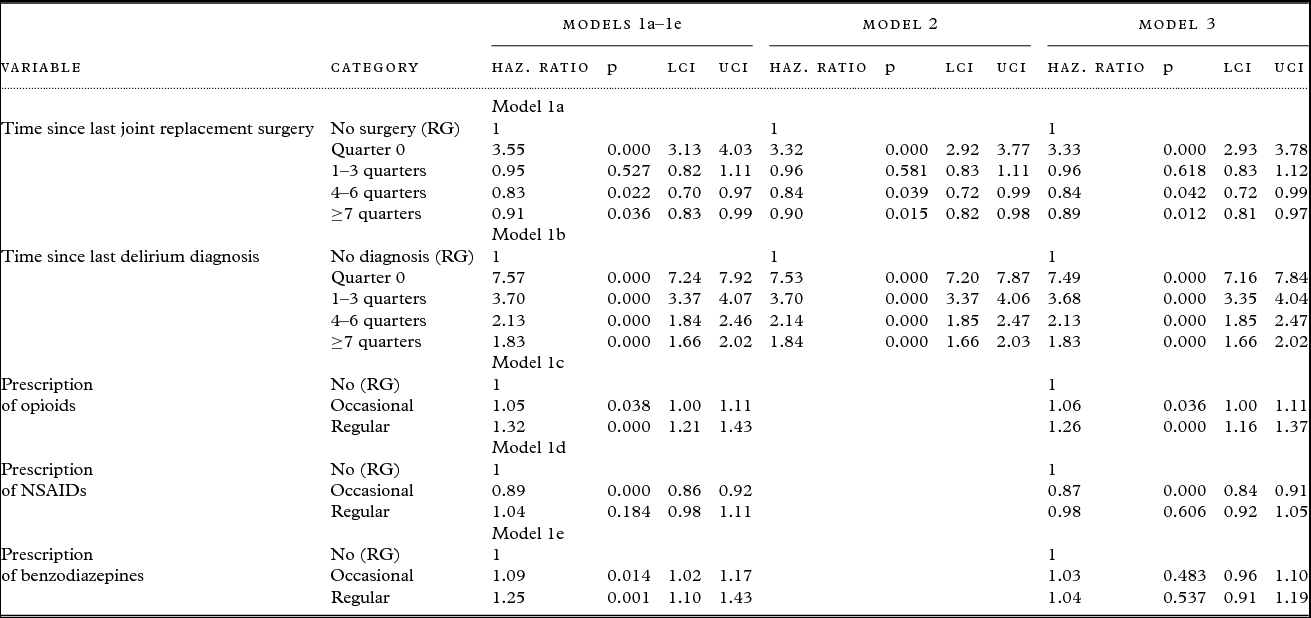
Source: Health claims data AOK 2004–2010; N=154,604; all models adjusted for age, gender, cerebrovascular diseases, hypertension, diabetes, and hypercholesterolemia; Models 1a–1e show the gross effect of the variable of interest unadjusted for the other information but adjusted for age, gender, cerebrovascular diseases, hypertension, diabetes, and hypercholesterolemia; Model 2 shows the joint effects of surgery and delirium; The first two models of Model 3 show the joint effects of surgery and delirium additionally adjusted for SAD-use, the last three models of Model 3 show the effect of medication additionally adjusted for surgery and delirium and the other medication; RG=reference group; LCI 95 % lower confidence interval, UCI 95 % upper confidence interval.
Model 1b explores the effect of delirium on incident dementia diagnoses. The effect was highest when delirium occurred in the same quarter as the dementia diagnosis (HR = 7.57, p value = 0.000) and remained significant, albeit at a lower level, even after 7 and more months (HR = 1.83, p value = 0.000). Neither controlling for surgery nor for SAD-prescription did attenuate the effect.
Models 1c–1e show the effect of SAD-prescription on the risk of dementia diagnosis. Both opioids and benzodiazepines increased the risk of a dementia diagnosis, with a clear dose dependency; NSAIDs were associated with a slightly lower risk. In model 3, controlling for surgery, delirium, and the other medication, the effect of benzodiazepine was attenuated, and sensitivity analyses show that this was due to the variable indicating delirium.
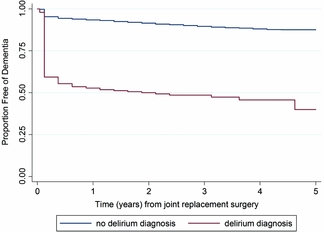
Table 3 summarizes incidence rates of dementia diagnosis by delirium diagnosis in the surgery quarter among 10,563 patients with at least one joint replacement surgery between 2006 and 2010. Surgery patients suffering from delirium experienced an incident dementia diagnosis earlier than those without a delirium diagnosis (log-rank test: p < 0.001, Figure 1).
Dementia incidence rates by variables of interest among persons with joint replacement surgery (N = 10,563)

Source: Health claims data AOK 2004–2010.
Rate*1,000 = Rate per 1,000 person years.
aIn person-years; LCI 95 % lower confidence interval, UCI 95 % upper confidence interval.
Kaplan–Meier curves on time to dementia for patients with and without diagnosis of delirium in the surgery quarter Source: Health claims data AOK 2004–2010; N = 10,563; Log-rank test for equality of survivor functions: χ 2 = 801.11, df = 1, p < 0.001.
Discussion
Here, we reported incidence rates of dementia diagnoses following joint replacement surgery based on a study sample of 154,604 cases retrieved from German claims data, containing 10,563 persons with at least one joint replacement surgery. Consistent with our hypothesis, dementia diagnosis incidence was highest in direct temporal proximity of surgery and declined when joint replacement surgery had been conducted at least 4 quarters before the effective date when controlling for age, sex, cerebrovascular disease, hypertension, hypercholesterolemia, diabetes, delirium, and SAD-prescription. Post-operative cognitive decline as potential confounder is not represented by ICD-10 codes so that we could not consider this potentially relevant condition. When discussing our findings, it is important to note that secondary analysis of claims data is not meant to confirm, but rather to generate hypotheses on potential associations that can be tested in subsequent primary data analysis. Of note, our data do not tell the incidence of dementia or delirium but the incidence of dementia or delirium diagnoses.
Related to this notion, we cannot finally resolve the strong effect in quarter 0, which is the quarter of surgery, since within one quarter we cannot discriminate between incident cases of dementia before or after joint replacement surgery. One potential cause for this high rate of dementia diagnoses in the first quarter is ascertainment bias, where coming to surgery may unveil pre-existing dementia. Thus, surgery would increase the rates of dementia diagnoses albeit dementia already existed before and was not a result of surgery. In addition, dementia and hip-fracture show a high co-occurrence in geriatric patients (Chaudhry et al., Reference Chaudhry, Devereaux and Bhandari2013), between 10% in a national registry (Tsuda et al., Reference Tsuda, Yasunaga, Horiguchi, Ogawa, Kawano and Tanaka2015) and 30% in a clinic's sample (Oh et al., Reference Oh, Sieber, Leoutsakos, Inouye and Lee2016). Consistently, the observation that incidence rates of dementia diagnoses declined strongly already 1–3 quarters after surgery suggests that a relevant proportion of dementia diagnoses may have already existed before surgery. The subsequent decline of dementia diagnosis incidence when joint replacement surgery had been conducted at least 4 quarters before the effective date agrees with the assumption of a survivor effect. People who survived the time immediately after joint replacement surgery without a dementia diagnosis might have a higher resilience against dementia incidence relative to the general population. A small study in 35 people of age 50 years and higher provides preliminary evidence that measures of cognitive reserve may contribute to cognitive recovery after joint replacement surgery (Scott et al., Reference Scott, Mathias, Kneebone and Krishnan2016). Factors that may add to a mid- to long-term positive effect on dementia incidence would be higher mobility, reduced pain and reduced analgesics and benzodiazepines prescription in people after joint replacement surgery. The concept of post-operative cognitive improvement is still controversial (Berger et al., Reference Berger2015; Aranake-Chrisinger and Avidan, Reference Aranake-Chrisinger and Avidan2017; Sauer et al., Reference Sauer, Veldhuijzen, Ottens, Slooter, Kalkman and van Dijk2017). Some authors have suggested that such observations merely reflect practice effects (Casey et al., Reference Casey, Ferguson, Kimura and Hachinski1989) or variability in neuropsychological testing (Rasmussen et al., Reference Rasmussen, Siersma and Ispocd2004). However, reduction of potentially detrimental medication and recovery of instrumental activities of daily living and mobility have been suggested to mediate cognitive improvement after cardiac surgery (Fontes et al., Reference Fontes2013). To our knowledge, such positive effects, however, have not yet been studied in association with joint replacement surgery.
In respect to delirium, patients with joint replacement surgery showed a strong association between delirium in the effective quarter and a diagnosis of dementia with a subsequent leveling parallel to the incidence rates of dementia diagnoses in people without delirium in the effective quarter. Again, in the first quarter the strong association may partly be explained by a kind of ascertainment bias where the occurrence of delirium may unmask a pre-existing dementia. In addition, however, delirium has been suggested to lead to permanent brain lesions that may accelerate cognitive decline in the presence of pre-existing neurodegenerative changes (Evered et al., Reference Evered and Eckenhoff2017a), where delirium and dementia share common pathogenetic mechanisms such as inflammation (Simone and Tan, Reference Simone and Tan2011), neurotoxicity or exhaustion of cognitive reserve (Simone and Tan, Reference Simone and Tan2011). Our findings extend previous findings on increased rates of short term (3 months) (Witlox et al., Reference Witlox2013) to mid-term (9 month) (Sprung et al., Reference Sprung2017) incidence rates of persisting cognitive impairment after post-surgery delirium. Assuming that a pre-existing delirium would be rare in people undergoing joint replacement surgery, our data support the notion that post-operative delirium is a risk factor for dementia incidence (Devore et al., Reference Devore2017; Mosk et al., Reference Mosk2017) as well as a likely complication of pre-existing dementia, consistent with previous observational studies (Davis et al., Reference Davis2012; Chaudhry et al., Reference Chaudhry, Devereaux and Bhandari2013). These data underscore the urgent need for perioperative delirium prevention; a recent pragmatic clinical trial has demonstrated potential clinical effectiveness of a delirium prevention program after hip surgery (Freter et al., Reference Freter, Koller, Dunbar, MacKnight and Rockwood2017).
Consistent with previous studies (Dublin et al., Reference Dublin2015; Gomm et al., Reference Gomm2016; Shash et al., Reference Shash2016), we found that regular use of opioid analgesics and benzodiazepines was associated with increasing incidence of dementia diagnosis; however, we did not find evidence that these drugs modulate the effect of surgery and delirium. In our data use was defined by filling prescriptions in the pharmacy; over-the-counter drugs, as common among NSAIDs, are not included and we cannot measure whether drugs were consumed.
The main purpose of administrative health claims data are cost reimbursement and cost calculation, and this has implications for secondary data analyses. Health claims data do not represent the actual distribution of specific dementia diagnoses. Alzheimer's (60–80%) and vascular dementia (10–20%) are the most prevalent causes of dementia according to findings of epidemiological studies. In contrast, in the AOK data only 27% of dementia cases were diagnoses of AD but 45–50% of the diagnoses were unspecified dementia (Schulz and Doblhammer, Reference Schulz, Doblhammer, Günster, Klose and Schmacke2012). We therefore used an overall indicator for dementia. Despite the fact that dementia diagnoses in medical claims data are neither specific nor standardized the prevalence and incidence based on AOK claims data fit well with other national and international studies (Doblhammer et al., Reference Doblhammer, Schulz, Steinberg and Ziegler2012, Reference Doblhammer, Fink and Fritze2015). Not every diagnosis is relevant for the purposes of cost calculation. Thus, a patient's cognitive impairment might not be documented if no further treatment is given. This could be particularly true for mild cases of dementia and cognitive impairment. We thus cannot explore pre- or post-operative cognitive decline as long as there is no diagnosis. Furthermore, delirium is known to be under-coded in administrative data using ICD-10 criteria compared to data using, e.g., DSM-IV criteria. The former are more restrictive than the latter (Kazmierski et al., Reference Kazmierski2010; Bellelli et al., Reference Bellelli2015).
However, the analysis of a large longitudinal health claims dataset instead of population-based surveys avoids potential other sources of bias. There is no bias due to response behavior or self-selection, selection by the healthcare provider, or the study design. In particular, people living in the community and people living in nursing homes are included, with the latter usually missing in surveys. All of the data are anonymized and made available independent of willingness to participate. Using medical diagnoses also prevents recall bias by the patient.
In our secondary data analysis, we cannot discriminate between survivor selection and potentially direct mid- to long-term positive effects of joint replacement surgery on cognition. Our findings, however, encourage both to focus on perioperative management to reduce the immediate cognitive consequences of joint replacement surgery and the conduction of prospective studies to test for potential mid- to long-term beneficial effects of joint replacement surgery on cognitive performance.
Implications
In summary our data suggest that mid- to long-term incidence of dementia diagnoses may be decreased after joint replacement surgery once patients have survived the immediate time after surgery without a dementia diagnosis. These findings need to be confirmed in prospective studies using clinical data. If confirmed, such data would underscore the urgent need for perioperative management that is effective in reducing perioperative dementia. In addition, potentially beneficial effects of joint replacement surgery on mid- to long-term recovery of mobility, medication use, and cognition in geriatric patients deserve further study. The current literature makes us aware of the large gaps in our knowledge about perioperative neurotoxicity, as nicely summarized in a recent workshop paper (Terrando et al., Reference Terrando, Eriksson and Eckenhoff2015) and illustrated by the lack of an ICD-10 code for post-operative cognitive decline. Our data support the notion that inter-disciplinary research on neurocognitive effects of surgery in the older population is urgently required (Evered et al., Reference Evered, Scott and Silbert2017b) and will have the potential to alleviate the burden of cognitive disease on patients and caregivers as well as healthcare systems.
Conflicts of interest
None.
Description of authors’ roles
SJT and TF have contributed to the conception and design of the study, acquisition and analysis of data, and drafting a significant portion of the manuscript. BH, ME, and WM have contributed to the analysis of data and drafting a significant portion of the manuscript. GD has contributed to the acquisition of data and drafting a significant portion of the manuscript.
Funding
There are no external funding sources to report.