Partial anomalous venous connection is defined as the abnormal venous connection between one or more pulmonary veins and the right atrium or its tributaries, such as the venae cavae, the innominate vein, or the coronary sinus. Reference DeLeon, Freeman and Ilbawi1 It accounts for approximately 3% of all CHDs. Reference Aboukhoudir, Aboukhoudir, Pansieri, Khennine, Hirsch and Rekik2 Anomalous right-sided pulmonary veins drainage is by far the most common form of partial anomalous venous connection, representing at least 90% of the cases. In these patients, the right upper and middle pulmonary veins are the most frequently involved, and they usually drain into the right atrium at the level of its lateral free wall, into the superior vena cava or at the cavoatrial junction. Reference Kim, Cho and Lee3 Left-sided partial anomalous venous connection is less frequent (10%), and it features the drainage of one or more left pulmonary veins, directly or by means of an additional vertical vein, into the innominate vein, the coronary sinus, or a persistent left superior vena cava. Reference Aguilar Jiménez, Torres, Arlati, Comas and Illas4
In 90% of cases, right-sided partial anomalous venous connection is associated with a sinus venosus type atrial septal defect, in most instances located near the superior cavoatrial junction. Reference Szychta, Cerin and Popa5 An intact interatrial septum is instead observed in only 3% of patients with partial anomalous venous connection.
Over the past decades, several surgical strategies for the correction of the partial anomalous venous connection have been described. The “single-patch” technique is utilised when the right pulmonary veins drain into the cavoatrial junction in close proximity to the atrial septal defect. In these cases, a single patch is indeed sufficient to perform both the atrial septal defect closure and the pulmonary veins rerouting to the left atrium. Reference Iyer, Somanrema, Pathak, Manjiunath, Pradhan and Krishman6 The “double-patch” technique is generally chosen instead when the pulmonary veins are connected to the superior vena cava above the cavoatrial junction. In these instances, after the atrial septal defect closure and the pulmonary veins rerouting, an additional pericardial patch is used to enlarge the cavoatrial junction, thus preventing superior vena cava stenosis. Reference Van De Woestijne, Verberkmoes and Bogers7 The Warden procedure, originally described in 1984, Reference Kottayl, Dharan and Menon8 is a useful technique that can be performed when the pulmonary veins connection lies above the superior cavoatrial junction. The superior vena cava is transected just above the most superior pulmonary vein and the distal caval stump is used as a channel for rerouting the pulmonary venous return into the left atrium through the atrial septal defect. Finally, the proximal stump of the transected superior vena cava is anastomosed to the right atrial appendage. Reference Gustafson9
The “double-decker” procedure, albeit more challenging and less widely performed, certainly deserves to be mentioned as well. It encompasses the same surgical principles of the Warden procedure to reroute the pulmonary blood flow and to avoid any surgical manipulation of the sinoatrial node, but without division and subsequent reconnection of the superior vena cava. Reference Hongu, Yamagishi and Maeda10
The most common post-operative complications after partial anomalous venous connection repair are superior vena cava stenosis, pulmonary veins stenosis, and atrial arrhythmias. The latter are mostly associated with surgical procedures that entail an extensive incision of the cavoatrial junction, as in this instance the loss of sinus rhythm with transient or permanent junctional or atrial ectopic escape is frequently observed. Reference Okonta and Agarwal11 The Warden procedure and the double-decker technique avoid surgical incisions near the sinoatrial node, presenting therefore a very low incidence of atrial rhythm disturbances. Reference Gustafson9,Reference Hongu, Yamagishi and Maeda10 When superior vena cava reconstruction is performed, as in the Warden procedure and in the double-patch technique, the incidence of superior vena cava stenosis is higher. Reference Van De Woestijne, Verberkmoes and Bogers7,Reference Gustafson9
We herein present a retrospective analysis of our experience in the surgical management of partial anomalous venous connection associated with sinus venosus type atrial septal defect. The aim of this study was to retrospectively compare early and long-term outcomes of paediatric and adult patients in relation to different surgical techniques utilised, focusing in particular on the occurrence of post-operative rhythm disturbances.
Materials and methods
This was a single-centre, retrospective study approved by the Institutional Review Board of our hospital. All patients who underwent surgical repair of partial anomalous venous connection associated with sinus venosus atrial septal defect between 1990 and 2019 were identified. Patients presenting partial anomalous venous connection without sinus venosus atrial septal defect or with associated other significant congenital heart anomalies were excluded from the study, whereas patients with associated minor abnormalities such as persistent left superior vena cava or bicuspid aortic valve were included. Surgical procedures were reviewed, while follow-up data were obtained from hospital records. The reports of the last echocardiogram performed were evaluated to identify any residual shunt or superior vena cava obstruction. Electrocardiograms (ECG) including Holter ECG were reviewed to detect ectopic atrial rhythm likely caused by iatrogenic sinoatrial node injury at the time of the surgery. Ectopic atrial rhythm was defined as a low atrial or coronary sinus rhythm characterised by negative P-waves in D2, D3 and AVF leads and short PR segment (<120 ms).
Surgical repair
All procedures were carried out through a median sternotomy, under moderate hypothermic cardiopulmonary bypass. Cold blood antegrade cardioplegia was used in all cases. Glutaraldehyde-treated autologous pericardial patches were employed to perform atrial septal defect closure, pulmonary veins rerouting, and cavoatrial junction enlargement when required. In a single case of Warden procedure, a direct superior vena cava–right atrial appendage anastomosis was performed to correct the upper venous drainage. The surgical technique for the partial anomalous venous connection repair was chosen according to the site of abnormal drainage of the pulmonary veins. When the connection was at the level of the superior cavoatrial junction close to the atrial septal defect, a single-patch repair was performed. Conversely, when the anomalous pulmonary veins drained into the superior vena cava, well above the cavoatrial junction, a double-patch repair was preferred in nearly all cases, except from a single Warden procedure which was performed in view of the surgeon’s personal preference. In all cases, surgical access to the right atrium was obtained through a longitudinal atriotomy parallel to the atrioventricular groove, or through an L-shaped atriotomy. In patients where an extensive superior cavoatrial enlargement was required (double-patch group), the incision was carried out as close as possible to the site of pulmonary veins connection to the superior vena cava, in order to limit iatrogenic damage to the sinoatrial node. When the single-patch technique was adopted instead, a more limited superior cavoatrial incision was performed.
Data analysis
Continuous variables are expressed as mean ± standard deviations or as median and interquartile ranges, while categorical variables are expressed as absolute numbers and percentages. Analysis of continuous variables was performed by analysis of variance (ANOVA) test or Mann–Whitney test, as appropriate. The Pearson’s and Fisher’s chi-square test and the t-test were used to analyse categorical variables. A p-value <0.05 was considered statistically significant.
Results
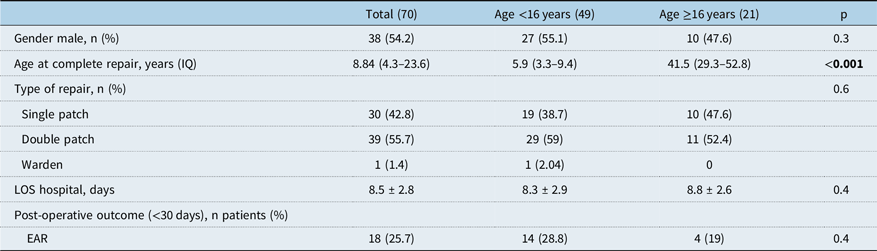
Between October, 1993 and December, 2019, 70 patients (male: 38, 54.2%) underwent surgical repair of partial anomalous venous connection associated with sinus venosus atrial septal defect. The median age at the time of surgery was 8.8 years (IQ 4.3–23.6) (Table 1). In 49 cases (70%), the repair was performed in paediatric age (<16 years old), while the remaining 21 of (30%) patients were operated in adulthood. Surgical technique entailed single-patch repair in 30 patients (42.8%), double-patch repair in 39 patients (55.7%), and 1 Warden procedure (1.4%) (Table 1). No perioperative mortality was observed.
Surgical repair and post-operative incidence rate of EAR according to the age-group

EAR = ectopic atrial rhythm; LOS = length of stay; n = number; SND = sinus node dysfunction; SVT = supraventricular
For all patients, complete data regarding their post-operative period were available. Overall, the mean post-operative length of stay was 8.5 ± 2.8 days. Fifteen patients presented post-operative ectopic atrial rhythm.
Post-operative course (<30 days) according to age
The percentage of ectopic atrial rhythm was increased amongst paediatric patients compared to the adults (28.8 versus 19%), albeit without reaching statistical significance (p = 0.4) (Table 1).
Post-operative course according to surgical repair
When comparing patients who underwent single-patch repair to patients who underwent double-patch repair, we did not find any statistically significant difference in terms of age at surgical repair (Table 2). Post-operative results were also similar in these two groups. In particular, the post-operative incidence of ectopic atrial rhythm was not different between the single-patch and the double-patch groups. Even when taking into account only the paediatric population, this difference was still not significant.
Surgical repair and post-operative complications according to the surgical technique and age group

EAR = ectopic atrial rhythm; LOS = length of stay, n = number; SND =: sinus node dysfunction; SVT = supraventricular
Long-term outcome
Median follow-up time was 52 months (15.1–113) and median age at follow-up was 16 years (10.5–35.7). At their last follow-up, the ectopic atrial rhythm was significantly more frequent (p = 0.02) amongst the paediatric patients compared to the adults, 14 patients (28.8%) and 1 patient (4.7%), respectively.
Discussion
In this retrospective study, we compared the post-operative and long-term occurrence of ectopic atrial rhythm in adult and paediatric patients who underwent surgical repair of partial anomalous venous connection + sinus venosus atrial septal defect over a 30-year period. Nearly, all patients were treated by means of single-patch and double-patch surgical techniques (42.8 and 55.7%, respectively). The presence of ectopic atrial rhythm at follow-up, intended as a direct consequence of an iatrogenic injury to the sinoatrial node, was not significantly different between double- and single-patch repair groups. This is consistent with the work of Said et al, Reference Said, Burkhart and Schaff12 who did not observe a significant difference in the incidence number of sinus node dysfunction and supraventricular arrhythmias amongst 124 patients treated by single or double-patch technique or Warden procedure. On the contrary, other institutions reported different results in terms of incidence of post-operative arrhythmias between surgical groups, with a significantly higher frequency of non-sinus rhythm in patients who underwent double-patch repair. Stewart et al Reference Stewart, Baillard, Kelle, Backer, Young and Mavroudis13 showed a 55% incidence of supraventricular arrhythmias in the double-patch group, compared to significant lower incidence in single-patch and Warden groups (24 and 0%, respectively). Similarly, a recent paper by Jaschinski et al Reference Jashinski, Cussig, Fonseca, Brukner, Kark and Loukanov14 displayed analogous features, where patients treated with the double-patch technique had a significantly higher incidence of non-sinus rhythm.
The reason behind the higher risk of iatrogenic sinoatrial node injury using the double-patch repair technique lies intuitively in the need for a more extensive superior cavoatrial incision, which is a peculiar feature of this operation. Reference Van De Woestijne, Verberkmoes and Bogers7 In this surgical scenario, the possibility of damaging the sinoatrial node is certainly increased than in other procedures where the surgeon remains far away from this area, such as in the Warden and in the double-decker operations. Reference Hongu, Yamagishi and Maeda10,Reference Lin, Yan and Wang15
The sinoatrial node is the natural pacemaker of the heart. It is a complex sub-epicardial structure located in the anterolateral aspect of the superior cavoatrial junction. Its yellowish appearance on the external surface should allow the surgeon to identify and avoid it when carrying out the cavoatrial incision. Nevertheless, anatomic variations of its extension and blood supply are common, thus explaining the high rate of post-operative sinoatrial node dysfunction.
In our analysis, we found a significantly higher incidence of sinoatrial node impairment in the paediatric population, and we acknowledge this may be of great importance. Post-operative incidence of ectopic atrial rhythm had a non-statistically significant increased trend in children compared to the adults, but when considering the long-term follow-up, this difference becomes statistically significant, as ectopic atrial rhythm occurred overall in 28.8% of paediatric cases versus 4.7% of adult cases (p = 0.02). In our opinion, this is likely to be the result of irreversible iatrogenic injury of the sinoatrial node in smaller patients, both in single- and double-patch techniques. In young children indeed, the presence of small anatomical structures forces the surgeon to perform the cavoatrial incision very close to the conduction system, increasing the risk of damaging the sinoatrial node. In adults instead, restoration of sinus rhythm over time occurred more frequently, perhaps because the larger dimension of the superior cavoatrial junction and its distance from the sinoatrial node, makes the incision of cavoatrial junction less likely to affect irreversibly the conduction system.
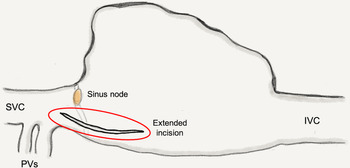
To our knowledge, this is the first study to analyse the different timing and pattern of post-operative incidence of ectopic atrial rhythm in paediatric and adult patients undergoing partial anomalous venous connection + sinus venosus atrial septal defect repair. We strongly believe that the significantly higher incidence of permanent ectopic atrial rhythm amongst the children could be related to the limited space between sinoatrial node area and cavoatrial incision. In single-patch and especially in double-patch technique, a surgical incision of variable extension is performed across the cavoatrial junction very close to the sinoatrial node. When the distance between the pulmonary veins connection plan and the sinoatrial node is relatively wide, as in adult patients, the chance to interfere with the sinoatrial node activity is fairly minimal. On the other hand, when this distance is shorter, such as in children, the probability of sinoatrial node dysfunction is increased (Fig 1). Therefore, the choice of surgical technique may play a crucial role to avoid the occurrence of iatrogenic sinoatrial node injuries causing certain arrhythmias, especially in the paediatric population. As initially mentioned, the Warden procedure is the most reproducible option to avoid surgical damage to the sinoatrial node, and there is nowadays increasing evidence of its superiority in terms of post-operative freedom from ectopic atrial rhythm, compared to single- and double-patch procedures. Reference Gustafson9,Reference Hongu, Yamagishi and Maeda10
The sinoatrial node is highly vulnerable in children undergoing superior cavoatrial incision for partial anomalous venous connection repair.

If these results are confirmed by further larger studies, surgical procedures that completely avoid invasiveness and trauma at the level of superior cavoatrial junction should probably be preferred in children. Amongst the available techniques, although not free from other complications, the Warden procedure could be considered the safest and most reproducible. Reference Lin, Yan and Wang15 In our study population, only one patient underwent the Warden procedure, and this was due exclusively to the surgeon’s preference. In view of our results and new insights, we believe that multicentre randomised prospective studies are needed to compare the arrhythmogenic effects of the Warden and double-patch techniques in children. In adult patients, in whom the Warden procedure may present technical challenges in view of a lower mobility of the superior vena cava, the double-patch technique will remain our preferred approach. Further studies are needed to specifically investigate the impact of ectopic atrial rhythm during growth in the paediatric population and to validate the protocol that will currently advocate at our institution.
The retrospective nature and the relatively small sample size are the main limitations of the present study. The bias may potentially be less if we take into account the consistency of a single centre and the homogeneous surgical strategy, nevertheless larger and prospective studies are certainly warranted.
The surgical management of partial anomalous venous connection with sinus venosus atrial septal defect, requiring superior cavoatrial incision, is associated with a high incidence of post-operative ectopic atrial rhythm. Reference Buz, Alexi-Meskishvili and Villavivencio-Lorini16 In our experience, this finding has been significantly higher amongst children, probably due to the smaller cavoatrial junction size and the subsequent close proximity of the sinoatrial node to the pulmonary veins connection site and surgical incision, hence increasing the risk of iatrogenic damage. Surgical techniques that avoid manipulation of the superior cavoatrial junction should, therefore, be preferred in children.
Acknowledgements
None.
Financial support
This research received no specific grant from any funding agency, commercial, or not-for-profit sectors.
Conflict of interest
None.
Ethical standards
This is a retrospective study, however we have obtained the IRB approval for it? The authors assert that all procedures contributing to this work comply with the ethical standards of the relevant national guidelines on human experimentation and with the Helsinki Declaration of 1975, as revised in 2008, and has been approved by the institutional committees (“IRB FTGM Massa approval” ID number: 17209, April 30th 2020).