

Introduction
Farmers consistently face decisions about whether to invest in a new production method with increased risks and uncertainties or to maintain a current system without new risks and uncertainties. A possible method used to evaluate a new business or investment opportunity is the traditional discounted cash flow methodReference Pažek1, Reference Pažek, Rozman, Borec, Turk, Majkovič, Bavec and Bavec2. Several researchers argue that the net present value (NPVt) is not adequate under uncertain conditions and typically considers projects to be irreversibleReference Amram and Kulatilaka3–Reference Tegene, Wiebe and Kuhn6. To evaluate suitable investment possibilities, an investor-farmer needs to take into account the value of keeping options open, including the impact of sources of uncertainty and risk attitudes. The risk and uncertainty associated with management decisions are included in the formulation of real options problemsReference Dixit and Pindyck5, Reference Turk and Rozman7 and real option modelsReference Brennan and Schwartz8. Theoretical advances in real options methodology have been formulated and assimilated in several empirical applicationsReference Dalila-Fontes9–Reference Pandza, Horsburgh, Gorton and Polajnar11 and studies on the application of real options in agriculture are emergingReference Hadelan, Njavro and Par12–Reference Musshoff and Hirschhauet17.
In this paper, the use of the decision-making process and its tools for evaluating investments in organic spelt-processing business alternatives using elements of the real options methodology is presented. The study focuses on the impact of NPVt as a parameter for investment decisions in the framework of cost benefit analysis (CBA) and the real options model (Black–Scholes (BS) and binomial models).
This paper is organized as follows. The theoretical background of the applied methodology is followed by a presentation of its application in a case study. In the results section, individual business alternatives for organic spelt processing are presented and discussed. Finally, the paper highlights the importance of incorporating the real options approach in agricultural investment evaluations and implications for decision making on the farm.
Case study
In this paper, the application of the presented methodology in the context of organic farming is presented. Organic farming is becoming more and more popular among Slovene farmers, especially in the observed region. At the beginning of 2009, the number of farms practicing organic farming exclusively or taking up organic farming systems amounted to more than 2.096 or 2.68% of all farms in Slovenia18. A few larger organic farms from this region specialize in grain production (i.e., wheat, rye, maize, barley, millet, oats and spelt). However, the level of organic farm income is closely linked to the exploitation of various new business opportunities. Spelt wheat planting (Triticum aestivum ssp. spelta McKey), already included in northeastern Slovenia crop rotations, appears more on small (<5 ha of arable land) and mixed organic farms, due to its high resistance to diseases and low input of nitrogen.
From another perspective, spelt wheat can be directly processed into different kinds of food products on the farm itself and represents additional business and market opportunities for organic farmers. The case study involves spelt production and processing for animal fodder, which is a real option for undertaking production and marketing of two products important in human nutrition – husked spelt grain and spelt flour. A small organic part-time farm (4 ha of arable land) in northeastern Slovenia was considered in order to compare spelt-processing investment projects using the methodological approach presented. The farm regularly includes other grains in addition to spelt wheat in its crop rotation. The annual area of spelt wheat is, according to crop rotation rules, limited to 1 ha with an average yield of 2500 kg unhusked spelt grain. The service of husking and milling the grain is outsourced by the farmer. He uses the spelt for animal fodder, but the alternative option considered in this model is to sell spelt grain and spelt flour to individual customers. However, spelt-processing investment projects are related to risk and uncertainty, and the proposed investment projects must be analyzed before their implementation. Based on a literature review, the real option analysis is recognized as a suitable tool in order to conduct such an analysis.
A real option is defined as the value of being able to choose some characteristic of a decision with irreversible consequences (sunk costs for investments), which especially affects financial income. Real option uses a flexible approach to uncertainty (i.e., ecological and technological production possibilities, economic efficiency of production, market and trade opportunity) by identifying its sources, developing future business alternatives and constructing decision rules. It attempts to reduce risk by monitoring the implementation of its decisions and requiring decision making to be adaptive throughout the life cycle of a project.
Thus, the case study examines aforementioned three options using the real option approach.
Materials and Methods
The methodological framework for the financial and real option approach assessment of spelt-processing alternatives lies within the interrelation of the spelt-processing simulation model, KARSIM 1.0Reference Pažek1. The first presented technique, CBA, is one of the common methodological approaches to farm management, while the real options approach is based on the BS and binomial models.
KARSIM 1.0 integrated deterministic simulation model
Simulation modeling can be efficiently applied in both cost-estimation and cost-benefit analysesReference Csaki19, Reference Rozman, Tojnko, Turk, Par and Pavlovič20. Furthermore, simulation represents one of the fundamental tools for making management decisionsReference Kljajić, Bernik and Škraba21. The computer simulation model, KARSIM 1.0, was developed for the financial and technological analysis of food processing (in the case of Slovene farms). This model consists of 74 production and food-processing submodels. The spelt-processing options are included within the KARSIM 1.0 model as four individual submodels: spelt husking, spelt flour, spelt cookies and spelt bread. Every submodel consists of a calculation of both investment and production costs. The system as a whole represents a complex calculation system and each submodel results in a specific enterprise budget. Through a special interface, the system enables simulation of different business alternatives at the farm level. Furthermore, based on enterprise budgets, cash-flow projections can be conducted together with the investment costs for each business alternative, and the NPVt for each simulated alternative can be computed. All iterations (calculations for individual alternatives) are saved into a database, which is then used as one of the data sources for further analysis and assessment. The KARSIM model has been described in detail in our previous researchReference Pažek1.
Traditional NPVt analysis versus the real options approach
The decision as to which spelt-processing method to undertake on an individual farm is rarely made on the basis of NPVt calculation alone. At this point, the real options methodology can be introduced into the planning process where some further KARSIM 1.0 results represent input variables for BS and binomial model analyses. The preferred approach to evaluating investments is NPVt analysis. For an investment of t periods, the formula is NPVt=−I+ΣTR−TC/(1+r)t, where NPVt is the net present value (€), I is the investment costs (€), TR is the total revenue (€), TC is the total costs (€), r is the interest rate (%) and t is the time (number of years)Reference Turk and Rozman7.
By isolating the cash costs from the enterprise budget, the annual cash flow is estimated, representing a basic input parameter for the computation of NPVt. In the NPVt equation, the aggregate benefits TR and the aggregate costs TC are annually summed and discounted to the present with the selected discount rate r.
In the following section, the concept of options will be introduced to show how the real options approach can be appended to the basic NPVt model. The real options approach has become an increasingly standard framework for investment-timing decisionsReference Morgan, Abdallah and Lasserre22.
BS model
To illustrate the real options of methodology, the BS model and the binomial model for organic spelt-processing business alternatives were developed. Real option describes an option to buy or sell an investment in physical or intangible assets rather than in financial assets. Thus, any corporate investment in plant, equipment, land, patents and brand names, for example, can represent the assets on which real options are written. In addition, investments can be evaluated as real options, and can be treated analogically. The value of real options is described by the best-known Black–Scholes option model (BSOPM)Reference Black and Scholes23. The BSOPM, based on stochastic calculus, is shown below:



where OV is the option value (€), S is the present value of cash flows from optional investment (€), d 1 is the log–normal distribution of N(d 1), d 2 is the log–normal distribution of N(d 2), X is the investment expenditure (€), rf is the annual risk-free continuously compounded rate (%), σ is the annualized variance (risk) of the investment's project, t is the period until investment (years) and e−rt is the exponential term (2.71828). The real options method explicitly accounts for uncertainty in the determination of an optimal decision in light of the stochasticity of an asset's value (e.g., the organic spelt grain quantity and quality production and consequently the available option results depending on many parameters). Some of them could be defined as stochastic parameters: technological parameters or input material (e.g., the efficiency of organic farming allowed specific fertilizer and substances for crop resistance and protection depends on environmental and ecological conditions of the observed region, the suitability of a seed variety or different unexpected market parameters); unexpected ecological conditions (such as weather, new pests, supply and demand concepts and consumer preferences). Further, spelt flour production is more complicated and risky; beyond the above-mentioned parameters, spelt flour production has very important technical parameters as well (e.g., grain-processing technology and storage conditions). The stochastic variable in calculus is expressed in the concept of annual, risk-free, continuously compounded rates and annualized variance (risk) of the investment's project. In the present case, some stochastic variables could also be defined as risk and uncertainty variables. For example, the agriculture policy plays an important role in organic spelt grain production at this moment. Using the corresponding financial instruments, the agriculture policy supports Slovene farmer spelt grain production (with subsidies). The abrogation of the above-mentioned instrument could cause uncertainty in organic spelt production:

where N(d 1) and N(d 2) represent probability distributions. The values of N(d 1) and N(d 2) are obtained from normal probability distribution tables. They give us the probability that S or X will be below d 1 and d 2. In the BS model, they measure the risk associated with the volatility of the value of S.
However, the strategic real options of the investment project are calculated using the BS methodology as follows:

where NPVSRO is the strategic real option (€). The strategic real options and BS models are seldom used in agricultural practice. To explicate the applicability of NPVSRO and BSOPM models in agricultural investments and present the results, a case study was performed.
The binomial model
The binomial option-pricing model is currently the most widely used real options valuation method. The binomial model (i.e., lattice) describes price movements over time, where the asset value can move to one of the two possible prices with associated probabilities. The binomial model is based on a replicating portfolio that combines risk-free borrowing (lending) with the underlying asset to create the same cash flow as the option. Since an option represents the right but not the obligation to make an investment, the payoff scheme for the option is asymmetric. The analysis performed in this work makes use of the multiplicative binomial model of Cox and RubinsteinReference Cox and Rubinstein24 the standard tool for option pricing in discrete time.
The binomial model methodological background can be presented by node of value NPVt that can lead to two nodes with their values being given by NPVt with probability 1+d=d 1 and 1−d=d 2, respectively. The probability of reaching each of these nodes is the usual equivalent Martingale measure used in the binomial option pricing model of Cox and RubinsteinReference Cox and Rubinstein24: d 1=(1+rf)−d/u−d and d 2=1−d 1, where rf is the risk-free rate over the interval dt, u=exp(σ ) and d=exp(−σ). It should be noted that as dt→0 the variables of the multiplicative binomial process converge to the geometric Brownian motion. At each step, the price moves up or down by an amount obtained from its volatility, which is assumed to be constant and known, and the time step length. Thus, the lattice provides a representation of all possible demand values throughout the whole project lifeReference Dalila-Fontes9. The investment project option value (OV) could be calculated using the backward induction processReference Rozman, Pažek, Bavec, Bavec, Turk and Majkovič25, Reference Winter and Amegbeto26.
Results and discussion
The identified business alternatives are evaluated using specially developed simulation models in an Excel spreadsheet environment. Basic simulation model production data and calculated economical variables for individual business alternatives are presented in Table 1.
Results for planned spelt-processing projects.

Note: Product quantity is the product quantity (kg) produced or processed at organic farm; total costs is the sum of fixed and variable product cost in €; total revenue is the product of product quantity (kg) and price (€); coefficient of economics is the quotient between total revenue (€) and total costs (€).
Based on discounted cash flow methodology, the traditional NPVt criterion is used extensively in assessing an investment opportunity for three analyzed spelt products (Table 1). The results are calculated with the assumption that the product sells successfully at the expected prices. The estimated production levels were calculated on the basis of the annual spelt production area. As shown in Table 2, CBA analysis shows positive NPVt for spelt processed for human nutrition (spelt grain and spelt flour). The highest NPVt was observed for husked spelt grain (NPVt=7574.00 €). The lowest NPVt was calculated for spelt grain for animal nutrition. Its market price is lower compared to that of husked spelt grain for human nutrition; however, the basic production costs are the same as for processed spelt grain. The investment return period (Pd) is the lowest for husked spelt grain, followed by that of spelt flour.
CBA analysis results of planned spelt-processing projects t (after 5 years and discount rate=10%).

Note: I is the investment costs (€); annual cash flow (€) is the difference between total revenue (€) and total costs (€); NPVt is the net present value (€); Pd is the investment return period (years); discount rate is the 10% (in this paper, the interest rate as discount rate was used for the CBA analysis; to adjust for risk or other factors it is appropriate to use higher value of discount rate).
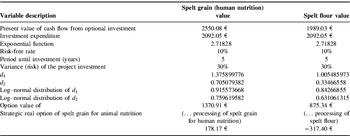
The results of traditional CBA show financial feasibility for spelt grain (human nutrition, NPVt=7574.00 €) and spelt flour (NPVt=5447.92 €). As expected, investment in spelt grain for animal fodder is financially unfeasible (NPVt=−1192.74 €), and the investment return period is unsuitable. The results of the traditional NPVt for spelt grain production (animal fodder, NPVt=−1192.74 €) presents the base for calculation of the strategic real option of spelt grain and spelt flour (for human nutrition). However, the results of the real options approach show a more favorable picture from the farmer's perspective. The risk-free rate and variance of the project's investment were defined as deterministic (between input model variables existing in a fixed cause–consequence relation, expressed in mathematical form). To illustrate the real options methodology, we present two examples of our real options model output. In the first part of Table 3, the variables used in the real options model calculation for the spelt grain and spelt flour production are demonstrated. The second part of Tables 4 and 5 show calculated simulation model results for real options' calculation.
Descriptions and values of variables for the real options model for spelt grain (human nutrition) and spelt flour.

Investment evaluation matrices for spelt grain for human nutrition.

Note: NPVt, net present value (€).
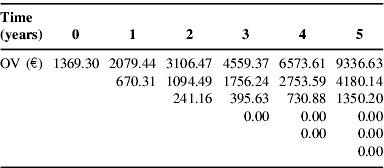
Option value results for spelt processing (spelt grain for human nutrition).
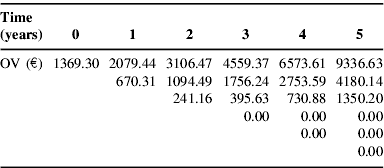
Note: OV, option value (€).
As seen in Table 3, the OV for husked spelt grain, calculated by BS methodology, is 1370.91 €. The results of the application of the BS methodology by analyzed farm business alternatives show the interest in the investment project (NPVSRO=178.17 €). Further, the results of analyzed farm business alternatives (spelt flour) indicate that the calculated OV is 875.34 €. According to the OV calculation, the strategic real option of spelt grain for animal nutrition and further processing into spelt flour is a lower value, and in the analyzed case, a negative value (−317.40 €). The result shows that the spelt flour production option is unsuitable for the farmer. On the basis of data calculated with the BS methodology, it can be concluded that the second business alternative (spelt flour) for the farmer is not the most appropriate option. Further, project investment option values are calculated using the binomial lattice. The results show that financially the most interesting and suitable investment is spelt grain production, where the option value results in a value of 1370.91 €, followed by spelt flour production (878.33 €). As expected, spelt grain production for animal nutrition is for the decision maker (i.e., the farmer), the worst alternative (OV=0.0 €). All binomial model results are calculated under the assumption that calculated d 1=1.350, d 2=0.741 and P=0.598. The detailed presentation of the binomial lattice calculations is given in Table 4. Table 5 shows more results for spelt grain production for human nutrition.
It should be mentioned that between both option model results exist low differences in the individual alternative assessments. In preliminary CBA results, the unsuitable investments in spelt grain production for animal nutrition could be seen already by CBA analysis, where NPVt=−1192.74 € (Table 2). However, the option models further confirm the preliminary CBA results (Tables 2 and 5).
Conclusions
The application of the discount cash flow approach in agriculture is not always the appropriate way to decide whether an investment project is feasible or not. In this work, an attempt was made to employ a real options approach to evaluate the spelt-processing business alternatives on an organic farm. The general implication of this empirical analysis is that risk and uncertainty play an important role in the farmer's decision to adopt a new organic spelt-processing business alternative that is more appropriate and feasible for the farm. Empirical results confirm that the production of spelt grain (for human nutrition) versus spelt flour is superior for the analyzed farm. However, BS methodology could be widely used in agricultural practice too, since it is easy to calculate and it explicitly models the relationship of all the variables. The model results are often useful in practice and helpful in setting up hedges in the correct proportions to minimize risk. Even when the results are not completely accurate, they serve as a first approximation to which adjustments can be made.
Acknowledgements
We express our grateful thanks to anonymous reviewers and editor for their useful comments and suggestions.