Introduction
Physical dormancy (PY) is common in fire-prone ecosystems around the world, particularly prevalent in the Fabaceae, Cistaceae, Malvaceae and Rhamnaceae (Ooi, Reference Ooi, Adkins, Ashmore and Navie2007; Turner et al., Reference Turner, Steadman, VIahos, Koch and Dixon2013; Baskin and Baskin, Reference Baskin and Baskin2014), all of which form persistent soil seed banks. The impermeable hard seed coat of PY seeds prevents gas and water exchange, which inhibits their germination. In fire-prone ecosystems, PY is broken by fire-related soil heating, with dormancy-breaking temperatures ranging between 40 and 120°C (Jeffrey et al., Reference Jeffery, Holmes and Rebelo1988; Keeley, Reference Keeley1991; Thanos et al., Reference Thanos, Georghiou, Kadis and Pantazi1992; Gonzále-Rabanal and Casal, Reference González-Rabanal and Casal1995; Moreira et al., Reference Moreira, Tormo, Estrelles and Pausas2010; Ooi et al., Reference Ooi, Denham, Santana and Auld2014; Liyanage and Ooi, Reference Liyanage and Ooi2015). Dormancy-breaking temperature thresholds maintained by physically dormant species are often used to predict the potential level of post-fire response (e.g. Bradstock and Auld, Reference Bradstock and Auld1995; Williams et al., Reference Williams, Congdon, Grice and Clarke2004; Santana et al., Reference Santana, Bradstock, Ooi, Denham, Auld and Baeza2010; Ooi et al., Reference Ooi, Denham, Santana and Auld2014; Wright et al., Reference Wright, Latz and Zuur2015).
Fire-related dormancy-breaking temperature thresholds vary between PY species (Trabaud and Oustric, Reference Trabaud and Oustric1989; Auld and O'Connell, Reference Auld and O'Connell1991) and within populations of single species (Liyanage and Ooi, Reference Liyanage and Ooi2015). It has been proposed that such variation has been selected for because of the inherent variability of fire (Trabaud and Oustric, Reference Trabaud and Oustric1989; Ooi et al., Reference Ooi, Denham, Santana and Auld2014; Liyanage et al., Reference Liyanage, Ayre and Ooi2016), which results in variation in soil heating over the area burnt (Bradstock et al., Reference Bradstock, Auld, Ellis and Cohn1992; Penman and Towerton, Reference Penman and Towerton2008). Having different dormancy-breaking temperature thresholds among species can therefore contribute to species co-existence, by distributing germination over space (Trabaud and Oustric, Reference Trabaud and Oustric1989; Ooi et al., Reference Ooi, Denham, Santana and Auld2014). It has also been suggested that within-species variation can operate as a bet-hedging mechanism, ensuring that at least some germination is possible across a range of fire severities, and that PY thresholds are maintained by co-varying with seedling characteristics, which ensure that seedling performance matches the post-fire conditions (Liyanage and Ooi, Reference Liyanage and Ooi2015; Liyanage et al., Reference Liyanage, Ayre and Ooi2016). Dormancy-breaking threshold temperatures have been used to estimate the potential magnitude of post-fire seedling establishment, depending on the fire severity and/or the amount of soil heating that occurs (Wright et al., Reference Wright, Latz and Zuur2015). Species with high dormancy-breaking temperature thresholds (≥ 80°C) require a relatively hot fire to produce suitable temperatures for breaking dormancy in the soil, whereas species with low thresholds may respond to lower severity fires or even soil heating generated during summer in canopy gaps (Auld and Bradstock, Reference Auld and Bradstock1996; Santana et al., Reference Santana, Bradstock, Ooi, Denham, Auld and Baeza2010, Reference Santana, Baeza and Blanes2013; Ooi et al., Reference Ooi, Denham, Santana and Auld2014; Liyanage and Ooi, Reference Liyanage and Ooi2015).
Predicting the germination response of species that form persistent seed banks is made complicated by the changes that potentially occur within the soil or over time. In most studies investigating fire-related dormancy-breaking thresholds of PY species, freshly collected seeds are used (e.g. Jeffrey et al., Reference Jeffery, Holmes and Rebelo1988; Trabaud and Oustric, Reference Trabaud and Oustric1989; Auld and O'Connell, Reference Auld and O'Connell1991; Keeley, Reference Keeley1991; Moreira et al., Reference Moreira, Tormo, Estrelles and Pausas2010; Ooi et al., Reference Ooi, Auld and Denham2012; Liyanage and Ooi, Reference Liyanage and Ooi2015). However, during burial, daily and seasonal temperature fluctuations cause physiological changes to seeds and physical deterioration of seed structures, which could change their dormancy and germination characteristics compared with those of fresh seeds, thereby changing the way they respond to fire-related dormancy-breaking cues (van Staden et al., Reference van Staden, Kelly and Bell1994; Schatral, Reference Schatral1996; Roche et al., Reference Roche, Dixon and Pate1997; Zeng et al., Reference Zeng, Cocks, Kailis and Kuo2005).
Alteration of dormancy-breaking responses in stored seeds has been identified for a number of physiologically dormant species (e.g. Roche et al., Reference Roche, Dixon and Pate1997; Tieu et al., Reference Tieu, Dixon, Meney and Sivasithamparam2001; Baker et al., Reference Baker, Steadman, Plummer, Merritt and Dixon2005; Turner et al., Reference Turner, Steadman, VIahos, Koch and Dixon2013), with the proportion of seeds that respond to smoke cues (but also to heat for some species) generally reported to increase after storage in laboratory or field conditions, presumably due to dry after-ripening. For PY species, changes to the dormant fraction with storage and a general pattern of increased germination with longer storage have been reported (e.g. Morrison et al., Reference Morrison, Auld, Rish, Porter and McClay1992; Van Assche and Vandelook, Reference Van Assche and Vandelook2006; Galíndez et al., Reference Galíndez, Ortega-Baes, Seal, Daws, Scopel and Pritchard2010; Orscheg and Enright, Reference Orscheg and Enright2011; Hudson et al., Reference Hudson, Ayre and Ooi2015). However, in fire-prone systems, variation in the non-dormant fraction is usually small for PY species, and of little value for predicting post-fire response (Ooi et al., Reference Ooi, Auld and Denham2012, 2014). While there are other examples of studies of PY species, where the effects of storage on germination response to a single ‘heat’ treatment (representing fire) has been tested (e.g. Baker et al., Reference Baker, Steadman, Plummer, Merritt and Dixon2005; Turner et al., Reference Turner, Steadman, VIahos, Koch and Dixon2013), no studies have investigated the effects of storage on dormancy-breaking temperature thresholds. These thresholds are the key seed-related characteristic that contributes to determining recruitment for PY species, and understanding such changes are therefore important for robustly predicting population persistence.
In this study, we investigated the effects of seed ageing on dormancy-breaking temperature thresholds of four PY species from south eastern Australia, all within the family Fabaceae. Two of the species are known to have a high temperature threshold for breaking dormancy (Acacia linifolia and Viminaria juncea), while the other two have low temperature thresholds (Aotus ericoides and Bossiaea heterophylla). Physical dormancy is represented in around 45% of dormant shrub species in this region (Ooi, Reference Ooi, Adkins, Ashmore and Navie2007), and previous work suggests that some species within the physically dormant Fabaceae family display lower levels of initial dormancy after dry storage (Morrison et al., Reference Morrison, Auld, Rish, Porter and McClay1992). Additionally, other studies have shown that the germination response of fresh seeds of a number of species is negligible, even at the highest soil temperatures likely to occur during fire (e.g. Auld and O'Connell, Reference Auld and O'Connell1991; Ooi et al., Reference Ooi, Denham, Santana and Auld2014; Liyanage and Ooi, Reference Liyanage and Ooi2015). These findings suggest that changes in dormancy over time are not only likely, but for some species are essential if a germination response is to occur. We therefore hypothesize that dormancy-breaking temperature thresholds of PY species change with time within the seed bank, and that both the storage conditions and duration can affect the magnitude of change. More specifically, we addressed the following questions:
-
(i) Do dormancy-breaking temperature thresholds change as seeds age in the soil seed bank? Similarly, do initial levels of dormancy also change?
-
(ii) Is there an interaction between the effects of ageing and type of storage condition?
-
(iii) Does the changing pattern of dormancy-breaking temperature thresholds vary among species? Particularly, do high threshold species maintain the requirement for high temperatures over time?
-
(iv) How can the changes observed potentially affect recruitment and population persistence?
Materials and methods
Study species and region
The dormancy-breaking temperature thresholds of four common native shrub species from the fire-prone sclerophyll vegetation of the Sydney region (Royal 34°03′S, 151°03′E and Heathcote 34°07′S, 150°58′E National Parks) in south eastern Australia were examined to assess their change in dormancy response with ageing. Rainfall in the study region is aseasonal, with approximately 1100 mm falling annually and peak monthly means occurring in January, March and June. Average monthly maximum/minimum temperatures are 26/18°C and 16/8°C in summer and winter, respectively (Australian Government Bureau of Meteorology, 2016). All study species occur within the Fabaceae family and produce physically dormant seeds (PY). Seeds were collected from 15–20 randomly selected mother plants of A. linifolia, B. heterophylla, A. ericoides and V. juncea, from single populations during the summer of 2013 (November–December). Among these species, previous work by Liyanage and Ooi (Reference Liyanage and Ooi2015) has shown that freshly collected dormant seeds of A. linifolia and V. juncea had high dormancy-breaking temperature thresholds, requiring at least a 100°C treatment to reach 50% germination. Bossiaea heterophylla and A. ericoides represented low dormancy-breaking temperature threshold species, requiring a 60°C treatment or less to reach 50% germination. The temperature treatment ranges applied for this study were therefore relevant to each threshold group.
Dormancy assessment of fresh seeds
A proportion of the collected seeds were used to assess initial dormancy-breaking temperature thresholds. Dry oven 10-min temperature treatments of 40, 60, 80 and 100°C were applied to three replicates of 15–20 fresh seeds (depending on seed availability) for the high threshold species V. juncea and A. linifolia. For the low threshold species B. heterophylla, and A. ericoides, 40 and 60°C treatments only were applied, as these were high enough to promote maximum germination. Treatment levels were based on the range of temperatures experienced in the soil during fire (Ooi et al., Reference Ooi, Denham, Santana and Auld2014). Temperature-treated seeds were allowed to cool and then placed on moistened filter paper in replicate Petri dishes to germinate under a 25/18°C and 12 h/12 h light/dark regime in a temperature-controlled incubator. This temperature regime was used to mimic summer mean maximum and minimum temperatures. Summer is the time that most natural fires occur (McLoughlin, Reference McLoughlin1998), and seeds that have their dormancy broken during fire respond to the next rainfall event, which in this region is most likely to occur in summer due to an aseasonal rainfall pattern. Three untreated replicates were used as the control for each species. Germination was recorded for 6 weeks at 2-day intervals, and scored on emergence of the radicle. To assess viability at the end of each germination trial, ungerminated seeds were scarified and placed back in the incubator for up to 4 weeks. All seeds had imbibed by this point and had either germinated or become soft and mushy. Seeds germinating after scarification represented those that had remained dormant from the treatment but were still viable. Viability of each replicate was calculated as the total number of seeds germinating before and after scarification.
Seed ageing and dormancy assessment
The remaining seeds from each species were divided into two sets, with one used for a field burial trial and the other for dry storage in laboratory conditions. For the burial treatment, seeds from each species were equally divided into sand-filled nylon mesh bags (10 × 20 cm) with a mesh size of 2 mm. For the smaller seeded species A. ericoides and V. juncea, bags containing 50 seeds each were used, while for the larger seeded A. linifolia and B. heterophylla each bag contained 25 seeds (Table 1). This ensured that the seed to sand proportions were similar across species. In December 2013, the bags were buried within the top 2 cm of the soil profile at the same field sites where seeds of each species were originally collected from. The bags were randomly assigned to one of three plots within each site, to account for within-site spatial variation, and their locations recorded with a global positioning system (GPS) for later retrieval. After 6 and 18 months, a minimum of three bags for each species were retrieved and air dried. Intact seeds were extracted from the sand by sieving. The number of seeds damaged during burial were recorded and seeds from each plot then pooled to randomize any microclimatic effects. Heat treatments were then applied as described above, with the same range of temperatures and the same conditions for germination that were used for fresh seeds. For the laboratory-stored seeds, replicates were placed in paper bags and stored at ambient laboratory conditions (~20 to 23°C) prior to use in germination trials after 6 and 18 months.
Dormancy-breaking threshold group (see Ooi et al., Reference Ooi, Denham, Santana and Auld2014), mean seed mass (± SE), number of mesh bags buried in the field and number of seeds stored in each mesh bag for fresh seeds of all four studied species.

Analysis
The percentages for initial viability (based on the number of viable seeds in the controls), mortality (the percentage of seeds killed) at each temperature treatment, as well as germination and the non-dormant fraction were calculated for fresh, field-stored and laboratory-stored seeds for each retrieval period. The non-dormant fraction over time was estimated using the number of viable seeds germinating in the untreated controls at 0, 6 and 18 months. Before each calculation, viable seed number per replicate was corrected using the mean viability of the control replicates. Data were analysed using generalized linear models (GLMs) with a binomial error structure and logit link function for each species separately. Analyses were conducted using the R statistical platform (R Core Development Team, 2014).
Germination response
To analyse germination data, storage time, type of storage (soil or laboratory) and temperature treatments were assigned as the predictor variables. We used model selection and determined the best fitting model from all possible subsets of three predictor variables using Akaike's Information Criterion (AIC) (Akaike, Reference Akaike, Petrov and Csaki1973). Based on germination results from the heating experiments, the lowest mean temperatures required to produce at least 20 and 50% germination of initially dormant seeds were calculated (G 20% and G 50%). A minimum of 20% increased seed germination is considered to be a high enough response to produce a noticeable flush of seedling emergence in the post-fire environment (Ooi et al., Reference Ooi, Denham, Santana and Auld2014). ‘Obligate pyrogenic dormancy class’ species (Ooi et al., Reference Ooi, Denham, Santana and Auld2014) are defined as high threshold species, and require at least an 80°C heat shock to reach 20% germination. We therefore used the G 20% index to identify whether dormancy-breaking temperature thresholds changed during storage in the soil. A lowering of the G 20% index would indicate that thresholds for producing a post-fire germination response were being reduced as the seed bank aged.
Decay pattern of high threshold seeds
Both low and high threshold species have at least some proportion of seeds at the dispersal stage that have high dormancy-breaking thresholds. To identify how quickly the seed banks reduce from high to low threshold, we calculated the half-life of the high threshold fraction for each species. This was done by plotting the percentage of seeds germinating at the next treatment temperature below 80°C for each replicate tray (i.e. the 60°C response) against time (duration of burial). The decay rate was then estimated by fitting exponential curves to each plot. The half-life of the initial high dormancy-breaking threshold seed fraction was then calculated from the exponential equation:
 $$y = ae^{-bt},$$
where a is the initial high dormancy-breaking threshold seed percentage, b is the decay rate and y is the percentage of high dormancy-breaking threshold seeds remaining in the soil seed bank at time t (Auld et al., Reference Auld, Keith and Bradstock2000). Replicates of some species showed a total loss of the high threshold seed fraction after the first retrieval (6 months), and in this case a linear regression was used to estimate the decay rate. For both model types, half-life was calculated by solving the equation for half of the initial percentage of high threshold seeds. For B. heterophylla, the 60°C treatments could not be conducted due to a lack of seeds in the field burial treatments. In this case, there were few differences between field and laboratory-stored results, and so the decay rate was based on laboratory-stored seed data. The half-life of high threshold seeds was not calculated for A. linifolia because this species displayed no change in threshold over the time period used in our study.
Change in viability and dormancy over time
We assessed how viability and the non-dormant fraction changed, and whether resilience to fire-related temperatures was maintained over time. Change in viability and initial dormancy after each storage time period of the laboratory-stored seeds was assessed using a one-factor GLM with time as the predictor. Due to viability of most retrieved field-buried seed lots being at or close to 100%, we investigated loss of laboratory-stored viability and the number of lost seeds from each of the retrieved bags. We plotted the mean for each over time, as well as comparing the percentage of lost seeds per replicate bag with the percentage of seeds becoming inviable during laboratory storage using regression. This allowed assessment of whether seed loss in the field could potentially be related to loss of non-dormant or inviable seeds.
Results
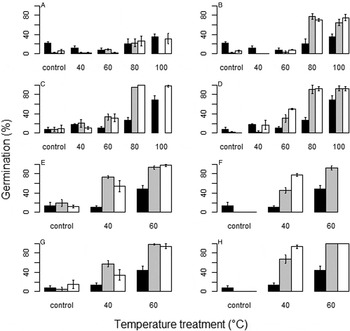
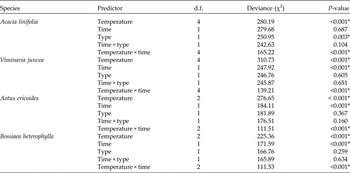
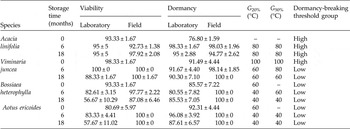
All four species showed an increase of germination in response to heat treatments over storage time (Fig. 1). In three of the study species, there was a significant interaction between temperature and storage time (V. juncea: d.f. = 4, χ 2 = 139.21, P < 0.001; A. ericoides: d.f. = 2, χ 2 = 111.51, P < 0.001; B. heterophylla: d.f. = 2, χ 2 = 111.53, P < 0.001), showing that germination response to heat treatments increased as seeds aged (Table 2). Although there was no significant effect of type of storage for these three species, examination of the data indicated that B. heterophylla and A. ericoides displayed differences at the 40°C treatment between the laboratory- and soil-stored seeds. For both of these species, a decline in germination after 18 months laboratory storage appeared to be related to a large decline in viability (Table 3). Additionally for B. heterophylla, there is a much sharper lowering of threshold obvious at 40°C for laboratory-stored seeds compared with field-buried seeds. For A. linifolia, however, there was a similar significant interaction between storage time and temperature (d.f. = 4, χ 2 = 165.22, P < 0.001), as well as a significant difference between laboratory- and field-stored seeds (d.f. = 1, χ 2 = 250.95, P = 0.003) (Table 2). Acacia linifolia seeds increased germination to 80% at the 80°C treatment after 6 months field burial, whereas maximum germination of laboratory-stored seeds was less than 30%, even after 18 months storage (Fig. 1). There was little decrease in initial dormancy levels (i.e. no significant increase in the non-dormant fraction) observed as a result of storage time (Fig. 1). Counterintuitively, A. linifolia displayed a significant increase in initial dormancy levels in laboratory-stored seeds as they aged (d.f. = 2, χ 2 = 5.32, P < 0.001) (Table 3). There was a similar increase in initial dormancy levels for field buried seeds for all species (Table 3).
Mean seed germination (± SE) of laboratory stored and field buried seeds, expressed as a percentage of the total initial viable seeds, after heat shock treatments of 40, 60, 80 and 100°C. Different coloured bars represent seeds stored for 0 ( ), 6 (
 ) or 18 (□) months. Graphs in the left column (panels A, C, E, G) represent laboratory-stored seeds and those on the right (panels B, D, F, H) represent field-buried seeds of Acacia linifolia (A, B); Viminaria juncea (C, D); Bossiaea heterophylla (E, F) and Aotus ericoides (G, H).

Results from the binomial GLM for germination of four species in response to temperature treatment (temperature), type of storage (type) and storage time (time).

*Significant differences at P < 0.05.
Initial viability (± SE), dormancy (± SE), temperature required to break 20% (G 20%) and 50% (G 50%) of dormant seeds, and dormancy-breaking temperature threshold group based on the G 20% for different time periods.

‘–’ indicates insufficient germination reached to determine dormancy-breaking threshold group, even in response to the highest temperature treatments.
Dormancy-breaking temperature thresholds measured by G 20% and G 50% were higher for freshly collected seeds, ranging from 80 to 100°C in high threshold and 60°C in low threshold species, than after storage (Table 3). The G 20% displayed a dramatic decrease over time for three of the study species, with both low threshold species, B. heterophylla and A. ericoides, dropping their threshold to the lowest fire-related temperature treatment of 40°C after only 6 months. The high threshold V. juncea also moved from a high to low threshold classification (Ooi et al., Reference Ooi, Denham, Santana and Auld2014). However, the G 50% showed that a large proportion of V. juncea seeds maintained a high threshold for at least 6 months (Table 3).
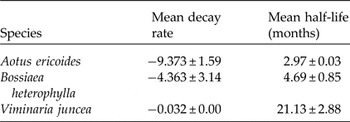
The estimated half-life of the high threshold seed fraction varied considerably between species (Table 4). The fractions of initial high threshold seeds were less than 50% for both low threshold species, which was reduced to almost 0% at the first retrieval (6 months). The estimated half-lives of their high threshold fractions were therefore below 6 months for both Aotus ericoides and B. heterophylla (Table 3). For the high threshold V. juncea, the half-life of the high threshold fraction of seeds was relatively long, taking over 21 months. The half-life for A. linifolia could not be robustly calculated; dormancy-breaking thresholds did not decay over the 18 months of burial.
Some fraction of the seed lot for each species has a high threshold. The estimated mean decay rate (± SE) and half-life (± SE) of the high threshold fraction is shown for each study species.

NB: no decay was recorded for Acacia linifolia and so a half-life was not calculated.
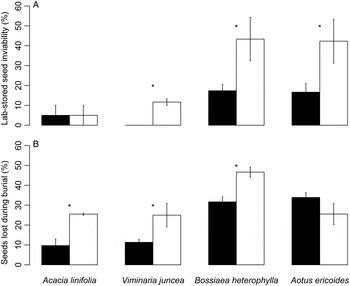
Viability of the high threshold species A. linifolia did not decline over time. However, it did decline significantly for both of the low threshold species B. heterophylla (d.f. = 2, χ 2 = 7.196, P < 0.001) and A. ericoides (d.f. = 2, χ2 = 11.095, P = 0.029), and the high threshold species V. juncea (d.f. = 2, χ 2 = 2.54, P = 0.002) by approximately 35, 25 and 10%, respectively, after laboratory storage for 18 months (Table 3; Fig. 2A). For buried seeds, there was a significant decline in the number of whole seeds retrieved over time for all species except A. ericoides (Fig. 2B). The relationship between the number of seeds missing from bags at retrieval and the proportion of seeds losing viability was highlighted by a strong positive correlation for B. heterophylla (R 2 = 0.506) and V. juncea (R 2 = 0.785) (data not shown). However, no clear relationship was found for A. ericoides or A. linifolia.
Comparison of seed viability decline and seed loss during laboratory storage and field burial, respectively. Bars represent mean values (± SE) for each of the study species for (A) the proportion of inviable seeds after laboratory storage and (B) the number of whole seeds lost during field burial, for 6 ( ) and 18 months (□). *Significant differences between storage time.

Discussion
We observed a clear lowering of dormancy-breaking temperatures over storage time for three of our physically dormant study species. The effects of ageing differed between species, however, with the low threshold species B. heterophylla and A. ericoides losing viability and dropping threshold levels more quickly than their high threshold counterparts. For the high threshold species, a proportion of V. juncea seeds were reduced to lower threshold levels over time, whereas all A. linifolia seeds maintained high thresholds over time. This provides an insight into the dynamics of dormancy-breaking temperature thresholds within persistence soil seed banks. These results have implications for allowing more sophisticated predictions for post-fire regeneration in response to fire (Keith et al., Reference Keith, Williams, Woinarski, Bradstock, Williams and Gill2002; Wills and Read, Reference Wills and Read2002; Hudson et al., Reference Hudson, Ayre and Ooi2015) which would not be possible from experiments that have tested the germination of stored seeds using non-dormant fractions or single fire-related temperature treatments.
Variation in dormancy-breaking temperature thresholds of fire-following species is directly related to understanding both the response to variation in fire severity (and the related levels of soil heating) and the impacts of changes to the fire regime associated with fire management and climate change. For example, species with high dormancy-breaking temperature thresholds would probably fail to recruit after less severe burns, such as those produced during cool season prescribed fires that result in low soil temperatures (Auld and O'Connell, Reference Auld and O'Connell1991; Auld and Bradstock, Reference Auld and Bradstock1996; Penman and Towerton, Reference Penman and Towerton2008; Ooi et al., Reference Ooi, Denham, Santana and Auld2014; Liyanage and Ooi, Reference Liyanage and Ooi2015). The results from our study suggest that some high threshold species, such as V. juncea, have a mechanism that provides some level of seed germination response under low severity conditions. This could be interpreted as a bet-hedging mechanism in response to variation in fire severity, which is only developed as seeds age within the seed bank.
Both the extent to which thresholds drop and the amount of time taken to decrease would be important in determining the ability of a species’ seed bank to respond to lower temperatures during fire. While there is an obvious decline in threshold temperatures, particularly when determined by the G 20% index, both high threshold species differ. Acacia linifolia maintained its high threshold throughout the duration of the experiment, indicating that the seed bank would retain a high threshold requirement over a typical fire return interval for the region of 7–17 years (Bradstock and Kenny, Reference Bradstock and Kenny2003). Viminaria juncea was more plastic, indicating that a greater proportion of seeds would be able to respond to lower temperatures. However, a relatively long half-life of the high threshold fraction meant that a large proportion of the seed bank would still require an 80°C treatment to produce a germination flush during the next fire event, due to fresh seed input and the slow rate of decline. Identifying both rapid and slow threshold changing species could help to further develop dormancy-breaking threshold groups and understand the population dynamics of fire-prone species associated with seed age and variation in the fire regime.
The results from our study lead to the question of whether a decline in temperature thresholds is simply a sign of seed decay or a trait which provides some benefit to species persistence. In other regions, where fire is not a driver of population dynamics, a decline in dormancy over time is essential for many PY species. For example, winter annuals lose dormancy over the hot summer months to promote germination during cooler months (Van Assche and Vandelook, Reference Van Assche and Vandelook2006), while arid species experience a gradual decline in the dormant fraction to take advantage of sporadic rainfall events (Ooi et al., Reference Ooi, Auld and Denham2009). In fire-prone regions, it is beneficial that seed banks maintain a high proportion of dormant seeds between fires, an assumption supported by our findings of little increase in the non-dormant fraction. However, this differs from a reduction in temperature thresholds. Our study species also displayed a relative increase in the number of dormant seeds, particularly after field burial, a result likely to be related to germination of the non-dormant fraction in the treatment bags (Zalamea et al., Reference Zalamea, Sarmiento, Arnold, Davis and Dalling2015), and the disintegration of inviable seeds. This hypothesis was supported for at least two of our species, B. heterophylla and V. juncea, where we found a strong correlation between viability decline during laboratory storage and seed loss from bags during field burial.
One hypothesis for the role of threshold reduction is related to the dynamics of seed bank formation. Upon reaching the soil surface, seeds can move vertically down the soil profile over time via both biotic and abiotic agents. Rainfall is the key abiotic cause, with the greatest rates of burial occurring in sandy soils (Benvenuti, Reference Benvenuti2007; Marthews et al., Reference Marthews, Mullins, Dalling and Burslem2008). The main biotic vector in our study region is ants, with one study reporting up to 38% of Acacia suaveolens seeds moved to nests (Auld, Reference Auld1986), resulting in a large proportion buried at depths over 5 cm (>20% of seeds). While some cycling of seeds within the depth profile is possible (Chambers and MacMahon, Reference Chambers and MacMahon1994), it is likely that, on average, older seeds are buried at greater depth than younger seeds. Soil is an effective insulator and temperatures experienced by the seed bank during fire decrease with increasing soil depth (Auld, Reference Auld1986; Auld and Bradstock, Reference Auld and Bradstock1996). The lowering of thresholds over time may therefore be a mechanism for maintaining a post-fire germination response, with older seeds responding to the lower temperatures experienced at depth, and younger seeds germinating in response to hotter temperatures closer to the soil surface. This ability would be mediated by seed size (Bond et al., Reference Bond, Honig and Maze1999; Hanley et al., Reference Hanley, Unna and Darvill2003), meaning that larger-seeded species may have less selective pressure to maintain higher thresholds. Future studies looking at dormancy-breaking temperature thresholds as seeds age, across a number of species with a range of seed sizes, would contribute to understanding the basis of this mechanism.
A striking finding from our experiments provides an answer for conflicting results reported in a number of previous studies. These have shown that dormancy of some PY species is not broken by fire-related temperatures in the laboratory, even though mass seedling emergence has been observed in the post-fire environment. Temperature treatments of up to 110°C produce no or little germination response, yet mortality occurs at 120°C. Examples come mainly from the Fabaceae, and include Acacia longifolia, Mirbelia platylobium and one of our study species, A. linifolia (Auld and O'Connell, Reference Auld and O'Connell1991; Ooi et al., Reference Ooi, Denham, Santana and Auld2014) but are also found in the Malvaceae, including Alyogyne hakeifolia and A. huegelii (Baker et al., Reference Baker, Steadman, Plummer, Merritt and Dixon2005). This has led to some confusion over the drivers of germination response for these species. All of these studies have been conducted using fresh seeds. The increased levels of seed germination that we observed for aged A. linifolia seeds therefore provides an explanation for such observations.
For A. linifolia we also observed relatively high germination in untreated fresh seeds, compared with other PY species in the study region, suggesting that dormancy may not have been fully developed at dispersal. In our system, there is little adaptive benefit for having a non-dormant seed bank fraction, such as the hypothesized reward for dispersal to safe sites suggested by others (e.g. Paulsen et al., Reference Paulsen, Colville, Kranner, Daws, Högstedt, Vandvik and Thompson2013; Zalamea et al., Reference Zalamea, Sarmiento, Arnold, Davis and Dalling2015), because successful recruitment is restricted to the post-fire environment and inter-fire germination is highly likely to fail, irrespective of the site reached (Whelan, Reference Whelen1995; Ooi et al., Reference Ooi, Auld and Denham2012). Additionally, dispersal by mammals is extremely rare for this species, and instead is primarily carried out by ants, which are rewarded by the elaiosome (Auld, Reference Auld1986). We suggest that the lack of dormancy observed in A. linifolia is an artefact of using freshly collected seeds, and the development into hard seeds, while relatively slow, is within a time frame that ensures minimal loss to germination. Other studies have reported several PY species that have non-dormant seeds at dispersal, with PY developing on exposure to low humidity levels (Pukittayacamee and Hellum, Reference Pukittayacamee and Hellum1988; Tozer and Ooi, Reference Tozer and Ooi2014). Tozer and Ooi (Reference Tozer and Ooi2014) found that this occurred rapidly for Acacia saligna once humidity dropped below 20%, meaning that initially non-dormant seeds of this PY species were likely to ‘harden’ within a few days of dispersal in their native habitat, and still be incorporated into the seed bank. In our study, it is difficult to identify the mechanism by which fresh A. linifolia seeds become dormant; however, germination response after the lower heat treatments (40 and 60°C) was significantly lower than the controls, without any increase in seed mortality. This suggests that such temperatures, which can be reached during hot summer days in the soil (Ooi et al., Reference Ooi, Auld and Denham2012), may play a role in the development of PY in the non-dormant fraction, potentially in addition to low humidity. This again highlights the need for further studies assessing both fresh and aged seeds to understand PY variation and response.
For both low threshold species B. heterophylla and A. ericoides, the vast majority of seeds required only a 40°C treatment to overcome dormancy after relatively short burial periods. This increases the likelihood of a large germination response of such species to cooler lower severity burns, and also potentially to have dormancy broken by the temperatures produced during the inter-fire period. Ooi et al. (Reference Ooi, Denham, Santana and Auld2014) found that such temperatures had the potential to promote germination, a response that could significantly increase under predicted future summer soil temperatures. Seedling recruitment during the inter-fire period is rarely successful in these fire-prone systems, meaning that increased levels of dormancy loss could cause significant soil seed bank decay (Ooi et al., Reference Ooi, Auld and Denham2012, 2014). Our study therefore highlights that the risks to population persistence from seed bank decay is higher than previously estimated, due to dormancy-breaking thresholds changing over time, with up to 90% of seeds from the facultative pyrogenic species B. heterophylla and A. ericoides requiring only the lowest temperature treatment of 40°C. Incorporating such data could improve predictions of population dynamics under predicted soil temperatures, particularly in the important but understudied area of seed persistence and climate change (Ooi et al., Reference Ooi, Denham, Santana and Auld2014; Hudson et al., Reference Hudson, Ayre and Ooi2015; Ooi, Reference Ooi2015; Parmesan and Hanley, Reference Parmesan and Hanley2015).
Most studies of persistent seed banks describe composition, density or germination response at a particular point in time, but far less often describe how these characteristics change over time (Fenner and Thompson, Reference Fenner and Thompson2005). Instead of losing dormancy, it is clear that our study species show a changing pattern of dormancy-breaking temperature thresholds. While several studies have described a change in sensitivity to dormancy-breaking cues after ageing (Galíndez et al., Reference Galíndez, Ortega-Baes, Seal, Daws, Scopel and Pritchard2010; Turner et al., Reference Turner, Steadman, VIahos, Koch and Dixon2013), our study highlights this important distinction in fire-prone regions, where maintaining dormancy is essential for the population, and therefore species, to persist in the long term. A change in thresholds provides a different outcome, and the mechanism underlying these changes appears to differ between species. The gradual decrease in dormancy-breaking temperature thresholds with increasing storage time provides a mechanism for increasing the range of thresholds present within the seed bank at any particular point in time, contributing to the maintenance of a bet-hedging capability or germination from depth. Understanding how widespread, and to what extent, such changes to PY occur could help to improve predictions of seed bank and recruitment dynamics in the post-fire environment, and help to robustly model population persistence. Studies need to be conducted across a larger range of species to draw more general conclusions.
Acknowledgments
We would like to thank Dr Owen Price for assisting with several of the statistical analyses.
Financial support
This work is supported by a University of Wollongong International Postgraduate Tuition Award (IPTA) and University Postgraduate Award (UPA) scholarships (G.L.) and an Australian Research Council Linkage Project grant awarded to M.O. and collaborators David Ayre, Tony Auld, Rob Freckleton and David Keith (grant number LP110100527). M.O. is supported as a Research Fellow for National Environmental Science Program's (NESP) Threatened Species Recovery Hub (Project 1.3).
Conflicts of interest
None