Over the last 50 years, the profession of emergency management (EM) has transformed into a distinctive vocation with its own knowledge base, educational curriculum, credentialing, and oversight.Reference Marks 1 Public health (PH) has had an increasing role in the management of disasters following the issuance of Homeland Security Presidential Directive-5 in 2003, the implementation of the National Incident Management System in 2004, and the adoption of the National Health Security Strategy in 2010. Over the past 15 years, there has been increasing professionalism of the PH system with specific training in EM. Unlike the EM workforce of the past, with its ensemble of retired military, police, and fire first-responders, the present day EM body now includes Master of Public Health–trained professionals, thoroughly educated in the understanding of academic theoretical models but who may have little authentic field experience. Feedback from regional emergency managers in Colorado indicates a lack of practical skills amongst individuals currently seeking employment, suggesting that current educational strategies and curricula have not kept pace with this shift. The changing disaster landscape and shift in workforce, together with the updated Next Generation Emergency Management Core Competencies,Reference Feldmann-Jensen, Jensen and Smith 2 call for a review of educational strategies and priorities to ensure that public health emergency management (PHEM) curricula are meeting current demands.
In response to the need for PH emergency managers who are better prepared to integrate into the EM structure, the Colorado School of Public Health (CSPH) Department of Environmental and Occupational Health initiated a series of Disaster/EM courses. As the interest in quality courses in this area became apparent, the CSPH collaborated with the University of Colorado Department of Emergency Medicine and the Community College of Aurora Disaster Management Institute (DMI) to introduce a new Public Health Emergency Preparedness and Disaster Response certificate. Under the leadership of Dr. Debra Kreisberg, this certificate features a unique, operational curriculum comprising simulation-based exercises embedded in a mastery learning framework to enrich PHEM training and increase the workforce readiness of CSPH graduates. Presented in the next sections are an overview of this novel curriculum, the theories supporting its design, and evidence of general applicability and value of the approach.
REPORT
Essential Functions of a PH Emergency Manager and Limitations of the Traditional Classroom Environment
A hallmark of a successful PH emergency manager is the ability to execute effective decision-making under conditions of uncertainty. PH emergency managers must practice dynamic, flexible problem-solving that relies on pattern recognition and the use of stored knowledge and experience to make judgments in unfamiliar, complex, and evolving environments.Reference Comfort and Wukich 3 Development of this skill requires an intimate knowledge of both essential EM and PH competencies and the ability to apply this expertise to new contexts. The successful application of learned information to a different setting is referred to as mastery and involves various levels of higher ordered cognition, including the application, analysis, synthesis, and evaluation of acquired knowledge.Reference Comfort and Wukich 3 – Reference Silvia 6 Achieving mastery of essential competencies and their effective application to real-world disaster scenarios should be the central goal of graduate PHEM curricula.
Unfortunately, a review of national EM/PH course syllabi revealed that current curricula disproportionately emphasize lower-level cognitive skills, such as knowledge and comprehension, involving the recollection, explanation, citation, and generalization of learned information,Reference Comfort and Wukich 3 but stop short of facilitating the application and knowledge transfer to new situations, which is indispensable in the development of adaptable learners. Comfort et al. identify the traditional, lecture-based classroom format as the major challenge in educating effective EM/PH emergency managers.Reference Comfort and Wukich 3 Because traditional educational frameworks emphasize the extraction of essential facts, processes, and principles,Reference Herrington and Oliver 7 without the integration, synthesis, or application of course knowledge to different contexts, learners may remain unable to retrieve and confidently apply their learning to real-life, problem-solving contexts because knowledge itself was viewed as the “final product of education rather than a tool to be used dynamically.”Reference Herrington and Oliver 7 (p23)
Knowledge Transfer and Mastery Learning
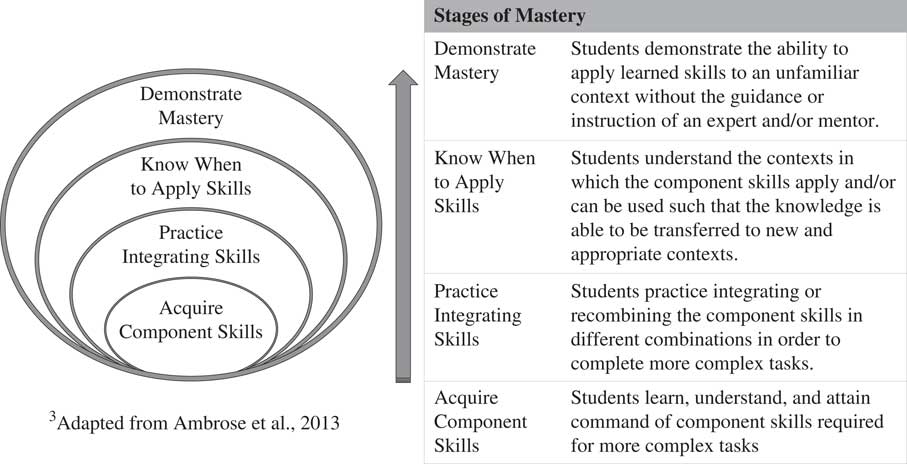
Research from the Scholarship of Teaching and Learning (SOTL) demonstrates that a mastery learning framework, depicted in Figure 1, compels learners to develop the higher order cognitive skills previously identified as critical to the education of effective PH emergency managers. As described by Ambrose and colleagues, the mastery learning framework is characterized by a 3-stage progression of knowledge acquisition and application that ultimately leads to mastery of a content area.Reference Ambrose 4 Mastery is defined as a learner’s ability to demonstrate “application of skills (or knowledge, strategies, approaches, or habits) learned in one context to a new context” without guidance from an instructor.Reference Ambrose 4 (p108) To achieve mastery, learners must develop the skills, practice integrating them, and understand when and how to apply them flexibly and appropriately.Reference Ambrose 4
Mastery Learning Framework.33 Adapted from Ambrose et al., 2013.

Cognitive and learning research shows that this final stage – the successful knowledge transfer beyond the classroom – is less likely to occur if the learning and transfer contexts are dissimilar.Reference Ambrose 4 Because replicating the uncertain, dynamic conditions of an emergency response context under the structured and stable conditions of a traditional classroom is understandably difficult,Reference Comfort and Wukich 3 generating an authentic learning environment becomes the challenge. Instructional design strategies, applied in PHEM curriculum development, can help enhance the authenticity of the learning environment and improve knowledge transfer to the field.
Active Learning Techniques and Authentic Learning Environments
Authentic learning and learning environments are models of instructional design that provide enhanced opportunities to make critical connections between knowledge and application, thus targeting the final step of knowledge transfer. The concept of authentic learning was strongly influenced by Brown, Collins, and Duguid’s theory of situated cognition, which recognizes the interdependence of learning and context, and postulates that the learning environment is not ancillary, but integral to the knowledge acquired.Reference Brown, Collins and Duguid 8 In the words of Collins, situated learning is defined as “learning knowledge and skills in contexts that reflect the way knowledge will be useful in real life.”Reference Collins 9 (p122)
Authentic learning models rely on active learning techniques such as case studies, problem-based exercises, and simulations to strengthen the connection between abstract concepts and real-life application.Reference Lombardi 10 Learning activities taking place within an authentic environment engage learners beyond mere content and push them to cultivate complex skills such as distinguishing between reliable and unreliable information, recognizing pertinent patterns in unfamiliar contexts, and problem-solving in multidisciplinary and multicultural contexts, thus exposing learners to relevant problems in environments that accurately simulate the complexities and limitations of the real world.Reference Lombardi 10 Through simulated exercises, learners are invited to participate cognitively, psychologically, and socially, shifting them from an observational role to one that requires exercising judgment, critical thinking, dynamic problem solving, and forces them to act and react in real-time to the consequences of actions taken. “Authentic learning exposes [learners] to the messiness of real-life decision making where there may not be a right or wrong answer […] but one solution may be better or worse than others depending upon the particular context.”Reference Lombardi 10 (p10)
Novel Simulation-Based Curricula
A series of classes in PHEM was initiated in 2013. These courses form the basis for a certificate program in Disaster Preparedness, launched in January 2016, which features an innovative curriculum structure centered around simulation and the creation of authentic learning experiences. The certificate is a 15-credit hour interdisciplinary program aimed at developing the knowledge and skill required to protect and promote the health of communities during natural disasters, bio-terrorist incidents, infectious disease outbreaks, and other emergent PH threats domestically and internationally. Owing to the partnership established with Pony Anderson at the DMI, students at the CSPH have access to a campus uniquely suited to PHEM training.
Fundamental to the birth of the certificate program was the belief that graduate PHEM curricula should enhance the development of practical skill sets and better bridge the gap between theory-based knowledge and real-world application for future employment as middle management and PH responders. Many factors were influential in the development of the simulation-based curriculum structure, including a desire to expose learners to training techniques used in real-life contexts found in the authentic learning environment, a desire to enhance learning by requiring the application of knowledge to actual planning processes and the production of outputs similar to those expected in real workplace scenarios, and, finally, a desire to improve the understanding and future performance of graduates through the utilization of simulation-based disaster scenarios.
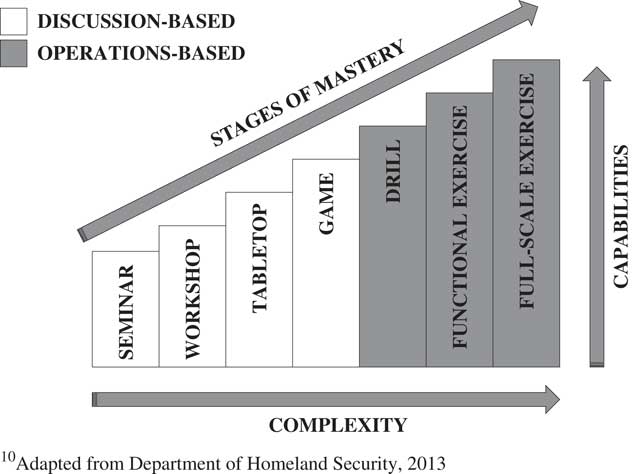
The novel simulation-based curriculum is designed, in part, to reflect the training exercise structure outlined in the Homeland Security Exercise and Evaluation Program (HSEEP), an exercise program management doctrine developed from national best practices. 11 HSEEP compliance is a requirement for agencies participating in exercises receiving federal funding. This alignment directly links graduate PHEM learning to training methodologies used by future employers (public and private) in the disaster response field. The training HSEEP exercise continuum depicted in Figure 2 and utilized by the CSPH certificate program uses a series of increasingly complex discussion and operations-based exercises, with each exercise building upon capabilities acquired in the previous exercises until mastery is achieved.
Training HSEEP Exercise Continuum.Reference Lombardi10 Adapted from Department of Homeland Security, 2013.

Learners begin by completing an introductory PHEM course designed to provide a broad overview of the structure and role of PH in domestic disaster response, exploring the legal frameworks, theory, and practice of the National Response Framework and National Health Security Strategy; the interplay and collaboration between medical and PH services; as well as the impact that all of these components have on a community’s ability to withstand and recover from a disaster event. At the start, learners engage in online learning modules detailing the basic principles of the Incident Command System (ICS) and its 4 major functional sections. As the course progresses, learners are asked to apply ICS management and organizational principles to more complex discussion-based scenarios, primarily consisting of online group discussions, workshops, and case study analyses. The case-studies furnish the opportunity for students to walk through the entire applied response skill set and become familiar with the policy frameworks. These activities, along with similar exercises targeting hazard and vulnerability assessments, psychological first-aid delivery, and crisis emergency risk communication, provide learners with opportunities to become adept in their use of core EM principles and more than 50 hours of practice integrating these principles in diverse contexts.
Following the introductory course, learners proceed with 2 advanced courses, the first exploring the unique context of disasters at the international level, and the second emphasizing the design, planning, and implementation of domestic emergency response efforts and some of the applied skills required of individuals employed in a variety of roles from PHEM first responders to PHEM middle management. Dispersed throughout both advanced courses are drills designed to highlight a wide array of emergency scenarios and aimed at practicing and reinforcing discrete applied skills, which are then used in subsequent exercises as the courses progress. Examples of drills include dressing out and decontaminating mannequins in an emergency department decontamination site and using radios to coordinate response during search and rescue. The course exercises build in scope, beginning with the basic logistics of a focused event response, such as the repair of a damaged airfield required for a supply shipment, to the more comprehensive assignment of planning and mapping a refugee camp that meets international minimum standards as enumerated in the Sphere Handbook for humanitarian response.
The principal aim of the advanced courses is to solidify the skill sets and principles learned in the preceding course to equip graduates for field success and effective integration into diverse roles within the field of PHEM. Learners are exposed to high-complexity, dynamic, functional, and full-scale planning and response exercises such as those used by real emergency response agencies, for example, conducting search and rescue and medical evacuation from within a building piled with rubble to simulate an earthquake. The use of sophisticated simulation technology and facilities available at the DMI, which include (1) a highly equipped EOC with large projector screens and mapping technology, (2) a vacant, 3-story, 400-room building with pre-set tornado and earthquake-impacted areas, and (3) open grounds, parking lots, and non-primary roadways, further enhance the authenticity of the learning experience and strengthen the tie to real-life application. These immersive, operations-based simulations not only allow the learners to demonstrate the application of skills in a real-life situation, but also re-create the chaos, overstimulation, and uncertainty true of real disaster scenarios.
DISCUSSION
Despite research from the SOTL which supports the use of active learning techniques to increase comprehension, knowledge retention, and learner engagement, skepticism about the feasibility of its integration into curriculaReference Silvia 6 has contributed to the absence of simulation and other problem-based exercises from traditional PHEM training. Concerns that the time required for preparation and planning is excessively burdensome or demanding, or that the financial and logistical hurdles of accurately re-creating a disaster or emergency context are too large for a typical PH curricula,Reference Silvia 6 diverge from the experience of using these tactics at the CSPH. In fact, simulation-based trainings have been found to be popular, cost-effective, useful tools to aid in the practice, validation, evaluation, and refinement of emergency preparedness core competencies. 11 – Reference Cohen, Sevdalis and Taylor 16
End-of-course survey data were collected from 40 learners enrolled in the CSPH certificate courses between 2015 and 2016. All but 2 participants reported a “good” or “excellent” experience engaging in the operations-based curriculum. Many written comments described the experience delivered throughout the curriculum as the most valuable learning they had received to date, and suggested that the course design be adapted for other areas of PH training. Eighty-six percent of learners agreed that the knowledge and skills acquired as part of the discussion and operations-based exercises are applicable to their future careers. One learner offered that, because of the “exemplary curriculum format” and hands-on application of concepts to real-world scenarios, they would equate the certificate program to “landing an internship after graduation.” Another student reported feeling like an “extremely valuable and employable candidate upon graduation as a result of the experience and training.” Preliminary feedback from the first class of graduates of the certificate program validated this sentiment. Although there is still much work to be done, the initial response has been largely positive, reinforcing that the program design is on the right track.
CONCLUSION
With a trend toward increasing frequency and the enlarging scope of natural and man-made disasters worldwide, it is impossible for any curriculum to adequately cover the wide range of threats to which individuals may have to respond.Reference McCabe, Barnett, Taylor and Links 17 However, embedding simulation-based exercises into PHEM curricula exposes learners early to diverse and authentic disaster scenarios where they can practice critical thinking and dynamic problem solving, increasing familiarity with anticipated disaster scenarios and confidence in exercising judgment in a real-world situation. Together, the simulation-based exercises and authentic learning environments result in mastery-level PHEM skill acquisition and the ability to apply learning to unfamiliar contexts. This form of PHEM graduate training emphasizes “role-relevant education and experience,”Reference McCabe, Barnett, Taylor and Links 17 (p165) which translates directly into workforce readiness. Graduates from the CSPH certificate program emerge as PH emergency professionals who are experienced, ready, willing, and able to respond.Reference McCabe, Barnett, Taylor and Links 17 Successfully implemented using typical school of PH support aligned with community resources, the CSPH curriculum should serve as a model for those wishing to enrich traditional training strategies.
Acknowledgment
The authors would like to thank the students, faculty, and Public Health and Emergency Management professionals who participated in the certificate program and simulation-based exercises; the Colorado School of Public Health; the Department of Environmental and Occupational Health, and specifically John Adgate for his support in realizing the certificate program and the novel curriculum structure; and the Community College of Aurora; the Disaster Management Institute, and specifically Pony Anderson for his support and partnership in enriching the curriculum through access to a campus uniquely suited to Public Health and Emergency Management training.