Introduction
Obsessive-compulsive disorder (OCD) is a prevalent, disabling, and comorbid condition that is frequently under-recognized and poorly treated, and is responsible for a major reduction of quality of life and significant functional impairment of patients and caregivers.Reference Grabe, Ruhrmann and Ettelt1, Reference Fontenelle, Mendlowicz and Versiani2 The lifetime prevalence of OCD ranges approximately between 1–2% of the general population.Reference Dell'Osso, Camuri, Benatti, Buoli and Altamura3 The 5th Edition of the Diagnostic and Statistical Manual of Mental Disorders (DSM-5)4 has allocated OCD a separate chapter, which confirms its growing importance as a distinct condition from other anxiety disorders, as well as its closer relation with other disorders (e.g., hoarding, trichotillomania) that are grouped within the same chapter. Although many patients with a diagnosis of OCD benefit from treatment with a selective serotonin reuptake inhibitor (SSRI), 10–40% of them do not respond to an adequate trial with such medications.Reference Mataix-Cols, Rauch, Manzo, Jenike and Baer5 Factors associated with poor outcome include early onset, comorbidity, and chronic course.Reference Dell'Osso, Benatti and Buoli6 In addition, a recent study showed that earlier onset of OCD is associated with a peculiar symptom profile that is characterized by specific obsessions content (ie, aggressive content, pathological doubts, hoarding) and compulsions (ie, repeating rituals and cognitive compulsions).Reference Narayanaswamy, Viswanath, Veshnal Cherian, Bada Math, Kandavel and Janardhan Reddy7 Furthermore, patients with early onset OCD were generally found to respond more poorly to treatment,Reference Erzegovesi, Cavallini, Cavedini, Diaferia, Locatelli and Bellodi8 as well as to monotherapy with anti-obsessional agents.Reference Rosario-Campos, Leckman and Mercadante9 In addition, a long duration of illness (DI) was found to be associated with lessened response to SSRIsReference Storch, Larson and Shapira10 and overall poorer outcome.Reference Catapano, Perris and Masella11
Beyond early onset and long DI, duration of untreated illness (DUI)—defined as the latency between disease onset and first adequate pharmacological treatment—represents a modifiable parameter whose reduction may positively influence the outcome and long-term course of OCD.Reference Dell'Osso, Buoli, Hollander and Altamura12, Reference Altamura, Dell'Osso, D'Urso, Russo, Fumagalli and Mundo13 In particular, studies investigating DUI in OCD, given the well-established reluctance, for different reasons, of OCD patients to seek help,Reference Goodwin, Koenen, Hellman, Guardino and Struening14, Reference Fullana, Mataix-Cols and Caspi15 have revealed a latency to first pharmacotherapy ranging from 6–8 years,Reference Dell'Osso, Camuri, Benatti, Buoli and Altamura3, Reference Altamura, Buoli, Albano and Dell'Osso16 along with a worse response to treatment in subjects with a longer DUI.Reference Dell’Osso and Altamura17 Such latency to treatment might be explained with the insidious onset and secretiveness and embarrassment associated with OCD, as well as with the specific obsessive contents that characterize some subgroups of patients.Reference Dell'Osso, Benatti and Buoli6
OCD symptoms, in fact, are remarkably diverse, regarding both clinical presentation and severity, with patients reporting only one or, more often, many symptoms belonging to different phenotypes.Reference Rasmussen and Eisen18 Studies are, however, conflicting about whether any particular phenotype of OCD is easier to treat or more likely to benefit from a particular treatment.Reference Mataix-Cols, Rauch, Manzo, Jenike and Baer5 For instance, symptom presentation has received growing empirical attention, as studies have revealed that specific phenotypes exhibit different treatment response rates.Reference Alonso, Menchon and Pifarre19 Checking and washing compulsions are the most common forms of ritualistic behavior in clinical samples of OCD from several different countries.Reference Fontenelle, Mendlowicz, Soares and Versiani20 Regarding socio-demographic characteristics, Khanna and MukherjeeReference Khanna and Mukherjee21 reported that patients with aggression/checking symptoms were more often young, single, and male, as well as more likely to have an early and insidious onset. On the other hand, patients with contamination/washing symptoms were more likely to be female and housewives, and more likely to experience OCD onset after marriage.Reference Khanna and Mukherjee21
In order to assess and quantify DUI, DI, and severity of illness across different OCD phenotypes and further characterize them in terms of clinical course and prognosis, we conducted the present naturalistic study.
Methods
We recruited 114 consecutive outpatients who were attending the University Department of Psychiatry at the Fondazione IRCCS Ca’ Granda, Ospedale Maggiore Policlinico, with a diagnosis of OCD, according to Diagnostic and Statistical Manual of Mental Disorders, 4th Edition, Text Revision (DSM-IV-TR)22 criteria. The sample included subjects with other psychiatric comorbidities. In case of psychiatric comorbidity, however, OCD had to be the primary disorder, causing the most significant distress and dysfunction and providing the primary motivation for seeking help. At the time of the interview, all patients were on a stable pharmacological treatment, prescribed by a psychiatrist, for at least 4 weeks.
After gathering patients’ written informed consent to have their clinical charts reviewed for research purposes, diagnoses were obtained through the structured clinical interview based on DSM-IV criteria (SCID I),Reference First, Spitzer, Gibbon and Williams23 during which patients’ main socio-demographic and clinical characteristics were collected. These included age of onset, illness duration, DUI, main clinical phenotype, and presence of psychiatric comorbidities. Moreover, OCD severity was assessed using the Yale–Brown Obsessive Compulsive Scale (Y-BOCS), and the main clinical phenotypes present at the moment of the interview were identified through the Y-BOCS Symptom Checklist, a list of common obsessions and compulsions that patients could have experienced during their lifetimes.Reference Goodman, Price and Rasmussen24, Reference Goodman, Price and Rasmussen25 When available, caregivers, as well as relatives or close friends, were involved in the collection of the clinical history; we used these other sources particularly to gain information regarding the onset phase, since some patients might report recall difficulties.
Descriptive analyses of the sample, one-way analysis of variance (ANOVA) test, Bonferroni post-hoc test, and correlation analysis using Pearson product moment coefficient were performed to assess the demographic characteristics of the sample and compare DUI, DI, and Y-BOCS scores across clinical phenotypes. The level of significance was set at 0.05. All the statistical analyses were performed using the Statistical Package for the Social Sciences for Windows software (version 17.0; SPSS Inc., Chicago, IL, USA).
Results
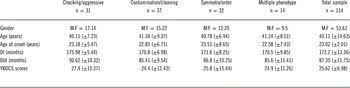
The main demographic and clinical variables of the whole sample (n=114) are summarized in Table 1. The sample showed an equal gender distribution and a mean age of 40.11±14.63 years. The mean DUI (87.35±11.75 months) resulted in approximately half of the mean duration of illness (172.2±13.36 months).
Main socio-demographic and clinical variables of the sample.

DUI, duration of untreated illness; DI, duration of illness; YBOCS, Yale-Brown Obsessive-Compulsive Scale. Means ± standard deviations (shown in brackets) are given for continuous variables.
After assessing patients’ main clinical phenotypes, 4 subgroups were identified: aggressive/checking (n=31), contamination/cleaning (n=37), symmetry/ordering (n=32), and multiple phenotypes (n=14). Two patients presented with pure obsessions (0.02%); all other patients presented with both obsessions and compulsions.
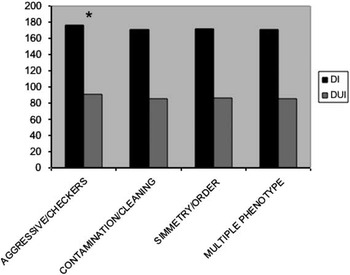
DUI and DI were found to be significantly longer in the aggressive/checking subgroup when compared to the other subgroups (one-way ANOVA: F=3.58, p<0.01; F=3.07, p<0.01) (Figure 1). No other significant differences among subgroups in terms of DUI and DI were found.
DUI and DI in OCD subgroups. One way ANOVA: F=3.58, p<0.01; F=3.07, p<0.01.

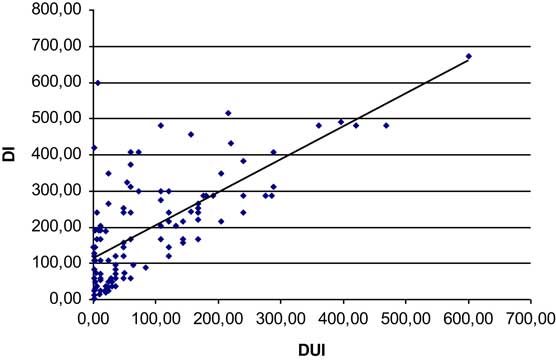
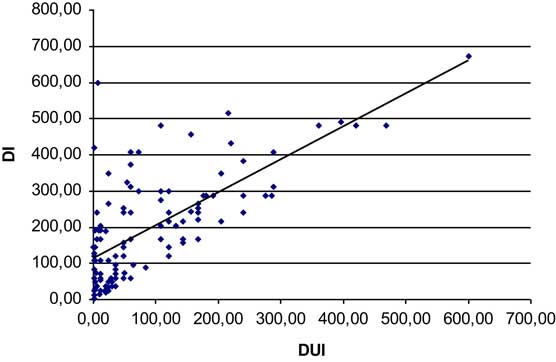
A strong, positive correlation between DUI and DI (r=.71, n=114, p=0.00) (Figure 3) was found in the whole sample, with a longer DUI associated with a long DI. The coefficient of determination R2 resulted in 50% of shared variance.
Pearson correlation analysis between DUI and DI in the aggressive/checking subgroup. A strong, positive correlation between DUI and DI was found in the whole sample, with a longer DUI associated with a long DI. The coefficient of determination R2 resulted in 50% of shared variance (r = .71, n = 114, p = 0.00). DUI, duration of untreated illness; DI, duration of illness.
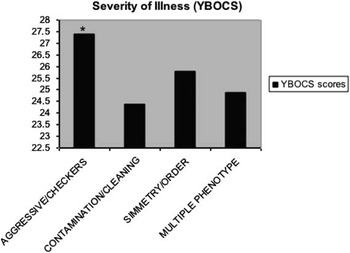
Y-BOCS scores of the aggressive/checking subgroup were found to be significantly higher than contamination/cleaning, symmetry/ordering, and multiple phenotype subgroups (one-way ANOVA: F=4.39, p<0.01) (Figure 2).
Y-BOCS scores in the 4 OCD subgroups. One Way ANOVA: F=4.39, p<0.01.

Discussion
Among the main findings of the present study, we found that a simple measure of predominant symptoms allowed clinicians to categorize 88% of the subjects into 3 major clinical phenotypes: aggressive/checking, contamination/cleaning, and symmetry/ordering. Our study also revealed that about 12% of participants, comprising the "multiple phenotype" category, could not be easily categorized, which underlines the frequent presence of symptoms belonging to different phenotypes in OCD.Reference Denys, de Geus, van Megen and Westenberg26
Regarding the total sample, it should be noted that the mean DUI (approximately 7 years) accounted for half the mean DI (approximately 14 years). This finding seems to be consistent with a previous study that observed that the mean latency to treatment in OCD patients was significantly longer compared to other anxiety disorders.Reference Dell'Osso, Camuri, Benatti, Buoli and Altamura3 In particular, in the study sample, patients had spent half of their disease without an adequate therapy.
When the whole sample was subdivided into 4 main clinical phenotypes, DUI and DI were significantly higher in the aggressive/checking subgroup compared to the other subgroups, respectively, contamination/cleaning, symmetry/ordering, and multiple phenotypes group. In addition, Y-BOCS scores were significantly higher in the aggressive/checking subgroup, compared to the others, suggesting that longer DUI and DI may determine a greater severity of illness. Furthermore, the results showed a strong, positive correlation between DUI and DI in the whole sample, and DUI could explain nearly 50% of the variance of the DI within the sample.
Reported results may be interpreted on the basis of previous findings that showed a lower insight for OCD patients with aggressive/checking symptoms. This characteristic may ultimately lead to a longer latency to pharmacological treatment.Reference Hasler, LaSalle-Ricci and Ronquillo27 Literature studies, moreover, showed that the aggressive/checking phenotype, compared to other clinical phenotypes, was more frequently associated with psychiatric comorbidities, such as major depressive disorder, which, due to its specific symptomatology, particularly guilt feelings, anhedonia, and apathy, may further increase patients’ reluctance to seek help.Reference Hasler, LaSalle-Ricci and Ronquillo27–Reference Prabhu, Cherian, Viswanath, Kandavel, Bada Math and Janardhan Reddy29
It should be noticed that, in the present study, the mean age of OCD onset and the mean age were similar across the 4 subgroups. Therefore, the highest age at first pharmacological treatment seems to be the main variable responsible for the higher DUI and DI in the aggressive/checkers, compared to the other phenotypes.
Moreover, the Y-BOCS scores of aggressive/checkers, reflecting patients' cross-sectional severity of illness, were higher compared to the other subgroups. This result, on one hand, may effectively indicate a greater severity for this phenotype. On the other hand, it may be related to longer DUI and DI per se. In fact, other studies found that the symmetry and hoarding groups were significantly associated with a greater severity of illness. In addition, the hoarding group was significantly more likely to show longer duration of illness and poorer outcome.Reference Matsunaga, Hayashida, Kiriike, Maebayashi and Stein30 In the present study, however, no pure hoarding patients were part of the sample (patients with hoarding behaviors were included in the group characterized by the presence of multiple phenotypes). In addition, with the publication of DSM-5, hoarding disorder is now considered a distinct disorder, independent from OCD, though it maintains a close link with obsessive-compulsive–related disorders.4
With respect to the literature heterogeneity regarding OCD phenotypes severity, we should note that such a parameter could also be influenced by patients' cultural and geographic backgrounds, since different cultural attitudes and prejudices, related to OCD-specific symptoms, could worsen patients’ distress and anxiety.Reference Williams, Elstein, Buckner, Abelson and Himle31
The following methodological limitations should be taken into consideration when interpreting the results of the current study. One is the possible occurrence of recall bias. In fact, particularly when analyzed retrospectively, the assessment of the DUI may not be accurate and implies the need to trust the reliability of patients as well as available relatives. From this perspective, studies on first episode patients who are identified at first hospitalization/psychiatric service are designed the best to reliably assess DUI. Another limitation is the use of a cross-sectional outcome measure, as a longitudinal one would have likely better detected eventual changes in the severity of illness over time. An additional limitation is the relatively limited size of sample subgroups, when divided on the basis of the phenotype. Further studies with larger samples are needed in order to characterize possible culture-related predominant phenotypes.
Taken as a whole, the present results on DUI and DI stress the urgent need to establish early diagnosis and treatment programs with better characterization of OCD phenotype, since we have found a relationship between the 2 variables, and given that a longer DI is ultimately associated with a poor outcome in the long-term.
Disclosures
The authors do not have anything to disclose.