The incarnation of Provence
On 6 January 1942 a special commission in the prefecture of Bouches-du-Rhône voted to demolish the bronze statue of Frédéric Mistral in the town of Arles, in Provence. Mistral – epic poet, Nobel laureate, and founder in 1854 of the Félibrige (a literary society dedicated to promoting the distinctive language and cultural traditions of Provence) – had long been a cherished symbol of Provençal revival. The destruction of his statue was part of the collaborationist Vichy government's controversial ‘bronze mobilisation campaign’ – a metal recovery programme initiated by the Vichy regime but in fulfilment of the terms of the Franco-German armistice – in which French bronze statues were dismantled and melted down and their component elements shipped to Germany to satisfy the Third Reich's demands for non-ferrous metal.
The destruction of Mistral's statue in Arles generated considerable controversy. For the inhabitants of the town, the destruction of their homage to the Provençal poet was an assault on local prestige and regional identity. For many it was also an indication of the growing disjunction between discourse and policy in the new state: here was a regime whose ideology was deeply indebted to regionalism dismantling a monument commemorating one of the most prominent figures of regional revival. Public opposition to the statue's destruction and the nature of the protest that it unleashed illustrates the uneasy and ambiguous relationship between the population in the unoccupied zone and Pétain's Vichy regime. Furthermore, the statue controversy unfolded at a pivotal time. Early 1942 saw decisive shifts in popular opinion throughout the southern zone and, by the end of the year, ‘the evidence provided by the intelligence network of the Renseignements Généraux gave a clear indication that the “population bourgeoise” and the paysans who had figured so consistently as sympathisers of the government were no longer reliable’.Footnote 2 The ‘emotional balance’ which had tipped heavily in favour of Pétain in 1940 was steadily undermined by Vichy's own policy.Footnote 3
Studies of the Vichy and occupation period in Provence and in the department of Bouches-du-Rhône have focused, for the most part, on urban resistance in Marseille and the Allied landings near Toulon in August 1944.Footnote 4 An exception to this are Jean-Marie Guillon's studies of Provence in the 1940s,Footnote 5 which concur with the work of W. D. Halls, H. R. Kedward and John Sweets in suggesting that the population of Provence – like that of the southern zone more generally – initially supported Pétain and his National Revolution, but grew increasingly disenchanted with the regime, especially following the German occupation of the southern zone in November 1942.Footnote 6 The dynamic that emerges from the incident of the destruction of Mistral's statue in Arles extends this view, and suggests that popular disenchantment with Pétain's regime came as a result of Vichy's failure to fulfil its own promises. In failing to implement its own doctrine – in particular the regionalist elements of the National Revolution – Vichy progressively alienated the Provençal population.Footnote 7 As a result, popular opposition and resistance to the regime appear in the broader context of regional identity.
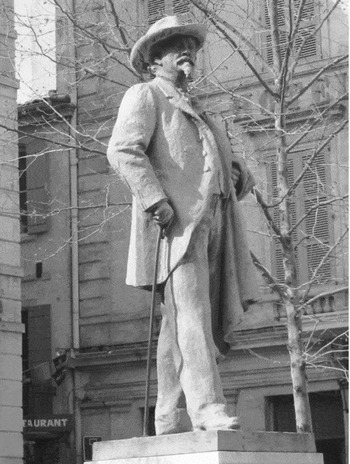
The misreading of the symbolic importance of Mistral's statue for Arles started in Marseille, where the prefectoral commission charged with implementing the bronze mobilisation campaign in the department of Bouches-du-Rhône justified its decision to dismantle the monument because the poet himself had been very critical of it. The statue, by the Toulouse sculptor Théodore Rivière, had been unveiled on Sunday 30 May 1909 before a select audience – its inauguration being the culmination of a weekend of festivities marking the fiftieth anniversary of the publication of Mistral's epic poem Mireille, and celebrating the poet's induction into the Légion d'Honneur.Footnote 8 The homage was, however, disappointing. The statue's casual pose, and the artist's decision to depict the poet in a suit, bow-tie and hat, with his cane in one hand and his coat in the other, led Mistral to comment, on seeing the statue for the first time, that if only his effigy were carrying a suitcase it would look as if he had just leapt off a train. The local art establishment concurred that, regrettably, their homage to Mistral was hopelessly mediocre.
For the prefectoral commission in Marseille in 1941, then, Vichy's bronze mobilisation campaign presented a serendipitous opportunity – the ministry of industrial production would arrange and pay for the statue's removal, the city of Arles would be compensated at 30 francs a kilogramme for the bronze that the statue contained, and the ministry of national education would provide a replacement monument in stone. By giving this statue up for mobilisation, the city would profit financially and aesthetically – and Mistral's memory would be honoured, they hoped, with a much more suitable work. There had been some concern that, symbolically, the removal of the statue – even temporarily – might be problematic, but municipal leaders in Arles and their superiors in Marseille were so certain that this was a beneficial arrangement that they proceeded energetically with the statue's removal and with plans for a replacement.
The sub-prefect of Arles neatly summarised the proceedings in a memo to his superior in Marseilles:
Because of the memories invoked by this statue, and despite the fact that – even in Mistral's view – it was very mediocre, I was personally of the opinion that it should be preserved. But the opinion of the architect for historic monuments for the department was the opposite. He testified that the statue in question was not worthy of Mistral, that . . . no other portrait of quality exists anywhere else, and the State has pledged to replace those removed statues by . . . [ones] of a higher artistic quality. This appeared [to me] to be the perfect opportunity to grant to a great artist the task of commemorating Mistral with a monument more worthy of his genius.Footnote 9
The two artists whom the sub-prefect had in mind for this replacement commission were Aristide Maillol – who, the sub-prefect felt, was ‘by far the most able to create a monument that would express the spirit and work of the poet as well as his likeness’ – or, if Maillol was unavailable, Charles Despiau, since, as the sub-prefect put it, ‘a figure of Mistral's stature should not be insulted a second time’.Footnote 10
The removal of the statue proved, however, to be a good deal more controversial than Arles's municipal administrators had anticipated. Despite a notice from the sub-prefect in the local press explaining that Mistral's memory could only benefit from these measures, the public outcry was considerable. The people of Arles, indifferent to academic debates over the aesthetic quality of the statue itself, and even to Mistral's own feelings about it, had their own impression of the artistic merit of the statue and its significance.
This bronze. . .recreates perfectly the stature and, most of all, the pleasant countenance of the poet, of the man universally known as the King of the Midi, the Homer of Provence, or more simply and piously, le maître. Furthermore, when you examine the statue up close, you immediately recognise the robust poet immortalised in bronze. It could even be said that this statue is a statue of Provence, since no one is the incarnation of our Midi more than Mistral. More than Mireille, more than Calendal, Mistral himself is Provence.Footnote 11
The importance given to Mistral's statue in the establishment and definition of Provençal identity can be traced to its inauguration in 1909, a momentous event that long held a central place in local memory. The town's newspapers had been abuzz with details of the plans and preparations for the celebration in the months leading up to the festivities. The weekend-long celebration began on Friday 28 May with a torch-lit procession through the streets of Arles. The next day, at ten in the morning, was the inauguration of the new premises of the Museon Arlaten, the museum of Provençal culture founded by Mistral. The afternoon's festivities included a farandole competition, a horse race on the boulevard des Lices, the illumination with fanfare of the place Lamartine and, finally, a concert and a public ball. Sunday's celebrations began with the inauguration of the statue:
M. Jules Charles-Roux presented the monument to the city. He reflected on the life and work of Mistral and, in concluding, exclaimed ‘May the good Lord protect you for the glory of our Provence, for the glory of the Republic, and for the glory of the nation, our beloved France! Long Live Frédéric Mistral!’Footnote 12
The mayor of Arles, M. Granaud, spoke next, accepting the gift of the statue on behalf of the town and remarking that its location – the place du Forum, a popular meeting place – could not have been better chosen. A procession of young ‘Mireilles’ – girls who had been named for Mistral's heroine – then presented flowers to the poet; this was followed by speeches from the director of the Académie Française, the president of the Société des Gens de Lettres, the president of the Conseil Général des Bouches-du-Rhône, and Prince Cantacuzène, delegate of the queen of Romania. As the statue was unveiled, the crowd erupted in cheers of ‘Vive Mistral!’ at which the poet rose and recited the first verses of Mireille. The inauguration ceremony was followed by a concert and performance of Mireille in the Arènes, and the whole extravaganza culminated in a fancy-dress ball, the theme of which was – what else? – Mireille.Footnote 13
In reflecting on the celebrations, one Arles weekly paper, Le Forum Républicain, concluded,
Arles will long remember, will always remember, this solemn celebration in honour of a genius so deeply tied to our city that to glorify the former, as was proclaimed [at the inauguration], is to glorify the latter!Footnote 14
Although there had been some opposition of a political nature to the commission of a statue of Mistral, the population of Arles was ultimately united by their homage to a man who was the ‘incarnation of Provence’. A letter from a Doctor Monteux, published in the Arles weekly L'Homme de Bronze on the day of the inauguration, 30 May 1909, called on the Provençal population to join together in celebration:
You would imagine that for such an event people would join together in a spirit of unanimity and common purpose. But that has unfortunately not been the case. Some notes of discord have recently disturbed the prevailing mood of goodwill. Politics has entered the fray! Because Frédéric Mistral is neither a socialist, nor a radical or a freethinker, he has been renounced by the municipal council of Châteaurenard. A Marseille daily has published strident pamphlets against the founder of the Félibrige and his disciples. I admit to being confounded by this indignation. A man's talent should be appreciated regardless of his political or religious opinions. An individual's public life takes nothing away from the moral or intellectual value of his work. Mistral and his school. . .gave the Provençal language its own marvellous masterpieces; they exerted a considerable influence on Romance literature, renewing its ancient traditions. The Félibrige has engendered a regionalism, a federalism that stands in opposition to the extreme centralisation that is the legacy of the imperial regime. Natives of Arles and Provence. . .come salute Mistral and pay homage to the Félibrige and to its admirable work!Footnote 15
Arles's other weekly, Le Forum Républicain – whose contributors were perpetually in bitter conflict with their colleagues at L'Homme de Bronze – made a similar call:
What is Mistral, if not the personification of Provençal traditions and identity? Where better than in Arles to conserve these traditions, this originality, in language, in costume, in customs, in games?. . .Let us all celebrate, ô Arlésiens; let us all take part in the glorification of the Maître whom we shall commemorate on Sunday, in one of our public squares; let us participate not only to pay to this beloved genius the solemn homage and expression of gratitude that are his due, but also because this is the celebration, the glorification, of our beloved home town!Footnote 16
The contributors and readership of Le Forum Républicain and L'Homme de Bronze generally agreed on very little, but regarding the commemoration of Mistral they found a common cause. In spite of political differences and a tradition of persistent and often acrimonious conflict, both papers saw in Mistral the incarnation of regional pride and prestige.
From its inauguration in 1909 to its destruction in March 1942, the monument to Mistral in the place du Forum functioned as a celebration not only of the poet's life and work, but of Provençal language and culture, and of the city of Arles itself. It became a site of pilgrimage for the Félibrige, but also for other local cultural organisations as well, and was unfailingly decorated with wreaths and flowers during regional festivals and civic holidays. It is not surprising, therefore, that in the wake of the statue's removal the sub-prefect in Arles sent a woeful memo to Marseille describing the ‘considerable emotion that grips the Provençal population following the removal of the statue . . . to which the inhabitants of Arles were so profoundly attached’.Footnote 17 For the people of Arles, the destruction of Mistral's statue was the height of sacrilege. Its removal was almost universally regarded by the population as an assault on regional and local identity, as a denigration of Provençal culture, and an insult to the very essence of the city itself, let alone the memory of its illustrious champion. Incensed members of the Félibrige sent letters of protest to Vichy and even succeeded in obtaining an order from the ministry of industrial production to prevent the removal of the statue, although this order arrived three weeks too late.
Regionalism and resistance
The furore over the removal of Mistral's statue deepened even further when, in spring 1942, Pétain named the poet as the symbolic father of the regime's regionalist doctrine. One of the primary goals of Vichy's National Revolution was a revival of French provincial life. The doctrine embraced an essentialist discourse of ‘true France’ that was anchored in an aspiration to return the nation to its traditional roots through a cultivation of the elements of provincial life that had been steadily undermined by modern society.Footnote 18 Pétain proclaimed that the National Revolution would ‘re-root Frenchmen in the French soil, from which they have always drawn not only [their] subsistence . . . but also the stout virtues that gave the country its strength’.Footnote 19 Fundamental to Vichy's return to the soil was a return to the regional culture and traditions of the petite patrie. As a cornerstone of the ideology of the National Revolution, regionalism also became a significant feature in French cultural life after 1940.Footnote 20 The Vichy government took steps towards achieving its goal of regional revival with the creation, in September 1940, of regional and departmental commissions of regionalist propaganda. The mandate of these commissions was ‘to create unity among us, to create a regionalist spirit, to inspire self-confidence and self-knowledge in our provinces’.Footnote 21 This was to be achieved through ‘propagande en profondeur’, including the encouragement of vernacular architecture, improvements to local museums, the encouragement of regionalist programming, and the revision of curricula in schools to incorporate regional dialects. In September 1940 a congress of ‘Occitanistes’ at Arles urged that voluntary school lessons in Occitan be made available, and called for the establishment of courses in the language at universities throughout the region.Footnote 22 The first cohort of students to complete their degree in the Occitan language graduated from the Collège d'Occitanie in June 1943. These regionalist initiatives were not only warmly embraced by provincial historical groups, learned societies, and local folklore associations like Mistral's own Félibrige, but were also generally welcomed by the local bourgeoisie as well as youth groups.Footnote 23
The apparent contradiction of attempting national regeneration through the promotion of regionalism was clarified by Pétain himself. ‘Attachment to the petite patrie’, he stressed, ‘takes nothing away from the love of the nation, but rather helps strengthen it by offering invincible resistance to everything that serves to undermine, erode or uproot us.’Footnote 24 It is in this relationship between the petite patrie and the nation that the importance of Mistral to the National Revolution becomes clear. Some regionalist movements, particularly those in Brittany and Flanders, carried the threat of separatism. But the Occitanism championed by Mistral and the Félibrige had no such centrifugal tendencies.Footnote 25 In a 1942 article entitled Mistral et la Patrie, Gabriel Balme explains the importance of Mistral and the Félibrige to the national regeneration under way:
It is good and proper for us, Jeunes Provençaux, to seek in the marvellous work of the gifted poet from Maillane, a solution to the sensitive and difficult questions that confront us. In the difficult period we are facing, Mistral is for us a prophet, and the light that emanates from his work illuminates the shadowy questions that assail us from all sides . . . Now that we can immerse ourselves freely in the pure, fresh and invigorating waters of the Félibrige, we can study very succinctly in Mistral . . . one of the fundamental principles of the Félibrige: the notion of patrie. Patrie, for [Mistral], is first of all the soil of his birth, his native land, his Provence . . . Mistral is the incarnation of Provence. All of his work, from Les Moissonneurs and Mireille to the creation of the Museon Arlaten, has the same goal: to glorify Provence. All of his characters are symbols of Provence, of its soil, of its life, of its history, of its river. Everything is a pretext to evoke its prestigious past . . . Mistral reminds the younger generation of the ties that bind them to the glorious history of Provence. He portrays all the humble moments of the daily life of the regional patrie, thereby evoking its collective soul that can never die. This patriotism extends harmoniously from the province to the nation, since Mistral conceives of his regional homeland entirely within the federation of the greater nation, France. Provençal patriotism is the indisputable base of French patriotism. The illustrious poet proclaims loudly: ‘Nous sommes de la grande France, franchement, loyalement.’Footnote 26
With Pétain citing Mistral as the inspiration and guide for the provincial renaissance to be undertaken by Vichy's National Revolution, national attention was drawn to the incident of the removal of his statue in Arles. The destruction of the monument was roundly condemned throughout France. Now in the spotlight, indignant Arlésiens stepped up their protest – the empty pedestal became a site of demonstrations, forcing the sub-prefect to press for its rapid removal and to seek advice, once again, from Marseille:
I would appreciate it if you could let me know whether I should permit the numerous delegations of local societies and félibres to gather at every opportunity before the empty pedestal and to leave flowers or make speeches that are thinly veiled protests. It is clear that these demonstrations, held to challenge and criticise a government decision, will only undermine [the regime's] authority.Footnote 27
Further undermining the regime's authority were rumours about the ultimate destination of the statue metal. The day that the statue of Mistral was removed from Arles, a sign appeared on the city's monument aux morts that read, ‘Will they dare touch this one?’ The sub-prefect explained, ‘the agitation of the population stems from the fact that they are convinced that these statues are being delivered to the Germans for their war production’.Footnote 28 Much resistance scholarship stresses the complicity and collaboration of Vichy with the German occupier as the overwhelming impetus for the development of resistance in the southern zone throughout 1941 and 1942.Footnote 29 Given this, it is illuminating to situate the events of protest and opposition that arose in response to the melting of bronze statuary in the broader context of resistance activity. In Arles, the bulk of protest and acts of opposition that surrounded the destruction of statuary were overwhelmingly motivated by a concern over local prestige and the preservation of regional culture and patrimony, rather than representing attempts to undermine the Nazi war effort.
Regionalism has a long and multifaceted history in France, and regionalist doctrines have found advocates on many points of the political spectrum, but the ‘plurality of the French countryside’ during the Vichy period has only recently received sustained scholarly attention.Footnote 30 Since regionalism was at the core of Pétain's National Revolution, it has been assumed that regionalist sentiments throughout France were all of the Vichy variety – reactionary, anachronistic, sentimental and anti-modern. In reality, regionalist movements in rural France in this period were politically very diverse and were as capable of inspiring resistance to as compliance with the Vichy regime. One of the central dilemmas that faces historians interested in popular opinion in wartime France is how to account for the fact that ‘an autocratic, right wing government should be established in the area of France which generally had voted for parties of the centre and left during the Third Republic’.Footnote 31 What comes to light with this incident in Arles is the role of regionalism in this process. The promise of regional revival inherent in the National Revolution appealed broadly to people of otherwise divergent political beliefs.Footnote 32 But when this promise was revealed as illusory, and the frustrated population began to withdraw from the regime, the same spirit of regionalism that previously inspired support subsequently inspired resistance.Footnote 33
In the French provinces regionalist sentiment was at the core of much of the protest surrounding the destruction of French bronze statues, protest initiated by a number of different groups, often otherwise representing divergent political agendas. In the case of Mistral's statue, the fact that a monument to a figure of regionalism and provincial revival was removed and destroyed by a regime whose ideology was deeply indebted to regionalist thinking, inspired acts that could certainly be considered resistance – the laying of wreaths and flowers on the naked plinth, as well as speeches and demonstrations that vehemently condemned the regime's administration and its bronze campaign. This protest, however, was motivated by an inherent support of a fundamental element of the ideology of the National Revolution, regionalism. As the pleas from the two competing weekly papers L'Homme de Bronze and Le Forum Républicain cited above demonstrate, this regionalism was embraced by people of very different political beliefs.
Statue of Frédéric Mistral, Arles (photograph by the author).

In the cases of many other bronze statues and monuments throughout France, a prevalent form of resistance to the bronze mobilisation campaign was to remove and hide the statues themselves – placing them in the ‘protective custody’ of certain elements in the community. The groups that engaged in this oppositional practice ranged from members of Vichy's own administration to clandestine Resistance networks, but all anchored their protest in a discourse of regionalism.Footnote 34
These ‘stolen’ monuments would typically disappear the night before they were scheduled to be dismantled by representatives of the ministry of industrial production. In Martigues, in Bouches-du-Rhône, a local man Maurice Richaud had, with the energetic support of the town's mayor, vigorously protested against the removal of a bust of his great-uncle Etienne Richaud, a former governor-general of Indochina. When the ministry of industrial production's contractors arrived to remove the bust of Richaud, its pedestal was bare. After six months of protest through administrative channels proved futile, the Richaud family took matters into their own hands to protect the memory of their prominent relative – an initiative taken out of family pride, no doubt, but also, as the mayor of Martigues asserted, in order to protect the prestige that this fonctionnaire had brought to the town of his birth.Footnote 35
The escalating measures taken by the mayor of Saint-Servan in Brittany to protect a small bust of Admiral Buvet in the town's marketplace offer another colourful example. The mayor first threatened to resign if the statue were touched. When that threat proved ineffective, he declared that there would be strikes, demonstrations and public disorder if any harm came to the monument. When his superiors still did not yield, the mayor built a protective scaffolding around the bust, and finally resorted to dismantling it himself, in the dark of night, and hiding it in the town hall until after the Liberation. The bust was proudly replaced on its pedestal on 10 November 1944. Why would a mayor go to such potentially dangerous lengths to protect a small metal bust of an obscure mariner? Because, in his words, the monument gave the town ‘a little panache’.Footnote 36
In the Auvergne there was a spate of disappearances of bronze statues and busts, at least two of them ‘rescued’ by a socialist resistance network led by Marcel Gaillard. On both empty pedestals, notes were left. One read, ‘I don't want to go to Germany, I've joined the maquis!’; the other, ‘I will return when the boches are gone!’ Here we do have explicit references to the occupier, but the police report on the disappearance of the second work – a small bust of a local agronomist commemorated for his role in the development of the Salers breed of cattle – stressed that ‘[the] event has caused no unrest among the population who see this act as serving to protect nôtre patrimoine from the metal recovery programme’.Footnote 37
The characterisation of this bust as ‘nôtre patrimoine’ is noteworthy, since the notion of patrimony is intimately tied to the spirit of regionalism that motivated these protests. These statues were seen as expressions and even embodiments of local culture, history and identity, and this perception fuelled fierce opposition to the campaign that was anchored in discourses of regionalism. We have become accustomed to thinking of patrimoine in a national context, perhaps as a result of Pierre Nora's work, and we tend to view patrimony according to how it forms and feeds national identities, ‘Frenchness’.Footnote 38 But the notion of patrimoine is closely linked to the creation and definition of regional and local identities. Furthermore, patrimoine, and especially commemorative statuary, serve to tie the petite patrie to the grande patrie, to bind local memories and identities to the larger national narrative.Footnote 39 Mistral's fame and achievements, therefore, made Arles a place of national importance and his statue there embodied both of these things – it functioned as commemoration and perpetuation of the man and his achievements, but also as a symbol of the national importance of the town he loved. The destruction of his monument, then, not only negated his achievements, it negated the town's sense of prestige.
Monuments, memory and municipal identity
In the light of this link between resistance, regionalism and patrimony, the epilogues to the story of Mistral's statue in Arles are revealing, and emphasise the distorting effect of French wartime experiences in the tumultuous climate of the immediate postwar period. I write ‘epilogues’ because there are two stories – one myth, one fact. Several people I spoke to in Arles were surprised to hear that, after the war, the destroyed statue of Mistral was replaced by an identical replica. The story they told was of a statue rescued by cheminots, en route to Germany. These Résistants, overcome by the realisation that this homage to Mistral would fuel Hitler's war machine, risked their lives to secure and then hide the monument, returning it in triumph to its rightful place after the Liberation. In reality, the statue was melted in France, probably in late 1942.Footnote 40 It was subsequently recast in bronze in 1948 by the Fonderies Meridionales in Marseilles from the original plaster cast preserved in the Musée d'Arles.
According to the newspaper Le Meridional, it was a committee of ardent traditionalists – probably many of the same people who had protested against the monument's removal six years before – who spearheaded the campaign to return the statue of Mistral to its base. This committee had the support of the mayor and the municipal council, who engaged in a prolonged, and ultimately futile, correspondence with the General Secretariat for Fine Arts and the ministry of national education over funding for the project. The ministry of national education was prepared to finance a new statue, but refused to fund any reproduction or recasting of monuments destroyed by Vichy.Footnote 41 The municipal council and the organising committee, however, were adamant that a reproduction of the original statue be returned to the place du Forum.Footnote 42 According to Le Meridional, the small square to which the statue was returned was ‘ordinary perhaps, but so rich in memories’.Footnote 43
The municipality eventually granted 120,000 francs of its own funds to the Committee for the Reconstruction of the Statue of Frédéric Mistral, for the recasting, reinstallation, and reinauguration of the monument.Footnote 44 The reinauguration of the statue was planned to coincide with the celebration of the Fête d'Arles on 3 July 1948. For the Saturday afternoon ceremony, a cortège of Arlésiennes escorted the official delegation to the place du Forum, and – as at the inauguration of the first statue in 1909 – a procession of young girls placed flowers on the pedestal.Footnote 45 The speeches, which met with enthusiastic applause, emphasised, like those delivered at the first inauguration ceremony, the glory of Mistral, the glory of Provence and the glory of Arles. The occasion, as it had been forty years before, was seized by a number of regionalist and folkloric groups as an opportunity to publicise and celebrate Provençal traditions.
It is interesting that the same statue and, in many ways, the same type of celebration was recreated in 1948. That the municipality chose, at its own expense and forgoing state funding, to reconstruct the former statue rather than commission a new monument was not simply a pragmatic decision (it is cheaper and easier to make a bronze from an existing cast) but a philosophical, even existential one. The well-intentioned plans of Arles's municipal authorities during the war, as well as Mistral's own protests over what he felt was an inappropriate likeness, had been overshadowed by the force of events and clouded by the ‘syndrome’ that subsequently afflicted French memory of the war years.Footnote 46 The destruction of Mistral's statue was, in the postwar period, remembered as an act of German barbarism. Le Meridional on 3 July and again on 5 July 1948 claimed that ‘the people of Arles, and from all over Provence, who value their traditions were deeply distressed when the statue of the poet and Provençal patriot was removed by the occupier . . . on 26 March 1942’.Footnote 47 As a result, the only appropriate remedy in the postwar period was to return a replica of the now universally beloved statue to its place of honour, thereby undoing the slight to Mistral's memory and Arles's prestige, highlighting the community's and the nation's victimhood, and erasing the remaining traces of the dark years from Arles's public spaces. Furthermore, the replacement of an identical statue enabled later generations to anchor their ‘memories’ of this incident in the tropes of Resistance hagiography.
Rumours in the post-war period about the ‘Resistance credentials’ of Mistral's statue have shaped public memory and perceptions of the monument and its history.Footnote 48 Rumours during the occupation period about the purpose of the bronze mobilisation campaign, the destination of the statue metal, and what statues would be removed and when, fuelled the oppositional practices that are the subject of this study. Jean-Marie Guillon has investigated rumour as a source of insight into life in wartime France. Rumour – ‘news passed on which might be true, or false, but which is always credible in the context of the moment, and meaningful for those who spread it’ – is particularly valuable in times of crisis and trauma as a barometer of public fears, a measure of political engagement, and as a way of penetrating collective imagination.Footnote 49 For Guillon, rumours in wartime France were ‘a way of calling into question that which is disseminated officially, which is not believed because of an age-old feeling, accentuated in these years, of not being told the whole truth, of being kept in the dark and of being lied to’.Footnote 50 Rumours were evidence of a widespread and systematic suspicion towards the regime and, according to Guillon, represent ‘a form of fighting, however meagre’:
This means that rumours played a role in the politicization of a large part of the French population as it rediscovered some common beliefs about the future. They helped to reconstruct a shared identity, affecting particularly milieus and individuals for whom politics was not a primary concern. They prepared changes in a public opinion which was being penetrated by ideas and representations of the Resistance before fully identifying with it at the Liberation.Footnote 51
Public fears (well founded, as it turned out) that the statue metal was destined for Germany did not inspire resistance aimed at undermining the Nazi war effort, as we have seen. Postwar rumours about the relationship between the statue and Resistance activity deeply misconstrued the true nature of that relationship. When taken alongside the wartime protest against the statue campaign, anchored as it was in discourses of regionalism and patrimony, these rumours instead reveal a deep collective yearning for unity and common identity.Footnote 52 The image that Vichy had projected, the promise inherent in the National Revolution, had created hopes and expectations that were ultimately foiled. For the population of Arles, erecting a statue of Mistral, taking strident measures to protect it, mourning its loss and installing its replica were all efforts to foster an inclusive, unifying common identity as Arlésiens and Provençaux and ultimately, in Mistral's words, to belong to ‘la grande France, franchement, loyalement’. This sense of common identity born of regional and national pride had been assailed in the interwar period and shattered by France's colossal defeat. As the events of 6 January 1942 demonstrated to a heartbroken town, it proved to be a false hope under Vichy, too.