INTRODUCTION
Receiving a cancer diagnosis is a frightening experience for most patients. Following their diagnosis, cancer patients require information about recommended treatment before they can make informed decisions and consent to treatment. Adjuvant treatment involves surgery; chemotherapy and/or radiotherapy. Patients often present for radiotherapy with feelings of fear and anxiety because they lack knowledge of the treatment and/or have been misinformed about treatment.Reference Gamble1 Recent researchReference Halkett, Kristjanson and Lobb2 identified that prior to treatment patients commonly believe that they will experience severe skin reactions and tiredness and perceive that treatment will severely damage their internal organs.
Previous studies report that accurate and relevant information provision in radiotherapy decreases emotional distress and anxiety and enables patients to cope better with the treatment they are receiving.Reference Knobf and Sun3 In contrast, inadequate communication and information provision can lead patients to have less confidence in medical staff who are treating them and to experience increased fear and a sense of loss of control.Reference Knobf and Sun3 As a result, patients who are misinformed and/or receive inadequate information may decline treatment or alternatively, may be more time intensive for radiation therapists (RTs) who are involved in their treatment.
Patients are able to obtain information about radiotherapy when they first meet their radiation oncologist (RO), during their planning appointment and during treatment.
Previous studies have evaluated patient satisfaction in radiotherapy,Reference Choi, Szumacher, Adams, Hayter and Danjoux4,Reference Schäfer, Dietl, Putnik, Altmann, Marienhagen and Herbst5 and tested interventions that are designed to better meet patients’ information needs;Reference Cartledge Hoff and Haaga6,Reference D' haese, Vinh-Hung, Bijdekerke, Spinnoy, De Beukeleer, Lochie, De Roover and Storme7 however, recent research has identified that patients continue to have unmet information needs prior to radiotherapy.Reference Halkett, Kristjanson, Lobb, O’Driscoll, Taylor and Spry8 More effective communication and information provision are likely to reduce patients’ levels of anxiety, improve patient compliance and the overall experience of receiving treatment.
When patients approach health professionals for information, health professionals have an ethical responsibility to either communicate with patients and provide them with information themselves or alternatively, direct them to another appropriate resource.Reference Schäfer and Herbst9 The main health professionals involved in providing information to patients who present for radiotherapy are ROs, radiation oncology nurses (RONs) and RTs. ROs provide information to patients about the benefits and risks associated with treatment when they are first referred for radiotherapy. ROs also consult their patients during treatment to monitor and manage any associated side effects. RTs play a critical role in patient communication, because the nature of a radiotherapy treatment course allows them to see and be available to talk with individual patients on a daily basis.Reference Halkett and Kristjanson10,Reference Bolderston11 RONs also play an important role in providing patient support, care and educationReference Gosselin-Acomb12,Reference Wengström, Häggmark and Forsberg13 throughout patients’ treatment.
Several studies have investigated whether the introduction of additional information interventions such as videos or written information are effective in meeting patients’ information needs prior to radiotherapy. For example, Dunn et al.Reference Dunn, Steginga, Rose, Scott and Allison14 tested whether a patient education video had a positive effect on patients’ psychological distress, knowledge about radiotherapy, and coping with treatment and physical symptoms. However, the sample size was small (n = 26 head and neck cancer patients and n = 66 breast cancer patients) and no significant differences were found for any of the outcome measures. Häggmark et al.Reference Häggmark, Bohman, Ilmoni-Brandt, Näslund, Sjödén and Nilsson15 conducted a randomised controlled trial with 210 patients, to determine whether providing patients with standard information plus verbal information in a group setting versus standard information alone, was effective in reducing patient anxiety and depression and improved patient satisfaction. Although patients who received the intervention expressed significantly greater satisfaction with information provision, there were no differences in terms of patient anxiety and depression, and the intervention was not implemented into routine practice due to the high cost involved. Jahraus et al.Reference Jahraus, Sokolosky, Thurston and Guo16 investigated whether an education program consisting of a video, individualised education provided by a nurse and a one hour education class was more effective than providing breast cancer patients with standard information. This study found that the intervention increased patients’ perceived knowledge; however, the sample size was very small (n = 79) and investigators did not evaluate patient anxiety and depression levels. Thomas et al.Reference Thomas, Daly, Perryman and Stockton17 conducted a randomised controlled trial to investigate whether a patient education video prior to chemotherapy and/or radiation therapy had a positive effect on reducing patient anxiety (n = 148 radiotherapy patients, n = 72 chemotherapy patients). Results showed that the video significantly reduced patient anxiety prior to treatment. However, the provision of a video does not compete with verbal consultations offered by health professionals due to the ability to tailor information to the individual and allow for the provision of both information and associated support.Reference Thomas, Daly, Perryman and Stockton17,Reference Coulter, Entwistle and Gilbert18 It may be possible to better address patients’ information needs and reduce anxiety and depression if we have an understanding of the roles of different health professionals in providing information and the communication that occurs between health professionals and patients.
Although previous research acknowledges the role of RTs and RONs in communicating with patients, there are no studies that specifically explore communication between patients and these health professionals or studies that describe RTs’ perspectives of their role in communicating with patients and providing information. This study aimed to address these issues by: (1) exploring what communication takes place during a treatment planning appointment with breast cancer patients; (2) determining what information RTs provide to patients during their planning appointment and treatment and (3) exploring RTs’ perspectives on their role in communicating with patients and providing information and support.
CONCEPTUAL FRAMEWORK
The conceptual framework used to inform this study was Feldman-Stewart and colleagues’Reference Feldman-Stewart, Brundage and Tishelman19 patient–professional communication framework. This framework proposes that the patient and health professional communicate so that they can address their individual goals. A patient’s primary goal may be to obtain information about treatment and its associated side effects, whereas a health professional may have other goals such as completing the treatment session. The communication that occurs and the messages conveyed and received are affected by each individual’s needs, skills, values, beliefs and emotions. External factors such as other health professionals or new information about the patient’s prognosis also have an influence on both parties during communication.Reference Feldman-Stewart, Brundage and Tishelman19 This framework allowed us to gain an understanding of how RTs perceive their role in communicating with patients and factors that could influence their ability to communicate effectively.
METHODOLOGY
Ethical approval was gained from Curtin University and the tertiary hospital where the simulated planning appointment and joint interpretive forums (JIFs) took place.
This study comprised the following three methodologies:
Survey of RTs using a self-report questionnaire,
Video-recorded simulated treatment planning appointments with RTs and RONs and
JIFs with RTs and RONs.
The use of these methodologies facilitated data triangulation, enabled us to obtain perspectives of both RTs and RONs and improved the rigour of the study.
Survey of RTs
The researchers previously surveyed 41 radiation oncology departments in Australia and New Zealand to determine when specific information was provided to patients who were receiving radiotherapy and which health professionals provided this information.Reference Halkett, Short and Kristjanson20 This study showed that the timing of information provision was inconsistent between radiotherapy departments and highlighted the need to gain further understanding of the role of RTs in providing information and support to patients. Therefore, a second survey was conducted to (1) gain an understanding of what information RTs provide to patients; (2) explore RTs’ perspectives on their role in communicating with patients and providing information and support and (3) determine how confident RTs are in communicating about different topics relating to radiotherapy.
The survey consisted of a self-report questionnaire which was developed in a word-based document using fixed check boxes. This enabled participants to complete the questionnaire on their computer and e-mail their responses to the researchers. Both qualitative and quantitative questions were included within the questionnaire. Prior to administering the questionnaire, five RTs evaluated its content validity, clarity of content and internal consistency. Minor changes were made to the questions in the survey before it was subsequently distributed to all radiation oncology departments in Australia.
Chief RTs in public and private departments located in Australia (n = 45) were contacted via email and asked to distribute the questionnaire to four RTs working in their department to achieve a sample size of 100 RTs. Participants were asked to either post their questionnaires back to the researcher or to email their responses. Once received, responses were de-identified by the researcher to maintain RTs’ confidentiality.
In 2006, it was estimated that there were approximately 1246 RTs working in Australia.21 Based on this figure, sample size calculations using Raosoft indicated that a sample size of 90 would achieve a 95% confidence level in participant responses and provide a margin of error of 10%.22 The radiation oncology department involved in the other methodologies used in this study (i.e., simulated planning appointments and JIFs) was not asked to complete the questionnaires.
Data were entered into SPSS Version 15. Quantitative data were analysed using appropriate descriptive statistics. Means and standard deviations were calculated, and one-way analysis of variances (ANOVAs) with Bonferroni adjustment and Levene’s test of homogeneity of variance were then used to analyse for differences between key variables. Independent sample t-tests (two-tailed) were also calculated to make comparisons between RT’s confidence levels in themselves and in their colleagues. p values were considered to be statistically significant if they were less than 0.05.
Qualitative data collected from the surveys were analysed using constant comparison (as described under section on JIFs) and by comparing responses obtained using the other research methods described below.
Video-recorded simulated radiotherapy planning appointments
The practice of recording health professionals’ interactions with patients is not new. Previous studies had video-recorded medical practitioners’ and nurses’ interactions with patients to gain an understanding of the communication that occurs and assess whether these practitioners are communicating effectively with patients.Reference Smith, Fuller, Kinnersley, Brigley and Elwyn23,Reference Kruijver, Kerkstra, Bensing and van de Wiel24 However, to our knowledge, this is the first study to video-recorded simulated planning appointments involving RTs and RONs.
Two RTs, one RON and two actor/patients were invited to participate in two video-recorded simulated planning appointments. The RTs and nurse who participated in the simulated planning appointment were purposively selected to participate because they were rostered in the treatment planning area in the previous year. Prior to the video recording, all participants were informed about the study and asked to provide written informed consent. RTs were asked to simulate the planning procedures for two actor/patients. These actor/patients were required to portray cases developed by the researchers (G.K.B.H. and S.M.) for the purposes of this study. These cases are presented in Figure 1. RTs were instructed to explain the procedure and simulate what would normally happen during the planning appointment. For ethical reasons, the actor/patients were not required to disrobe for the procedure and planning computer tomography (CT) scans of the actor/patients were not carried out. The simulated planning appointments were video recorded. Following the planning appointment, the RON was asked to meet the patient and conduct this meeting as per normal procedure.
Summary of scenarios used for simulated planning appointments.

The research team video recorded a simulated planning appointment rather than an actual patient’s planning appointment so that it was possible to control key variables such as the setting and the cases presented (patients). Actors were asked to play the role of the patient because there were privacy concerns with the use of actual patients. In particular, video recording of actual patients with much of their clothing removed for treatment planning was deemed to seriously impinge on patient privacy. The actors were not required to undress or undergo any associated measures (e.g., tattooing) during this study. Actors or standardised patients have assisted in medical education and research for many years.Reference Beullens, Rethans, Goedhuys and Buntinx25 The use of actors is advantageous because they are able to provide feedback about the actual performance of the health professional.Reference Beullens, Rethans, Goedhuys and Buntinx25 The disadvantage of simulating the appointment is the unknown degree to which participants’ behaviour is altered due to the notion of being observed. Nevertheless, this methodology has been found to be a reliable and valid technique for observing interactions between health professionals and patients.Reference Fraser, McKinley, Mulholland, Harden, Hart and Mulholland26,Reference Jiwa, McKinley, O’Shea, Arnet, Spilsbury and Smith27 For the purposes of this research, the use of simulated appointments provided an ideal opportunity to observe interactions that are likely to occur during a treatment planning appointment. It enabled researchers to develop an understanding of the roles that RTs and RONs play when communicating with patients and providing information at this time point.
The complete video footage was reviewed several times by two researchers (GKBH and HA) before performing a detailed analysis of individual segments of the recordings. Qualitative analysis was used to determine the main steps involved in the planning process and to explore how RTs and RONs communicated with patients. The analysis was summarised and the two researchers involved discussed their findings.
JIFs
After detailed analysis of the video recordings, segments of the recordings were selected for viewing and discussion at the JIFs. JIFs bring together a number of people to jointly reflect and discuss a particular topic.Reference Mohram, Gibson and Mohrman28 During JIFs, individuals are given the opportunity to discuss their own and others’ perspectives before forming an integrated understanding of the topic being discussed.Reference Mohram, Gibson and Mohrman28
Two JIFs were held, one consisting of five RTs and the other of five RONs. RTs who participated in the JIF were purposively selected if they were rostered in treatment planning in the previous year. All RONs working in the department were invited to participate in the JIF held with the nurses. During each JIF, two members of the research team facilitated the discussions (GKBH and HA) and one patient/actor attended to provide their perspective of the interactions during the simulated planning appointments. Written informed consent was obtained from all participants. After viewing selected video segments, participants were asked to discuss the procedure seen, the specific information that had been provided to patients and ways of improving the procedure for the benefit of both the patient and the health professionals. This method of playing segments of a video recording back to participants is known as ‘stimulated recall’ because short segments of footage stimulate participants to recall their perspective and thoughts about a particular procedure.Reference Saba, Wong, Schillinger, Fernandez, Somkin, Wilson and Grumbach29 The primary researcher and facilitator (GKBH) attempted to keep the discussion open and asked all participants to contribute to the discussion. Both JIFs were audio recorded and notes were taken by a second member of the research team (HA).
Audio recordings of the JIFs were transcribed verbatim. Grounded theory and the constant comparative method were used to analyse the data. Transcripts were entered into the software program QSR Nvivo, Version 7 (2006). Open, axial and selective coding were then used to analyse this data. Open coding involved repeated reading of the transcripts and a line-by-line analysis of this data. Axial coding was used to link data and determine the mechanisms that existed. Selective coding was then used to link data together and derive the primary themes.
RESULTS
Demographics of questionnaire participants
Of 180 RTs 110 (61% response rate) completed the questionnaire. Seventy-four per cent (n = 81) of participants worked in public hospitals rather than private hospitals and 67% (n = 74) participants worked in metropolitan locations rather than rural locations. The survey participants had the following roles: chief RT (n = 1), manager RT (n = 5), senior RT (n = 38), specialist RT (n = 10) and qualified RT (n = 55). Participants had varying levels of experience: more than 10 years full time equivalent (FTE) experience (n = 39), 6–10 years FTE (n = 36), 1–5 years experience (n = 31) and less than one year FTE (n = 4).
Prevalence of patient anxiety and distress
Survey participants were asked to identify how many patients they perceive are anxious and distressed during planning and treatment. With just one exception, all respondents indicated that at least 1 in 10 patients exhibit some form of anxiety prior to treatment planning. Fifty per cent of surveyed RTs felt that at least 50% of patients are anxious during their planning appointment. All respondents also reported that at least 1 in 10 patients exhibit anxiety on the first day of treatment and remain anxious during their treatment.
Although 68% of RTs felt that patients who are distressed are not reticent to complete treatment, 28% of RTs believed that they are. Eight per cent of RTs were unsure whether distressed patients are reticent to complete treatment. Ninety-five per cent of RTs responded that patients who are distressed are more time intensive when it comes to completing the planning procedure correctly than patients who are not distressed.
Main themes
The main themes that emerged from all three data collection methodologies were: role definition, reducing patient anxiety and distress and barriers and strategies to facilitating effective communication. The final theme presented in this results section is: RTs’ confidence in communication. This theme was derived from the survey data only.
Role definition
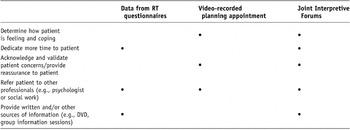
RTs reported that they play a front-line role in providing information to patients during both the planning appointment and throughout the patient’s treatment. RONs were also reported to play a critical role in ensuring that patients have the information and support they require. The detailed roles of RTs and RONs are explored in Table 1.
Summary of the communication and information provision roles that RTs and RONs play

Reducing patient anxiety and distress
Overall, all three methodologies confirmed that patient anxiety and distress are major factors that impact on the effectiveness of RT and RON communication and information provision to patients. Participants in the surveys and JIFs identified a number of strategies that could be used to reduce patient anxiety and distress. Observation of the video data also identified strategies used by RTs and RONs to assist the actor/patients to deal with anxiety that they were feeling during the planning appointment (Table 2).
Techniques used by RTs and RONs for reducing patient anxiety and distress

Barriers and strategies to facilitate effective communication
Participants in all three methodologies used in this study described barriers that make effective communication difficult under these circumstances. These barriers include: lack of training in assessing level of patient anxiety and managing anxious patients, time constraints, the need to focus on technical tasks and a lack of awareness of patient’s specific needs at the planning appointment.
Observation of the video data demonstrated that time was a barrier for RTs involved in the CT planning appointment. Cathy Smythe, one of the actor/patients, (see Figure 1) identified that she was particularly anxious about receiving treatment because her character’s mother had died from breast cancer. The RTs tried to support this patient; however, this was difficult because they also needed to position the patient and complete the required tasks within the allocated time.
Both survey and JIF participants identified a number of strategies that could be used to facilitate effective communication. These strategies included: more time, employ additional staff, have a dedicated RT patient educator/patient liaison, match staff to patients, assignment of one nurse to each patient, individual/group information sessions, use of a checklist, increase availability of information resources (e.g., more written information, DVDs, Web resources), streamline inter-disciplinary communication, private areas for discussions with patients, invite family members to appointments, provide RTs with training and education courses on patient communication and psychosocial issues and meet with patients prior to procedures in a consultation format.
Although some of these strategies could be easily implemented, other strategies described would require management support from individual departments and require substantial changes to be made in workplace operations and staffing. For example, participants in the JIFs identified that RTs may be able to perform the planning appointment more efficiently and effectively if they had the opportunity to meet the patient prior to the procedure. This meeting could assist them in learning about patients’ individual needs, discuss issues that they are experiencing and assist them to feel less anxious about the procedure they are about to undergo. It was suggested that this meeting could take place in a consultation between the RT and the patient prior to the treatment planning appointment.
RTs’ confidence in communication
RTs’ confidence in communicating and providing information to patients was assessed in the questionnaires using a 9-point Likert scale. Participants were asked to rate how confident they were about discussing specific issues related to radiotherapy and how confident they were about their colleagues’ ability to communicate about the same issues. The two issues that RTs felt least confident about discussing were ‘indications or reasons for prescribing radiotherapy’ and ‘psychosocial issues’. Figure 2a shows RTs’ own confidence in communication for each issue (1 = not confident and 9 = very confident) and Figure 2b demonstrates RTs’ confidence in their colleagues’ communication skills.
(a) RTs confidence in explaining different aspects of RT. (b) Confidence in colleagues' ability to discuss issues relating to RT. Data shown represent medians, inter-quartile ranges (boxes) and absolute data range for each item (error bars).

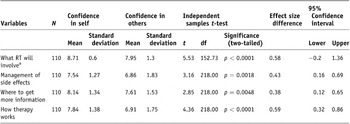
Eight independent samples t-tests (two-tailed) were used to compare confidence with self and confidence with others for each of the variables. A Bonferroni correction was made to maintain a family-wise type 1 error rate of 0.05. Statistically significant differences were found for explaining what RT will involve, management of side effects, where to get more information, how therapy works and explaining how the linear accelerator works (Table 3). For the remaining variables (when to seek medical attention, psychological issues and indications for prescribing radiation therapy), the means were not significantly different when comparing confidence in self with confidence in others.
Means and standard deviations, effect size difference and confidence intervals for each variable that had statistically significant differences when comparing confidence in self and confidence in others

a t-Statistic did not assume equal variances and in this instance Glass’s delta was used under the assumption of unequal variances. All t-statistics assumed equal variances and where this was the case, Hedges g was used an as estimate of effect size.
Levene’s test of homogeneity and one-way ANOVA tests were used to determine whether there was any statistical difference in RTs confidence in themselves or others depending on their current role. The groups for the independent variable current role were chief RT (n = 1), manager RT (n = 5), senior RT (n = 38), specialist RT (n = 10) and qualified RT (n = 55). For the independent variable current role, the Levene’s test of homogeneity of variance was statistically significant for the dependent variable ‘explaining how the linear accelerator works’ after Bonferroni correction (F 3,104 = 12.80, p < 0.0001). The remaining tests of homogeneity of variance were not statistically significant at p < 0.05. Similarly, ANOVA revealed a statistically significant difference for only one of the dependent variables (how the linear accelerator works) after Bonferroni adjustment (F 3,104 = 5.38, p = 0.0018). Because Levene’s test was statistically significant for this dependent variable, Welch’s variance-weighted ANOVA was used and revealed a statistically significant difference between group means (F 3,14.25 = 5.26, p = 0.019). The results of a post hoc Games–Howell test for the variable ‘how the linear accelerator works’ revealed a statistically significant difference between means for qualified RT (mean = 6.40, SD = 3.97) and senior RT (mean = 8.45, SD = 0.86), Glass’s Δ = –2.379 (95% confidence interval: –3.457, –1.301)). This suggests that senior RTs are more confident in describing how a linear accelerator works than qualified RTs. It was interesting to note for all other items there were no significant differences in confidence levels between staff working in different roles.
Levene’s test of homogeneity of variance and one-way ANOVAs were also used to determine whether years of experience statistically affected RTs confidence. However, all comparisons were statistically non-significant.
DISCUSSION
This study provides a unique analysis of the roles of RTs in communicating with and providing information to cancer patients. It is apparent that RTs are involved in treating many patients who are anxious or distressed. Depending on the experiences that patients have, they may decide to decline treatment or take more time to treat because they have not received the information that they require. Our study aimed to explore what communication and information exchange takes place between RTs and breast cancer patients during a radiotherapy planning appointment and the roles RTs play as communicators.
Previous research has explored patients’ perspectives of the role of both RTs and RONs.Reference Halkett and Kristjanson10–Reference Wengström, Häggmark and Forsberg13 However, this study is the first to observe RTs and RONs interactions and communication in a simulated setting with standardised patients during the treatment planning appointment and obtain RTs perspectives of their roles in these areas. Table 1 provides a summary of the tasks that RTs and RONs were observed completing during the simulated planning appointments and the information that is provided to patients at this time point. Communication between RTs and the standardised patients was difficult during the planning appointment, because RTs needed to complete technical tasks and collect the information needed to plan the standardised patient’s treatment.
This study demonstrates that RTs perceive that they play a front-line role in providing information to patients. This information may include a range of different topics from information about the current procedure being undertaken to information about the side effects patients may experience during treatment. Our findings also provide an understanding of the possible roles that RONs may play in providing information to patients. However, these roles may vary between departments and countries. Additional research is therefore warranted in this area.
Analysis of the survey data found that RTs had varying levels of confidence depending on which issues they may need to discuss with patients. The topics that RTs were least confident in discussing were ‘the indications or reasons for prescribing radiotherapy’ and ‘psychosocial issues’. RTs’ responses to this survey may assist in determining where RT education requires more focused attention. Interestingly, although the topics remained in the same order for each item, participants were statistically significantly less confident in their colleagues’ ability to communicate about the following topics: explaining what RT will involve, management of side effects, where to get more information, how therapy works and explaining how the linear accelerator works. RTs most probably have their own ideas as to why their confidence in each other may be lacking, but it was not possible to explain the underlying reasons for this lack of confidence in this research. Team building exercises may be of benefit in individual departments to improve RTs’ levels of confidence in each other.
As Feldman-Stewart and colleaguesReference Feldman-Stewart, Brundage and Tishelman19 suggest in their patient–professional communication framework, patients and health professionals come to radiotherapy appointments with different goals that need to be met. Because patients often know little about radiotherapy and do not retain all of the information that their RO has provided, they come to their planning appointment with a need for information about the procedure and the treatment that they require. During the planning appointment, RTs, as staff who are responsible for carrying out the procedure, are asked to provide more information, while also trying to reach their goals of completing the task of taking images and planning the patient’s treatment. Therefore, the goals of the patient and RTs are different and the patient’s needs for information may go unmet until the procedure has been completed unless both parties are focused on the goal of ensuring that the patient has the information they require before proceeding with the planning appointment.
JIF participants agreed that it would be beneficial if RTs had the opportunity to meet with patients immediately prior to their planning appointment using a consultation, much like medical practitioners discuss key concerns or issues with their patients when they first present at a clinic. This consultation would enable RTs to:
Establish rapport with patients prior to treatment which will allow open and reciprocal communication.
This will allow RTs to engage, empathise, educate and enlist the patient in the treatment regime.Reference Squier30
Particularly in radiation therapy, this will enable the therapist to identify any psychosocial issues or physical limitations exist that may affect procedures (e.g., sore back), and determine whether patient needs to see RON, RO or other allied health professional prior to procedure.
Improve documentation of care.
It was perceived by participants in the JIFs that the addition of this appointment would reduce the duration of the planning appointment and enable the patient to feel less vulnerable while undergoing this procedure. Breast cancer patients may feel reluctant to communicate with health professionals, because throughout the planning procedure they are required to lie on the treatment couch with the top part of their body exposed. Communication may be difficult for some patients in this vulnerable position, particularly if the health professionals performing the procedure are focused on the tasks that need to be completed. A separate consultation before the actual planning procedure could avoid this situation; however, RTs participating in our study identified that a separate consult may be unfeasible for the following reasons: time, demand to prepare patient’s position if the RO is waiting to verify treatment set up, other scheduled patients and a lack of space within the hospital for the RT to meet privately with the patient.
Some radiation oncology departments around the world may already have RTs meeting with their patients prior to the planning appointment to facilitate information provision; however, this is currently not routine practice in Australia and there are no guidelines about the role of RTs during the planning appointment. Furthermore, this practice may vary between departments and as far as we know communication skills training programs do not focus on assisting RTs to develop consultation skills. There are a number of studies that have shown the effectiveness of providing health professionals with communication skills training;Reference Gysels, Richardson and Higginson31,Reference Butow, Cockburn, Girgis, Bowman, Schofield, D'Este, Stojanovski and Tattersall32 however, no published studies have specifically assessed the benefit of providing RTs with communication skills and consultation training. Although, research has reported that RTs can also play a role in consulting patients for weekly review appointments.Reference Shi, Cox, Atyeo, Loh, Choung and Back33 Further research needs to focus on testing the effectiveness of providing RTs with training on consulting patients and evaluating whether a ‘consult’ prior to treatment planning is effective in reducing patient anxiety and improving patients’ perceived knowledge of radiotherapy.
A 61% response rate was achieved for the questionnaire. This response rate is high for a study involving health professionals self completing and returning questionnaires.Reference Gore-Felton, Koopman, Bridges, Thoresen and Spiegel34 It is necessary to acknowledge that this survey may be biased by asking the chief RTs to invite RTs to participate in completing this survey. The tendency may have been to ask more experienced RTs to complete the survey. However, this method was necessary because we were unable to identify individual RTs using alternative methods and funding did not allow us to travel to individual RT sites throughout Australia. The researchers also acknowledge that the video-recorded appointments and JIFs were only conducted with a small number of staff within one department and only involved two patient cases. Therefore, the ability to generalise these results may be limited. The use of the video recordings and JIFs was chosen because it enabled data triangulation and provided a controlled setting that enabled the researchers to explore the roles of staff in detail. The authors acknowledge that information provision and communication between staff and patients may vary between departments. However, the authors found that the survey results from around Australia were consistent with the data obtained using the other two methodologies described. Finally, this study did not facilitate a comprehensive analysis of the role of RONs, because they did not provide input into survey responses. Further research is warranted in this area.
CONCLUSION
RTs play an important role in communicating with patients and providing information, particularly when patients experience anxiety and emotional distress. The three methods used in this study facilitated data triangulation and enabled us to observe communication between RTs, RONs and patients. The main barrier for RTs to provide patients with the information and support that they require during their planning appointment is time allocated to carry out the procedure. Therefore, it may be of advantage for RTs to ‘consult’ with the patient prior to their radiotherapy planning appointment. Further research is required to determine whether patients’ information needs are better met and patient anxiety is reduced if RTs meet with them using a consultation prior to their treatment planning appointment.
Acknowledgements
This project was supported by a Cancer Council of WA Early Career Grant. The first author is supported by a National Breast Cancer Foundation Postdoctoral Research Fellowship. The authors thank the radiation therapists, radiation oncology nurses and actor/patients who participated in the video recording and Joint Interpretive Forums. They also thank the five radiation therapists who reviewed the questionnaires before they were administered, the chief radiation therapists who distributed the questionnaires and the radiation therapists who took part in completing the questionnaires. Finally, we thank Jonathon Little who assisted with statistical analysis of the survey data.