Language is acquired rapidly in early childhood. It is widely recognized that, from a young age, girls demonstrate better linguistic skills than boys in terms of vocabulary size and syntactic complexity (Fenson et al., Reference Fenson, Dale, Reznick, Bates, Thal and Pethick1994; Galsworthy, Dionne, Dale, & Plomin, Reference Galsworthy, Dionne, Dale and Plomin2000; Hyde & Linn, Reference Hyde and Linn1988; Maccoby & Jacklin, Reference Maccoby and Jacklin1974). In light of frequent reports in the literature of gender-based differences in language, mostly based on quantitative research, the question arises whether differences between girls’ and boys’ language skills exist in French Canadian children in Quebec, a population as yet seldom studied (Boudreault, Cabirol, Trudeau, Poulin-Dubois, & Sutton, Reference Boudreault, Cabirol, Trudeau, Poulin-Dubois and Sutton2007). What develops in the language of French Canadian girls and boys between 8 and 30 months of age? This is the question addressed in the present research, using both quantitative and qualitative perspectives. This study analyzes the quantitative development of gestures, vocabulary, and grammar, and looks at the nature of the first words according to gender as well, a question that has been rarely addressed so far.
The results obtained will contribute to the discussion of whether separate normative data may be warranted for young boys and girls learning Quebec French, and will help the development of educational strategies that educators in child care settings use to support language development in young children. This is particularly relevant in Quebec, because the provincial investigation of the quality of child care settings (Grandir en Qualité) revealed important gaps in the support for language development offered to children by educators (Bigras, Drouin, & Fournier, Reference Bigras, Drouin, Fournier, Drouin, Bigras, Fournier, Desrosiers and Bernard2004). The results could then be applied in preprofessional training and continuing education of early childhood educators. Therefore, describing the language skills of French Canadian boys and girls is an important place to start.
A large number of studies in different languages have addressed the question of the influence of genderFootnote 1 on language acquisition, in particular, because the use of parental reports has emerged as a research strategy and the need for early evaluation of language has been recognized (Eriksson & Berglund, Reference Eriksson and Berglund1999; Fenson et al., Reference Fenson, Dale, Reznick, Bates, Thal and Pethick1994; Jackson-Maldonado, Thal, Marchman, Bates, & Gutienez-Clennen, Reference Jackson-Maldonado, Thal, Marchman, Bates and Gutienez-Clennen1993; Kern, Reference Kern2007; Maital, Dromi, Sagi, & Bornstein, Reference Maital, Dromi, Sagi and Bornstein2000; Thodardottir & Ellis-Weismer, Reference Thodardottir and Ellis-Weismer1996). In particular, Kern's (Reference Kern2007) results showed that lexical production scores were higher for girls than for boys who were learning French. It is important to note, however, that Quebec French has unique characteristics that distinguish it from European French, and preliminary data has revealed quantitative differences in vocabulary size: speakers of Canadian French had larger lexicons than speakers of European French (Boudreault et al., Reference Boudreault, Cabirol, Trudeau, Poulin-Dubois and Sutton2007). In addition to these overall differences, a potential difference in gender stereotypes among cultures also calls for specific gender-related data in different communities. Thus, studies of children learning Quebec French are needed.
DEVELOPMENT OF LANGUAGE IN GIRLS AND BOYS
Early language development consists of communicative sounds and gestures, and more importantly, the child's comprehension of the surrounding world via social interactions. Between 11 and 14 months, the child starts to produce sequences of sounds that resemble adult lexical elements closely enough to be called “first words” (Clark, Reference Clark2003). About 5 or 6 months later, the child will have acquired a vocabulary of around 50 words. A rapid increase in the rate of vocabulary learning then usually occurs (the “vocabulary spurt”; Gayraud & Kern, in press; Hilaire et al., Reference Hilaire, Kern, Viguié, Dudognon, Langue and Romieu2001). Thus, between the ages of about 18 or 19 months and 42 months of age, the child acquires approximately 1,200 words, an average of at least 1 or 2 new words each day over a 2-year period (Rondal, Reference Rondal1978).
Syntax also emerges in stages. Between the ages of 18 and 24 months, the child uses utterances composed of two words (combinatory stage). Gradually, words are combined to form sentences. According to Parisse and LeNormand (Reference Parisse and LeNormand2000), the utterances children produce between 18 and 21 months of age are composed of a “collection of words”; but at 30 months children use some utterances that are more complex, demonstrating good knowledge of the basic syntax of the language used in their environment. Fenson et al. (Reference Fenson, Dale, Reznick, Bates, Thal and Pethick1994) noted that 87% of 24-month-old children and 93% of children between 25 and 27 months already combined words. These findings suggest that the emergence of syntax usually occurs around 24 months.
There is generally agreement that children's verbal communication abilities reach a functional level around the age of 3 years, but that individual variation is present throughout language development (Bates, Dale, & Thal, Reference Bates, Dale, Thal, Fletcher and MacWhinney1996; Bates et al., Reference Bates, Marchman, Thal, Fenson, Dale and Reznick1994; Fenson et al., Reference Fenson, Dale, Reznick, Bates, Thal and Pethick1994, Reference Fenson, Bates, Dale, Goodman, Reznick and Thal2000; Kern, Reference Kern2003). In addition to individual differences, gender may also influence language development during early childhood. Girls demonstrate better linguistic skills than do boys, even from a young age (Bornstein, Hahn, & Haynes, Reference Bornstein, Hahn and Haynes2005; Boudreault & Trudeau, Reference Boudreault and Trudeau2005; Galsworthy et al., Reference Galsworthy, Dionne, Dale and Plomin2000; Hyde & Linn, Reference Hyde and Linn1988; Maccoby & Jacklin, Reference Maccoby and Jacklin1974; Morisset, Barnard, & Booth, Reference Morisset, Barnard and Booth1995). Studies suggest that language milestones such as the use of the first word, may appear earlier or more rapidly in girls than in boys. Girls tend to produce more words and longer sentences than boys. They also tend to be more verbal and to demonstrate more facility with grammatical rules, making their speech seem more coherent than that of boys (Coates, Reference Coates and Coates1993; Halpern, Reference Halpern1997; Maccoby, Reference Maccoby1998; Swaroop, Nanda, & Kang, Reference Swaroop, Nanda and Kang2001). By the age of 3 years, girls appear to be ahead of boys, and their superior verbal skills could give them increased access to their social environment. However, this tendency seems to decrease beyond the age of 3. Based on a review by Maccoby and Jacklin (Reference Maccoby and Jacklin1974), Coates (Reference Coates and Coates1993) stated that the verbal difference between boys and girls disappears in the first years of school and only reappears around the age of 10 or 11.
Although the work of Fenson et al. (Reference Fenson, Dale, Reznick, Bates, Thal and Pethick1994) based on the original version of the MacArthur Communicative Development Inventories (MCDI) found only a partial influence of gender (explained variance = 2– 4%) on language between 8 and 30 months of age (N = 1,803), recent studies indicate not only that a gender effect does exist but also that this finding merits further attention (Bornstein & Cote, Reference Bornstein and Cote2005; Bornstein et al., Reference Bornstein, Hahn and Haynes2005; Otto, Reference Otto2005). Based on a study with French children, Grégoire (Reference Grégoire and Piérart2005) even highlights the importance of providing distinct norms according to gender, and suggests that using one set of norms for both girls and boys is likely to lead to systematically overestimating the language skills of girls and underestimating the skills of boys. Thus, the following question arises: Are there indeed differences in language performance of French-speaking girls and boys in Quebec?
Kern's (Reference Kern2003) results from 663 French children between 16 and 30 months of age (346 girls, 317 boys) may help clarify this question up to a certain point. An effect of gender was found for number of words produced, as measured by the French adaptation of the MCDI: Words and Sentences. Collapsing the data across ages, girls produce significantly more words than boys. Further, Boudreault and Trudeau's (Reference Trudeau, Boudreault, Marsolais, Rioux and Tousignant2005) study of 396 children French-speaking children in Quebec between 16 and 30 months of age (194 girls, 202 boys) using the Quebec French version of the MCDI, also demonstrated the influence of gender on expressive vocabulary. Girls obtained higher vocabulary Z scores on average than boys. Boudreault and Trudeau called for further analysis of this phenomenon with a larger sample to explore how this effect of gender may evolve with age.
Several hypotheses have been put forward to explain possible differences in language development between girls and boys. There appear to be two main categories of potential explanations: those based on biological influences, and those based on sociocultural influences. Biological factors such as a different rate of neurological maturation (Bornstein et al., Reference Bornstein, Hahn and Haynes2005) or differences in brain organization and function (Kimura, Reference Kimura1992) may underlie gender differences in language development. One argument that supports this type of explanation is that gender differences tend to become less pronounced with age. For example, as Bornstein et al. (Reference Bornstein, Hahn and Haynes2005) report, the fact that brain maturation is faster in girls than boys would support an earlier and more rapid development of linguistic skills.
Above and beyond potential biological influences, language differences between girls and boys may also be explained at least in part by the influence of their different linguistic experiences (Maccoby & Jacklin, Reference Maccoby and Jacklin1974). Differences in interests or in the ways used to engage in relationships and to communicate with others may also come into play. In other words, it is possible that a process of differential gender socialization is taking place during development. These types of hypotheses may suggest avenues for exploration of linguistic differences between girls and boys. There may be an interaction between biological and sociocultural explanations, and they may not be mutually exclusive.
In sum, the literature suggests that girls may have a linguistic advantage over boys at a young age. However, the linguistic portrait of French-speaking children in Quebec has not yet been well described. The purpose of this article is to explore language development of French Canadian girls and boys between 8 and 30 months of age using the Quebec French version of the MCDI (Frank, Poulin-Dubois, & Trudeau, Reference Frank, Poulin-Dubois and Trudeau1997; Trudeau, Poulin-Dubois & Frank, Reference Trudeau, Poulin-Dubois and Frank1997). A cross-sectional design with a large sample was deemed necessary to adequately address the question of gender differences in language development. In addition, a measure with demonstrated reliability and validity for the Québécois population was required. Quantitative and qualitative linguistic indicators were used. Possible effects associated with the mother's level of education and the child's age, noted in the literature as a moderating factor (Dolloghan et al., Reference Dolloghan, Campbell, Paradise, Feldman, Janosky and Pitcairn1999; Kern, Reference Kern2003), were controlled in the statistical analyses. The results of the study by Boudreault and Trudeau (Reference Boudreault and Trudeau2005) confirm the effect of mothers’ education level on children's vocabulary between 16 and 30 months (n = 396), as measured by the Inventaire MacArthur du développement de la communication (IMDC). Post hoc Scheffé tests showed that children of mothers having a high school education level or less were significantly lower than the children of mothers who had complete college or university. Mother's education is a variable that will be controlled in subsequent analyses.
METHODS
Participants
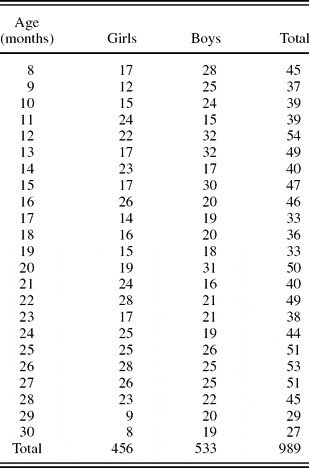
The participants were 989 children (456 girls, 533 boys) between 8 and 30 months of age, divided into 1-month age groups. Table 1 shows their distribution by age group and gender. There were 367 children between 8 and 16 months (158 girls, 209 boys) and 622 children between 16 and 30 months (298 girls, 324 boys). Participants were monolingual speakers of Quebec French (i.e., exposed to French 80% of the time or more) with no known developmental, speech, language, or hearing difficulties. Across the whole sample, the mean age of the children was 19 months (SD = 6.6 months), 19.4 months for the girls (SD = 6.3), and 18.8 months for boys (SD = 6.8). Most children (70.6%) attended daycare and 54.2% had one or more siblings. About half (52.1%) of the mothers had university-level education, 29.7% had a college diploma, and 18.2% had a professional or secondary-level diploma. There were no significant differences between the boys and girls on any of the sociodemographic variables, including age and family size. In addition, there were no significant differences in the number of girls and boys in each 1-month age group, thus confirming the homogeneity of the sample.
Gender distribution for the total sample and for each age group

Note: Parents of 18 (12 girls, 6 boys) 16-month-olds filled out the Quebec French version of the MacArthur Communicative Development Inventories: Words and Gestures (Fenton et al., 1994) whereas parents of 28 other (14 girls, 14 boys) 16-month-olds completed the Words and Sentences.
Materials
Sociodemographic questionnaire. This questionnaire was completed by a parent and gathered information about the child's age, gender, speech, and language development (age at first word, first word produced, etc.), other linguistic characteristics (native language, exposure to another language, etc.), and daycare attendance (yes/no). The questionnaire also asked about the family unit (intact: with biological or adoptive parents; nonintact: single-parent, blended family, or other situations), the education level of each parent (secondary, professional or less, college, or university) and whether brothers or sisters were present in the family.
The IMDC: Mots et gestes (MCDI: Words and gestures) for children between 8 and 16 months and the IMDC: Mots et énoncés (MDCI: Words and Sentences) for children from 16 to 30 months constitute the Quebec French adaptation of MCDI (Fenson et al., Reference Fenson, Dale, Reznick, Bates, Thal and Pethick1994), a parent report measure of vocabulary and early grammatical development (Trudeau, Frank, & Poulin-Dubois, Reference Trudeau, Frank and Poulin-Dubois1999). The MCDI questionnaires have been adapted into more than 45 languages around the world (see http://www.sci.sdsu.edu/cdi/), and their validity and reliability demonstrated repeatedly (Fenson et al., Reference Fenson, Marchman, Thal, Dale, Reznick and Bates2007; Miller, Sedey, & Miolo, Reference Miller, Sedey and Miolo1995; Trudeau, Boudreault, Marsolais, Rioux, & Tousignant, Reference Trudeau, Boudreault, Marsolais, Rioux and Tousignant2005). Results based on these inventories have been found to be strongly correlated with data from natural observations or from standardized tests of cognitive and linguistic development (Fenson et al., Reference Fenson, Marchman, Thal, Dale, Reznick and Bates2007). Preliminary data gathered thus far confirm the validity of the Quebec French version of the MCDI (Boudreault et al., Reference Boudreault, Cabirol, Trudeau, Poulin-Dubois and Sutton2007). In particular, a significant positive correlation was found between all IMDC scores and chronological age (r = .91 to .99, p = .001; Trudeau et al., Reference Trudeau, Bacopoulos-Viau, Boudreault, Boulanger, Marsolais and Michaud2006). Thus, the Quebec French version of the MCDI is sensitive to age, and it can measure language growth.
The IMDC: Mots et gestes (Trudeau et al., Reference Trudeau, Poulin-Dubois and Frank1997) for children between 8 and 16 months collects information on receptive and expressive vocabulary as well as the child's use of communicative gestures. The first part of the questionnaire includes a list of 408 words divided into 19 semantic categories such as people, animals, games, and toys, as well as action verbs. The parent checks the words in the list that the child understands, or understands and produces. The parent also indicates whether the child understands each of a list of 27 sentences and whether the child tends to repeat words and to label objects in his or her surroundings. The second part contains 63 gestures and actions grouped in five categories (first communicative gestures, games and routines, actions with objects, pretending to be a parent, and imitating other adult actions). The parent indicates whether the child uses each of the gestures described. For the purposes of this study, the scores associated with number of communicative gestures expressed, number of words understood, number of sentences understood, and number of words produced by the children from 8 to 16 months were used as dependent variables.
The IMDC: Mots et énoncés (Frank et al., Reference Frank, Poulin-Dubois and Trudeau1997) evaluates expressive vocabulary and first word combinations of children between 16 and 30 months. The first section is a list of 664 words covering 21 semantic categories. The parent identifies the words on the list that the child uses (i.e., says). The second section is 125 items divided into four categories (morphological markers, word forms, irregular words, complexity) and measures children's morphosyntactic development. For the first three categories, lists of different grammatical forms are presented and the parent checks those used by the child. These scores added together yield a “grammatical forms” score. For the complexity category, which includes 37 items, two syntactic options are offered and the parent checks the one that more closely resembles the child's production. For each item, the second option represents a more advanced form than the first (e.g., soulier papa (daddy shoe)/soulier à papa (daddy's shoe). A point is given each time the parents check the second option. This score is called the “syntactic complexity” score. Other questions ask whether the child talks about objects that are not currently visible in the environment and about events that are taking place at the present time, that already happened, or that are likely to happen in the future. The parent is also asked to provide three examples of the longest sentences produced by the child, such as Atie maman (Mommy gone) or Gros bobo à moi (Me got booboo). Taken together, this section provides information about the acquisition of grammar. For the purposes of this study, the dependent variables were the scores on the following section of the MCDI: vocabulary, grammatical forms used, and syntactic complexity.
Procedure
Once institutional ethics approval was obtained, the children were recruited from January 2003 to December 2005 through a notice placed on the website PetitMonde: Le portail de la famille et de l'enfance (see http://www.petitmonde.com) and by posters displayed in places visited by parents of young children across the province of Quebec, such as daycare centers, community health centers, private medical clinics, and community centers. Once parents gave their consent and the eligibility of their child was confirmed, a packet was sent to the parent by mail, including the information and consent form, a copy of the appropriate IMDC, and the sociodemographic questionnaire. The parent completed the documents and returned them by mail in a preaddressed, stamped envelope. The inclusion criteria regarding exposure to French at least 80% of the time and not having a language delay were confirmed by the information gathered with sociodemographic questionnaire that the parent completed.
Finally, language samples were collected from a subset of the children (n = 37). During a visit to the research laboratory, which lasted approximately 60 min, the parents were asked to play with their child as they normally would for about 20 min. Toys were provided, including choices that were likely to be of interest to the children and to elicit conversation (e.g., doll and accessories, cars, playhouse, cooking gear, and for younger children, rattles and stuffed animals). The session was videotaped and then transcribed and coded for analysis using the Systematic Analysis of Language Transcripts software. Transcription and coding of the samples followed the guidelines for Canadian French described in Thordardottir (Reference Thordardottir2005). For the purpose of this study, the variables derived from the Systematic Analysis of Language Transcripts analysis were the number of words produced by the child, and the mean length of utterance in words. These were computed automatically by the software.
Analyses
The data from each questionnaire (Mots et gestes and Mots et énoncés) were analyzed separately. Prior to carrying out statistical analyses, the normality of the score distribution for each measured variable was verified (mean, standard deviation, missing values, extreme values, etc.). To document gender differences, multivariate analysis of covariance (MANCOVAs) was used on all the dependant variables. Follow-up univariate analyses of covariance (ANCOVAs) were achieved to determine the source of gender differences for each dependant variable studied. Further analyses were conducted to compare girls and boys at each age level and to examine developmental curves. The average gain (AG) was calculated for girls and for boys using the following formula: (mean score at 16 months − mean score at 8 months)/8, or (mean score at 30 months − mean score at 16 months)/14, depending on the age group. The monthly gain (MG) was also calculated for each variable by subtracting the score at month x from the score at month x + 1. A particular MG was deemed large if it was at least 1.5 times greater than the AG. An α level of .05 was used for all statistical tests.
RESULTS
The results are presented in four parts. In the first section, the relationship between the language profiles obtained from the IMDC and from the free play session was examined to demonstrate the validity of the IMDC as a means of exploring gender differences. In the second section, the results for the younger subgroup of children (8–16 months) whose parents completed the IMDC: Mots et gestes are described. The dependent variables were mean number of communicative gestures produced, mean number of words understood, mean number of sentences understood, and mean number of words produced. In the third section, the results for the older subgroup of children (16–30 months), whose parents completed the IMDC: Mots et énoncés are examined. The dependent variables were mean number of words produced, mean number of grammatical forms used, and mean scores in syntactic complexity of sentences. The level of education of the mother and the age of the child were treated as covariables in all analyses. The final section of the results deals with the first 100 words acquired by girls and by boys.
Gender differences with the IMDC and in the spontaneous language sample
IMDC results were compared with the analysis of spontaneous language samples collected in free play with the parent, for a subsample of the participants (n = 37) at two age ranges: 19–21 months (n = 17) and 26–28 months (n = 20). There were significant positive correlations between the number of words reported by the parents, and the number of words produced in the language sample (0.74 for 19- to 21-month-olds, and 0.78 for 26- to 28-month-olds). These analyses support the validity of the IMDC. Moreover, there was a significant effect of gender on the mean length of utterance in words (MLUW) derived from spontaneous speech samples F (1, 36) = 4.39, p = .04, η 2 = .12. The MLUW was higher for the girls (M = 2.3, SD = 0.7) than for the boys (M = 1.7, SD = 0.7). These results suggest that further investigation of gender differences using the complete sample is warranted.
Children from 8 to 16 months of age
The MANCOVA revealed a significant effect of gender on the dependent variables within the 8- to 16-month-old sample (mean number of communicative gestures produced, mean number of words understood, mean number of sentences understood, and mean number of words produced). The approximated F, based on Wilk's test, is F (4, 326) = 2.89, p = .02, η 2 = .03. The follow-up ANCOVAs revealed that this multivariate effect was because of gender effects on the following dependant variables: mean number of sentences understood, F (1, 332) = 3.96, p = .05, η 2 = .01, and mean number of words produced, F (1, 366) = 9.86, p = .002, η 2 = .03. In both cases, scores were higher for the girls (M = 14.2 sentences understood, SD = 7.3 and M = 8.5 words produced, SD = 9.9) than for the boys (M = 12.2, SD = 7.0 and M = 5.7, SD = 6.8, sentences and words, respectively).
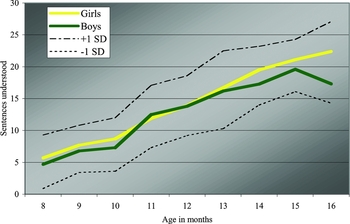
More specifically, gender differences for the number of sentences understood seemed to be larger at 16 months of age (22.4 – 17.3 = 5.1 sentences understood; see Figure 1). However, this impression was not confirmed by the ANCOVA conducted for each age bracket of 1 month (8–16 months): there was no significant difference between boys and girls at any specific age. In addition, the results for number of sentences understood highlight the large interindividual variability within all the age groups (see Figure 1).
The mean number of sentences understood by boys and girls between 8 and 16 months. Dotted lines plot the standard deviations of the total sample (collapsed across gender). *p < .05. **p < .01. ***p < .001. [A color version of this figure can be viewed online at journals.cambridge.org/aps]

The number of sentences understood increased between the ages of 8 and 16 months from 5.7 to 22.4 for girls and from 4.7 to 17.3 for boys. For girls, the AG increase in sentences was 2.09 (16.7 sentences/8). One large increase was also noted for girls, at 10 to 11 months (8.7 to 11.9 = 3.2 MG, MG/AG = 1.5). For boys, the AG was 1.6 (12.6 sentences understood/8). Two large increases were noted, at 10 to 11 months (7.3 to 12.5 = 5.2 MG, MG/AG = 3.3) and at 12 to 13 months (13.8 to 16.2 = 2.4 MG, MG/AG = 1.5). Although the first marked increase occurred at the same age for both gender groups, the increase was larger for boys than girls.
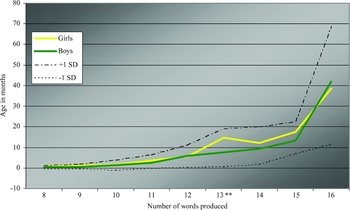
Regarding mean number of words produced, Figure 2 suggests that the difference between boys and girls was more pronounced at 13 months of age (14.7 – 7.7 = 7 words produced). Subsequent ANCOVAs confirmed this impression: there was a significant effect of gender at 13 months (girls: M = 14.7, SD = 11.4 vs. boys: M = 7.7, SD = 6.9), F (1, 48) = 7.66, p = .008, η 2 = .09. No effect of gender was observed in the other age groups, despite the apparent trend toward higher scores for the girls. Here again, the span of the scores is an indication of the extent of interindividual variability across the whole age range, both for girls and boys.
Mean number of words produced by boys and girls between 8 and 16 months. Dotted lines plot the standard deviations of the total sample (collapsed across gender). *p < .05. **p < .01. ***p < .001. [A color version of this figure can be viewed online at journals.cambridge.org/aps]

The mean number of words produced by girls increased from 0.7 to 38.5 between the ages of 8 and 16 months (see Figure 2). For boys, the increase was from 0.4 to 41.9. The AG was 4.7 words for girls and 5.2 for boys. The largest MGs were observed for girls between the ages of 12 and 13 months (5.6–14.7 = 9.1 MG) and of 15 and 16 months (17.6–38.5 = 20.9 MG). These two sharp increases are 1.9 and 4.4 times greater than the AG for girls. For boys, only one MG meets the criterion of at least 1.5 times the AG: between 15 and 16 months (13.4–41.9 = 28.5 MG), the observed increase was 5.5 times the AG. Thus two periods of sharp increase were observed for the girls but only one for the boys. The first increase noted for girls occurs earlier than for boys.
Children from 16 to 30 months of age
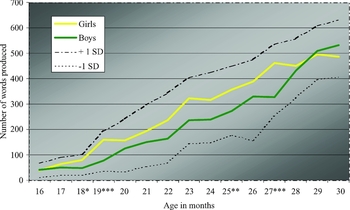
The MANCOVA revealed a significant effect of gender for all dependent variables within the 16- to 30-month-old sample (mean number of words produced, mean number of grammatical forms used, mean scores in syntactic complexity of sentences), with the approximated F, based on Wilk's test, F (3, 520) = 8.81, p = .000, η 2 = .05. The follow-up ANCOVAs revealed that this multivariate effect was because of the effect of gender on all three dependent variables: words produced, F (1, 525) = 23.38, p = .000, η 2 = .04, grammatical forms, F (1, 600) = 28.26, p = .000, η 2 = .05, and syntactic complexity, F (1, 525) = 15.86, p = .000, η 2 = .03. In all cases, girls exhibit higher scores than boys. More specifically, girls produced more words (M = 290.5, SD = 179) than boys (M = 248.7, SD = 193.5; see Figure 3) and used more grammatical forms (M = 8.2, SD = 5.3) than boys (M = 6.7, SD = 5.7; see Figure 4). They also produced sentences that were more syntactically complex (M = 11.6, SD = 11.8) than boys (M = 9.8, SD = 11.7; see Figure 5).
Mean number of words produced by boys and girls between 16 and 30 months. Dotted lines plot the standard deviations of the total sample (collapsed across gender). *p < .05. **p < .01. ***p < .001. [A color version of this figure can be viewed online at journals.cambridge.org/aps]

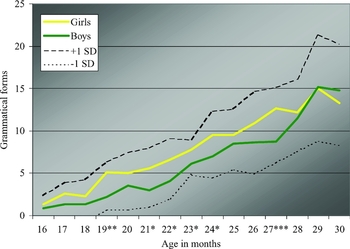
Mean number of grammatical forms employed by boys and girls between 16 and 30 months. Dotted lines plot the standard deviations of the total sample (collapsed across gender). *p < .05. **p < .01. ***p < .001. [A color version of this figure can be viewed online at journals.cambridge.org/aps]

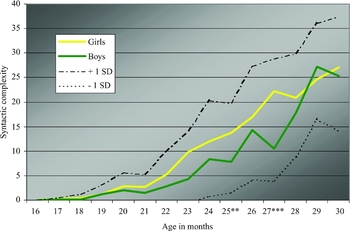
Mean syntactic complexity scores for girls and boys from 16 to 30 months. Dotted lines plot the standard deviations of the total sample (collapsed across gender). *p < .05. **p < .01. ***p < .001. [A color version of this figure can be viewed online at journals.cambridge.org/aps]

Closer examination of Figure 3 suggests that the difference in words produced by boys and girls was largest at 27 months of age (460.4 – 328.1 = 132.3 words). Subsequent ANCOVAs confirmed a significant effect of gender at 27 months, F (1, 49) = 13.64, p = .001, η 2 = .23, but also at 18 months, F (1, 35) = 4.75, p = .04, η 2 = .13, 19 months, F (1, 32) = 14.74, p = .001, η 2 = .33, and 25 months, F (1, 50) = 7.09, p = .01, η 2 = .13. In all of these comparisons, the number of words produced was significantly higher for girls than for boys (see Figure 3).
Regarding the developmental curves, girls produced an average of 38.5 words at 16 months and 486.8 words at 30 months, AG = 32, whereas boys produced an average of 41.9 words at 16 months and 532 words at 30 months, AG = 35. MGs were at least 1.5 times larger that the AG at four points for girls: 18 to 19 months (79.6 – 160.1 = 80.5 MG, MG/AG = 2.5), 22 to 23 months (236.4 –322.1 = 85.7 MG, MG/AG = 2.7), 26 to 27 months (388.8 – 460.4 = 71.6 MG, MG/AG = 2.2), and 28 to 29 months (449.6 – 496.5 = 46.9 MG, MG/AG = 1.5); and at four different points for boys: at 22 to 23 months (163 – 236.8 = 73.8 MG, MG/AG = 2.1), 25 to 26 months (271.9 – 330.1 = 58.2 MG, MG/AG = 1.7), 27 to 28 months (328.1 – 432.1 = 104 MG, MG/AG = 3), and 28 to 29 months (508.9 – 432.1 = 76.8 MG, MG/AG = 2.2). In other words, acquisition of words seems to take off earlier for girls than boys, although several sharp increases occurred between 16 and 30 months of age for both genders. Here again, the standard deviation suggests that interindividual variability is large (see Figure 3).
Figure 4 presents the number of grammatical forms used by girls and boys from 16 to 30 months. Gender differences seem fairly consistent between 16 and 27 months, and then appear to diminish. A closer examination revealed the following significant differences: at 19 months, F (1, 32) = 11.36, p = .002, η 2 = .28, 21 months, F (1, 39) = 5.22, p = .03, η 2 = .12, 22 months, F (1, 48) = 5.65, p = .02, η 2 = .11, 23 months, F (1, 377) = 4.03, p = .05, η 2 = .10, 24 months, F (1, 43) = 4.47, p = .04, η 2 = .10, and 27 months, F (1, 49) = 12.49, p = .001, η 2 = .21. In all cases the number of grammatical forms is greater for girls than for boys.
The mean number of grammatical forms increased from 1.4 to 13.3 among girls and among 0.9 to 14.8 among boys. The AG is thus 1.4 for girls, and 1.2 for boys. Large MGs were noted at four different points for girls: at 18 to 19 months (2.3 –5.1 = 3.2 MG, MG/AG = 2.3), 22 to 23 months (6.6 – 7.8 = 2.2 MG, MG/AG = 1.6), 28 to 29 months (12.2 – 15 = 3.2 MG, MG/AG = 2.3), and 29 to 30 months (15.0 – 13.3 = 2.3 MG, MG/AG = 1.6), and at three points for boys: at 22 to 23 months (4.1 – 6.1 = 2 MG, MG/AG = 1.7), 27 to 28 months (8.8 – 11.5 = 2.7 MG, MG/AG = 2.3), and 28 to 29 months (11.5 – 15.2 = 3.7 MG, MG/AG = 3.1). Acquisition of grammatical forms thus appears to begin slightly earlier for girls than boys (i.e., at 18 months), although both groups show three sharp increases between 22 and 30 months.
Gender differences in syntactic complexity of sentences were larger for girls than for boys at 25 months (13.7 − 7.8 = 5.9) and at 27 months (22.2 − 10.6 = 11.6; see Figure 5). The ANCOVAs confirm these differences, F (1, 50) = 6.81, p = .01, η 2 = .12 at 25 months, and F (1, 49) = 13.69, p = .001, η 2 = .23 at 27 months. Five large MGs were noted for girls: at 22 to 23 months (5.2 – 9.8 = 4.6 MG, MG/AG = 2.1), 23 to 24 months (9.8 – 12 = 3.8 MG, MG/AG = 1.7), 25 to 26 months (13.7 – 17 = 3.3 MG, MG/AG = 1.5), 26 to 27 months (17 – 22.2 = 5.2 MG, MG/AG = 2.4), and 28 to 29 months (20.8 – 24.6 = 3.8 MG, MG/AG = 1.7); and four for boys: at 23 to 24 months (4.3 – 8.4 = 4.1 MG, MG/AG = 1.7), 25 to 26 months (7.8 – 14.3 = 6.5 MG, MG/AG = 2.7), 27 to 28 months (10.6 – 17.8 = 7.2 MG, MG/AG = 3), and 28 to 29 months (17.8 – 27.2 = 9.4 MG, MG/AG = 3.9). In short, the AG appeared higher for boys than girls, although once again, these increases appeared slightly earlier for girls than for boys. Interindividual variability in syntactic complexity was present, regardless of gender.
First 100 words
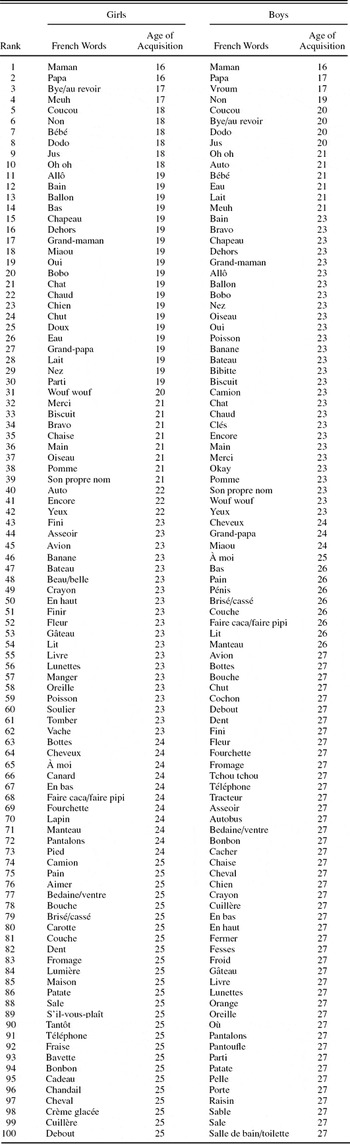
To explore the gender comparison further, the first 100 words produced by a subset of children (n = 777, 375 girls, 402 boys) were examined. A word was considered “acquired” at a particular age if it was produced by 90% of the children in that age group. Table 2 presents an exhaustive list of the order and age of acquisition of the first 50 words and the first 100 words by the girls and by the boys in this sample. These results show that the age at which 50 words were acquired was 23 months for girls, and 26 months for boys. Similarly, the age at which 100 words were acquired was 25 months for girls and 27 months for boys. Table 2 also shows that 83 of the first 100 words were common to both genders, even though the majority of them were acquired earlier by girls (76/83) than by boys. Only two of the 83 common words (2.4%) were acquired earlier by boys than by girls: auto (car) ranked 10th, and camion (truck) ranked 31st. Five of the 83 (6%) common words were acquired at the same age by boys and girls: maman (mommy) at 16 months, poisson (fish) at 23 months, banane (banana) at 23 months, bateau (boat) at 23 months, and cheveux (hair) at 24 months.
Rank and age of acquisition of the first 100 words by girls and boys

There were 17 words in the first 100 words that were unique to each gender. The words produced by boys only were vroum (vroom, ranked 3rd), bibitte (bug, ranked 29th), clés (keys, ranked 34th), okay (okay, ranked 38th), pénis (penis, ranked 49th), cochon (pig, ranked 59th), tchou tchou (choo choo, ranked 66th), tracteur (tractor, ranked 68th), autobus (bus, ranked 70th), cacher (to hide, ranked 73rd), fermer (to close, ranked 81st), froid (cold, ranked 83rd), pantoufle (slipper, ranked 92nd), pelle (shovel, ranked 95th), porte (door, ranked 96th), sable (sand, ranked 98th) and salle de bain–toilette (bathroom, ranked 100th). The words produced by girls only were doux (soft, ranked 25th), beau–belle (nice, ranked 48th), finir (to finish, ranked 51st), manger (to eat, ranked 57th), soulier (shoe, ranked 60th), canard (duck, ranked 66th), lapin (rabbit, ranked 70th), pieds (feet, ranked 73rd), aimer (to like, ranked 76th), carotte (carrot, ranked 80th), lumière (light, ranked 84th), s'il vous plait (please, ranked 89th), fraise (strawberry, ranked 92nd), bavette (flap, ranked 93rd), cadeau (gift, ranked 95th), chandail (pullover, ranked 96th) and crème glacée (ice cream, ranked 98th). Girls acquired their first verb s'asseoir (to sit) at 23 months. Boys acquired this verb at 27 months.
DISCUSSION
The results of this study of 8- to 30-month-old francophone children in Quebec are consistent with the other findings concerning the influence of gender on language acquisition (Bornstein et al., Reference Bornstein, Hahn and Haynes2005; Boudreault & Trudeau, Reference Boudreault and Trudeau2005; Fenson et al., Reference Fenson, Dale, Reznick, Bates, Thal and Pethick1994; Galsworthy et al., Reference Galsworthy, Dionne, Dale and Plomin2000; Hyde & Linn, Reference Hyde and Linn1988; Maccoby & Jacklin, Reference Maccoby and Jacklin1974; Morisset et al., Reference Morisset, Barnard and Booth1995). More specifically, between 8 and 16 months, girls understand more sentences and produce more words than boys. Between 16 and 30 months, girls produce more words than boys, and their utterances contain more grammatical forms, and are more advanced syntactically, but gender explains only a small percentage of the variance (2–5%) for all differences noted. On the whole, these results are consistent with those of Kern (Reference Kern2003) and Boudreault and Trudeau (Reference Boudreault and Trudeau2005) concerning European French children and French Canadian children, respectively, as well as with Fenson et al. (Reference Fenson, Dale, Reznick, Bates, Thal and Pethick1994) for American English-speaking children.
Overall, the data suggest that gender-based differences in language acquisition by French-speaking children in Quebec emerge more clearly around 17 to 18 months, an age at which the vocabulary spurt tends to begin (50–100 words; Clark, Reference Clark2003). These differences continue to be present up to approximately 27 months of age. Moreover, at 27 months, significant differences appear for all linguistic variables considered here (number of words produced, number of grammatical forms used, and syntactic complexity of utterances). These findings lead one to believe that at this age, a phenomenon of linguistic differentiation by gender is observed: girls have a clear advance over boys. Subsequently, there is a crossing over of girls’ and boys’ linguistic scores around 28–29 months, depending on the variable. Thus, boys catch up to girls and then seem to surpass them until 30 months of age (except in syntactic complexity), although these differences do not reach statistical significance. It should be noted, however, that effect sizes were small. In other words, the intergender differences reported are consistently smaller than the differences within each gender group. Although girls on average may have slightly better language skills than boys, this is unlikely to be noticeable because of the large individual differences in the normal range of language ability.
Based on the quantitative results, it seems clear that a true linguistic precocity of girls compared to boys exists, despite the degree of interindividual variability observed. It could be argued that these findings support the creation of separate normative data based on gender. Close examination of the developmental curves for each variable revealed differences in rates of acquisition at several points between the ages of 8 and 30 months. For instance, among the 8- to 16-month-olds, large MGs of spoken words was observed earlier (12–13 vs. 15–16 months) in girls than boys. Among the 16- to 30-month-olds, the frequency of large MGs was similar between boys and girls but this increase occurred earlier for girls than for boys (18–19 vs. 21–22 months). These findings could be interpreted as showing that girls and boys follow different developmental paths, and thus suggest that separate norms for language development are warranted for girls and boys, at least until 28 months of age.
However, although several significant differences were found, in all cases they were relatively small and were based on average scores for children in 1-month age groups. It would be premature on this basis alone to use different norms for girls and boys when determining whether the child's development is within the normal range or delayed. Future studies will be required to examine the performance of girls and boys around the lower limit of the normal range. Nonetheless, the findings suggest that caution is necessary when assessing young children to interpret performance in light of possible contributing factors, including gender. The finding of differences between the early vocabularies of girls and boys also suggests that caution be used if assessing knowledge of specific words in children. Although there was overlap in the words in the first 100 words acquired by girls and by boys, there were also striking differences in the timing of acquisition of many specific words.
This study used a cross-sectional approach with a large sample (n = 989) to obtain an overview of language in girls and boys from 8 to 30 months within a reasonable time frame (Rubin & Babbie, Reference Rubin and Babbie1997). It is possible, therefore, that evaluating different children at each age rather than following the same children across the age range may have created a bias in interpretation. However, as Bordens and Abbott (Reference Bordens and Abbott1996) emphasize, the tight distribution of the age groups (1-month intervals) and the relatively short time period during which the data were collected, contribute to the homogeneity of the groups and thus allow developmental hypotheses to be put forward (Masiéri, Reference Masiéri1965; Tabachnick & Fidell, Reference Tabachnick and Fidell2001). Other studies using a longitudinal approach should be carried out to verify the developmental profiles found here. Further research is also needed with children older than 30 months of age.
The use of a parent-report measure as a way of exploring gender differences in language development may also be questioned. The belief that girls are more linguistically gifted than boys is pervasive among parents. Even if this belief may reflect the fact that girls really are linguistically more advanced to boys, the parents’ belief that girls are better at language than boys may bias them to give higher scores to their daughters than their sons. However, the comparison of the IMDC and the language samples support the validity of the IMDC in measuring gender differences in language development, at least for expressive vocabulary and syntactic complexity. Moreover, Houston-Price, Mather, and Sakkalou (Reference Houston-Price, Mather and Sakkalou2007) found that parents tend to underestimate children's vocabulary knowledge but we do not know whether this phenomenon is more marked for one gender.
It is worth noting that although girls tended to produce more words than boys, the same trend was not seen in word comprehension. This finding may mean that the gender gap is specific to productive skills, but it could also mean that our measures were unable to capture differences between boys and girls’ receptive skills. Assessing word comprehension may be more difficult for parents than reporting on the words produced by their child. Beccause no data were obtained in the laboratory setting to confirm the absence of a gender difference in comprehension, it is not possible to conclude with certainty that this difference does not exist.
Whether gender differences in the language of young francophone children in Quebec can be explained by biological or sociocultural influences cannot be determined from the results of this study alone, and the question still remains whether the early linguistic advantage of girls over boys reflects a different rate of biological maturation or rather a different socialization process that serves to highlight gender differences. These questions are complex and are certainly not limited to the linguistic skills of the children. The study described here was not specifically designed to untangle these hypotheses. However, in the literature, it is suggested that gender-based language differences may be a composite process involving both biological and sociocultural factors. These variations would be a consequence of sociocultural influences that allow biological differences to be manifested. In this sense, biological influences would act as an initial springboard, on which sociocultural influences would exert their influence. In other words, it may be a case of sociocultural influences supporting the actualization of biological differences. Chiland (Reference Chiland, Coslin, Lebovici and Stork1997) suggests that “any culture, like any individual, must deal with the existence of two sexes and build on the biological groundwork, to create of the illusion of what are masculinity and femininity.” Thus, any interaction based on language between individuals within the culture “is doing gender” (Krüger, Reference Krüger and Mosconi1998).
The qualitative analysis of the first 100 words in the lexical repertoire of children supports in part the hypothesis that sociocultural factors influence children's language development even from a young age. Despite the fact that 83% of the words were in the initial vocabularies of both girls and boys and that girls acquired the majority of the words (91.5%) in this repertory before boys, boys produced transportation-related words before girls, except for the word avion (plane). Thus the words vroum (vroom, ranked 3rd), tchou tchou (choo choo, ranked 66th), bateau (boat, ranked 28th), camion (truck, ranked 31st), tracteur (tractor, ranked 68th), and autobus (bus, ranked 70th) appeared in boys’ initial lexicons only. This suggests that effects related to differential socialization based on gender may come into play in the types of word children acquire, rather than in terms of number of words produced. In other words, these data may reflect differences in interests or socialization experience. It is through interaction with their social environment (parents, teachers, etc.) that children acquire words reflecting their understanding of their environment that may be characteristic of their gender. Other studies are needed to address these questions directly, and to compare different sociocultural groups on these issues.
The findings suggest that the linguistic advantage of girls appears early, between approximately 17 months and 27 months, but becomes less evident from 28 months on, when boys seem to catch up to girls. Thus, gender contributes significantly but modestly (1–5%) to the explained variance in young children's language. Given the numerous differences in the developmental curves of boys and girls, separate normative data for each gender group may be warranted if further demonstration of these differences is found in future studies. Given the fundamental role of language in the global development of the child, and taking into consideration the fact that boys are more at risk for speech and language difficulties (Viding et al., Reference Viding, Spinath, Price, Bishop, Dale and Plomin2004), it seems essential to continue the study of gender differences in French Canadian children as well as in other linguistic and cultural groups.
ACKNOWLEDGMENTS
This study was supported by grants awarded by Social Sciences and Humanities Research Council of Canada (SSHRC) and the Canadian Language and Literacy research Network (CLLRNet). The authors thank Élise-Ariane Cabirol, Isabelle Marsolais, Anne Rioux, and Jasmine Tousignant for their precious contributions to this study.