Radiofrequency catheter ablation is nowadays considered the therapy of choice for the majority of children with supraventricular tachycardia beyond the age of 5 years.Reference Abrams 1 It has been reported to be safe and effective in large paediatric cohorts.Reference Kugler, Danford and Houston 2 – Reference Kubus, Vıt and Gebauer 5
The majority of supraventricular tachycardia seen in children without CHD is atrioventricular re-entry tachycardia caused by an accessory pathway, followed by atrioventricular nodal re-entry tachycardia and focal atrial tachycardia.Reference Abrams 1 , Reference Blaufox 6 The arrhythmia substrate is located on the left side in as many as 37–50% of all ablation procedures for supraventricular tachycardia in the form of a left-sided accessory pathway or a left atrial ectopic focus.Reference Nielsen, Kottkamp and Piorkowski 4 , Reference Kubus, Vıt and Gebauer 5 , Reference Hiippala and Happonen 7 The left atrium and the mitral valve annulus are accessed either by a transseptal puncture via the femoral vein and the right atrium or by a retrograde approach via the femoral artery, the aortic valve, and the left ventricle.
In adults, the risk of major complications after transseptal puncture has been well defined in large populations and has been reported to be 0.8%.Reference De Ponti, Zardini and Storti 8 , Reference De Ponti, Cappato and Curnis 9 In children, the anatomical conditions are more difficult owing to the smaller size of the vessels and the atria. The procedure is technically more challenging, and may therefore result in a higher rate of complications. Literature on this topic is rare, however. In this study, we describe the feasibility and safety of transseptal puncture for radiofrequency catheter ablation in a paediatric cohort.
Materials and methods
This is a retrospective analysis of all consecutive patients below 18 years of age undergoing attempted transseptal puncture for electrophysiology studies at two tertiary-care centres between 2005 and 2013. All procedures were performed under general anaesthesia by the same two experienced senior electrophysiologists. Intravenous anticoagulation was established in all patients. At the beginning of the procedure, a Heparin bolus (50 IU/kg) was administered, after successful transseptal puncture continued, aiming at a target-activated clotting time of 250–300 seconds, which was monitored at intervals of 30 minutes. After the procedure, acetylsalicylic acid was given for 3 months in doses of 3–5 mg/kg/day.
The transseptal puncture was performed by using a Brockenbrough needle (BRK or BRK-2; St. Jude Medical, St. Paul, Minnesota, USA) in a Mullins sheath (SLO; St. Jude Medical, St. Paul, Minnesota, USA) under biplane fluoroscopic guidance, as described in detail elsewhere.Reference McGinty, Smith and Rogers 10 First, a steerable catheter was placed in the coronary venous sinus as an anatomic landmark. No other landmarks – for example, HIS position or aortic sinus – were used. Subsequently, the SLO sheath was inserted from the right femoral vein over a guide wire into the superior caval vein and the sheath was rotated towards the posterior wall. In this position, the guide wire was replaced by the Brockenbrough needle with the tip of the needle still inside the sheath. The sheath was then withdrawn from the atrial septal wall until it had fallen into the fossa ovalis. The position of the needle was checked carefully by fluoroscopy in anterior–posterior and left anterior oblique projections. The needle was advanced with the marker with the tip pointing towards the 4 to 5 o’clock position at the proximal end of the sheath. After successful transseptal puncture, the tip was removed, highly saturated blood was aspirated, and a guide wire was introduced into the left atrium and positioned in the left upper pulmonary vein. By leaving the heart shadow in the direction of the pulmonary vein in anterior–posterior fluoroscopic view, the correct position of the guide wire was again confirmed. With support of the guide wire, the sheath and dilator were advanced into the left atrium. Transoesophageal echocardiography was used only in cases of anatomical abnormalities or unusual positioning of the transseptal sheath during fluoroscopy. Transthoracic echocardiography was used routinely at the end of the procedure before sheath removal to check for pericardial effusion, on the first post-interventional day and at outpatient visits 2 weeks and 1 year after the intervention.
The data for this analysis were extracted from the report of the intervention, the discharge summary, the in-hospital complication registry, the echocardiographic reports, and reports of outpatient visits after the intervention. In the statistical analysis, numerical results were expressed as medians and ranges. For diagrams, we used Graph Pad Prism 5 and Grubbs’ test, also called the ESD method: extreme studentised deviate test, to determine whether one of the values listed was a significant outlier from the rest. Differences in proportions between two groups were tested by one-way analysis of variance and Bonferroni’s multiple comparisons test. Values of p<0.05 were defined as significant.
Results
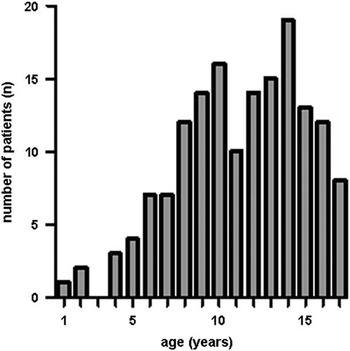
The study cohort consisted of 154 patients with 157 procedures at the following two centres: the Children’s Hospital in Zurich – 85 procedures; and the Lake Constance Heart Centre – 72 procedures. The median age was 12.5 years (range 1.1–17.9 years) with an asymmetric age distribution in favour of older children and adolescents as shown in Figure 1. The median weight was 42 kg (range 9.0–97.0 kg); in 37 patients, the weight was 30 kg or less. In all, 81 patients (53%) were male.
Number of patients versus age.

All patients underwent pre-interventional transthoracic echocardiography. Intracardiac anatomy was normal in 151 patients. In all, three patients suffered from CHD: one patient with d-transposition of the great arteries, one with cc-transposition of the great arteries, and one with agenesia of the left pulmonary artery with right aortic arch. Detailed information about the existence of a patent foramen ovale was evidenced in 95 patients. In four of them, a pre-interventional interatrial shunt was present. The external diameter of the transseptal sheath ranged from 6 to 8.5 Fr (6 Fr in 23, 7 Fr in 26 from Medtronic Minneapolis, Minnesota, USA, 8 Fr in 105, and 8.5 Fr in three patients from St. Jude Medical, St. Paul, Minnesota, USA). The 8.5-Fr sheath was used in the case of a cooled tip catheter (NaviStar) for the CARTO 3D-Mapping System (Johnson and Johnson, New Brunswick, New Jersey, USA).
The transseptal puncture was always successful, with a notable exception in one procedure: a 13-month-old boy who had concealed Wolff–Parkinson–White syndrome with a left-sided accessory pathway. He had suffered from recurrent episodes of atrioventricular re-entrant tachycardia since birth, despite a dual anti-arrhythmic prophylaxis with amiodarone and flecainide. Intracardiac anatomy was normal, but the left atrium was small. Puncture of the atrial septum itself was successful, but it was not possible to advance the 6-Fr paediatric Mullins sheath and the dilator into the left atrium, because the lumen of the small left atrium collapsed with the leftward bulging of the atrial septum, as monitored on transoesophageal echocardiography. An intermittent inferior ST segment elevation was seen during that manoeuvre, as a consequence of a spasm of the coronary arteries, due to tension on the aortic root.
Complications such as pericardial effusion, puncture of the aortic root or the pulmonary artery, stroke or an ischaemic event, or death have not been observed in the study population.
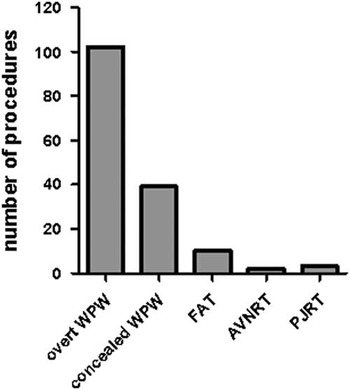
Indications for the radiofrequency ablation in our study cohort were as follows: left-sided accessory pathway in 146 (93%), including 102 Wolff–Parkinson–White syndrome with pre-excitation, 41 concealed Wolff–Parkinson–White syndrome, and three permanent junctional reciprocating tachycardia; nine (5.7%) focal atrial tachycardia; and two (1.3%) atypical atrioventricular nodal re-entry tachycardia (Fig 2).
Radiofrequency ablation was found to be successful in 152 of 156 procedures (97.4%). In four patients, the procedure was not therapeutic, and thus it was aborted because of the high risk of atrioventricular blockage as a result of the close proximity of the ablation site to the intrinsic conduction system in two patients; two procedures failed because of the inability to reach the pathway in a septal-posterior position, with epicardial course in one and an additional pathway in another patient. In the group of patients with a body weight below 30 kg, all procedures were found to be successful.
In three patients, transoesophageal echocardiography was used in addition to fluoroscopy because of uncertainty of intracardiac anatomy and/or abnormal position of the interatrial septum.
Overall, for the patients in the study, the median procedure time was 120 minutes (range 60–450 minutes), with a radioscopy duration median of 10.5 minutes (range 1.8–75 minutes). The median X-ray dose was 3.2 Gy cm2 (range 0.3–35 Gy cm2). The parameters were dependent upon the type of arrhythmia.
Number of procedures versus type of arrhythmia. AVRT=atrioventricular re-entry tachycardia; FAT=focal atrial tachycardia; PJRT=permanent junctional reciprocating tachycardia; WPW=Wolff–Parkinson–White syndrome.

Transthoracic echocardiography on the first post-interventional day showed a new residual shunt at the atrial level in 29 (19%) of all procedures. None of them was haemodynamically relevant. The presence of a post-interventional residual shunt did not depend on the size of the sheath. The 1-year follow-up of 18 patients with early post-interventional interatrial shunting showed a persistence of the interatrial shunt in four patients.
During the median observation period of 40 months (range from 1 to 103 months), we registered arrhythmia recurrences in five patients (3.2%). These patients underwent a second electrophysiological study with radiofrequency ablation between 9 months and 4 years after the first intervention; four patients relapsed with accessory pathways – posterolateral, anterolateral, posteroseptal, and lateral – and one patient demonstrated a relapse of a focal atrial tachycardia.
Discussion
The feasibility and safety of the transseptal puncture, especially in the context of left free-wall pathways, have been described in children already in the early years of radiofrequency catheter ablation.Reference Saul, Hulse and De 14 , Reference Lesh, van Hare and Scheinman 15 In the same study, this approach was recommended as the preferred access in the paediatric age group.Reference Lesh, van Hare and Scheinman 15 In our study population, the transseptal puncture has also been shown to be a safe procedure in electrophysiological studies. We have not seen any complications in 156 consecutive procedures in an unselected paediatric cohort. Despite the retrospective nature of our study, the strength of this statement can be perceived as high because we systematically screened all patients after the intervention with specific focus on possible complications, such as pericardial effusion. We also observed the clinical course during at least 24 hours after the intervention in each patient so that clinical abnormalities such as neurological symptoms caused by thromboembolic events would have been diagnosed too. Nevertheless, transseptal puncture remains a complex intervention with the possibility of relevant complications: paediatric cohorts reported a rate of major complications of up to 5.7% in 106 procedures, including perforation of the posterior wall of the left atrium, transient ischaemic attack, mitral valve injury, and transient mid-brain arterial occlusion.Reference Law, Fischbach and LeRoy 16 The paediatric radiofrequency ablation registry, a large multi-centre cohort, indicates a rate of 3.3% major complications in 1867 transseptal punctures.Reference Friedman, Walsh and Silka 17 This registry includes procedures dating back to 1991; thus, there may have been a mild decline in the rate of complications in the recent era.Reference Kugler, Danford and Houston 2 Complications can still occur, and thus the team has to be well prepared and ready for timely intervention. The immediate availability of a cardiac surgeon in particular can be lifesaving for a patient with acute pericardial tamponade after transseptal puncture.
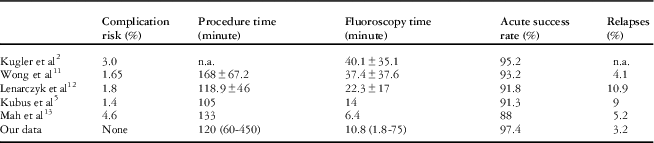
The patient cohort described in this study is a representative sample regarding patient age and range of arrhythmia substrates when compared with other published paediatric series. The procedure time, radiation dose, fluoroscopy time, success rate, and arrhythmia recurrence were found to be in the lower range compared with other paediatric cohortsReference Kugler, Danford and Houston 2 , Reference Nielsen, Kottkamp and Piorkowski 4 , Reference Wong, Yung and Lun 11 , Reference Lesh, van Hare and Scheinman 15 , Reference Friedman, Walsh and Silka 17 – Reference Yoshida, Tsugutoshi and Yoshida 20 , which validate our findings and support the therapeutic efficacy of radiofrequency catheter ablations via the transseptal approach (Table 1)
Procedural data and recurrences.

. Other centres have described shorter procedure times and fluoroscopy dose and time by the retrograde approach,Reference Vora, McMahon and Jazayeri 19 but it should kept in mind that these parameters are dependent mainly upon the experience of the operator.
It is to be expected that transseptal puncture in infants and toddlers is associated with a higher risk of complications. In these patients, the procedure is technically demanding because of the high mobility/flexibility of the atrial septum and the small diameter of the left atrium. In our study cohort, size limitation was experienced in only one patient with a body weight of 9 kg at the age of 13 months. All other procedures were found to be technically feasible without any problems down to a body weight of 13 kg. This favourable outcome has also been reported recently in a series of 43 patients who underwent a transspetal puncture at a body weight of <30 kg.Reference Yoshida, Tsugutoshi and Yoshida 20 In this study, even the subgroup of 10 patients with a body weight of <15 kg remained free from complications.
An alternative to the transseptal puncture is the retrograde transaortic approach. Historically, transseptal puncture was the first available technique to access the left atrium, mainly for the direct measurement of the left atrial and left ventricular pressures in the 1960s.Reference Roelke, Smith and Palacios 21 Later, the ability for retrograde left heart catheterisation developed, therefore reducing the need for transseptal puncture.Reference Roelke, Smith and Palacios 21 At that time, transseptal puncture was mainly used to perform a dilatation of the stenotic mitral valve. With the beginning of radiofrequency catheter ablations, the transseptal puncture gained more interest again and has turned into a routine procedure in most electrophysiology laboratories around the world, mainly in the context of pulmonary vein isolation procedures for the therapy of atrial fibrillation. In Europe, electrophysiologists in paediatric centres are still reluctant in the use of the transseptal puncture: in a recent survey, the retrograde transaortic approach was the preferred technique for the left accessory pathway ablation in two-thirds of the participating hospitals.Reference Hernández-Madrid, Hocini and Chen 22
The results of our study do not support this attitude. A significant number of complications in patients who underwent a retrograde approach has been reported. One series with 158 retrograde procedures in adults reported six patients (3.8%) with complications including coronary artery thrombosis, aortic valve perforation, and vascular complications at the site of the arterial sheath.Reference Calkins, Langberg and Sousa 23 In children, due to the smaller size of their anatomical structures – namely, the femoral artery, the aortic valve, and the coronary arteries – the rate of complications is expected to be even higher than in adults; specific reports on this intervention are rare in the literature, however. Major complications after the retrograde aortic approach have been observed in 2.6% of 769 procedures of a large multi-centre registry.Reference Friedman, Walsh and Silka 17 In a single-centre experience with paediatric procedures, there was a femoral artery occlusion in one (3.4%) and minor complications in six (20%) of 30 retrograde procedures.Reference Law, Fischbach and LeRoy 16 Perforation of a leaflet of the aortic valve has also been reported in a 15-year-old patient in this context.Reference Seifert, Morady and Calkins 24
On the other hand, the difference in the overall rate of complications of the transseptal versus the retrograde approach is statistically not significant. This has been shown in a large multi-centre paediatric series of 1099 left-sided pathway ablationsReference Van Hare, Javitz and Carmelli 3 and in a paediatric single-centre experience in 154 patients.Reference Law, Fischbach and LeRoy 16
Comparing the transseptal with the retrograde transaortic approach, the technical aspects of the mapping and ablation procedure have to be taken into account as well. The angle at which the ablation catheter approaches the mitral valve annulus via transseptal puncture is more favourable and facilitates catheter manipulation as compared with the retrograde approach. This has been shown in direct comparison between the retrograde and the transseptal approaches in 106 adult patients, where ablation times were significantly shorter in the comparison group.Reference Lesh, van Hare and Scheinman 15 More recent publications in adult populations comparing transseptal puncture and retrograde approaches at the same institution report a similar efficacy and safety inherent in these two approaches, but the ablation times were shorter and there was a smaller number of radiofrequency applications needed in procedures using the transseptal approach.Reference Silva, Nadalin and Kraemmer 18 , Reference Hashem, Choudhury and Paul 25 Shorter durations of procedure time and fluoroscopy time of the transseptal versus the retrograde approach have also been shown in the paediatric population,Reference Law, Fischbach and LeRoy 16 the latter being of paramount importance in this age group, which is vulnerable to radiation exposure. All the statements mentioned above are based on retrospective data analyses. A prospective randomised trial would be helpful to further answer the question of whether the transseptal or the retrograde approach is more appropriate for an individual patient at a specific age.
There are many possible ways to successfully perform transseptal puncture and all of them have their advantages and disadvantages. The most crucial point is to confirm the position of the transseptal needle within the left atrium and a redundant amount of information, while keeping the rest of the procedure as simple as possible. With our approach, this was achieved by biplane fluoroscopy – position of the needle and later position of the guide wire – and aspiration of oxygenated blood from the left atrium. The electrophysiologist needs to be familiar with every step of the procedure and the procedure must be executed in a uniform manner so as to be prepared for any anatomical or technical variation in each individual patient. Our approach was established because it is simple, fast, and can be performed by a single operator. It should not be withheld from the paediatric age group. Complications, although rare, can be potentially serious; therefore, the procedure should only be carried out in dedicated tertiary-care centres with immediate availability of a specific cardiothoracic surgery and intensive care team.
Residual atrial septal defects after transseptal puncture are seen in up to 87% of cases immediately after the procedure. Most of these defects close spontaneously, whereas as many as 15% are still present at 18 months after intervention.Reference McGinty, Smith and Rogers 10 The rate of residual atrial septal defects following transseptal puncture in our cohort was found to be low, with 4.18% after 1 year, and therefore is consistent with previously published studies, where it had been observed in 0–4.3% for a comparable sheath size from 8 to 14 Fr in an adult population.Reference Yoshida, Yoshikawa and Akasaka 26 ,27 Although case reports describing adverse consequences in the long term exist, these residual atrial septal defects are generally thought to be well tolerated and do not appear to be clinically significant with regard to shunting, embolism, right ventricular dysfunction, or development of pulmonary hypertension.Reference McGinty, Smith and Rogers 10
This is a retrospective study with all its inherent limitations. For this reason, some variables are missing – for example, the duration of the process of the transseptal puncture itself and the correspondent fluoroscopy time were not recorded separately, and therefore cannot be analysed in this study.
Acknowledgements
None.
Financial Support
This research received no specific grant from any funding agency, commercial, or not-for-profit sectors.
Conflicts of Interest
None.
Ethical Standards
The authors assert that all procedures contributing to this work have complied with the ethical standards of the relevant national guidelines on human experimentation (Swissethics) and with the Helsinki Declaration of 1975, as revised in 2008, and have been approved by the appropriate institutional committees (Cantonal Ethics Committee of Zurich).