Coronary revascularisation for stenotic lesions caused by Kawasaki disease can be achieved surgically or interventionally. The optimal type of revascularisation needs to be selected for each individual vessel. The timing and technique are dependent on the anatomy and patient age. Reference Fukazawa, Kobayashi and Ayusawa1,Reference Kitamura, Tsuda and Kobayashi2 The long-term outcome after coronary artery bypass grafting has been reported. Reference Kitamura and Tsuda3 Although percutaneous transluminal coronary rotational atherectomy is a possible coronary revascularisation technique for localised stenosis with coronary artery calcification caused by Kawasaki disease, Reference Ishii, Ueno and Ikeda4–Reference Suda, Iemura and Nishiono6 there are no long-term reports on PTCRA in this population. Cardiologists should be aware of some characteristics in this population, as well as the benefits and adverse effects after PTCRA, because they differ due to standard atherosclerosis with ageing in adults. Reference Fukazawa, Kobayashi and Ayusawa1,Reference Daniels, Tjajadi and Walford7 . Knowing the long-term efficacy and complication rate of PTCRA helps to decide the indication and timing of the procedure in future patients. We report the long-term results of PTCRA alone for severe localised stenosis caused by Kawasaki disease.
Patients and methods
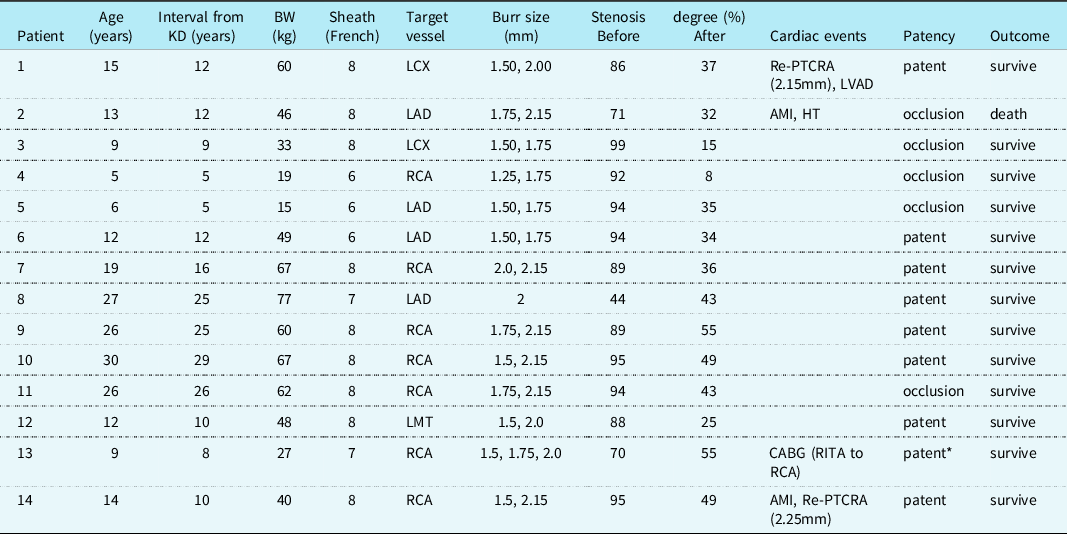
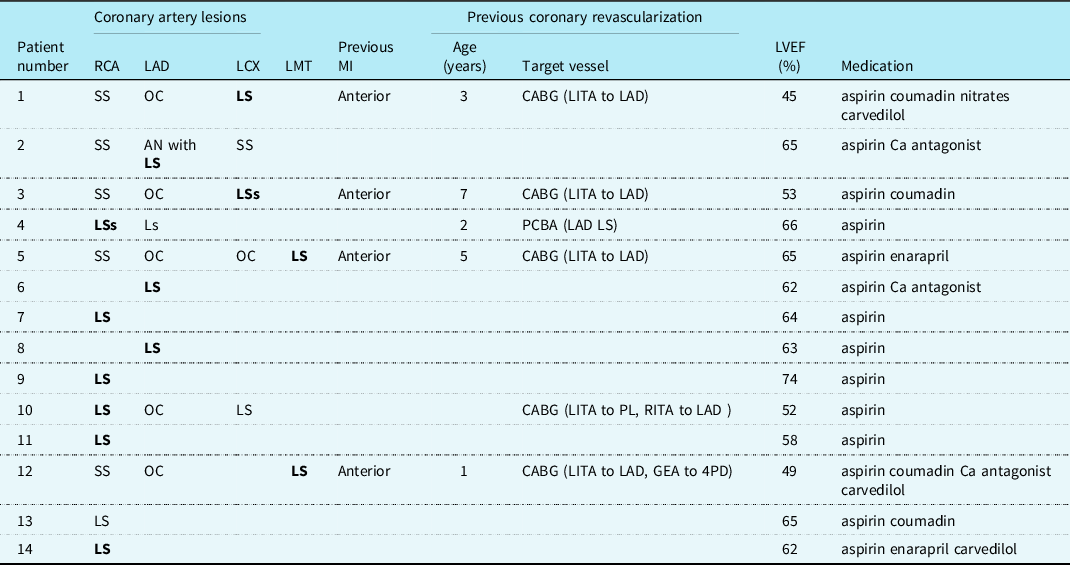
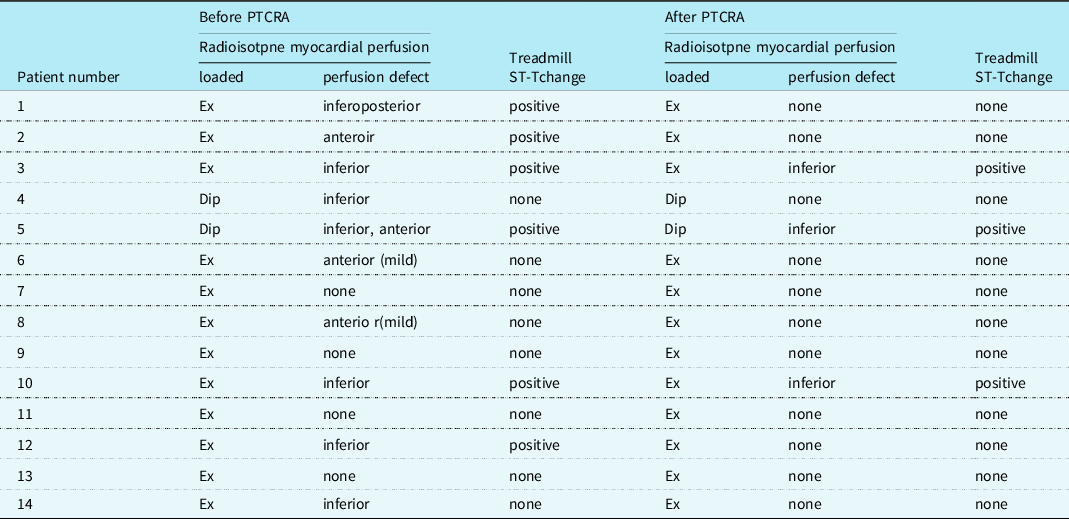
Thirteen males and one female underwent PTCRA for severe localised stenosis with calcification caused by Kawasaki disease between 1997 and 2013 in our institution. The age at the time of PTCRA ranged from 5 years to 30 years (median 13 years) (Table 1). One boy had undergone an arterial switch operation for transposition of the great arteries during the neonatal period before the onset of Kawasaki disease. The age at the onset of Kawasaki disease ranged from 3 months to 3 years (median 11 months). The interval from the onset of Kawasaki disease to PTCRA was from 5 to 29 years (median 12 years). The target vessels were the right coronary artery in seven patients, left anterior descending artery in three, and left circumflex and left main trunk in two, respectively. The coronary artery lesions caused by Kawasaki disease in each patient are shown in Table 2. Five patients had undergone coronary artery bypass grafting and one patient underwent percutaneous transluminal coronary balloon angioplasty for localised stenosis of the left anterior descending artery. Four patients had experienced previous myocardial infarction due to an occlusion of the left anterior descending artery, and they had undergone coronary artery bypass grafting to the left anterior descending artery (Table 2). The interval from the previous coronary revascularisation to PTCRA ranged from 10 months to 18 years with a median of 3 years. The number of patients with one-vessel and multi-vessel disease was six and eight, respectively. The left ventricular ejection fraction measured by the left ventriculogram is shown in Table 2. Ten patients had ischaemic changes in either dipyridamole or exercised loaded myocardial perfusion imaging with 99m Tc methoxyisobutyl isonitrile or on a treadmill test. One patient had dyspnoea on the effort before PTCRA (Patient 1) (Table 3). The fractional flow reserve was used in one patient to decide the indication (Patient 8).
Detailes of PTCRA

*The target site was patent. Complete occlusion of covered stent in the site of the covered stent otherr than the target vessel.
BW, body weight, RCA, right coronary artery, LAD, left anterior descending artery, LCX, left circumflex, LMT, left main trunk
AMI, acute myocardial infarction, HT, heart transplantation LVAD, left ventricular assist device
CABG, coronary artery bypss grafting, RITA, right internal thracic artery
Characteristics in patients who had undergone PTCRA

Bold, target vessel for PTCRA
RCA, right coronary artery, LAD, left anterior descending artery, LCX, left circumflex, LMT, left main trunk
LVEF, left ventricular ejection fraction, LS, localised stenosis, AN, aneurysm,OC occlusion,
CABG, coronary artery bypass grafting, PCBA, perctaneous transluminal coronary balloon angioplasty,
RITA, right internal thoracic artery, LITA, left internal thoracic artery, PL posterolateral branch
GEA, gastroepiploic artery, PD, posterior descending coronary artery, Ca antagonist, calcium antagonist
Myocardial perfusion imaging and treadmill test before and after PTCRA

Dip, dipyridamole, Ex, exercise
The body weight at the time of PTCRA ranged from 15 to 77 kg (median 49 kg). Three patients less than 10 years old underwent PTCRA under general anaesthesia, and the others, underwent local anaesthesia and a subcutaneous administration of pethidine hydrochloride or oral sedation. The procedures were carried out in a standardised manner. A flexible 0.014-inch guidewire was passed through a guiding catheter into the target lesion. The burr was advanced through the guiding catheter and carefully set just proximal to the ingress of the lesion. The diameter of the first burr was decided according to the diameter of the most stenotic lesion in the selective coronary angiograms. The first small burr was advanced into the lesion at 160,000–180,000 rotations per minute. The maximum burr size was determined by the diameters of the coronary arteries just distal to the target sites in selective coronary angiograms. A 6F guiding catheter was used in three patients depending on the burr size used and 7F and 8F catheters were used in three and eight patients, respectively. After the procedure, intravascular ultrasound and optical coherence tomography were performed in 11 patients and 1 patient, respectively. Additional low-pressure balloon angioplasty after rotational atherectomy was performed only in the first and last patients (Patients 1 and 14).
A routine follow-up angiogram was performed 3–6 months after the first PTCRA in all patients, because re-stenosis in the target vessel with severe calcification could not be evaluated by CT angiography. After the first follow-up angiogram, the time for the next follow-up angiogram was decided based on the findings during the first follow-up angiogram. The follow-up coronary angiograms after PTCRA ranged from 3 months to 20 years (median 1 year). The interval from PTCRA to the latest outpatient department visit ranged from 1 to 22 years (median 13 years). All 14 patients were given aspirin after the procedure and 4 patients received coumadin. Other medicines included calcium antagonists (three patients), angiotensin-converting enzyme inhibitors (three patients), beta blockers (three patients), and nitrates (one patient).
The medical records of the 14 patients who had undergone PTCRA since 1997 were retrospectively analysed and their coronary angiograms after rotational atherectomy were reviewed. The retrospective study was approved by the Ethics Committee of the National Cerebral and Cardiovascular Center (R19003–2). The paired t-test was used to compare the degree of the stenosis rate before and after PTCRA. The rates of patency of the target vessel, survival, and cardiac event-free rate after PTCRA were calculated by the Kaplan–Meier method.
Results
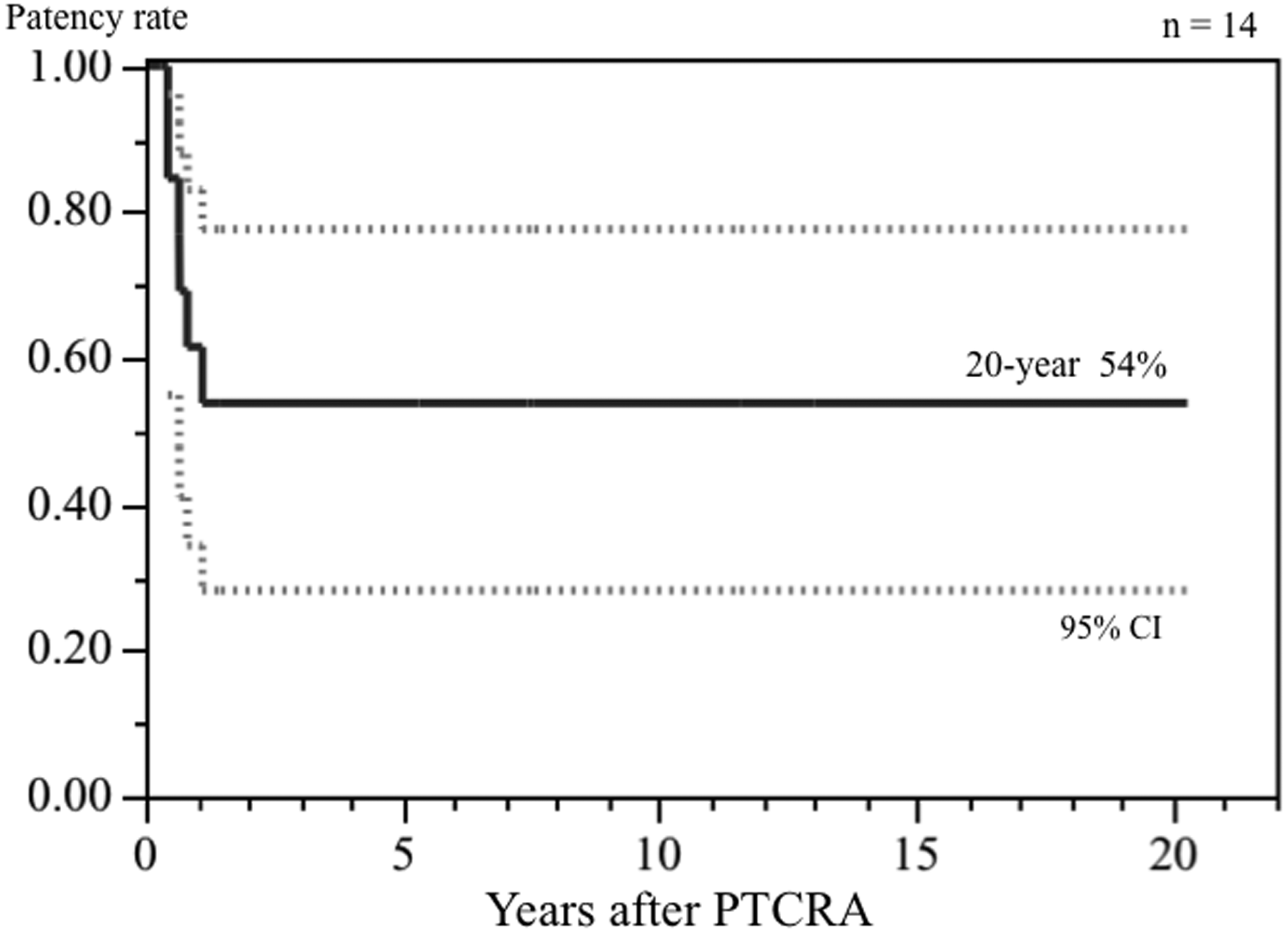
Two and three burrs were used in 13 patients and 1 patient, respectively. The size of the initial burr ranged from 1.25 to 1.75 mm, and the maximum burr size ranged from 1.75 to 2.15 mm (Table 1). The maximum burr size used was 1.75 mm in four, 2.00 mm in four, and 2.15 mm in six. Complications during the procedure occurred in three patients. A 9-year-old boy underwent a covered stent implantation after an arterial switch operation for transposition of the great arteries because of dissection of the proximal portion of the right coronary artery rather than the target lesion (Patient 13). Transient arrhythmia occurred in two patients. Immediately after PTCRA, the mean stenosis degree improved from (mean ± standard deviation) 86 ± 15% to 37 ± 14% (p < 0.001) in the selective coronary angiograms, and PTCRA was successful in all patients (Table 1). The ischaemia improved in seven patients (70%) (Table 3). In the follow-up coronary angiograms within 1 year, eight vessels (62%) including re-PTCRA 1 year after the initial PTCRA were re-stenosed. Four patients (29%) had an asymptomatic complete occlusion. Their ages at the time of the procedure were 5, 6, 9, and 30 years, respectively (Patients 3, 4, 5, and 10). Four patients (29%) had cardiac events in the late period after the procedure. Three patients had an occlusion with symptoms within 1 year after the procedure, and one patient had ventricular fibrillation. A late death related to acute myocardial infarction 3 months after PTCRA occurred in one patient (7%). The 20-year survival rate was 93% (95% confidence interval 63–99), and the 20-year patency rate was 54% (95% CI 28–78, n = 14) (Fig 1). The cardiac event-free rate at 10 and 20 years was 79% (95% CI 50–92) and 39% (6–87), respectively (n = 14). The 20-year patency rate in patients more than 10 years old was 77% (95% CI 42–94, n = 10).
The patency rate of the target vessels after PTCRA.

The details of the cardiac events are as follows. A cardiac event occurred in a 13-year-old boy (Patient 2). Three months after PTCRA, a follow-up coronary angiogram and IVUS study were performed. Those findings revealed no remarkable changes in the selective coronary angiograms after the examination. Two hours after the follow-up coronary angiogram, he had an acute wide anterior myocardial infarction. Although a saphenous vein graft was anastomosed to the left anterior descending artery immediately, he needed a left ventricular assist device and underwent a heart transplantation. However, he died from a rejection after the heart transplantation. This patient had a two-vessel occlusion and had undergone rotational atherectomy on the other vessel. As a result of this experience, a CABG should have been selected for such a case (5).
A cardiac event occurred in one patient with a covered stent because of a coronary dissection other than of the target vessel (Patient 13). He had syncope due to complete atrioventricular block 3 months after PTCRA. A coronary angiogram showed a complete occlusion at the site of the covered stent of the right coronary artery, although the target site was patent. The RCA was injected through the collateral arteries from the left coronary artery. After the CABG to the RCA, his complete atrioventricular block improved.
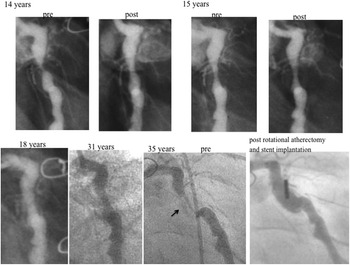
A 15-year-old boy underwent re-PTCRA with a burr of 2.15 mm after 1 year because of re-stenosis (Patient 1). Good patency of the target vessel has been maintained for 17 years (Fig 2) (5). However, his complications included some atherosclerotic factors such as obesity and hypercholesterolemia at the age of 32 years. His body height and weight were 163 cm and 77 kg, respectively. His low-density cholesterol was 181 mg/dl. His left ventricular dimension increased from 64 to 76 mm, and his ejection fraction decreased from 35 to 24% on two-dimensional echocardiography. Pulmonary hypertension was suspected due to the peak velocity of tricuspid regurgitation. Losing weight to improve the hypercholesterolemia and the evaluation of the coronary arteries using selective coronary angiography was recommended. He suddenly collapsed during work at his office at the age of 35 years. He was transferred to an emergency hospital for cardiopulmonary resuscitation. His ventricular fibrillation continued despite defibrillation, and he was restored to normal sinus rhythm during selective coronary angiographic examination with percutaneous cardiopulmonary support. He had severe re-stenosis in the target lesion of the left circumflex (Fig 2). He underwent re-PTCRA, and high-pressure balloon angioplasty was added. The dissection of the coronary artery occurred after balloon angioplasty, and he underwent a drug-eluting stent implantation. His left ventricular ejection fraction did not improve, and a left ventricular assist device was implanted for him to await a heart transplantation.
Changes in the stenosis in serial coronary angiograms after PTCRA (Patient 1) (upper). At 15 years, before rotational atherectomy (stenosis degree 85%), after rotational atherectomy (stenosis degree 39%) at 16 years, before re-rotational atherectomy (stenosis degree 68%), and after re-rotational atherectomy (stenosis degree 46%) (lower). A good patency was found at the age of 17 years and 31 years. At the age of 35 years, severe re-stenosis was detected.

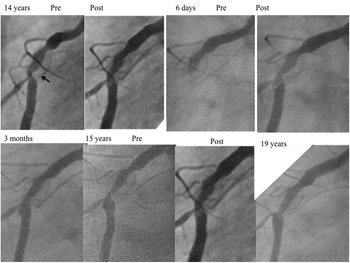
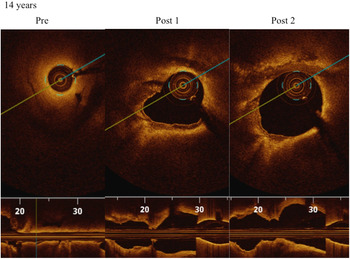
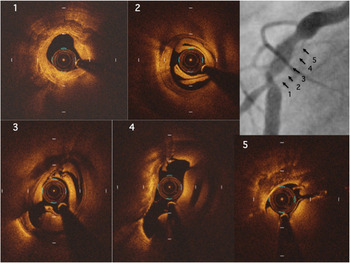
Lastly, another patient had an acute myocardial infarction and re-stenosis (Patient 14). He had PTCRA for localised stenosis with calcification at the age of 14 years. The first PTCRA was successful (Fig 3). The images of the optical coherence tomography before and after the procedure are shown in Figure 4. The minimum lumen area was enlarged by the procedure. However, he had chest pain due to acute myocardial infarction 6 days after PTCRA. To our regret, he had not taken aspirin after the procedure because of a mistake by the medical staff. In the emergency percutaneous coronary intervention, aspiration of thrombus and balloon angioplasty was performed. The use of argatroban effectively prevented thrombus formation. The emergency procedures were successful. A coronary angiogram 3 months later did not show any re-stenosis, and no myocardial ischaemia was detected on the treadmill test. However, he had chest pain again 9 months after PTCRA during exercise. Although there was no change in the electrocardiogram, the coronary angiogram showed severe re-stenosis (Fig 3). He underwent re-PTCRA with a burr of 2.25 mm because of re-stenosis. An image of the site of re-stenosis on optical coherence tomography is shown in Figure 5. The lumen of the re-stenosis site was occupied by the newly proliferated intima (Fig 5). No re-stenosis had been detected 4 years after re-PTCRA.
Follow-up coronary angiograms after PTCRA (Patient 14).

The imaging by optical coherence tomography imaging before and after PTCRA optical coherence tomography showed the high echoic intimal layer of the vascular wall.

Optical coherence tomography imaging 9 months after PTCRA (Patient 14). In a 15-year-old boy, the imaging of the re-stenosis that occurred 9 months after rotational atherectomy is shown. Severe reactive intimal hyperplasia was detected at the re-stenosis.

Discussion
Although the immediate results of PTCRA were effective in all patients, complete occlusion was present in the follow-up coronary angiograms in three small patients in whom the maximum burr size was 1.75 mm. There are some particular problems in children. PTCRA cannot always be recommended because of the small vessels of children. Reference Kitamura and Tsuda3,Reference Tsuda, Miyazaki and Yamada5 The size of the burr employed in small infants is limited because the diameter of the distal native artery is small. Furthermore, the size of the guiding catheter is also limited by the diameter of the femoral artery. For these reasons, the internal lumen diameter after successful PTCRA in small children is small, and the patency of the target vessel might not be maintained. Intensive anticoagulant therapy after a successful procedure may be advisable in small patients. Four patients of more than 10-years old maintained patency of the target vessel, and two maintained a good patency of the target vessel after re-rotational atherectomy for 17 years and 4 years, respectively. In the two patients, the maximum burr size in the re-PTCRA was larger than that in the initial PTCRA. To our regret, we could not get a chance to conduct re-intervention in the one patient with re-stenosis after 20 years before his fatal cardiac event, because of his rejection of the examination.
A rotational atherectomy is suitable for severe localised stenosis with calcification. Reference Tsuda, Miyazaki and Yamada5–Reference Gordon, Daniels and Kahn8 Re-stenosis within the first year after PTCRA often develops because of reactive intimal thickening after the procedure. In a target vessel in which a burr with a diameter of larger than 2.15 mm can be used, good patency of the vessel can be maintained by close follow-up and re-PTCRA. New aneurysms may develop after high-pressure balloon angioplasty in addition to PTCRA. Reference Akagi, Ogawa and Ino9 New aneurysms, stent fractures, and malapposition can occur after a stent implantation. Reference Kaneko, Kashima and Hashimoto10–Reference Yoon, Lee, Kim, Jang, Shim and Hawng14 Whether the stent implantation in this population is useful or not, it remains unknown. Even if a stent was not implanted, it can maintain a patency of more than 10 years in young adults. Re-stenosis can occur owing to its disease progression and coronary risk factors with ageing. Because the pathogenesis of intimal thickening remains unknown, it is unclear whether drugs can prevent intimal thickening. Contrarily, drugs can treat some adverse effects such as new aneurysm formations. Therefore, rotational atherectomy alone is recommended in this population at present. If the patient is younger, it may be better to avoid an emergency stent implantation except in life-threatening situations requiring rescue. Reference Tsuda15
In our institution, the following factors favour selection of PTCRA for treatment: evidence of ischaemia and single-vessel disease rather than multi-vessel disease, and a limitation of burr size confining the procedure to bigger children. However, if re-vascularisation with CABG rather than the target branch is contemplated, a combined therapy would be useful in patients with multi-vessel disease. PTCRA is most appropriate for short segment stenosis without giant aneurysms. Another restriction is that of possible thrombotic occlusion after PTCRA and consequently localised stenosis with giant aneurysm, which is considered to be unsuitable for PTCRA.
Although four patients in this study had severe localised stenosis of the right coronary artery, ischaemia was not always detected. Even if severe localised stenosis exists, symptoms are rare and evidence of ischaemia is often unusual. Three of these patients had a good patency and one had a cardiac event. We must carefully decide the benefits and risks in each patient. The indication for PTCRA in patients without any apparent ischaemia remains controversial. Recently, the fractional flow reserve for determining the indication for coronary intervention in adults is recommended. Percutaneous coronary intervention treatment should improve remarkably in the future thanks to the improvement of the devices. Long-term follow-up is mandatory in this population, because most patients are young. The indications and timing of PTCRA should be further investigated from the viewpoint of its efficacy and complications in light of future improvements in the devices.
Conclusions
The results of PTCRA were poor in small children because of the use of a small burr. Re-stenosis within the first year after PTCRA often develops because of reactive intimal thickening after the procedure. If a target vessel is a patent 1 year after the procedure, the long-term patency may be expected in patients of more than 10 years old. Based on the accumulation of the data, the indication of PTCRA in this population must be further reconsidered regarding the benefits and risks.
Acknowledgements
We thank the staffs belong to department of cardiovascular medicine at National Cerebral and Cardiovascular Center for their support of the PTCRA procedure.
Financial support
This research received no specific grant from any funding agency, commercial, or not-for-profit sectors.
Conflict of interest
None.
Ethical standards
All procedures performed in studies involving human participants were in accordance with the ethical standards of the institutional committee with the 1964 Helsinki declaration and its later amendments or comparable ethical standards.