

Introduction
Many organizations today face a critical decision: Should they terminate their defined benefit (DB) pension plan? Recent trends in US private pensions are undeniable. Over the last 25 years, DB plans – once the centerpiece of the retirement portfolio – have lost considerable ground to defined contribution (DC) plans, which have become the primary vehicle for saving for retirement. Some analysts and experts claim that traditional DB plans are a dying breed (if not already dead). Detractors typically contend that DB plans are too complicated and too risky for plan sponsors, and are underappreciated by employees.
DB plans have been disappearing mostly from smaller firms – more than two-thirds of firms in the Fortune 1000 currently sponsor a DB pension plan. But after the ‘perfect storm’ of falling equity prices and interest rates, many large and long-standing plan sponsors have either terminated their DB plan or frozen the plan to new hires – or are thinking about it. Terminating or freezing a plan enables the sponsor to offload the financial and regulatory risks and burdens posed by these programs, which have become increasingly onerous. But are these sponsors considering how such decisions will affect their workers' commitment and productivity – and ultimately the organization's success?
Watson Wyatt set out to learn how employees felt about their DB and DC plans. Watson Wyatt's Retirement Attitude Survey (WWRAS) asked over 8,000 employees at firms with a DB plan, a DC plan or both about their satisfaction with various plan features, their understanding of their benefits and how these plans affect their workforce decisions. While most workers value both types of plans very highly, employees covered by a DB plan tend to be significantly more satisfied with their retirement program than those without, according to the survey. This has important implications for plan sponsors, as greater plan appreciation is strongly linked to higher employee commitment. As will be shown, a program's design and features can have very meaningful effects on workers' behavior, which in turn can create favorable economic returns for the organization.
The business case for employer-sponsored pensions
Employers spend a great deal to fund and administer their retirement programs. Many firms are willing to make this investment because pensions serve as a very effective human resource tool, thus playing an important role in firms' compensation strategies. Retirement programs have been shown to reduce turnover, motivate workers and regulate retirement behavior. Empirical evidence also suggests that offering pensions – or not – influences the type of worker a firm attracts, helping firms recruit productive and loyal workers. While the productivity effects have typically been associated with DB plans, recent research has shown that 401(k) plans exhibit similar effects in shaping workers' behavior.Footnote 1
The extent to which a retirement program affects workers' behavior ultimately depends on how highly employees value their plans. Employer-sponsored retirement plans cannot meet all individual employees' retirement savings needs. They are designed to meet broad retirement goals, with contributions and benefits determined under a backdrop of stringent federal regulations. So employees' appreciation may vary broadly, depending on their individual circumstances and needs.
Workers who value a retirement program highly are more likely to remain with an employer that sponsors one. This enables employers to target rewards to their most valuable employees – namely those with the most know-how and experience in their own operations. A successful retirement program can become a very effective workforce management tool, creating significant value for an organization.
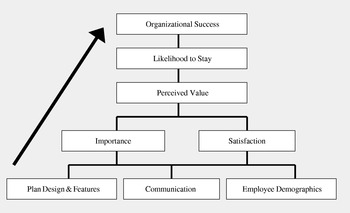
Figure 1 illustrates a simple way to think about how retirement programs influence company performance. Plan sponsors must make many choices in designing a retirement program. The most basic choice is deciding between a DB plan, a DC plan, or some combination of the two. Employers also must choose from a range of features, such as the richness of the benefit, vesting restrictions, and eligibility requirements. The plan type and its structure strongly affect how highly employees value the program. Some employees appreciate the security of a DB plan, while others assign a higher value to the financial independence of a DC program. The specific plan and features will influence the type of employee the firm attracts as well as employees' workforce decisions.
Creating value from your retirement program
Source: Watson Wyatt Worldwide.

Another important driver of appreciation is how well employees understand their benefits. Pensions are very complex, and gratification is delayed – especially for younger workers. Many employees pay little attention to their retirement program, leaving retirement planning for a later date. Employers can get employees more involved by presenting information in terms that participants can understand. Communication should clearly state how much participants will receive, how and when benefits become available, and what they stand to gain by working for the sponsor until they retire. Workers who fully understand their retirement programs are better equipped to prepare for their own secure retirement and better able to recognize their retirement deal as a valuable piece of their overall compensation.
How well employees understand their programs will largely depend on the plan sponsor's communication program. Effective communication programs that include financial education and interactive resources, such as projection modelers, boost employees' appreciation of their retirement plans. Other factors affect plan satisfaction as well, such as age, pay, and education level. Older and higher-earning employees are typically more engaged in planning for their retirement years and appreciate their programs more than younger, lower-earning employees.
Workers' appreciation for their retirement plans can be thought of in two ways. First, employees whose retirement programs give them an important reason to continue working for their current employer are said to have high plan appreciation. Second, workers who are highly satisfied with their plan's design and features can also be said to highly value their plan. The highest levels of plan appreciation are among employees who consider their retirement plan to be very important and are satisfied with their plan. The combination of the two represents the retirement program's perceived value to employees.
Employees who value their plans the most tend to appreciate and understand the monetary value of their retirement benefits, viewing them as part of their total compensation. These workers are more likely to respond to embedded incentives in their program, which may encourage either retention or retirement, depending on the employer's needs.
Retirement programs are very expensive. Enhancing employees' appreciation of their retirement programs can produce a bigger ‘bang for the buck’ for employers. All else remaining equal, employees who better understand and appreciate their compensation packages are typically more committed workers, which translates into lower turnover. The associated cost reductions and productivity gains can significantly increase shareholder value.
While an effective retirement program can provide retention and retirement incentives that meet the organization's workforce needs, these programs work best in tandem with an effective performance management system. Even the best retirement program may not be able to sort out top performers from less productive workers in a complex work environment.Footnote 2
A direct way of measuring a retirement program's influence on employee behavior is by examining how its value to employees affects employee commitment. The WWRAS asked respondents to indicate the importance of their DB and DC plans in two ways. First, we asked employees whether and to what extent the retirement plan gave them an important reason for taking their job. Second, we asked them whether and to what extent the plan gives them a compelling reason to stay with their employer. We combined both responses into a single summary variable of plan importance.
Separate from their feelings about their plans, we asked employees to indicate their likelihood of staying with their current employer until retirement and their likelihood of leaving their employer within the next two years. We created another summary indicator by combining employee responses to measure employees' overall likelihood of staying with their employers.
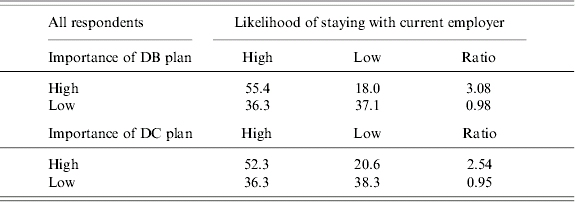
Responding workers who consider their DB plan highly important are over three times more likely to express a strong desire to stay at their current organization than other workers (Table 1). Employees who consider their DC plan very important are 2.5 times more likely to intend to stay with their current employer. In fact, for both DB and DC plans, more than half of respondents who value their retirement plans highly also indicate a high likelihood of staying with their current employer. For employees who assign low importance to their DB plan, roughly equal numbers say the plan would (36.3%) or would not (37.1%) influence their decision to remain with their current employer. The situation is much the same for workers who assign a low value to their DC plan.
Importance of the retirement plan to employees and impact on retention
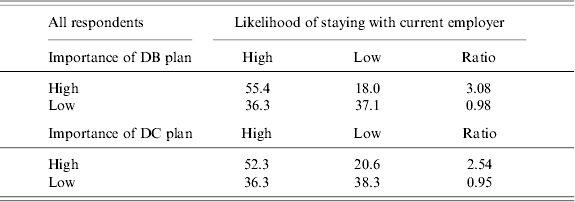
Notes: Plan importance combines employees' indications of their retirement plan's importance in attracting them to the firm and in giving them a reason to stay. High and low represent the top one-third and bottom one-third of respondents. For individuals covered by both plan types, we created a separate indicator for each plan. All respondents were also asked to indicate their likelihood of staying with their current firm aside from its retirement plans.
Source: Watson Wyatt's Retirement Attitude Survey.
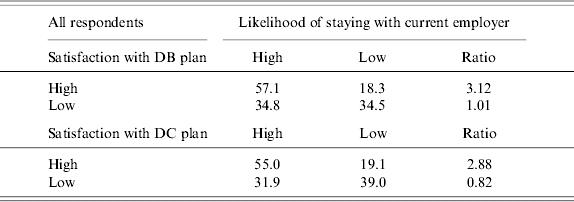
Higher plan satisfaction is also strongly associated with employees' intentions to remain with their current employers (Table 2). For DB plans, employees' overall satisfaction was determined by combining employee ratings of eight features: value of benefits as future income, information about current value, information about projected value, form of benefit payout, benefit availability age, years of service before vesting, ability to access funds before retirement, and how the plan compares with competitors' plans. For DC plans, overall plan satisfaction was determined by employees' satisfaction with eight features: match rate, type of matching funds, contribution limits, investment options, information about balances, education programs, plan administration, and how the plan compares with competitors' plans.
Employee satisfaction with DB plan and impact on retention
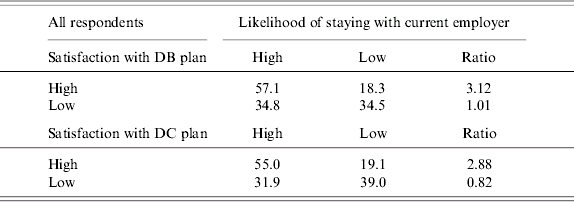
Notes: We determined employee satisfaction for both DB and DC plans by combining employee responses across several plan design features. High and low represent the top one-third and bottom one-third of ratings. For individuals covered by both plan types, we created a separate indicator for each plan. All respondents were asked to indicate their likelihood of remaining with their current firm aside from its retirement plans.
Source: Watson Wyatt's Retirement Attitude Survey.
Employees who are most satisfied with their DB plans are more than three times more likely than other employees to plan on remaining with their employer until retirement. An equivalent relationship emerges for employees who are highly satisfied with their DC plans. However, employees who are much less satisfied with their DB and DC plans are equally likely to plan on staying with their employer or not.
As shown in Tables 1 and 2, improving plan importance and satisfaction among employees strongly increases their desire to stay with the company, which can boost the success of the organization.Footnote 3 While these results identify a strong link between employees' appreciation of their retirement plans and their commitment to the firm, other factors may also influence employee commitment. For example, to what extent are older employees more committed to their company than younger employees? Do some industries tend to employ more committed employees than others? The remainder of this analysis uses multivariate regression analysis to identify factors that influence employees' appreciation of their retirement plans and ultimately their commitment to their employers. We follow the schematic in Figure 1 above from bottom to top, examining the drivers of plan appreciation. These drivers include plan design and employee demographics. We also estimate how greater plan appreciation influences employees' desire to continue working for their current employers.
The next section describes the data and their unique characteristics. Section 3 describes and estimates the factors that influence employees' perceptions of plan value. We describe the questions we asked to define the value employees assign to their retirement program – plan importance plus employee satisfaction. Section 4 gauges the effect of plan appreciation on employee commitment. The fifth section summarizes our findings.
About the survey and methodology
The Watson Wyatt Retirement Attitude Survey (WWRAS) was completed by 7,911 employees from a national panel in the summer of 2003. The survey asked these workers a broad assortment of questions to gauge their understanding and appreciation of their employer-sponsored retirement plans. The survey questioned respondents about their DB plans, 401(k) plans, and retiree medical plans, where applicable. All respondents are covered by a DB plan, a 401(k) plan, or both. Two-thirds of responding employees have both a DB plan and a 401(k) plan, while 27% have only a 401(k) plan. Four per cent have only a DB plan.
We asked employees how well they understood their plan and its features, how important the plan was to them as part of their retirement package, and how satisfied they were with the plan and its design. We also asked respondents to indicate their preferences for various plan features, to rate the plan's communication program, and to describe their current retirement planning and goals.
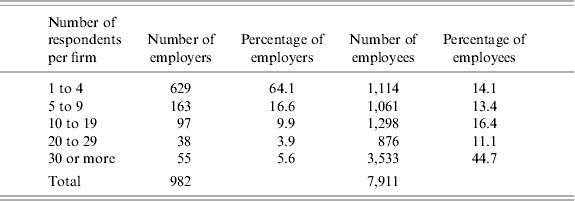
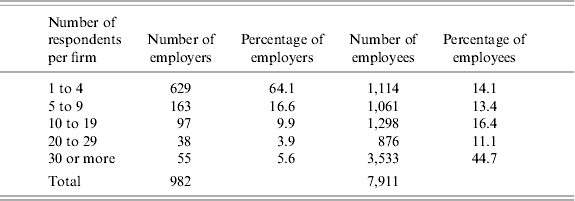
The final sample includes 982 firms (Table 3). In most cases, fewer than five responding employees work for the same employer (629 firms). However, there are several exceptions. In fact, in 55 participating firms, 30 or more employees responded, accounting for nearly 45% of all respondents. The average firm in the sample is quite large. On an employee-weighted basis, the average employee works for a firm with 39,500 employees. However, on a company-weighted basis, the average firm employs roughly 18,000 employees.
Number of employees per employer-sponsor
Source: Watson Wyatt's Retirement Attitude Survey.
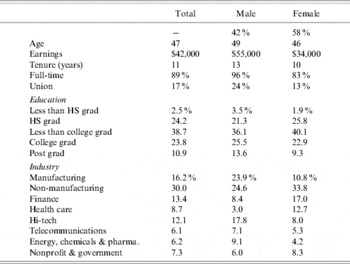
The final sample includes more women than men (58% versus 42%, Table 4). The average worker is 47 years old, earns $42,000 and has worked for her current employer for 11 years. Men are typically older than women (aged 49 versus 46), earn higher salaries ($55,000 versus $34,000) and have longer tenures with their current employer (13 years versus 10 years). Most respondents work full-time (89%) and do not belong to a union (83%). Responding men are more likely to work full-time than women (96% versus 83%) and to belong to a union (24% versus 13%).
Descriptive statistics of respondents in the WWRAS

Source: Watson Wyatt's Retirement Attitude Survey.
Nearly all responding employees are high school graduates (97.5%), and most of them have had at least some college-level courses (73.4%). Roughly one in three workers has at least a college degree, which is consistent between men and women. However, the typical man is much more likely to work for a manufacturing or hi-tech firm, whereas women are more concentrated in the non-manufacturing, health care, and financial industries.
Employee response surveys offer comprehensive data about critical demographic characteristics, such as age, earnings, and education. However, respondents often have difficulty accurately recalling details about their employer's benefit programs. This is particularly true for retirement programs, which are complicated. As a result, research studies of this sort are often riddled with significant respondent error bias that could potentially skew results.
A unique aspect of this dataset is that all respondents are matched to their actual plan design information using the Watson Wyatt COMPARISON™ database. This enables us to directly account for any inaccuracies in employees' responses. One of respondents' most basic errors is misidentifying their plan type – DB or DC. To help them determine their plan type, we provided a very simple description of both types in the questionnaire. Being able to match what respondents say to the type of plan we know they have enables us to verify the accuracy of responses.
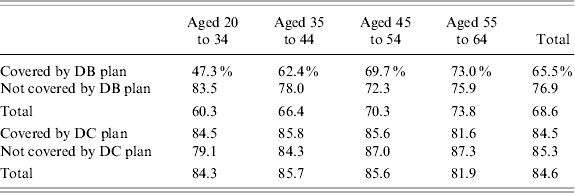
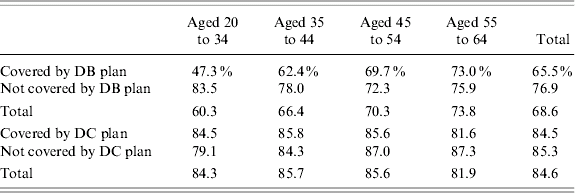
Table 5 confirms that employees often have trouble identifying even the most basic features of their retirement programs. This is particularly true for younger workers with a DB plan. In fact, less than 50% of employees aged 20 to 34 accurately identify their DB plan. As expected, older employees are more aware of their retirement program; three-quarters of older respondents correctly identify their DB plan. Accuracy rates are much higher for DC plans, generally independent of a worker's age.
Percentage of respondents who correctly identify their retirement plan
Source: Watson Wyatt's Retirement Attitude Survey.
This analysis estimates the effect of plan type and features on the perceived value of these plans and on employees' commitment to their employer. We use multivariate regression analysis to isolate the effect of plan design characteristics on the value employees attach to their retirement program, while controlling for other confounding effects. We focus largely on employees who accurately identify the most basic aspects of their retirement programs. This approach provides an equivalent basis upon which to evaluate how alternative plan types and features influence a program's perceived value to employees.
Employees who cannot correctly identify their plan type could be assumed not to value it highly – their perceived value of the plan is essentially zero. These employees provide no explicit information on plan importance and satisfaction with their retirement plans – the factors that determine perceived value. However, the estimated effects of plan type on the value employees attribute to their plan compounds both the ‘true’ plan effects with the respondent's inability to accurately identify their plan. As seen in Table 5, this would create a strong downward bias against DB plans and distort our ability to accurately compare the two plan types. Yet, per the discussion below, we also provide estimates in which the perceived value for misreporting respondents is set to zero.Footnote 4
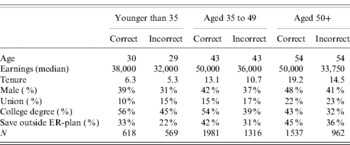
The population of respondents who correctly identify their plans may be very different from those who fail to do so. In that case, this approach would alter the relationship between individual plan characteristics and their estimated perceived value. But as we see in Table 6, average values are fairly consistent between employees who correctly identify their plans and those who do not. However, employees who accurately identify their plan type also tend to be more highly paid, more likely to have a college degree, and more likely to save outside their employer's retirement plans.
Comparison of demographic characteristics between respondents who identify their retirement program correctly/incorrectly

Notes: ‘Correct’ identifies respondents who correctly identified their plan type. ‘Incorrect’ includes respondents who could not identify their retirement plan type. Both categories include only respondents under 60.
Source: Watson Wyatt's Retirement Attitude Survey.
Employees' perceived value of the retirement program
This section examines how various plan and employee characteristics affect the value employees place on their retirement programs. The WWRAS asked employees to rate their retirement plans' importance to them and their plan satisfaction. Employees who are covered by both DB and DC plans were asked to assess each plan separately. To better understand plan importance and plan satisfaction, we look at the components of each in greater detail below. We then use regression analysis to estimate the factors that affect perceived plan value.
Importance of retirement plans
As noted above, we based our measure of plan importance on employees' responses to two questions: (1) How did the plan affect your decision to work for your current employer? (2) How does the plan affect your desire to continue working for your employer? The answer to the first question measures the retirement plan's effect on attraction; the answer to the second question indicates its effect on retention.
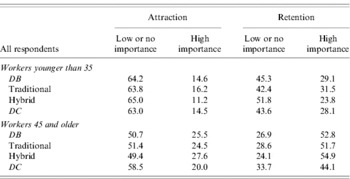
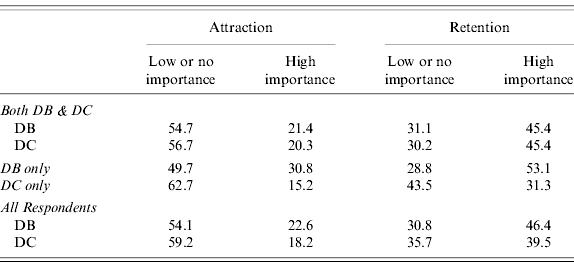
Table 7 shows the role retirement plans play in attracting and retaining younger and older employees. In general, retirement plans are much better at retaining workers than at attracting workers. Roughly twice as many employees say their plan strongly affects their decision to remain with their current employer than say the plan convinced them to sign on in the first place. Older employees are significantly more likely than younger employees to have been attracted to their firm by the retirement plan. Older employees are also more likely to consider their retirement plan an important reason to continue working for their employer. This is not surprising, given that older workers are generally much more focused on retirement than younger workers.
Importance of the retirement plan in attracting and retaining employees

Notes: On a scale of 1 to 5, ‘high importance’ indicates a response of 4 or 5; ‘low or no importance’ indicates a response of 1 or 2.
Source: Watson Wyatt's Retirement Attitude Survey.
DB and DC plans are generally equally effective in attracting and retaining employees within each age group. These results are surprising, since 401(k) plans are generally considered to be more attractive than DB plans, especially to younger workers. In fact, DB plans are just as important in convincing younger workers to take a job as 401(k) plans (14.6% versus 14.5%). DB plans have slightly greater powers of attraction for older workers than 401(k) plans (25.5% versus 20.0%). In terms of retention, DB plans are more likely to give older workers a compelling reason to remain with their employer than 401(k) plans (52.8% versus 44.1%). DB and 401(k) plans exert very similar effects on younger employees.
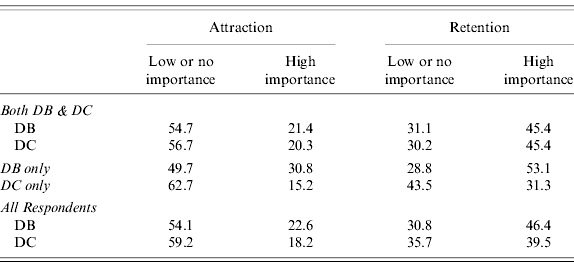
The tables above show only modest differences in the extent to which plan type affects employee commitment. However, these results do not account for the different mix of retirement programs that employers offer. Table 8 shows the attraction and retention power of retirement plans for workers whose employers offer (1) a DB and DC plan, (2) only a DB plan and (3) only a DC plan.
Importance of retirement plan in attracting and retaining employees by plan type
Notes: On a scale of 1 to 5, ‘high importance’ indicates a response of 4 or 5; ‘low or no importance’ indicates a response of 1 or 2.
Source: Watson Wyatt's Retirement Attitude Survey.
In general, retirement plans wield the strongest attraction and retention power at DB-only firms. Employees at these firms are twice as likely to cite their retirement plan as an important factor in choosing their employer than workers at firms that offer only a DC plan. In fact, employees at firms that offer only a DB plan are significantly more likely to rate their retirement plan as a highly important reason for joining the company than employees covered by both a DC and a DB plan.
Retirement plans appear to have the greatest retention effect at DB-only firms. Fifty-three percent of respondents at DB-only firms say their retirement plan gives them a very important reason to stay with their current employer. This is comparable to the retention effect we identified among older workers (Table 7). In companies that offer both a DB and a DC plan, both plans appear to improve employee retention. Workers at DC-only firms, on the other hand, are significantly less likely to cite their retirement plan as a reason to stay on the job than workers whose employers offer a DB plan. This further supports the assertion that DB plans engender more employee loyalty and commitment than DC plans.
Satisfaction with retirement plans
Employers have long sought to enhance organizational performance by improving employee satisfaction. The idea that a satisfied employee is a better employee seems intuitive. And, as shown above, designing a retirement plan that strongly appeals to employees can create significant value for an organization. Which plan characteristics elicit the most favorable ratings from employees?
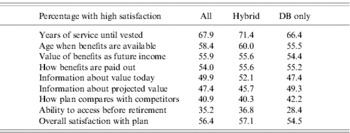
The WWRAS asked employees to rate their satisfaction with a number of retirement plan features. Table 9 shows the percentage of employees who are highly satisfied with various features of their DB plans, including plan generosity, vesting, eligibility, age when benefits become available and plan communications. Overall, about one-half of the respondents are highly satisfied with their DB plan. Responding employees indicate the highest satisfaction with their plan's vesting requirements, benefit availability age, plan generosity, and form of benefit payout in retirement. Employees reported being least satisfied with limited access to their money before retirement. To a lesser extent, employees also are less satisfied with plan communication and with how their plan compares to those at other organizations.
DB plan satisfaction by plan design feature

Note: High satisfaction includes those who responded ‘satisfied’ or ‘very satisfied’ on a 5-point Likert scale.
Source: Watson Wyatt's Retirement Attitude Survey.
Worker satisfaction is relatively consistent across the various plan types and mix of retirement programs. Most notable is that employees seem just as enthusiastic about their hybrid pension plans as they are about traditional DB plans. The popular media's portrayal of employees being strongly dissatisfied with their hybrid pensions is not echoed by these survey findings. Similarly, employees at DB-only firms are just as satisfied with their plans as those who are also covered by DC plans.
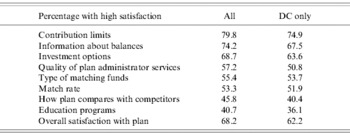
On the DC side, employees were asked to indicate their satisfaction with plan features such as the value and type of matching contributions, available investment options, permissible employee contributions, and educational materials (Table 10). Roughly two-thirds of all responding employees are satisfied with their 401(k) plans, which is about 10 percentage points higher than employee satisfaction with DB plans. Employees appear most satisfied with communication of their account balances, contribution limits, and available investment options. Workers are least satisfied with their employer's investment education programs and how their plan compares to those offered by other organizations. However, employees at DC-only firms tend to be slightly less satisfied with their plans than the average respondent. This difference is perceptible with each plan design feature.
DC plan satisfaction by plan design feature

Note: High satisfaction includes those who responded ‘satisfied’ or ‘very satisfied’ on a 5-point Likert scale.
Source: Watson Wyatt's Retirement Attitude Survey.
Determinants of plan importance and satisfaction
A number of factors influence a retirement plan's perceived value. As described in Figure 1, these include employee demographics, plan type and features, and employees' understanding of their plan. The tables above have demonstrated that plan type and the employee's age have very meaningful effects on a plan's perceived value and satisfaction. However, this approach does not control for confounding factors that affect plan importance and satisfaction. Moreover, it does not isolate and quantify the effect of each factor. So we employ multivariate regression analysis to determine the precise effects of employee comprehension, employee characteristics, and plan type and design on employees' appreciation of their retirement plans.
For the regression analysis, we create a summary indicator, hereafter importsat, to capture the perceived value employees attribute to their retirement program. This was done by scaling the product of plan importance and plan satisfaction by its maximum overall score.Footnote 5 The highest value of importsat corresponds to workers who consider their plan to be very important and are highly satisfied. The lowest value of importsat corresponds to workers who consider their plan relatively unimportant and express low satisfaction. This approach gives equal weight to plan importance and plan satisfaction. We adjust the maximum overall score based on the types of retirement program offered. For workers with both a DB and a DC plan, the maximum overall score is twice that for workers covered by only one type of plan. As a result, the summary indicator of plan importance and satisfaction takes a value between 0 and 1 regardless of whether employees have one or both types of plans.
Importsat is about 37% for the average respondent. In other words, the average respondent's level of perceived importance and satisfaction with his or her retirement program is about 37% of the maximum. Respondents at the 25th percentile are about 24% and those at the 75th percentile are roughly 51% of the maximum level.
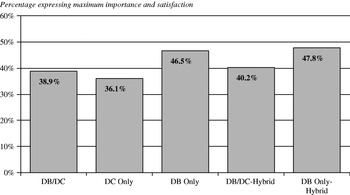
This analysis estimates the effect of different plan types on importsat. How does the average worker's appreciation of his plan vary under alternative plan types? Figure 2 shows predicted values of importsat for a hypothetical 40-year-old male high-school graduate who earns $45,000 a year in a non-union job. He has worked for the same employer for ten years.
The impact of plan design on plan importance and employee satisfaction
Notes: Estimates are based on a non-union, 40-year-old male high school graduate who earns $45 K annually. He has worked for his current employer for 10 years and saves outside the plan.
Source: Watson Wyatt's Retirement Attitude Survey.

The results suggest that workers covered by DB plans appreciate their retirement programs significantly more than those without such plans.Footnote 6 The predicted value of importsat for DB-plan-only workers is 47%, compared to 36% for DC-plan-only workers.Footnote 7 However, many employees are covered by both plan types. For these workers, importsat is estimated to be about 39%. Appreciation rates for workers with hybrid DB plans are roughly 1.3% higher than those for workers with traditional DB plans.
Based on Figure 2, one might conclude that adopting a DB plan will immediately boost employees' appreciation of their retirement programs and increase employee commitment (which we explore more fully in the next section). We must be cautious, however, since the plan type affects the types of workers attracted to a firm. For example, terminating a DB plan and offering only a DC plan would significantly affect the type and mix of workers who would want to join and remain with the company. Remember, importsat captures employees' satisfaction with their retirement plan as well as its importance in attracting them to their employer. This analysis suggests that DB plan participants assign a higher value to their retirement program than their counterparts at DC-only firms.
While plan type explains some variations in employees' appreciation of their retirement programs, it does not account for the broad differences in plan design and features. To boost employees' appreciation, employers typically increase benefits, enhance communication or both. To better understand the role of plan design, we estimate how plan generosity and communication affect employees' appreciation of their retirement plans.Footnote 8
We define generosity in a DB plan by the percentage of final salary that an employee of average age and tenure would receive at normal retirement age. This is called the replacement rate. We estimate that the average respondent will receive an annuity worth 30% of his final salary from his DB pension plan.
For DC plans, we define generosity according to matching and non-matching employer contributions. For matching contributions, we assume that employees contribute the maximum that triggers an employer match, and contributions accumulate at a 6% annual rate. The average firm in the sample matches 50% of employees' contributions up to the first 4% of pay.
The WWRAS also asked employees a series of questions to evaluate their retirement plans' communication program. First employees were asked to indicate how frequently they receive information about their retirement plans. For the 401(k) plan, we asked employees how often they received information about the importance of participating, current and projected account balances, and investment strategies. On the DB side, employees were asked how often they received estimates of their pension's current value and projections of its value at retirement. We also asked employees to assess the overall effectiveness of their employers' communication programs in preparing them for retirement and explaining the benefits they will receive, and the timeliness of communication. To assess the responses, we created communication indicators for communication frequency and effectiveness by combining the underlying questions into summary variables.
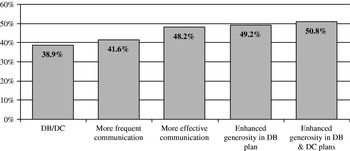
Figure 3 shows predicted values of importsat for a typical worker who is covered by both a DB and a DC plan with a standard communication program and average plan generosity. In this baseline case, we estimate importsat at 39%. If we increase the frequency of plan communication, employees' appreciation of their retirement plan rises by about 3 percentage points, to 42%.
The Impact of communication and generosity on retirement plan importance and employee satisfaction
Notes: Estimates are based on a non-union, 40-year old male high-school graduate who earns $45 K annually. His tenure is ten years with a company that sponsors both a traditional DB and a DC plan. He saves outside the plan. Differences in each level of communication and generosity represent a one-standard-deviation improvement.
Source: Watson Wyatt's Retirement Attitude Survey.

Increasing the rate of DC communication has over twice the effect on employee appreciation as a comparable increase in DB communication. Enhancing the effectiveness of communication has an even greater impact, boosting importsat by another 6.6 percentage points, up to 49%. In total, these results suggest that communicating to employees more often and doing it better would increase employees' appreciation of their plans by nearly 25%.
Raising plan generosity also boosts employees' appreciation of their retirement program but its effect is more modest. For an employee with both plan types, increasing the DB plan replacement rate from 30% to roughly 45% – a one-standard-deviation improvement – would raise importsat by 1 percentage point. Similarly, a 10-percentage point (one-standard-deviation) increase in the DC plan's replacement rate – from 20% to 30% – would boost employees' appreciation by another 1.6 percentage points. So increasing DC plan generosity would be nearly three times as effective at increasing plan appreciation as a comparable increase in DB plan generosity. Overall, enhancing both communication and generosity could boost typical workers' appreciation of their retirement plans by over 30%.Footnote 9
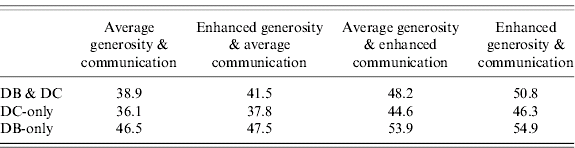
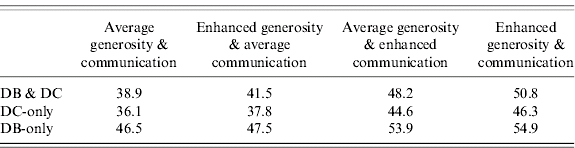
Table 11 combines the effects of enhanced generosity and communication on employee appreciation for different plan types. Here again, we see that DB participants value their retirement programs much more highly than DC-plan-only workers. In fact, to boost employee appreciation up to the level at typical DB-only firms, DC plan sponsors would have to enhance both their communication and generosity. Firms with only a DC plan typically provide more generous matching contributions than companies that also offer a DB plan. But the difference is smaller than one might expect. Average plan generosity for DC-only firms is 17% compared to 13% at firms that also sponsor a DB plan. Moreover, communication is similar for all DC plans, whether or not they are the only plan. As such, DC-only firms would require marked enhancements to their communication and plan richness to significantly boost employees' appreciation of their plans.
The impact of enhanced generosity and communication on retirement plan appreciation
Source: Watson Wyatt's Retirement Attitude Survey.
As shown above, communication strongly affects a retirement plan's perceived value. While more frequent communication certainly helps, the most effective way to boost plan appreciation is by doing it better. There is one caveat: employees often have difficulty recalling the precise details of their employer's communication programs. If employees who value their retirement programs most highly also have the clearest understanding of their company's communication programs, the findings could overstate the impact of effective communication.
To more accurately measure the effect of communication effectiveness, we linked a sub-sample of workers from WWRAS to their companies' responses to Watson Wyatt's 2003 Communication ROI Survey (CxROI). CxROI asked employers for information about the structure, processes, and strategies of their communication program and to assess its overall effectiveness across a number of critical activities. We created a summary score that weighted equally the value of their responses for each communication category. While the CxROI measure is broader in scope than our analysis, the key underlying drivers of the CxROI measure the effectiveness with which companies provide information about the value of employees' total rewards and explain programs and policies.
Relating plan appreciation to the CxROI measure gives us a more objective gauge of communication effectiveness. We linked 1,720 employees at 137 different companies to the CxROI measure of communication effectiveness. Again, we found that communicating effectively strongly increases a retirement plan's perceived value. A significant boost in the CxROI measure of communication effectiveness – a one-standard-deviation rise – increases plan appreciation, importsat, by 5.8 percentage points. This closely mirrors the estimated 6.6 percentage point gain from improving DC plan communication.
Plan generosity and communication are not the only features that influence a plan's perceived value. We extended our model to include proxies for plan eligibility and vesting requirements for both plan types. For DB plans, we also measure whether the plan offers an early retirement subsidy and, if so, the percentage of the full benefit an employee would receive at age 60 with ten years of service. For DC plans, we built in proxies to indicate the availability of loans and restrictions that limit employee contributions to less than 15% of pay.Footnote 10
Each additional plan feature significantly affects a DB plan's perceived value, but eligibility is the only feature that makes a big difference for DC plans. For both plan types, eligibility restrictions based on either age or service tend to lower employees' appreciation of their plans. Employees tend to appreciate DB plans with five-year cliff vesting requirements more than plans that impose longer vesting periods. Employees' appreciation of their DC plans is not affected by vesting requirements.
Employees indicate greater appreciation for DB retirement programs that offer early retirement subsidies. Moreover, employees value plans that pay out a higher portion of the full benefit at age 60 with ten years of service more highly than other plans, although the increase is slight. In DC plans, neither the availability of loans nor restrictions on employee contributions affect employees' appreciation of their retirement programs.
Many individual characteristics are strongly linked to plan appreciation. In general, older, higher-earning workers are more satisfied with their retirement plans and consider them more important than younger workers. While plan appreciation increases along with age and pay, the relationship tends to be nonlinear. Between ages 25 and 40, plan appreciation rises from 35% to 39% of the maximum value. But between ages 40 and 55, appreciation grows to only 41%. Job tenure and pay increases also have a perceptible and non-linear relationship to importsat; however, their impact is quite modest. For example, there is only a 2-percentage point difference in plan appreciation between a worker with 25 years of service and one with five. Some evidence suggests that men tend to value their retirement program more highly than women, and, surprisingly, unionized workers tend to value it less than non-unionized workers.
Education has mixed effects on plan appreciation. Workers with some college education are slightly more appreciative of their retirement program than other workers. Workers with at least a college degree and those with a high school degree (or less) value their programs similarly. Finally, workers who save on their own as well as through their employer's retirement plan express more appreciation for their retirement programs. These workers may assign a higher value to planning for the future than others and thus value their retirement programs more highly.
As noted above, the estimates so far have been based on workers who correctly identify their retirement programs. We also performed similar estimates for a reconfigured measure of perceived value in which we assigned respondents who misidentified their retirement plan a value of zero. Under this scenario, the median value of importsat is 17% of the maximum, while the 25th percentile is 0.5% and the 75th percentile is 33%.Footnote 11
The regressions with the reconfigured estimate of importsat produce results very similar to those above, except the predicted positive effect of having a DB plan turns strongly negative. This reflects the high number of workers who don't understand their plan or the difference between DB and DC plans. It is noteworthy, however, that employees with a hybrid pension plan report higher appreciation – between 2.4 and 3.6 percentage points higher – for their retirement program than workers with a traditional DB plan. Again we find that greater plan generosity and more effective communication are associated with higher levels of plan appreciation. However, employees with a college degree report significantly higher appreciation for their plans, probably reflecting their greater understanding.
How do retirement plans affect employees' desire to stay?
The positive relationship between pensions and retention has long been recognized as an important reason employers sponsor these programs. In retirement plans, employees essentially sacrifice some current earnings in exchange for later retirement income. DB plans reward employees who stay and penalize those who quit before retirement. The greater the difference between the stay pension and the quit pension – commonly referred to as the ‘pension loss’ – the higher the cost of quitting. A deferred-wage contract with large quit costs will tend to attract workers who are in for the long haul and to deter those inclined to shorter tenures. The combination of the selection effect with the marginal effects of pension loss helps explain higher retention rates in pension firms.
In many respects, the measure of importsat reflects both the financial incentives imbedded in a retirement program and the selection effect that attracts particular workers to a firm. As previously noted, the measure of importsat combines individuals' responses to two groups of questions. First, respondents were asked to indicate their satisfaction with various aspects of their retirement plan – highlighting many of the financial incentives underlying their plan. Second, respondents were asked to indicate how important their retirement plan was in attracting them to their firm – highlighting the selection effect. While importsat does not quantify an exact amount of pension loss, as a number of other studies have done, it should closely reflect the financial incentives to discourage job flight. In addition, importsat will be higher for workers whose retirement plans gave them an important reason to take their current position. If some workers are inherently less inclined to longevity than others, workers who choose their firm partly because of its retirement program are more likely to stay put until retirement.
Importsat also captures employees' perceptions of the value of their retirement programs, a factor that is often overlooked in studies of turnover behavior. Workers don't always understand the financial incentives imbedded in these programs. This is particularly true for DB plans, with their complex benefit formulas. To provide enticing incentives, employers must ensure that employees understand the financial ramifications of their employment decisions. Employees cannot rationally respond to financial incentives if they don't understand the terms of the deal and what they stand to gain – or lose.
So we anticipate that workers with higher levels of importsat will be much less likely to quit than other workers. DB plan participants have higher levels of importsat than their counterparts with only a DC plan (Figure 2). Does this imply that workers at DB firms are also more likely to stay with their current employer? A number of other factors must be considered as important disincentives to job mobility. DB plan participants are typically older than other workers, their pay is higher, and they tend to work for larger firms in older industries.Footnote 12 We use regression analysis to estimate the effect of importsat on job mobility while controlling for these concurrent effects.
One limitation of cross-sectional data is the inability to measure whether employees left their organization in any given year. To find out, we would need to track a worker over two points in time – generally a year – to determine whether the worker terminated during that time. An alternative approach to computing actual turnover is measuring employees' desire to stay with their current employer. The WWRAS asked respondents to indicate the extent of their agreement with two statements: (1) I intend to leave my current employer within the next two years, and (2) I intend to stay with my current employer until retirement.
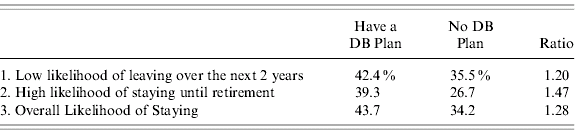
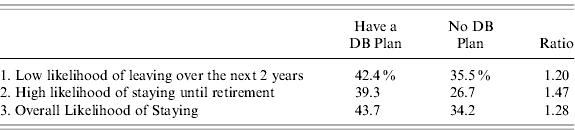
In Table 12, we show the percentage of respondents who say they are unlikely to leave over the next two years and are very likely to stay with their employer until they retire. We separate those with DB plans from those who work at DC-only firms. Employees with DB plans are 20% more likely to say they will probably stay with their employer for the next two years than workers with only a DC plan. When employees are asked about staying with their employer until retirement, DB participants are nearly 50% more likely to indicate a high probability of doing so than DC-only participants.
Retention effects of retirement plans
Note: Low represents a score of 1 out of 5; high represents a score of 5 out of 5. For the combined indicator, high is 9 or 10 out of 10.
Source: Watson Wyatt's Retirement Attitude Survey.
We also created a combined indicator summarizing employees' overall desire to stick with their current jobs.Footnote 13 Respondents with DB plans are nearly 30% more likely to plan on staying with their current employers than those without DB plans.
Again, these estimates do not control for many confounding factors that could explain the higher propensity for employees with DB plans to stay with their employer. So we used a probabilistic model to estimate the likelihood that workers would indicate a strong desire to stay with their firm.Footnote 14 We used the summary indicator described above and assigned ‘one’ for those who respond ‘high’ and ‘zero’ for the others. On average, 40% of respondents say they are highly likely to keep their current job. In fact, 25% indicate the highest possible score on both underlying components.
The model then estimates how an employee's propensity to stay changes along with various core factors. While we predominantly focus on the impact of importsat and plan design on employee commitment, the model also measures the effect of personal characteristics such as age, earnings, and tenure. Prior research suggests that a number of company factors are also important in explaining turnover. For this analysis, we controlled for company size and industry affiliation.Footnote 15 We limited our sample to workers between ages 21 and 60, because older workers' mobility decisions are typically tied to retirement.
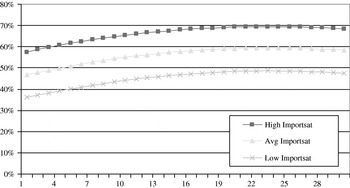
The probability model suggests that employees who both consider their retirement plan highly important and are highly satisfied with their plan also express a strong desire to stay with their current employer. The propensity to stay also rises with age and years of service; we find no correlation to pay. To more accurately describe the effects of advancing age and tenure on higher rates of importance and satisfaction, we derived an age-and-tenure profile of predicted values for an average worker's commitment at various levels of importsat. We based the age profile on a male high-school graduate earning $45,000 annually. He has worked for a manufacturing company for five years and saves outside the plan. We based the tenure profile on a 40-year-old worker who otherwise shares the same characteristics. Finally, we based estimates on three different levels of importsat, with each level representing a one-standard-deviation improvement.
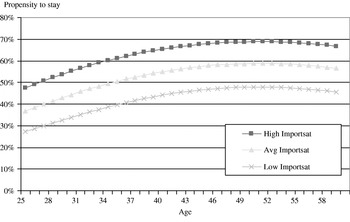
Employees' appreciation of their retirement programs profoundly affects their desire to stay, as Figure 4 clearly illustrates. Increasing importsat from a low level to an average level – a one-standard-deviation increase – raises an employee's propensity to stay from approximately 47% to approximately 57%. This translates roughly into a 22% increase in the employee's likelihood of staying. When workers' appreciation for their retirement plans jumps from a low to a high level – a two-standard-deviation increase – their likelihood of staying climbs nearly 50%. Commitment to one's employer also rises quite sharply along with age. For a given level of work experience, an employee's propensity to stay rises by nearly 50% between ages 25 and 45. However, the trend flattens after that and declines slightly for the oldest workers, probably reflecting retirement.
Employees' propensity to stay with current employer at various levels of plan importance and satisfaction by age
Notes: Estimates are based on a non-union high school graduate who earns $45 K annually, has worked for the employer for five years and saves outside the plan. Differences in predicted values of employees' propensity to stay represent a one-standard-deviation improvement in importsat. For the regression analysis, we included workers aged 21 to 60.
Source: Watson Wyatt's Retirement Attitude Survey.

Figure 5 depicts the relationship between workers' commitment and years of service. Once again, higher employee appreciation increases a worker's desire to stay with the firm, as does increasing tenure. However, tenure wields less power than age. Over the first 15 years of service, a worker's propensity to stay rises quite steadily, but the trend flattens thereafter. For a worker with one year of tenure whose appreciation for the plan is average, the stay probability is roughly 47%. When tenure rises to 15 years, the probability rises to 58%. The stay probability remains fairly stable after that, except for a slight decline at the highest tenure levels.
Employees' propensity to stay with current employer at various levels of plan importance and satisfaction by tenure
Notes: Estimates are based on a 40-year-old male high school graduate who earns $45 K annually in a non-union job. His company sponsors both a traditional DB and a DC plan, and he saves outside the plan. Differences in predicted values of employees' propensity to stay represent a one-standard-deviation improvement in importsat.
Source: Watson Wyatt's Retirement Attitude Survey.

As noted above, importsat reflects the financial disincentives imbedded in the retirement program to discourage employees from leaving before retirement. It also reflects the importance of the retirement plan in attracting employees. The literature has paid considerably more attention to employees who remain with their employers to avoid capital losses than to the tendency of turnover-prone workers to avoid jobs covered by DB programs.Footnote 16 To better understand the individual effect of each, we re-estimated the above model with separate indicators for plan importance and plan satisfaction.Footnote 17
The results reveal a strong positive relationship for both indicators. However, a significant increase in plan satisfaction has over twice the effect on an employee's desire to stay than a similar increase in plan importance. For employees with significantly higher plan satisfaction, the likelihood of staying with their employers increases by 24% relative to the average worker. However, a significant increase in plan importance is associated with an 11% boost in employee commitment. Being attracted to a company because of its retirement plan is an important factor in job change decisions. However, employee commitment appears most responsive to satisfaction with the retirement program, which, as noted above, largely reflects the financial incentives built into the plan.Footnote 18
One drawback to focusing exclusively on the relationship between importsat and workforce commitment is that we cannot isolate the effect of plan type on employee commitment. In particular, are there distinguishable differences in commitment between workers covered by DB plans and those covered only by DC plans? When we include plan indicators in the likelihood-to-stay model, we find that both plan types create strong stay incentives among workers. In fact, estimates at first appear to indicate that DC plans have a modestly stronger retention effect than DB plans.Footnote 19 But, upon further inspection, tests reveal no significant differences between DB and DC plan indicators.Footnote 20 Both DC and DB plans exert similar effects on tenure.
The retention effect exerted by DC plans is somewhat surprising. The benefits provided by these plans are portable, so job mobility does not impose a pension penalty. And vesting periods in DB plans are typically longer than those in DC plans, which we would also expect to boost retention for DB plan participants. In fact, when employers introduce portability into a DB program – such as by converting it to a hybrid pension – workers' commitment tends to fall significantly. The average hybrid plan participant is about 12% less likely to express a strong probability of staying with his employer than his counterpart with a traditional pension plan, according to our estimates.
Finding that DC plans exert a strong retention effect similar to that of DB plans is not unprecedented – previous research has reached a similar conclusion. Gustman and Steinmeier (Reference Gustman and Steinmeier1993) found that DC plans deter mobility just as potently as DB plans. They concluded that offering any retirement plan mattered more than the plan type. Mobility generally rises and falls depending on whether workers can earn more at another job, rather than the amount of their current wages and any potential pension loss. Gustman and Steinmeier explain turnover primarily in terms of a compensation premium paid by jobs with pension plans. This falls into the same nexus that pension firms pay efficiency wages – wages set above competitive levels to give workers an incentive to stay.
In this analysis, however, we limited our sample to workers with pension coverage, and yet DC plans have much the same impact on mobility as DB plans. Limiting our sample in this way should in part control for the wage differentials offered by non-pension firms.
One concern with this approach to estimating the effect of employees' appreciation of their retirement plans on their commitment to their employer is that, as we showed in the previous section, employee appreciation correlates highly to plan type, particularly for DB plans. Moreover, many demographic characteristics such as age and tenure are highly correlated with employees' appreciation for their retirement plans. So the correlation between the explanatory variables could make it difficult to disentangle the separate influences of importsat and plan type on employee commitment.Footnote 21 As the current model suggests, plan type would have a direct effect on job mobility through the plan type indicators and also an indirect effect through importsat.
To isolate the impact of plan type on employees' commitment to their firms, we had to eliminate its indirect effect through importsat. To do so, we substitute the residual from the plan appreciation model we discussed earlier for the importsat variable in the original model. The residual encapsulates all aspects of employees' appreciation for their retirement programs that are not accounted for by the explanatory variables in the appreciation model, which include various plan aspects – plan type, generosity, and communication – and individual characteristics. Presumably, the residual captures information such as how the program compares to competitors' programs. It could also reflect an employee's preference for deferred compensation in a tax-advantaged account, which we could not account for directly in the model. Or more broadly, the residual could reflect a general sense of organizational and cultural cohesion as well as a general sense of satisfaction with the compensation package.
When we adjust importsat, we find – again – that DB plan participants are much more likely to indicate a high probability of staying with their employers.Footnote 22 In fact, DB plan participants are roughly 10 percentage points more likely to plan on staying with their employers than workers without DB plans. However, under the new model specification, DC plan participants are no more likely to express a strong desire to stay put than workers without DC plans. The ‘golden handcuffs’ comes off at DC-only firms. Moreover, the type of DB program an employer offers also exerts a powerful effect on an employee's commitment. Having a hybrid DB pension plan rather than a traditional DB plan cuts the reduction in job mobility in half. This further supports the hypothesis that portable retirement benefits lead to higher rates of workforce turnover.
We expanded the model to determine whether plan generosity and communication directly affect employee commitment, rather than having an indirect impact through importsat.Footnote 23 In this formulation, communication effectiveness has rather modest effects on employees' propensity to stay, and plan generosity has a similar limited effect. Beefing up the DB plan increases employee commitment minimally. Enhancing benefits in the DC plan has no effect on employee commitment.
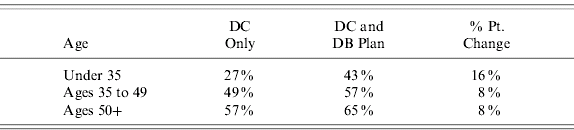
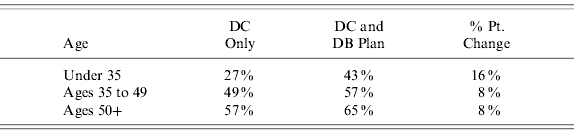
These results suggest that DB plans powerfully influence employees' desire to stay with their companies. However, how does the effect play out among different age groups? To find out, we separately re-estimated the likelihood-to-stay model for young, middle-aged, and older workers. As shown in Table 13, DB plan participants of all ages are significantly more likely to indicate a strong desire to stay with their companies. However, a DB plan's effect on retention is greatest among younger workers. Forty-three percent of younger workers with a DB plan indicate a strong desire to stay with their employers compared to 27% with only a DC plan.
Projected impact of plan design, importance and satisfaction on young, middle-aged and older employees' likelihood of staying with current employer
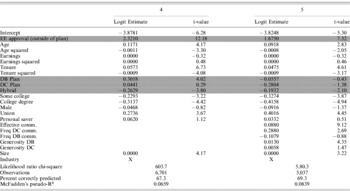
Notes: We based these estimates on separate Logit regressions for each age group based on Model 4 in Table A.3.1.
Source: Watson Wyatt's Retirement Attitude Survey.
These findings are applicable only to employees who can correctly identify their retirement plan. But even when we expand our sample to include all workers, the link between plan type and commitment are very similar.Footnote 24 So as companies balance the risks and costs of sponsoring a DB plan against its benefits, they should consider the potentially adverse effects of eliminating their DB program on workforce commitment. Moreover, terminating DB plans could have undesirable self-selection effects, whereby the company attracts less committed workers. These deleterious effects on attraction and retention could become very expensive, eventually leading to disappointing shareholder returns.
Conclusion
Retirement plans are expensive. If employees don't fully understand or appreciate their plans, employers are not getting the most from their investment in terms of attraction and retention. Many employers overlook the potential value added by increasing employees' understanding and appreciation of their retirement plans. This can be an expensive mistake. DB and DC plans that are highly valued by employees can serve as very effective human resource management tools. A plan's perceived value to employees strongly affects their commitment to their current employer, which is linked in turn to greater organizational success.
Although increasing plan generosity and enhancing plan communication can significantly boost employees' appreciation of their retirement programs, there is a tradeoff to consider. While providing more generous benefits increases employees' appreciation, it can also be very expensive. In many cases, enhancing the communication program is not only more cost effective; it may do a better job of helping employees understand and appreciate their plans.
As companies review their retirement program strategy, they need to consider the potential human resource risks associated with their decisions. DB plans significantly increase employees' commitment to their organizations, owing largely to the higher perceived value of these programs. Even after controlling for plan appreciation, employees with a DB plan tend to report higher levels of commitment than those with only a DC plan. And strikingly, this result is strongest among younger workers. However, an important question that is not addressed in this analysis and would be a rewarding research effort to consider is the extent to which pensions convince the ‘right’ people to stay.
Even so, the results presented here highlight the potential human resources ramifications from company's pension choices. To achieve the organizational success they want, employers must consider how changes to their retirement programs could reshape their workforce and disrupt their operations. It would be a mistake to put short-term cost reductions ahead of long-term success.
Appendix
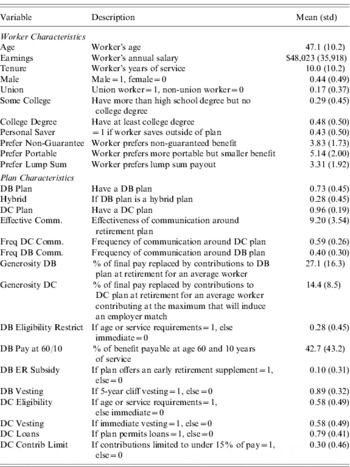
Description of regression variables

Notes: DB and DC specific variables are means (STD) for those covered by the respective plan. Values are for those who correctly identify their plan.
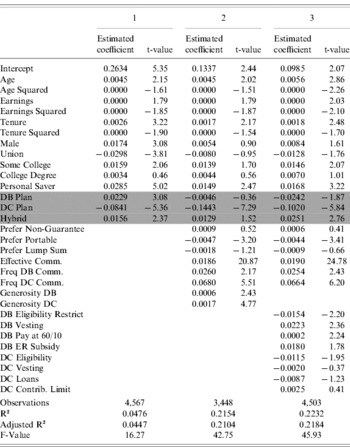
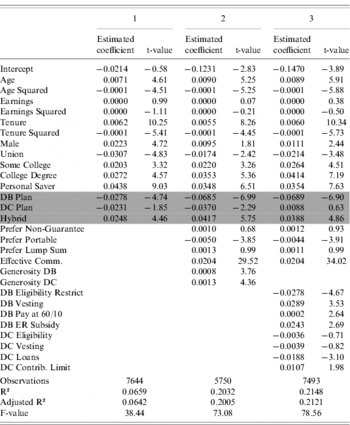
Ordinary least squares estimates of factors that affect plan importance and plan satisfaction

Notes: Dependent variable is the percentage of maximum importance∗satisfaction and takes a value between 0 and 1, whereby 0 represents minimum importance∗satisfaction and 1 is maximum importance∗satisfaction as a percentage of total importance∗satisfaction. Includes workers who correctly identify their retirement plan.
Ordinary least squares estimates of factors that affect plan importance and plan satisfaction

Notes: Dependent variable is the percentage of maximum importance∗satisfaction and takes a value between 0 and 1, whereby 0 represents minimum importance∗satisfaction and 1 is maximum importance∗satisfaction as a percentage of total importance∗satisfaction. Workers who do not correctly identify their retirement plan are set to zero.
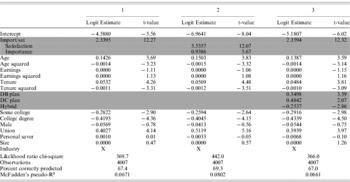
Logit estimates of factors that affect employees' likelihood of staying with their current employer

Notes: Dependent variable takes a one for workers who indicate a high likelihood of staying with their employer until retirement (5 out of 5) and a low likelihood of leaving their employer within the next two years (1 out of 5); otherwise, dependent variable is zero. Includes workers under 60 who correctly identify their retirement plans.
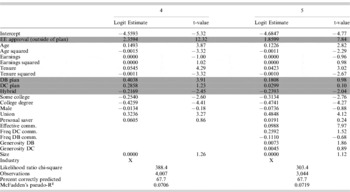
(continued). Logit estimates of factors that affect employees' likelihood of staying with their current employers

Notes: Dependent variable takes a one for those indicating a high likelihood of staying with their employer until retirement (5 out of 5) and a low likelihood of leaving their employer within the next two years (1 out of 5); otherwise dependent variable is zero. Includes workers under 60 who correctly identify their retirement plans.
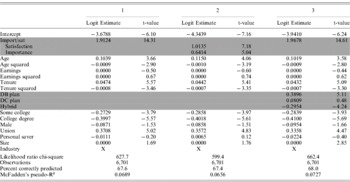
Logit estimates of factors that affect employees' likelihood of staying with their current employers

Notes: Dependent variable takes a one for those indicating a high likelihood of staying with their employer until retirement (5 out of 5) and a low likelihood of leaving their employer within the next two years (1 out of 5); otherwise dependent variable is zero. Importsat is set to zero for workers under 60 who incorrectly identify their retirement plan.
(continued). Logit estimates of factors that affect employees' likelihood of staying with their current employers

Notes: Dependent variable takes a one for those indicating a high likelihood of staying with their employer until retirement (5 out of 5) and a low likelihood of leaving their employer within the next two years (1 out of 5); otherwise dependent variable is zero. Importsat is set to zero for workers under 60 who incorrectly identify their retirement plan.