Since colonial times, the dowry system has spread throughout Indian society, from urban to rural communities and from the higher to the lower levels (Khan and Ayesha Reference Kjan and Ayesha1982; Srinivas Reference Srinivas1978, 26; Leslie Reference Leslie and Werner1998). Ethnographies and scholarly works (Fruzzetti 1982, Srinivas Reference Srinivas1978, Das Reference Das and Jain1975, Van der Veen Reference Van Der Veen1972, Ramu Reference Ramu1977, Sharma Reference Sharma and Hirschon1984, Paul 1986) have explained the phenomenon as having to do with social mobility and economic concerns: marriage exchanges are public affirmations of status. Fruzzetti (1982, 39) juxtaposes dowry gifts with the giving of the bride by maintaining that the gift of a virgin is dictated by caste and kinship principles whereas a dowry is dictated by the sheer availability of cash and property. Historical works by Sheel (Reference Sheel1999) and Oldenburg (Reference Oldenburg2003) have elaborated further on the origin of the dowry. Sheel (Reference Sheel1999) points out that the British colonialists' understanding of the Brahmanic marriage as the typical Hindu marriage form—and the basis for practicing law—spread the dowry custom. Oldenburg (Reference Oldenburg2003), who tracks the course of the dowry system's changing perceptions and functions in the Punjab over time, observes how cash and property began to form an increasing part of dowries' composition when land became a marketable commodity in the colonial period and its value thus rose exponentially. Both Sheel and Oldenburg note how the premodern dowry was consonant with the premodern notions of rights to land, arguing that the present-day dowry pathology owes its origin to the exclusion of women from property rights to land as fashioned by the British.
This articleFootnote 1 examines the rise of dowry system in Janta, a West Bengali village in the Bankura district, where the dowry payments are a relatively new phenomenon. In comparison to the Calcutta neighborhood where I carried out earlier research (Tenhunen Reference Tenhunen2003), the villagers were investing more of their assets in dowries. The oldest generation in Janta had experienced times when no demands for money or other gifts had been made during marriage arrangements, but since the 1950s huge dowry payments have become the central financial transactions in the region. This made me realize that I could complement the archival studies on the spread of dowry payments by talking to people who had experienced and witnessed the changes. Fruzzetti's (1982) exhaustive analysis on marriage rituals and gift giving, carried out in the 1960s and 70s in the nearby town of Vishnupur, provides a crucial point of comparison for this study. In addition to oral history interviews on dowry practices, I draw from my research on the changes in caste, gender and class relationships in the village. I argue that the dowry payments do not merely represent economic considerations in a class conscious society, but that they reflect a rearticulation of both the tradition and market, of gender, ritual, and class identities, and that paying attention to the multiplicity and local variation of dowry practices provides a key to its understanding.
Present day India's dowry system poses problems for the society: there are wife givers' menacing and strained relationship with wife receivers, dowry-related crimes against women, and the great economic sacrifices that parents have to make to arrange their daughters' marriages. But the dowry system also poses the problem of how to conceptualize markets and gifts. In questioning the appropriateness of the juxtaposition of modern markets and gift economies, and seeking new ways to conceptualize the role of gifts in a market economy, my research interest is in line with recent works by both economic historians and anthropologists aiming to reconceptualize exchange systems and gift giving in modern capitalist systems (Davis 1992, Sahlins 1994, Piot Reference Piot1999).
A study of the dowry system in present-day India has implications for the general discussion and understanding of economic systems. Economic historians (Commander Reference Commander1983, Fuller Reference Fuller, Bloch and Parry1989, Good Reference Good1982, Reference Good1991) have demonstrated that the view of the jajmani system (a caste-based gift exchange system) as the dominant mode of the rural, pre-colonial economy in India is misleading. As the Indian jajmani system was one example on which Polanyi (Reference Polanyi1957) based his juxtapositioning of gift- and market-based economies, economic historians' criticism paves the way towards questioning Polanyi's theories on the great transformation. In turn, the reevaluation of economic anthropology's major categories calls for the reconceptualization of present-day exchange systems, such as the dowry in India. Paying a dowry for marriage does not lead to a complete commodification of women, but it differs significantly from giving mere ritual gifts. I maintain that neither gift giving nor the juxtapositioning of gift and market economies can be examined from an economic viewpoint alone or separate from cultural concerns. Reconceptualizing gifts in market economies requires an ethnographic approach and the examination of the contexts of gift giving.
Much of the general discussion and theorization of the dowry problem have tended to overlook the local categories of gifts, although ethnographic studies (Vatuk Reference Vatuk1975, Fruzzetti 1982) have demonstrated that the meaning of dowry gifts lies in their multiplicity. In Indian languages there isn't just a single term that could be translated as ‘a dowry’, but several that refer to different types of gifts. In Bengal, there are two main types of marriage gifts: dan, a freely given gift and pon, gifts which are demanded (pon also means a promise or a bet). Pon is also referred to as dabi, a rightful demand. Fruzzetti notes that in addition to these, there are gifts that are given without a ritual context (upohar), gifts which are payments for services (paona) and gifts given to a groom (tattva). This paper focuses on dan, dabi and pon, the terms around which the discourse on dowry centers in present-day rural West Bengal. I aim to understand the nature of pon, the commodification of gifts, and the reinterpretation of the culture of gifts within a market-based economy. Has the giving of money as a gift incorporated new meanings in reciprocity systems? How do women perceive their role in reciprocity systems: do they criticize the commodification of reciprocity in marriage, or do they perceive a dowry as contributing to their higher status and honor? I will start by describing the changes in gift giving and then proceed to analyze the construction of these gifts and the changes.
The bulk of the material for this research consists of oral history interviews, carried out in 2003 and 2004 with 30 elderly women, on the change in dowry practices over the past few decades at the village of Janta in the Bankura district of West Bengal. I also interviewed four marriage brokers on the current marriage system and collected a complete household census of the village which covers the respondents' caste, neighborhood, sex, age, marital age, occupation, education, the number of children and the type of housing. In addition, I avail myself of the research material that I collected at the village in 1999–2000 and, recently, in 2005. I have obtained many of my insights into village life through observation, participant observation and chatting. Although what has happened to the dowry system is a trend throughout India, I by no means present the cases in Janta as representing all India in general. Despite the prevalence of the dowry system throughout India, there is considerable variation in its development, nature and extent in different communities. It is not within the scope of this article to explore the similarities or the full regional variation in dowry practices in India as based on earlier studies. But just to give an example in comparison to Janta, dowry exchanges were significantly lower in a Bangladeshi refugee village, Subhaspalli, located just two kilometers from Janta. Subhaspalli residents also rely less on agriculture and their marriages are arranged over a much broader area with other refugee communities in the countryside, and even in cities.
Bordered by immense paddy fields, Janta is densely populated by 2,328 inhabitants living in clustered houses. The village's main source of livelihood is paddy cultivation, with most landowners also growing vegetables. Sixty-two per cent of its adult male population are farmers and 21 per cent are laborers, most of whom periodically engage in agricultural labor. Housing materials are telling of the village hierarchy: 74 per cent of the high caste houses and 26 per cent of the low caste houses are cemented. The Tilis are the dominant caste in Janta, both in terms of their numbers and landownership, although the government classifies them as belonging to the Other Backward Castes (OBC). The government classifies Bagdis as a scheduled caste; their main source of livelihood in the village being day labor. Some castes continue their hereditary occupations (Tatis weaving, Kumars pottery, Napits barbering and Cutas carpentry), but with the exception of the carpenter caste, their hereditary occupations only supplement their income from farming. My work on the dowry system includes all other castes with the exception of the Brahmins, who are a small minority in the village.
Changing Gifts and Brides
Marriage practices have not changed in the village, in the sense that most marriages are arranged and take place within castes. In present-day rural West Bengal, marriage rituals and their meanings follow Fruzzetti's (1982) description and analysis of the 1960s and 1970s' rituals as reflecting the Bengali construction of the person. The gift of a virgin (dan) is the greatest and most auspicious gift a man can give, and this giving of a bride is accompanied by other gifts. The size of the dowry reflects the groom and the bride's parallel status, although the dowry's size is defined by many factors. Most women marry outside their native villages, and alliances are preferably sought from villages where a member of the extended kin can investigate the potential groom or bride. Similar to Fruzzetti's description of marriage practices in Vishnupur, there are no fixed patterns of exchanging women, although marriage alliances in Janta are often sought within the circle of one's in-laws. Nevertheless, the marriage circle of the West Bengali villages is more clearly delineated than in urban areas or in the refugee villages.
What has, however, seen drastic changes are the brides and the marriage gifts. Fifty years ago the ideal bride was a child given to the groom's family along with a dowry of voluntary gifts of brass utensils and golden jewelry. Instead of the bride's side paying dowry, bor pon, to the groom's side, the groom's side paid a kanya pon, bride price, the size of which was more customary than negotiated. Today the ideal bride is a high school graduate and the marriage arrangements always entail negotiations on the size of the dowry that the bride's side gives to the groom's side. The groom's side lists all the items on the basis of the negotiations between the groom and the bride's families and the parties agree on the delivery schedule. A large part of the dowry is usually paid in installments after the marriage. The dowry is not accumulated just by the bride's family, but also by her extended kin and friends who are tied by a network of reciprocal obligations.
In present-day rural West Bengal, the highest dowry demands are made by large landowners, especially those who also run small-scale businesses, and by government employees who, in the villages, are mostly teachers. Government employees are usually also large landowners because a large bribe is needed to acquire a government job. The highest strata of rural society can demand up to Rs 15 0000— clearly putting them out of a working class family's reach. Laborer and marginal farmer families barely earn the 3000 rupees a month that a family of four needs for basic expenses. For farmers, land is a crucial dowry measure. During the high point in dowry demands in 1999, I was told that a groom's parents could demand a dowry of Rs 20 000 per bigha (0,33 acre) of their land. Since then, the dowry demands of farmers who do not run a side business have decreased drastically due to the crisis in paddy cultivation which has lowered the profitability of paddy cultivation.Footnote 2 Nevertheless, many small and middle landowners, especially families with more sons than daughters, have been able to increase their landholdings through marriages: land is often purchased with dowry payments, or given as part of a dowry.
The elderly villagers explain the onset of excessive dowry demands as caused by people becoming wealthier and wanting to secure better houses for their daughters. Indeed, since India's independence, the intensification of agriculture and land reforms has led to new types of economic differentiation in rural India. Cash and property first started forming part of dowries' composition when land became a marketable commodity during the British colonial rule. Pre-British India was ruled by local Rajas and various intermediaries between the Raja and the peasant tillers of the soil whom the emperor had rewarded with zamindari holdings for life. The British East India Company's permanent settlement policy changed the economic and social structure of Bengal by making the land the zamindars' private property, and ignoring the previous relationships between the tiller, intermediaries of various kinds and the state (Cohn and Berreman Reference Cohn and Berreman1971: 80).
The abolition of the zamindari system in 1955, and the implementation of the land ceiling law in the 1960s, led to the consolidation of power in favor of middle peasants throughout India. This resulted in the decline of ex-zamindar bhadralalok, the non-cultivating and absentee landowners, and the rise of the chasi, the landowning, self-cultivating peasants. The rise of the Left Front in West Bengal in the 1970s did not threaten the middle peasants' position. In fact, the middle peasants introduced Communism to rural West Bengal by mobilizing the lower classes against the predominantly landed village elite who was allied with Congress (Mallick Reference Mallick1993: 130, see also Bhattacharya 1999 on the Left Front's support of the middle peasants). Bandyopadhyay (Reference Bandyopadhyay2003) notes that the Left Front had few other alternatives than to mobilize the middle peasants when it suddenly needed to build its base in the rural areas from scratch. In turn, the middle and upper peasantry seized the opportunity to replace the older rural aristocracy's authority.
Before independence, two large landowners owned most of the arable village land, but there are no longer large absentee landowners in Janta. In the sample (N = 44) of landowners whom I interviewed on the size of their land holdings, 43 per cent were marginal, 34 per cent small, 13 middle and 9 per cent large. Adapting Mallick's (Reference Mallick1993: 39) definition of West Bengali farmers, I define as marginal those landowners who own less than four bighas (I bigha equals 0,33 acre), and as small, those who own 4–9 bighas. I base the cut-off point between the small and marginal on the fact that, according to the villagers, four to five bighas of land are required to support a household of four to five persons. Consequently, all marginal farmers as well as small farmers with large households are compelled to supplement their income from farming with wage labor. I classify as middle farmers those who own 10–20 bighas, and those owning more than 20 bighas as large landowners. Anybody landless or owning less than three bighas (one acre) of land is considered eligible to receive 0.5–3 bighas (0.16–1 acre) of land. However, the plots given are usually only 0.5 bigha and not large enough to support even a small family. The great majority of the landless in Janta have yet to receive their share, since the government lacks land for distribution. Of the 108 scheduled caste men in Janta, only 13% own land and five percent are sharecroppers (author's own household census 2004).
In Janta, dowry demands began in the 1950s, after the abolition of the zamindari system. At first, dowry demands (dabi and bor pon) complemented and accompanied freely given gifts (dan). According to Fruzzetti (Reference Fruzzetti1993), this was also the situation in Vishnupur in the 1960s and 1970s: dowry consisted of both pon and gifts, such as jewelry, utensils, and clothing, that were freely given to the bride to accompany her to her in-laws' house. Villagers in present-day rural Bengal still differentiate between dan and dabi, but now they say that there is nothing but dabi (dabir baire kichu nei), demand: all gift items have become part of the negotiations.
The key dowry items, the brass utensils, were used for the daily cooking until they were replaced by vessels made of cheaper materials, such as steel and aluminum and plastic for water containers. The designs of the vessels made of new materials are based on the brass utensils' forms. The adoption of cooking vessels made of new materials has changed the meaning of the brass items given as gifts at weddings. They are no longer articles of everyday use, but have become valuables that remain stored away for most of the year, only taken out during a few religious ceremonies. The higher the groom's status and position, the higher the number of the brass items given. Utensils and golden jewelry are not only part of dabi, but they are also often exchanged for cash. Most women no longer had the dan they had received on their marriages, because the items had been pawned, sold or given as gifts on their daughters' marriages.
However, the major change derived from the inclusion of cash as part of the dowry is that the groom and bride's various characteristics were given a monetary value after the introduction of pon. Elderly villagers claim that earlier issues such as the color of a complexion did not matter in the marriage negotiations, whereas today such personal characteristics directly influence the dowry's size. In present-day rural West Bengal, the bride's education, light complexion and government job can reduce the dowry significantly. On the other hand, the parents of a well off groom, preferably a landowner who also runs small scale business and has a flawless reputation can demand 100 000 rupees. Parents usually try to find out about the potential bride or groom's character and reputation because any defects affect the dowry size. The wealthiest strata also considers the medical history of the potential bride and the groom, and blood tests are usually taken to rule out hereditary illnesses. Most villagers explain these tests as being about finding out whether the couple's blood matches interpreting the medical discourse through the indigenous construction of blood (rokto).
During one of my stays in Janta, a potential groom's family had suddenly come to see one of the village girls, and their marriage had been finalized and performed the same day. The groom was a middle landowner who demanded Rs 20 000 in cash, only about a fourth of what he could have asked. Later I heard that the dowry had been set low because the groom had wanted to marry for love, but his parents forced him to enter into an arranged marriage. The bride's side was able to marry their daughter to a well off family without having to pay a high dowry, but the villagers thought that by overlooking the groom's prior relationship, the family risked their daughter's happiness. Dowry-related crime in India gets much public attention, but I did not encounter any harassment of women for more dowry in the region where I worked. The dowry system has rather led to speculation with potential brides and grooms' marriageable qualities or the lack thereof. Bride takers can prosper by accepting brides with defects and, in turn, bride givers can save by marrying their daughters to houses whose reputation is blemished. A marginal landowner family, for instance, knowingly chose a mentally unstable bride for their son in return for land. When the first daughter-in-law committed suicide due to her illness (she was not harassed by the in-laws), the parents again arranged a marriage for their son to another mentally ill girl, again receiving land.
There are many reasons for the continuation of dowry giving despite its aberrations and the burden it places on girls' parents. A dowry indicates a natal family's appreciation of a girl as well as her status in the conjugal village. Parents are ready to make economic sacrifices to see their daughters married to good houses. Moreover, the money given at marriages circulates. The bride givers may run into debt, but the bride takers become wealthier. Not only men are at the receiving end, as women consider a dowry as their share of their parents' assets that they leave behind to join their husband's household. Many small farms are only viable thanks to the wealth that the wife brought to the house in the form of land or cash that was used to buy land.
Multiplicity in Marriage Practices and Negotiations
The giving of high dowries may have accentuated the Bengali construction of personhood and the meanings of kinship by raising the stakes between bride givers and takers: the exchanges of wealth are based on expectations of a proper kinship relationships between the bride givers and takers. Rising dowry demands have nevertheless also led to alternatives to the traditional marriage practices. Marriages are often arranged suddenly in order to bring down the cost of feeding the extended kin at the wedding party. These short-cut marriages are arranged at either the bride or groom's home, or in a temple, which lowers the cost even further. Such an instant marriage could slightly affect the family and kinship in that performing a marriage ceremony in the presence of only a few family members could create a reserve between them and the more extended kin. These short-cut marriages are often, but not always, love marriages. They have not drastically transformed the kinship system, although the villagers feel that those marriages that do not follow village exogamy, influence the alliance structure.
The general answer given to the question why guardians do not usually approve of love marriages was that they had wanted to marry their daughters and sisters off to better families. Yet, with dowry demands continuously increasing, it is doubtful whether a marriage to a more prosperous house was always possible. Another explanation offered for their disapproval was that love marriages upset the family hierarchy, as would be the case if a younger brother or sister intended marrying before their older siblings. The main objection, however, was generally tacit and stemmed from the desire to protect the family honor. No father or older brother was willing to allow his daughter or sister to meet a boy before marriage, especially if this was unsupervised. If such a boy were not willing to marry his girlfriend, arranging the girl's marriage to someone else might prove complicated and require a large dowry. On the other hand, love marriages require less dowry than arranged marriages.
In Janta, the acceptance of love marriages is also facilitated by the fact that they support caste endogamy in the village and that they resemble arranged marriages in that the parents or guardians of the couples usually get to negotiate the dowry and set the marriage date. Nevertheless, love marriages may induce changes. The villagers speculated more on the changes in the relationships with the in-laws than on the possible difference that such a marriage could effect in the husband-wife relationship as opposed to that of an arranged marriage. Perhaps the husband-wife relationship was considered equally unpredictable in both types of marriages. Love marriages are known to lead to divorces, while, on the other hand, arranged marriages are entered into with the expectation that they lead to a loving relationship between spouses.
Most love marriages occur between people from the same village, and many married women considered it absurd to be able to see one's parents' house from one's in-laws' house. The proper relationship between the houses would, according to women, require distance. They feel that distance contributes to the woman's adjustment because problems and conflicts that should be settled within the confines of a single house cannot extend to any other house. Distance also sustains the meanings of kinship, thus upholding the honor between the houses. Even if in-laws have come to accept a love marriage, if their son-in-law lives next door, his visits do not become such momentous events as they would if he were to visit from further away. And if there is no proper meaning assigned to in-laws, kutum, this could lead to kutum not fulfilling their obligations. Women stated that the benefit of an arranged marriage is that the parents who arranged the marriage feel an obligation to see to their daughter's well being even after the marriage. Love marriages are therefore experienced as causing a change in the alliance patterns and in the integration of families into kinship networks.
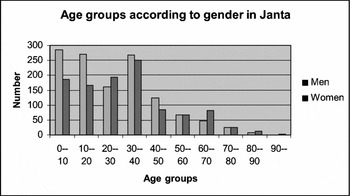
As the above mentioned examples illustrate, the general trend of increasing dowry payments does not exclude diversity. In fact, the criteria in respect of dowry payments contribute to diversity. As a marriage broker emphasized, each case is different. Not everyone who could demand an exorbitant dowry does so, and not everyone who demands, gets what is expected. In turn, girls' houses can decide whether they want to marry their daughter up, or whether they will accept a house with a lower status, which will decrease the dowry. I was told that whereas service holders and large landholders continue to demand and get high dowries, landless and marginal landowners and unemployed men are finding it hard to find brides. Villagers claim that this as well as the lessening of dowry demands is due to the distorted gender ratio (see chart 1.). Indeed, there are significantly fewer girls than boys in the village which may tell of the neglect of female children. I did not find any evidence of villagers detecting the sex of the unborn child by ultrasound. Usually couples who manage to have a male first born child stop having more children, whereas the ones who have girls try to have a son and this may also contribute to the gender imbalance. The skewed gender ratio may be doing more to alleviate the giving of dowry than its prohibition by law—the giving of a dowry was prohibited in India in 1961.
Source: author's survey 2004

The Logic of Demand (dabi)
The spread of dowry demands (bor pon and dabi) has brought a certain type of market logic to marriage negotiations. Yet, the payment of dowry also evades classification in Western or mere economic terms or functions. Dowry giving in Janta is not perceived as a compensation for the groom's family for receiving an unproductive household member. On the contrary, sons' early marriages are often necessitated by the need for female labor. Although high caste women do not work on the paddy fields or elsewhere outside the home, they have a substantial role in agricultural production. In addition to such crucial household tasks as the daily cooking, women are responsible for the time-consuming work of refining paddy into rice by boiling and drying the paddy seeds. The intensification of agriculture thanks to the adaptation of new irrigation technologies has doubled the harvests along with women's work. Women also participate in the husking of the paddy. Vegetable fields are located nearer to the house than paddy fields, and women from small and marginal farms can participate in all phases of vegetable cultivation with the exception of plowing. Only Brahmin women and women from large farms refrain from working in the vegetable fields. The low caste women can work as daily labor even in the paddy fields as well as in the tile factories.
In present day India, the inheritance law is regarded as a major motivation for the prevalence of the dowry system. Since the law does not guarantee women's rights to inheritance by prohibiting the disinheritance of daughters, the dowry system is seen as a way to give women a share of their natal property. However, these functional arguments do not explain why parents choose to give their daughters a dowry and not an inheritance. As an ample amount of previous research (Sharma Reference Sharma and Hirschon1984, Agarwal Reference Agarwal1994, Madan Reference Madan1975, Vatuk Reference Vatuk1975, Parry Reference Parry1979, and van der Veen Reference Van Der Veen1972) has illustrated that, contrary to Tambiah's (1973) interpretation, dowry in India cannot be classified as women's pre-mortem inheritance, because brides have no control over most of the gifts that they receive at their marriage. Nevertheless, dowry gifts are considered women's assets. Contrary to the popular opinion that dowry denigrates women, most women feel that the dowry given at their marriage contributes to their positive self image. As Oldenburg (Reference Oldenburg2003, 9) points out, a dowry is a woman's safety net in a setting where women always marry outside their natal villages and where their rights in their natal homes lapse when they leave for their marital homes. Oldenburg stretches the argument to controversially define dowry as one of the few indigenous, woman-centered institutions in an overwhelmingly patriarchal and agrarian society.
The villagers describe a dowry's purpose as being given for their daughter's happiness (meye sukhe thakar jonno). Dowry is a form of collective property, and the woman's happiness is seen as depending on the fate of the collective family, for whom the dowry is given. Even the giving of dowry is often a collective act; dowry does not merely consist of the girl's parents' property but the extended kin and friends participate in raising the dowry. Although there is no guarantee of what the groom's family will do with the dowry that they receive, girls' parents try to find out whether the potential groom would use the gifts productively (to extend cultivation or a small scale business) in the interest of the daughter's future (meyer bhabishot). A girls' parents try to avoid grooms who may squander the money, or plan to use the money to repay existing loans, or for sisters' marriages. Land offers the bride most security because the land ownership is directly given to the bride. Even if the groom's family uses the money that they have received as a gift to buy land, this land stays with the married couple even when the joint family disperses into nuclear units. However, giving land depends on the land market of the groom's village; conveniently located land is not always available.
Although dowry demands in the Kolkata working class neighborhood where I worked earlier (Tenhunen Reference Tenhunen2003) were lower than in rural West Bengal, women were even there motivated to give their daughters a dowry. These women received an income from paid employment and used a large part of this for their daughters' marriages. They wanted to concentrate their efforts on arranging their daughters' marriages with care and proper gifts, in contrast to their own marriages that had usually been hastily arranged without proper gifts being exchanged. Women are not passive objects of marriage arrangements and exchanges, but see it as being in their interest to shape the practice. Rather than trying to escape cultural and social constraints or trying to pursue autonomy, women are pursuing their agency in shaping the cultural formations that constitute their identities.
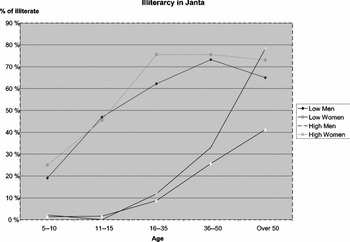
Women's interests in marriage arrangements are, in turn, part of broader changes in the gender relationships in the village, the most pronounced of which are an increase in women's education, women becoming visible in formal politics, and a few high caste women taking up white collar jobs. The decline in illiteracy has been most dramatic among the higher caste women who have gained full literacy in the 11–15 age groups (see chart 2.). This is the highest rate among any age group and is also higher than the literacy of the high caste boys in the same age group. High caste women have caught up with men in literacy and the younger age groups among low castes are catching up with the high castes, but the gap between the literacy levels of low and high castes still remains broad. (Author's survey 2004)
Illiteracy in Janta according to caste and gender (Source: the author's survey 2004)

Women's detailed accounts of the changes illustrate that women have been involved in forging new identities in subtle ways. Instead of radical changes, many women have experienced subtle reforms in family life to which the increase in the general standard of living has contributed. They describe a better life as the ability to be a good family person, to live happily with the family in a small family group in which women can express their opinions, concerns, and wishes. The goals of freedom translate into husbands being more attentive to women's wishes by accompanying their wives to the cinema, on shopping trips and on picnics at tourist sites. Thanks to the increasing prosperity, husbands are now better able to fulfill their wives' fascinations (shoks): women can dress better, eat better, and decorate their houses. Women, who at most have realized subtle changes in their own lives, express determination to provide more major changes for their daughters: better education, less hard work, new job options—and later marriage to good families along with substantial dowries.
It is traditionally the father's responsibility to look for suitable brides and grooms. Mothers cannot go to interview potential brides for their sons and most certainly not grooms for their daughters, but they nevertheless participate in marriage arrangements by finding out about suitable boys and grooms though their networks. The recent introduction of the working phone system to the region has increased women's role in marriage negotiations—since 2001 most parts of rural West Bengal have been covered by cellular phone networks. Instead of leading to attempts to stop the practice altogether, the critical discourse on the dowry system has led to attempts to curb malpractice and to reform marriage arrangements. In the village, women protect their right to regain their dowry in case of a divorce with the help of political parties and women's organizations. I was told that in earlier generations girls were not consulted regarding their prospective groom, but asking the girl's opinion has become a common practice now. Dowry murders are indeed reported, but one can currently also read about cases where, even on the day of the ceremony, the bride's side has refused to carry on with the marriage and reported the groom's side to the police for demanding additional dowry.
Women's interests have played a role in dowry demands, but it is the blending of gendered status- and purity-related considerations which most directly influence how dowry demands are assessed. Dowry negotiations are influenced by the supply and demand of certain characteristics related to hierarchical considerations. Dowry demands not only reflect class and economic status, but also factors that relate to caste considerations, such as education and a white complexion, which are considered essentially upper caste, Brahmin features. I will next examine the blending of the caste and class status by taking a look at the broader context of the social relationships in Janta where the past decades have been a decisive phase in the villagers' economic growth and prosperity.
Class, Caste, and Personhood
When I asked villagers what kind of development (unnoti) they had experienced, both small landowners and landless said that they no longer had to endure regular periods of starvation and food scarcity, which was common only a decade ago. Development is experienced and talked about as the improved ability to earn enough to feed one's family. At the same time the new affluence is conceptualized as part of the broader cultural standard of living, often captured by the expression khaua, makha, pora, which literally means eating, rubbing of oil, and wearing of clothes and which points to the essentials of life. One can fill one's stomach twice a day (as opposed to having rice only once a day) with a greater variety vegetables and with better quality rice than before (when the main course was coarse rice, mota bhat). Women no longer have to wear the epitome of poverty, thick saris (mota saris). Women recalled that these cheap and durable saris, which can still be found in the market, were uncomfortably hot and so heavy that it was difficult to get out of the river after bathing (women bathe with their saris on). Now even the poorer women have taken to wearing thin saris, and they can afford to keep a good sari for special occasions, such as visits outside the village. They can also afford soap for washing and oil to rub on their skin after bathing.
There is a widespread agreement that the gap between the different village strata, between the high and low castes, has narrowed. The upper castes note that the Tili caste's pride has increased and Tilis point out the same change within the lower castes. Left Front policies and new job opportunities have lessened the landless laborers' dependency on the landowners, and Bagdis comment on the remarkable improvement in their caste position. Yet, caste remains one of the villagers' primary identities. News from other villages is always told in relation to the caste identity of the people involved. Villagers know one another's caste identity, while strangers' caste identity is concluded on the basis of their dialect, behavior, or deduced from their clothing.
Issues of pollution and touching are the key principles of how villagers perceive caste: “Here we have caste discrimination (amader eikhane jater bichar kare), didi. We do not touch the Bauris, we do not touch the Muslims. No Tili touches us,” a Bagdi woman explained. Caste discrimination (jater bichar) entails the prevention of pollution through contact with lower castes. Caste purity is chiefly maintained by caste endogamy and by avoiding touching or sitting on the same level as a lower caste person, receiving cooked food from a lower caste, or touching the dishes from which a lower caste person has eaten. Individual villagers justified caste discrimination to me on the grounds of the other villagers' disapproval of caste pollution. Polluting a higher caste person is also considered a sin.
Ideas of purity and pollution prevail in the village, but they do so in a very different setting when compared to the jajmani system (in the pre-British era), or to the era during which the low castes were dependent on the few large landowners of the dominant caste, which lasted from the British rule up to the implementation of the land ceiling laws. Service relationships between castes have become secondary to market relationships, and no single large landowner can act as the highest authority in the village. With the exception of the Tilis, the castes do not meet to discuss disputes as a community. The Tili committee (samiti) still announces rulings on disputes, but unlike the party and the panchayat, it cannot enforce its will on the villagers. In a conversation with me, even the head of the Tili committee emphasized that the caste committee has nothing to do with politics. The main tasks of the caste association are to give advice when families divide their property and to organize religious festivals (pujas). When I asked the villagers whether the Tili samiti ever discusses breaches of caste purity, I was told that the maintenance of caste purity is up to individual households. Instead of a communal body supervising caste discrimination, caste practices are debated in various arenas. Moreover, opportunities for inter-caste socializing, which already starts at primary school where children of all castes have their midday meal (sponsored by the central government) together, have increased.
The high and low castes in Janta do share an understanding and knowledge of what impurity entails, but the consensus is uncomfortable. As Mencher (Reference Mencher1975) also pointed out, the ones higher in the hierarchy go to greater lengths to justify and rationalize the system, presenting explicit or implicit self-doubt about the premise of caste. Had a full consensus prevailed in Janta, the justifications would have been unnecessary. I found indications of the prevalence of the ideas of purity and pollution as well as of the lessening and even outright criticism of caste discrimination. The gap between liberal and critical emotions, and between discussions regarding caste and the maintenance of discriminating practices may be widening. It is possible that the debates and the ambivalence regarding caste are creating space for a change in the dominant caste practices, such as caste endogamy in marriage (as has happened in urban India)—the first case of inter-caste love marriage took place in Janta in 2004.
Sanskritization, which views lower castes as increasing their position by adopting upper caste practices, has explained the pattern of change in caste relations, particularly within the middle castes. In Janta, striving for a purer life style did not appear to be a prime motivation. Lower castes talked about the imitation of the village society's upper strata in terms of consumption, of being able to eat and dress so well that they cannot be recognized as low. Caste is a social reality in the village, but it is not perceived as unchanging or one's sole form of identity. The villagers also recognize class positions, although class differences follow the caste lines, and people observe caste differences in their daily interaction. Most Tilis own land, most of the few village Brahmins have white collar jobs and most low caste people are day laborers. Even those low castes and landless who have received land from the government still depend on wage labor because their plots of land are too small. Caste is the more prominent form of identity in the village when compared with urban areas. In a Kolkata neighborhood where I did research (Tenhunen Reference Tenhunen2003), people seldom identified others predominantly by caste; inter-caste arranged marriages were common, and neighborhoods were not caste-based.
In Janta, class is recognized most by the Tilis among whom there is most class differentiation: those who own enough land and need not work as laborers are considered superior to those who are compelled to work as day laborers. Everybody recognizes those who have white collar jobs as upper class, bhadralok. I was told that low caste, salaried people are also considered as belonging to the upper class, bhadralok, and are even accepted by the Brahmins. Tili women mentioned that my acceptance in the village by higher caste people—they allowed me to sit on the same level as they—was influenced by class, my status as an educated, wealthy (they presumed that as a Westerner, I would be wealthy) person.
The villagers' emphasis on consumption, khaua, makha, pora instead of on striving for a pure life style, indicates that one's identity is indeed based on more than one's ritual status that is based on ideas of purity. Better standards of khaua, makha, pora are conceptualized according to the cultural criteria for class identity, and especially the bhadralok (upper class) lifestyle. Reaching new consumption levels is the lower castes' way of increasing their position, which helps to circumvent purity issues: they do not imitate the high castes' pure habits and thereby confirm the high value of purity, nor do they directly threaten the caste hierarchy. In fact, attaining new levels of consumption has stressed class identity, but has also contributed to the collective pride in one's caste.
As Schneider (Reference Schneider1980) pointed out, gender, class, and kinship connect through the concepts of personhood. The discourses on body, caste, class and gender are interlinked because they all ultimately refer to concepts of personhood. Consequently, rather than doing away with other identities, improvements in any one of these statuses can contribute to other statuses by leading to the reinterpretation of all the interconnected statuses. Although acquiring a higher status by earning more does not influence one's purity and ritual status, it can influence the collective pride in one's caste group. In turn, the new pride can motivate caste members to question the cultural code of conduct based on ideas of purity. The introduction of the monetary gift has intensified the connections between different aspects of personhood facilitating multiple criteria for social standing and dynamism.
Much of the earlier research has interpreted pon as having to do with class and economic status in contrast to dan as having to do with ritual status. I argue that caste and class identities are separate and yet porous and they may interact. Moreover, the porousness of class and caste relates to what has happened to the different categories of gift. Instead of simply entailing adoption of an additional category of gifts to accompany other types of gifts, the gift of money along with the spread of the cash economy and the changing notions of property has led to the rearticulation of dan. According to Fruzzetti (1982), pon differed from other marriage gifts in that it was changeable and negotiable. In present day rural Bengal, the logic of dabi has pervaded all gifts and facets of personhood. At the same time, the market logic of dabi has become based on hierarchical considerations.
To summarize, the gift of money does not merely represent class and economic identities, rather, its introduction is connected to a reconstruction of gender and caste identities as well. The article demonstrates how the giving of money has influenced other categories of gifts, while the market logic has drawn from cultural considerations. Yet, money is not the only agent in the process; gifts are essentially about constructing social and cultural identities: the interconnected domains of gender, kinship, caste and class. The introduction of the monetary gift has made it possible to make connections and set a price on different aspects of personhood facilitating and intensifying the connections between different discourses on personhood. The earlier research on dowry has emphasized the all-India aspects of the dowry exchanges. The rising dowry demands have intensified the meanings given to kinship; nevertheless, giving money as gifts also enables multiplicity, and I suggest that paying attention to the local variations of the gift giving makes it possible to understand the ongoing creative rearticulations of tradition and the market. Dowry bargaining has many strategies and moreover the excessive demands have led to alternatives which can cut down the expenses such as marriages arranged suddenly in the presence of only the immediate kin as well as love marriages which generally require lower dowries than arranged marriages.