Introduction
The cacao (Theobroma cacao L.) tree was domesticated in Southern Mexico and the North Central American region (Cuatrecasas, Reference Cuatrecasas1964; Motamayor et al., Reference Motamayor, Lopez, Ortiz, Moreno and Lanaud2002). Motamayor et al. (Reference Motamayor, Lachenaud, da Silva e Mota, Loor, Kuhn, Brown and Schnell2008) identified 10 genetic clusters in cacao as the Marañón, Guiana, Contanama, Curaray, Nanay, Iquitos, Nacional., Purús, Criollo and Amelonado. The crop was introduced in Ghana in the 19th century and its cultivation spread rapidly across the forest regions of the country.
Formal research into cacao in British colonial West Africa started in 1938 in Ghana, and was occasioned by the ravages of the crop by the cocoa swollen shoot virus (CSSV) disease and difficulties in establishing the crop due to loss of primary forest cover (Posnette, Reference Posnette1940). It soon became apparent that the traditional West African Amelonado cannot make significant contribution to genetic improvement of the crop. The first efforts at base-broadening of cacao in West Africa was the introduction of F1 seeds derived from 102 pods of cacao from Trinidad (Posnette, Reference Posnette1951) originally collected by Pound (Reference Pound1938) from the Upper Amazon region in Peru. Open pollinated F2 and F3 seeds of predominantly 10 Upper Amazon trees were distributed to farmers in Ghana, Nigeria and Sierra Leone from 1954 onwards (Glendinning, Reference Glendinning1957). Parentage of the F1 plants derived from the 102 pods was limited to trees from one region of Peru in the areas of Rio Nanay, Iquitos Island and Parinari on the Rio Marañón corresponding to three cacao genetic groups of Motamayor et al. (Reference Motamayor, Lachenaud, da Silva e Mota, Loor, Kuhn, Brown and Schnell2008).
As the base-broadening efforts primarily emphasized resistance to CSSV disease, the breeding objectives were well focused, but narrow in terms of the targeted germplasm for introduction. To further broaden the base of cocoa available for variety development, various introductions were done from countries in the centre of diversity of the crop, through the International Cocoa Quarantine Centre, UK, and conserved as field GeneBank over different time scales (Lockwood and Gyamfi, Reference Lockwood and Gyamfi1979; Abdul-Karimu et al., Reference Abdul-Karimu, Adomako and Adu-Ampomah2006). Varieties that are easy to establish, precocious and with high cropping efficiencies are particularly needed to ensure profitability of production. Both Padi et al. (Reference Padi, Adu-Gyamfi, Akpertey, Arthur and Ofori2013a) and Ofori et al. (Reference Ofori, Padi, Acheampong and Lowor2015) identified significant differences between some more recent introductions for combining abilities for ease of establishment under moisture stress.
High cropping efficiency generally relates to a significant reduction in vegetative vigour and size during production (Daymond et al., Reference Daymond, Hadley, Machado and Ng2002; Padi et al., Reference Padi, Opoku, Adomako and Adu-Ampomah2012) minimizing any adverse effects of high seedling vigour on crop management. The objectives of the present study were to determine the combining abilities for vigour, precocity and cropping efficiency of clones from cacao populations that have been underutilized in developing varieties in Ghana so as to broaden the genetic base of cacao used for commercial plantings.
Materials and methods
The study utilized cacao varieties derived from manual pollinations made from June to July 2009 between five female and seven male clones using a North Carolina II (NC II) mating design. The female clones were AMAZ 15-15, PA 107, PA 150, PA 7 and T79/501. Except for AMAZ 15-15 and PA 107, these are important clones used as parents in the seed gardens across West Africa. AMAZ 15-15 is a clone of Iquitos origin, whereas clones with the prefix PA are of Parinari origin, belonging to the Marañón genetic group (Motamayor et al., Reference Motamayor, Lachenaud, da Silva e Mota, Loor, Kuhn, Brown and Schnell2008). T79/501 was derived from PA 7 × NA 32 made in Trinidad and collected by Posnette in 1944 (Lockwood and Gyamfi, Reference Lockwood and Gyamfi1979). The male clones were selected from cacao genetic groups that are underrepresented in the seed gardens used for variety development in Ghana. They include AMAZ 3-2 (Iquitos origin), APA 4 (an Amelonado clone originating from Columbia), CRG 9006 (derived from GU 144C × MAN 15-2), EQX 78 (originating from Ecuador), Goaso (Amelonado clone selected in Ghana), GU 255V (a clone of Guiana origin) and MAN 15-2 (a clone originating from Brazil). The 12 cacao clones were genotyped with 72 single nucleotide polymorphism (SNP) markers to reveal patterns of genetic diversity among them. The 72 SNP markers were selected based on their levels of polymorphism in the previous experiments (Ji et al., Reference Ji, Zhang, Motilal, Boccara, Lachenaud and Meinhardt2012; Padi et al., Reference Padi, Ofori, Takrama, Djan, Opoku, Dadzie, Bhattacharjee, Motamayor and Zhang2015), and their map positions are given in (Allegre et al. Reference Allegre, Argout, Boccara, Fouet, Roguet, Bérard, Thévenin, Chauveau, Rivallan, Clement, Courtois, Gramacho, Boland-Augé, Tahi, Umaharan, Brunel and Lanaud2012). SNP fingerprinting was performed at KBiosciences using the competitive allele-specific PCR KASPar chemistry (KBiosciences, Hoddesdon, Hertfordshire, UK). The variety PA 7 × PA 150 obtained from the seed gardens in Ghana was used as standard in the experiment to obtain a total of 36 test varieties. Mature hand-pollinated seed pods were harvested and seeds were nursed in polythene nursery bags from December 2009 to April 2010.
The experimental site located at Tafo (latitude 06°14′N, longitude 0°21′W) was characterized by a sandy loam soil, with organic carbon and total nitrogen contents (%) of 1.35 ± 0.191 and 0.15 ± 0.079, respectively. The soil was of acidic reaction (pH 5.45 ± 0.026) with available phosphorus (ppm) and exchangeable potassium (meq/100 g soil) contents of 14.65 ± 1.301 and 1.22 ± 0.039, respectively. The mean annual rainfall recorded from 2010 to 2014 at the location was 1721 mm with a bimodal pattern of April to July and September to November. Plantain was established at a spacing of 2.5 × 2.5 m2 between and within rows to provide temporary shade to the cacao plants. Gliricidia sepium was planted in alternate rows of the plantain to obtain a planting density of 5 × 5 m2 to provide longer-term shade to the cacao plants. Seedlings of Terminalia spp. were planted at a density of one tree per 500 m2 (20 trees/ha) as permanent shade for the duration of the crop. Cacao seedlings were transplanted to the site in June 2010 at a spacing of 2.5 × 2.5 m2 (1600 plants/ha) with 20 plants per plot in a randomized complete block design with four replicates. In July 2010, each cacao seedling was fertilized with 70 g nitrogen supplied as ammonium sulphate. No agrochemical was applied thereafter for the first 24 months after planting. Following the start of flower production, application of fertilizers and agro-pesticides followed recommended practices for cacao production in Ghana.
Stem diameter of each seedling was measured 15 cm above the ground surface with the aid of electronic calipers at 6 monthly intervals from September 2010 to March 2015. The trunk cross-sectional area (TCSA) was obtained from the stem diameter measurements. Annual dry bean yields were estimated from the total number of healthy pods produced per plot (typically in four separate annual harvests) divided by the pod index. The pod index was obtained from the number of pods required to obtain 1 kg of dry cacao beans, estimated from the dry weight of a sample of 30 pods per plot. As the analyses focused on a relatively young crop, and black pod disease caused by Phytophthora spp. was controlled by following recommended regime of fungicide sprays, incidence of the disease was minimal with large variations in incidence between plots, and diseased pods were excluded from yield estimations. The first year of yield records were obtained from October 2012 to March 2013, but was not analysed due to large variation in yield of the first year records, typical of cacao. Precocity was defined as the average annual yield obtained in the second and third years of yield recording from April 2013 to March 2015. Cropping efficiency was estimated as the cumulative yield (averaged per tree) from April 2013 to March 2015 divided by the increase in TCSA over the same period.
Data analyses
The GENALEX 6.501 program (Peakall and Smouse, Reference Peakall and Smouse2006, Reference Peakall and Smouse2012) was used to perform principal co-ordinate analysis (PCoA) on the 12 parental clones to observe the pattern of genetic relatedness between them. Pairwise Euclidean distances (GD) were calculated on the 72 SNP data, and the GD was used to conduct the PCoA using a covariance matrix with data standardization option. For the agronomic data obtained, plot level values were used in analyses of variance (ANOVA) following tests for normality (based on the plot of residuals). Except for the PCoA, all statistical analyses were performed using the GenStat statistical software, version 12 (VSN International Ltd., Hemel Hempstead, UK). First, the ANOVA considered all 36 crosses to test for significant differences among the varieties. The analyses utilized the cumulative or average trait values across years, with varieties considered fixed effect. The GCA and SCA effects were estimated with the model (Dabholkar, Reference Dabholkar1999)
 $${Y_{ijk}} = {\rm \mu} + {g_i} + {g_j} + {s_{ij}} + {r_k} + {e_{ijk}}.$$
Y ijk is the value of the character measured on cross i × j in the kth replication; g i is the general combining ability (GCA) effect of the ith parent; gj is the GCA effect of the jth parent; s ij is the SCA effect of cross i × j; r k is the replication effect; e ijk is the environmental effect peculiar to (ijk)th individual; and μ is the population mean effect. The effects of females and males were considered fixed, whereas replication effect was considered random. The additive and dominance variances were estimated following the method of Dabholkar (Reference Dabholkar1999). The average covariance of half sibs (additive variance) was estimated following the method of King et al (Reference King, Quinby, Stephens, Kramer and Lahr1961). The variance components were used to estimate narrow-sense heritability (h 2) on a full-sib progeny mean basis as suggested by Hohls (Reference Hohls1996). The genetic correlation [and associated standard error (SE)] between two traits, i and j were estimated as suggested by Hallauer and Miranda (Reference Hallauer and Miranda1988).
Results
Clone diversity and performance of F1 varieties
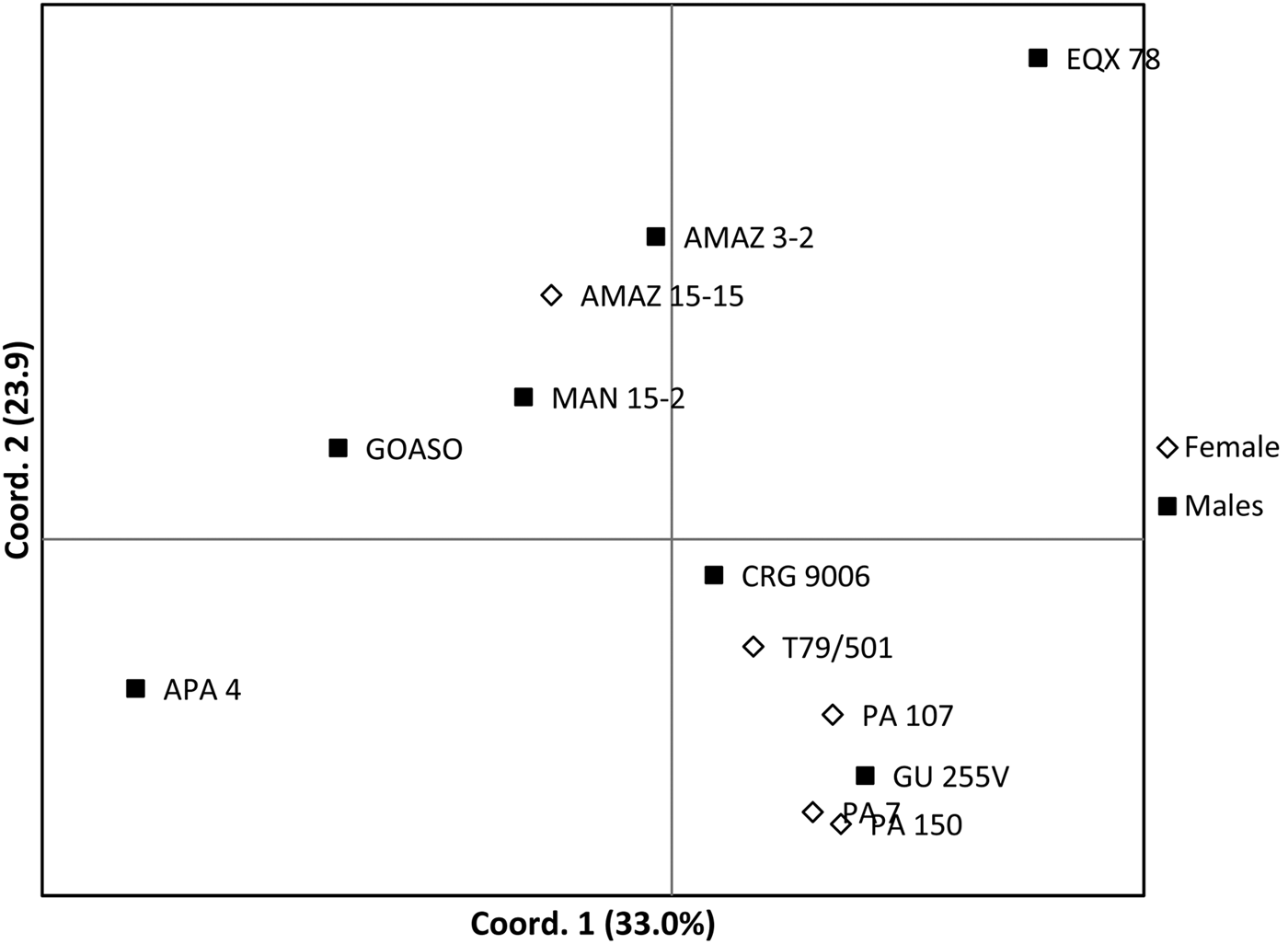
The genotypes of the 12 parental cacao clones based on 72 SNP loci are provided in Supplementary Table S1. As expected, because the male clones were intentionally selected to increase the diversity available for variety development, all estimates of genetic diversity were higher among males than female clones: higher percentage polymorphism (97% versus 74%), higher expected heterozygosity (0.36 ± 0.016 versus 0.28 ± 0.022), and higher Shannon information index (0.54 ± 0.020 versus 0.41 ± 0.032). In the PCoA (Figure 1), female clones were generally grouped together (except AMAZ 15-15), whereas male clones were more diverse, a reflection of the preponderance of clones of Marañón origin or parentage in the seed gardens.
Principal coordinate plot of 12 cacao clones genotyped at 72 SNP loci, five clones used as females and seven as males in a factorial mating design to generate 35 F1 crosses.

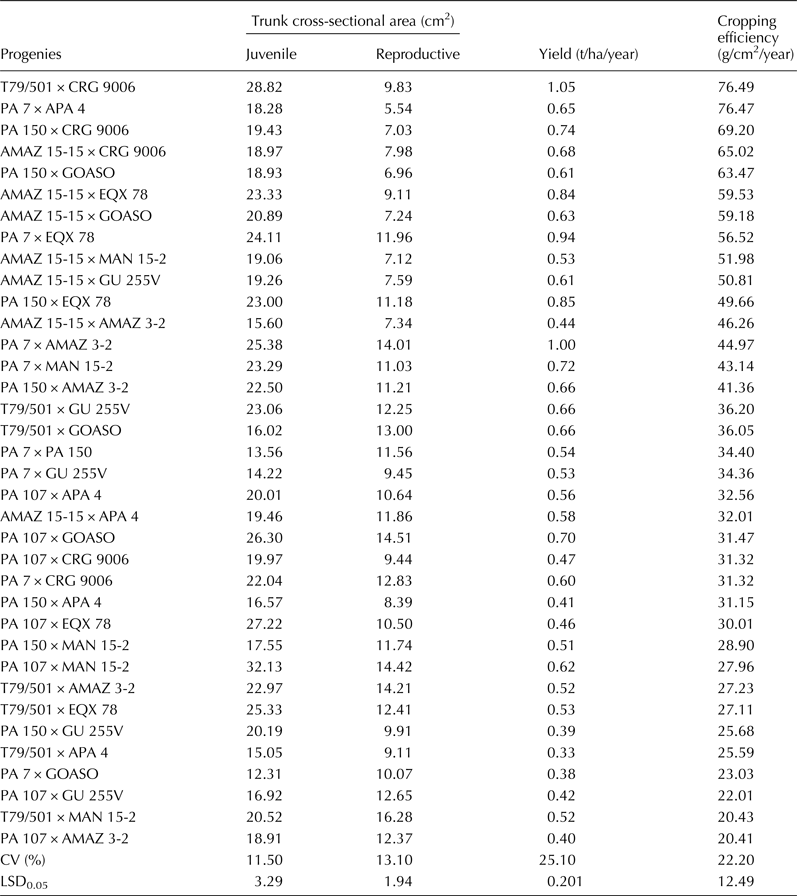
Among the 36 F1 varieties, significant differences were observed from the ANOVA for the increase in TCSA during the juvenile and reproductive periods, the average yield and cropping efficiency. Increase in TCSA from March 2011 to March 2013 (juvenile phase) was higher than that from March 2013 to March 2015 (reproductive phase) by a factor of 2 on average (Table 1). This indicates that rate of vegetative biomass addition reduced significantly with onset of pod production. The juvenile phase increase in TCSA ranged from 12.31 to 32.13 cm2 among the varieties. Varieties with the smallest increment were dominated by those with PA 7 as a female parent, whereas the varieties with the largest increments were typically those with PA 107 as female parent. In the reproductive phase, a threefold difference was observed between varieties for increase in TCSA, ranging from 5.51 cm2 in PA 7 × APA 4 to 16.28 cm2 in T79/501 × MAN 15-2. Among all varieties, PA 7 × APA 4 had the largest reduction in the rate of increase in reproductive phase TCSA relative to that in the juvenile phase. Conversely, the standard variety had the slowest reduction in the increase in reproductive phase TCSA relative to the juvenile phase.
Growth and yield performance of 36 cacao progenies evaluated over a 5-year period at Tafo, Ghana

Though most varieties started pod production by 27 months after transplanting, the yields for the first year of yield recording (September 2012 to March 2013) had large error variances, typical of early yields in tree crops, and was not reported. Bean yields were least in T79/501 × APA 4 (0.33 t/ha/year) with 14 other varieties having yields not significantly different. The standard variety produced 0.54 t/ha/year, whereas the highest yielding variety T79/501 × CRG 9006 recorded 1.05 t/ha/year. Cropping efficiency varied almost fourfold from 20.41 g/cm2/year in PA 107 × AMAZ 3-2 to 76.49 g/cm2/year in T79/501 × CRG 9006. Generally, varieties with AMAZ 15-15 as female or CRG 9006 as male parent recorded higher cropping efficiencies. The standard variety recorded cropping efficiency of <50% of that of the top three most efficient varieties.
Variance components and combining ability analyses
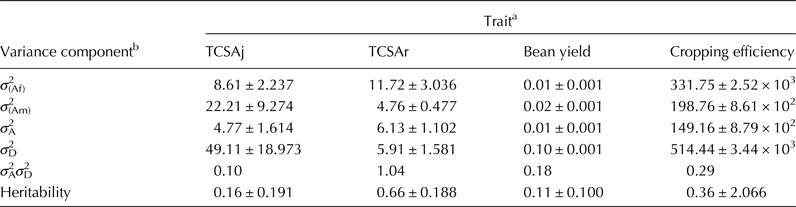
The mean squares from the ANOVA based on the NC II design showed significance of the mean squares for females, males and females × males for all four traits under study. For all traits (except for increment in TCSA during the reproductive phase), the dominance variance component (SCA variance) was much larger than that due to the additive variance component (GCA variance) derived from the pooled variance of female and male effects (Table 2). The ratio of the additive to dominance variance that indicates the importance of additive effects was therefore much lower than unity for all traits, except for the increment in TCSA during the reproductive stage. Similarly, except for the increment in TCSA during the reproductive stage, the narrow sense heritability estimates were low, with large SE.
Variance components from performance of cacao progenies obtained from a factorial cross of five females and seven males evaluated at Tafo from 2010 to 2015

a TCSAj is the juvenile stage increase in trunk cross-sectional area; TCSAr is the reproductive stage increase in trunk cross-sectional area.
b σ 2 (Af) is the additive variance component due to females, σ 2 (Am) is the additive variance component due to males, σ 2 A is the average additive variance component from females and males, σ 2 D is the dominance variance component, and σ 2 A σ 2 D is the additive: dominance variance ratio.
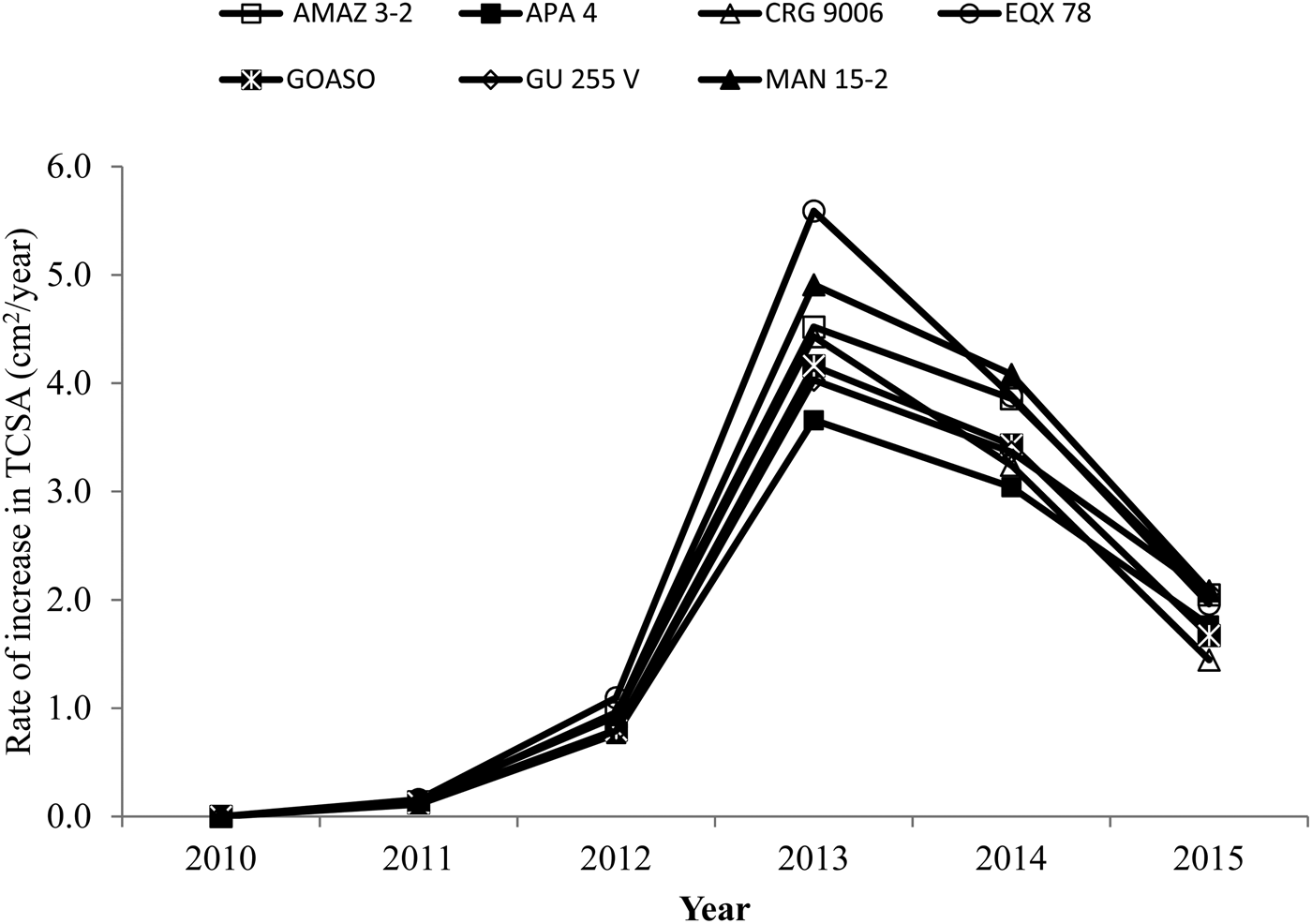
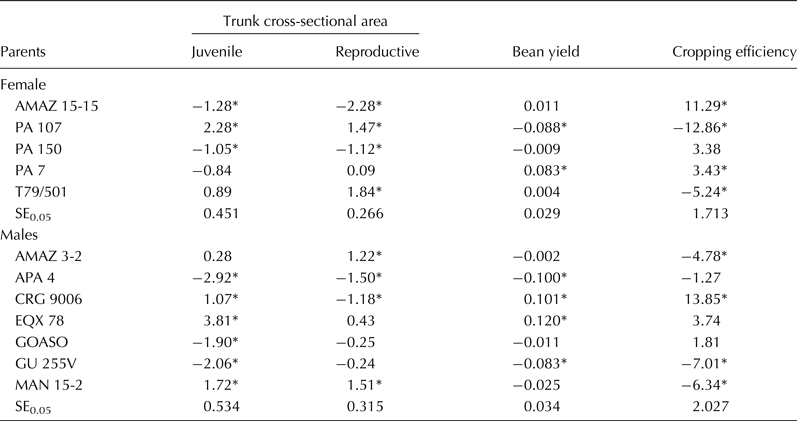
The GCA effects for the four traits are indicated in Table 3. For the female clones, AMAZ 15-15 and PA 150 recorded significant negative GCA estimates for increase in TCSA during both the vegetative and reproductive phases. On the other hand, PA 107 had significant positive GCA effects for the increase in TCSA during both juvenile and reproductive phases, indicating its contribution to F1 varieties with large plant sizes. The GCA effects of PA 7 and T79/501 were not significant. During the reproductive stage, T79/501 had significant positive GCA whereas the GCA estimate for PA 7 was not significant. Among the male clones, EQX 78, MAN 15-2 and CRG 9006 had positive GCA estimates for juvenile phase increase in TCSA whereas APA 4, GU 255V and GOASO had negative GCA estimates. Except for CRG 9006, the sign of GCA estimates for the reproductive phase TCSA were generally the same as for the juvenile phase TCSA. CRG 9006 induced a much slower increase in TCSA during the reproductive phase compared with its performance in the juvenile phase. Similarly, the per se performance of paternal clones for increase in TCSA over time (Figure 2) depicts a much slower increase in TCSA by CRG 9006 once pod production started in 2013. Clones EQX 78 and GOASO also induced much slower increases in reproductive stage TCSA compared with the other clones. For bean yields, only the positive GCA estimate of PA 7, and the negative estimate for PA 107 were significant. Among the male clones, only EQX 78 and CRG 9006 had significant positive GCA estimates for bean yields, whereas GU 255V and APA 4 had negative contribution. For cropping efficiency, AMAZ 15-15 recorded a large positive GCA estimate, followed by PA 7. The positive GCA estimate for clone PA 150 was not significant at P = 0.05 based on the SE. T79/501 and PA 107 recorded significant negative GCA estimates for cropping. Among the male clones, only CRG 9006 had a significant positive GCA for cropping efficiency. MAN 15-2, GU 255V and AMAZ 3-2 had significant negative GCA estimates for cropping efficiency.
Rate of increase in TCSA based on per se paternal performance for seven cacao clones in a 5 × 7 factorial mating, evaluated over 5 years.

GCA for the increase in TCSA during the juvenile and reproductive periods, and for yield and cropping efficiency for five female and seven male cacao clones evaluated at Tafo, Ghana

* Estimates significantly different from zero.
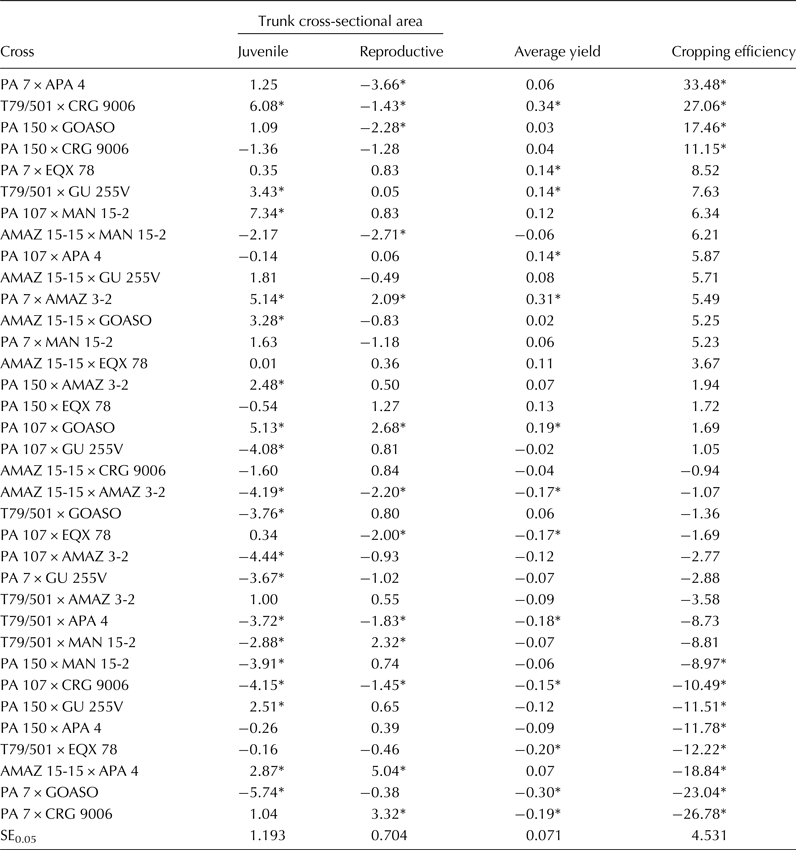
Among the 35 F1 varieties, 19 had significant SCA estimates for juvenile phase increase in TCSA, with nine being positive and 10 negative (Table 4). Except for PA 7 that contributed to only one variety having a positive SCA estimate for the juvenile phase increase in TCSA, the other female clones each have two progenies with positive SCA effects regardless of the GCA estimate of the parent. For the reproductive phase increase in TCSA, 13 had significant SCA effects with five being positive and eight negative. Thirteen varieties had significant SCA for bean yield with six being positive and seven negative. Only four varieties had positive significant SCA effect for cropping efficiency with eight having significant negative SCA estimates. In general, values of SCA effects of the F1 varieties could not be predicted based on the parental GCA values. For example, for reproductive stage increase in TCSA, AMAZ 15-15 × APA 4 recorded significant positive SCA though both parents had significant negative GCA estimates. For bean yields, PA 7 × CRG 9006 had significant negative SCA effect though both parents had positive GCA estimates for the trait. Though the correlation of variety per se performance and SCA estimates were generally high with r being 0.78, 0.69, 0.84 and 0.75 (P < 0.01) for juvenile phase TCSA, reproductive phase TCSA, bean yield and precocity, respectively, the associated r 2 values suggests significant deviations from expected SCA estimates based on per se performance of the F1 varieties.
SCA effects for growth and yield traits of 35 cacao crosses derived from a factorial mating design of five females and seven males, evaluated over a 5-year period in Ghana

* Estimates significantly different from zero.
The genetic correlation estimates between traits showed that bean yield had significant genetic correlation with TCSA in the juvenile phase (r g = 0.63 ± 0.31) but not TCSA in the reproductive phase (r g = 0.10 ± 0.51). Cropping efficiency had significant genetic correlation with bean yield (r g = 0.70 ± 0.26) and reproductive phase TCSA (r g = −0.71 ± 0.25), but not with TCSA during the vegetative phase (r g = 0.11 ± 0.51). These relationships are in line with the expected trait performance of the ideal cacao variety for high precocity and cropping efficiency.
Discussion
In spite of almost eighty years of research into cocoa production in West Africa, yields in the sub-region are the lowest among the major production blocs, averaging about 0.5 t/ha. Gockowski et al. (Reference Gockowski, Afari-Sefa, Dziwornu and Fredua-Agyeman2011) indicated that under either low-input, medium-input or high-input systems of production in the Ghanaian commercial plantations, maximum yields of 0.45 t/ha, 0.7 and 1.0 t/ha, respectively, are obtained well after the plantation has past 10 years of age. Though the production environment has changed significantly over the years (declining soil fertility, climate change effects on increasing dry spells) little change has occurred in the genetic diversity of the clones used to generate varieties in the seed gardens (Opoku et al., Reference Opoku, Bhattacharjee, Kolesnikova-Allen, Motamayor, Schnell, Ingelbrecht, Enu-Kwesi and Adu-Ampomah2007; Padi et al., Reference Padi, Ofori, Takrama, Djan, Opoku, Dadzie, Bhattacharjee, Motamayor and Zhang2015). The emphasis of the present study was to identify clones with good combining abilities for reduced tree size and high bean yields in the early years of bearing, from cacao genetic groups that are underrepresented in the varieties currently used for establishing commercial plantations.
In the present study, the high yields and substantial genetic variation for all four traits observed among the F1 varieties underscore the importance of broadening the genetic base for production. The genetic correlations observed in the present study are consistent with what has been found in other studies, between the juvenile phase increase in TCSA and yield (Sounigo et al., Reference Sounigo, N'Goran, Paulin, Lachenaud, Clément, Eskes, Bekele, End and Eskes2005; Padi et al., Reference Padi, Takrama, Opoku, Dadzie and Assuah2013b) and between yield and cropping efficiency (Daymond et al., Reference Daymond, Hadley, Machado and Ng2002; Padi et al., Reference Padi, Opoku, Adomako and Adu-Ampomah2012). Glendinning (Reference Glendinning1966) observed a negative correlation between trunk growth increment during the pod bearing phase and yield among a collection of cacao clones, similar to observations in the present study. The argument that selecting for rapid increase in TCSA during the juvenile phase will result in high yielding trees that are too large to manage (Glendinning, Reference Glendinning1960, Reference Glendinning1967) are counteracted by the use of the cropping efficiency which is an index that integrates yield with vegetative growth. High cropping efficiency implies that yields are obtained in reasonably sized trees to make crop management practices (pruning, pesticide application and harvesting) possible over the life of the crop. Varieties with high cropping efficiencies in the present study were of two types: those with large yields and moderate reduction in the rate of increase in TCSA (e.g. T79/501 × CRG 9006), and those with moderate yields but with large reduction in the rate of increase in TCSA (e.g. PA 7 × APA 4) enabling the selection of high-yielding varieties with suitable tree sizes. Indeed, the three male clones associated with the largest yields (CRG 9006, EQX 78 and GOASO) had the largest reduction in rate of increase in TCSA during the bearing phase indicating that these clones partition large amounts of assimilates to reproductive growth. Generally, because the yield for a particular cacao genotype varies with its size (Daymond et al., Reference Daymond, Hadley, Machado and Ng2002) the cropping efficiency is a much better indicator of productivity than yield itself. The narrow sense heritability estimates were rather very low for yield and TCSA increment in the juvenile phase, low for cropping efficiency and moderately high for TCSA increment in the bearing phase implying that environmental influence on reproductive phase TCSA is minimal. The high genetic correlation between the cropping efficiency and TCSA in the reproductive phase makes the latter a suitable focus for selecting varieties with high cropping efficiency.
The presence of significant GCA (based on males and females) and SCA (female × male) mean squares for all measured traits indicated that both additive and non-additive gene actions were important. However, contrary to previous reports (Adomako et al., Reference Adomako, Allen and Adu-Ampomah1999; Pang, Reference Pang2006; Padi et al., Reference Padi, Opoku, Adomako and Adu-Ampomah2012) the GCA:SCA ratios were much less than unity suggesting predominant role of non-additive gene effects, and that SCA was the main component accounting for the differences among the F1 varieties. In the present study, the predominance of SCA implies that specific cross combinations between the introduced clones and seed garden females are more important than relying on the per se (average) performance of the clones to predict the performance of the F1 varieties. The ideal variety is considered as that with positive SCA for juvenile phase TCSA, negative SCA for reproductive phase TCSA and positive SCA for early bean yields (precocity), which will result in the variety exhibiting positive SCA for cropping efficiency. Among the 35 varieties, only T79/501 × CRG 9006 had a pattern of SCA estimates that meet these criteria. The three other varieties with positive SCA estimates for cropping efficiency all had non-significant positive SCA values for yield implying that their favourable SCA for cropping efficiency were achieved through a reduction in the rate of increase in TCSA during reproductive growth rather than to high bean yields. The variety T79/501 × CRG 9006 should meet the expectations of rapid field establishment, early high yields and high cropping efficiency. In general, out of the 35 cross-combinations, 14 F1 varieties proved outstanding, with no single male clone being productive in cross combinations with all female clones tested. On the basis of the four productivity traits assessed, three of the more recently introduced clones (CRG 9006, EQX 78 and GOASO) hold potential for generating varieties with currently available female clones in the seed gardens. The following cross combinations are likely to be of value for these clones: CRG 9006 with T79/501, PA 150 and AMAZ 15-15; EQX 78 with PA 7, PA 150 and AMAZ 15-15; GOASO with PA 150, AMAZ 15-15 and PA 107. The other male clones, AMAZ 3-2, APA 4 and MAN 15-2 have high yielding varieties with PA 7, whereas GU 255V combined well with AMAZ 15-15 and T79/501. The potential of these 14 F1 varieties may be validated in multi-location tests under farmers’ production conditions across the cacao production belt to determine those best adapted to specific ecological regions. It is worth noting that 10 of these 14 varieties were superior for either yield and/or cropping efficiency to the standard variety (PA 7 × PA 150) that was recommended based mainly on the good GCA of the parents for yield following tests under similar conditions as that reported in the present study (Adomako et al., Reference Adomako, Allen and Adu-Ampomah1999). It is well recognized that the implications of combining ability estimates for ranking parents and F1 varieties are limited to the particular set of clones tested. As noted by Chahal and Gosal (Reference Chahal and Gosal2002), even in the absence of SCA, the actual performance of a hybrid may be far from that predicted based solely on GCA of the parents. The poorer performance of the standard variety in relation to F1 varieties developed with each of its parents in the present study attests to this point.
Because of the limited number of cacao clones that can be tested for combining abilities in any particular experiment aiming to broaden the genetic base, choice of clones should consider available information on pre-breeding activities of clones in the international germplasm collections. Most of the cacao clones in the international collections distributed in previous collaborative research projects throughout the production countries have been characterized for resistance to major pests, diseases and key physiological traits (Turnbull et al., Reference Turnbull, Daymond, Lake, Main, Radha, Cryer, End and Hadley2010; Daymond and Hadley, Reference Daymond, Hadley and Eskes2011; Eskes, Reference Eskes2011), providing guidance on choice for testing for yield traits. Except for GOASO and CRG 9006 that are clone selections undertaken in Ghana, all the other clones used in the present study are available in the international collections through the International Cocoa Quarantine Centre, Reading, UK (Turnbull and Hadley, Reference Turnbull and Hadley2016). Overall, the study suggests that there is a large scope for increasing yield of commercial cacao plantings in Ghana by utilizing clones from genetic groups that have previously not been utilized for variety development, but available in the international germplasm collections.
SUPPLEMENTARY MATERIAL
The supplementary material for this article can be found at http://dx.doi.org/10.1017/S1479262116000277.
Acknowledgements
The efforts of staff of the International Cocoa Quarantine Centre, Reading UK, in facilitating the introduction of clones held at the Centre into the germplasm holdings in Ghana is gratefully acknowledged. This paper is published with the permission of the Executive Director of the Cocoa Research Institute of Ghana as manuscript number CRIG/03/2016/028/002.