Introduction
The concept of microplastics (MPs) was first proposed in 2004 (Thompson et al., Reference Thompson, Olsen, Mitchell, Davis, Rowland, John and Mcgonigle2004) and has received much attention due to its widespread presence in the marine environment and the various certain and uncertain hazards to organisms. Plastic particles with a size of less than 5 mm are generally considered as MPs. MPs can be found almost everywhere: in the urban atmosphere (S et al., Reference Wright, Ulke, Font, Chan and Kelly2020), in the deep sea up to 5 km below sea level (Van Cauwenberghe et al., Reference Van Cauwenberghe, Vanreusel, Mees and Janssen2013), in the ice of the Arctic Circle (Goldstein et al., Reference Goldstein, Titmus and Ford2013) and in inaccessible mountains and lakes (Free et al., Reference Free, Jensen, Mason, Eriksen, Williamson and Boldgiv2014). MPs in our environments have extensive effects on all sorts of organisms. Large amounts of MPs have been found existing in organisms low on the food chain, such as mussels and zooplankton (Browne et al., Reference Browne, Awantha, Galloway, Lowe and Thompson2008; Setälä et al., Reference Setälä, Fleming-Lehtinen and Lehtiniemi2014). Moreover, MPs can enter the animal's blood, lymphatic system (Browne et al., Reference Browne, Awantha, Galloway, Lowe and Thompson2008) and liver (Aryani et al., Reference Aryani, Khalifa, Herjayanto, Solahudin, Rizki, Halwatiyah, Istiqomah, Maharani, Wahyudin and Pratama2021). They also cause damage to animal's intestinal tract and reproductive system (Vo and Pham, Reference Vo and Pham2021). MPs are also found in large quantities in human food: in tap water (Albert et al., Reference Albert, Nur Hazimah, Enya, Merel, Svenja and Jennifer2019), sea salt (Diogo et al., Reference Diogo, Pinheiro, Amorim, Oliva-Teles, Guilhermino and Vieira2019), seafood (Smith et al., Reference Smith, Love, Rochman and Neff2018) and so on. MPs can be easily accumulated in human body as a result of food chain biomagnification (de Souza et al., Reference Anderson Abel de Souza Machado, Werner, Christiane, Hempel and Rillig2018). In vitro studies on human cells have shown that MP fibers can irritate the lungs and destroy alveolar cells (Goodman et al., Reference Goodman, Hare, Khamis, Hua and Sang2021). Nanometer-sized MPs can even cross the blood–brain barrier and placenta and cause changes in endogenous metabolites and gut microbial communities (Glade-Wright, Reference Glade-Wright2019). In a recent study, new technology was used to measure plastic particles ≥700 nm in the blood samples from 22 healthy humans and the mean of the sum quantifiable concentration was 1.6 μg ml−1 (Leslie et al., Reference Leslie, Velzen, Brandsma, Vethaaka, Garcia-Vallejo and Lamoree2022).
The hazards of MPs can be broadly classified into three categories. First, plastic particles themselves can cause some physical damage to the digestive tract of organisms (Lei et al., Reference Lei, Liu, Song, Lu, Hu, Cao, Xie, Shi and He2018). Second, through toxicological mechanisms, MPs can result in various of lesions, for example, oxidative damage (Lei et al., Reference Lei, Liu, Song, Lu, Hu, Cao, Xie, Shi and He2018), inflammation (Yuanxiang et al., Reference Jin, Xia, Pan, Yang, Wang and Fu2018), immune deficiency (Moslem et al., Reference Moslem, Bahmanbeigloo, Keshavarzifard, Khanjani and Lyons2020), increased mortality (Anita et al., Reference Anita, Petra, Urban, Marjan and Andrej2016) and reduced fertility (Jun et al., Reference Jun, Li, Lu, Zheng, Zhang, Tian, Wang and Ru2019). Third, owe to the physical properties of MPs, a variety of chemical pollutants such as polychlorinated biphenyls, polybrominated diphenylethers, nonylphenols, etc. (Mato et al., Reference Mato, Isobe, Takada, Kanehiro, Ohtake and Kaminuma2001; Kosuke et al., Reference Kosuke, Hideshige, Yamashita, Mizukawa, Fukuwaka and Watanuki2013; Hämer et al., Reference Hämer, Gutow, Köhler and Saborowski2014) as well as some heavy metals (Haibo et al., Reference Haibo, Wang, Zhou, Zhou, Dai, Zhou, Chriestie and Luo2018; Shanshan et al., Reference Shanshan, Ding, Razanajatovo, Jiang, Zou and Zhu2019) can stick to the surface of plastic particles, which will pose additional unidentified potential risks. Although the impact of MPs on human health is not entirely conclusive, these studies suggest that MPs are a potential threat to the Earth's ecology as well as to humans.
At present, the research on the hazards of MPs is mainly focused on two types of plastics, polyethylene and polystyrene (PS), while fewer studies on other types of MPs have been conducted. In this experiment, we chose polypropylene (PP) as the object of study. PP is considered as one of the five major types of plastic. Extensive application areas of PP include the production of clothing, blankets and other fiber products, medical devices, automobiles, bicycles, machine parts, transport pipes, chemical containers, and also a small amount of food and pharmaceutical packaging (Maddah, Reference Maddah2016). As the raw material of meltblown cloth in medical masks (Hasan et al., Reference Hasan, Heal, Bashar and Haquea2021), PP is more closely related to human life along with the outbreak of the COVID-19 in 2019. PP is also the main material for bottled water bottles as well as baby bottles. Therefore, humans are inevitably exposed to PP through breathing and drinking water. Studies have shown that PP-MPs can be detected in the fecal waste of adults (Harvey and Watts, Reference Fiona and Jonathan2018) and infants (Li et al., Reference Li, Shi, Yang, Xiao, Kehoe, Gun’ko, Boland and Wang2020a). Therefore, we need to pay attention to the potential hazards of PP-MPs and evaluate them systematically.
In this study, we used the model organism Drosophila to measure a range of physiological indicators including motility, sugar, lipids, protein content, feeding, and egg production in Drosophila after 20 days of PP-MPs and sugar/yeast/agar medium mixture ingestion.
Materials and methods
Drosophila culture
W1118 Drosophila was used in this experiment. Emerging adults were collected within 24 h and flies were divided into males and females after 48 h of mating. Flies were kept in an incubator with light/dark cycle of 12 h at a temperature of 25°C, humidity of 60%, and light intensity of 500 Lux. They were fed in sugar/yeast/agar medium. These flies were transferred to a new bottle every 2 days.
PP-MPs mixture to food
In this experiment, 2000 mesh (6.5 μm) PP-MPs were used. Ethanol and water were prepared in the ratio of 1:1 as cosolvent. PP-MPs of 0.1, 1, 10, and 20 g were added to 60 ml of ethanol and 60 ml of water cosolvent respectively. To make the PP-MPs uniformly distributed in the cosolvent, magnetic stirring was first performed for 2 h and ultrasonic vibration was performed for 30 min before the medium food was finished. When the food temperature cooled down to 60 degrees, 0.1, 1, 10, and 20 g of PP particles were respectively added to 1 liter of medium food and then stirred the mixture for 2 min before the medium start to solidify. The control group only added 60 ml of ethanol and 60 ml of water. Subsequently, we obtained the concentration of 0.1, 1, 10, 20, and 0 g l−1 (control group) PP-MPs medium food. Drosophila were fed with the above method for 20 days in order to perform the following experimental manipulations.
Food intake
We added 200 μl of 5.4% blue dye on the surface of medium food in the tube and shook the tube to uniform the distribution of blue dye. After the food standing for 24 h, 20-day-old female and male flies (20 flies per tube, n = 3) were cultured on the blue dye food at 25°C for 4 h. Then we collected the flies and froze them. After being frozen at −20°C for 20 min until the flies are completely inactive, they were crushed in 1000 μl H2O and centrifuged to obtain supernatant. Since the flies have ingested food with blue dye, the supernatant appeared light blue. Then we measure the absorbance of the supernatant at 629 nm. The result can qualitatively show the food intake of each group of Drosophila (Richard et al., Reference Richard, Piper, Wertheim and Partridge2009).
Lipid, protein, and carbohydrate levels
Twenty-day-old female and male flies (30 flies per tube, n = 3) were collected. After being frozen at −20°C for 20 min, they are ground in 1000 μl of 0.01 M PBS and centrifuged to obtain the supernatant. Triglyceride content was determined by Triglyceride Assay Kit (Nanjing Jiancheng Institute of Biological Engineering), protein content was determined by Protein Quantitative Assay Kit (Nanjing Jiancheng Institute of Biological Engineering), and glucose concentration was determined by Glucose Assay Kit (GOPOD format, Megazyme Inc., Shanghai, China).
Locomotor activity
Twenty-day-old flies were collected and placed in test tubes (10 flies per tube, n = 3). Drosophila tubes were placed in the Drosophila Activity Monitoring (DAM) system for locomotor activity monitoring. The measurement time was more than 26 h and the middle 24 h were chosen for data analysis to reduce errors. According to previous researches, we defined the group sleep behavior of a tube of flies to require at least 5 min of maintained inactivity (Shaw et al., Reference Shaw, Cirelli, Greenspan and Tononi2000; Rana et al., Reference Rana, Rera and Walker2013).
Fecundity
Twenty-day-old, fully mated female flies (20 flies per tube, n = 5) were placed in an incubator at 25°C and with a 12 h dark/light cycle. The food surface was added with 100 μl of 1.08% blue dye, and after 20 h the parental female flies were removed and the number of eggs laid per 20 female flies was counted.
Statistical analysis
Statistical analyses were performed using SPSS. Unpaired t-tests were used to analyze food intake, fecundity, lipid, protein and carbohydrate content. Activity analysis was performed using a two-tailed paired t-test. The cut-off value for statistical analysis was P < 0.05.
Results
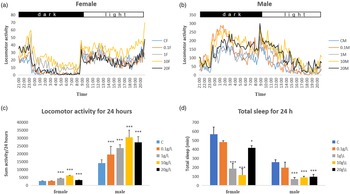
To investigate whether the behavior of Drosophila would change after consuming PP-MPs, we measured its locomotor activity. The results highlighted that both male and female flies showed a statistically significant increase in locomotor activity after exposure to PP-MPs (P < 0.01). According to the 24 h total activity statistics, there was no significant change in the activity of female flies at 0.1 g l−1 concentration, while the activity of female flies at 1, 10, and 20 g l−1 concentrations increased by 59.24, 120.49, and 20.82% respectively (fig. 1a, c). The activity of male flies was significantly increased at all concentrations by 38.59, 68.24, 116.09 and 93.85% respectively (fig. 1b, c). It is noteworthy that the activity of male and female flies was not exactly positively correlated with the concentration. There was a significant decrease in activity in the 20 g l−1 compared to the 10 g l−1 group (P < 0.001 for both male and female flies). MPs likewise reduced group sleep behavior that was maintained for more than 5 min, and the results were generally consistent with 24 h total activity (fig. 1d).
The effect of different concentrations of PP-MPs on Drosophila locomotor activity. (a) Effect of PP-MPs on female flies locomotor activity. (b) Male flies. (c) The sum locomotor activity for 24 h (***P < 0.001). (d) Total sleep for 24 h (*P < 0.05, ***P < 0.001).

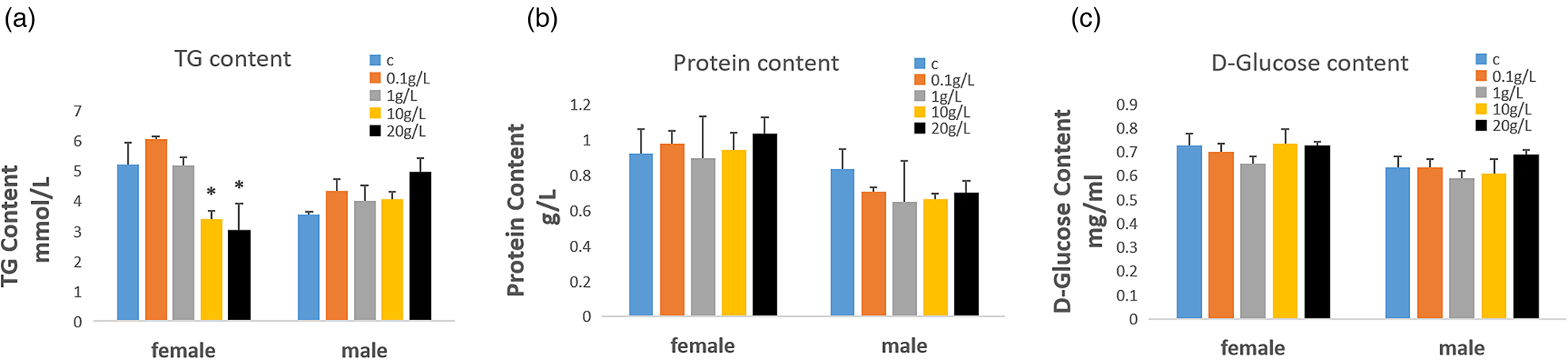
The energy metabolism of organisms is a relatively complex biochemical reaction. Therefore, we briefly measured the lipid, protein and carbohydrate of Drosophila. The experiments showed that PP-MPs had a greater effect on female flies than male flies. The greatest effect on Drosophila lipids was observed under exposure to PP-MPs. Compared with the control group, the lipid content of female flies decreased by 34.5 and 41.5% at the concentration of 10 and 20 g l−1 respectively (P < 0.05). While it increased at the concentration of 0.1 g l−1 instead, but not significantly (fig. 2a). The protein and carbohydrate content of Drosophila did not change significantly (fig. 2b, c). It indicates that the energy metabolism of Drosophila was affected under the exposure of PP-MPs and the nutrients of flies were reduced.
The effect of different concentrations of PP-MPs on Drosophila TG, D-glucose, and protein content. (a) Effect of PP-MPs on the TG content. (b) Effect of PP-MPs on the protein content. (c) Effect of PP-MPs on the D-glucose content (*P < 0.05 unpaired t-test, data represent mean ± SEM).

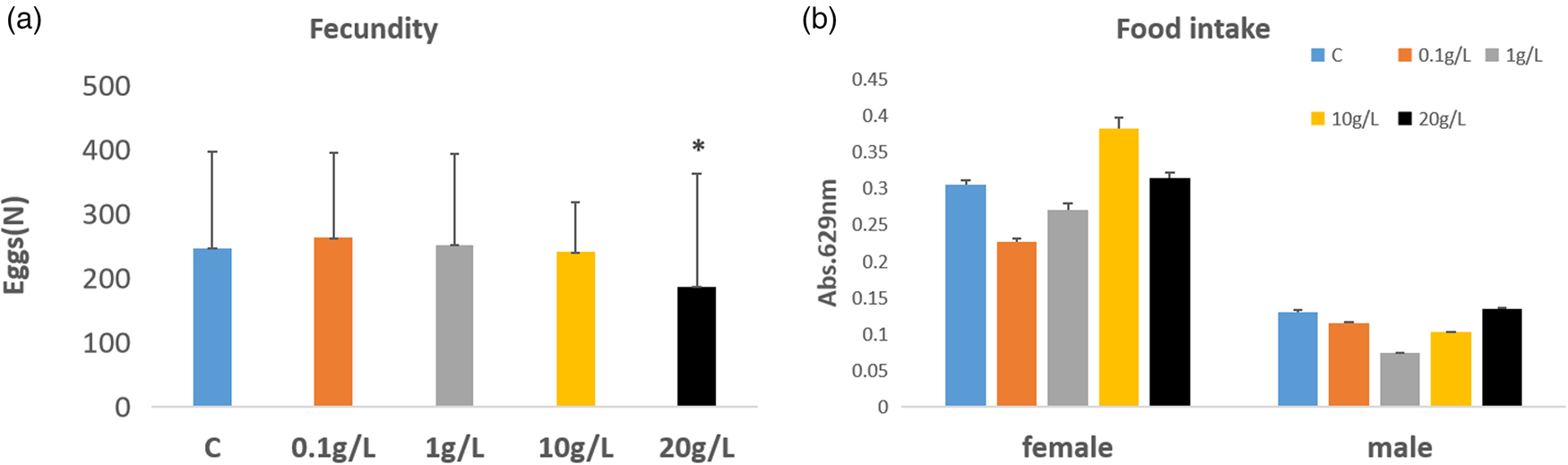
Drosophila that exposed to PP-MPs also ingested PP-MPs. Therefore, we measured the food intake of Drosophila. The experimental results showed that there was no significant change in both female and male flies compared to the control group (fig. 3a).
The effect of different concentrations of PP-MPs on Drosophila fecundity and food intake. (a) Effect of PP-MPs on the fecundity. (b) Effect of PP-MPs on the food intake (*P < 0.05 unpaired t-test, data represent mean ± SEM).

We also tested the effect of PP-MPs on the fecundity of Drosophila. The results showed that being exposed to PP-MPs decreased the egg production of Drosophila by 24.3% at the concentration of 20 g l−1 only, which was statistically significant. In contrast, low concentrations had no significant effect on egg production of Drosophila (fig. 3b).
Conclusions
According to our study, we found a very significant increase in the locomotor activity of male and female flies. There are studies that agree with our findings that the ingestion of MPs increases nematode crawling speed, leading to motor excitement (Lei et al., Reference Lei, Liu, Song, Lu, Hu, Cao, Xie, Shi and He2018). More extensive studies have shown that MPs can stimulate microbial motility in soil and sea (Li et al., Reference Li, Yang, Dou, Qian, Zhao, Yang and Fanin2020b). The increased motility of fruit flies in our study may result from the neurotoxicity caused by MPs. Some studies on fish have shown that exposure to MPs increases brain acetylcholinesterase activity (Barboza et al., Reference Barboza, Clara, Patrícia, Filipa, Vanessa, Bruno, Joana, Miguel, Carlos and Lúcia2020). It is possible that MPs cause rupture of acetylcholine-containing vesicle membranes in presynaptic neurons, leading to an increased release of neurotransmitters into the cholinergic synaptic gap and to an overstimulation of postsynaptic receptors, which result in neurotoxicity (Massoulié et al., Reference Massoulié, Pezzementi, Bon, Krejci and Vallette1993). The results of experiments on mice showed that acetylcholinesterase activity was inhibited after being exposed to PS-MPs, thereby reducing the locomotor activity of mice, again indicating that MPs are significantly neurotoxic (Liu et al., Reference Liu, Zhao, Dou, Hou, Cheng and Jiang2022). GABA neurons also play an important role in Drosophila, where they can inhibit downstream excitatory neurons via the GABA transporter and other pathways (Neckameyer and Cooper, Reference Neckameyer and Cooper1998). After MP ingestion, acetylcholine neurons and GABA neurons of nematode are significantly damaged (Barboza et al., Reference Barboza, Vieira, Vasco, Neusa, Felix, Cristina and Lúcia2018; Lei et al., Reference Lei, Liu, Song, Lu, Hu, Cao, Xie, Shi and He2018). This may lead to an imbalance of excitatory–inhibitory processes. Drosophila activity was reduced at a concentration of 20 g l−1 compared to 10 g l−1 instead. We can explain this phenomenon by hormesis (Calabrese et al., Reference Calabrese, Iavicoli and Calabrese2013). There is a two-phase dose-response of low-dose stimulation and high-dose inhibition: under low levels of MPs, a stimulatory effect is induced, stimulating GABA neurons and increasing Drosophila activity. In contrast, exposure to high levels of MPs causes significant damage to acetylcholine neurons and GABA neurons, leading to a decrease in locomotor activity. Definitive conclusions require more detailed studies on the differences in the concentration of MPs and the time of exposure to MPs.
PP-MPs have sex-specific effects in influencing Drosophila physiology, significantly reducing lipid content in females, while having no significant effect on males. In biological systems, fatty acids are important components and regulators of cell structure, homeostasis, and signaling. It has been shown that there would be less food adhering to MP particles (Wright et al., Reference Wright, Rowe, Thompson and Galloway2013). Therefore, one possibility is that Drosophila exposed to high concentrations of MPs would consume more MPs with the same amount of food intake and the reduction in the amount of food consumed would lead to an energy deficit, thus reducing their fat content. It has also been shown that MPs can be retained in the gut of juvenile peacock fish, impairing digestion, stimulating immune responses, and altering the gut microbial community (Huang et al., Reference Huang, Wen, Zhu, Zhang, Gao and Chen2020). Exposure of zebrafish to PS-MP caused alterations in the metabolic profile of the fish liver and was able to disrupt lipid and energy metabolism (Lu et al., Reference Lu, Zhang, Deng, Jiang, Zhao, Geng, Ding and Ren2016). MPs also remain in the intestine of worms for long periods of time, taking up digestive capacity for long periods of time and using up more energy in this way (Wright et al., Reference Wright, Rowe, Thompson and Galloway2013). Therefore, another possibility is that MPs affect the metabolism of lipids and energy. Glucocorticoids are hormones involved in the stress response and can inhibit the expression of enzymes involved in fatty acid oxidation. MPs can also cause an increase in the transcripts involved in the response to glucocorticoid-stimulated response, which lead to the impairing of fatty acid metabolism (Nagao et al., Reference Nagao, Parimoo and Tanaka1993; Letteron et al., Reference Letteron, Brahimi-Bourouina, Robin, Moreau, Feldmann and Pessayre1997). It has also been shown that exposure to MPs leads to gene upregulation and production of myelin basic proteins in the central nervous system of zebrafish, thereby inhibiting acetylcholinesterase activity, which can not only affect its activity but also disrupt lipid and energy metabolism (Chen et al., Reference Chen, Yin, Jia, Schiwy, Legradi, Yang and Hollert2017). The third possibility is that MPs directly affect lipid metabolism in Drosophila.
In addition, our study found that MPs reduce the number of eggs laid by female flies and affect their fertility. Nutrition plays an important role in ovarian development and egg-laying behavior of female Drosophila. Under poor nutritional conditions, the proliferation rate of ovarian somatic cells in Drosophila is significantly reduced (Drummond-Barbosa and Spradling, Reference Drummond-Barbosa and Spradling2001). Previously, it was found that MPs can significantly affect the feeding of marine copepods, leading to insufficient energy intake and affecting egg production and egg development (Cole et al., Reference Cole, Lindeque, Fileman, Halsband and Galloway2015). It has been shown that MPs can affect energy uptake and energy allocation in Drosophila and oysters, thereby interfering with insulin signaling and ecdysone response pathways that play a role in regulating ovarian development, resulting in insufficient follicle cell formation in the ovary and thus affecting spawning (Drummond-Barbosa and Spradling, Reference Drummond-Barbosa and Spradling2001; Gricourt et al., Reference Gricourt, Mathieu and Kellner2006; Uryu et al., Reference Uryu, Ameku and Niwa2015; Sussarellu et al., Reference Sussarellu, Suquet, Thomas and Huvet2016). Therefore, our observation of reduced egg production may be explained by the fact that PP-MPs reduce nutrient intake and affect the Drosophila insulin signaling and ecdysin response pathways.
We have observed that PP-MPs can increase behavioral activity, reduce lipid content and affect reproduction in Drosophila. In general, the higher the concentration of PP-MPs, the greater the effect is. The results of this study provide some preliminaries for further studies on the effects of PP-MPs on Drosophila and provide a preliminary understanding of the effects of PP-MPs on physiological indicators of insects. Since environmental MPs may also affect the physiological functions, survival, and reproduction of various insects, MPs in the environment may have a large impact on the whole ecology. Our study, therefore, will also provide insight into the role of PP-MPs for higher organisms and humans. Whether the physiological effects on Drosophila observed in this paper are long-lasting and eventually have an impact on lifespan? Do PP-MPs have a long-lasting effect on offspring? Does the size of MPs and other types of MPs have the same effect on Drosophila? Further studies are expected to be conducted afterwards.
Financial support
This work was supported by the grant to J.S. (Zhejiang Provincial Natural Science Foundation of China, LY22C060002).
Conflict of interest
None.
Compliance with ethical standards
The research was conducted on Drosophila melanogaster. The research complies with ethical standards.
Ethical approval
Not applicable.
Informed consent
Not applicable.
Data availability statement
The data that support this study will be shared upon reasonable request to the corresponding author.