In 1988, the Nederlands Dans Theater gave its first performance of a fantastical ballet, one of choreographer Jiří Kylián's full-length narrative ballets, called Kaguyahime. The work is based on a story called Taketori Monogatari (The Tale of the Bamboo Cutter), which is considered to be the oldest-known Japanese literary tale, dating back to the ninth or tenth century, and has been a well-loved story in Japan for more than a thousand years.Footnote 1 Though Kaguyahime ballets had been produced by some Japanese ballet companies before Kylián,Footnote 2 it is through Kylián's version that the ballet has become known worldwide. Though the piece has been said to be a rare example of a narrative ballet by Kylián, it might be seen as abstract rather than narrative. Kylián uses the libretto and music which Maki Ishii (1936–2003) wrote for the Star Dancers Ballet (choreographed by Yoshihisa Endo) in Tokyo in 1985, but in fact he seldom gives much priority to the plot of the libretto.Footnote 3 Since he does not seek to bring out the narrative thread through choreography, even a Japanese audience would find it difficult to relate the story to what was occurring on stage. Nevertheless, his Kaguyahime does have the ability for some reason to persuade at least a Japanese audience that it is a version of the Kaguyahime story. The question is how the work can achieve this effect while also being highly abstract.
Most of Kylián's works are one-act non-narrative pieces, and his choreographic style has often been described as ‘non-narrative dramatic ballet’.Footnote 4 The term ‘non-narrative dramatic’ may sound contradictory, but in Kylián's pieces ‘dramatic’ should be understood as referring to a manner of presentation that gives the audience a sense of drama. In describing Kylián's pieces, Lesley-Anne Sayers, a scholar of dance, states that ‘his motivation comes from within, from an emotion or idea which resonates outwards’;Footnote 5 the inner quality of expression is undoubtedly a hallmark of his works and a factor in making them ‘dramatic’. But it is unclear yet how his ‘motivation’ is developed through his métier of choreography and how it brings out such qualities in the form of a dance piece.
I would like to focus on the actual methodology that contributes to the dramatic nature of Kylián's works: his use of theatrical space. Space composition is one of the oldest themes in ballet. Since Jean-Georges Noverre's ballet reform in the eighteenth century, the idea that the stage space should be a well-composed tableau has been a basic principle of ballet composition. Though we, of course, find scenes that purposely violate the principle in dance pieces nowadays, Kylián's works do not appear to depart from traditional choreography, which are different from such pieces by innovative choreographers. His space composition looks methodical and detailed, calculated to organize the stage space. Nevertheless, some scenes in his pieces appear to be composed on the basis of a principle other than the tableau. For example, he frequently uses a line parallel to the depth of the stage for the dancers’ arrangement, sometimes even in the middle of the stage. This looks quite ineffective from the perspective of design as a tableau. Another example is Kylián's use of the boundary areas of the stage. The frame of a tableau serves to divide the fictional world of a work from the real world, but he uses this area to gain a certain theatrical effect – one that cannot be explained by the principle of a tableau, of treating the composition within a frame.
In the following discussion on Kylián's space composition, I first examine his non-narrative works and analyse his practice of arranging and moving dancers around the stage, examining the principles of composition he employs, which are different from those of a tableau. I shall then analyse the scene structure of Kylián's Kaguyahime in terms of its libretto, and clarify how he reduces the narrative content of the story to an abstract form. Finally, I shall analyse the piece in terms of its space composition on the basis of previous discussions, and clarify how his method brings out the dramatic or theatrical nature of this highly abstract piece.
Space composition using the ‘surface–line–point mechanism’
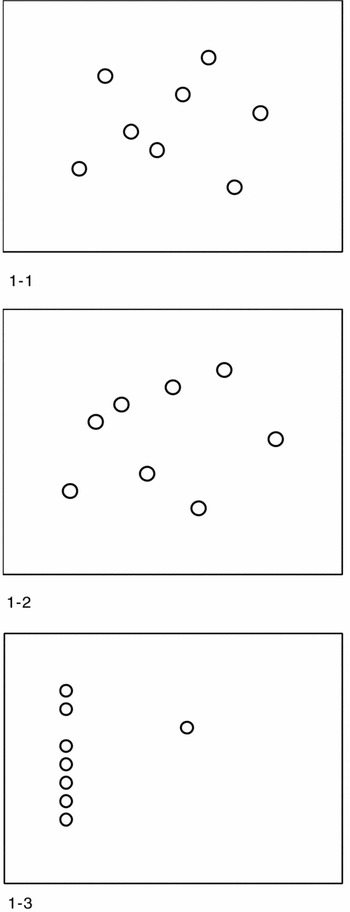
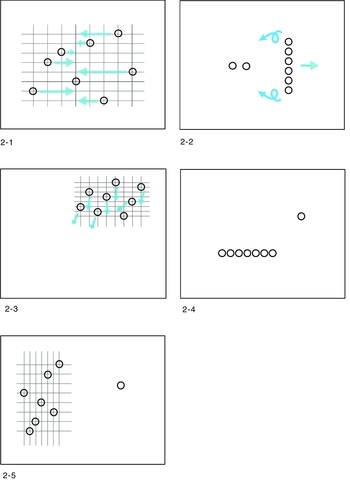
First, I would like to show some patterns of dancers’ arrangements on the stage which Kylián employs repeatedly in his one-act non-narrative pieces.Footnote 6Figure 1 illustrates two examples: a dispersed pattern (Figs. 1-1, 1-2) and a line parallel to the depth of the stage (Fig. 1-3). These do not look anything special in terms of design. In order to help find the common patterns shared by these pieces, I will assign these patterns a grid composed of lines parallel to the width and the depth of the stage (Fig. 2-1). In Figures 1-1 and 1-2 the eight dancers on the stage are in an arrangement whereby no two are on the same line in either direction, longitudinally or transversely, with the result that individual dancers can be seen by the audience and they can move along either line without disturbance from other dancers. This is the pattern of arrangements that the author identifies in Kylián's pieces as used for his basic method of space composition. This pattern can be observed, for example, in Symphony of Psalms (1978), Svadebka (1982), Falling Angels (1989), Sarabande (1990), Petite Mort (1991) and Kaguyahime.
Arrangement of dancers. 1-1: Dispersed pattern (Symphony of Psalms). 1-2: Dispersed pattern (Falling Angels). 1-3: Lineal pattern (Symphony of Psalms).

Arrangement of dancers in Falling Angels. 2-1: The initial arrangement of eight dancers on the grid. In the meantime, the dancers gather in a line. 2-2: The two dancers out of the line dance a duet. 2-3: The dancers gather to make a compressed group. In the meantime, the dancers gather in a line. 2-4: The dancers gather in line for another soloist scene. 2-5: The dancers gather to make a compressed group.

The mechanism of this arrangement uses a grid to organize group movements of the dancers. But since each dancer is seen as an individual, and she/he can advance independently of other dancers in respect of movement along the longitudinal or transverse lines, they can be organized on the basis of individual dancers. In Falling Angels, the eight dancers constitute an octet, where each dancer in the ensemble is distinguished in turn by behaving differently from the others. In Petite Mort, six pairs of dancers constitute a sextet in the same way, where each pair in the ensemble plays a different part in a concerted way, such that an abstract world as a whole is unfolded, thereby giving the audience the impression that they are ‘seeing’ a musical sextet. In Kylián's choreography, dancers are seldom used en masse. Each has his/her individual role even in an ensemble, and this is made possible through dancers’ arrangements such as those in Figure 1-1 or 1-2.
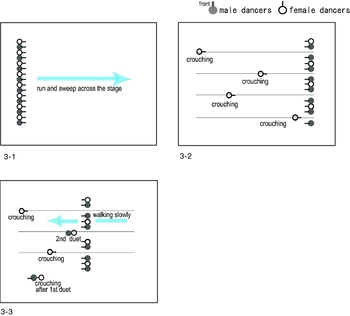
By moving in either of two directions, the dancers can immediately change their arrangement, from being dispersed to being in a line in either alignment: if all move to the right or left, in a line parallel to the depth of the stage (Fig. 2-2); if they move to the front or back, in a line parallel to the width of the stage (Fig. 2-4). In fact, the lineal pattern of Figure 1-3 turns out to be a gathered form derived from the dispersed pattern of Figure 1-1. This mechanism of changing dancers’ formations works to control the area for the ensemble on the stage, and if the area shrinks – not necessarily to a line (see Figs. 2-3, 2-5) – a space for soloists emerges (Figs. 2-2, 2-4, 2-5). Soloists can emerge from the ensemble by remaining on the spot as other dancers gather, and when the ensemble disperses, they are picked up and disappear back into the ensemble. An immediate transformation from an ensemble scene to a soloist's scene (and vice versa) is made possible through this mechanism, and the dance itself changes scenes in its own right, without a break point. Falling Angels (Fig. 2) and Symphony of Psalms (Fig. 3) are the pieces in which this mechanism is fully exploited.Footnote 7 In Falling Angels, scenes evolve through the alternate shrinking and expanding of the ensemble's area. Figures 3-1 and 3-2 illustrate the scene transition from Part I to Part II in Symphony of Psalms: at the end of Part I, a line of the ensemble sweeps the width of the stage to allow four female soloists to drop out on the way, and Part II then begins with the soloists’ scene.
Arrangement of dancers in Symphony of Psalms. 3-1: At the end of Part 1, the line of dancers sweeps across the stage. 3-2: Four female dancers are dropped on the way. Part 2 begins with their dances. 3-3: The line walks slowly to the left. When the line reaches each dropped female dancer, a duet begins, and thus four duets unfold one after another.

In short, in these pieces the space of the stage is constructed in terms of ‘surface–line–point’. ‘Surface’ means the spread of the ensemble on the stage; ‘line’, the gathered arrangement of the ensemble; ‘points’, individual dancers coming out of the ‘surface’ or ‘line’ – any member in a surface or a line can be a point that dances a soloist's part. When dancers are soloists as points, or, in an ensemble, dispersed as a surface, each has his/her different role, but when they make a line they behave as a mass. They usually stay still in a line parallel to the depth of the stage near either wing, while in Part II of Symphony of Psalms a line walks extremely slowly across the stage, with four female dancers being picked up by four male dancers in the line one after another on the way, so that four duets are unfolded (Fig. 3-3).
Kylián uses this grid system as a formal basis for his composition. The system itself does not express anything, but is simply used for dance composition, just as the tonal system itself expresses nothing but is simply used for musical composition. It stands as it is, and it does not even require a frame, physically or conceptually, in which to be set. While ballet, over its history, has built up very effective methods for handling the kaleidoscopic geometry of the corps de ballet, this mechanism for changing the dancers’ formation has nothing to do with this kind of spatial design. In the first place, the ‘surface–line–point’ method cannot, and has never been intended to, form any special geometric patterns other than to arrange dancers in a ‘surface’, in a ‘line’ and as ‘points’. On the contrary, instead of working on geometric designs of group dances, where individual dancers should fit into and hide themselves in a spatial figure, a choreographer using this system, which reduces the spatial composition to its simplest, concentrates on making the movements of the individual dancers. We see here a formal device of Kylián's space composition, one based on a completely different principle from those of a tableau. I shall call this method of space composition the ‘grid system’ or the the ‘surface–line–point mechanism’.
If the system is used on a theatre stage, the appropriate number of dancers will be from six (Sarabande) to twenty (Svadebka): too small or too large a number of dancers makes it impossible to arrange the dancers on a stage using a grid. This mechanism is therefore applied to a piece by a small or medium-sized ensemble, in which all dancers play parts both as soloists and as part of an ensemble – a style of choreography appropriate for companies such as the Nederlands Dans Theater. The system can be captured objectively and used as a technique of dance composition. In fact, we can see this used by other choreographers. In Minus 16 (1999), made by Ohad Naharin, for example, a line parallel to the depth of the stage walks across the stage slowly, while each dancer comes in and out of the line and dances a solo in turn, just as in Part II of Symphony of Psalms (Fig. 3-3). Nacho Duato, who was once a member of the Nederlands Dans Theater, also uses this method for his own pieces such as Por vos Muero.
Spatial extension of the stage
In Symphony of Psalms and Falling Angels, all the dancers, sixteen and eight respectively, stay on the stage all the time, with no break points, entrances or exits. In Symphony of Psalms there is a scene in which they make a line near the wing with their backs to the audience, and it seems that they might be going to enter the wing, but they don't, as if the stage is closed at the side. On the other hand, the depth of the stage is used to great effect, as if it extends boundlessly upstage: at the beginning of Falling Angels all the dancers enter the stage upstage and walk straight downstage, while at the end of Symphony of Psalms all the dancers walk straight upstage, disappearing in the same direction when the upstage wall is lifted. The upstage is so dark that the audience cannot see how far it extends, so the dancers appear from darkness and disappear into it. So why do these pieces not use the wing, as if it is closed off, and why do they use the stage so deeply, as if it extends boundlessly?
Let us consider other types of space composition from Kylián's pieces, ones that do not employ the grid system for space composition. Symphony in D (1976) is a piece danced by sixteen dancers. During the piece, the dancers enter and exit the stage one after another, and exclusively in a transverse direction, through the wing curtains. The upstage is shut off by a wall. From right to left or from left to right, the dancers sometimes flit by the stage. Sometimes they come back to the stage backwards, immediately after going into a wing; sometimes they show only a part of the body from the wing curtain; sometimes they look into a wing and react to dancers who are in it. The dancers perform so often at the right or left side of the stage – that is, at the boundary between onstage and offstage – that the imagination of the audience is stretched to encompass what may be happening beyond the visible stage. In effect, the audience is made to feel that the field of events is not limited to the stage but extends into the wings.
Stamping Ground (1983), danced by six dancers, uses similar effects. In this piece, at the upstage boundary of the stage there is a curtain made of a bundle of ribbons, and the dancers pass through any part of it: they can thus enter and exit not only through the wing curtain but also through the upstage curtain. In the first half, the solo part, each dancer enters from upstage and exits to the wing. In the second half, the duo/trio part, the dancers come and go both through the wing and through the upstage curtain. At the end, all dancers disappear beyond the upstage curtain. Since the dancers come in and out of the stage one after another during the piece and often perform at the boundary between onstage and offstage, in this piece too the audience is made to feel that the field of the piece extends beyond the visible stage.
There is, thus, a clear difference concerning dancers’ entrances and exits between Symphony of Psalms/Falling Angels (which employ the grid system for space composition) and Symphony in D/Stamping Ground (which do not use it) and the pattern of ‘space extension’ that the audience is encouraged to envisage. Why are the spaces of these pieces constructed differently in this way? The reason seems to lie in the different characters of these pieces. In Symphony of Psalms and Falling Angels, a complete world of dance unfolds, and all the dancers behave as a united body from beginning to end. In Symphony in D and Stamping Ground, on the other hand, we are presented with a certain dramatic context: Symphony in D portrays a ballet company comically; Stamping Ground represents a forest inhabited by imaginary creatures.
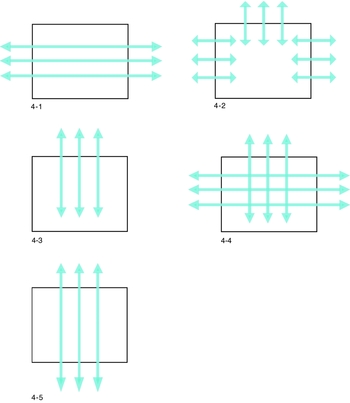
In all these pieces, Kylián seems also to consider the invisible part beyond the stage as his scope of choreography. Figure 4 illustrates in which way the stage space is extended in each piece. In Symphony in D the space is extended transversely (Fig. 4-1). In Stamping Ground the forest spreads out all around the stage – so that the wing is a field nearby, while beyond the upstage curtain is somewhere further away (Fig. 4-2). In Symphony of Psalms and Falling Angels the stage extends only in the upstage direction, from where the whole body of dance emerges (Fig. 4-3). When the ‘angels’ appear from the profound darkness, or the ‘psalms’ disappear into it, one can imagine that at the end of the darkness there might be a place which an illusion called ‘dance’ inhabits.
Pattern of spatial extension. 4-1: Spatial extension in Symphony in D. 4-2: Spatial extension in Stamping Ground. 4-3: Spatial extension in Falling Angels, Symphony of Psalms. 4-4: Spatial extension in Kaguyahime (Sections I, II, III). 4-5: Spatial extension in Kaguyahime (Section VII).

The scene structure of Kylián's Kaguyahime
Briefly, in Taketori Monogatari, on which Kylián's full-length narrative ballet Kaguyahime is based, an old bamboo cutter finds a baby inside a mysteriously shining stalk of bamboo. He and his wife bring her up, and she becomes an extraordinarily beautiful woman. The news of her beauty spreads, and five young noblemen come to ask for her hand in marriage. She concocts impossible tasks for them to accomplish, by demanding that they contrive to bring her particular items. All try, but in vain. Next, the Mikado, the Emperor, comes to see her and falls in love, but she refuses him as well. When the time comes, on the night of the full moon, emissaries from the Moon come down and the guards around her house lose all their power under their mystical force. Putting on a hagoromo – a feather robe to wipe out her human memories – she returns to the place she came from: the Moon.
Kaguyahime reads as a fantastic tale at the beginning and at the end,Footnote 8 and as a realistic novel in the middle. At the beginning, Kaguyahime descends to Earth, and at the end, when she ascends to Heaven, she is wearing a hagoromo, as in a hagoromo legend,Footnote 9 while the courtship sections caricature the life of the court nobility. The tale has thus a dual character, and among literati there have been hot debates about the interpretation: which characters are essential, whether the work should be understood as a fantasy or a novel that mirrors aspects of real life.Footnote 10 The identity of Kaguyahime – whether she is a human maiden or a fairy – also remains an open question. Whichever aspects of the tale are considered essential, one thing remains true: the tale contains the duality of the heavenly and the earthly.
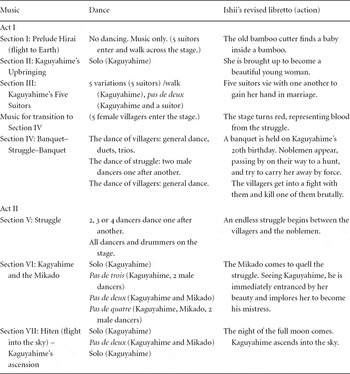
Ishii largely follows the plot of the original story in his ballet libretto, but he replaced the episodes of the five suitors with scenes of banquet and struggle, borrowing the idea from a radio drama script, Kaguyahime (1974), written by the playwright Yasuaki Hangai (1935–).Footnote 11 No Kaguyahime ballet produced so far treats court life as a theme: the five suitors’ episodes, though a part of the original story with dramatic potential, are not considered to be a subject for mute ballet. Below is an encapsulation of Ishii's original libretto in the programme edited by Star Dancers Ballet.Footnote 12
Act I, Section I, ‘Prelude Hirai (flight to Earth)’. An old bamboo cutter finds a baby inside a shining stalk of bamboo.
Section II, ‘Kaguyahime's Upbringing’. He and his wife bring her up and she becomes a beautiful young woman.
Section III, ‘Kaguyahime's Five Suitors’. All the younger men come to see her and fall in love. Eventually five noblemen appear, each taking advantage of their wealth and power, and vie with one another to gain her hand in marriage, but the more intense the passion they show, the deeper her sadness becomes.
Section IV, ‘Banquet – Struggle – Banquet’. The old couple invite villagers to a banquet to celebrate Kaguyahime's twentieth birthday. In the middle of the banquet, comes the sixth nobleman. The villagers become furious at his insolence and arrogance, get into a fight with him and kill him.
Act II, Section V, ‘Struggle’. An endless struggle begins between the villagers and the nobleman's family and followers.
Section VI, ‘Kaguyahime and the Mikado’. The Mikado comes to quell the struggle, but on seeing Kaguyahime, he is entranced by her beauty and implores her to become his mistress. Though initially moved by the depth of his love, she cannot accept his proposal, realizing that she must one day return to the Moon. Her sadness is all the more poignant when she thinks that she will eventually have to leave the old couple, too.
Section VII, ‘Hiten (Flight into the Sky) – Kaguyahime's Ascension’. This comes on the night of the full moon. Kaguyahime dances to bid farewell to the old couple and the Mikado, and ascends into the sky.
Kylián wanted Ishii to change some parts of the original music, and Ishii revised it in conformity with Kylián's request.Footnote 13 The libretto was also changed: the five suitors in Section III appear not as noblemen but as villagers, and the noblemen first appear in Section IV.Footnote 14 But in any case, the details of the action are less relevant to his ballet, and the old bamboo cutter, who is one of the main characters in the original story and in the libretto, does not even appear; neither do the emissaries from the Moon. Table 1 shows the dances and the actions (revised for Kilián's ballet) of the ballet in parallel with the musical structure.Footnote 15
Kylián's Kaguyahime

Now let us look at the whole structure of the piece from a perspective other than narrative construction. The piece begins with an extremely calm and mystical air, develops gradually towards the highly energetic struggle scenes in Section V,Footnote 16 and ends by revisiting the initial mystical air. Correspondingly, the number of dancers increases through Act I, from the solo of Kaguyahime, the variations of the male dancers and the pas de deux, to the dance involving all the villagers, while Act II opens with the performance of all the dancers and drummers on the stage and ends with Kaguyahime alone, disappearing into the Moon. In this scene structure we can also see the contrast between what is heavenly and what is earthly, which constitutes the dual axis of the original story. Kaguyahime, a supernatural being, gradually joins the company of earthly beings. The struggle scene in the middle is an earthly incident in which Kaguyahime does not even appear. After that, the pas de deux is danced between Kaguyahime and the Mikado, in an interaction between heavenly and earthly beings in the highest positions of power, but finally Kaguyahime returns to her heavenly world. In short, the scenes progress as follows: heavenly (Sections I and II), heavenly plus earthly (Sections III and IV), earthly (Section V), heavenly plus earthly (Section VI) and heavenly (Section VII). The scene construction of this piece is, incidentally, the reverse of that in nineteenth-century fantastic ballet, in which the fantastical scene, the ballet blanc, is in the middle, sandwiched between the human drama.
It is now possible to understand why Ishii's original libretto was changed in Kylián's version. In Kylián's version, Section III is the scene in which Kaguyahime gradually enters the earthly world. For the organic development of the action and mood, the five suitors, the first human beings whom Kaguyahime encounters on Earth in this piece, need to be friendly villagers rather than noblemen. The absence of the old bamboo cutter and his wife is the crux for deciding the style of the piece. If they had appeared, the story should have begun with the old couple's delight in finding a baby, and ended with their grief at her leaving, rather than Kaguyahime's mystical solo. In this case, the scene structure described above would not have been practicable either.
The space composition of Kaguyahime
Let us now analyse the space composition of Kylián's Kaguyahime on the basis of the discussion so far. As we see in Table 1, a large part of the piece is made up of Kaguyahime's solos or duets. But the piece adopts the grid mechanism in Sections III and IV, where more than six dancers are on the stage. While, overall, the lines in the two directions, parallel to the width and the depth of the stage, have important roles as a formal basis for the piece, they seem to be used not only to form the basis of choreographing the movements of individual dancers and as arranging and moving dancers efficiently, but also to bring some elements of the narrative to the stage in terms of space composition.
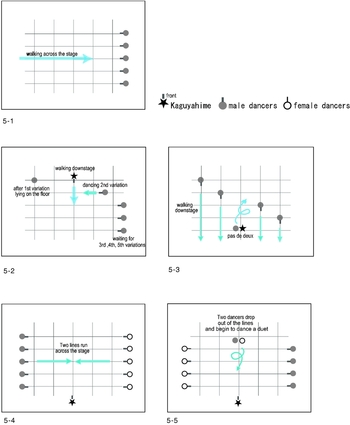
I will examine how these lines work in each section.Footnote 17 In Section I, the five suitors enter from the left in a line parallel to the depth of the stage and walk straight to the right across the stage; they stay in a line at the end of the stage on the right (Fig. 5-1). In Section II, Kaguyahime appears upstage and dances in place; in Section III she walks slowly from upstage straight downstage along a longitudinal line, while each of the five suitors comes out of the line and they dance a variation one after another at the same level of the stage along a transverse line (Fig. 5-2). After dancing, they walk down along a longitudinal line and make a line downstage (Fig. 5-3). Kaguyahime's entrance from upstage indicates that she is coming from another world, in contrast to the suitors’ entrance from the side, which indicates that they belong to this world. Here we can see the contrast between what is heavenly and what is earthly forming the basic structure in the space. In Sections I, II and III these two directions indicate that the stage is a place in the expansion of this world (to the side) and to the other world (upstage). When Kaguyahime and a suitor dance in these two different directions at the same time (Fig. 5-2), there is a formal indication that they belong to different worlds, and that joining them together will not be a simple matter. We may illustrate the spatial extension of the stage in these scenes as Figure 4-4.
Arrangement of dancers in Kaguyahime. 5-1: Section I. Five suitors enter the stage from the left. 5-2: Section III (the 2nd variation). Five suitors dance variations one after another on the same level of the stage, while Kaguyahime walks downstage slowly. After the variations, they lie on the floor. 5-3: Section III (pas de deux). The fifth suitor dances a pas de deux, while the other suitors walk downstage slowly to a line. 5-4, 5-5: Section IV. During the time the villagers are dancing together, they make a line on each side of the stage, then all run across the stage together. When they cross at the centre, one male and one female dancer drop out of the lines and begin to dance a duet; the scene changes to one for soloists. The dancers in lines await their turns.

In Section IV, the scene changes. At the beginning all the villagers, ten dancers, dance at the banquet in a dispersed arrangement. Meanwhile they make a line on each side of the stage, then all run across the stage together (Fig. 5-4). When they cross at the centre, one male and one female dancer drop out of the lines and begin to dance a duet (Fig. 5-5). The dancers in line await their turns. Next, noblemen enter the banquet from upstage: in this scene the depth of the stage is limited by a curtain cut in places. The female villagers enter the wings. The male villagers and noblemen separate to each side of the stage and dance duets of fights, one after another. Two fighters come out, one from each side, and confront one another in the middle of the stage. The noblemen, who are defeated, disappear upstage. In this scene, the whole stage presents only the sublunary world. The spatial extension of the stage can be regarded as in Figure 4-2, where the two directions may indicate that the stage is a place in the expansion of the village (to the side) and to other places outside the village (upstage).
In Section V, the villagers and the noblemen make lines on each side of the stage. The musicians also align with them: Western percussionists on the side of the noblemen, Japanese drummers on the side of the villagers. The dancers in both lines await and dance duos, trios or quartets of fights, coming out of the lines in their turns. Since both fighters advance sideways and confront each other in the middle of the stage, the transverse lines are emphasized in this scene, indicating that the struggle is between human beings in this world. In the middle of the section, the musicians who have been playing in the orchestra pit run up to the stage from the middle under the stage to join in the struggle. The so-called ‘fourth wall’ is broken. One reason Kylián brings the musicians onto the stage is to include them in a grand spectacle, presenting especially the powerful performance of the popular Japanese ensemble of Kodo drummers. But at the same time this breaking of the fourth wall strongly suggests that the earthly world on the stage is to be extended to the auditorium and the audience is regarded as joining the struggle, with only Kaguyahime not joining in. The opening of the fourth wall in this scene can be considered also as foreshadowing the one in Section VII which marks the climax of the piece: without the former, for the audience the latter would be too abrupt an event for it to be perceived as occurring in the fictional world.
In Section VI, the Mikado appears from upstage to win Kaguyahime. From here, the composition with the emphasis on longitudinal lines, which have been eclipsed in Sections IV and V, begins to return. In Section VII, when the emissaries from the Moon, represented by the strong light momentarily reflected downstage, come from upstage and confront the Mikado, he is driven downstage by the reflection. They face each other on a longitudinal line, indicating that this is a confrontation between what is earthly and what is heavenly, in contrast to the confrontation between noblemen and villagers in Sections IV and V. It is noticeable that the strong reflection hits the eyes not only of the Mikado in the fictional world, but also of all the audience in the auditorium; here the fourth wall is broken again, and the audience is placed in the same space as the Mikado and confronted by the celestial emissaries as a target of their attack.
Though in Ishii's original music, Section VII, ‘Hiten’, forms one of the highest points, Kylián dares to shorten this part considerably. On the CD recording of Ishii's Kaguyahime music, the parts omitted in Kylián's ballet are played in the original version for Endo's ballet, though other parts are played in revised form in Kylian's ballet. It is understandable that Ishii could not leave out the part from his work on the CD. In Endo's version, the scene is played by, in addition to Kaguyahime and the Mikado, all the villagers and the emissaries from the Moon, with the music. Endo depicted this scene as a tableau, and Ishii's music was for this tableau. But Kylián created this scene with a lighting design projected toward the auditorium for a fraction of a second.
The breaking of the fourth wall may not be a special device in the theatre, but Kylián employs it in a most logical and structured way in the whole composition of this piece. It creates not only the decisive moment of the piece, but also plays an essential role in making the following, final scene dramatic. In the last scene, the composition used in Section III returns: Kaguyahime walks slowly along a longitudinal line, but in the opposite direction from that in Section III, from downstage, upstage towards the Moon. The transverse stripes lit on the floor indicate the expanse of the earthly world, in contrast to the direction of the heavenly world. The simple action of Kaguyahime's walking away with her back to the audience has a crucial theatrical effect after all the events of the piece: in this last scene, it is the audience, who belong to this world and have, like the villagers and Mikado in the story, been attacked by the emissaries from the Moon, who see Kaguyahime returning to the Moon. The fourth wall has been opened and Kaguyahime is leaving the entire earthly world – not only the fictional one but also the real one.
Kylián reduces the tale of Kaguyahime to the contrasting constituents of the original story and depicts the contrast – what is heavenly and what is earthly – in his piece. Correspondingly, the space of the piece is structured on the basis of the two contrasting worlds, using the formal framework of longitudinal and transverse lines. The method of space composition does not fall within the concept of well-composed tableau. Instead of completing visual images of the dramatic situation on the stage, Kylián treats the whole theatre as the object of his choreography, the place in which the space is conceptually divided between the fictional and the real worlds, while physically sharing the same place and time. Within one place and time, imagining extensions of the fictional world and perceiving the transmutation of the world: these are theatrical experiences that are no less dramatic than watching a tableau.Footnote 18