Introduction
As a better understanding of the complex interplay between genes and environment has emerged, some of the simpler notions of ‘nature versus nurture’ have fallen out of favour. Nowhere is this more obvious than in studies showing that many environmental measures in fact show substantial heritability (Plomin et al. Reference Plomin, Lichtenstein, Pedersen, McClearn and Nesselroade1990; Kendler & Baker, Reference Kendler and Baker2007). One such environmental factor is the adversity, or stressful life events (SLEs), an individual has encountered. SLEs have been known to play an important role in the development of mental disorders, for example as a trigger for the onset of major depression (Kendler et al. Reference Kendler, Karkowski and Prescott1999b), psychosis (Bebbington et al. Reference Bebbington, Wilkins, Jones, Foerster, Murray, Toone and Lewis1993; Kessing et al. Reference Kessing, Agerbo and Mortensen2004) and mania (Kennedy et al. Reference Kennedy, Thompson, Stancer, Roy and Persad1983). Although SLEs might seem to be purely external environmental factors, there is evidence from twin studies for a genetic component ranging from 20% to 50% (Plomin et al. Reference Plomin, Lichtenstein, Pedersen, McClearn and Nesselroade1990; Kendler et al. Reference Kendler, Neale, Kessler, Heath and Eaves1993; Billig et al. Reference Billig, Hershberger, Iacono and McGue1996) when self-report measures are used. Longitudinal studies have also shown that patterns in reporting SLEs are consistent for individuals through life (Andrews, Reference Andrews1981; Woods et al. Reference Woods, Dery and Most1982). This heritability is often only found for SLEs that are considered ‘dependent’, that is potentially influenced by an individual's behaviour, suggesting that heritable aspects of an individual's behaviour may play a role in their choice of environment and exposure to SLEs, with ‘independent’ events often found to lack any heritable component (Kendler et al. Reference Kendler, Karkowski and Prescott1999a; Bemmels et al. Reference Bemmels, Burt, Legrand, Iacono and McGue2008; Boardman et al. Reference Boardman, Alexander and Stallings2011). Furthermore, there is some evidence that this heritability is, at least in part, mediated by factors such as personality (Saudino et al. Reference Saudino, Pedersen, Lichtenstein, McClearn and Plomin1997; Kandler et al. Reference Kandler, Bleidorn, Riemann, Angleitner and Spinath2012). This may reflect gene–environment correlation, where genetically controlled behaviours make an individual more likely to encounter or seek out stressful environments (e.g. a propensity towards risk taking). Alternatively, this could reflect heritable personality types more likely to interpret or report events as stressful. This is supported by studies showing increased heritability of self-reported events compared to objective measures (Thapar & McGuffin, Reference Thapar and McGuffin1996; Kendler & Baker, Reference Kendler and Baker2007).
Although quantitative genetic investigations have shown heritability of SLEs, no molecular research has been carried out on known environmental measures to date. To expand upon the results of twin studies, we first aimed to look at the correlation between siblings in the reporting of SLEs to establish familiarity. Second, we estimated the additive genetic variance explained by single nucleotide polymorphisms (SNPs) for the reporting of SLEs, using the software tool genome-wide trait association analysis (GCTA; Yang et al. Reference Yang, Lee, Goddard and Visscher2011). We also examined if these estimates of the heritability captured by common SNPs varied with regard to those events supposedly dependent or independent of an individual's actions, or after correcting for personality measures. Third, we sought to identify specific genetic variants associated with the reporting of SLEs in a genome-wide association study (GWAS).
Method
Samples
The sample consists of individuals from the Depression Case Control (DeCC) study (Cohen-Woods et al. Reference Cohen-Woods, Gaysina, Craddock, Farmer, Gray, Gunasinghe, Hoda, Jones, Knight, Korszun, Owen, Sterne, Craig and McGuffin2009) and the Depression Network (DeNT) study (Farmer et al. Reference Farmer, Breen, Brewster, Craddock, Gill, Korszun, Maier, Middleton, Mors, Owen, Perry, Preisig, Rietschel, Reich, Jones, Jones and McGuffin2004). Both were retrospective studies of DSM-IV/ICD-10-defined recurrent depression of at least moderate severity. The controls were recruited through the Medical Research Council (MRC) general practice research framework, and screened for any history of psychiatric disease. DeCC provided 2327 individuals (1222 cases and 1106 controls) from the UK with both phenotype and genotype data. DeNT provided 744 sibling pairs with phenotype data for correlation analysis, and 294 genotyped individuals for genetic analysis. Only UK individuals were used for genetic analyses to avoid population stratification. The studies were approved by the local ethical committees and informed written consent was obtained from all participants.
Measures
The SLE data were derived from the Brief Life Event Questionnaire (BLEQ), which consisted of 12 items and was based on the List of Threatening Experiences Questionnaire (LTE-Q; Brugha et al. Reference Brugha, Bebbington, Tennant and Hurry1985). Individuals had to state whether or not they experienced the respective SLEs within the past 6 months. As this was a retrospective study, cases were not selected for in episode. Response categories were defined in a binary fashion, either present or absent, and a sum of the number of reported SLEs was constructed for every individual. Following the LTE-Q categories, SLEs were split into those considered dependent on an individual's actions and those that were deemed to be independent. Illness, death and being robbed were considered as independent SLEs; unemployment, separation, financial problems and legal matters as SLEs dependent on individuals' behaviour. This totalled five independent events and seven dependent events. These sums of numbers of independent and dependent events were then used in secondary analyses.
Personality was evaluated using the revised Eysenck Personality Questionnaire (EPQ-R), with separate measures for extraversion, psychoticism and neuroticism (Eysenck & Eysenck, Reference Eysenck and Eysenck1975; Eysenck et al. Reference Eysenck, Eysenck and Barrett1985). Each of these personality measures was used individually as a covariate to test for confounding in the heritability of reporting SLEs.
Genotyping and quality control
For the whole sample Illumina Human Hap610-Quad BeadChips [Centre National de Genotypage (CNG), France] were used for genotyping. The genotyping is described in more detail elsewhere (Lewis et al. Reference Lewis, Ng, Butler, Cohen-Woods, Uher, Pirlo, Weale, Schosser, Paredes, Rivera, Craddock, Owen, Jones, Jones, Korszun, Aitchison, Shi, Quinn, MacKenzie, Vollenweider, Waeber, Heath, Lathrop, Muglia, Barnes, Whittaker, Tozzi, Holsboer, Preisig, Farmer, Breen, Craig and McGuffin2010). Individuals were excluded if the missing rate of genotypic data was >1%, the data showed abnormal heterozygosity or discrepant gender assignment, or the participants were close relatives (up to second degree) or of non-European ancestry. If SNPs showed minor allele frequency <1%, missingness of >1% or departure from Hardy–Weinberg equilibrium (p < 1 × 10⁻⁵), they were excluded.
Statistical analyses
Sibling correlation for SLEs
From the DeNT sample one sibling pair was selected from each family. Spearman's correlation was conducted in Stata (StataCorp, 2011) for all SLEs, and for independent and dependent SLEs separately. For this analysis we also created a sum of SLEs that were not defined by familial events; thus the items ‘death of parent’, ‘serious illness, injury or assault of a close relative’ and ‘death of close family friend or another relative’ were excluded.
GCTA
GCTA was implemented to investigate the phenotypic variance in the number of SLEs explained by all SNPs (Yang et al. Reference Yang, Lee, Goddard and Visscher2011). Analyses were conducted for all SLEs and separately for those considered dependent or independent. Correction for case–control status, study, genotyping batch and the first five principal components was applied. The addition of further principal components did not seem to alter the findings. Individuals were also screened for relatedness, and in any pair where R > 0.025, one individual was excluded. To test the effect of personality, we then repeated this analysis correcting for psychoticism, neuroticism and extraversion separately.
GWAS
To identify specific genetic variants related to the number of reported SLEs, GWAS were conducted for all SLEs, and for dependent and independent SLEs separately, using PLINK (Purcell et al. Reference Purcell, Neale, Todd-Brown, Thomas, Ferreira, Bender, Maller, Sklar, de Bakker, Daly and Sham2007). The threshold for genome-wide significance was set to p < 5 × 10⁻⁸, and p < 5 × 10⁻⁶ was used for suggestive significance (Dudbridge & Gusnanto, Reference Dudbridge and Gusnanto2008). The first two ancestry informative principal components were included as covariates and no inflation of genomic control values above λ = 1.05 was seen.
Replication
Top hits from the GWAS were replicated within two separate samples. The first was a cohort of controls from a bipolar dataset from Toronto, collected as part of the bipolar disorder arm of the RADIANT studies, to which DeCC and DeNT belong (Gaysina et al. Reference Gaysina, Cohen-Woods, Chow, Martucci, Schosser, Ball, Tozzi, Perry, Muglia, Craig, McGuffin and Farmer2009). They totalled 257 individuals with phenotype and genotype information, collected in a similar manner to the DeCC and DeNT studies. The second was a set of 894 cases from a clinical depression cohort of individuals in Munich, again collected in a similar manner to the DeCC and DeNT studies (Tozzi et al. Reference Tozzi, Prokopenko, Perry, Kennedy, McCarthy, Holsboer, Berrettini, Middleton, Chilcoat and Muglia2008; Muglia et al. Reference Muglia, Tozzi, Galwey, Francks, Upmanyu, Kong, Antoniades, Domenici, Perry, Rothen, Vandeleur, Mooser, Waeber, Vollenweider, Preisig, Lucae, Muller-Myhsok, Holsboer, Middleton and Roses2010). For the Munich sample, individual event data were not available, only a summary score for the BLEQ for cases. Therefore, this sample could be used for replicating findings for the total number of events, but not hits specific to dependent or independent events.
Results
Sibling correlation for SLEs
Altogether, 744 sibling pairs were available to test the familiality of SLEs. Spearman's correlation was conducted to investigate the relationship between the number of SLEs reported by siblings. Significant positive correlations were found for all variables, with the total number of events correlating at 0.19 (p < 0.001). Both independent and dependent events were correlated, although independent events to a much greater degree (an R 2 of 0.25 compared to 0.08, with p < 0.001 and p = 0.03 respectively). This is probably because independent events included many that were related to illness or death of family members and an analysis of total events, excluding those specifically family related, produced results similar to just dependent events (R 2 = 0.08, p = 0.03).
GCTA
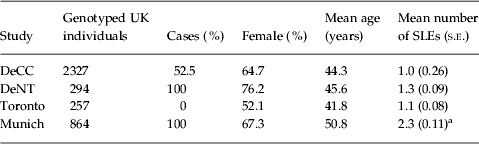
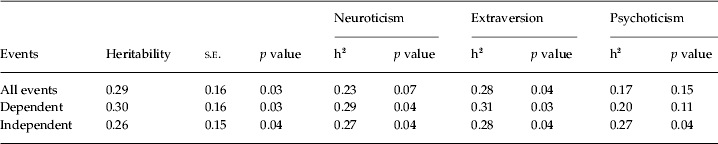
After quality control, genome-wide association data were available from 2578 unrelated individuals and 541628 SNPs. The composition of these samples is outlined in Table 1, with the average number of events in the past 6 months prior to interview per person near to one in all. The correlation between total number of independent and dependent events was 0.15. The results from the GCTA show that a significant proportion of variance could be attributed to common genetic variants for all, dependent and independent SLEs. The phenotypic variance accounted for by all SNPs for the number of reported SLEs was 29% (p = 0.03, s.e. = 0.16). When distinguishing between SLEs dependent on and independent of subjects' behaviour, SNPs explained 30% of the variance (p = 0.03, s.e. = 0.16) for dependent events and 26% (p = 0.04, s.e. = 0.15) for independent events. The GCTA was rerun after correcting for the effects of personality, giving the results outlined in Table 2. The total variance explained by SNPs for the number of SLEs was no longer found to be significant after correcting for either neuroticism (from 29% to 23%, p = 0.07) or psychoticism (to 17%, p = 0.15). Neuroticism scores did not affect GCTA estimates when events were separated into those considered dependent on or independent of an individual's actions, and psychoticism only confounded the analysis of dependent events. Accounting for extraversion scores did not affect the results.
Description of studies and the distribution of stressful life events (SLEs)
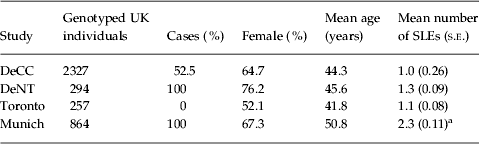
DeCC, Depression Case Control study; DeNT, Depression Network study; s.e., standard error.
a Note that for the Munich replication sample, the mean Brief Life Event Questionnaire (BLEQ) score is displayed rather than the number of events.
Variance explained by common SNPs for total stressful life events (SLEs), and split into those considered dependent or independent of an individual's state of mind. Also shown are the adjusted estimates after correcting for the personality measures neuroticism, extraversion and psychoticism separately
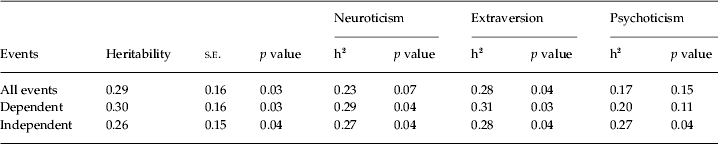
SNP, Single nucleotide polymorphism; SLE, stressful life event; s.e., standard error.
GWAS
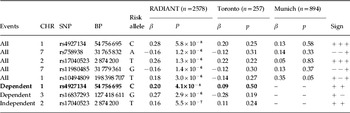
For the analysis of the number of SLEs as a continuous trait in 2578 cases, the study had 50% power to detect association with an SNP with a frequency of 25%, accounting for 1.1% variation in SLEs, or 80% power for 1.5% variation. No genome-wide significant results were found for the total number of events in the genome-wide association, although five SNPs reached suggestive significance. One of these (rs4927134 on chromosome 1) reached genome-wide significance when only dependent events were included. One SNP not found in the primary analysis of all events (rs16837293) reached suggestive significance when only dependent events were included, and one of the SNPs in the primary analysis (rs17040523) was found to be in suggestive significance when using only independent events. Details of the SNPs with the strongest association found are given in Table 3. None of these top hits reached even nominal significance in the replication samples (p < 0.05).
SNPs with the strongest signals for associations in GWAS of the number of reported SLEs, and their associations in the two replication samples: controls from a bipolar sample in Toronto and cases from a depression study in Munich (which lacked information on whether the SLEs were independent or dependent)

SNP, Single nucleotide polymorphism; GWAS, genome-wide association study; SLE, stressful life event; CHR, chromosome; BP, base position; Sign, direction of effect per respective study.
Discussion
This study has provided new molecular evidence showing that common genetic variants explain a significant proportion of the variance in self-reported environmental factors. Twin studies have previously suggested a heritability of approximately 20–50% for the number of reported SLEs (Plomin et al. Reference Plomin, Lichtenstein, Pedersen, McClearn and Nesselroade1990; Kendler et al. Reference Kendler, Neale, Kessler, Heath and Eaves1993; Billig et al. Reference Billig, Hershberger, Iacono and McGue1996) and, in keeping with this, we found that ∼30% of the phenotypic variance in SLEs was tagged by common SNPs. A degree of underestimation is expected in this study as only common single nucleotide variants were genotyped, often relying on linkage disequilibrium to tag the true number of common variants, and missing copy number or rare variants entirely. This may suggest that the ‘true’ heritability is towards the top end of the range found in twin studies. Of note, there was no clear difference in the variance explained for supposedly independent or dependent SLEs, although the confidence intervals are large. This is in contrast to the findings from twin studies, but may reflect the fairly crude division of independent and dependent events in this analysis.
Regarding the role of personality, correcting for either neuroticism or psychoticism resulted in a non-significant heritability of the total number of SLEs, with psychoticism also showing a confounding effect when analysis was restricted to dependent events. Psychoticism has previously been associated with increased reckless and impulsive behaviour (Pickering et al. Reference Pickering, Farmer, Harris, Redman, Mahmood, Sadler and McGuffin2003), which may impact the risk of those events likely to be labelled ‘dependent’ to a greater extent. Neuroticism has been associated with a high level of depression symptoms (Farmer et al. Reference Farmer, Redman, Harris, Mahmood, Sadler, Pickering and McGuffin2002), and perhaps its effect captured a difference in the sample due to inclusion of depressed individuals that was not fully corrected for. This highlights one of the main limitations of this study, which is the inclusion of cases and controls. Despite correcting for affected status and using the number of events at 6 months before interview rather than before episode, the results may not be entirely reflective of a sample from the general population. Unfortunately, because of the need for large samples, the heritability in controls alone could not be tested. These results are, however, in line with findings from twin and family studies, showing that neuroticism accounts for a portion of the heritability of reporting stressful events (Dudbridge & Gusnanto, Reference Dudbridge and Gusnanto2008; Kandler et al. Reference Kandler, Bleidorn, Riemann, Angleitner and Spinath2012).
The association analysis of specific SNPs provided no replicable findings, but this is not entirely surprising because of the small effect sizes reported in associations with even the clearest of phenotypes. None of the SNPs found at suggestive significance were associated with personality disorders or other candidate genes. A strong positive correlation for the number of reported SLEs among siblings was also found, with the highest correlation for independent SLEs. This finding is self-explanatory as life events were included that overlap because of relatedness, for example ‘serious illness of close relative’, although excluding such items still leads to a significant positive correlation. This could be evidence for the role of genetic similarity, but of course could be due to shared environmental factors.
Taking together the results from the GWAS, GCTA and sibling comparison, we add to the now considerable evidence that the reporting of SLEs is heritable. Our results also support studies showing that at least part of this heritability can be attributed to confounding from heritable personality measures. It should be noted, however, that in this study we relied entirely on self-reporting, and using such ‘soft’ measures meant we were unable to differentiate between the heritability of propensity towards reporting SLEs and the heritability of experiencing SLEs. Nonetheless, this finding is of relevance to studies exploring gene–environment interactions, where gene–environment correlation may be a concern. It also provides more insight into the complexities of disentangling the heritable component of a disorder, such as depression, that is often associated with stressful events.
Acknowledgements
The RADIANT studies were supported by a joint grant from the MRC and GlaxoSmithKline (G0701420), and received financial support from the National Institute for Health Research (NIHR) Biomedical Research Centre for Mental Health at the South London and Maudsley National Health Service (NHS) Foundation Trust and the Institute of Psychiatry, King's College London. The MARS project is funded by the German Federal Ministry of Education and Research (BMBF, project nos 01ES0811 and 01KG0709), and genome-wide genotyping was supported by the Bavarian Ministry of Commerce and the Excellence Foundation for the Advancement of the Max Planck Society. This work was also supported by the BMBF within the context of the German National Genome Research Network (NGFN-2 and NGFN-plus).
Declaration of Interest
K. J. Aitchison, A. E. Farmer and P. McGuffin have received consultancy fees and honoraria for participating in expert panels for pharmaceutical companies including GlaxoSmithKline. K. J. Aitchison declares interests through Advisory Boards for Johnson & Johnson, Lundbeck, Roche Diagnostics and Bristol–MyersSquibb; membership of the Bristol–Myers–Squibb UK Steering Group, 2003 to present; consultancy work for Roche Diagnostics, Johnson & Johnson Pharmaceutical Research and Development, Lundbeck, and Bristol–MyersSquibb Pharmaceuticals Limited; grants awarded by Johnson & Johnson Pharmaceutical Research and Development, Bristol-Myers Squibb Pharmaceuticals Limited, and E. Merck Pharmaceuticals. F. Tozzi and P. Muglia were employees of GlaxoSmithKline when the research was performed. M. Ising has received consultancy honoraria from MSD Merck. E. B. Binder has received grant support from PharmaNeuroboost.