1 Of islands and individuals
The recently published Atlas of Pidgin and Creole Language Structures (APiCS) volume, in parallel with historical surveys, focuses on the cartographic representation of 130 features from seventy-six of the world's contact languages. It seems worthwhile to focus attention on two of these features, namely the variation and function of possession and possessive markers, and article grammar. The forms I analyse are toponyms in Pitcairn and Norfolk, the languages of Pitcairn Island and Norfolk Island respectively.Footnote 2
Norfolk stems from the language which emerged on Pitcairn Island from 1790 in a small community comprised of Polynesian and English speakers after the Mutiny on the Bounty took place in what is modern-day Polynesia in 1789. The Bounty’s mission was to collect and transport breadfruit from Tahiti to the Caribbean to feed slaves on Britain's burgeoning plantations. All the Pitcairn Islanders were moved to Norfolk Island in 1856. This marks the beginning of Norfolk as a form of the language of Pitcairn which has undergone changes due to its transplantation to a new environment. Several families migrated back to Pitcairn Island in 1859 and 1864. Since this time, Pitcairn and Norfolk have existed ostensibly as two similar yet distinct varieties of a language with a common heritage.
Small island languages have been of interest to linguists and creolists because of their ability to illustrate how language change can be measured in controlled circumstances. Such languages are significant because establishing the influences of single individuals in the development and change of languages is unprecedented. Pitcairn and Norfolk provide several examples and these can be isolated in order to learn more about the languages. Here I focus on two features present in Pitcairn and Norfolk toponym grammar, namely the for (Pitcairn) (1) and fer (Norfolk) (2) construction, and ha/ah (Pitcairn) (3) and ar/dar (Norfolk) (4) article usage:
(1)

(2)
(3)
(4)


These features have in all likelihood arisen from the presence of St Kitts Creole, a language of the Leeward Islands spoken by Bounty midshipman Edward Young, who sided with Fletcher Christian during and after the mutiny. Other examples illustrating the range of these constructions in non-toponym forms are the Pitcairn phrase (5) and and the Norfolk phrase (6) or (7), where the generic noun is not obligatory.
(5)
(6)
(7)


In toponyms, fer ‘for, of’ (spelling variants for, fa, fe) serves a possessive function and is generally combined with what I label the double possessive placename form: Ar/Dar/Ø [generic noun] fer/for [proper noun] -’s. Here I consider whether the article ar/dar has come primarily from St Kitts Creole. As an alternative and less likely hypothesis, I assess the possibility that ar/dar forms in Norfolk toponyms are derived from any number of English dialects spoken by the other Bounty mutineers and the Polynesian varieties spoken by the Polynesian women.
In a similar way to English toponyms, Pitcairn and Norfolk toponyms can take determiners. A major component of these languages’ determiner grammar in toponyms is the distinction between demonstratives and articles. There are two Pitcairn article forms – ha and ah – and two Norfolk article forms – ar and dar – which can loosely be termed indefinite and definite articles, respectively. These same forms are similarly used as demonstratives equivalent to English ‘this’ and ‘that’.Footnote 4
Apart from the variation in the use of ar and dar in Norfolk toponyms, which are summarised in the phonological rule for toponyms which are prepositional phrases: dar → ar/C __, e.g. (8a) not (8b), there appears to be no consistent pattern for when ha or ah or ar or dar are used.
(8)

Apart from a context following a consonant, all ar and dar forms are interchangeable, e.g.
(9)
(10)
(11)


The ar/dar distinction can be used for emphasis and specificity, i.e. the specific (12) in contrast to the non-specific or general (13):
(12)
(13)


It is necessary to consider the influence from Polynesian varieties on possession in Pitcairn and Norfolk. At face value, Tahitian possession is similar. There is a difference between whether the possession occurs with a noun or a pronoun. With pronouns, the possessive occurs before the noun being possessed, e.g.
(14)

With common nouns, the possessive follows, e.g.
(15)
(16)


Pitcairn and Norfolk do not require the same degree of stringency when distinguishing between pronominal or nominal possession. Although (17) is more common than (18) or (19), both the pronominal and nominal forms are acceptable.
(17)
(18)
(19)


This fact negates the prima facie assertion that the Pitcairn and Norfolk double possessive placename form has resulted directly from Tahitian and that there may be other influences. In the Caribbean, the article/Ø + noun + fer/for/fe + noun/pronoun is currently only found in Suriname. Only Jamaican and its offshoot Belizean have pre-pronominal possessives with for ‘fe’, as in (20) and (21):
(20)
(21)


Examples of these forms are the Norfolk name in (22) and the Pitcairn name in (23):
(22)
(23)


By analysing two small island toponymic situations whose grammatical stocks are similar, the degree of grammatical and possibly lexical change in a relatively stable element of the lexicon, i.e. toponyms, can be observed. For example, the Pitcairn (24) appears as less grammatically complex than (25):
(24)
(25)


I assess whether there has been any significant change between the respective lexis and grammar of Pitcairn toponyms and Norfolk toponyms, and what extralinguistic factors have effected these changes.
2 Historical background
First, some historical background is required. Baker & Mühlhäusler (Reference Baker and Mühlhäusler2013) have provided sufficient historical context for the linguistic relevance of Edward Young to discussions of Pitcairn and Norfolk, so I restrict my presentation to the relationship between Young's St Kitts Creole language heritage and the features of toponymic grammar on the two islands I consider. Young's date of birth was around 1766. He was the only Bounty mutineer born on the Caribbean island of St Kitts. He sided with the main mutineer Fletcher Christian and died on Pitcairn Island in 1800. By this stage, Young's contribution as one of the major influences on the language, and particularly on the lexicon of the children's language, was quite entrenched in Pitcairn (Baker & Mühlhäusler Reference Baker and Mühlhäusler2013). While Hancock (forthcoming) remains sceptical as to the extent of the Kittitian influence through Young in Pitcairn and Norfolk, despite the evidence of over fifty lexical items which Baker & Mühlhäusler argue are in all likelihood Kittitian,Footnote 6 what has not been analysed explicitly is the potential of there existing any conceivable lexical and grammatical influence of Edward Young's Kittitian language in Pitcairn and Norfolk placenames.
In a similar fashion to Baker & Mühlhäusler's (Reference Baker and Mühlhäusler2013) study of Young's lexical contributions to Pitcairn and Norfolk, there is a need to assess the influence of several grammatical elements which may also be attributable to Young and his St Kitts linguistic heritage. More so, as Baker & Mühlhäusler (Reference Baker and Mühlhäusler2013: 173) submit: ‘Yet, almost 50 years later, only limited progress has been made towards identifying what these [English-derived Caribbean Creole] features might be (e.g., Hancock Reference Hancock and Hymes1971; Baker and Huber Reference Baker and Huber2001).’ Because Young was the only Caribbean linguistic exponent on Pitcairn Island who could have introduced certain words, I venture he also introduced grammatical features. My analysis contributes to the large pending task of comparing Pitcairn and Norfolk, languages which remain ill understood and under documented. Comparing the grammar of placename constructions in Pitcairn and Norfolk is crucial for this comparative work.
Although it is feasible the fer forms in Pitcairn toponyms may have come from any of the other varieties of English spoken by the other Bounty mutineers, e.g. William McCoy's Ross-shire Scottish or Matthew Quintal's Cornish, a more likely explanation is the influence of Young's St Kitts Creole. I assess the interaction between grammatical features and the use of these features in toponyms as key social deictic markers of identity and individuality in placenames. Their usage delineates heritage and ancestry or comefrom as either Pitcairner or non-Pitcairner, and has thus been expanded in and adapted to the new social and natural environment of Norfolk Island.
The Pitcairn for and ha/ah (indefinite/definite article) forms are derived from a corpus of more than 400 Pitcairn names from a comprehensive list of Pitcairn Island toponyms published in Ross & Moverley (Reference Ross, Moverley, Schubert, Alaric Maude, Flint and Gimson1964: 170–88), coupled with Evans’ (Reference Evans2005) unpublished placename map of Pitcairn. These Pitcairn for toponyms are compared to Norfolk fer and ar/dar forms taken from a longitudinal study of Norfolk toponymy (these names are compiled in Nash Reference Nash2013, with several ar/dar and fer forms documented from Edgecombe Reference Edgecombe1991: 102). The ha/ah and ar/dar elements are attributable to Young. By analysing fer/for and ha/ah – ar/dar forms, I assess whether an aspect of the ‘toponymic worldview’ the Pitcairners brought with them, as seen through analysing two grammatical features from one Kittitian speaker, remained stable on Norfolk Island or not.
In Bruyn & Shrimpton's (Reference Bruyn, Shrimpton, Baker and Bruyn1999: 421) word index to literary gentleman Samuel Augustus Mathews’ St Kitts texts, among other meanings, daw (meaning 1) is defined as ‘“that, the”, demonstr. adj., article’. Other meanings are ‘it is’, ‘that's’ and ‘at’, with other functions being an aspectual marker indicating ongoing or habitual action and the nominal copula ‘be’. I posit that ha (/hɑ:/)/ ah (/ɑ:h/) Pitcairn forms and ar (/ɑ:/)/ dar (/dɑ:/) Norfolk forms in placenames are derived from meaning 1: ha/ah and ar/dar are demonstratives, articles. The loss of the voiced interdental fricative – [ð] – in the ancestral varieties of English, which influenced Pitcairn, and two of the differential products in Pitcairn and Norfolk – [h] and [d] respectively – is a case of stopping, i.e. where a homorganic stop substitutes a fricative. Glottal substitution could possibly account for the change from [d] in dar to [h] in ha in Pitcairn articles, while initial consonant loss accounts for [h] to [ɑ:] in ah in Pitcairn articles and [d] in dar to [ɑ:] in ar in Norfolk articles. All of these processes are common enough in language simplification, which took place during the genesis of Pitcairn as a distinct contact language. Ha and ah and ar and dar, while phonologically dissimilar, serve similar functions within toponym constructions. Daw appears as an orthographic variant of dar.
Kittitian foo (meaning 1) (Bruyn & Shrimpton Reference Bruyn, Shrimpton, Baker and Bruyn1999: 423) is defined as ‘for, of, to’. It is attested commonly as a non-finite complementiser in constructions like (26) and (27):
(26)
(27)


and with a pronominal possessive to form constructions like (28) and (29):
(28)
(29)


Examples taken from written St Kitts Creole texts of Samuel Augustus Mathews from the late 1700s and early 1800s, the written form of the variety contemporaenous with the spoken of Edward Young, are:
(30)
(31)
(32)
(33)


Foo as the non-finite complementiser as in (34) is similar to Pitcairn (35) and Norfolk (36), and the pronominal possessive form (37) is similar to the Norfolk (38).
(34)
(35)
(36)
(37)
(38)


As regards the phonology of foo and the resultant for/fer in Pitcairn and Norfolk, it appears the final -r is likely to have resulted directly from the [r] in rhotic inputs in the Englishes present during the initial development of Pitcairn. For example, the Scottish varieties spoken by mutineers John Mills and William McCoy and the Cornish English of Matthew Quintal was strongly rhotic in the late 1700s. It is worth mentioning Baker et al.’s (Reference Baker, Bruyn, Shrimpton, Winer, Baker and Bruyn1998: 23) description of the phonology of foo:
Compare Jamaican fi and fo <for (C&L:176) [Cassidy & Le Page (Reference Cassidy and Le Page1967) Reference Cassidy and Le Page1980]. However, Mathews’ spelling probably represents [fu]; cf Haitian pou < French pour. The latter might explain the [u] vowel if we suppose that creolized French was present in St Kitts at some point.
The data I present below suggest this benefactive pronominal possessive in Pitcairn and Norfolk toponyms is derived from St Kitts forms as expressed by Mathews.
3 The Pitcairn Island data
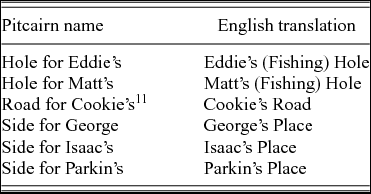
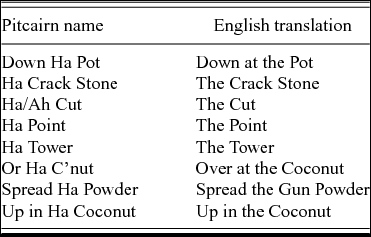
Table 1 lists alphabetically all the for toponym forms and in table 2 all ha Footnote 12 forms are listed alphabetically.
For toponym forms (derived from Evans Reference Evans2005)

Ha toponym forms (derived from Evans Reference Evans2005)

There is a distinct absence of articles ha/ah at the beginning of toponyms in table 1, as in (39a), not (39b):
(39)

This contrasts with the large number of Ar/Dar [generic noun] fer [proper noun] -’s forms in Norfolk names (see below). Of the more than 400 placenames attested by Ross & Moverley (Reference Ross, Moverley, Schubert, Alaric Maude, Flint and Gimson1964: 170–88) and Evans (Reference Evans2005), five names use the for (fer) possessive benefactive construction. Where there are several English fishing placenames on Pitcairn, e.g. Ron's Fishing Place, Old Man Fishing Place and Soldier Fishing Ground, the form Ø [generic noun] for [proper noun] -’s is distinctively non-English and most likely illustrates contact-induced alteration from the English possessive to the more complex Pitcairn possessive.Footnote 13
The ha toponym forms in table 2 are similar to how articles operate in English toponyms, e.g. ‘The Cut’ substitutes the Pitcairn definite article ha to form Ha Cut. While the syntax of Pitcairn or English names adhering to the form [article] [common (compound) noun], as in examples (40)–(47), is the same, the cultural implications of choosing between using a Pitcairn or an English article in placenames is significant.
(40)
(41)
(42)
(43)
(44)
(45)
(46)
(47)


The use of a Pitcairn article implies that a toponym is a Pitcairn toponym. Based on Bruyn & Shrimpton's (Reference Bruyn, Shrimpton, Baker and Bruyn1999: 421) evidence that daw is of St Kitts origin, there is the strong likelihood that ha/ah is derived from daw, hence the use of Pitcairn ha/ah toponym forms is likely to be St Kitts derived. The distinction between the two Pitcairn article forms ha/ah, like the Norfolk ar/dar, is determined pragmatically rather than being influenced by the Englishes spoken by any of the Bounty mutineers. For example, (48), with ah as definite article with no emphasis, and (49) differ in the amount of emphasis and specificity applied to the noun phrase in the toponym.
(48)
(49)


4 The Norfolk Island data
There is a large number of Norfolk toponyms that use fer (English: of, for; Norfolk variants: fa, fe). This form is used both in toponyms, e.g. (50), and when describing other nouns, e.g. (51):
(50)
(51)


These forms have their origin on Pitcairn Island, although their use appears to be more common on Norfolk Island. The Pitcairn toponyms in (52) and (53) have both been elicited (Gathercole Reference Gathercole1964: 13), as have (54) and (55) (Götesson Reference Götesson2012).
(52)
(53)
(54)
(55)


The choice of either Ar/Dar [generic] fer [proper noun] -’s or the English possessive form [proper noun] -’s [generic] in isolation is unpredictable.
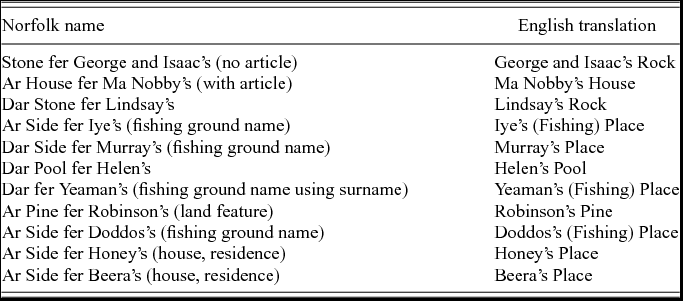
Table 3 lists examples of Norfolk fer toponym forms. While these are the documented Norfolk names using the form Ar/Dar [generic] fer [proper noun] -’s, the pattern is productive for many other toponyms, especially fishing ground names (see Nash Reference Nash, Clark, Hercus and Kostanski2014). For example, the toponyms Alfred's, Reuben's, Bill's, Gooty's and Frankie's are all productive in the following forms:
(56)
(57)


Norfolk fer toponym forms (compiled by the author from fieldwork on Norfolk Island between 2007 and 2009 with additions from map published in Edgecombe 1991: 102)

This Ar/Dar [generic] [proper noun] -’s form corresponds with other Norfolk benefactive forms like:
(58)

Comparing the Pitcairn form (59) with Norfolk (60), there appears to have been a significant degree of syntactic expansion in Norfolk in forms which attribute benefaction to people in possessive (genitive) constructions and toponyms.
(59)
(60)


There appear to be two other attestations of this expansion: there are more recorded Ar/Dar [generic] fer [proper noun] -’s form toponyms on Norfolk Island than on Pitcairn Island; there are more generic nouns which are attested in toponyms of this form in Norfolk than in Pitcairn toponyms (side, pine, pool, house and stone in Norfolk names, hole, road and side in Pitcairn).
5 Conclusion and future work
My hypothesis is that after the Pitcairners’ language was transplanted to Norfolk Island, it developed and the toponomasticon expanded in different domains of usage. Because of the larger size of Norfolk Island, its more diverse landscape, and the more varied underwater reef topography on Norfolk Island compared to Pitcairn Island, which is a smaller island with a more homogeneous and steeper underwater and terrestrial geography, more fishing ground names developed and thus more names needed to be used and managed within the burgeoning Norfolk language and Norfolk toponomasticon post-1856.
Although there is a dearth of available data, the evidence at hand suggests there has been an expansion of the Pitcairn for and ha/ah forms to the more grammatically complex fer and ar/dar forms in Norfolk. In addition to the obvious lexical changes in placenames resulting from people describing different places, there appear to be two principal driving factors in the expansion of grammatical forms in toponyms on Norfolk. Because of the larger size and scale and more diverse Norfolk environment, more complex and specific grammatical forms were needed to describe and distinguish landscape features in what was to the Pitcairner arrivals a new and unknown landscape; because the population on Norfolk Island since the move from Pitcairn Island in 1856 has been much greater than any of the recorded population sizes on Pitcairn Island, one would expect to find a greater need to make finer distinctions regarding people, property and ownership. Benefaction in Pitcairn and Norfolk is one of the principal methods to make these distinctions. In addition, the use of fer and ar/dar toponym forms both in written descriptions, of which there are very few, and in speech, some of which I have documented during fieldwork with Norfolk Island fishers, is a key social deictic marker of identity and distinctiveness – its usage delineates heritage and ancestry (Norfolk: comefrom) as either Pitcairner or non-Pitcairner. It appears such forms have been expanded in and adapted to the new social and natural environment of Norfolk Island.
The appearance of the complex ar/dar and fer forms and their persistence in Norfolk toponyms suggest that the influence of St Kitts midshipman Edward Young should be accorded more emphasis than has been given hitherto. The St Kitts influence of Edward Young proposes that the inaccurate characterisation of Pitcairn and Norfolk as consisting of only English and Tahitian elements (e.g. Reinecke et al. Reference Reinecke, Tsuzaki, DeCamp, Hancock and Wood1975) is in need of revision. It is exciting for this study that the influence of a single linguistic socialiser on Pitcairn Island can be isolated to such a degree on Pitcairn Island and Norfolk Island, in Pitcairn and Norfolk, and that Young's St Kitts influence on a small and developing speech community can be analysed within the domain of a word class such as toponyms. As Hancock (forthcoming: 2) tells us when referring to the historical study of the influence of Edward Young in Norfolk:
its creole(like) characteristics too may be traceable to that same one man. If true, it would be a very interesting and possibly unique case of language transmission – but it must be considered with caution.
The fact that the fer/for form from St Kitts Creole is present in Pitcairn toponyms and continues in Norfolk toponyms indicates the grammatical resilience of this preposition. In order to assess the amount of language change in Pitcairn and Norfolk placenames and in other aspects of these languages more generally, there is an urgent need to conduct primary linguistic field research on Pitcairn Island as well as with the Pitcairn Island diaspora in New Zealand and Australia.