Introduction
At the height of the devastating Syrian civil war that has stretched over the last decade, political commentators variously argued that the Syrian state was ‘melting down’ and ‘collapsing’,Footnote 1 had become ‘a failed state’,Footnote 2 ‘belong[ed] to the trash can of history’,Footnote 3 and had ‘effectively ceased to exist’.Footnote 4 What is more, the Syrian conflict also seemed to ‘suck … Iraq into its maelstrom’,Footnote 5 threatening to leave the entire ‘map of the modern Middle East … in tatters’.Footnote 6 As one commentator put it, ‘Syria and Iraq no longer exist’ and ‘the sooner we realize it, the better’.Footnote 7 Doubts about Syria's statehood were reflected also in academic assessments, which described it as ‘fragmented’,Footnote 8 ‘hybrid’,Footnote 9 ‘limited’,Footnote 10 and ‘failing’.Footnote 11
At the same time, most scholars agree that, despite ‘the extreme debilitation of both the Weberian state and respect for Syrian sovereignty’,Footnote 12 the Syrian state has not disappeared.Footnote 13 Two main factors are often invoked to account for the persistence of the Syrian state: its internationally uncontested legal statusFootnote 14 and the resilience of the regime of Bashar al-Assad, which, with the assistance of Iran and Russia, ultimately turned the tide in its favour.Footnote 15 Yet, while both are important factors in explaining why the Syrian state did not disappear, they are conceptually and empirically insufficient. Neither legal status nor the regime are tantamount to ‘the state’, and their endurance calls for an explanation in its own right.
Any inquiry into the potential vanishing or persistence of the Syrian state, I submit, requires an engagement with the concept of the state that avoids common reductions to government or regime, administrative infrastructure, nation, territory, or legal status. Focusing on the persistence of any particular dimension alone not only unduly simplifies the dynamics that prevented the Syrian state from disappearing, but also obscures the underlying logic behind the constitution and persistence of states in the modern international order more generally. Instead, statehood is better understood as composed of three layers of relationships that presuppose each other logically and co-constitute each other in practice. The first two are routinely regarded as constitutive dimensions of statehood: ‘internal’ state-society relationsFootnote 16 and ‘external’ state-state relations.Footnote 17 The third layer is the most basic and yet the most often neglected one: the state form itself. At least according to the dominant modern historical imagination, the state-based international has been constituted in opposition to alternative forms of political organisation, most notably supposed pre-modern ‘barbarians’, universal theocracy, and transnational empire.Footnote 18 Thus, while individual states acquire their status only as components of the international order, the international order is in turn instantiated only through individual states, whose neatly delineated territories cover the inhabited globe.Footnote 19 In practice, states are enacted in all three dimensions simultaneously, from the state form as international principle of political organisation through the external status of individual states to their particular governments and ‘degrees’ of internal order.
Challenges to the state can also be distinguished along these three intertwined dimensions, from cases of: (1) internal state collapse, in which domestic authority and administrative infrastructure break down; through (2) external state fragmentation, in which states lose parts of their territory to secessionists or are replaced by new states; to finally (3) the dissolution of states and the state form in favour of a radical alternative. If contemporary challenges to the international order itself are arguably rare, the would-be ‘caliphate’ of the self-declared Islamic State (IS) has recently been interpreted as such a collective threat.Footnote 20 The challenges to the Syrian state – and Iraq – are thus different from those facing many other states in the region and beyond, not only in terms of their scale but also because they concern all three dimensions of statehood. As I argue in this article, it is the attempt by the IS to virtually obliterate Syria and Iraq as territorially delineated nation-states that compelled other states to halt the emergence of an alternative not merely to a particular government or individual state, but to the modern international order itself. This reinforced the re-enactment of the Syrian state in all its intertwined layers, as state form, external status, and internal order, while the struggle against the brutal Assad regime increasingly receded to the background.
Drawing on a number of recent in-depth empirical studies of the Syrian civil war,Footnote 21 the article reconstructs the rising challenges to the Syrian state over the course of the last decade to capture the turning points at which key foreign actors came to work against its looming fragmentation and dissolution. In the following section, I outline the internal, external, and international dimensions of the modern state concept and link them to their respective challenges and re-enactments. In section two, I trace Syria's slide into civil war and the apparent internal collapse of the administrative infrastructure to explore the competing performances of ‘the state’ by the regime and the rebels. In section three, I examine the seeming ethno-sectarian fragmentation of Syria and fantasies of its external partition into new states, as well as competing domestic visions of the Syrian nation and international reactions to them. In section four, I turn to the apparent threat of the dissolution of Syria and Iraq by jihadists and the IS in particular. I argue that the fear of this radical alternative, and the rejection of any potential new states by important regional and international actors, eventually led to the reaffirmation of the Assad regime as the authority seemingly best positioned to hold Syria internally and externally together, and thus maintain the statist international order. I conclude by discussing the implications of the Syrian case for our understanding of the intertwined re-enactment of states and the international.
1. Conceptual entanglement: The three layers of statehood
The concept of the state, which lies at the heart of the modern political order, divides politics within states from politics between states.Footnote 22 Both International Relations (IR) and political science subscribe to this dual view of states as ‘containers’,Footnote 23 within which relations between states and societies play out internally, and as ‘units’,Footnote 24 which compete and cooperate externally.Footnote 25 In addition, the distinction also presupposes the state form and the state-based international itself. The state is thus, at least implicitly, conceptualised in three layers: (1) internal government and administrative infrastructure; (2) externally delineated national territory and legal status; and (3) the state form as constitutive component of the international order. While these layers are often approached separately in different literatures, I argue that they should be understood together, as three intertwined and hierarchically-ordered dimensions of statehood, to capture the dynamics of state (re-)enactment and state disappearance in practice.
First, studies of state formation as well as of comparative politics tend to focus on state-society relations within the ‘container’Footnote 26 of the (nation-)state. Such distinctions as between ‘strong’ and ‘weak’ states,Footnote 27 or between ‘strong’, ‘hard’, and ‘fierce’ states,Footnote 28 refer to the relationship between state and society within already identified states. State making and historical state formation have also been largely depicted as taking place inside of states.Footnote 29 Internally, the state usually appears in two dimensions more specifically: as the government, or regime, exercising a certain form of ‘despotic power’Footnote 30 and as an administrative apparatus shaping society through its ‘infrastructural power’.Footnote 31 However, the presupposed status of the state depends neither on the survival of any particular regime,Footnote 32 nor on a specific degree of its administrative capacity. Struggles for power within states aim to replace the ruling government or regime, but they remain ‘internal’. Similarly, as the literatures of ‘quasi-’,Footnote 33 ‘failed’,Footnote 34 ‘fragile’,Footnote 35 ‘limited’,Footnote 36 and ‘collapsed’Footnote 37 states suggest, the weakness or destruction of a state's domestic institutions does not entail the end of the sovereign status that defines the state externally.Footnote 38 As a consequence, no matter how ‘failed’ any state is,Footnote 39 it remains formally a state by virtue of its international legal sovereignty.Footnote 40 Indeed, from this perspective, any domestic challenge to the state's government or administrative control that does not threaten to break up the state merely indicates the state's internal troubles.
Second, the emergence and disappearance of states in both IR and international law is linked to the achievement and loss of external status, which is usually, if not always, legally recognised. That is, while external sovereignty is routinely violated in international practice,Footnote 41 as illustrated by foreign interventions in Libya or Yemen, individual states can only disappear by fragmenting into new states, through partition, secession, dismemberment, or annexation.Footnote 42 From this angle, the history of international relations is also the history of ‘the expansion of international society’Footnote 43 through the recognition of new states, including in waves such as those following the breakup of multinational empires after the First World War and colonial overseas empires during the 1960s.Footnote 44 More recent examples of state fragmentation range from the dismemberment of the Soviet Union and Yugoslavia into their constituent republics, through the agreed-upon independence of Eritrea and South Sudan, to the emergence of unrecognised states such as Somaliland in Somalia and Abkhazia and South Ossetia in Georgia.Footnote 45 Crucially, however, while individual states are occasionally contested by separatists or even replaced by new states, this does not challenge the model of the state itself, because secessionists only seek externally recognised statehood for themselves.Footnote 46
Third, the most basic – and yet the most commonly ignored – dimension of statehood is the state form itself as the dominant principle of contemporary political organisation, of which every individual state is an instantiation. The universalised international state system is based on ‘the presumption that every section of occupied land across the world is the sovereign territory of some state’, and that ‘there can be no empty political spaces: interterritoriality abhors a political vacuum’.Footnote 47 At least formally, the ‘inhabited surface of the earth’Footnote 48 is neatly divided between states, and states alone. This does not mean that other types of political community or ‘non-state actors’ would not co-exist with states, but they usually exist within the statist world.Footnote 49 Although the state system thus appears all-encompassing at least since its universalisation in the second half of the twentieth century, it has only been constituted by excluding supposed alternatives, such as pre-modern ‘barbarians’, theocracy, or universal empire, marked as ‘the double outside of the modern international’.Footnote 50 For Bull, notable threats to the international order have included the violent expansion of the French revolution, the Napoleonic wars, global communism, and the new world order promoted by Nazi Germany.Footnote 51 In the last decades, jihadist universalism has arguably come to radically challenge the modern state-based international,Footnote 52 and the IS has been explicitly put into the tradition of the aforementioned contenders, albeit more in terms of its audacious political programme than its actual power on the ground.Footnote 53 Rare as they are, such direct attacks on the international order reveal that it is itself historical, contingent, and changeable, rather than given, necessary, or irreplaceable.Footnote 54
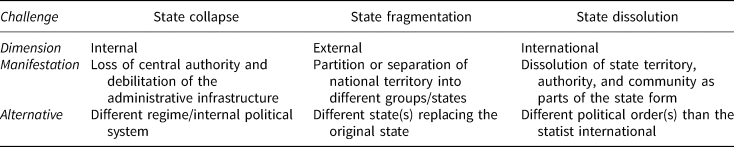
The three dimensions of the state described above each face specific challenges: (1) internal collapse of the regime or administrative apparatus of the state; (2) fragmentation of the external status of the state; and (3) dissolution of the state form as the basic unit of the international order. Each challenge presents a particular alternative, from a new government or political system on the internal level, through a new state on the external level, to a different political order on the international level (Table 1).
Three types of challenges to the state.

Thinking about the state in three layered dimensions also means that statehood cannot be reduced to any one of them. Rather, states are enacted as an ensemble of practices, which assume the existence of states along the three intertwined dimensions. This is consistent with an understanding of statehood as performatively enacted.Footnote 55 As Timothy Mitchell suggests:
the state needs to be analyzed … not as an actual structure, but as the powerful, metaphysical effect of practices that make such structures appear to exist … By approaching the state as an effect, one can both acknowledge the power of the political arrangements that we call the state and account for their elusiveness.Footnote 56
Indeed, a myriad of actors and practices are involved in the everyday enactment of states through ‘mundane arrangements’,Footnote 57 from the maintenance of electricity networks by state agents, through public representations of the nation in political speeches, to government requests for food provisions and medical supplies from the UN.Footnote 58 These practices also imply that ‘domestic’ and ‘international’ actors alike assume and recognise states in the shape of a particular government and public service provider, as well as a sovereign entity with a given territory. When considering the contestation and (re-)enactment of states, we must thus also pay attention to the various assumptions of and commitments to statehood in the three different dimensions. Changing positions of foreign powers in particular can be decisive for upholding or undermining the authority of governments and the sovereignty of states.
From the perspective of other states, challenges to statehood rise in significance from: (1) ‘internal’ revolt and collapse within particular states, which do not directly challenge other states; through (2) a state's ‘external’ fragmentation into new states, which compels others to either endorse the new states or else reaffirm the challenged parent state; to (3) the dissolution of states as part of the ‘international’ order itself. The latter, although rare in practice, acutely triggers what Bull calls the ‘preservation of the system and society of states itself’ as the first-order priority of states that have to fend off a threat to them all.Footnote 59
A comparative glance at the Middle East and North Africa region illustrates the difference between the three types of challenges to statehood and their relative significance for other states. For instance, although the struggles between the different governments, rebels, and other actors in Libya have had a devastating effect on state authority and divided the country internally, they have not seriously threatened its external borders or status as a state, and foreign powers have continued to compete for influence ‘within’ Libya without breaking it up.Footnote 60 By contrast, the secessions of South Yemen or the Kurdish regions in Syria and Iraq would have changed the map of the region, provoking other states to either support or – more often – reject their secessionist claims. Still, separatists do not pose a challenge to the state system itself, unlike jihadists with the wherewithal to promote an alternative on the ground. Indeed, while oaths of allegiance to the IS have eventually been sworn by jihadist groups around the world, including in Libya, Somalia, and Egypt, it is in Syria and Iraq that the IS created a cross-border ‘caliphate’ and set out to dissolve the international order itself. As such, the case of Syria provides a rare opportunity to investigate all three challenges to statehood and the performative effects of representing ‘the state’ internally, externally, and internationally. As I argue in the following analysis, the reactions to the perceived attack on the international order by the IS ultimately help explain the persistence of the Syrian state in its external and internal dimensions.
2. Internal struggle: ‘State collapse’ and competing state performances
When Lakhdar Brahimi stepped down as UN special envoy for Syria in summer 2014, he left with the grim warning that Syria was ‘going to be a failed state, with warlords all over the place’.Footnote 61 The situation had, indeed, dramatically escalated since 2012, when the regime's violent response had turned the peaceful protests of 2011 into a civil war. The regime had lost territorial control over vast parts of the territory, cities were laid to waste, material infrastructure was destroyed, and large parts of the population were violently displaced or forced to flee the country. However, as I discuss in this section, this apparent ‘state collapse’ did not entail the actual disappearance of the Syrian state. On the contrary, the ‘internal’ struggle for power was in fact premised on the continued existence of Syria as a delineated nation-state, with the regime holding on to the state's administrative infrastructure and rebels attempting to conquer or re-enact it locally. In exploring how the regime and the various rebel groups sought to outperform each other as representatives and organisers of ‘the state’, the section sets the stage for an analysis of the rising stakes of the conflict.
2.1. Rebellion, civil war, and military stalemate
As the regime escalated its violent response to protests around the country,Footnote 62 some activists were intimidated by the brutal crackdowns, while others went into hiding and joined emerging armed groups in the countryside.Footnote 63 This played into regime tactics of militarising the conflict, although the scale of local protests and proliferation of armed groups quickly overwhelmed the capacity of the Syrian army to suppress them. By July 2012, insurgent groups had taken over about half of the country's territory, with the regime abandoning some provinces and geographic areas in an attempt to shorten the frontlines and focus on defending key cities, outposts, and roads.Footnote 64 However, the strategic retreat of the Assad regime, aimed to secure its immediate survival, left more space for rebel groups to develop so that by summer 2012 ‘many observers were predicting the regime's imminent collapse’.Footnote 65
This assessment was shared by foreign governments sympathetic to the wave of popular ‘Arab Spring’ uprisings sweeping North Africa and the Middle East in 2011, and critical of the Syrian regime's brutal repression in particular.Footnote 66 Within a few months, Syrian President Bashar al-Assad lost several recently gained allies in the region, including Turkey and Qatar. Apparently convinced that the Syrian regime was not only unwilling to compromise but also close to falling, they became important supporters of the rebellion.Footnote 67 On 18 August 2011, after renewed appeals for a moderation of the regime's response to the uprising and a launch of a political transition process, the US, UK, France, Germany, and Canada jointly called for Assad to step down.Footnote 68 Russia and Iran publicly rejected these demands and the emerging international frontlines set the stage for increased foreign interference.Footnote 69 However, the struggle for power within Syria was waged by internal and external actors on the premise that there was a Syrian state over which they were fighting internally.
The expectation of imminent regime collapse was misguided, however, not only because the regime had a major coercive advantage and fiercely loyal security services, elite military units, and the Syrian Air Force at its disposal,Footnote 70 but also because it was more deeply entrenched in the society than many had assumed. In particular, the regime received support from social groups that had profited from or depended on its rule, including a large number of state employeesFootnote 71 and vast parts of the upper middle-class ‘state bourgeoisie’, which had become an ‘organic backbone of the regime’Footnote 72 since the 1990s.Footnote 73 For additional military muscle, the regime could draw on Shabiha gangs and regime-friendly volunteer units, as well as on long-standing tribal allies and armed bands of Palestinian refugees.Footnote 74 Since 2012, many pro-regime militias were organised under the umbrella of the National Defence Forces (NDF), which reportedly numbered more than 100,000 fighters in 2013.Footnote 75 By recruiting this militia force,Footnote 76 the regime ‘weaponiz[ed] the vast web of client networks constructed over four decades of Assad family rule’.Footnote 77
Moreover, many Syrians who were not outspoken regime supporters or profiteers of its rule did not join the rebellion either. Lisa Wedeen discusses several factors other than direct intimidationFootnote 78 that explain the ‘seductive ground for non-rebellion’.Footnote 79 These include the ‘ideology of the good life’Footnote 80 under stable autocratic rule, as promoted in the 2000s,Footnote 81 misinformation and uncertainty about what was going on and who allegedly committed which crimes,Footnote 82 and the fear of chaos and sectarian violence, especially among minorities.Footnote 83 In order to spread these messages, the regime ‘was able to marshal its ideological state-market apparatus – talk show hosts, actors, directors, and advertisers who were indebted (mahsub) to the regime – in the service of maintaining its rule’.Footnote 84 With large parts of the Syrian population living in regime-held areas, the effect of non-mobilisation was an important complement to regime efforts of directly defeating rebels and mobilising loyalists.
The transformation of peaceful protests into an insurgency and the resilience of the regime set the stage for a civil war which, despite increasing foreign support for different sides in the conflict, was first and foremost understood as a struggle for power within Syria.
2.2. Public services, rebel governance, and the regime's hold on ‘the state’
As the regime proved more resilient than expected and the uprising had turned into a civil war, many protestors who had sought to overthrow the regime and overtake the institutions of the state joined or formed rebel groups instead. Where they seized local control, they began building alternative state institutions that provided services to local populations, thereby creating a ‘state’ bottom-up to rival the official one under government control. At the same time, the regime's efforts at maintaining control over vital parts of the bureaucratic infrastructure and public services across the country aimed to convince the population of the continued existence of ‘the state’ under its exclusive control.Footnote 85 The internal struggle over the state was thus not only about battles and frontlines, but also about bread, education, medicine, and the public servants providing them.
Although many rebel groups engaged in competitive state building on different scales, including through taking over city councils, providing basic services, and establishing alternative justice systems, the regime ultimately ‘outperformed’ these instances of rebel governance, for three main reasons. First, the regime actively sought to keep exclusive control over the administrative infrastructure. As Kheder Khaddour points out, ‘[a] key element of the Assad regime's survival has been its ability to claim that the Syrian state has remained the irreplaceable provider of essential public services’.Footnote 86 While the civil war severely damaged the public service provision in many sectors, with shortages in supplies and services rendering life much more difficult especially in rebel-held areas, the regime invested heavily in maintaining a degree of services provided by state-run agencies, including in education, health, food security, electricity, as well as the administration of registries and issuing of passports, diplomas, and other documents.Footnote 87 This served both to reward loyal population segmentsFootnote 88 and to render the regime-held areas more attractive.Footnote 89 However, the regime aimed to provide these services also in the contested and rebel-held parts of the country. Concentrating administrative functions in fortified outposts, the regime was thus able to keep the population dependent on the central state infrastructure and establish its enduring control. Its grip over the extensive state bureaucracy was further maintained by the continued payment of salaries to state employees, regardless of their location.Footnote 90 Hence, even state officials in rebel areas working for local rebel councils, schools, or hospitals would collect their monthly salaries from the government.Footnote 91 This arrangement also persisted because the expertise of government-paid employees was essential for the continued operation of public services in rebel-held areas, and rebel groups usually did not have the resources to replace, pay for, or dispense with them. As a result, despite the severe destruction of material and administrative infrastructure and the reduction of public services during the war, the regime continued to perform ‘the state’ in much of the Syrian territory.
Second, where rebels were able to take over local governance functions, they were generally confronted with two types of challenges. For one, the limited access to the national and international supply of essential goods, the lack of qualified personnel, and the need for hard currency to pay salaries rendered many small groups and local councils quickly unviable and dependent on larger groups or foreign funders.Footnote 92 For another, the spontaneous forms of organisation led to a mosaic of thousands of different groups, which often insisted on local autonomy and rendered unified coordination difficult.Footnote 93 Different attempts to consolidate rebel governance, and protect the population from acts of extortion and looting, also led to the establishment of competing courts and police forces.Footnote 94 The national anti-regime umbrella structures – the Free Syrian Army (FSA), the Turkey-based Syrian National Council (SNC), and the National Coalition of Syrian Revolution and Opposition Forces – were also internally divided and detached from rebel forces on the ground. This division was exacerbated by the competition between foreign powers – mainly Qatar, Turkey, Saudi-Arabia, and the US – for influence over the rebel groups.Footnote 95 Anti-regime forces were thus not only unable to take over the state bureaucracy, but also struggled to establish a unified alternative ‘state’ across the country, with many instances of rebel governance being fragile, overlapping, and competing.
Third, where rebel governance was successful, and especially where it was run by politically moderate rebels and local councils, the regime followed a policy of ruthless destruction to eradicate these alternative manifestations of ‘the state’. As Khaddour as well as José Ciro Martínez and Brent Eng show in detail,Footnote 96 the air bombardment campaigns and the deliberate targeting of public infrastructure, including hospitals, water tanks, and bakeries, were not only a brutal military strategy to cut off rebels groups from their supply lines and logistical support, but also aimed to prevent the creation of a rebel-run state infrastructure, thus putting pressure on populations under rebel control to flee to regime-held territory. Targeting alternatives, the regime thus fostered its exclusive ‘hold on the state’.Footnote 97 Without the much-demanded no-fly zone that rebels expected foreign powers to establish,Footnote 98 but which the US in particular would not provide, their rival institutions were exposed to destruction by the regime.
Hence, although the Assad regime was at the verge of defeat in summer 2012 and again in 2013 and 2015 – saved in each case by its foreign allies – its grip on the state infrastructure and continued performance as ‘the state’ seemed to maintain it internally, while rebel governance either failed or was deliberately destroyed by the regime. Despite the myriad of social, political, and military challenges it was facing, the regime sought not only to undercut the view that the state had already been entirely destroyed, but also to present itself as the better alternative to any nascent or potential rebel government. As Bashar al-Assad put it in an interview, ‘as long as the government and the state institutions are fulfilling their duty towards the Syrian people, we cannot talk about failed states’.Footnote 99 Outside observers thus worried that ‘[g]etting rid of Assad and his ruling clique would likely lead to state collapse.’Footnote 100 The apparent link between functioning state infrastructure and centralised government would become even more important in light of the rising ethno-sectarian fragmentation and the increasing fear of foreign states that Syria would break apart into different territories.
3. External fragmentation: Ethno-sectarian divisions and national representation
The peaceful protests in 2011 began with explicitly inclusive slogans such as ‘United, united, united, the Syrian people are united’ and ‘The people want the fall of the regime’.Footnote 101 Most rebel units also understood themselves as part of an inclusive national army, rather than as sectarian groups, and fought under the pre-Ba'ath Syrian flag.Footnote 102 Yet, despite the efforts of imagining a united, post-Assad Syrian nation,Footnote 103 ethno-sectarian affiliations were rapidly instrumentalised by the regime, radical Sunni insurgent groups, and their respective regional allies, while Kurdish activists seized on the opportunity to promote their autonomy. As a consequence, two competing visions of the Syrian nation were increasingly thrown into sharp relief: the Islamist project of religion-based rule in a reordered society and the promise of a pacified, multisectarian society under Assad's autocratic control. Eventually, the prospect of state disappearance by fragmentation into different territories raised the stakes for foreign actors who had taken a single Syrian state for granted, thus slowly shifting their focus from regime change to the preservation of the Syrian nation-state.
3.1 Islamisation, ethno-sectarian division, and fantasies of partition
As the inclusive FSA remained fraught with infighting and lost significance after 2013,Footnote 104 more disciplined Islamist and jihadist groups rose to prominence.Footnote 105 Groups like the Islamist Harakat Ahrar Al-Sham al-Islamiyya and Jaysh al-Islam,Footnote 106 the jihadist Jabhat al-Nusra,Footnote 107 and various other waxing and waning umbrella groups,Footnote 108 took a sceptical position towards or outright rejected the authority of the FSA, SNC, and National Coalition, choosing to build their own administrative and judicial systems in areas under their control instead.Footnote 109 Despite the different ideological commitments and floating alliances of the different Islamist and jihadist groups,Footnote 110 they all emphasised Sunni Islam as a source of their political programme. With their rise to dominance, they gave the insurgency an ever more sectarian outlook.Footnote 111
Another factor in increasing the sectarian polarisation was the involvement of regional powers favouring sectarian groups in their competition for influence.Footnote 112 Radical Islamists received support from Qatar and private donors from the Gulf region,Footnote 113 while the regime drew on Shi'a militias sent by Iran from Iraq and elsewhere.Footnote 114 Although the regional rivalry between Saudi Arabia, Turkey, Qatar, and Iran is more complex than this image suggests,Footnote 115 the often invoked confrontation between a ‘Sunni encirclement’ and a ‘Shia Crescent’,Footnote 116 stretching from Iran over Iraq and Assad's Syria to Hizballah in Lebanon, provided a powerful narrative of regional fault lines that encouraged mobilisation for a Syrian proxy war.Footnote 117
Finally, the Democratic Union Party (PYD), the Syrian branch of the Kurdistan Workers’ Party (PKK), succeeded in establishing an autonomous region in the three mainly Kurdish provinces in the northeast of the country. Since the regime largely left them under the control of the PYD,Footnote 118 it effectively eliminated Kurdish anti-regime protests in exchange for Kurdish autonomy. The PYD's struggle against the expanding IS since 2014 and US support for the PYD-led Syrian Democratic Forces (SDF) since 2015 helped foster the autonomous Kurdish project of Rojava, which was officially declared in 2016 in the Kurdish provinces.Footnote 119
The sectarian mobilisation strategy of Islamist rebels, the regime, and regional powers, as well as Kurdish de facto autonomy, contributed to the fragmentation of the country so that anxious observers saw it as being ‘on the verge of implosion or disintegration’.Footnote 120 With the international borders of Syria also coming under the control of different armed groups, the externally delimited territory appeared increasingly like a mere ‘spatial envelope in which competing internal legitimacies operate’.Footnote 121 In an attempt to (re)imagine what could replace the ‘artificial entity called Syria’,Footnote 122 plans and maps for new states came to circulate among commentators and analysts, with some of them proposing the creation of new state entities such as ‘Kurdistan’, ‘Alawetistan’, ‘Sunnistan’, and ‘Shiitistan’.Footnote 123 These would replace the fragile heterogeneous states carved out by European powers following the infamous Sykes-Picot agreement of 1916 with new, homogeneous, and supposedly more stable states.
Although the Syrian territorial state has indeed had a troubled history of consolidation,Footnote 124 the invocation of ‘Sykes-Picot’ has been criticised for a number of reasons. First, despite the undeniable impact of the borders drawn by European powers,Footnote 125 the mandate territories of Syria and Iraq neither simply followed the war-time plans of France, Britain, and Russia, nor were their eventual borders entirely unhistorical.Footnote 126 Second, the focus on allegedly arbitrary borders drawn after the First World War neglects the impact of seventy years of independence and state formation, as well as the development of a distinct modern Syrian national identity.Footnote 127 Finally, the simplistic cartographic representation of ethno-sectarian groups, ready to be partitioned into new states, misrepresents the actual distribution of these population groups across the country, as well as the political allegiances that cut across any such divisions.Footnote 128
All these flaws notwithstanding, the frequent invocations of ‘the end of Sykes-Picot’Footnote 129 and the various fantasies of partition point to an acute concern about the potential alternatives to the Syrian nation-state.Footnote 130 With the military stalemate, rebel governance, tangible Kurdish autonomy, and the Islamisation of the insurgency, the struggle for power within Syria was increasingly perceived as a struggle for the existence of the Syrian nation-state itself.
3.2 Performing the nation at home and abroad
As the Syrian nation-state appeared to be endangered, it became increasingly important for both the regime and the various rebel groups to project a vision of a united nation to both domestic and international audiences who were concerned about the fragmentation of the Syrian nation-state and the manifestation of any potential alternatives to it. In representing ‘the nation’, as in providing public services, the regime ultimately ‘outperformed’ the rebels.
Although most insurgents held on to their national identity as Syrians and saw their struggle as aimed at toppling the regime and installing a new government, their representation of the nation suffered from two major problems. First, even when disregarding the Kurdish PYD and jihadist groups not committed to preserving the Syrian nation-state,Footnote 131 visions for a postwar Syria visibly varied with the different stripes of secular and Islamist groups.Footnote 132 Second, the rebel groups lacked a common institutional representation. The SNC and National Coalition were paralysed by infighting, the FSA had fragmented, and Islamist and jihadist groups competed for dominance, as did their foreign funders, especially Qatar, Saudi Arabia, and Turkey. While many foreign governments sympathising with the uprising had recognised the SNC as ‘a legitimate representative of Syrians seeking peaceful democratic change’Footnote 133 in 2012, two years later that recognition rang hollow. Who represented the Syrian people was an open question and Islamists and jihadists appeared most likely to shape events in the case of a rebel victory, as especially the US government increasingly feared.Footnote 134
The regime profited from the ethno-sectarian fragmentation, as well as the radicalisation of the insurgency and the perceived risk to the survival of the Syrian nation-state. In the resulting uncertainty, it could present its own model of the Syrian nation – the status quo ante of a supposedly multisectarian, prosperous, and united Syria – as the best available alternative.Footnote 135 Domestically, this message was underwritten by performative representations of the Syrian nation united under Assad that pervaded public statements, state news, and commercial TV shows, weaving together images of national sentimentality, personal sacrifice, and state sovereignty.Footnote 136 Asma al-Assad's performance as ‘national sovereignty incarnate’Footnote 137 in television appearances is an illustrative case in point. For instance, on Mother's Day in 2013, she was shown hosting mothers of fallen soldiers, consoling them by saying that their sons ‘went to protect the nation, to protect you, knowing that the nation is a mother and Syria is the mother of all’ and emphasising that ‘if all the mothers of … young men are like this, each year you [Syria] will be fine’.Footnote 138 Meanwhile, her husband insisted that he would not rest until he had ‘liberated … every part’ of Syrian ‘territory’.Footnote 139 The regime's reliance on sectarian gangs, private auxiliaries, and foreign soldiers was thus glanced over in favour of this deceptively elegant representation of the nation as one, united under a single authority, to which fragmented and radical rebels presented no desirable alternative. Internationally, the regime could also capitalise on its formally recognised status at the UN and its involvement in consecutive rounds of the Geneva talks as the government of Syria.Footnote 140
Given the rise of ethno-sectarian discourses in the civil war and the looming fragmentation of the Syrian nation-state, the performative enactment of ‘the nation’ by both the rebels and the regime gained new significance for foreign states as well. In particular, states that had supported rebel groups were confronted with the potential fallout from their engagement. Two of the most important supporters of the uprising ultimately changed their policy objective from regime change to preventing the fragmentation and disappearance of Syria. The US retracted as it became increasingly concerned about Syria turning into a ‘failed state’ and jihadists using it as a safe haven.Footnote 141 The shift became apparent when the Assad regime crossed President Obama's ‘red line’ by using chemical weapons against civilians in summer 2013 and the US shirked back from its commitment to intervene militarily. Even the option of bombing the Syrian Air Force, which would cripple Assad's military power without committing American troops on the ground, was rejected as likely clearing the field for Islamists and jihadists.Footnote 142 Judging the alternative worse than the ongoing situation, the US turned from an early supporter of the uprising to a sceptic, concerned more about the persistence and stability of the state than regime change.
Turkey, another important early supporter of the rebellion, also silently dropped the goal of regime change in favour of attempting to thwart the establishment of any notable PKK/PYD-run autonomous region or, worse, a Kurdish de facto state in northern Syria.Footnote 143 As President Erdogan declared in 2015, ‘We will never allow the establishment of a [Kurdish] state in Syria's north and our south.’Footnote 144 To achieve its goal, Turkey would variously cooperate with both Islamist rebel groups and their enemies, Iran and Russia.Footnote 145 The policy shifts of both the US and Turkey illustrate the changing stakes of the Syrian civil war. Over time, foreign states, whatever other particular objectives they pursued,Footnote 146 became less concerned with who ‘won’ and more invested in ensuring that Syria, as an entity, persisted at all.
4. Transnational jihad and the challenge to the state-based international order
While Islamists of various shades had played an important role in the insurgency early on, since 2013 the rise of the potent jihadist groups Jabhat al-Nusra and especially the Islamic State in Iraq and Syria (ISIS) changed the dynamics of the conflict further. Both groups had an explicitly transnational agenda that challenged not only the Syrian and Iraqi states but also the modern international order itself. This threat changed the stakes of the conflict and ultimately pushed international opponents of the Assad regime to relinquish their support for the rebels to preserve Syria and Iraq, and thereby the territorialised state system itself, even at the cost of acquiescing in the resurgence of the previously opposed Assad regime.
4.1. The IS alternative to the state system
After having consolidated Raqqa as provincial capital in eastern Syria in spring 2014, ISIS fighters pushed deeply into Iraq. Their spokesman Abu Muhammad al-Adnani encouraged them to ‘march forward and redraw the map’, for they were ‘fighting a failed nation’ and had ‘an appointment in Baghdad and Damascus and Jerusalem and Mecca and Medina’, and eventually in ‘Rome’.Footnote 147 The battlefield successes of ISIS in summer 2014 looked spectacular, provoking panic both inside and outside of the region. ISIS fighters, recruited from around the world, rapidly switched back and forth between different frontlines, seizing Iraqi and Syrian government equipment, heavy weapons, and oil and gas fields, capturing and mass executing Syrian and Iraqi soldiers, and expanding from the Turkish border through the Euphrates valley and Mosul to the gates of Baghdad. By August 2014, ISIS had secured a vast territory across eastern Syria and western Iraq in which it eliminated rival groups and installed its own system of rule. In so doing, it came to pose an audacious challenge not only to Iraq and Syria,Footnote 148 but also to the territorially delineated nation-state model of the modern international order. To the extent to which the Assad regime had cynically focused its war efforts on other rebel groups and let ISIS develop freely,Footnote 149 it had found a potent jihadist group with which to shock the world as the radical alternative to its own survival.
Indeed, ISIS differed from other insurgent groups in terms of its transnational jihadist trajectory, strategy, and agenda. Until joining the Syrian civil war and changing its name into ISIS in April 2013,Footnote 150 the Islamic State in Iraq (ISI) had been an Iraqi-dominated organisation that had succeeded the notorious Al-Qaeda in Iraq (AQI). Its cadres included seasoned jihadists from Iraq and other countries, as well as former Iraqi officers and Ba'ath party members with significant military, intelligence, and organisational know-how.Footnote 151 Looking back at an evolution that had begun with a small Al-Qaeda group under Musab al-Zarkawi in Afghanistan in 1999, the IS was uniquely sectarian, organisationally sophisticated, and transnationally oriented among the insurgent groups fighting in Iraq and Syria.Footnote 152 In contrast to its Syrian branch, Jabhat al-Nusra, whose leaders were dispatched by ISI in 2011 to gain a foothold in Syria, ISIS did not seek to blend in or infiltrate the insurgency, but openly demanded submission and rejected compromises.Footnote 153 When the group's leader Abu Bakr Al-Baghdadi announced that Jabhat al-Nusra would be reintegrated into ISIS, Jabhat al-Nusra‘s leader Abu Muhammad al-Jolani rejected the demand. This led to a jihadist split. While Jabhat al-Nusra chose to fight alongside other Syrian insurgent groups, and became one of the most potent of them, many jihadists joined ISIS in its more audacious challenge.Footnote 154
The declaration of a caliphate in July 2014, widely rejected by Syrian insurgent groups and Sunni scholars across the Islamic world, highlights the transnational agenda of the IS and sets it apart from other, more nationally oriented political projects pursued by other groups. In contrast to Jabhat al-Nusra, which aimed to assist in the local struggle to prepare the ground for the global one, the IS sought to immediately realise its caliphate.Footnote 155 Echoing the expectations of Western policy experts that the borders supposedly drawn by the Sykes-Picot agreement were dissolving, the IS celebrated the bulldozing of border signs between Iraq and Syria as the ‘[e]nd of Sykes-Picot’.Footnote 156 As al-Baghdadi announced: ‘Syria is not for the Syrians and Iraq is not for the Iraqis. The Earth is [God]'s.’Footnote 157 By denouncing compromises and territorial limits to its expansion or its claim of authority over the Islamic umma, burning the passports of its recruits, and accepting oaths of allegiance from jihadists across the world, the IS defied the established notions of citizenship, territorial jurisdiction delimited by borders between distinct states, and sovereignty in a system of formal equals. Despite its mimicking of modern statehood in its own bureaucratic organisation,Footnote 158 it rejected the territorially delineated state form as the basic component of the modern international order. Given its spectacular territorial conquests across different countries, it appeared to actually dissolve the regional state order, as it also boasted in various propaganda videos.
4.2 Preserving Syria and Iraq, re-enacting the international order
In summer 2015, the Syrian regime was again pushed towards the brink of defeat. Jaysh al-Fatah, a conglomerate group led by Ahrar al-Sham and Jabhat al-Nusra, conquered the strategic city of Idlib in the north, while the IS took control of Palmyra, thus moving closer to Damascus. In the wake of these advances, President Assad openly admitted that the Syrian army was reaching the point of exhaustion.Footnote 159 At this critical point, the regime was pulled back from the brink by its Russian ally. Starting in September 2015, the Russian air force began bombarding rebel positions, halting their advances and enabling the regime's tactic of encircling and besieging rebel areas to force them to surrender or withdraw. The Russian air force, fighting alongside Iranian Revolutionary Guards, Hezbollah, the NDF, and Syrian troops, was decisive in slowly turning the tide in favour of the regime.Footnote 160
Although different motivations likely played a role in the Russian decision to intervene on behalf of the Assad regime,Footnote 161 when addressing the General Assembly of the United Nations in September 2015, President Putin emphasised ‘the power vacuum created in some countries of the Middle East and North Africa’, which had been ‘filled with extremists and terrorists’.Footnote 162 He continued that it was ‘an enormous mistake to refuse to cooperate with the Syrian government and its armed forces, who are valiantly fighting terrorism face to face’.Footnote 163
However, if the Russian – and Iranian – assistance to the regime was decisive, so were the decisions of the foreign backers of the rebels to scale down their assistance.Footnote 164 Given the major advances of rebel forces in 2015, and the mergers that spawned such powerful groups as Jaysh al-Fatah in the northwest and Jaysh al-Islam in the Damascus-suburb of Ghuta, it is clear that the reason for this shift was not the decreasing prospect of ‘winning’ the war by toppling the regime. Instead, the decreasing support for the rebels among both Western and regional sponsors reflected the changing perception of the stakes of the Syrian conflict.
The US was the earliest and potentially most significant foreign backer of the rebel forces to reconsider its policy. Although the Obama administration had shied away from the use of force against the regime in 2013, it did intervene militarily in summer 2014 against the IS. In his speech announcing US strikes against IS targets, President Obama declared that ‘ISIL poses a threat to the people of Iraq and Syria, and the broader Middle East – including American citizens’ and he warned that ‘If left unchecked, these terrorists could pose a growing threat beyond that region – including to the United States.’ He expressed his will to ‘rally other nations on behalf of our common security and common humanity’ against the IS, which would ultimately be, not merely repelled, but ‘vanquished from the Earth’.Footnote 165
Although the US president also reiterated that he would not collaborate with ‘a regime that will never regain the legitimacy it has lost’Footnote 166 and that the US continued to support train-and-equip missions in Syria against Assad, these half-hearted missions were terminated within a year.Footnote 167 Instead, a large anti-IS coalition of regional and international partners was forged,Footnote 168 and in the run-up to the Geneva III talks in early 2016 the US finally dropped its demand that Assad must step down immediately.Footnote 169 In fact, since 2014, the US air force had been fighting the IS not only alongside the SDF in Syria but also alongside Iranian-led militias in Iraq.Footnote 170 Further, without openly changing its position towards the Syrian regime, the US allowed Russia to help Assad restore his authority across most of the territory. Similarly, France and the UK joined the anti-IS coalition, while quietly dropping their demand for Assad to step down from power.Footnote 171
Turkey, Saudi Arabia, and Qatar eventually abandoned the rebel cause as well, although they had played a major role in promoting various Islamist – if not jihadist – rebel groups, including Jaysh al-Islam and Ahrar al-Sham.Footnote 172 All of them put their own goals first, however. As Turkey had grown increasingly concerned about the creation of a Kurdish state in the wake of a partition of Syria, in 2016 it launched its first invasion in northern Syria against the PYD. Beyond its operations against the PYD, and later the IS, it largely acquiesced to Russia's new dominant role and no longer pursued regime change in Damascus,Footnote 173 notwithstanding its continuing sponsorship of various rebel groups in the Idlib province and clashes with Syrian regime forces there. Meanwhile, Saudi-Arabia, which was also directly targeted by the IS,Footnote 174 had itself become worried about the spread of jihadists in the region and joined the international coalition against the IS.Footnote 175 As its regional rivalry with Qatar further distracted both countries, and the Russian intervention rendered a rebel victory ever less likely, they eventually withdrew from the Syrian civil war.
The alignment of foreign powers around their opposition to the IS halted the group's expansion and slowly rolled back its gains, while reaffirming the territorial jurisdictions and sovereignty of Iraq and Syria, thus bolstering the claims of their respective governments to represent their states both externally and internally. The international order was re-enacted by re-enacting its component states, and shielding them from dissolution.
This international alliance to prevent state dissolution and reaffirm the Syrian and Iraqi states came at a price since it accepted the survival of the Assad regime. With regime change no longer worth its apparent cost for many foreign supporters of the rebellion, they scaled down their assistance and Russian and Iranian support eventually turned the tide in favour of the Assad regime. The fall of eastern Aleppo in summer 2016 presented a significant blow for the rebellion, and the ‘de-escalation zones’ negotiated between Russia, Turkey, and Iran in the Astana peace process sealed the fate of the insurgency for all practical purposes.Footnote 176 The fragmentation of the Syrian territory was further reversed when the PYD, deprived of US support in 2019, formally appealed to the Assad regime for protection against the Turkish forces.Footnote 177 The UN Security Council's support for the Russian-negotiated ceasefires and the set-up of the International Syria Support Group (ISSG), which included both former rebel- and regime-supporters,Footnote 178 showed that regime change was no longer pursued. What had begun as a struggle for power within Syria had turned into a multidimensional struggle for the Syrian nation-state. This allowed the regime to defeat most rebel groups, although not to take back control over all of Syria's territory, reunite the maimed nation, rebuild the administrative infrastructure, restart the economy, or fully regain its international political recognition.
Conclusion
Despite the insurmountable destruction of the social fabric and material infrastructure that Syria has suffered, the Syrian state has not actually vanished. As I have argued, however, its persistence cannot be fully explained by either of the two prevailing accounts: that powerful allies saved the Syrian state by bolstering the regime internally or that the external status of Syria could simply not have been suspended by events on the ground. For one, although Russian and Iranian support was indeed crucial in preventing the military defeat of the regime, it was not enough to help it survive or reclaim Syria's territory. The growing reluctance of foreign supporters of the rebellion, most notably the US, to continue to assist the rebels fight the Assad regime was at least as important. This reluctance was the result of increasing fears over the external fragmentation of Syria and especially its potential dissolution in favour of a jihadist alternative expanding across state borders in the region. For another, legal status is a convention that holds for a community sharing and respecting it, as is indeed the case in the modern international order, for which the sovereignty of individual states is the constitutive building block, despite its occasional violation in practice. But it risks to become hollow where a radical alternative supersedes the shared assumption of the territorially delineated state form and promotes a different political order that disregards international law and state status. In fact, Syria's sovereignty and territory could eventually not be taken for granted but had to be defended against the dissolution of the regional state order by the IS ‘caliphate’ and other radical jihadi groups.
The extreme case of Syria illustrates the interconnected re-enactment of statehood in its internal, external, and international dimensions. In contrast to other states in the region experiencing internal destruction and foreign intervention, such as Libya or Yemen, the Syrian – and Iraqi – civil wars have escalated not only to threats of external fragmentation, but, much more importantly, to a potential dissolution of the state-based order in the region. With the stakes rising, the external status of Syria, as well as the remnants of its internal order, became key components of the re-enactment of the international order itself. While in other cases the debilitation of internal order is contained ‘within’ the state, in the cases of Syria and Iraq this was no longer so, compelling other states to acquiesce to the survival of the Assad regime, which had more successfully performed the territorially delineated state, both internally and externally, than its various rebel competitors. This is not to say that Syrian rebels could not potentially have overtaken the government and still maintained the state, but, for a variety of reasons discussed, this is not what happened. Ultimately, the Syrian state persisted because the apparent alternatives to it were rejected and actively opposed by other states seeking to preserve the international order.
Beyond the context of Syria and the expansion of the IS, the multilayered constitution of states illustrates the insights gained by a differentiated understanding of challenges to statehood and their stakes for other states. As neither a particular degree of government authority, nor infrastructural power, nor legal status present the ultimate bedrock of statehood, challenging states in one or another dimension does not necessarily make them vanish. Indeed, supposed failed states exist by virtue of their ‘external’ status, despite a low degree of Weber-style ‘internal’ order, while de facto states persist as ‘internal’ orders without formal ‘external’ recognition. In both cases, however, they affirm the state form itself as their model.Footnote 179 If the role of the state form often remains implicit in discussions of intervention, state collapse, secession, and recognition, it becomes acutely visible where it is challenged by an alternative against which it needs to be defended. The constitution, vanishing, and persistence of states must thus be understood against the horizon of the contingent re-enactment not only of states but also of the statist international as a whole.
Acknowledgements
Earlier drafts of this article have been presented at the EISA Pan-European Conference, the Peace Research Institute Frankfurt, the University of Helsinki, and the Centre for International Studies (CERI) at Sciences Po, Paris. I would like to thank Kevin Koehler, Anna Leander, Irene Weipert-Fenner, Nicole Deitelhoff, Christopher Daase, Timo Walter, Alain Dieckhoff, Gilles Dorronsoro, Adam Baczko, Stéphane Lacroix, Catherine Hass, Philippe Bonditti, Zeynep Gulsah Çapan, Pınar Bilgin, Zuzana Hudáková, and two anonymous reviewers for their valuable feedback and suggestions. I am also very grateful for the funding provided by the Gerda-Henkel Foundation through the ‘Islam, the Modern Nation-State, and Transnational Movements’ project scheme.