Secondary forests occupy a growing portion of the tropical landscape mosaic due to regeneration on abandoned pastures and other disturbed sites (Asner et al. Reference ASNER, RUDEL, AIDE, DEFRIES and EMERSON2009). Tropical secondary forests and degraded old-growth forests now account for more than half of the world's tropical forests (Chazdon Reference CHAZDON2003), and provide critical ecosystem services (Brown & Lugo Reference BROWN and LUGO1990, Guariguata & Ostertag Reference GUARIGUATA and OSTERTAG2001).
An increasing body of research has explored the convergence of tropical secondary-forest structure and composition with that of comparable old-growth forests (Brearley et al. Reference BREARLEY, PRAJADINATA, KIDD, PROCTOR and 2004, Guariguata & Ostertag Reference GUARIGUATA and OSTERTAG2001). However, successional trajectories of tropical secondary forests can vary significantly due to differing land-use histories and proximity to neighbouring forests that can serve as seed sources for regeneration (Chazdon Reference CHAZDON2003, Finegan Reference FINEGAN1996). While some regenerating secondary forests appear to be converging on characteristics of old-growth forests (Norden et al. Reference NORDEN, CHAZDON, CHAO, JIANG and VILCHEZ-ALVARADO2009), others appear to form novel forests that differ from the site's original forest communities (Lugo & Helmer Reference LUGO and HELMER2004). As a growing portion of the world's tropical forests are regenerating, information on their recovery and functioning is critical.
Forest regeneration depends on seed arrival, successful seedling establishment and growth. Seed arrival is typically related to proximity to old-growth or secondary forests (Finegan Reference FINEGAN1996, Guariguata & Ostertag Reference GUARIGUATA and OSTERTAG2001). However, even in cases with adequate seed sources, conditions in regenerating secondary forest may prevent seedling establishment or persistence (Guariguata & Ostertag Reference GUARIGUATA and OSTERTAG2001). Delayed or arrested succession can follow, whereby a secondary forest experiences indefinite suppression of a return to forest structure and composition considered representative of the old-growth forest in the area.
We compare patterns of seedling regeneration in contiguous old-growth and secondary-forest patches in a small forest fragment in Singapore. This small tropical island has experienced notable losses to its floristic and faunal diversity, owing to a near total conversion of forest to anthropogenic use (Corlett Reference CORLETT1992, Turner et al. Reference TURNER, TAN, WEE, BIN IBRAHIM, CHEW and CORLETT1994). Despite these losses, small reserves on the island remain and are of critical importance in biodiversity maintenance (Turner & Corlett Reference TURNER and CORLETT1996).
The Bukit Timah Nature Reserve (BTNR; 1°21′N, 103°46′E) was initially designated a forest reserve in 1887 and survived subsequent revocation of its protected status, illegal logging and occupation during World War II, prior to its final recognition as a nature reserve in 1951 (LaFrankie et al. Reference LAFRANKIE, DAVIES, WANG, LEE and LUM2005). BTNR contains the only significant patch of undisturbed forest remaining on the island, covering 164 ha of lowland and coastal hill dipterocarp forest. The reserve is isolated due to surrounding development, including highways, shopping centres and residential growth. It is separated from one additional, adjoining forest fragment by a major highway. A centrally located area of 71 ha within the reserve has experienced limited anthropogenic disturbance, but remained free of logging and is considered a mix of old-growth and secondary forest (sensu Brown & Lugo Reference BROWN and LUGO1990).
In 1993, the Center for Tropical Forest Science established a 2-ha permanent forest dynamics plot in old-growth forest at BTNR with a nearly adjacent (~50 m) 2-ha secondary-forest plot added in 2004 (LaFrankie et al. Reference LAFRANKIE, DAVIES, WANG, LEE and LUM2005). The secondary forest has a complex disturbance history that likely resulted in severe degradation, or complete loss of, organic soil in many places. Clearing, terracing and agriculture appear to have persisted from the mid-1800s into the 1950s, with incorporation into the reserve in 1962 (H. K. Lau & Mohd Noor, pers. comm.). It is now characterized by secondary, disturbance-adapted species such as Dillenia suffruticosa (Dilleniaceae), Adinandra dumosa (Theaceae) and Campnosperma auriculata (Anacardiaceae; LaFrankie et al. Reference LAFRANKIE, DAVIES, WANG, LEE and LUM2005). Within the secondary forest plot, we also distinguished between secondary and a more degraded secondary-forest area. The degraded forest has a lower, more open canopy and includes understorey patches of ferns Dicranopteris spp. (Gleicheniaceae) and the pitcher plant Nepenthes gracilis (Nepenthaceae), both indicators of higher light and poorer soil characteristics (Corlett Reference CORLETT1991).
In January 2005, we established 1-m2 sample quadrats at 5-m intervals along 50-m transects spaced parallel to each other 10 m apart in the old-growth forest plot and along similar transects spaced 5 m apart in the secondary forest plot. We sampled 200 plots in the old-growth forest, 140 in the secondary forest and 180 in the degraded secondary forest. Plots occurring on a trail were excluded. Within each quadrat, all free-standing, woody seedlings ≥20 cm tall and < 1 cm dbh were counted and measured, and broken stems were noted. In a subset of the quadrats (100 in old-growth forest, 70 in secondary and 130 in degraded), we semi-quantitatively assigned average leaf litter depth within the plot to the following categories: low (0–4 cm), medium (4–8 cm) and high (>8 cm).
Variation in seedling density (counts per seedling plot) among forest types and leaf litter categories was analysed with generalized linear models (GLM) with negative binomial errors (which performed better than Poisson errors based on preliminary tests). Significance was assessed using Chi-squared likelihood ratio (LR) tests to compare models with and without forest type and leaf-litter category. Differences among forest types in the proportion of seedling plots falling into each leaf-litter depth category was tested using a chi-squared contingency table test. We used GLM with binomial errors to test for variation in the proportion of broken stems among forest types. Analyses were performed in R 2.10.0 (http://www.r-project.org).
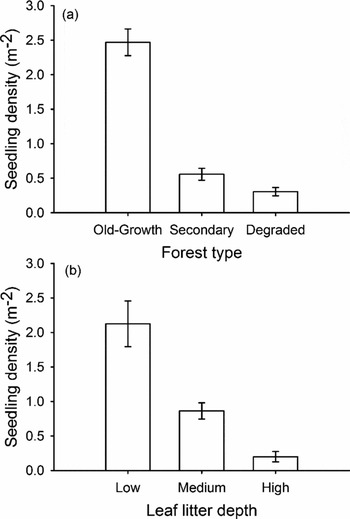
Seedling density varied significantly among forest types (LR χ2 = 180, P < 0.001), with mean seedling density highest in the old-growth forest and lowest in the degraded secondary forest (Figure 1a). Across all forest types, seedling density also decreased with increasing leaf-litter depth (LR χ2 = 71.4, P < 0.001; Figure 1b). The best-fit model for seedling density included both leaf-litter depth (LR χ2 = 45.5, P < 0.001) and forest type (LR χ2 = 20.7, P < 0.001), but no interaction term (LR χ2 = 7.37, P = 0.12). Litter depth varied significantly among forest types (χ2 = 100, df = 4, P < 0.001; Table 1). In old-growth forest, 64% of seedling plots had low leaf-litter depths, compared to 23% and 6% in secondary and degraded forest areas. The percentage of plots with deep leaf litter was greatest in the degraded forest (Table 1).
Variation in seedling density among forest types (a) and low (0–4 cm), medium (4–8 cm) and high (>8 cm) leaf-litter depth categories (b) in the Bukit Timah Nature Reserve, Singapore. Data represent mean ± 1 SE.

The number (proportion) of seedling plots within each forest type in the Bukit Timah Nature Reserve that fell into each leaf-litter depth category.

Seedling height also differed significantly among forest types (Kruskal–Wallis χ2 = 9.62, df = 2, P = 0.008). Mean seedling height (± 1 SE) was higher in old-growth forest (790 ± 27 mm) than in secondary (629 ± 53 mm) and degraded forest areas (579 ± 68 mm). Relatively few seedlings >1 m tall were encountered in secondary and degraded forest areas compared with old-growth forest. The smaller seedling heights in secondary and degraded forest were not due to higher stem breakage, since the proportion of broken stems was higher in old-growth forest (16.4%) than in secondary (11.5%) and degraded (1.8%) areas and varied significantly among the forest types (deviance = 12.7, df = 2, P = 0.002). Differences in proportion of broken stems are likely explained by the higher number of canopy trees in old-growth forest resulting in more branches breaking young seedlings as they fall from the canopy.
Seedling density at BTNR was significantly lower in secondary forest as compared with old-growth forest, and even lower in the degraded secondary. This finding is contrary to previous studies that reported higher seedling densities in secondary forests compared with later-successional or old-growth forests (Capers et al. Reference CAPERS, CHAZDON, REDONDO BRENES and VILCHEZ ALVARADO2005, Denslow & Guzman G. Reference DENSLOW and GUZMAN2000, but see Nicotra et al. Reference NICOTRA, CHAZDON and IRIARTE1999), presumably due to greater canopy openness that facilitates higher light availability (Chazdon et al. Reference CHAZDON, PEARCY, LEE, FETCHER, Mulkey, Chazdon and Smith1996). Light is commonly considered a limiting factor for seedling establishment and growth in closed-canopy tropical forests (Montgomery & Chazdon Reference MONTGOMERY and CHAZDON2002). Moreover, seedlings in the secondary and degraded secondary forests were smaller than those in old-growth forest, suggesting barriers to seedling establishment and growth.
Higher leaf-litter depths in the degraded and secondary forest likely contributed to the lower seedling densities found in these areas. The deeper leaf litter is a result of prolific litter production by C. auriculatum and D. suffruticosa, which may then resist decomposition due to intrinsic properties or due to forest conditions (e.g. lower humidity). Leaf litter can serve as both a physical and chemical barrier to successful seedling recruitment by physically impeding growth, disrupting light availability and wavelengths, or through leaching of allelopathic chemicals (Facelli & Pickett Reference FACELLI and PICKETT1991). Leaf litter can reduce seed germination in BTNR (Metcalfe & Turner Reference METCALFE and TURNER1998). While there was some evidence that reduced seedling density was related to litter layer depth, the best model for seedling density also included forest type, indicating that increased litter depth in secondary forest types relative to old-growth forest only partially explains differences in seedling density. High leaf-litter depths in the degraded secondary forest are compounded by fern patches, which have thick root mats and are likely allelopathic, inhibiting seed germination and shading out seedlings (Shono et al. Reference SHONO, DAVIES and CHUA2006).
Other factors likely contribute to the observed differences in seedling density and height, including seed availability, seed dispersal and the ability of seedlings to establish and persist. Although there is a lack of reproductive-size trees in the secondary forest types that likely limits the secondary forest seed pool, the close proximity of old-growth forest might provide sufficient seed sources. However, dispersal from old-growth into secondary forest is almost certainly impacted by the major loss of local fauna at this site. Small-seeded plants, the most likely to be dispersed, are the least likely to germinate in thick litter (Corlett Reference CORLETT1992, Metcalfe & Turner Reference METCALFE and TURNER1998). Moreover, the secondary forest types have land-use histories that likely resulted in soil degradation. Local soils subject to fire and agriculture are nutrient-poor and have low pH (Grubb et al. Reference GRUBB, TURNER and BURSLEM1994). Seedling growth in BTNR is limited by nutrient availability in old-growth forest and this is likely to be even more severe in secondary forest (Burslem et al. Reference BURSLEM, GRUBB and TURNER1996), which may help explain observed differences in size class distributions. Ultimately, the impacts of reduced reproductive capacity, a depauperate disperser fauna, and altered litter and soil characteristics are all likely to be contributors to the observed differences.
The secondary and degraded secondary forests have not been subject to disturbance for over 50 y; however, they remain significantly different from adjacent old-growth forest. The observed lack of seedling recruitment in the secondary and degraded forests may represent a state of delayed or arrested succession. Succession in degraded lands in Singapore appears to be an extremely slow process, perhaps requiring >100 y to reach secondary forest (Corlett Reference CORLETT1991). If the regeneration of diverse and stable forest within BTNR is presently impeded, as our results suggest, then active management of the reserve may be warranted (Shono et al. Reference SHONO, DAVIES and CHUA2006); accelerating succession in secondary forest would effectively provide a larger refuge. Future research should focus on the mechanisms inhibiting seedling regeneration and explore the possibility of applied restoration to accelerate secondary forest succession and recovery.
ACKNOWLEDGEMENTS
S. Letcher and two anonymous reviewers provided valuable comments. K. Shono and S.K.Y. Lum provided field assistance. The National Parks Board, Singapore and the Center for Tropical Forest Science granted permission to work in BTNR and the forest dynamics plot, respectively. This research is supported by a grant from the Freeman Foundation for Asian Studies and an NSF Graduate Research Fellowship to G.R. Goldsmith. L.S. Comita acknowledges fellowship support from the National Center for Ecological Analysis and Synthesis.