Introduction
The number of Americans older than 65 is expected to more than double in the next 40 years, increasing from 40.2 million in 2010 to 88.5 million in 2050 (Alzheimer's, Reference Alzheimer's2014). Of these older individuals, many will experience both cognitive decline and impairment in performing daily activities. Some of these declines may be signs of impending disease. While early cognitive changes often are recognized as the first symptoms of decline, impairment in daily functioning can also occur early and be quite distressing. This impairment may impact personal or environmental safety or ability to care and protect oneself. An important question is whether there are clinical characteristics of subtle yet observable functional changes before dementia that may anticipate future cognitive decline.
In elderly persons, subtle cognitive deficits occur within the normal range on standard testing protocols and predict the time to clinically relevant cognitive impairment before clinical symptoms are reported (Kawas et al., Reference Kawas2003; Visser et al., Reference Visser, Kester, Jolles and Verhey2006). Similarly, there are subtle functional deficits, specifically with instrumental activities of daily living (IADLs) that can be identified and predate a diagnosis of MCI (Peres et al., Reference Peres, Chrysostome, Fabrigoule, Orgogozo, Dartigues and Barberger-Gateau2006; Di Carlo et al., Reference Di Carlo2007; Reppermund et al., Reference Reppermund2013). Mild cognitive impairment (MCI) is commonly referred to, as a state in which there is cognitive decline in older adults that is not of sufficient magnitude to impact daily life and so meet criteria for dementia (Albert et al., Reference Albert2011). Because many persons with MCI are at increased risk of transitioning from normal aging to dementia it is of great public health importance to study this transition (Fischer et al., Reference Fischer2007; Marchesi, Reference Marchesi2012). Dementia due to Alzheimer's disease (AD), for example, is most commonly preceded by a long prodromal period during which cognitive symptoms insidiously emerge though without significant impact to one's life (Nowrangi et al., Reference Nowrangi, Rao and Lyketsos2011). The presence of brain amyloid (imaged by PET) in functionally “normal” older adults has been associated with subtle but significant cognitive deficits, which may reflect early neuropathological changes (Sperling et al., Reference Sperling2013). As impairments in daily functioning increase, a diagnosis of the dementia syndrome is made. The extent of this impairment and its measurement, however, is not well-understood. As our population ages such IADLs as financial management, driving an automobile, medication management, and other complex judgment and decision-making processes will become areas to carefully monitor as deficits in these can lead to unwanted or even dangerous outcomes (Harada et al., Reference Harada, Natelson Love and Triebel2013). The development and course of functional changes that occur along the continuum towards dementia; however, are poorly defined and their relationship with the transition from no appreciable cognitive deficits to MCI or dementia has not been well-studied.
Because of both the clinical and scientific interest in identifying early stages of dementia, there is a growing body of research focused on better characterizing the transitions between those who appear cognitively normal and MCI or dementia (Vallotti et al., Reference Vallotti2001; Kryscio et al., Reference Kryscio, Schmitt, Salazar, Mendiondo and Markesbery2006; Artero et al., Reference Artero2008; Oulhaj et al., Reference Oulhaj, Wilcock, Smith and de Jager2009). Moreover, characterizing the earliest changes in daily functioning that might predict the onset of disease states might help identify individuals who could participate in secondary prevention trials that may halt, delay, or reverse disease progression.
Though cognition and functioning are related to each other, the overall objective of the present study is to understand the transition from apparently normal cognition to MCI or dementia from the perspective of daily functioning. Because there are relatively small but observable and measurable deficits in daily functioning in a subset of those who cognitively test as normal, we intend to investigate whether these individuals go on to develop MCI or dementia when examined independent of cognitive measures. In order to accomplish this goal, we will measure the independent utility of the Functional Activity Questionnaire (FAQ) in predicting conversion to MCI or dementia, with and without adjustment for cognitive performance. We first hypothesize that relatively small changes in the FAQ are associated with an increase in the risk of conversion to MCI or dementia. We underscore here that we are not asserting causation. Secondarily, we hypothesize that those primarily with deficits in IADLs specific to financial activities will go on to convert from normal aging to MCI or dementia compared with other IADLs. We will do this by individually examining the FAQ's component parts.
Methods
Participants and study design
National Alzheimer Coordinating Center (NACC): Volunteers were recruited from 34 past and present NIA-funded Alzheimer's Disease Centers (ADC) across the USA. NACC has developed and maintains a large database of standardized clinical and neuropathological research data (Beekly et al., Reference Beekly2004). Data included in this study occurred between September 2005 and January 20015. All ADCs were overseen by local IRBs, and after complete description of the study to the subjects, written informed consent was obtained. Volunteers were evaluated annually by trained clinicians either in the clinic or at home. At each annual visit, a Uniformed Data Set (UDS) (Beekly et al., Reference Beekly2007) was collected, which included demographics, medical history, family history, behavioral, and functional assessments, as well as a neuropsychological battery. Race and ethnicity were based on the participant's report. Diagnoses were made by a clinician or consensus conference using all available data (Morris et al., Reference Morris2006; Morris, Reference Morris2008; Weintraub et al., Reference Weintraub2009). MCI diagnoses were made using modified Petersen criteria (Petersen et al., Reference Petersen2001; Petersen et al., Reference Petersen2009) and AD diagnoses were made using NINCDS/ADRDA criteria (McKhann, Reference McKhann2011). Normal participants were not diagnosed with either MCI or any type of dementia.
Measures
The Functional Activities Questionnaire (FAQ) was administered to the informant at each visit by a trained and certified NACC staff member (Morris et al., Reference Morris2006; Morris, Reference Morris2008; Weintraub et al., Reference Weintraub2009). The FAQ (Pfeffer et al., Reference Pfeffer, Kurosaki, Harrah, Chance and Filos1982), is a 10-item clinical measure of independence for completing daily tasks necessary for independent living that can be administered to either patient or caregiver. The FAQ is a consistently accurate instrument with good sensitivity (85%) and also has good reliability (exceeding 0.80) (Pfeffer et al., Reference Pfeffer, Kurosaki, Harrah, Chance and Filos1982). Tests of validity have been performed on the FAQ and have established it as both a bedside as well as a research instrument. The abilities assessed in the FAQ are: (1) writing checks, paying bills, or balancing a checkbook; (2) assembling tax records, business affairs, or papers; (3) shopping alone for clothes, household necessities, or groceries; (4) playing a game of skill or working on a hobby; (5) heating water, making a cup of coffee, or turning off the stove after use; (6) preparing a balanced meal; (7) keeping track of current events; (8) paying attention to or understanding and discussing a TV, book, or magazine; (9) remembering appointments, family occasions, holidays, medications; (10) traveling out of the neighborhood, driving, arranging to take a bus. For each activity, four levels ranging from dependence (scored 0) to independence (scored 3) are specified. Sum scores range from 0 to 30 with higher scores reflecting greater dependency. A cut-point score of 9 (dependent in 3 or more activities) is recommended to indicate impaired function and possible cognitive impairment. If the subject had never done one of these activities, a coding of “not applicable” was given and was excluded from this analysis.
Several tests of memory and executive function were selected for inclusion in the analysis because performance of daily functional tasks requires effective recruitment and execution of cognition specifically in these domains (Royall et al., Reference Royall, Lauterbach, Kaufer, Malloy, Coburn and Black2007; Hughes et al., Reference Hughes, Chang, Bilt, Snitz and Ganguli2012; Monsell et al., Reference Monsell2014). While other cognitive domains such as language and visuospatial ability are also necessary, most evidence suggests episodic memory and executive control are essential (Royall et al., Reference Royall2002; Royall et al., Reference Royall, Lauterbach, Kaufer, Malloy, Coburn and Black2007; Reinvang et al., Reference Reinvang, Grambaite and Espeseth2012). Therefore, we included the following cognitive tests to assess executive function: (1) Trail Making Test (TMT) A and B jointly assess attention, visual scanning and search skills, and psychomotor speed and coordination (Reitan, Reference Reitan1955). Independently, TMT A assesses processing speed whereas TMT B assesses set switching therefore, both were included in the analysis and the difference between TMT B and A as a measure of executive function. (2) Category (animals and vegetables) fluency evaluated semantic and phonemic verbal fluency (Lezak, Reference Lezak and Lezak2004c). (3) Digit span forwards and backwards (Jensen and Figueroa, Reference Jensen and Figueroa1975) are also measures of working memory and often fall under the auspices of executive function. Memory function was primarily evaluated by use of: (3) Mini-Mental State Exam (MMSE) (Folstein et al., Reference Folstein, Folstein and McHugh1975) which includes screening estimates of episodic recall but also of orientation, attention, language, and visual construction. (4) Current Logical Memory 1A Story Units Recalled is an age-, sex-, education-adjusted z-score for the total number of items recalled (Abikoff et al., Reference Abikoff1987). This test examines the ability to recall a short story and is used as an approximation of episodic memory. The Boston naming test (Kaplan et al., Reference Kaplan, Goodglass and Weintraub1983; LaBarge et al., Reference LaBarge, Edwards and Knesevich1986) was also included in the analysis to assess effect of language function. It assesses confrontational word retrieval commonly in patients with aphasia due to a variety of neurological conditions. The Wechsler Adult Intelligence Scale (WAIS-R) digit symbol test was added to provide an estimate of processing speed (Wechsler, Reference Wechsler1939). Finally, we included the Geriatric Depression Scale (GDS), which is a 15-item screening measure for depression in older adults. Scores range from 0 to 15, with scores greater than 5 indicating a positive screen (Yesavage, Reference Yesavage1988).
Statistical analysis
Conversion was defined as change in diagnostic class from normal to MCI or dementia. We compared demographics, baseline cognitive measures (as described above), FAQ total (0–30) and individually (0–3) between converters and non-converters using t-tests or χ 2 tests (p < 0.05). All tests were two-sided; t-tests assumed unequal variances and used Satterthwaite's approximation for degrees of freedom (Satterthwaite, Reference Satterthwaite1946).
In order to test our hypothesis, we fit three statistical models that systematically adjusted for cognitive variables. In the base model, (1) we fit Cox proportional hazards models and included for baseline age, sex, years of education, GDS, and total FAQ. To further investigate the effect of cognition, we fit two other models additionally controlling for, (2) non-executive (memory and naming): MMSE, logical memory, Boston naming, and (3) combined executive function and non-executive: TMT B–A, animal and vegetable category fluencies, and digit span forward and backward, WAIS-R (executive measures) with non-executive as in (2). Time to conversion or censor was measured in years.
Secondarily, we fit Cox proportional hazards models to FAQ subcategories, as referenced earlier, to investigate which abilities, if any, predicted conversion. To control for cognitive variables as well as age, sex, years of education, we applied the same three-model procedure as described above in the primary analysis. All computations were done using STATA version 11.0 (StataCorp, College Station, TX).
Results
Participant characteristics
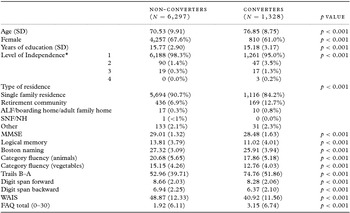
Our data request included all visits for all 7,625 participants with more than one visit and who were cognitively normal at their first visit. Of these individuals, 1,328 converted to either MCI or dementia by visit 10. Table 1 summarizes demographic, cognitive, and functional data by conversion status. Converters were more likely to be older, female, and have slightly less education over all. On a scale of independence with 1 indicating complete independence and 4 complete dependence, converters, at baseline, were somewhat more dependent. Not surprisingly, converters tended to live less independently than their non-converter counterparts and a greater percentage lived in a retirement community or other assisted living environment. Cognitively, converters had lower MMSE, and episodic memory scores (logical memory) and tests of executive function were lower than those of non-converters.
Mean participant characteristics at baseline (SD)

* Level of Independence: 1: able to live independently; 2: requires some assistance with complex activities; 3: requires some assistance with basic activities; 4: completely dependent.
In terms of daily living activities, converters had a total FAQ score significantly higher than non-converters though mean scores did not meet FAQ cut point of 9, which recommends loss of independence. Within each subscale, converters also scored slightly higher than their counterparts.
Functional activity hazard models
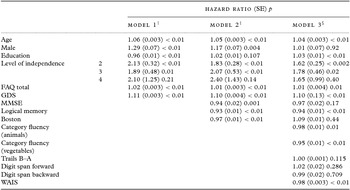
We fit Cox proportional hazard models with conversion to MCI or dementia as the outcome. Table 2 reports Hazard Ratios with standard errors for all three models (as described above). Most notably, the hazard ratio estimate for total FAQ did not change between model 1 (1.02, (0.003), p < 0.01), model 2 (1.01, (0.003), p < 0.01) and model 3 (1.01, (0.004), p = 0.01). Though the association between total FAQ at baseline and conversion-free survival is small, these models suggest that there is no attenuation of the association after adjusting for the cognitive tests. A separate analysis (not shown) was conducted to include various covariates into the statistical model. These included history of heart attack, stroke, seizure, traumatic brain injury, use of anxiolytics including benzodiazepines, prior diagnosis of major psychiatric disorder, and alcohol use. The association between FAQ and hazard of conversion was not altered across all three models when including these covariates.
Cox proportional hazard models for conversion to MCI or dementia

† Model 1: adjusted for baseline age, sex, years of education, and total FAQ.
‡ Model 2: model 1 + MMSE, logical memory, Boston naming.
§ Model 3: model 1 + model 2 + TMT B–A, animal and vegetable category fluencies, and digit span forward and backward.
Subanalysis: Hazard estimation of each FAQ subscales
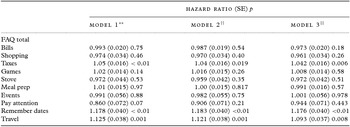
Table 3 reports sub analyses in which we examine the association between each FAQ subtest and conversion-free survival. The subtests associated with the greatest hazard of conversion were ability to do taxes, remember dates, and travel.
Cox proportional hazard models for conversion to MCI or dementia using FAQ components

** Model 1: adjusted for baseline age, sex, years of education, and total FAQ.
†† Model 2: model 1 + MMSE, logical memory, Boston naming.
‡‡ Model 3: model 1 + model 2 + TMT B–A, animal and vegetable category fluencies, and digit span forward and backward.
Discussion
In this analysis, we sought to examine the association between baseline functioning and conversion to MCI or dementia. We tested the hypothesis that changes in functional ability as measured by the FAQ-predicted conversion from normal to either MCI or dementia, even after adjustment for cognitive tests. We first found that indeed there was variability among total FAQ scores in older adults who tested cognitively within normal range. While FAQ scores were understandably low (since these participants were in the normal NACC cohort) and did not meet the cut point to indicate functional impairment, we did find that those who converted to MCI or dementia had higher baseline total FAQ (Table 1). We found a statistically significant association between baseline FAQ total score and risk of conversion to MCI or dementia. To our knowledge, this association has not been previously identified in a large sample. Additionally, the association between baseline FAQ and risk of conversion was not attenuated after adjustment for cognitive test scores (Table 2). Finally, we showed that the ability to do taxes, remember dates, and to travel were associated with increased risk of conversion (Table 3).
As individuals advance in age, the ability to maintain an independent and good quality of life is dependent not only on their health status but also on their cognitive and functional abilities. To date there is a consistent body of literature supporting a general pattern of age-related changes in cognitive function in which crystallized abilities (general knowledge and acquired skills) are relatively preserved with increasing age, while fluid abilities (reasoning, pattern recognition, and novel problem solving) gradually decline after they peak, typically in one's 20’s–30’s (Salthouse et al., Reference Salthouse, Reynolds, Tam, Josephson and Mahmood2010; Harada et al., Reference Harada, Natelson Love and Triebel2013). Specific cognitive domains that are typically investigated in regards to normal age-related changes; namely cognitive (psychomotor) speed, attention, executive functions, and memory have also been attributed to MCI and dementia. It is often inferred, then, that declines in cognitive performance as measured by neuropsychological tests closely mirrors or even causes loss of functional abilities that ultimately define the dementia syndrome (Reppermund et al., Reference Reppermund2011; Shankle et al., Reference Shankle2013; Caselli et al., Reference Caselli2014).
To our knowledge, this is the first study of the FAQ as an indirect measure of functional ability to predict conversion to MCI or dementia. Other studies have examined conversion from normal to MCI or dementia in relation to functioning but have not explored association directly (Wadley et al., Reference Wadley2007; Artero et al., Reference Artero2008; Jefferson et al., Reference Jefferson2008). Because the neurodegenerative process leading to dementia begins early in adulthood and progresses over decades (Braak and Braak, Reference Braak and Braak1995; Bookheimer et al., Reference Bookheimer2000), more research is seeking to examine earlier pre-morbid stages to identify individuals that may be more amenable to intervention. A number of studies have now shown that daily functioning becomes impaired in the early stages of cognitive decline before a diagnosis of dementia is warranted and that these individuals go on to develop MCI or dementia (Barberger-Gateau et al., Reference Barberger-Gateau, Dartigues and Letenneur1993; Tabert et al., Reference Tabert2002; Burton et al., Reference Burton, Strauss, Hultsch and Hunter2006; Peres et al., Reference Peres, Chrysostome, Fabrigoule, Orgogozo, Dartigues and Barberger-Gateau2006; Mariani et al., Reference Mariani2008). This is set in the context that those with MCI are at increased risk of progressing to dementia (DeCarli, Reference DeCarli2003; Bruscoli and Lovestone, Reference Bruscoli and Lovestone2004; Panza et al., Reference Panza2005; Pinto and Subramanyam, Reference Pinto and Subramanyam2009). As a result, the revised criteria for MCI as put forward by Albert et al. (Reference Albert2011), suggests that while those with MCI may have mild problems performing complex functional tasks, they are able to live independently. Similarly, a number of studies have shown that early impairment in activities of daily living increased risk of conversion from normal to MCI to dementia (Perneczky et al., Reference Perneczky2006; Bangen et al., Reference Bangen2010; Marshall et al., Reference Marshall2014). In the Sydney Memory and Ageing Study (Reppermund et al., Reference Reppermund2013), the investigators showed that participation in highly cognitively demanding activities specifically predicted amnestic MCI but not non-amnestic MCI whereas those with low cognitive demand did not predict MCI or dementia (Reppermund et al., Reference Reppermund2013). Similarly, Peres et al. (Reference Peres, Chrysostome, Fabrigoule, Orgogozo, Dartigues and Barberger-Gateau2006), Di Carlo et al. (Reference Di Carlo2007), and DeCarli (Reference DeCarli2003) found that in those with normal cognition, self-reported IADL restrictions predicted progression to dementia after 2 and 4 years, respectively.
While clinicians frequently use neuropsychological measures to account for differences in functional status among older adults these tests are designed to evaluate specific cognitive abilities rather than functional abilities, and there is little evidence to support such test use in this manner (Chaytor and Schmitter-Edgecombe, Reference Chaytor and Schmitter-Edgecombe2003; Farias et al., Reference Farias, Harrell, Neumann and Houtz2003). Research does suggest, however, that global cognition assessed by such measures as the MMSE as well as measures of executive functioning such as the Delis–Kaplan Executive Function System (Delis et al., Reference Delis, Kramer, Kaplan and Holdnack2004; Homack et al., Reference Homack, Lee and Riccio2005), account for the greatest proportion of variance of functional ability (Duda et al., Reference Duda, Puente and Miller2014). Several studies have shown specific associations between executive functions (Mariani et al., Reference Mariani2008; Pereira et al., Reference Pereira2010), memory and psychomotor speed (Barberger-Gateau et al., Reference Barberger-Gateau, Dartigues and Letenneur1993; Tuokko et al., Reference Tuokko, Morris and Ebert2005). In a study by Reppermund et al. (Reference Reppermund2011), significant associations were observed between an instrument of functional ability, the Bayer-Activities of Daily Living (B-ADL) and five cognitive domains (Memory, Attention/processing speed, visuospatial, language, and executive functions) in tasks that designated to be “high cognitive demand” by factor analysis. Other studies including a review of 68 papers by Royall et al. (Reference Royall, Palmer, Chiodo and Polk2005), however, showed only modest association between cognitive measures and functional outcomes. Results from this analysis show the independent association of the FAQ and hazard of conversion to MCI or dementia. This is of potential importance given that neuropsychological batteries take a long time and may be expensive to administer while the FAQ is relatively simple and take a shorter time to administer. Taken together, these results with those from other studies point to a complex interaction between cognition and daily functioning that more likely to be reciprocating rather than linear or simple causation.
The results of this analysis demonstrate a striking association between changes in financial management (taxes) with conversion to MCI or dementia. Financial ability has been the focus of insightful research in normal and pathological cognitive aging. Financial capacity comprises a broad range of conceptual, pragmatic, and judgment and decision-making abilities ranging from basic to more complex skills such as bill payment, balancing a bank account, and exercising complex financial judgment (Marson et al., Reference Marson2000; Farias et al., Reference Farias, Mungas, Reed, Harvey, Cahn-Weiner and Decarli2006). It has been systematically shown that impairment in financial capacity is one of the earliest IADL changes seen in MCI. Studies by Marson et al., have shown impaired performance on a measure of financial capacity called the financial capacity instrument (FCI) (Marson et al., Reference Marson2000; Marson et al., Reference Marson2009). The neurocognitive predictors of financial ability in people with MCI and AD include measures of attention and working memory (executive function), short-term episodic memory, visuomotor tracking, and written arithmetic ability (Royall et al., Reference Royall, Lauterbach, Kaufer, Malloy, Coburn and Black2007; Okonkwo et al., Reference Okonkwo2008). These cognitive abilities as they pertain to financial capacity have been associated with brain changes including the medial frontal cortex and decreases in posterior cortical volumes (Stoeckel et al., Reference Stoeckel2013). Results of this analysis support the assertion that financial capacity is a significant and early indicator of future functional decline and potentially conversion to MCI or dementia. Additionally, this analysis also shows an association between conversion and remembering dates and traveling. A study by Marshall et al. (Reference Marshall2014) showed that the remembering shopping items as well as appointments and events discriminated between cognitively normal individuals and MCI here suggesting agreement with other research related to memory-based functional abilities. Traveling as a specific instrumental activity to our knowledge does not appear to have been studied and so represents a potential area of focus for future investigation.
This study over-all has several strengths including large sample, which enabled analysis of the FAQ by subcategories rather than by total score as is most commonly done. Moreover, the choice of the FAQ reflects an informant-based rather than self-reported instrument, which is a common weakness in other studies. Finally, the statistical approach of the study sought to examine functioning in relation to cognition rather than in addition to it provides a useful perspective in disentangling the two. While it is desirable to develop predictive models in a participant-by-participant fashion, there are challenges to doing this, which includes needing to develop it in a training sample and test it in a separate one. The strength of this these present data is that an association has been shown between functioning and conversion independent of cognition and this may be the basis of developing separate predictive models in the future. Weaknesses included potential selection biases since the sample included typically highly educated volunteers who were mostly female. Additionally, sex differences in functioning as well as relative sensitivity and specificity of the FAQ in determining conversion was not investigated but we identify them as potential topics for future research. As our population ages, it will become important to understand both cognitive and functional transitions because of the potential for delaying the development of pathological states such as AD but also for identifying candidates for disease modifying therapies or identifying and developing effective compensatory measures and employing assistive technologies.
Conflict of interest declaration
None.
Description of authors’ role
M. Nowrangi designed the study, conducted the data collection, performed the analysis, and generated the manuscript. P. Rosenberg designed the study, supervised the data collection and analysis, and generated the manuscript. J.M. Leoutsakos designed the study, supervised the data collection, analysis, and generation of the manuscript.
Disclosures of competing interests
None.
Acknowledgments
The NACC database is funded by NIA/NIH Grant U01 AG016976. NACC data are contributed by the NIAfunded ADCs: P30 AG019610 (PI Eric Reiman, MD), P30 AG013846 (PI Neil Kowall, MD), P50 AG008702 (PI Scott Small, MD), P50 AG025688 (PI Allan Levey, MD, PhD), P50 AG047266 (PI Todd Golde, MD, PhD), P30 AG010133 (PI Andrew Saykin, PsyD), P50 AG005146 (PI Marilyn Albert, PhD), P50 AG005134 (PI Bradley Hyman, MD, PhD), P50 AG016574 (PI Ronald Petersen, MD, PhD), P50 AG005138 (PI Mary Sano, PhD), P30 AG008051 (PI Steven Ferris, PhD), P30 AG013854 (PI M. Marsel Mesulam, MD), P30 AG008017 (PI Jeffrey Kaye, MD), P30 AG010161 (PI David Bennett, MD), P50 AG047366 (PI Victor Henderson, MD, MS), P30 AG010129 (PI Charles DeCarli, MD), P50 AG016573 (PI Frank LaFerla, PhD), P50 AG016570 (PI Marie-Francoise Chesselet, MD, PhD), P50 AG005131 (PI Douglas Galasko, MD), P50 AG023501 (PI Bruce Miller, MD), P30 AG035982 (PI Russell Swerdlow, MD), P30 AG028383 (PI Linda Van Eldik, PhD), P30 AG010124 (PI John Trojanowski, MD, PhD), P50 AG005133 (PI Oscar Lopez, MD), P50 AG005142 (PI Helena Chui, MD), P30 AG012300 (PI Roger Rosenberg, MD), P50 AG005136 (PI Thomas Montine, MD, PhD), P50 AG033514 (PI Sanjay Asthana, MD, FRCP), P50 AG005681 (PI John Morris, MD), and P50 AG047270 (PI Stephen Strittmatter, MD, PhD).”