Introduction
Poultry have been domesticated for thousands of years. Archaeological evidence suggests that domesticated chickens existed in China 8,000 years ago and that they later spread to Western Europe, possibly by way of Russia (Alders, Reference ALDERS2004). Domestication may have occurred separately in India or domesticated birds may have been introduced from Southeast Asia. Accounts of cock fighting in India from 3,000 years ago indicate that chickens have been part of the culture for a long time. Domestic chickens appeared in Africa many centuries ago; they are now an established part of African life.
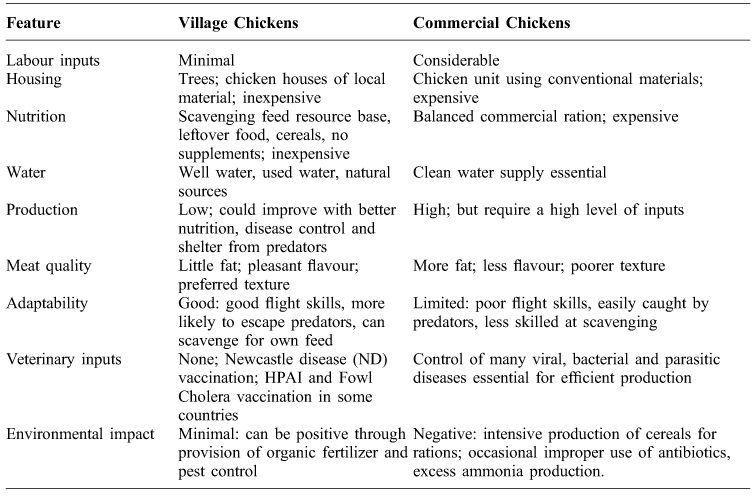
Village poultry can be found in all developing countries and play a vital role in many poor rural households (Alders, Reference ALDERS2004; Alexander et al., Reference ALEXANDER, BELL and ALDERS2004; Spradbrow, 1993/94). They provide scarce animal protein in the form of meat and eggs and can be sold or bartered to meet essential family needs such as medicine, clothes and school fees. Village poultry are active in pest control, provide manure, are required for special festivals and are essential for many traditional ceremonies. The output of village poultry is lower than that of intensively raised birds but it is obtained with a minimum input in terms of housing, disease control, management and supplementary feeding (Table 1). They are generally owned and managed by women and children and are often essential elements of female-headed households (Bagnol, Reference BAGNOL2001; Guèye, Reference GUÈYE2000).
Comparison of village and commercial chickens (Alders and Spradbrow, Reference ALDERS and SPRADBROW2001).
In many countries, social goodwill is created by offering guests a meal containing meat; more often than not, poultry. Honoured guests can be given a live bird to take home as a mark of respect. Poultry and poultry products can be sold to obtain items that enable families to participate fully in community activities. Village poultry have many advantages in mixed farming systems as they are small, reproduce easily, do not need large investment and can scavenge for food. They thrive on kitchen waste, broken grains, earthworms, snails, insects and vegetation.
During the 1990s, the world's poultry population grew by 23% in developed countries and 76% in developing countries (Branckaert et al., Reference BRANCKAERT, GAVIRIA, JALLADE and SEIDERS2000). This spectacular increase was largely the result of increased commercial production, notably in the Far East where growth averaged 90%. In poor countries, however, the conditions for a successful commercial poultry sector are rarely present. These conditions include:
• An ability to purchase inputs such as improved breeds;
• An ability to purchase quality day-old chicks;
• The ability to purchase quality feed, vaccines, drugs and equipment;
• The availability of a skilled workforce;
• Strict disease control; and
• Domestic markets on which poultry products can be disposed of at attractive prices.
Before broiler or egg production can be established on a medium- or large-scale commercial basis, an area must be either self-sufficient in cereal production or have access to hard currency from exports. In countries where these conditions have not been satisfied, poultry production is based on traditional extensive low input/low output husbandry methods. Poultry production has been an integral part of small farms for centuries and will continue to be for the foreseeable future. Approximately 20% of the protein consumed in developing countries comes from poultry meat and eggs. Rural household poultry production contributes 70% of total production in most low-income, food-deficit countries (Branckaert et al., Reference BRANCKAERT, GAVIRIA, JALLADE and SEIDERS2000).
Research in villages in different countries has revealed that the genetic potential of village chickens is generally not the major constraint to their production (Dolberg, Reference DOLBERG2003). In fact, in situations where there is limited supplementary feed, housing and veterinary medications, village chickens are much more likely to survive and reproduce than commercial breeds. The heavier commercial breeds often have problems escaping predators, are poor scavengers for feed and show poor broodiness, and so replacement stock must be purchased rather than raised in the village.
One of the major constraints to production of village chickens is Newcastle disease (ND; Alders and Spradbrow, Reference ALDERS and SPRADBROW2001; Alders, et al., 2005a; Alexander et al., Reference ALEXANDER, BELL and ALDERS2004). In countries where ND is endemic, outbreaks of this disease regularly result in mortalities of 50 to 100%. In developing countries where ND is not endemic, outbreaks may occur less frequently but potential losses due to the disease make vaccination mandatory. Collaborative research on the control of ND in village chickens in Asia and Africa has developed a cost-efficient model for ND control in village poultry (Copland and Alders, Reference COPLAND and ALDERS2005). Despite the need to control ND in village chickens, it has been difficult to achieve a sustainable control program. Experience has shown that a sustainable ND control program is composed of five essential elements:
• An appropriate vaccine, vaccine technology and vaccine distribution mechanisms;
• Effective extension materials and methodologies that target veterinary and extension staff as well as community vaccinators and farmers;
• Simple evaluation and monitoring systems of both technical and socio-economic indicators;
• Economic sustainability based on the commercialisation of the vaccine and vaccination services and the marketing of surplus chickens and eggs, and
• Support and coordination by relevant government agencies for the promotion of vaccination programs.
Poverty alleviation and household food security
The rationale for a pro-poor livestock development policy to incorporate village poultry production is logical as most of the poorest households keep poultry. The identification of farmers whose only livestock is poultry can, in many cases, be a tool for targeting very poor farming households (Dolberg, Reference DOLBERG2003). Impact studies have demonstrated that income from the sale of eggs in South Asia is used to educate children and begin the process of asset accumulation. Eggs, in particular, offer an important source of nutrition containing approximately 315 kilojoules of digestible energy and are one of the best sources of quality protein known. Eggs also supply an array of vitamins such as A, B12, and K (a bone-boosting nutrient also involved in blood coagulation) and also provide choline, a B group vitamin that plays a role in brain development and function. In addition, eggs can be stored for several days under village conditions and require very little energy or time to cook. In addition, the sale of poultry products allows investment in other livestock such as goats, cattle, expanded poultry production and other business enterprises (Alders, Reference ALDERS2004).
The implementation of an effective ND control program in countries such as Mozambique and Tanzania has resulted in increased chicken numbers, increased household purchasing power, increased home consumption of chicken products and increased decision-making power for women (Alders et al., Reference ALDERS, DOS ANJOS, BAGNOL, FUMO, MATA and YOUNG2003; Alders et al., Reference ALDERS, BAGNOL, HARUN, MSAMI, SPROWLES and YOUNG2005b; Bagnol, Reference BAGNOL2001). In the south of Mozambique, women have been able to sell excess chickens in order to buy goats and eventually cattle, thus giving them access to resources previously denied to them, as ruminants have been traditionally raised by men. Where families allocate chickens to children, the children may sell their chickens to buy school supplies.
HIV/AIDS mitigation and wildlife conservation
In households where there is a lack of able-bodied workers, such as those affected by HIV/AIDS or those that have a disabled family member, village poultry provide a source of high quality nutrition and income without requiring much in the way of labour or financial inputs.
Restocking with village chickens can be of utmost importance for poverty alleviation as the poorest households and families affected by long-term disease such as HIV/AIDS find chicken raising an easy activity that can contribute to household food security and income. Given that women are the main carers of sick people and that chickens are usually under women's control, chickens can play an important role providing them with additional resources to carry out their important task of supporting people living with HIV/AIDS (IRPC, Reference IRPC2005).
Illegal hunting of wildlife by communities around conservation areas such as national parks has a severe impact on migratory and non-migratory wildlife populations (Sinclair, Reference SINCLAIR1995). Subsistence bushmeat hunting, which makes up a significant proportion of poaching, is attributed primarily to a lack of sufficient alternative sources of protein and income (Campbell et al., Reference CAMPBELL, NELSON and LOIBOOKI2001). One approach to reducing bushmeat hunting and its consequent threat to conservation, is to improve the ability of people to subsist on alternative sources of protein (Loibooki et al., Reference LOIBOOKI, HOFER, CAMPBELL and EAST2002). Loibooki et al. (Reference LOIBOOKI, HOFER, CAMPBELL and EAST2002) found that households raising more small domestic livestock were less likely to participate in bushmeat hunting. Vaccination of village chickens against ND has resulted in increased birds numbers in communities bordering South Luangwa National Park in Zambia and further studies are underway in South Luangwa to determine if increased village poultry numbers will translate into decreased bushmeat sale and consumption (Alders et al., 2008).
Planning interventions according to production systems, context and cost-benefits
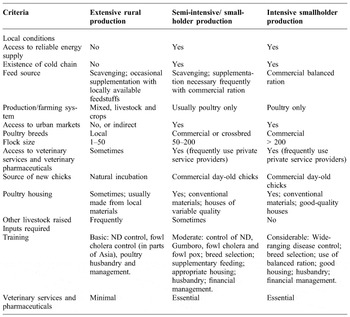
Many village poultry-based projects have demonstrated that it is possible to build on the scavenging system and to organize interventions that have an impact on poor households. Exactly what these interventions should be and how they should be organized varies according to local conditions (Table 2). Reductions in mortality through vaccinations conducted by trained community vaccinators (Alexander et al., Reference ALEXANDER, BELL and ALDERS2004) and improved management that protects young chicks for the first 6-8 weeks are high on the list (Dolberg, Reference DOLBERG2003). If the program is to be sustainable, an increase in production will require a market for the sale of eggs, live birds or meat so that producers are able to pay for production inputs.
Matching chicken programmes with local conditions (adapted from Alders, Reference ALDERS2004).

It may seem that having more poultry will make an enterprise more profitable, but this is not always the case (Alders, Reference ALDERS2004). Care must be taken to ensure that inputs and expertise are available and affordable; otherwise attempts to intensify poultry production will not be sustainable. As the density of a poultry population increases, more sophisticated disease-control measures are required. Improved breeds need good-quality housing and feed to produce well. Improved breed hens do not brood instinctively, so replacement stock must be brought in, which requires a reliable source of day-old chickens or pullets in the case of layers.
Feed costs account for approximately 70% of the variable costs associated with the production of commercial poultry. Corn and soybeans are frequently incorporated into poultry rations and these feedstuffs are also used to produce biofuels and food for human consumption. As the price of these feedstuffs increase (due to increased demand or decreased supply due to poor harvests; Kiers et al., Reference KIERS, LEAKEY, IZAC, HEINEMANN, ROSENTHAL, NATHAN and JIGGINS2008), the profit margin for smaller producers will evaporate and these producers will go out of business either temporarily or permanently.
Hoffmann et al. (Reference HOFFMANN, RIETHMULLER and STEANE2003) noted that while there are differences in production per cow in developing countries in Asia, such comparisons need to be heavily qualified. For many small farmers, an animal's efficiency is far less important than its survivability and manageability. Not only are environments (climate, elevation, housing, feeds used, risk of disease and/or insect attack etc.) quite different but the roles of animals, their mature size, feed resources used and their ‘biological efficiency’ are missed in such comparisons. Similarly, village poultry are hardy, scavenge for their own feed, can run and fly to escape predators and are capable of reproducing (i.e. village hens become broody) to supply replacement stock for the household flock. All of these points make them very valuable to their owners who frequently lack the capital required to invest in commercial breeds of poultry.
In countries with an active poultry export industry, such as Thailand, it is possible to promote small scale poultry production where small producers are linked to larger companies that provide inputs (including extension services) and market access. This type of organisation of production has the potential to facilitate quality assurance activities as all involved in the production process are linked and benefit from the production of a quality product. Small producers that operate independently often lack capital and access to poultry health services and are more likely to encounter problems with poor quality rations and disease.
Output of village poultry in terms of weight gain and number of eggs per hen per year is often low, but there is minimal input in terms of housing, disease control, management and supplementary feeding. In countries such as Mozambique and Lao PDR, improving village poultry production in a cost-effective manner requires the introduction of appropriate management skills, together with locally available supplementary feed, disease control, shelter, improved flock management and development of effective marketing strategies.
Improving village poultry management, including biosecurity practices, can make an important contribution to the prevention and control of Highly Pathogenic Avian Influenza (HPAI). In countries currently free from HPAI, working with village chicken owners as well as commercial producers, to control killer diseases such as ND by vaccination will
• establish links between the owners and veterinary services; provide an opportunity to raise awareness about disease and disease transmission (i.e. introduce owners with little access to formal education to the concept of pathogens and how their transmission can be prevented)
• demonstrate the interest of authorities in improving village poultry production to facilitate the development of trust
• help to encourage village poultry owners to report mortality in birds, especially those that have been regularly vaccinated against ND.
In countries where HPAI is endemic, taking a holistic approach to poultry health is the key to success. HPAI prevention and control activities across all poultry sectors provide an opportunity to not only reduce the risk of HPAI but also reduce other zoonotic and financially important diseases.
HPAI and ND cannot be distinguished on the basis of clinical signs alone and this causes many problems for HPAI prevention and control activities. As most HPAI awareness raising campaigns make reference to HPAI only, a significant number of village poultry farmers think that the new word introduced to refer to HPAI in their local language is simply describing the disease that they have been seeing in their birds for many years (Alders and Bagnol, Reference ALDERS and BAGNOL2007). Hence, when disease occurs in their birds they will eat or sell them as they have done for generations in order to salvage some benefit from a difficult situation. Additionally, when authorities respond to HPAI outbreaks by stamping out birds without paying adequate compensation (in some cases none at all), many poultry owners are unlikely to report disease on subsequent occasions. HPAI control programs need to work with communities to assist them to actively prevent diseases such as ND, design movement controls (such as isolating new birds for two weeks, restricting the movement of poultry traders within villages, etc) and prepare disease control action plans. As village poultry usually move freely during the day to scavenge for their feed, disease prevention and control plans must be designed at the level of the village and not the individual household flock.
A quote recorded as part of an anthropological study in Cambodia done in association with the FAO HPAI Control Program, provides a clear illustration of the perception of village poultry farmers:
“Some people are now fencing their chickens, but only at night time. During day time, poultry walk free and are feeding themselves. This is because we do not have any money to feed them. We want to make the fence and fence chickens in one place but we do not have money to make a fence and to provide them with commercial feed. Fencing chickens in one place is better but we do not have the money to feed them.[…] We cannot buy commercial food because it costs a thousand Riels per kilogram. Usually, we just feed our chickens with cooked rice left over from our food.” (Hinkler, Reference HINKLER2007).
Conclusions
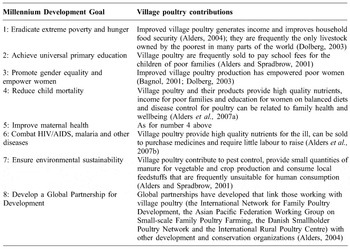
The implementation of effective village poultry production programs in Asia, Africa and Latin America has resulted in increased poultry numbers, increased household purchasing power, increased home consumption of poultry products and increased decision-making power for women (Dolberg, Reference DOLBERG2003; Alders, Reference ALDERS2004; Alders et al., Reference ALDERS, BAGNOL and YOUNG2007a). The Millennium Development Goals (MDGs) are eight targets to be achieved by 2015 that respond to the world's main development challenges. The MDGs are drawn from the actions and targets contained in the Millennium Declaration that was adopted by 189 nations-and signed by 147 heads of state and governments during the UN Millennium Summit in September 2000. Village poultry improvement programs have the potential to contribute to each of the goals and to do so for the most vulnerable families in developing countries (Table 3).
Potential contributions by village poultry to the Millennium Development Goals.

It is notable that countries where HPAI H5N1 is now endemic have a commercial poultry industry that comprises a significant number of small-scale commercial poultry producers with poor biosecurity practices (Sims, Reference SIMS2007). Otte et al. (Reference OTTE, PFEIFFER, TIENSIN, PRICE and SILBERGELD2007) noted that while biosecurity practices for village poultry are relatively few, the relative risk from disease is also relatively lower than that associated with intensive poultry production. Indeed, the emergence and persistence of poultry diseases such as ND, HPAI and IBD has paralleled the development of the intensive commercial poultry industry. The commercial poultry industry in many countries have instituted measures to reduce the prevalence of Salmonellosis in response to public health concerns and such success stories suggest that the industry will also respond appropriately to the current HPAI crisis.
Poultry have contributed to human health and wellbeing for thousands of years. The majority of people now live in urban areas, and the commercial poultry industry has an important role to play in the provision of quality poultry and poultry products for these consumers. However, village poultry continue to be an important part of livelihood strategies for millions of rural communities. Village poultry improvement programs developed in collaboration with producers and traders have the ability to improve not only the wellbeing of rural communities but also provide quality village poultry and village poultry products to urban consumers who are willing to pay a premium price for these products.
Acknowledgements
The authors would like to acknowledge the support given to village poultry research and development by the Australian Centre for International Agricultural Research (ACIAR) and the Australian Agency for International Development (AusAID). A thank you also goes to our colleagues at the Food and Agriculture Organization of the United Nations (FAO), the International Livestock Research Institute, the International Rural Poultry Centre of the KYEEMA Foundation, the Wildlife Conservation Society and GRM International. Furthermore, our gratitude is extended to the veterinarians, extension specialists, researchers, traders and farmers in many parts of the world who have given freely of their time and expertise over the years.