1. Introduction.
Abstruse theories like quantum mechanics and general relativity routinely violate common intuitions about causality and determinism. In contrast, classical physics is often assumed to be a paradigm example of a fully deterministic physical theory that never violates these intuitions, or that violates them only in the most extreme circumstances, which render such situations as plainly unphysical. A number of authors have argued that this is not so, and that classical physics is a poor choice of hunting ground for such beliefs. A definitive guide to the discussion is John Earman's A Primer on Determinism (Reference Earman1986), which collects and discusses various situations that threaten the uniqueness of solutions for common differential equations governing dynamics of ordinary classical systems. A more recent attempt by John Norton (Reference Norton2003) presents another simple Newtonian system that seems to exhibit stochastic acausal behavior in that it allows generation of spontaneous motion of a mass without any external intervention or any change in the physical environment. The latter system is of particular interest since, unlike most of Earman's examples, it does not seem to involve, at least directly, any singularities, wild divergences, or any other bullying with infinities of physically meaningful parameters in any way that often leave the true believer of determinism unsatisfied. Norton uses this example to support his vision of causality more as a notion belonging in folk science than a fundamental principle underlying all natural processes, and unifying all the domains of science at some deeper level.
While by and large sympathetic with the general thrust of the ‘antifundamentalist’ program of Norton, we intend to demonstrate that his mass on the dome example fails to provide support for such a view. We show that the existence of anomalous nontrivial solutions in this case is due to the violation of an often overlooked and yet important Lipschitz condition and discuss its physical significance. We show that the Lipschitz condition is closely linked with several important temporal properties of certain solutions such as time reversibility and the Markov property, so that the failure to recognize this condition as an important implicit assumption within Newtonian mechanics may unsurprisingly lead to physically impossible solutions that have no serious metaphysical import, as, for instance, in Norton's causal skeptical antifundamentalist program.
The rest of the paper is organized as follows. Section 2.1 introduces Norton's mass-on-the-dome example and the time reversal argument. In Sections 2.2–2.5, we expose the loopholes of this example, some of them potentially fatal to the project, and introduce a cleaner version free of loopholes and unnecessary complications. Section 3 discusses the Lipschitz condition as it appears in the theory of ordinary differential equations (ODEs) and as it enters the mass-on-the-dome example. Section 4 applies (infinite) asymptotic reasoning to display the asymmetry of time reversal arguments for the non-Lipschitz velocity fields and an unphysical singular nature of the spontaneous motion generation is revealed.
2. The Mass on the Dome.
2.1. Setting the Stage: The Original Formulation.
A unit point mass slides frictionlessly on the surface under the action of gravity. The surface is shaped as a symmetric dome described by the equation

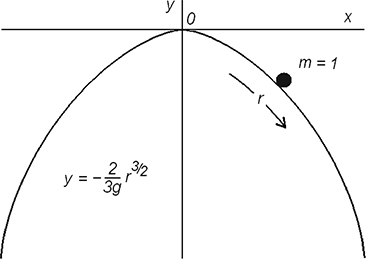
where r is the radial coordinate in the surface, that is, the distance traveled by the mass from the highest point of the dome along the surface, |y| specifies how far the dome surface lies below the apex as a function of r, and g is the acceleration due to gravity (Figure 1).
Mass sliding on a dome.

Newton's second law of motion, F = ma, as applied to the mass on the surface, is

If the mass is initially located at rest at the apex r = 0, then one obvious solution to (2) for all times t is a trivial one:

The mass simply remains at rest for all times. However, there exists another class of unexpected solutions. By direct computation it can be shown that, for any radial direction, the expression

where T ≥ 0 is an arbitrarily chosen constant, satisfies Newton's second law (2).
Note that equation (4) describes a point mass sitting at rest at the apex of the dome, whereupon at an arbitrary time T ≥ 0 it spontaneously moves off in some arbitrarily chosen radial direction. Solutions (4) appear to be in full accord with Newton's second and first laws, if one takes the first law in its instantaneous form: “In the absence of a net external force, a body is unaccelerated.” No force, no acceleration.
As for the initiating cause that sets the mass in motion, the instant t = T is obviously not the first instant at which the mass moves; it is the last instant at which the mass does not move. In fact, one can name no first instant at which the mass moves. So, if there is no first instant of motion, then there is no first instant at which to seek the initiating cause.
Another powerful argument involving the time reversal trick can be given in support of acausality of the mass motion. Since the Newtonian dynamical laws of gravitational systems are invariant under time reversal we can invert the sliding-down-the-dome scenario to produce another legitimate solution which insults the principle of causality. Instead of having the mass starting at the apex of the dome, we will imagine it starting at the rim and that we give it some initial velocity directed exactly at the apex. If we give it too much initial velocity, it will pass right over the apex to the other side of the dome. If we give it too small initial velocity, it will rise toward the apex, but before it reaches the apex it halts and slides back to the rim. Now if we give the mass just the right amount of initial velocity, it will rise up and momentarily halt exactly at the apex.
The proper analysis of the latter situation reveals that the time required for the mass to reach the apex moving along the surface of this particular shape is finite. That this time is finite is essential for the time reversal trick to succeed. Infinite time would mean that the mass never actually arrives at the apex, and the time reversal scenario would display a mass that has been in motion at all past times, without any spontaneous launches. It should be emphasized that by no means is this feature common to all domes. For hemispherical or parabolic domes, for instance, the time taken for the mass to reach the apex to its momentary halt is unbounded. In the case of the dome of Figure 1 the time reversal trick does work.
2.2. The Mass on the Dome: Cartesian Perspective.
Defining the surface by (1), in terms of the distance r traveled by the mass along the surface, conceals important details about the actual geometry of the dome and directionality of motion as viewed from the ‘external’ Cartesian perspective. Special care should be taken not to overlook these details since they may prove crucial in the general case. Indeed, it can be shown that the original formulation of the mass-on-the-dome example harbors several loopholes, some of which are potentially fatal to the project. Fortunately, most of these difficulties are reparable and can be overcome by slightly modifying the original formulation of the problem. As the next section shows, the modified version inherits all the strangeness of being a source of spontaneous motion generation without our having to deal with the loopholes and unnecessary qualifications.
Consider an axially symmetric dome, and x is a Cartesian radial variable. It can be shown that y(x) as a function of the Cartesian coordinate x can be expressed as follows:

where
 $k=3/ (2g^{2}) $
and the constant
 $C_{1}=-(1/ k) (1-C^{2/ 3}) ^{3/ 2}$
. Note that the dome surface appears to be defined not for all x, but only for x out of some (final) interval [0, L) with the constants C and L constrained as follows:

2.3. The Mass on the Dome versus the Mass on the Pinnacle.
Having expressed the shape of the dome in the linear Cartesian coordinates, it is easy to see that not all the domes described by formula (5) would fit well for generating spontaneous motion within Newtonian mechanics. Indeed, having fixed some ‘rim’, L < 1/k, and depending on the value of the constant C, two distinct cases are possible.
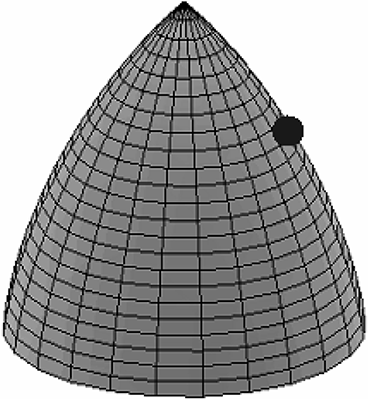
Case 1: C ≠ 1. It can be shown that the tangent line to the dome surface at zero hits the y-axis at some non-zero angle—the mass arrives at the apex not exactly horizontally but at some non-zero angle. As we pass through zero into negative values for x, the tangent line to the surface experiences a sudden step-like jump, so dy/dt is simply not defined at x = 0. We shall refer to this case as the mass-on-the-pinnacle scenario (Figure 2).
The mass on the pinnacle.

Since dy/dt enters the expressions for the tangential gravitational and normal forces acting on the mass, these forces appear not to be defined at zero either. As Newton's second law of motion, F = ma, cannot be written for the mass at zero, the mass-on-the-pinnacle scenario simply does not belong in Newton's mechanics jurisdiction, and should be isolated from the discussion by an appropriate stipulation.
Case 2: C = 1. The shape of the dome takes a relatively simple form:

for all x out of the interval (−L, L),
 $L< 1/ k$
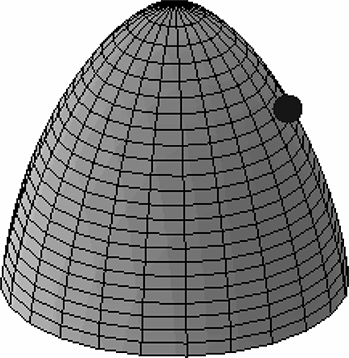
, for which the surface is defined. Note that the mass arrives at the apex exactly horizontally. Even though the second and higher derivatives of y(x) do diverge at zero, this fact by itself, at least directly, seems to generate no singularity or divergence in any physically meaningful parameter. We shall refer to this situation as the (proper) case of the mass on the dome (Figure 3). All discussion that follows below will have this situation in mind.
The mass on the dome.

In the vicinity of the apex, that is, at the limit |x| → 0, the graph behaves as a fractional power function:

which, of course, should have been expected, since, for small x, the x-coordinate almost coincides with the radial coordinate r measured along the practically horizontal surface.
On the other side of the interval, as x approaches the ‘rim’, |x| → L, the graph descends steeper and steeper until it hits the vertical wall at |x| = L. (The graph of this function appears in Figure 1.)
2.4. The Mass on the Dome or the Mass in the Air?
Consider again the three classes of trajectories produced if we give the mass at the rim some initial velocity directed at the apex along the surface: those where the mass halts before it reaches the apex and falls back to the rim; those where the mass halts exactly at the apex; and those where the mass passes the apex with some nonzero velocity and rushes over to the other side of the dome.
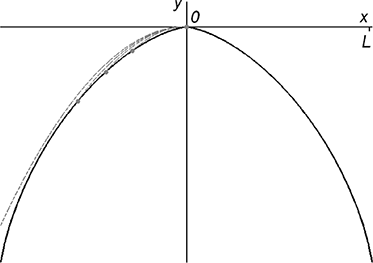
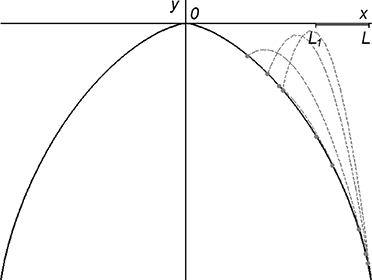
Consider the trajectories from the third class when the mass passes over the apex. As the mass proceeds through the apex with a nonzero velocity into negative values for x, it continues its motion along an artillery shell like ballistic trajectory. However, in the vicinity of the apex, the dome surface descends faster than any such parabolic trajectory so that the mass necessarily detaches itself from the surface once it enters the negative values for x, refusing to follow the prescribed track. (The results of numerical simulation for different velocities appear in Figure 4.)
Passing over the dome apex.

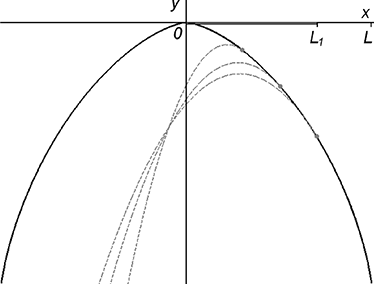
Similar detachment occurs in the second, more important, class of trajectories, for which the mass should halt exactly at the apex. To see this, recall that at the ‘rim’, x = L, the tangent to the surface plane is exactly vertical. It means that the mass, initially positioned at the rim and given any initial velocity directed at the apex along the surface, will go up (and then fall back) precisely vertically, detaching itself from the surface and thus, again, refusing to follow its curvature. A careful analysis reveals that this is true not only for the rim x = L taken as an initial position of the mass, but also for some vicinity of the rim. Indeed, for domes thus defined, there always exists a (finite) interval (L 1, L), 0 < L 1 < L, such that, for all initial positions of the mass (the ‘rims’) taken within this interval, the ballistic trajectory of the mass descends slower than the dome surface immediately under it, thus causing the mass to detach from the surface. (The results of numerical simulation for different initial positions are shown in Figure 5.) Clearly, such initial positions would be a poor choice for being the ‘rim’ since, as mentioned before, letting the mass fly along its ballistic parabolic path would irreparably ruin the time reversal argument.
Mass detachment in the vicinity of the rim.

Any attempt to bypass this difficulty by pushing the mass back on the prescribed track (e.g., switching to a bead-on-the-wire example) would necessarily involve additional forces (viz., the elasticity forces of the wire along which the bead would slide) without which the mass will simply refuse to follow the track. Adding new forces (external or internal), as we shall soon see, brings new and undesirable complications into Norton's original problem.Footnote 1
These complications become especially important (and more subtle) when we move away from the rim to the vicinity of the apex. Unlike the previous situation, for any initial position of the mass taken within the interval (0, L 1), the ballistic trajectory of the mass now descends faster than the dome surface, and no detachment of the mass from the surface occurs. (The results of numerical simulation are shown in Figure 6.) Though we need not resort to elastic wires going through the mass to keep it from detaching itself from the surface of the dome, the elasticity of the dome acquires special importance here.
No mass detachment in the vicinity of the apex.

At this point, we can discern a general pattern that begins to emerge. We do not want to let the mass move along its free flight parabolic trajectory; parabolic trajectories give infinite past times for the time reversal scenarios, thus stripping the whole argument of its force. In the vicinity of the rim this can be done by invoking the elasticity forces of the wire through which the bead-mass now slides (or applying some other external force). In the vicinity of the apex these are the elasticity forces of the dome that would “straighten up” the mass path sufficiently to yield the required curvature; were it not for the elasticity forces of the dome, the mass would choose to follow its free-flight ballistic path. In any case, there is a (very strong) force field in the neighborhood, and directed toward the surface, that ensures that the mass moves along the required path. Yet, as the following sections will show, no finite, however large, elasticity coefficient of the dome can allow for the time reversibility of the mass motion; only an absolutely rigid dome can make the time reversal trick possible; thus there is a singularity in a physically meaningful parameter of the situation.
2.5. The Mass on the Dome, Modified.
Many of the difficulties mentioned above can be overcome and will disappear if we make the following change in the original formulation. Instead of defining the surface by (1), in curvilinear terms of the distance r traveled by the mass along the surface, we define it, just as (7) suggests, in the usual linear Cartesian coordinates by

In this case, first, the situation no longer harbors the mass-on-the-pinnacle case in which the slope of the surface experiences a sudden step-like jump at the apex. The mass moving along the surface will now always arrive at zero exactly horizontally and no qualifications to the contrary are necessary. Second, the surface is now defined for all x, not just for all x out of some interval (−L, L), L < 1/k; there are no more ‘preferred rims’ or vertical walls. Third, with any arbitrary (x-positive) point on the dome taken as the motion starting point (the ‘rim’), no detachment of the mass from the surface when it starts at its ‘rim’ ever occurs; there is no need to resort to elastic wires to keep the mass on the prescribed track.
This does not, however, prevent the mass from detaching from the surface for the third class of trajectories once the mass passes the apex with nonzero velocity, as in Figure 4. Fortunately, these trajectories play no role in Norton's time reversal argument, so we shall simply ignore them. As the following sections will show, the so modified mass on the dome example inherits all the strangeness of being a source of spontaneous motion generation with no need to deal with the above discussed loopholes and unnecessary qualifications.
3. The Lipschitz Condition.
We recall that the function x(t) satisfying the initial condition (t 0,x 0) is a solution of the differential equation determined by a vector field v

if the following identity holds for all t in the interval I on which x(t) is defined:

Let
 $v(x) =\mathrm{sgn}\,(x) \vert x\vert ^{3/ 4}$
. For such a field, (8) has more than one solution, for example, the solutions
 $x_{1}(t) =0$
and
 $x_{2}(t) =\vert t/ 4\vert ^{4}$
satisfy the same initial condition (0, 0). In fact, (8) has a one-parameter family of solutions obtained by gluing together the corresponding halves of the two solutions,
 $x_{1}(t) =0$
and
 $x_{2}(t) =[ (t-T) / 4] ^{4}$
, at some arbitrary time
 $T> 0$
. (This situation is typical in that if (8) has more than one solution, then it has a ‘continuum’ [i.e., a closed connected set] of solutions.) In the general theory of ordinary differential equations it is hardly a surprising fact; if the direction field v is continuous but nondifferentiable (only Hölder continuous), the solution with initial condition in the equilibrium position may fail to be unique. Indeed, for any
 $v(x) =\mathrm{sgn}\,(x) \vert x\vert ^{\alpha }$
, where
 $0< \alpha < 1$
, there always exists a family of branching solutions for (8) that satisfy the same initial condition (0, 0):

where
 $f_{+}=\mathrm{max}\,(f,\, 0) $
, for an arbitrary T.
Geometrically, the reason for non-uniqueness in these cases is that the velocity decreases too slowly when approaching the equilibrium position. As a result, the solution manages to reach the singular point in a finite time. It turns out that the smoothness of v guarantees the uniqueness in these cases.
The condition that
 $\vert v(\zeta) \vert \leq k\vert \zeta -x_{2}\vert $
, where the constant k is independent of the point ζ of the interval
 $[ x_{1},\, x_{2}] $
(i.e., the condition that the slope of the chord of the graph be bounded), is called a Lipschitz condition and the constant k a Lipschitz constant. It can be shown that a sufficient condition for uniqueness is that the right-hand-side function v satisfy a Lipschitz condition
 $\vert v(x) -v(y) \vert \leq k\vert x-y\vert $
for all x and y (see, e.g., Arnold Reference Arnold and Cooke1992).
It is by no accident that we chose the function |v| = |x|3/4 to exemplify the Lipschitz discontinuity. Writing down the energy conservation relation for a unit mass sliding on the surface of the axially symmetric dome defined by the equation y(x) = −|x|3/2 gives us

so that

which, to the factor of (2g)1/2, coincides with our |v|. The right-hand side of the expression is non-Lipschitz: its derivative,
 $(9g/ 8) ^{1/ 2}\vert x\vert ^{-1/ 4}$
, is unbounded in the neighborhood of the origin. As a result, the uniqueness theorem does not apply. Gluing together in a smooth manner the corresponding halves of the two solutions,
 $x_{1}(t) =0$
and
 $x_{2}(t) =[ (t-T) / 4] ^{4}$
, at some arbitrary (positive) time T reproduces Norton's anomalous solutions. Since the existence of anomalous nontrivial solutions in Norton's case can be wholly attributed to (spatial) Lipschitz-discontinuity of the potential well wherein the mass moves, we shall call such solutions (spatial) Lipschitz indeterministic.
It should also be noted that a Lipschitz condition is weaker than that for the function v to be smooth. Indeed, the uniqueness theorem holds in the case when the first derivative of v exists but is discontinuous. What that means with respect to our situation is that the mass-on-the-pinnacle case cannot be amended by defining the otherwise undefined values of the derivative dy(x)/dt.
4. Asymptotic Reasoning and Time Irreversibility.
Batterman (Reference Batterman2002) discusses what he calls asymptotic reasoning in physics, that is, the qualitative analysis of behavior of physical theories in the neighborhood of singular limits, and its relevance to philosophical issues of explanation, reduction and emergence. Batterman argues that many physically and philosophically important theories and models involve a new and powerful category of explanation based on asymptotic reasoning that has been totally overlooked by philosophers of science.
Whereas much of Batterman's efforts have been directed to issues of intertheoretical reduction and the development of the new type of explanation with the idea of emergence, we shall be applying the asymptotic reasoning to see whether a particular model, namely, Norton's mass-on-the-dome example, involves any physically inadmissible idealizations.
One of the key ideas involved in infinite asymptotic reasoning is a commonplace fact of mathematics that finite and infinite compositions may differ in their essential properties. (For example, a finite intersection of open sets is always an open set, but an infinite intersection of open sets can yield a closed set.) If some property is preserved at any finite stage of a finite sequence of operations, there is no guarantee that this property will be preserved in the transition to the infinite stage. One may argue that many paradoxes in philosophy can be traced to exactly this illegitimate projection—incorrectly projecting properties from finite to infinite compositions.Footnote 2
The violation of a (spatial) Lipschitz condition that leads to non-uniqueness of solutions occurs at one point of the dome only—the apex. Granting infinite divisibility of matter and neglecting the issues with the vanishing Lebesgue measures of the initial conditions, a more philosophically interesting issue arises, namely, that of time irreversibility of the solutions.
Note that, even though the Lipschitz condition is violated at a single point, the apex, this violation depends on the behavior of the dome in the infinitesimal vicinity of the apex; it is crucial that the first derivative of the dome's shape experiences unbounded growth in the infinitesimal proximity of the apex. An arbitrarily small vicinity of the apex has been chosen, the particular shape of the path that the mass moves along outside of this vicinity is absolutely immaterial to the spontaneous motion at the apex to begin; no points of the dome outside of this area in any way affect the spontaneous generation of motion at the apex.
Now, we know that in a (real) body that is not deformed, the arrangement of the molecules correspond to a state of thermal equilibrium; all parts of the body are in mechanical equilibrium. This means that if some portion of the body is considered, the resultant of the forces on that portion is zero. When a deformation occurs, the arrangement of the molecules is changed, and the body ceases to be in its original state of equilibrium. Therefore, forces arise that tend to return the body to equilibrium. These internal forces, which occur when a body is deformed, are called internal stresses. If no deformation occurs, there are no internal stresses. The internal stresses in a real physical body are due to molecular forces, that is, the forces of (electromagnetic) interaction between the molecules. An important consequence of this fact is that no internal stresses in the theory of elasticity can be non-smooth or have divergent or singular derivatives (Landau and Lifshitz Reference Landau, Lifshitz, Sykes and Reid1959).
In the mass-on-the-dome example, the trajectories of the first class (where a mass is given an initial push up and it stops exactly at the apex) can now be shown to be robust under the ever increasing rigidity of the dome in the following sense. Take any arbitrarily large elasticity coefficient k 1 of the dome. Place a mass on the ‘rim’ (any fixed point on the dome other than the apex), give it a push up so that the mass halts exactly at the apex. Write down the formal exact solution of such a motion (highly nontrivial, given that we are not to neglect any dome deformation effects). Call this solution, as a function of time, x1(t). Double (triple, etc.) the elasticity coefficient k 1 to get a new k 2. Get a similar solution x2(t). Proceed in a similar manner to get an infinite series of solutions: x1(t), x2(t), …, xi(t), … . It can be shown that, in some appropriate sense, this sequence converges to some limiting solution, x(t), which we shall call a solution for an absolutely rigid dome (the elasticity coefficient is infinite).
Notice now what happens if we try to time reverse the situation. Fix some finite k 1, place a (point) mass on the top of the dome, and will the mass move down? Given that the mass is a point mass (to hit exactly the apex) and that the internal stresses in the (non-absolutely rigid) dome are smooth, there exists no way the surface of the dome hits the apex in a non-smooth manner. No Lipschitz-discontinuity—no non-uniqueness—the mass will stay on top forever! Try doubling, tripling, etc., the elasticity of the dome—you get the same picture. As long as the dome elasticity stays finite (and no matter how big), there is no spontaneous motion generation when the mass is on the top!
The situation changes essentially if we take an absolutely rigid dome with no deformations at all; only then, given the nature of the internal forces that we have, could the Lipschitz condition be violated and the mass slide down. Thus, a limiting solution of this family of solutions exhibits a property (of being non-unique), whereas any solution in an approaching series (corresponding to a physically plausible situation) fails to exhibit this property. The only way to generate non-Lipschitz spontaneous motion of the mass down the dome is to have an absolutely rigid dome; any diversion from actual infinity in the elasticity coefficient would result in the mass staying on top forever.
There is an important lesson to be learned from this example, namely, to be very careful in using time reversibility tricks. As Norton's mass on the dome shows, these are the cases the real metaphysical power of which may essentially depend on the nature of idealizations done in those models, and the techniques of asymptotic reasoning may prove crucial in elucidating these issues.