Introduction
In the United States, critical care transport (CCT) teams are comprised typically of highly trained nurses and paramedics who provide airway management, advanced ventilator support, invasive monitoring, and other intensive care procedures.Reference Roeder 1 , Reference Gebremichael, Borg and Habashi 2 These teams frequently are called upon to provide interfacility transport of patients, either by air or ground, with a goal of providing care during transport that is commensurate with that provided in the intensive care unit.
There are few published data on the patterns of medication administration by CCT teams.Reference Gebremichael, Borg and Habashi 2 , Reference Saha, Langridge and Playfor 3 Given the wide range of patients transported, CCT teams must initiate, titrate, and discontinue a vast array of medications. Patients on mechanical ventilation particularly are at high risk of adverse events when being transported between facilities, requiring significant personnel and resource utilization during transport.Reference Singh, MacDonald, Bronskill and Schull 4 - Reference Singh, Macdonald and Ahghari 6 Understanding the number and frequency of medications administered to this subset of critically ill patients with hypoxemic respiratory has implications for formulary development, crew training, and patients’ inter-transport needs. This study describes the medication administration patterns for a subset of patients with severe hypoxemic respiratory failure transported by one CCT service.
Materials and Methods
This study was approved by the Internal Review Boards (IRBs) of the three receiving hospitals, with the IRBs waiving the need for informed consent.
This was a retrospective review of transports of patients with severe hypoxemic respiratory failure from October 2009 through December 2012 from referring hospitals to three tertiary care hospitals. The CCT service was a consortium of six academic medical centers, with approximately 2,700 transports a year, of which, approximately 85% were interfacility. Each fully integrated team consisted of one Registered Nurse and one Emergency Medical Technician-Paramedic per duty shift for each rotor wing, fixed wing, and ground vehicle, and each team completed the full range of transport requests.
All decisions to transfer a patient were initiated by the physicians at sending facilities. The CCT service electronic medical record system was searched to identify intubated, adult patients with a primary clinical classification, as indicated by the original transport team, of “medical” or “respiratory,” excluding transports with a primary clinical classification of neurological, trauma, burn, surgical, or cardiac. From that initial screening, 2,251 records were filtered by the primary and secondary ICD-9 codes to identify patients with pulmonary or septic diagnoses. Transport records were searched electronically by three of the co-authors for the terms “Acute Respiratory Distress Syndrome,” “hypoxia,” or “hypoxemia,” and the charts of patients receiving at least a fraction of inspired oxygen of 50% were selected for inclusion. Documentation of medication administration was assessed in both the medication administration flowsheet and the narrative summary by three of the co-authors and transcribed into a primary database, maintained at the primary research site. Data were collected inclusively, and a medication was documented as having been administered if it was recorded in either the narrative summary or in the flowsheet. While documentation practices and the thoroughness of the transport records indicate no obvious omissions, if medications were administered but not recorded in the transport record, there were no ancillary data sources to assess and any missing data were therefore excluded from analyses.
The transport records were reviewed for demographic data, pertinent comorbidities, and information regarding diagnosis, as known to the CCT team, and were recorded. All medications administered on the included transports were recorded, and the doses for both bolus dosing and infusions were recorded. Administration of crystalloid boluses and transfusion of blood products were also recorded. An “administration” of medication was defined as one patient receiving one medication via one route, even if the patient received multiple doses of the same medication in transport. Receiving the same medication via a different route constituted a different administration. “Infusions” were defined as medications administered continuously via intravenous (IV) line with an intention to titrate. Medications that were given with a rate, but with a pre-defined dose, such as 1 g of vancomycin, were defined as “bolus medications.” If an infusion was stopped at the sending hospital by the CCT team prior to transport, the medication was included in the analysis as a “discontinuation,” but not as an infusion. Medications that were discontinued in transport were counted as both a discontinuation as well as an infusion.
Data were analyzed in a descriptive manner.
Results
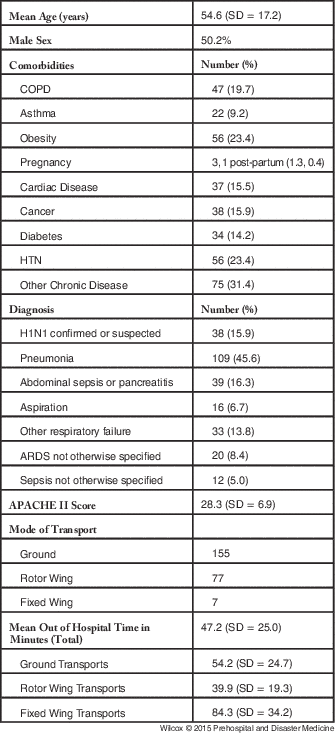
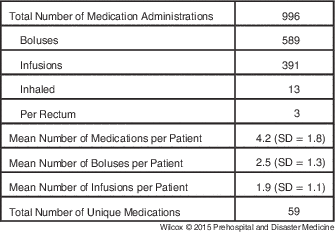
During the time period of the study, the CCT service performed 8,953 transports, and 239 charts were identified for analysis. Table 1 lists demographic information. Medications were administered by the CCT team to 98.7% of these patients, with only three patients not receiving any medications from the team. Fifty-nine medications were administered in total (Table 2), with 996 instances of administration. Fifteen drugs were each administered to only one patient. The mean number of medications per patient was 4.2 (SD=1.8), of which 1.9 (SD=1.1) per patient were administered as infusions (Table 2). Fifty-one patients (21.3%) received three or more infusions, with the maximum number of infusions being seven, occurring in one patient transport.
Demographics

Abbreviations: ARDS, acute respiratory distress syndrome; COPD, chronic obstructive pulmonary disease; HTN, hypertension.
Medications and Fluids in Transport

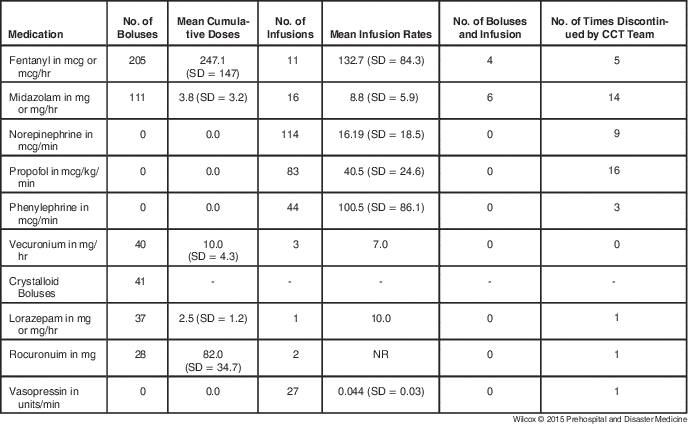
The most commonly administered medications were fentanyl, midazolam, norepinephrine, propofol, and phenylephrine. The 10 most frequently administered medications accounted for 76.7% of all medications given. Table 3 details the doses, route, and frequency of administration of these medications.
Ten Most Frequently Administered Medications

Abbreviations: CCT, critical care transport; kg, kilogram; mcg, microgram; mg, milligram.
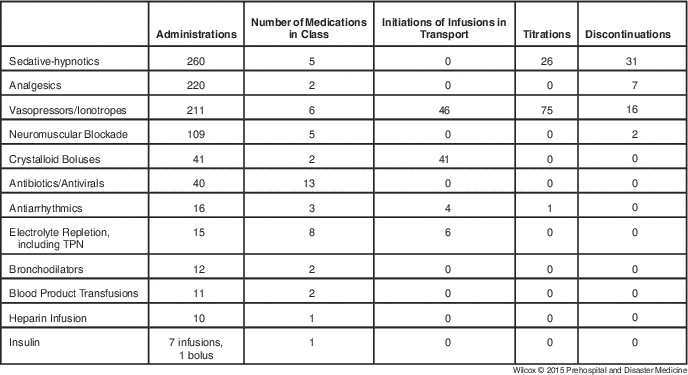
When considered in terms of therapeutic class, the most commonly administered group of drugs were the sedative/hypnotics, which accounted for 26.1% of all prescription episodes (Table 4).
Classes of Medications Provided

Abbreviation: TPN, total parenteral nutrition.
Although the CCT often continued sedative infusions started at the sending facility, the team did not initiate any infusions for sedation or analgesia during transport, instead using bolus dosing for these medications. However, they did discontinue medications frequently, often stopping sedative infusions and providing boluses (Table 4).
Neuromuscular blocking agents were administered 109 times. Forty-one patients were treated with crystalloid boluses, nine received packed red blood cells, and two patients were transfused fresh frozen plasma (Table 4).
Discussion
These results demonstrate that, even within a relatively homogeneous population of critically ill patients transferred with hypoxemic respiratory failure, a wide range of medications were administered. Patients with hypoxemic respiratory failure were selected for analysis as they are considered to be a resource-intensive population during transport, and in this study, the CCT teams frequently did initiate, titrate, and discontinue continuous infusions, in addition to providing numerous doses of bolused medication. There are few published data on the patterns of medication administration in transport.Reference Gebremichael, Borg and Habashi 2 , Reference Saha, Langridge and Playfor 3 Of the available studies, a previous study from 2006 in pediatric CCT reported findings similar to this study’s. Their teams administered 38 IV drugs to 175 patients, and 10 medications accounted for 90% of the administrations.Reference Saha, Langridge and Playfor 3
This study delineated bolus medications and infusions, given the numerous considerations for each type of administration. Bolus medications carry a risk of medication errors given the frequency of administration and the multiple means of delivery.Reference Taxis and Barber 7 Infusions have other considerations, namely, the need for additional equipment with pumps and dedicated IV lines. Both calculation errors and difficulty with infusion equipment have been cited as common reasons for medication errors.Reference Keers, Williams, Cooke and Ashcroft 8 Different clinical areas may use different units for infusions, creating an opportunity for error.
The patterns of medication administration by CCT teams vary with multiple factors, including the patient population and the health care system within which the team is operating.Reference Saha, Langridge and Playfor 3 In this study, the CCT team did not start sedative infusions and only titrated propofol for sedation, otherwise electing to provide bolus sedation during the transport. This is reflective of local practice patterns and may not reflect other practices. However, the CCT team frequently started, titrated, and discontinued vasoactive medications, including pressors, ionotropes, and antiarrhythmics.
A small number of drugs were used frequently, with the 10 most frequently administered medications constituting over 75% of administrations. However, the total array of drugs that were used was broad in this study. This discrepancy has important implications. Appreciating the required pharmacy is important for the stocking of medications in transport. Several authors and guidelines have recommended the minimum number and type of medications to be carried in transport.Reference Warren, Fromm and Orr 9 , Reference Beninati, Meyer and Carter 10 While many of the medications administered in this study were included in these lists of recommended transport medications, not all were. Carrying all medications that may be required is not practical, and this should be recognized in advance, as in some circumstances, less frequently used drugs should be prepared for transport purposes prior to the departure of the transport team.Reference Saha, Langridge and Playfor 3
Additionally, in considering the discrepancy between frequency of use and breadth of possible medications, one must consider the risks of medication errors. A systematic review of medication errors has demonstrated that a lack of knowledge about medications may be a factor in errors.Reference Keers, Williams, Cooke and Ashcroft 8 Therefore, the risk of medication errors may be exacerbated by the administration of less frequently used medications, as occurred intermittently this study. The Institute for Safe Medication Practices (Horsham, Pennsylvania USA) has issued a list of high alert medications for the acute setting, including adrenergic agonists, anesthetic agents, antiarrhythmics, anticoagulants, and insulin. 11 While errors may not be more common with these medications, the risk to patients in the event of an error is higher. Notably, many of the medications used in transport fall into these categories.
Limitations
This study was a retrospective study, and therefore subject to the limitations of a retrospective review. Additionally, this data set represents only those patients transported with hypoxemic respiratory failure, and therefore, may not represent fully the broader population of all adult patients undergoing transport. However, even in this subset of patients, the diversity and complexity of dosing regimens can be appreciated and potentially can inform broader logistical pharmaceutical considerations, including medication stocking, crew training, and real-time medication administration practices during transport of critically ill patients.
Conclusions
These results demonstrate that, even within a relatively homogeneous patient population of patients transferred with hypoxemic respiratory failure, a wide range of medications were administered. The CCT teams frequently initiated, titrated, and discontinued continuous infusions, in addition to providing numerous doses of bolused medication.
Acknowledgements
The work contained herein was performed at three tertiary care hospitals: Massachusetts General Hospital, Brigham and Women’s Hospital, and Beth Israel Deaconess Medical Center, all located in Boston, Massachusetts USA.